Romans 7:14-25 – Our Existential Angst

We know that the law is spiritual; but I am unspiritual, sold as a slave to sin. I do not understand what I do. For what I want to do I do not do, but what I hate I do. And if I do what I do not want to do, I agree that the law is good. As it is, it is no longer I myself who do it, but it is sin living in me. For I know that good itself does not dwell in me, that is, in my sinful nature. For I have the desire to do what is good, but I cannot carry it out. For I do not do the good I want to do, but the evil I do not want to do—this I keep on doing. Now if I do what I do not want to do, it is no longer I who do it, but it is sin living in me that does it.
 
So, I find this law at work: Although I want to do good, evil is right there with me. For in my inner being I delight in God’s law; but I see another law at work in me, waging war against the law of my mind and making me a prisoner of the law of sin at work within me. What a wretched man I am! Who will rescue me from this body that is subject to death? Thanks be to God, who delivers me through Jesus Christ our Lord!
 
So then, I myself in my mind am a slave to God’s law, but in my sinful nature a slave to the law of sin. (New International Version)
 
We can relate to the Apostle Paul. We, along with him, have many times said to ourselves, “I don’t understand why I act the way I do. I don’t do what I know is right. I do the things I hate.” 
 
Paul’s existential angst is a timeless description of our common human condition. There are times we seem completely unable to follow our conscience and do what’s right. It can be maddening, even to the point of experiencing a continual low-level discouragement and/or depression which underlies almost everything we do.
 
The prescription for dealing with this mental, emotional, and spiritual malady does not include the law. That’s right. Putting our willpower and effort into obeying commands gets us nowhere. Even if we obey laws and rules and commands for a time, our efforts eventually break down. We fail to do what we want and do just the opposite.
 
The law isn’t bad. It just doesn’t have the capacity to transform us. The law’s purpose is to show us how bad off we really are in this world, to give us an awareness of our true condition so that we will seek help. 
 
We humans are a bundle of contradictions, doing good, then bad, and flip-flopping back and forth – all with great frustration.
 
In our abject misery, what then, shall we do? Who will help us? Is there anyone to save us from our plight?
 
Sheer willpower and obedience will not help us; it won’t work. It will only give us a false hope. Any success in using such willpower only deludes one into believing they have the answer… until they yet fall again into the abyss of their own inner darkness.
 
The good news is that there is a Savior, a Redeemer, a Rescuer who has the will and the power to deliver us from our predicament.
 
The grace of God in Christ is the operative power that changes lives, not the law. Freedom from the tyranny of our “should’s” and our misplaced desires comes from Christ’s forgiveness through the cross. 
 
Like a lover enamored with his beloved, our desires become oriented toward Jesus for his indescribable gift to us. That is the strength of grace. Transformation is relational; it is found in a person, not a program. And the only person and relationship which has the ability to change us is, I believe with all my heart and mind, the Lord Jesus Christ.
 
Why? Because I myself have been transformed and changed by such a relationship with Christ. I, along with the hymn writer John Newton, can say, “I once was lost but now am found, was blind but now I see.”
 
“Self-help” for all the good it really can do, is in many ways an oxymoron. There is no Bible verse which states that God helps those who help themselves.
 
Yes, we have an incredible capacity for good and vast internal resources within us which we lack awareness of for which we can tap into. Yet, when it comes to an outright metamorphosis, we need a new heart – and we can no more simply decide to change our lives any more than we can perform heart transplant surgery on ourselves.
 
People need the Lord.
 
Whenever the foundation of a house is about to crumble, it won’t do to rearrange the living room furniture and do a bit of spruce up painting. And we deceive ourselves if we believe that all our efforts at landscaping the property and having a great curb appeal will do the trick.
 
If the foundation crumbles, the house implodes, and nothing else will matter.
 
Jesus is our cornerstone. Without him, we are at risk, about to fall and without hope. With him, true restoration and renewal happens. And then, when the house is repaired and in order, we set about the task of being good stewards and maintaining and caring for the wonderful changes which were made.
 
If we want freedom from self-loathing and to experience peace and contentment, calmness and confidence, satisfaction and settled peace, then we will grow ever closer to the Savior who exudes all those qualities, and more.
 
For the Lord not only saves and delivers; he also sanctifies and encourages. And the existential angst becomes forgotten.
 
Saving God, I thank you for delivering me from sin, death, and hell through your Son, the Lord Jesus. May your Holy Spirit apply the work of grace to my life every day so that I can realize practical freedom from all that is damaging and destructive in my soul. Amen.

Matthew 9:27-34 – How To Use Your Faith

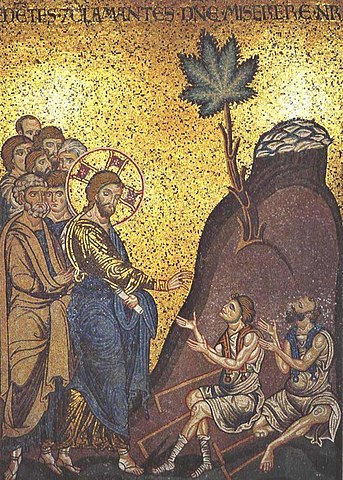
Jesus healing two blind men, 11th century mosaic, Sicily

As Jesus went on from there, two blind men followed him, calling out, “Have mercy on us, Son of David!”

When he had gone indoors, the blind men came to him, and he asked them, “Do you believe that I am able to do this?”

“Yes, Lord,” they replied.

Then he touched their eyes and said, “According to your faith let it be done to you”; and their sight was restored. Jesus warned them sternly, “See that no one knows about this.” But they went out and spread the news about him all over that region.

While they were going out, a man who was demon-possessed and could not talk was brought to Jesus. And when the demon was driven out, the man who had been mute spoke. The crowd was amazed and said, “Nothing like this has ever been seen in Israel.”

But the Pharisees said, “It is by the prince of demons that he drives out demons.” (New International Version)

Every day the news is a steady stream of disease, death, war, and outright human suffering. It’s as if the phrase, “slow news cycle,” is a thing of the past.

As we stare into the face of trouble, I find myself uttering the ancient prayer of the Church: “Lord have mercy.  Christ, have mercy.  Lord have mercy and grant us your peace.” 

We collectively feel the weight of the world’s suffering, experience the heaviness of concern for family and friends, and perhaps wonder how much more people can take.

It’s in the topsy-turvy times that I come back again and again to the deep spiritual convictions which inform what I do each day. One of those underlying creeds and affirmations is this:

Jesus is trustworthy, no matter whether my faith or the faith of others is small or great.

In our Gospel lesson for today, two blind men were healed according to their faith in Jesus. The diverse healing accounts of Jesus in the New Testament, whether the faith was large or small in those healed, leads me to the conclusion that:

It isn’t faith itself that heals, saves, or transforms – it is Jesus.

All the healing accounts in the New Testament Gospels have something in common: They all directly point to Jesus as the object of faith. 

It isn’t about the level or amount of faith, but about where the faith is placed. 

For the Christian, faith itself doesn’t mean much if it isn’t in Jesus.

If I place a large and sincere faith in an inanimate object such as money; in a position of power; or, even in my own independence, my faith isn’t worth much. 

If I have a huge faith in a doctor or a psychiatrist to heal my body or my mind, I will quickly discover there are limits to their abilities. 

If I have a confident faith that my family will meet all my needs, my faith will eventually run into failure when they let me down. That’s because the ultimate object of faith is Jesus. 

If all my faith eggs are in the church basket, my faith will eventually face a crisis because it is a misplaced faith.  Furthermore, the answer I provide for others is not simply getting them to attend church or to adopt my moral code.

There should be a consistency that runs through us all. For Jesus doesn’t change—yesterday, today, tomorrow, he’s always totally himself.

Hebrews 13:8, MSG

We know with certainty that circumstances change, as everyday seems to bring new levels and permutations of unprecedented alterations to our lives – and through it all, Jesus remains as the ever-present Savior, seated at the right hand of God ceaselessly interceding on behalf of those who offer even the slightest mustard seed of faith.

“For truly I tell you, if you have faith the size of a mustard seed, you will say to this mountain, ‘Move from here to there,’ and it will move, and nothing will be impossible for you.”

Jesus (Matthew 17:20-21, NRSV)

It says something about our modern Western society that whenever we hear the words of Jesus on faith that we interpret the mountain moving as an immediate event that happens almost instantaneous, like a snap of the finger. Yet, there is nothing in those words that says that. There is also nothing that says an individual necessarily does it.

The fact of the matter is this: Jesus heals, transforms, and delivers people from sickness, sin, trouble, and overwhelming circumstances in his own good time, not ours.

Just because we pray without ceasing for days, weeks, months, and even years for something doesn’t mean we lack faith if the prayer isn’t answered immediately. It could be that God wants others involved, maybe even across generations, for the impossible mountain to be moved.

It is misplaced faith which expects microwave results. Faith placed appropriately in Jesus as the object of belief discerns that faithful prayer is consistently prayed until there is an answer.

Healing and restoration will happen – just maybe not always how or when we think it will.

Almighty God, you know that we have no power in ourselves to help ourselves: Keep me both outwardly in my body and inwardly in my soul, that I may be defended from all adversities which may happen to the body, and from all evil thoughts which may assault and hurt the soul; through Jesus Christ our Lord, who lives and reigns with you and the Holy Spirit, one God, forever and ever. Amen.

Psalm 124 – Help Is Here

If it had not been the Lord who was on our side
    —let Israel now say—
if it had not been the Lord who was on our side,
    when our enemies attacked us,
then they would have swallowed us up alive,
    when their anger was kindled against us;
then the flood would have swept us away;
    the torrent would have gone over us;
then over us would have gone
    the raging waters.

Blessed be the Lord,
    who has not given us
    as prey to their teeth.
We have escaped like a bird
    from the snare of the hunters;
the snare is broken,
    and we have escaped.

Our help is in the name of the Lord,
    who made heaven and earth. (New Revised Standard Version)

As a church pastor, many Sundays I begin the worship service with the ancient confession of faith that “Our help is in the name of the Lord, who made heaven and earth.” It is a call to worship the God who is above all and sees all – and can do something about the adversity and trouble we face in the world. 

With each new day, our attention needs guidance toward the positive acknowledgment that the eternal and ever-present God is ready and vigilant to skillfully and lovingly direct us through our waking hours. 

There is no biblical reference anywhere in Holy Scripture that God helps those who help themselves. The Lord is indiscriminate in providing aid for all without prejudice. All we need do is ask for it. Whereas we can certainly make positive choices and advocate for ourselves with effective help, our supreme and ultimate help is in the Lord. 

Our fears about the future, our insecurities of what will happen, and our anxieties about all the upcoming stuff we must face can be transformed with the biblical perspective of acknowledging our great need for divine intervention. 

The Lord is our most prescient support. The virtual meeting you have been dreading; that conversation you have been avoiding; a deadline that has been looming over your head; the ongoing health issues which seem to never end; these, and all situations, can only find their proper perspective in light of the God who helps.

I am a believer in making daily affirmations of faith in God. Early in the morning, I deliberately affirm and profess my firm beliefs in the Lord, even if I don’t feel like it, each and every day so that some solid robust theology is at the forefront of my mind, and the attributes of God sink firmly into my heart. 

I rely on such rituals because faith does not simply come through checking-off a list of orthodox beliefs, then moving on as if those beliefs have no connection to daily life. Rather, faith arises as a response to the recognition that God is good – all the time – and that the Lord helps those who intentionally and constantly seek divine help and enablement.

There are a lot of things we do not know: What will happen tomorrow? How will that situation shake out in the end? Will this relationship flower or wither?… a million questions can weigh down our hearts with anxiety. Yet, there is a sure and certain truth we can count on right now and for every minute into the future: God is with us.

God’s ever-present help remains the constant ballast in a sea of changing circumstances.

“If God is on our side, can anyone be against us?… I am sure that nothing can separate us from God’s love—not life or death, not angels or spirits, not the present or the future, and not powers above or powers below. Nothing in all creation can separate us from God’s love for us in Christ Jesus our Lord!”

Romans 8:31, 38-39, CEV

Not even the graveyard can limit God. With the Lord, death is defeated. Resurrection is a reality. The enemy is flat on his face. Evil’s power is weakened. We are only in danger if we let ourselves go near our old toothless foe. And even then, we have the shield of faith, the sword of the Spirit, and the shoes of peace.

The dangers of water and fire, traps and snares, enemy armies and spiritual foes are all undone by an almighty God. The maker of heaven and earth personally advocates for and helps us. Indeed, the Lord is on our side.

Creator God, you are the ever-present One who provides everything I need for life and godliness. I need your help today and everyday so that I can confidently do your will.  I stand with full assurance of faith because I serve the Lord Jesus, who is benevolent and always does what is right and just. Amen.

1 Corinthians 2:1-11 – Relying on Spiritual Power

Brothers and sisters, when I came to you, I didn’t speak about God’s mystery  as if it were some kind of brilliant message or wisdom. While I was with you, I decided to deal with only one subject—Jesus Christ, who was crucified. When I came to you, I was weak. I was afraid and very nervous. I didn’t speak my message with persuasive intellectual arguments. I spoke my message with a show of spiritual power so that your faith would not be based on human wisdom but on God’s power.

However, we do use wisdom to speak to those who are mature. It is a wisdom that doesn’t belong to this world or to the rulers of this world who are in power today and gone tomorrow. We speak about the mystery of God’s wisdom. It is a wisdom that has been hidden, which God had planned for our glory before the world began. Not one of the rulers of this world has known it. If they had, they wouldn’t have crucified the Lord of glory. But as Scripture says:

“No eye has seen,
no ear has heard,
and no mind has imagined
the things that God has prepared
for those who love him.”

God has revealed those things to us by his Spirit. The Spirit searches everything, especially the deep things of God. After all, who knows everything about a person except that person’s own spirit? In the same way, no one has known everything about God except God’s Spirit. (God’s Word Translation)

We need the Holy Spirit of God.

Without the Spirit’s help, Jesus is just one guy out of thousands who were crucified in history – merely an example of someone martyred for his faith. Yet, Jesus was infinitely more. Christians discern Jesus as the Son of God and Savior of the world. 

Because of Christ’s life, death, resurrection and ascension, people can be redeemed from empty lives, saved from destructive life-patterns, and given the kind of security and purpose which God intended from the beginning. The Spirit’s role is to take these redemptive events of Jesus and apply them to our lives. 

Christian Trinitarian theology understands we are unable to see the truth about the cross of Jesus Christ unless God the Holy Spirit, sent by God the Father and the Son, breaks into our lives and does an intervention, showing us our denial about how we are really doing – as well as our delusions about who we really are.

Admitting we need the Holy Spirit of God means the power of Christianity and the Christian life rests with Jesus Christ and him crucified, and not with us.

We are, in many ways, powerless. I realize this is not a popular message, especially in Western society. Tell the average American they are powerless, and they’ll think you’re off your rocker. It sounds ridiculous. Some would argue that we have done quite well, thank you very much, on our own. We have a couple of cars, a house, a job, and a family. After all, we worked hard, and we did it.

However, any worldly success we gain, and getting the things we want, may lead us to the delusion we have the power to do whatever we want.

Oh, sure, we might reason, we have problems just like everybody else. After all, we cannot control everything.  But we are not completely powerless. Just because we have difficult circumstances and a few problem people in our lives doesn’t mean I am weak, right? God will step in a take-over where I leave off, right?…

Wrong. Apart from the Holy Spirit of God, we are unable to become Christians and live the Christian life.

If we believe we manage our lives fine, with some help from God, then we might be in denial about how much we place ourselves at the center of the world. Whenever our consistent response to adversity, or the realization we are not handling something well, is to try and fix ourselves, we are living the delusion we have the power to independently change.

A reflexive response in asking Google to find answers to our problems; or dealing privately with our personal issues; or expecting our willpower to be enough; or passively resigning ourselves to mediocre lives because we have tried to change or be different; then we are feeding the delusion we don’t really need the Holy Spirit of God. I just need more effort or information to overcome my problems, right?

Wrong. More won’t solve our issues. And when it doesn’t, we easily become discouraged. We might even chide ourselves for our inability to deal with problems.

Our real need is for the true power source of the Christian life. We need the Holy Spirit applying the work of Jesus Christ to our lives so that we can live a victorious life.

Unfortunately, it typically takes a tragedy or crisis to break our delusion of power – a bad marriage, a family member’s addiction, a runaway child, a terminal illness, a bankruptcy, a death.

How bad do you and I need to hurt before we will admit we are not managing our lives well, at all, and that the real power to change resides with the Holy Spirit?

There is power in the cross of Jesus Christ. The Apostle Paul believed this with all his heart. Although Paul was an intelligent and learned person, he did not rely on his abilities but on proclaiming the power of Jesus and him crucified.

The crucifixion of Christ was a past action with continuing and forceful ripples into the present time.

The cross of Jesus is more than an historical event; it is an ongoing reality to experience for victory over all the brokenness of this world and all the mess we have made of things putting ourselves at the center of the universe.

The Reformer, John Calvin, repeatedly instructed and encouraged his Geneva congregation that the Spirit joins us to Christ, assures us of salvation, and grows us in confidence through the Scriptures. Calvin, although a genius, did not rely on his intellect or abilities but insisted we need the Spirit’s witness to mature as followers of Jesus.

There are tough situations and incredibly sad realities which are mysteries beyond our comprehension. They defy simplistic answers and are greater than our attempts to explain them. Hard problems stretch our faith. And they ought to cause us to cry out to God and Christ’s Church for help because we are powerless to manage our lives.

We absolutely and totally need the Holy Spirit of God. Without the Spirit, we are lost. But with the Spirit we experience the saving power of Christ’s cross to deal with everything in our lives.

The Serenity Prayer: God grant me the serenity to accept the things I cannot change; courage to change the things I can; and wisdom to know the difference.  Living one day at a time; enjoying one moment at a time; accepting hardships as the pathway to peace; taking, as Jesus did, this sinful world as it is, not as I would have it; trusting that he will make all things right if I surrender to his will; that I may be reasonably happy in this life and supremely happy with him forever in the next. Amen.