Wednesday of Holy Week (Psalm 70)

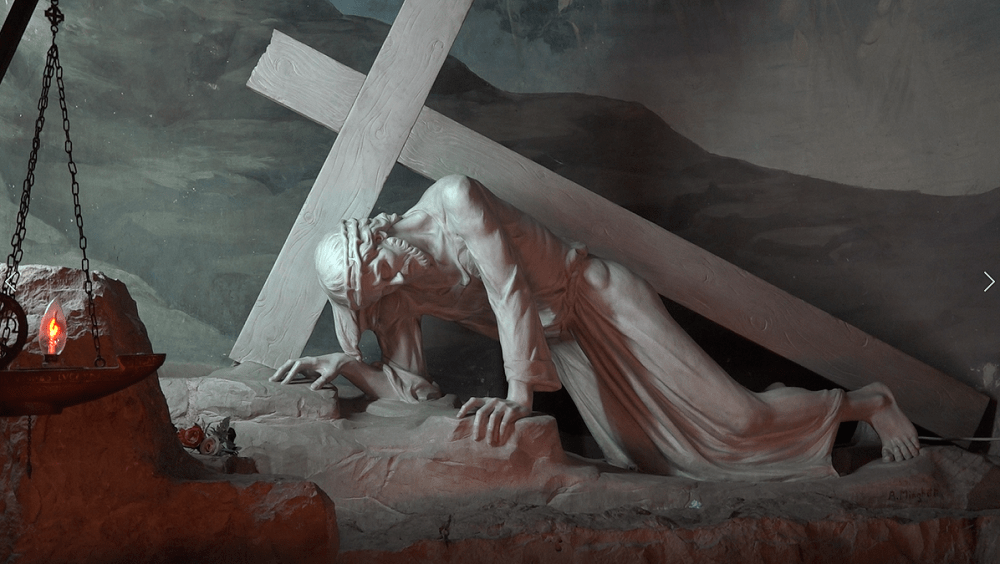
Ninth Station of the Cross, Jesus falls the third time, by Théophile Marie François Lybaert, c.1886

Be pleased, O God, to deliver me.
    O Lord, make haste to help me!
Let those be put to shame and confusion
    who seek my life.
Let those be turned back and brought to dishonor
    who desire to hurt me.
Let those who say, “Aha, Aha!”
    turn back because of their shame.

Let all who seek you
    rejoice and be glad in you.
Let those who love your salvation
    say evermore, “God is great!”
But I am poor and needy;
    hasten to me, O God!
You are my help and my deliverer;
    O Lord, do not delay! (New Revised Standard Version)

We all need help. Even Jesus.

As we journey with Jesus, and walk with him along the Via Dolorosa, we learn to set aside our illusions and delusions of radical independence, and to adopt his sense of dependence upon the heavenly Father. We come around to saying that we need divine help.

Continuing with a deliberate Christological view of the psalms, we are reminded that there was a time that Jesus felt desperation, just like we do. We go with him to the Garden of Gethsemane. And even though, in our own stressed out souls, we end up falling asleep and failing to pray as we ought, nevertheless we remember that the Lord Jesus sweat great drops of blood and agonized over what he was about to face.

There are times when the help we need isn’t for next week or tomorrow, but immediately, now!

I don’t know if you have ever been in such a stressful and dangerous situation in which all you could say is “Help, help me!” The abject feeling is helplessness is palpable and just plain awful. The sense there is nothing you can do to improve your circumstance other than some sort of merciful divine intervention is more than unnerving. It’s downright hard to breathe, let alone cry-out to be rescued.

In today’s psalm, it seems there were people getting a twisted sense of joy over the misfortune of others. It’s as if they were delighting in the confusion and vulnerability of those unable to stop what is happening.

In the throes of such stress and danger, the help we need is to have the evil turned back on the wicked. The psalmist wants such persons off his back – to have God hunt them like they are hunting the poor and needy who have no ability to resist.

It makes sense this psalm is short, just a few verses. Long prayers aren’t necessarily better than short ones, especially when it’s a frantic cry for God’s help. There is nothing in Holy Scripture that dictates how long or short prayer ought to be.

“Help!” just might be one of the best prayers we can pray. One little word. That’s all it takes.

It makes sense to me that this is an honest prayer. When in the throes of some horrible situation, all pretension goes out the window. Honest heartfelt prayers are the best kind of prayer.

If we are hurting badly enough, boldness comes quickly to the tip of our tongues. I once had a kidney stone and walked, doubled over in pain, into the Emergency Department of a hospital. I yelled at the first staff person I encountered, saying, “I need help, NOW!

To confess our great need to a God who listens might just be the best kind of theology we could ever express.

In such a terrible place of agony – of either body, soul, or both – there’s no thought to keeping up appearances, but only an unfiltered expression of need. Our prayers can, and need to be, earnest and urgent.

Prayer can be short, honest, and urgent because emergent situations require it. So, what do you do when you feel desperate? How do you handle your emotions? Where do you go for help?

In this Holy Week we are reminded that Jesus looked to the Father for help. In the worst of circumstances – facing ridicule, torture, and a horrible death – the Lord Jesus let the psalms shape his own prayers of desperation while under severe stress and duress:

“The one who ate my bread has lifted his heel against me.” (John 13:18; Psalm 41:9)

“They hated me without a cause.” (John 15:24; Psalm 69:4)

“I am deeply grieved, even to death; remain here, and stay awake with me.” (Matthew 26:38; Psalm 42:5-6)

“My God, my God, why have you forsaken me?”

Jesus (Matthew 27:46; Psalm 22:1)

Then Jesus, crying with a loud voice, said, “Father, into your hands I commend my spirit.” Having said this, he breathed his last. (Luke 23:46; Psalm 31:16)

There is a God who understands our plight. Jesus, the pioneer of our salvation, has gone before us in the way of suffering. He knows what it’s like to experience the agony and anguish of evil’s weight. He is our great high priest, the one who can intercede effectively and compassionately for us in our great times of need:

Now that we know what we have—Jesus, this great High Priest with ready access to God—let’s not let it slip through our fingers. We don’t have a priest who is out of touch with our reality. He’s been through weakness and testing, experienced it all—all but the sin. So, let’s walk right up to him and get what he is so ready to give. Take the mercy, accept the help. (Hebrews 4:14-16, MSG)

May you find in Jesus the help you so desperately need. Amen.

Tuesday of Holy Week (Psalm 71:1-14)

Station 3 of the Stations of the Cross, along the Via Dolorosa in Jerusalem

In you, O Lord, I take refuge;
    let me never be put to shame.
In your righteousness deliver me and rescue me;
    incline your ear to me and save me.
Be to me a rock of refuge,
    a strong fortress to save me,
    for you are my rock and my fortress.

Rescue me, O my God, from the hand of the wicked,
    from the grasp of the unjust and cruel.
For you, O Lord, are my hope,
    my trust, O Lord, from my youth.
From my birth I have leaned upon you,
    my protector since my mother’s womb.
My praise is continually of you.

I have been like a portent to many,
    but you are my strong refuge.
My mouth is filled with your praise
    and with your glory all day long.
Do not cast me off in the time of old age;
    do not forsake me when my strength is spent.
For my enemies speak concerning me,
    and those who watch for my life consult together.
They say, “Pursue and seize that person
    whom God has forsaken,
    for there is no one to deliver.”

O God do not be far from me;
    O my God, make haste to help me!
Let my accusers be put to shame and consumed;
    let those who seek to hurt me
    be covered with scorn and disgrace.
But I will hope continually
    and will praise you yet more and more. (New Revised Standard Version)

Christians take a decided interpretation of seeing Christ in the psalms. For us, we can envision Jesus saying these words of lament in the last days of his earthly life and ministry.

Why lament?

Lament is a significant piece of Lent, and is especially present in these final days of the season, Holy Week. To lament is to offer a public and passionate expression of grief. And it’s not optional but necessary and vital to the Christian experience, not to mention the human condition.

Without lamenting our great losses, our grief comes out sideways, inevitably harming others with our snarky vitriol. Lament gives expression to our deep grief. It enables us to come to grips with what has happened in the past, or happening to us in the present, and within us.

What does it mean to lament?

  • A lament is an expression of personal grief, due to any significant change or loss; it is the normal emotional, spiritual, physical, and relational reaction to that loss.
  • Lamenting is an intentional process of letting go. Relationships, dreams, plans, and people all die. We cannot get them back. Lament helps us find and live into a new identity after the loss or change.
  • Expressing grief through lament is intensely personal; there is no one-size-fits-all. No one else can do our lamentation for us.

How do I lament?

There are many psalms of lament, including our psalm lesson for today. They all have a typical structure to them, including:

  • Addressing God: Crying out for help. Some psalms of lament expand to include a statement of praise or a recollection of God’s intervention in the past. (Psalm 71:1-3)
  • Complaint: Telling God (said with some flavor!) about our problem or experience through a range and depth of emotional, relational, and spiritual reactions to the change or loss. (Psalm 71:4)
  • Confession of Trust: Remaining confident in God despite the circumstances. Beginning to see problems differently. (Psalm 71:5-8)
  • Petition: Proclaiming confidence in God. Appealing to God for deliverance and intervention. Keep in mind that petitioning is not bargaining with God or a refusal to accept loss. Rather, it is a legitimate seeking of help. (Psalm 71:9-13)
  • Words of Assurance: Expressing certainty that the petition will be heard by God. (Psalm 71:14a)
  • Vow of Praise: Vowing to testify in the future to what God will do with praise. (Psalm 71:14b-24)

I encourage and urge you to consider the following spiritual practice in this Holy Week: Set aside some time and craft your own psalm of lament.

Choose an event from your past which created grief for you. It can be recent or from years ago. Using the structure of lament psalms, thoughtfully write out each element as I have outlined it. Then, read it aloud to God. Perhaps even take another step by reading your lament aloud to a trusted family member, friend, or faith leader.

Our grief needs the outlet of lament. Grief which is not expressed ends up sitting heavily in the soul. Eventually, over time, if not acknowledged and spoken aloud, it can easily become putrid and rancid, poisoning our spirit, and compromising our faith.

Sharing your story through lament is biblical, practical, and I insist, necessary. I regularly craft psalms of lament whenever I have events or people who keep sticking with me in my thoughts and in my heart. Here is one example from a few years ago, after a mass shooting in my city:

Lord, in our shock and confusion, we come before you.

In our grief and despair, in the midst of hate,

in our sense of helplessness in the face of violence,

we lean on you. How long, O Lord, must we keep facing this!?

For the families of those who have been killed, we pray.

For the family of the shooter—help us to pray, Lord.

For the communities that have lost members—their anger, grief, fear—we pray.

For the churches striving to be your light in darkness, beyond our comprehension, we pray.

In the face of hatred, may we claim love, Lord.

May we love those far off and those near.

May we love those who are strangers and those who are friends.

May we love those who we agree with and understand,

and even more so, Lord, those who we consider to be our enemies.

Lord, have mercy. Christ, have mercy. Lord, have mercy.

Heal our sin-sick souls, and grant us your peace.

Make these wounds whole, Lord, for you can do it. Amen.

Guide Me By Your Good Spirit (Psalm 143)

Listen to my prayer, Lord!
    Because of your faithfulness, hear my requests for mercy!
    Because of your righteousness, answer me!
Please don’t bring your servant to judgment,
    because no living thing is righteous before you.

The enemy is chasing me,
    crushing my life in the dirt,
        forcing me to live in the dark
            like those who’ve been dead forever.
My spirit is weak inside me—
    inside, my mind is numb.

I remember the days long past;
    I meditate on all your deeds;
    I contemplate your handiwork.
I stretch out my hands to you;
    my whole being is like dry dirt, thirsting for you.

Answer me, Lord—and quickly! My breath is fading.
    Don’t hide your face from me
        or I’ll be like those going down to the pit!
Tell me all about your faithful love come morning time,
    because I trust you.
Show me the way I should go,
    because I offer my life up to you.
Deliver me from my enemies, Lord!
    I seek protection from you.
Teach me to do what pleases you,
    because you are my God.
Guide me by your good spirit
        into good land.
Make me live again, Lord, for your name’s sake.
    Bring me out of distress because of your righteousness.
Wipe out my enemies because of your faithful love.
    Destroy everyone who attacks me,
        because I am your servant. (Common English Bible)

Many Westerners tend to think about sin as bad individual actions which are quite personal. However, sin is much bigger than that. Primarily, sin is a force, a power in this universe which weighs on every molecule within it. None of us can escape having to deal with it.

For persons like the psalmist, they strive to be good and live a just life, yet they are continually dogged by others who have given into the “dark side.” The wicked discern the force of sin in the world, and then decide to move with it – believing that good guys finish last.

Yet, there is another powerful force in the universe – and it’s a greater power than sin.

Everywhere we look, we see a bad spirit. And that sinful spirit is behind the injustice, oppression, war, conflict, ignorance, and avarice which exists in every nation, community, and even home. Entrenched opinions, yelling at each other, the refusal to consider evidence, and narrow thinking have permeated our societies and pitted people against one another.

This evil spirit of the age is captured in the Apostle Paul’s words as he reflected on this and other psalms:

As it is written:

“There is no one righteous, not even one;
    there is no one who understands;
    there is no one who seeks God.
All have turned away,
    they have together become worthless;
there is no one who does good,
    not even one.”
“Their throats are open graves;
    their tongues practice deceit.”
“The poison of vipers is on their lips.”
    “Their mouths are full of cursing and bitterness.”
“Their feet are swift to shed blood;
    ruin and misery mark their ways,
and the way of peace they do not know.”
    “There is no fear of God before their eyes.”

Now we know that whatever the law says, it says to those who are under the law, so that every mouth may be silenced and the whole world held accountable to God. Therefore no one will be declared righteous in God’s sight by the works of the law; rather, through the law we become conscious of our sin. (Romans 3:10-20, NIV)

The psalmist doesn’t want to be a part of the sinful force and the bad spirit. He, instead, knows that sometimes he’s part of the problem, along with being a victim of sin, and thus, knows he needs deliverance from this awful power.

Promises to do better and personal willpower won’t cut it, when it comes to changing a life and a society. Rather, we must tap into a good spirit, which is ultimately, the Spirit.

Even though all have been both victim and victimizer, and fall short of God’s glory, all are justified freely by God’s grace through the redemption that came by Christ Jesus. (Romans 3:23-24)

Once we were blocked from prayer because of obstacles existing unaware among us and within us. But now we see the world for how it’s been touched by foulness and degradation, so we pray.

The spirit of the age will fail us. Our own spirit will be fickle. God’s Spirit, however, is continually living and active with the force of grace and mercy.

In our fear, it’s okay, even good, to flee from evil. Yet, we must complete the process by not only fleeing from the bad spirit, but also fleeing to God’s Spirit.

Prayer, then, becomes our lifeline. It’s our connection to what is right, just, and good. In Christianity, the Spirit is the one who conforms us to the glory of God and the image of Jesus. The Spirit is our Teacher, Guide, and Advocate, keeping us on God’s good path.

We need to live according to the Spirit – which is a continual journey of removing obstacles to faith and allowing God’s good gifts to awaken within us.

My counsel is this: Live freely, animated and motivated by God’s Spirit. Then you won’t feed the compulsions of selfishness. For there is a root of sinful self-interest in us that is at odds with a free spirit, just as the free spirit is incompatible with selfishness. These two ways of life are contrary to each other, so that you cannot live at times one way and at times another way according to how you feel on any given day. Why don’t you choose to be led by the Spirit and so escape the erratic compulsions of a law-dominated existence? (Galatians 5:16-18, MSG)

Yes, sin is a powerful force, manifesting itself in a host of bad spirits all around us. But grace is greater than all sin, and God’s good Spirit shall overwhelm and overcome all evil.

Visit this place, O Lord, we pray, and drive far from it the snares of the enemy; may your holy angels dwell with us and guard us in peace, and may your blessing be always upon us, through Jesus Christ our Lord. Amen.

Bread from Heaven (Exodus 16:27-35)

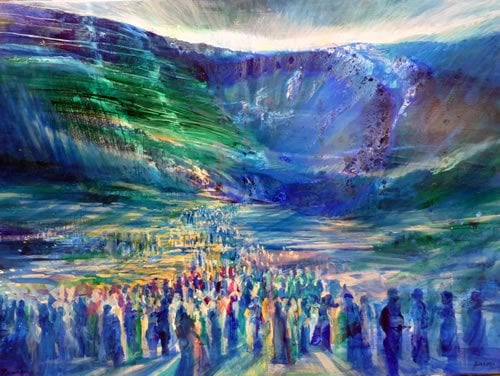
Bread From Heaven, by Nigel Wynter

On the seventh day some people went out to gather food, but they didn’t find any. The Lord said to Moses, “How long will you refuse to do what I have commanded and instructed you to do? Remember: The Lord has given you this day of rest as a holy day. That’s why he gives you enough food on the sixth day for two days. On the seventh day stay in your place—no one is to go out. Everyone, stay where you are.” So the people never worked on the seventh day of the week.

The Israelites called the food manna. It was like coriander seeds. It was white and tasted like wafers made with honey.

Moses said, “This is what the Lord has commanded: Take two quarts of manna to be kept for your descendants. This way they will see the food that I gave you to eat in the desert when I brought you out of Egypt.”

Moses said to Aaron, “Take a jar, put two quarts of manna in it, and put it in the Lord’s presence to be kept for your descendants.” Aaron put the jar of manna in front of the words of God’s promise to be kept there, as the Lord commanded Moses.

The Israelites ate manna for 40 years until they came to a place to settle. They ate manna until they came to the border of Canaan. (God’s Word Translation)

“What is it?” is the quite literal meaning of the word manna. And the answer is: It is bread from heaven.

The manna was food for the Israelite people in their 40 years of sojourning through the desert. There is also an implicit question surrounding this bread: What to do with it? Well, of course, you eat it. But, before eating it, there are issues and instructions about the manna’s arrival and collection.

The special food, only graciously given to this particular group of cantankerous people, appeared in the mornings for six days a week, not seven, and only had a shelf life of one day, with the exception of the singular Sabbath day each week.

There is a time to go out and gather, and there is a time to stay put and eat; a time to work, and a time to rest. The lack of wisdom in timing could cost you not only a meal, but also your overall sense of paying attention to God’s commands.

It is the fool who spurns the relationship between events, that is, the space between when the Lord speaks and when humanity responds. Our human responsibility is dependent upon Divine sovereignty. Ignoring the voice of God, or simply failing to listen out of present anxieties or fears, will nearly always result in a skewed response-ability.

Yes, indeed, we all have very legitimate needs for cuisine, clothing, companionship, care, and compassion. If these vital needs go unmet, we are undone and shall die. Yet, there is also the question of how we will go about getting those very important and basic needs met – and many people, having not listened well to the instructions about life, will go about attempting to meet those needs in illegitimate ways.

Trying to satisfy legitimate needs through illegitimate means ends up eroding the soul, compromising character, and searing the conscience. It’s inevitable that such a person will grumble and complain, projecting on God the evil that is, in reality, residing within the human heart.

Whenever folks go out and try to gather what isn’t there, they have lost their way and their very real needs will not really be met, at all.

This is why humans need remembrances – to have reminders of what time it is and what’s important to do and not do, to seek the appropriate paths of living well, and to avoid the pitfalls of dead end trails.

One purpose of Sabbath is to remember – to recall the great story of deliverance and never forget where we came from, so that we will continually have before us where we are going.

I Am the Bread of Life, by Joseph Matar

The Christian remembers the saving and redemptive events of Jesus by coming to the Table. We gather together to ingest bread from heaven, to partake of the Bread of Life. For those who choose to carefully listen and pay attention, the words of Christ will not only speak life into our weary selves, but shall also shape how we go about getting our needs met and satisfied:

The people began to murmur in disagreement because he had said, “I am the bread that came down from heaven….”

But Jesus replied, “Stop complaining about what I said. For no one can come to me unless the Father who sent me draws them to me, and at the last day I will raise them up. As it is written in the Scriptures, ‘They will all be taught by God.’ Everyone who listens to the Father and learns from him comes to me….

“I tell you the truth, anyone who believes has eternal life. Yes, I am the bread of life! Your ancestors ate manna in the wilderness, but they all died. Anyone who eats the bread from heaven, however, will never die. I am the living bread that came down from heaven. Anyone who eats this bread will live forever; and this bread, which I will offer so the world may live, is my flesh.”

Then the people began arguing with each other about what he meant. “How can this man give us his flesh to eat?” they asked.

So Jesus said again, “I tell you the truth, unless you eat the flesh of the Son of Man and drink his blood, you cannot have eternal life within you. But anyone who eats my flesh and drinks my blood has eternal life, and I will raise that person at the last day. For my flesh is true food, and my blood is true drink. Anyone who eats my flesh and drinks my blood remains in me, and I in him. I live because of the living Father who sent me; in the same way, anyone who feeds on me will live because of me. I am the true bread that came down from heaven. Anyone who eats this bread will not die as your ancestors did (even though they ate the manna) but will live forever.” (John 6:41-58, NLT)

Consider well, then, where and how you will find the sustenance of the soul, love, and in what ways you will listen to the words of Jesus and gather them for your next meal. Will you hoard your heaven-sent food, or will you share?

O God, our Provider and Sustainer, we who are many are one body in Christ, for we all share in the one bread. Refresh, strengthen, and preserve us as we journey in this life, in the name of Jesus Christ. Amen.