Listen to Lady Wisdom (Proverbs 9:1-12)

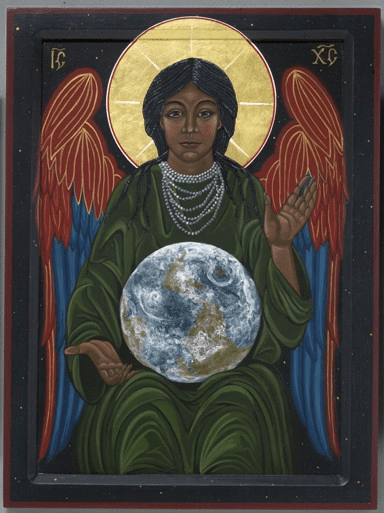
Sophia, Divine Wisdom, by Mary Plaster

Wisdom has built her house;
    she has set up its seven pillars.
She has prepared her meat and mixed her wine;
    she has also set her table.
She has sent out her servants, and she calls
    from the highest point of the city,
    “Let all who are simple come to my house!”
To those who have no sense she says,
    “Come, eat my food
    and drink the wine I have mixed.
Leave your simple ways and you will live;
    walk in the way of insight.”

Whoever corrects a mocker invites insults;
    whoever rebukes the wicked incurs abuse.
Do not rebuke mockers or they will hate you;
    rebuke the wise and they will love you.
Instruct the wise and they will be wiser still;
    teach the righteous and they will add to their learning.

The fear of the Lord is the beginning of wisdom,
    and knowledge of the Holy One is understanding.
For through wisdom your days will be many,
    and years will be added to your life.
If you are wise, your wisdom will reward you;
    if you are a mocker, you alone will suffer. (New International Version)

Life is full of choices. Whether we quibble about how much free will or deterministic fate a person actually has, or has not, we are still left with the ability to choose how we shall proceed and/or respond to basic life situations.

The two basic choices in life were often displayed in early film and television cartoons by having an angel on one shoulder and a devil on the other. The stereotypical portrayal helps us see that there is always a choice between good and evil.

Although our choices in life are quite personal and specific to a particular situation, the choice between good and evil is much bigger than this. It is choosing a certain way to look at the world, which then influences and informs the concrete decisions we make in life.

In our lesson for today, wisdom is personified as a lady calling out to us as people. In contrast, foolishness or folly is equally personified. The two ladies are continually speaking to us.

Lady Wisdom leads the community of sages who know how to live a right, just, and good life; she invites others to join her at the table and learn her ways. On the other hand, Lady Folly heads a group of simpletons who are driven by the passions of the moment; she easily attracts those who want cheap and easy solutions.

Wisdom’s message is a passionate appeal to take the path of insight through God’s revealed will. We are encouraged to leave empty-headed ways of thinking, and live with awareness, insight, and direction. The term “wisdom” in Scripture is the ability to apply sound biblical instruction and divine commands to concrete situations in our lives. 

For the spiritual person, especially, it is vital and imperative to daily listen to Lady Wisdom and follow her instructions.

The fact of the matter for too many people is that they are too impatient to let Lady Wisdom teach them her ways. It takes too much time, and is too hard for them. So, they turn to Lady Folly, who makes bogus promises of satisfaction without all the time and effort.

Idolatry (running toward other gods) immorality (running to victimize another) lying (running the mouth without any truth to it) and arrogance (running to get quick power and authority) often results from the inability to wait on the lessons that Lady Wisdom deeply desires to impart to us. 

Wisdom is not gained quickly; her teachings must be learned slowly with careful application over time. We are much too prone to wanting the simple solutions to complex problems that Lady Folly offers. But Lady Wisdom calls us to leave such simplistic thinking and take the high road of authenticity, self-awareness, and attention to the common good of all persons.

Therefore, rather than rushing to Google for answers to our questions; instead of allowing another person to make decisions for us; in place of implementing sheer pragmatic plans; allow Lady Wisdom to penetrate the mind and the heart so that what comes out is thoroughly good, benevolent, just, and helpful. 

And the best place to begin in starting down the road of wisdom is to give the Lord proper place in our lives. The skills for a good life gets its start through respect of God and obedience to the Lord. To truly have understanding and a wise life, one must get to know God. 

Nobody can talk themselves into wisdom, because it takes a reverent spirit, listening ears, and measured words to be able to put Lady Wisdom’s instruction into practice. There are no substitutes.

All-Wise God, the One who is never in a hurry and who is always holy, create in me a wise mind and a wise heart. Help me to sit still long enough for wisdom to bring spiritual growth and maturity to my life, through Jesus Christ my Lord, in the power of the Holy Spirit. Amen.

Use Your Freedom For Good (Exodus 33:1-6)

Then the Lord said to Moses, “You and the people you brought out of Egypt must leave this place. Go to the land I promised to Abraham, Isaac, and Jacob with an oath, saying, ‘I will give it to your descendants.’ I will send a Messenger ahead of you, and I will force out the Canaanites, Amorites, Hittites, Perizzites, Hivites, and Jebusites. Go to that land flowing with milk and honey. But I will not be with you, because you are impossible to deal with, and I would destroy you on the way.”

When the people heard this bad news, they acted as if someone had died. No one wore any jewelry. The Lord had said to Moses, “Tell the Israelites, ‘You are impossible to deal with. If I were with you, I might destroy you at any time. Now take off your jewelry, and I’ll decide what to do with you.’” After they left Mount Horeb, the Israelites no longer wore their jewelry. (God’s Word Translation)

It took little time for the covenant between God and the Israelites to be violated. The relationship between the Lord and the people was meant to be cemented through a special covenant in which Yahweh makes promises to them and gives them instructions and commandments; and the Israelites pledge their fealty and promise to obey.

But the people quickly reneged on the relationship. While Moses was up on Mount Sinai, receiving the Law from God, the Israelite grumbles and complaints came to full flower. They went their own way and made a calf idol out of gold.

So, the Lord’s judgment broke out amongst them. The Levites, to their credit, rallied around Moses and the Lord, and took out the rabble rousers in the camp. What’s more, God sent a plague that killed many.

In the aftermath of the rebellion against Moses and the Lord, God ordered the people to leave Mount Sinai – the place where everyone was to have a positive experience of Yahweh’s presence. God’s anger and wrath were so aroused that it became impossible for the divine presence to go with the people. Only Moses, as God’s emissary, would be able to guide the Israelites so that they are not completely eradicated.

Mount Sinai, by Sefira Lightstone

Yet, even after all the bad attitudes, rebellious actions, and an idolatrous spirit among the Israelites, Yahweh will still keep the divine promise to Abraham, Isaac, and Jacob to deliver them and bring them to the Promised Land.

Today’s story has the feel of a chastened child sitting in the corner, having to think about what they just did to raise the ire of the parent. The Israelites moved from Sinai in a somber mood, realizing more clearly than ever how much their lives are tied and linked to God’s divine presence.

At God’s command, the people removed their jewelry and took off their party clothes from the celebration that got them into so much trouble. It began to sink in, that the Lord departed from them because of their great sin. They started to realize, albeit too late, that they really screwed up their relationship with God.

The Israelites didn’t know how good they had it with the divine pillar of cloud by day and fire by night to lead them – and how much they actually depended on the God-given manna for their sustenance and existence.

It’s all too typical for us humans that we fail to realize what we have, until it’s gone. The ancient Israelites were freed from a cruel slavery in Egypt. They clearly did not handle their freedom well, at all. Perhaps the people were so used to being in bondage that, when they go their freedom, they just adopted a different sort of slavery – to their sinful passions.

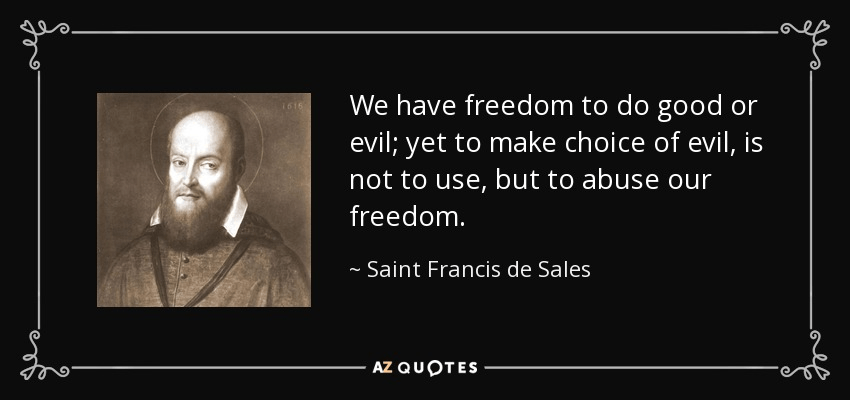
Let’s handle our freedom with some responsibility and accountability, so that we do not go down the same rebellious path as the ancient people of God. You and I are free to choose what we do, what we think, and how we spend our time. It’s easy to blame outside forces when circumstances are hard; and to grumble whenever we don’t like something.

Freedom is a spiritual discipline; we must learn how to intentionally practice it and use it for good. The following are four areas to purposefully work on with our freedom by making good choices:

Choose your words carefully. What comes out of your own mouth is up to you. Let those words reflect who you truly are; and let your speech impact others around you for good, and not evil.

Choose your attitude with some self-awareness. With awareness comes choices. For example, if we are not aware of our own anger, it will eventually come out sideways on another person. Our sullen attitude and jaded perspective will color our relational interactions. But if we are aware of our emotions, we can choose to effectively work through them, and then decide what sort of attitude we’re going to have.

Choose your actions before you do them. Seemingly insignificant choices turn into small actions. The small actions become habits. And habits shape character and create a life. We make choices every day about what we’ll do and not do. In every sort of situation we have choices to act, such as: Will I let go, or will I try and control others? Will I walk, or drive? Will I spend, or save? Shall I prepare, or procrastinate? Be fit, or be fat? Talk or listen?… and a thousand other choices of action.

Choose your beliefs with care. Our beliefs and our faith determines how we act and behave. If we believe in a good God who has our best interests at heart, we will freely trust such a God. But if we believe God to be a capricious Being who is aloof from my concerns, then we will make choices to watch out for number one and view others with suspect.

If you are behaving in ways that aren’t working for you, examine what belief is causing that behavior. Then decide whether that’s a belief you really need to have, or not, then change it, if necessary.

Every choice we make, contributes to the person we want to become, and sets us on the path to where we want to be in life. Maybe if the ancient Israelites had more awareness of this, they might have chosen very differently.

Gracious God, grant me clarity and awareness to make wise decisions. Enlighten my heart and mind, as I seek to follow your divine guidance. In the face of uncertainty, give me the courage to trust your promises. Help me embrace the path set before me, with a spirit of love and grace. Amen.

James 4:8-17 – Make Wise Spiritual Resolutions

Come near to God and he will come near to you. Wash your hands, you sinners, and purify your hearts, you double-minded. Grieve, mourn and wail. Change your laughter to mourning and your joy to gloom. Humble yourselves before the Lord, and he will lift you up.

Brothers and sisters do not slander one another. Anyone who speaks against a brother or sister or judges them speaks against the law and judges it. When you judge the law, you are not keeping it, but sitting in judgment on it. There is only one Lawgiver and Judge, the one who is able to save and destroy. But you—who are you to judge your neighbor?

Now listen, you who say, “Today or tomorrow we will go to this or that city, spend a year there, carry on business and make money.” Why, you do not even know what will happen tomorrow. What is your life? You are a mist that appears for a little while and then vanishes. Instead, you ought to say, “If it is the Lord’s will, we will live and do this or that.” As it is, you boast in your arrogant schemes. All such boasting is evil. If anyone, then, knows the good they ought to do and doesn’t do it, it is sin for them. (New International Version)

Resolve to Come Near to God

God is longingly looking out the window watching and waiting for us to come home (Luke 15:11-32). And when we are seen, God will run and come near to us.

We can come to God morning, noon, and night; when things are good and when they are bad. God gives generously to all without finding fault if we will but come near. (James 1:5)

When my oldest daughter was a small child, her bike was stolen. When she discovered it was gone, we sat down together in the backyard and came to God and prayed. I barely finished praying, we both looked up, and a police cruiser pulled up in the alley behind our house. The officer rolled down his window and said, “Hey, are you missing a bike?” 

We hopped in the back of the cruiser and the officer took us to a place where someone had ditched the bike. It was a tremendous lesson to both my daughter and I that when we come to God, God comes to us. I realize life doesn’t always work that way, yet we can be assured God listens, hears, and will respond.

Resolve to Wash Your Hands

We cannot approach God with blood on our hands. We need to come squarely facing our guilt and shame. God wants us to admit our guilt, confess it as such, receive forgiveness, and deal with matters of restitution, reconciliation, or making amends.

Look at what this very experience of godly sadness has produced in you: such enthusiasm, what a desire to clear yourselves of blame, such indignation, what fear, what purpose, such concern, what justice! (2 Corinthians 7:11, CEB)

Resolve to Purify Your Heart

Whereas the previous resolution was more external, this one addresses the inner person, the heart. Not only do our actions need to be cleaned up through washing our hands (repentance) our attitudes need cleansing, as well. 

Our hearts cannot be devoted to two masters. Double-minded persons need to become single-minded with pure, not mixed, motives.

“The man who tries to walk two roads will split his pants.”

African Proverb

Resolve to Grieve

God blesses those people who grieve. They will find comfort! (Matthew 5:4, CEV)

Any significant change or loss creates grief. And it is necessary to grieve. Grief is not an event but a process. Everyone’s grief is intensely personal and has its own timetable. It is not crazy, selfish, or unspiritual to grieve.  In fact, it is biblical.

The only way to get on the other side of grief is by telling your story. Sharing with each other, giving testimony to God’s grace, and expressing emotion is important. There cannot be healing apart from grief and lament.

Resolve to Mourn

Mourning is the emotional response to how terrible our fallen world is and can be, and how much we really need God.  It is to see that sin in all of its foulness and degradation is horrible and destroys everything it touches.

People who do not or cannot mourn are hard-hearted. They need deep spiritual transformation. By his wounds we are healed.

Resolve to Wail

We are actually commanded to cry – more than cry – to wail.  Whereas mourning might be more private and personal, wailing is more public.

I believe one of the greatest tragedies in today’s modern church is that Christians can become so focused on victory that they end up crying alone. Nobody should ever have to cry by themselves. Weep with those who weep. If there ever was an appropriate place for crying, it should be amongst likeminded brothers and sisters.

Resolve to Change

In the face of immense human need in this world, there must be change. We cannot turn the clock back to a more bygone idyllic era. We are here, now, together on spaceship Earth. We must come to grips with the kind of change needed to live above petty human degradation.

I once had a discussion with a young woman about heaven and hell. When we first started conversing, she expressed the desire to be in the place that had the better party going on. By the time we finished talking, she was grieving, mourning, and crying. I never knew what became of her – I even forget her name now. But once she got just a glimpse of sin’s gravity, it completely undid her.

Resolve to Be Humble

Humility is the path to intimacy with God and one another. The paradox is that through grieving, mourning, and wailing we become joyful and experience God. Through suffering there is glory. Being last makes us first.  Entering through the narrow gate brings us into the broad open space of eternal life.

Resolve to Not Slander One Another

To slander means to “speak against” or “speak down” to someone. Slander always contains false information based on bogus observations and misinterpretations. To intentionally tear-down another person either to their face or to other people is slander.

People sometimes believe they have a right to speak against another person. That really says more about the slanderer than the slandered. Slander is a spirit of retaliation and revenge. It is being self-righteous and acting as the judge.

Resolve to Not Be Judgmental

A critical and condemning spirit breaks the biblical law of love and declares itself the authority. It wrongheadedly believes it knows best for everyone.

When we put our focus on others and do not deal with our own critical spirit, we play God. That is not our job. 

Never pay back evil with more evil. Do things in such a way that everyone can see you are honorable. Do all that you can to live in peace with everyone. Dear friends, never take revenge. Leave that to the righteous anger of God. For the Scriptures say,

“I will take revenge;
    I will pay them back,”
    says the Lord.

Instead,

“If your enemies are hungry, feed them.
    If they are thirsty, give them something to drink.
In doing this, you will heap
    burning coals of shame on their heads.”

Don’t let evil conquer you but conquer evil by doing good (Romans 12:17-21, NLT)

Resolve to Have God in Your Plans

Some folks plan and map out their lives without a consideration of what God wants. They hold back on God, only giving partial effort and resources. And this can happen to any of us. We may not all have money and power, but we all have time, and how we use our time says a lot about our faith.

Jesus said we cannot serve both God and money (Matthew 6:24). In God’s economy, money is a tool to be used to meet needs and bless others. However, many persons tend to make audacious plans with money by accumulating debt and presuming they can pay it off; encouraging their kids to get high paying jobs as their highest objective; and, relying on the market economy to provide for them in the end. 

Money and making plans are good. Yet, the almighty dollar is not to be the motivating factor in our lives, and God needs to be squarely in the middle of all that we do.

So, resolve to embrace the virtue of humility – considering both others and God in making plans and decisions. For if we fail to do what we know we ought, our guilt will eventually catch up to us. Better to rely on God’s grace and make necessary changes.

Holy One, you are eternal, ever-present, and boundless in love. Yet there are times when we fail to recognize you in our daily lives. Sometimes shame clenches our hearts, and we hide our true feelings. Sometimes fear makes us small, and we miss the chance to speak from our strength. Sometimes doubt invades our hopefulness, and we degrade our own wisdom. In the daily round from sunrise to sunset, remind us again of your holy presence hovering near us and in us. Free us from shame and self-doubt. Help us to see you in the moment-by-moment possibilities to live honestly and to act courageously, through Jesus Christ our Lord. Amen.

1 Samuel 31:1-13 – Warning Signs from a Tragic Life

The Philistines made war on Israel. The men of Israel were in full retreat from the Philistines, falling left and right, wounded on Mount Gilboa. The Philistines caught up with Saul and his sons. They killed Jonathan, Abinadab, and Malki-Shua, Saul’s sons.

The battle was hot and heavy around Saul. The archers got his range and wounded him badly. Saul said to his weapon bearer, “Draw your sword and put me out of my misery, lest these pagan pigs come and make a game out of killing me.”

But his weapon bearer wouldn’t do it. He was terrified. So, Saul took the sword himself and fell on it. When the weapon bearer saw that Saul was dead, he too fell on his sword and died with him. So, Saul, his three sons, and his weapon bearer—the men closest to him—died together that day.

When the Israelites in the valley opposite and those on the other side of the Jordan saw that their army was in full retreat and that Saul and his sons were dead, they left their cities and ran for their lives. The Philistines moved in and occupied the sites.

The next day, when the Philistines came to rob the dead, they found Saul and his three sons dead on Mount Gilboa. They cut off Saul’s head and stripped off his armor. Then they spread the good news all through Philistine country in the shrines of their idols and among the people. They displayed his armor in the shrine of the Ashtoreth. They nailed his corpse to the wall at Beth Shan.

The people of Jabesh Gilead heard what the Philistines had done to Saul. Their valiant men sprang into action. They traveled all night, took the corpses of Saul and his three sons from the wall at Beth Shan, and carried them back to Jabesh and burned off the flesh. They then buried the bones under the tamarisk tree in Jabesh and fasted in mourning for seven days. (The Message)

Life is a process. Rarely does anything happen instantly. Human growth, maturation, life, and death unfold over years. So, a major life issue is attending to what process are we given to – a process which allows for human thriving – or a process that causes a failure to thrive.

King Saul sadly gave himself to a downward spiral of jealousy, paranoia, and poor decisions. His end was tragic. Yet perhaps we might learn some lessons in the form of warnings. Let’s consider the life of Saul as a cautionary tale, heeding us to avoid his foibles and pitfalls.

Unfortunately, Saul made deliberate choices in his life which led to his ignominious death. In fact, Scripture makes it plain that Saul died because of unfaithfulness:

Saul died because he was unfaithful to the Lord; he did not keep the word of the Lord and even consulted a medium for guidance and did not inquire of the Lord. So, the Lord put him to death and turned the kingdom over to David son of Jesse. (1 Chronicles 10:13-14, NIV)

Premeditated, deliberate, conscious wrongdoing can only expect a predictable process of moral failure and divine judgment. Consider some observations from Saul’s life so that we will be kept from going down his path of destruction:

  • Saul made decisions which solely benefited himself, and not the entire community. He deliberately disobeyed orders from the prophet Samuel and tried to justify his behavior with a godly veneer (1 Samuel 13:1-14; 15:1-26). Later, King David engaged in some deliberate acts of sin and disobedience. Yet, David did not share Saul’s outcome because he humbled himself before God, admitted his guilt, and turned away from disobedience (2 Samuel 12:1-13). There always remains the opportunity to turn to God, as long as we are alive.
  • Saul never owned his bad decisions, and it led to his paranoia and warped thinking. Saul kept believing he was okay – and that everyone else was wrong or against him. If we ever get to the point of living with our sin as if it’s acceptable, then we need a prophet to come along and show us the error of our ways and beliefs. Saul had a prophet in his life: Samuel, who was one of the best. Yet, Saul often altered Samuel’s advice or dispensed with it altogether.
  • Saul’s wrongdoing did not always lead to immediate negative consequences. That is the typical nature of sin. It bites, but the pain isn’t felt until later. Saul was rejected by God as king. In reality, this rejection did not occur until Saul’s death. Whenever Saul made poor decisions, he felt gratification in the immediate moment. Later, however, he was tormented by an evil spirit (1 Samuel 16:14). Conversely, the righteous person understands the principle of delayed gratification.
  • It wasn’t just Saul who suffered because of his own jealousy and paranoia. Other people suffered, as well. David clearly suffered emotional and spiritual duress because of Saul’s jealousy. The priests and the people of Nob were mercilessly murdered because of Saul’s paranoia (1 Samuel 22:6-19). We must be quite careful to avoid being shortsighted about our decisions. Just because we might neither anticipate nor see any negative consequences to others doesn’t mean there aren’t any. Sin destroys, period, whether we know it, or not.
  • Saul’s identity and worth as a person was dependent on his title and position as king. So, when that position was threatened, Saul thought his very personhood was in grave danger. The truth is that our worth as humans is not tied to whether we have a lofty position, or a particular pedigree. Our dignity as people is forever tethered to bearing the divine image.

A healthy life process of decision-making which includes consulting wise voices and collaborating with people of integrity will surely result in good things, not bad. So, let us walk in the narrow path of wisdom, while continually forsaking the broad road that leads to destruction.

Gracious God, our sins are too heavy to carry, too real to hide, and too deep to undo. Forgive what our lips tremble to name, what our hearts can no longer bear, and what has become for us a consuming fire of judgment. Set us free from a past that we cannot change; open to us a future in which we can be changed; and grant us grace to grow more and more in your likeness and image, through Jesus Christ, the light of the world. Amen.

*Above: woodcut of King Saul’s death by George Wigland, 1860