The Truth about Lying (Acts 5:1-11)

Now a man named Ananias, together with his wife Sapphira, also sold a piece of property. With his wife’s full knowledge he kept back part of the money for himself, but brought the rest and put it at the apostles’ feet.

Then Peter said, “Ananias, how is it that Satan has so filled your heart that you have lied to the Holy Spirit and have kept for yourself some of the money you received for the land? Didn’t it belong to you before it was sold? And after it was sold, wasn’t the money at your disposal? What made you think of doing such a thing? You have not lied just to human beings but to God.”

When Ananias heard this, he fell down and died. And great fear seized all who heard what had happened. Then some young men came forward, wrapped up his body, and carried him out and buried him.

About three hours later his wife came in, not knowing what had happened. Peter asked her, “Tell me, is this the price you and Ananias got for the land?”

“Yes,” she said, “that is the price.”

Peter said to her, “How could you conspire to test the Spirit of the Lord? Listen! The feet of the men who buried your husband are at the door, and they will carry you out also.”

At that moment she fell down at his feet and died. Then the young men came in and, finding her dead, carried her out and buried her beside her husband. Great fear seized the whole church and all who heard about these events. (New International Version)

We all know what a deceitful liar is because, well, we have all lied and practiced deceit in our lives. How ubiquitous is lying? According to one Harris poll:

  • The average person tells at least 2 lies every day. (That’s the equivalent of 730 lies per year)
  • 60% of people lie at least once in a 10-minute conversation.
  • 40% of people deceive prospective employers by lying on their resumes.
  • 90% of peoplelie on their online dating profiles.
  • 80% of spouses lieto their partner about their spending habits.
  • 50% of teenagers lieto their parents about their whereabouts.

And those are just lies that have been admitted. So, how many more lies and deceptions are there really out there?…

We also all know why we lie. You will likely find yourself in these top five reasons for lying:

  1. Fear of punishment
  2. Protection from harm
  3. Avoidance of shame or embarrassment
  4. To gain advantage and/or power over others
  5. Out of habit and/or compulsion

However, maybe you aren’t in touch with how lying really impacts you, how powerful deceitfulness truly is on your own psyche and personhood. Lying has major consequences for us including:

  • Loss of trust and damage to relationships
  • Loss of physical health and damage to mental health
  • Loss of job and damage to reputation
  • Loss of resources and experience of damages in lawsuits

In the instance of two people, Ananias and Sapphira, it meant loss of life and damage to the fellowship of new believers in the fledgling church.

The couple’s guilt, in front of the Apostle Peter and the entire church, is that they were counterfeit community members. Ananias and Sapphira were not what they seemed to others. They were not truthful because they were not vulnerable.

By lying in order to achieve an honor and a status they had not earned, Ananias and Sapphira not only dishonored and shamed themselves as patrons; they also unwittingly exposed themselves as outsiders who were pretending to be honest believers. In short, the two of them were imposters.

Their deceit demonstrates that they were still functioning within the existing Roman patronage system. Yet, true followers of Christ in the believing community, purposefully practiced a different system. The Christians had an interpersonal relation of giving and receiving love – which worked out itself in sharing all things in common with one another, without the class distinctions of the patronage system.

The cross of Christ abolished walls of separation and established a truly egalitarian society. To feign equality, but actually still live about in the inequitable world, is tantamount to rejecting the work of Christ’s cross.

The deception of Ananias and Sapphira was an attempt to appear just like Barnabas – who was the real deal, and the consummate steward of resources. Barnabas was an encourager, always thinking of others and the needs of the community (Acts 4:36-37).

Ananias and Sapphira wanted to look generous, but their motives were really to give in order to maintain their class status, and not for the sake of love. What’s more, their lie about it and their lack of honesty and vulnerability was clearly seen by Peter and interpreted by him as nothing less than lying to the Holy Spirit of God.

One of the purposes of the Holy Spirit is to form God’s people into a community that uses resources in accordance with a deep concern for others. It’s not surprising, then, that Ananias and Sapphira’s fakery of generosity is presented as falsifying the work of the Spirit. Their deception was an outright threat to Christian spiritual identity and community.

Like Ananias and Sapphira of old, our contemporary lying is typically to misrepresent who we are and how we are really doing and feeling.

The most common lie of people in the United States is saying “I’m fine” when they are really and truly not okay. Anxiety, depression, and the appearance of negativity is a source of guilt and shame for many Americans – so they lie about how they’re really doing.

It’s better to fake it, they believe, because no one actually cares how I’m doing. There is still very much a cultural stigma around people who admit not feeling well or not being okay. And that, my friends, very much needs to change.

It’s always good to begin with being honest with small things and avoiding white lies. Instead of lying, practice gratitude. Being thankful for all the small things in life is a truthful replacement to a lie. I wonder what Anania and Sapphira would have been like with that sort of healthy spiritual practice. But alas, we can only imagine.

In the case of you and I, we need not have to wonder. We can begin today by observing the good, the beautiful, and the truthful, and express gratitude for all the little ways for the good which is seen.

Grant me today, O God, some new vision of your truth. Inspire me with the spirit of joy and gladness. Make me the cup of strength to suffering souls; in the name of the strong Deliverer, our Lord and Savior, Jesus Christ. Amen.

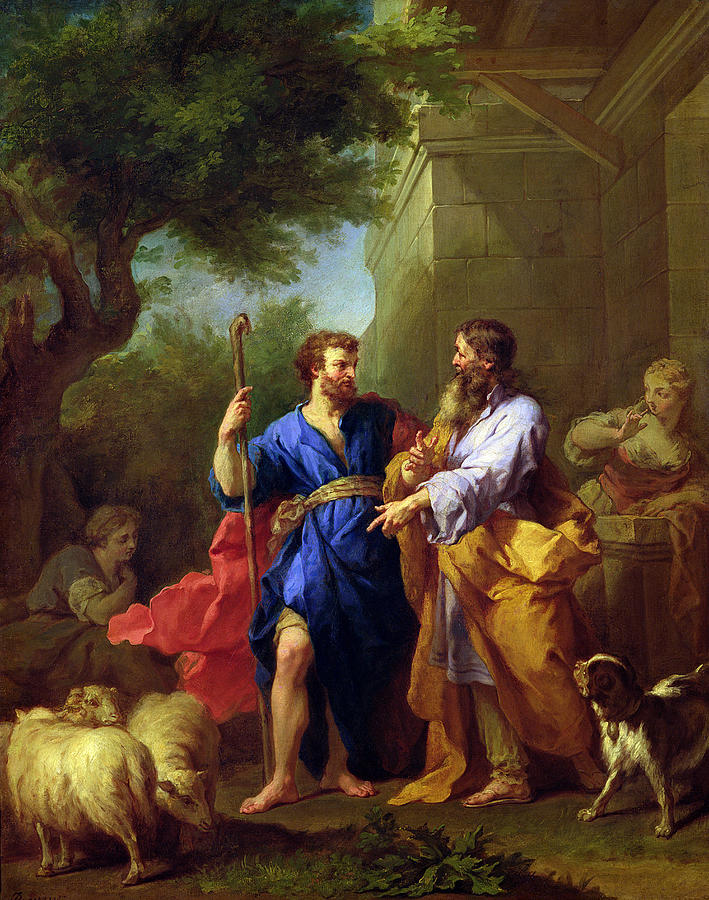
Trust vs. Trickery (Genesis 30:25-36)

Jacob and Laban, by Pietro da Cortona (1596-1669)

After Joseph was born, Jacob said to Laban, “Release me from our agreement and let me return to my own country. You know how hard I’ve worked for you, so let me take my wives and children and leave.”

But Laban told him, “If you really are my friend, stay on, and I’ll pay whatever you ask. I’m sure the Lord has blessed me because of you.”

Jacob answered:

You’ve seen how hard I’ve worked for you, and you know how your flocks and herds have grown under my care. You didn’t have much before I came, but the Lord has blessed everything I have ever done for you. Now it’s time for me to start looking out for my own family.

“How much do you want me to pay you?” Laban asked.

Then Jacob told him:

I don’t want you to pay me anything. Just do one thing, and I’ll take care of your sheep and goats. Let me go through your flocks and herds and take the sheep and goats that are either spotted or speckled and the black lambs. That’s all you need to give me. In the future you can easily find out if I’ve been honest. Just look and see if my animals are either spotted or speckled, or if the lambs are black. If they aren’t, they’ve been stolen from you.

“I agree to that,” was Laban’s response. Before the end of the day, Laban had separated his spotted and speckled animals and the black lambs from the others and had put his sons in charge of them. Then Laban made Jacob keep the rest of the sheep and goats at a distance of three days’ journey. (Contemporary English Version)

Jacob left home by himself and went to his mother’s family. After twenty years away, he had two wives and twelve sons by four different women. He had worked for his father-in-law Laban for all that time – all to Laban’s advantage. During those twenty years, there was plenty of complicated and awkward family drama.

Now Jacob was ready to be done with all that. He wanted to move on and go back to the place of his family origin. But, of course, Laban had a good thing going and did not want Jacob to leave. So, he did his best to convince him to stay. Jacob was able to set his own terms. And there was some space put between his burgeoning family and his in-law’s.

But returning is a lot more difficult than leaving. When I left home as a young man I had all my worldly possessions in a ’74 Chevy Vega. And when I returned to the land of my origins, it was in a large rental truck with a wife a three kids. There was a lot of logistics involved, not to mention all the relationships we left.

For twenty years, Jacob and Laban did a weird relational dance. They were both tricky dudes, and were continually attempting to maneuver and outmaneuver the other. Yet, Jacob mostly got the brunt of unfairness.

In reality, Jacob owed Laban nothing. He had agreed to work for him fourteen years in total. But he could take nothing with him except his family – which would leave him with no means of support. And Laban was not about to give his son-in-law any support outside of his fatherly-in-law control.

Jacob came up with a strange set of terms concerning the flocks of sheep. Laban logically calculates that Jacob is unlikely to gain much profit from the plan, and can still keep the status quo going. So it becomes a done deal.

In a typical relational dynamic which they have become accustomed to, Laban himself sorts the flock, removes all the spotted and speckled sheep to a safe distance, and leaves Jacob with the rest.

So, if Jacob is to acquire any flock of his own, he needs to discover a way of breeding multicolored sheep from monochrome ones – a task which seems to be improbable if not impossible. But that’s exactly what Jacob does in the end, and that is yet the subject of another Old Testament lesson….

So, exactly what is today’s lesson? Life is anything but a nice, neat trajectory upwards toward achieving goals. Rather, life is a series of twists and turns, leading us to often take three steps forward and two steps backward in a herky-jerky sort of journey. Yet, behind it all, the Lord’s promises are still there, still in effect, still being worked out, in order to be fully realized. Nothing and no one is going to derail the plans and purposes of God.

Sometimes we need to be reminded that God is the giver of prosperity, and not anyone or anything else.

When you become successful, don’t say, “I’m rich, and I’ve earned it all myself.” Instead, remember that the Lord your God gives you the strength to make a living. That’s how he keeps the promise he made to your ancestors. (Deuteronomy 8:17-18, CEV)

To the person who pleases him, God gives wisdom, knowledge and happiness, but to the sinner he gives the task of gathering and storing up wealth to hand it over to the one who pleases God. (Ecclesiastes 2:26, NIV)

If any of you lacks wisdom, you should ask God, who gives generously to all without finding fault, and it will be given to you. (James 1:5, NIV)

We may, at times, feel the need to acquire what we want through trickery or manipulation. However, there is a God in heaven who sees and who cares. The Lord delights is being generous and giving to us, that is, if we are aware and attentive enough to ask. We might not get what we want immediately, and it likely won’t be easy, but we shall nonetheless receive it. We only need to trust.

Heavenly Father, source of all life, we thank you for the many ways in which you have blessed and enriched our lives: Keep us from possessiveness and greed, and lead us into the greater joy of sharing your gifts with others, through Jesus Christ, in whom is perfect peace. Amen.

How To Deal with Temptation (James 1:12-16)

Eve reaching for the forbidden fruit, by S.J. Grove, 1995

Blessed is the one who perseveres under trial because, having stood the test, that person will receive the crown of life that the Lord has promised to those who love him.

When tempted, no one should say, “God is tempting me.” For God cannot be tempted by evil, nor does he tempt anyone; but each person is tempted when they are dragged away by their own evil desire and enticed. Then, after desire has conceived, it gives birth to sin; and sin, when it is full-grown, gives birth to death.

Don’t be deceived, my dear brothers and sisters. (New International Version)

The slow slog of uphill adversity, at various times, is a common experience of us all. We must deal with circumstances we didn’t choose, and situations that are out of our control. Throw into the mix that many people have few resources, and you have a feeling of being totally overwhelmed.

In this state of being, it’s challenging to maintain solid decision-making, emotional stability, and spiritual support. We need both encouragement and warning so that we can be strengthened in faith.

The Apostle James sought to encourage and warn a small struggling church who were enduring difficult and unwanted situations. He reminded the believers that the person who perseveres under a time of trial and testing of faith is blessed. 

To be “blessed” is to have God’s stamp of approval. God approves of learning, enduring, and maturing through hardship. For such people, God has promised to give “the crown of life.” All the hard lessons we have under our belts, puts us in the position to connect with Jesus and enjoy God.

Don’t blame others

Sometimes, however, we face suffering not because of the circumstances which God brings in our lives, but because of our own unwise response to difficulty. 

Problems are compounded whenever we blame our troubles on others, and refuse to learn what God is trying to teach us. This sort of response has it’s origins in the Garden.  

Adam said to God, “The woman whom you gave to be with me, she gave me fruit of the tree, and I ate.” (Genesis 3:12) The implication of Adam is that he would have remained innocent, if God had not put Eve in the Garden with him. 

Ever since, blame-shifting has been a staple of human behavior. Our bruised hearts and damaged egos send us desperately looking for someone else to blame when we are confronted with our own trouble. 

“There are two eras in American history: the passing of the buffalo and the passing of the buck.”

Will Rogers

Some folks can be so desperate to justify themselves, they end up saying illogical things, such as: 

  • “I wouldn’t lose my temper if my co-workers were easier to get along with, my kids behaved better, and my spouse were more considerate.” 
  • “I would be a patient person if I didn’t have so many things to do, and if the people around me weren’t so slow and incompetent!” 
  • “I would have a pure mind if there were not so many sexual images in our culture.”
  • “I wouldn’t worry about the future if I had more money, and no health problems.”
  • “My spiritual life would be much better if the pastor did a better job.”
  • “I would follow if there were some decent leadership around here.”
  • “I could never forgive that person [or God].”
  • “My neighbor is an incredible cook; I can’t lose weight with such good food.”
  • “I’ll never be happy, as long as that person is in my life.”

So, I ask us, “What will it take?”…

  1. To stop making excuses? 
  2. To quit blame-shifting onto others? 
  3. To trust God and step out in faith?
  4. To cease worrying about what other people think and start doing what God thinks? 
  5. To look at faith as a dynamic relationship with the Lord, instead of just a static thing you possess? 
  6. To read Holy Scripture as if your life depended on it? 
  7. To minister with initiative and confidence? 
  8. To be humble, do justice, and act with mercy? 
  9. To spiritually grow?
  10. To truly enjoy life?

Don’t blame God

It seems that to err is human; to blame it on the divine is even more human.

God cannot be tempted; it’s not an option. God hates sin and disobedience; the Lord has no appeal for it, at all. It’s a moral impossibility for God to even consider attempting to do evil. Therefore, since God cannot be tempted by evil, God cannot tempt people toward evil.

Then why in the Sam Hill would we ever blame anything on God? Because it’s a cheap easy (and pathetic) way of absolving ourselves from responsibility for our own unwise choices, words, and actions. 

Certainly, God tests us, in order to improve our character, and to bring us toward greater spiritual maturity. Yet, God never forces us to make bad, immoral, or evil choices. God may have brought the trial and testing into our lives; but how we respond to it is up to us.

Take responsibility for yourself

The real culprit behind temptation is one’s own personal and strong desire. It’s the intense motive to have-to-do-it, have-to-say-it, and have-to-have-it, which are at the root of temptation. 

We all have legitimate needs, wants, and desires for love, security, companionship, and to make a difference in the world. Yet we may seek illegitimate means to satisfy those needs. We are lured to the hook by the enticing bait of temptation, and if we bite, that’s on us. Our own temptations lure us to satisfy our legitimate needs in illegitimate ways. 

And when we get ourselves in a pickle because of following our own temptations, the internal push to blame others and/or God becomes strong. It doesn’t help that blame-shifting feels good; it gets the monkey off my back – at least for a time. 

But like a bad addiction, blame-shifting needs to occur in a bigger dose, after a shorter duration of time. Before you know it, we’re caught in a destructive cycle. The temptation has enticed us and we have taken the bait.  Like a fish-eyed follower of evil, we succumb to the lust for ambition, revenge, sex, power, fame, or money.

Know the consequences of blaming others

Temptation, like a smooth operator, comes along and gives a slick pitch about how our troubles can be managed or taken away through blaming others, even God. Then, all of sudden, like a star-struck fan seeking to be satisfied, we take the bait and go to bed with the idea. 

We let sin’s temptation have its way with us. Now, it’s inside us. Like a fetus, the small sin grows within. Eventually, this pregnancy will come to full term. But instead of giving birth to life, there is the terrible agony of death.

Conclusion

Everyone struggles in some way with some sort of temptation. We don’t all wrestle with the same demons, but we’re all tempted in some manner. However, the cycle of guilt and separation from God can be broken. The glory of the gospel is that it breaks the power of sin.

So, hear the good news: 

Don’t let anyone fool you by using senseless arguments [blame-shifting]. These arguments may sound wise, but they are only human teachings. They come from the powers of this world and not from Christ… Christ has taken away your selfish desires… God let Christ make you alive when he forgave all our sins.

God wiped out the charges that were against us for disobeying. He took them away and nailed them to the cross. There Christ defeated all powers and forces… Now the forces of the universe don’t have any power over you….

Kill every selfish desire. Don’t be immoral or indecent or have evil thoughts. Don’t be greedy, which is the same as worshiping idols….  You must quit being angry, hateful, and evil. You must no longer say insulting or cruel things about others. And stop lying to each other. You have given up your old way of life with its habits….

God loves you and has chosen you as his own special people. So be gentle, kind, humble, meek, and patient. Put up with each other, and forgive anyone who does you wrong, just as Christ has forgiven you. Love is more important than anything else. It is what ties everything completely together.

Let the peace that comes from Christ control your thoughts. And be grateful. Let the message about Christ completely fill your lives, while you use all your wisdom to teach and instruct each other. With thankful hearts, sing psalms, hymns, and spiritual songs to God. Whatever you say or do should be done in the name of the Lord Jesus, as you give thanks to God the Father because of him. (Colossians 2:8-3:17, CEV)

Amen.

Revelation 17:1-18 – A Vision of the End

“The Whore of Babylon” by Hans Burgkmair, 1523

One of the seven angels who had the seven bowls came and said to me, “Come, I will show you the punishment of the great prostitute, who sits by many waters.With her the kings of the earth committed adultery, and the inhabitants of the earth were intoxicated with the wine of her adulteries.”

Then the angel carried me away in the Spirit into a wilderness. There I saw a woman sitting on a scarlet beast that was covered with blasphemous names and had seven heads and ten horns. The woman was dressed in purple and scarlet, and was glittering with gold, precious stones and pearls. She held a golden cup in her hand, filled with abominable things and the filth of her adulteries. The name written on her forehead was a mystery:

BABYLON THE GREAT

THE MOTHER OF PROSTITUTES

AND OF THE ABOMINATIONS OF THE EARTH

I saw that the woman was drunk with the blood of God’s holy people, the blood of those who bore testimony to Jesus.

When I saw her, I was greatly astonished. Then the angel said to me: “Why are you astonished? I will explain to you the mystery of the woman and of the beast she rides, which has the seven heads and ten horns. The beast, which you saw, once was, now is not, and yet will come up out of the Abyss and go to its destruction. The inhabitants of the earth whose names have not been written in the book of life from the creation of the world will be astonished when they see the beast, because it once was, now is not, and yet will come.

“This calls for a mind with wisdom. The seven heads are seven hills on which the woman sits. They are also seven kings. Five have fallen, one is, the other has not yet come; but when he does come, he must remain for only a little while. The beast who once was, and now is not, is an eighth king. He belongs to the seven and is going to his destruction.

“The ten horns you saw are ten kings who have not yet received a kingdom, but who for one hour will receive authority as kings along with the beast. They have one purpose and will give their power and authority to the beast. They will wage war against the Lamb, but the Lamb will triumph over them because he is Lord of lords and King of kings—and with him will be his called, chosen and faithful followers.”

Then the angel said to me, “The waters you saw, where the prostitute sits, are peoples, multitudes, nations and languages. The beast and the ten horns you saw will hate the prostitute. They will bring her to ruin and leave her naked; they will eat her flesh and burn her with fire. For God has put it into their hearts to accomplish his purpose by agreeing to hand over to the beast their royal authority, until God’s words are fulfilled. The woman you saw is the great city that rules over the kings of the earth.” (New International Version)

Today’s New Testament lesson is the beginning of a long and elaborate vision of the Apostle John. The vision includes a woman and a scarlet beast, and the angel’s interpretation of what John saw.

An Incredible Vision

“The Whore of Babylon” from Martin Luther’s 1534 translation of the Bible.

Consistent with Old Testament’s imagery depicting the relationship between God and people, John’s vision is of a prostitute whom the kings of the earth committed adultery. This great offense will not be overlooked. It is provoking divine wrath.

The prostitute sits on a scarlet beast, an imposing and rather incredible looking creature with seven heads and ten horns. The woman and the beast signify and portray the pinnacle of opulence, extravagance, and luxury. Yet, she is also the ultimate depiction of corruption, indecency, and irreverence.

The great prostitute influences all the world. She is the evil genius behind the blood of the Christian martyrs. The woman deceives and connives so that she can wreak her violence against the saints of God.

John appears to be slack jawed with all this. The prostitute’s seductive influence has been so great that nations fall to her erotic power. She is so diabolically smooth, her presentation so marvelous, that even John is mesmerized by her.

Why Are You Astonished?

The angel’s question to John is akin to saying, “Well, what did you expect? The Wicked Witch of the West? Evil is much more sinister than an ugly old woman. Unrighteousness cloaks itself in nice garb. Snap out of it, man!”

Astonishment and awe belong to God, not some alluring vision of beauty. The enticement only traps humanity into a sticky web which the Black Widow can feed upon. The woman and the beast are doomed to destruction. Their time is imminently near.

John (and us) must see beyond the surface presentation to the darkness within. Antichrist is not only a person but the evil systems which feed upon helpless humans caught in the web of seduction.

The End Times

The leaders of the earth, deceived and smitten by the temptress, ally together to wage war on all that is right, just, and good – all the while believing they are fighting for beauty. It will eventually climax at Armageddon, the place of final victory over all the malevolence.

The Lamb shall overcome the nefarious forces of corruption. The faithful followers of God need only to persevere and see the punishment of the wicked. Please keep in mind that none of this has a timetable for us to chart. Biblical time revolves primarily around events, not precision clockwork.

It is not our task to walk around predicting dates, nor is it to point fingers at anyone we don’t like as being the antichrist. There’s plenty of shock-and-awe in the Apocalypse of John without us adding to it with our half-baked ideas of the end times.

The world, as it presently exists, is distorted by sin. And we humans tend to be ill-equipped in discerning the difference between The Great Prostitute and Lady Wisdom. What the book of Revelation does for us is show, with alarming symbolism, just how difficult it can be to navigate this old fallen world.

So, let us run to God; trust in the Lamb; and be filled with the Spirit.

Sovereign God, you are slow to anger and abound in steadfast love. Grant to national leaders the wisdom, courage and insight needed for this time of change and uncertainty. Give to all who exercise authority determination to defend the principles of freedom, love and tolerance, strength to protect and safeguard the innocent and clarity of vision to guide the world into the paths of justice and peace. This we ask through Jesus Christ our Lord. Amen.