The Day of the Lord (Zechariah 14:1-9)

Art by Larissa Lando

A day of the Lord is coming, Jerusalem, when your possessions will be plundered and divided up within your very walls.

I will gather all the nations to Jerusalem to fight against it; the city will be captured, the houses ransacked, and the women raped. Half of the city will go into exile, but the rest of the people will not be taken from the city. Then the Lord will go out and fight against those nations, as he fights on a day of battle. On that day his feet will stand on the Mount of Olives, east of Jerusalem, and the Mount of Olives will be split in two from east to west, forming a great valley, with half of the mountain moving north and half moving south.You will flee by my mountain valley, for it will extend to Azel. You will flee as you fled from the earthquake in the days of Uzziah king of Judah. Then the Lord my God will come, and all the holy ones with him.

On that day there will be neither sunlight nor cold, frosty darkness. It will be a unique day—a day known only to the Lord—with no distinction between day and night. When evening comes, there will be light.

On that day living water will flow out from Jerusalem, half of it east to the Dead Sea and half of it west to the Mediterranean Sea, in summer and in winter.

The Lord will be king over the whole earth. On that day there will be one Lord, and his name the only name. (New International Version)

Even though people are polarized politically, not on the same page spiritually, and with as many diverse opinions as the grains of sand on a beach, we all seem to agree on one thing: The world is a messed up place.

Indeed, our world in fundamentally broken. There is injustice everywhere. You don’t have to go very far to find corruption. Selfishness abounds. Wars and violence and death proliferate in every corner of the globe. Just watching the evening news can give a person secondary trauma.

The Bible is not aloof to the injustice and human suffering of this old fallen world. Ancient peoples saw their share of hard circumstances and horror. We have difficult passages in Holy Scripture, like today’s Old Testament lesson, because we live in a difficult world.

There is, however, an end to it all. The prophet Zechariah communicated that God shall intervene and personally hold to account the world’s systems, institutions, organizations, communities, nations, and individuals. Because God is Love, the Lord will not put up with systemic evil and wicked hearts forever.

We people are both victims and perpetrators. By God’s grace, whenever we perpetrate injustice, we will become aware of it and seek to make it right through spiritual repentance and personal restitution. And if we don’t, may the Lord have mercy on us.

The Day of the Lord is a phrase referring to God’s divine judgment on this world. The Lord will personally come, according to the prophet Zechariah, to judge the world and establish a gracious and benevolent rule forever. On that day, events shall unfold which have never happened before.

Zechariah, of course, is not the only prophet to foresee the great Day of the Lord coming in power and glory. Notice what a few of the other prophets say:

Wail, for the day of the Lord is near;
    it will come like destruction from the Almighty.
Because of this, all hands will go limp,
    every heart will melt with fear.
Terror will seize them,
    pain and anguish will grip them;
    they will writhe like a woman in labor.
They will look aghast at each other,
    their faces aflame.

See, the day of the Lord is coming
    —a cruel day, with wrath and fierce anger—
to make the land desolate
    and destroy the sinners within it.
The stars of heaven and their constellations
    will not show their light.
The rising sun will be darkened
    and the moon will not give its light.
I will punish the world for its evil,
    the wicked for their sins.
I will put an end to the arrogance of the haughty
    and will humble the pride of the ruthless.
I will make people scarcer than pure gold,
    more rare than the gold of Ophir.
Therefore I will make the heavens tremble;
    and the earth will shake from its place
at the wrath of the Lord Almighty,
    in the day of his burning anger. (Isaiah 13:6-13, NIV)

Alas for that day!
    For the day of the Lord is near;
    it will come like destruction from the Almighty…

The Lord thunders
    at the head of his army;
his forces are beyond number,
    and mighty is the army that obeys his command.
The day of the Lord is great;
    it is dreadful.
    Who can endure it? (Joel 1:15; 2:11, NIV)

“The day of the Lord is near
    for all nations.
As you have done, it will be done to you;
    your deeds will return upon your own head.” (Obadiah 15, NIV)

The great day of the Lord is near—
    near and coming quickly.
The cry on the day of the Lord is bitter;
    the Mighty Warrior shouts his battle cry.
That day will be a day of wrath—
    a day of distress and anguish,
        a day of trouble and ruin,
    a day of darkness and gloom,
        a day of clouds and blackness—
    a day of trumpet and battle cry
against the fortified cities
    and against the corner towers. (Zephaniah 1:14-16, NIV)

The Day of the Lord is the final day of reckoning for those who have stubbornly held to their unjust ways and failed to acknowledge there are better and righteous ways to live and operate in the world. God shall purge the earth of evil.

Just because suffering and wickedness have endured for several millennia, does not mean that God is absent, uncaring, or will do nothing. And just because people (supposedly) get away with being self-centered and calloused toward their fellow humanity, does not mean they won’t have to face the Judge someday.

If you have suffered from a harsh leader, or endured an unjust situation, or seen others you care about crushed by an oppressive system, please understand that God does see it all – and God will vindicate the godly, while holding the ungodly accountable for their wickedness.

It is frustrating, even maddening, to have to put up with injustice day after day. Take heart to neither give up nor give in, because the Lord your God has your back. There is support for today, and justice for tomorrow.

Almighty God, who created humanity in your own image: Grant us grace to fearlessly contend against evil, and to make no peace with oppression. Help us to use our freedom, and employ it in the maintenance of justice among individuals and nations, to the glory of your holy Name, through Jesus Christ our Lord. Amen.

The Second Woe Upon the Earth (Revelation 9:13-21)

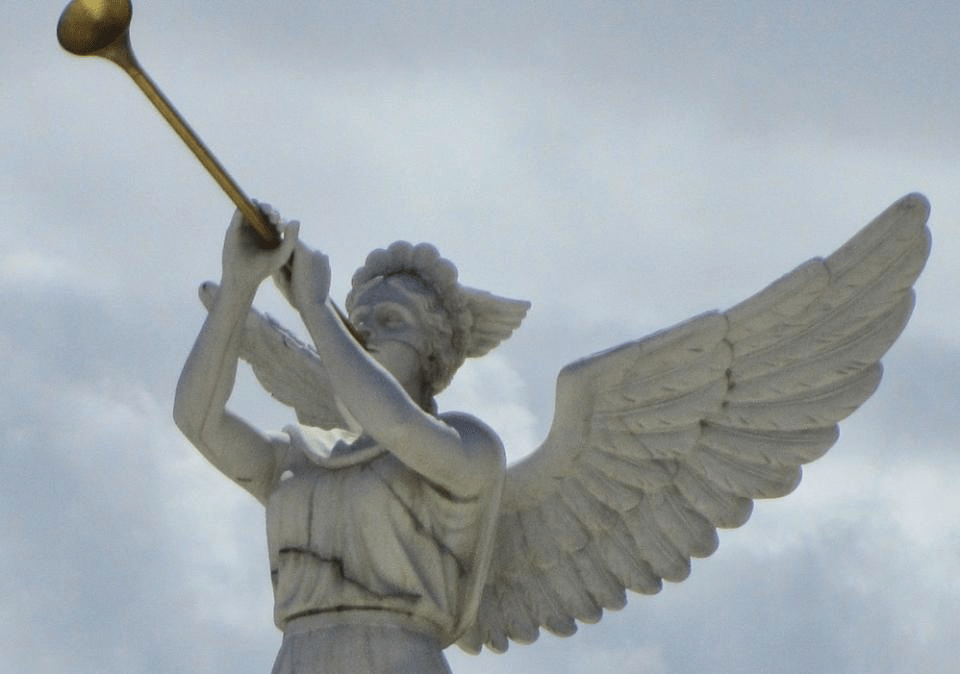
The sixth angel sounded his trumpet, and I heard a voice coming from the four horns of the golden altar that is before God. It said to the sixth angel who had the trumpet, “Release the four angels who are bound at the great river Euphrates.” And the four angels who had been kept ready for this very hour and day and month and year were released to kill a third of mankind. The number of the mounted troops was twice ten thousand times ten thousand. I heard their number.

The horses and riders I saw in my vision looked like this: Their breastplates were fiery red, dark blue, and yellow as sulfur. The heads of the horses resembled the heads of lions, and out of their mouths came fire, smoke and sulfur. A third of mankind was killed by the three plagues of fire, smoke and sulfur that came out of their mouths. The power of the horses was in their mouths and in their tails; for their tails were like snakes, having heads with which they inflict injury.

The rest of mankind who were not killed by these plagues still did not repent of the work of their hands; they did not stop worshiping demons, and idols of gold, silver, bronze, stone and wood—idols that cannot see or hear or walk. Nor did they repent of their murders, their magic arts, their sexual immorality or their thefts. (New International Version)

In an apocalyptic vision of God’s judgment at the end of time, the Apostle John saw seven angels with seven trumpets. Each blast of the horn brought ever increasing levels of destruction upon the earth. The final three trumpets are also described as the three woes. (Revelation 8:2-6, 13)

The Sixth Trumpet (Second Woe)

The sixth angel sounded the sixth trumpet, which was also the second woe pronounced on the world. Four angels are released from their place of restraint. Whereas the invasion of locusts in the fifth trumpet (first woe) came from the pit of hell, the next invasion comes from the east, from the outskirts, that is, outside the Roman Empire.

The terrible angels go out to kill a third of all humanity. They lead a massive destructive force that overwhelms the earth. The incredible army looks something like centaurs, being horse and rider in one. And out of their mouths come fire, smoke, and sulfur. These are three plagues which brings death to a third of humanity.

The Response to the Second Woe’s Invasion

John records the human response to the divine judgment unleashed upon humanity with the four angels and their three plagues. In reality, it’s actually a lack of response; there is no change of heart and no repentant attitude from anyone. The awful devastation does nothing to elicit any sort of self-reflection, public awareness of sin, or reconsideration of ways by those left alive.

The Apostle records that the rest of the people, after going through such a traumatic time, keep up their worship of demons and their idolatry. They continue to murder, carouse, and steal, as if nothing had happened.

What’s more, John’s graphic and disturbing vision – from it’s very beginning – does not record a single person turning away from their evil ways. The surviving inhabitants of the earth act like old Pharaoh in Egypt during the days of Moses and the exodus; their hearts are hard, and they are not about to change.

What It Means For Us

A big question for us as contemporary people, two-thousand years removed from John’s apocalyptic vision is this: Do the judgments contained in the book of Revelation have any relevance for us today?

Some might dismiss all of this as weird historical story that nobody can really understand, so we might just as well put it aside as belonging in the past. Others grew up hearing “fire and brimstone” sermons from Revelation that did nothing for them other than help them decided that they never want to be in a church again and listen to a sinner about how sinful everybody is.

Although I do not condone hellfire preaching that does little more than make people feel bad, I do believe these difficult judgment chapters in the book of Revelation have something to say to us which we would do well to hear.

  • If we dig in and want what we want, without considering anyone else or even God, then we really cannot expect blessing either in this life or the life to come.
  • If and when disaster or destruction happens – and afterwards go on our merry way as if nothing even occurred – then we have come under divine judgment.
  • If we purposely stick our heads in the sand, and intentionally avoid what is happening around us in this world, then it will not go well for us in the end.
  • If we become angry, and nurse the grudge to the point of becoming hateful and unloving, then the hardness of heart will not recognize God’s visitation when it comes.
  • If we hurt and harm others without any remorse, or make excuses for bad behavior when called out on it, then we are no better than the unrepentant mass of humanity in the book of Revelation.

There is coming a time when it will be too late. The Day of the Lord will come. There will be a final judgment. But if you are reading this, there is obviously still time. Spiritual procrastination only leads to destruction. Spiritual attention to the here-and-now leads to life. What will you do “Today?”

Our Father who is in heaven,

uphold the holiness of your name.

Bring in your kingdom

so that your will is done on earth as it’s done in heaven.

Give us the bread we need for today.

Forgive us for the ways we have wronged you,

just as we also forgive those who have wronged us.

And don’t lead us into temptation,

but rescue us from the evil one. Amen.

Good vs. Evil (2 Thessalonians 2:7-12)

For the mystery of lawlessness is already at work, but only until the one who now restrains it is removed. And then the lawless one will be revealed, whom the Lord Jesus will destroy with the breath of his mouth, annihilating him by the manifestation of his coming. The coming of the lawless one is apparent in the working of Satan, who uses all power, signs, lying wonders, and every kind of wicked deception for those who are perishing because they refused to love the truth and so be saved. For this reason God sends them a powerful delusion, leading them to believe what is false, so that all who have not believed the truth but took pleasure in unrighteousness will be condemned. (New Revised Standard Version)

There are two opposing forces which are operating in this world. One is the power of evil, manifested through lawlessness, selfishness, and wickedness. The other power is good, and it is seen wherever there is a concern for the common good of all people. Labors of love for all humanity and right relations with everyone are a demonstration of the peaceable fruit of righteousness existing in the world.

To put it succinctly, a spirit of merciful grace and a spirit of careless judgment both exist throughout the world.

Hate what is evil; cling to what is good.

The Apostle Paul (Romans 12:9, NIV)

The Apostle Paul wrote his letter to the church in Thessalonica because the believers there were confused. Somebody had told them that the end of the age already happened. Paul sought to set the record straight, that we are still anticipating the return of the Lord and the final judgment of all things.

The great Day of the Lord will not come until the faithless one, the person of lawlessness, the son of destruction, is revealed. Such a person opposes God and has the force of evil behind them. So, who is this person?

The person is not a single individual. Paul was helping the Thessalonian believers understand the actual situation by wrapping the abstract concept of evil into human form, so that they could visualize its reality and sinister nature. In truth, there will be lots of individual humans who manifest themselves through evil intent and actions, until the Lord’s return.

Grace is the operative power which restrains all the evil. A lot of people have questions about God and evil. Why is there so much evil? How come God doesn’t snuff it all out? Is the Lord not able to do anything? What’s going on?

Those are honest questions. And they come from a place of limited human perspective. Let’s turn this on it’s head. It’s not that God is impotent or isn’t doing anything about evil. Think of it this way: When you scoop up a bunch of sand in your hands, there are a lot of sand grains which fall to the ground. If the sand is evil, and the hands are God’s, the reality of the situation is that the Lord has most of the evil kept at bay.

In other words, if God were not involved in this world, at all, we would be living in a real dystopian society – people staying up at night to guard their homes with guns, and anxious folks attacking each other with impunity. As bad as some things are, it could be infinitely worse than it is.

The grace of God is active in restraining evil and providing believers with what they need to not only survive, but also to thrive in this world.

His divine power has given us everything needed for life and godliness, through the knowledge of him who called us by his own glory and excellence. Thus he has given us, through these things, his precious and very great promises, so that through them you may escape from the corruption that is in the world because of lust and may become participants of the divine nature. (2 Peter 1:3-4, NRSV)

A reversal occurs because of God’s grace. The wickedness which exists, especially within the human heart, is dealt with and transformed into a force for good in the world.

Once we, too, were foolish and disobedient. We were misled and became slaves to many lusts and pleasures. Our lives were full of evil and envy, and we hated each other. But—when God our Savior revealed his kindness and love, he saved us, not because of the righteous things we had done, but because of his mercy. (Titus 3:3-5, NLT)

Grace is wonderful for those who believe. However, for those who are faithless, grace is inoperative – simply because the wicked consider virtues like mercy and grace as weak and useless; they have no intention of either giving or receiving such drivel.

From a certain angle, it may seem that God is harsh. The Lord hardens hearts, sends powerful delusions, and entertains mysteries which some people will never discover. Yet, from another point of view, these are all necessary divine tools in dealing with unjust humanity and their systems of oppression.

Justice and righteousness are championed by God, and therefore, injustice and unrighteousness will not be put up with by the Lord. And that is a good thing. Love not only gives, but it also protects and withholds. Evil will be dealt with according to God’s good grace and in God’s good time – and not according to a limited human perspective or any person’s impatience.

The time is short, and the time is near; everything shall not continue, as it presently is, forever. This is why the author of Hebrews exhorted people to pay attention to “Today” with a capital “T.” Today won’t be here tomorrow. Tomorrow is the Day of the Lord. So, while it’s Today, we must be responsive.

My friends, watch out! Don’t let evil thoughts or doubts make any of you turn from the living God. You must encourage one another each day. And you must keep on while there is still a time that can be called “Today.” If you don’t, then sin may fool some of you and make you stubborn. (Hebrews 3:12-13, CEV)

We must encourage each other with continued faith and patience until the end of the age. We can do this. We are all in this life together, so let us keep on holding up one another and carrying each other’s burdens. In so doing, we will not be lawless, but fulfill the Law of Christ. (Galatians 6:2)

Keep on being brave! It will bring you great rewards. Learn to be patient, so you will please God and be given what he has promised. As the Scriptures say,

“God is coming soon!
    It won’t be very long.
The people God accepts
will live because
    of their faith.
But he isn’t pleased
with anyone
    who turns back.”

We are not like those people who turn back and get destroyed. We will keep on having faith until we are saved. (Hebrews 10:35-39, CEV)

May it be so, to the glory of God. Amen.

Against Apathy (Obadiah 15-21)

The day of the Lord is near
        against all the nations.
    As you have done, so it will be done to you;
        your actions will make you suffer!
Just as you have drunk on my holy mountain,
        so will all the nations around you drink;
    they will drink and swallow quickly,
        and they will be like they’ve never been before.

But on Mount Zion there will be those who escape,
        and it will be holy;
        and the house of Jacob will drive out those who drove them out.
The house of Jacob will be a fire,
        the house of Joseph a flame,
        and the house of Esau straw;
    they will burn them up completely,
        and there will be no one left of the house of Esau,
for the Lord has spoken.
Those of the arid southern plain will possess Mount Esau,
        and those of the western foothills, the land of the Philistines;
    they will possess the land of Ephraim and the land of Samaria,
        and Benjamin will possess Gilead.
Those who remain of the Israelites
            will possess the land of the Canaanites as far as Zarephath;
    and those left from Jerusalem and who are now living in Sepharad
        will possess the cities of the arid southern plain.
The deliverers will go up to Mount Zion
        to rule Mount Esau,
        and the kingdom will be the Lord’s. (Common English Bible)

The prophet Obadiah is a small book in the sea of the Old Testament prophets (a single chapter of twenty-one verses). It’s a prophecy dedicated to the singular focus of delivering a message of divine judgment against the nation of Edom.

Why judgment? Because when people remove themselves from or place themselves in opposition to God (and God’s people) they can expect divine retribution, rather than restoration.

“The day of the Lord” is a phrase used throughout Holy Scripture as a reference to God’s upcoming judgment of the world. Along the way, until that final day, there are many nations which come and go.

Actions

Edom was in an ideal position to help Judah when King Nebuchadnezzar and the Babylonians captured Jerusalem in 586 B.C.E. But they didn’t. They could have given military assistance; but the ancient animosity between Jacob (Israel) and Esau (Edom) prevented this.

They still could have sheltered the Jews fleeing Jerusalem and Judah in order to escape the Babylonian onslaught. Edom’s rocky strongholds would have been extremely difficult for Babylon to maneuver in pursuit of Judah. Yet, the Edomites refused to trouble themselves in offering Judah even the slightest assistance in the day of its great need.

In fact, the situation was worse than refusing to assist. Edom committed violence against Judah at the time of Jerusalem’s fall. The Edomites progressed from being aloof and disinterested observers of Judah’s fate, to gloating over Judah’s trouble, to participating as invaders of Jerusalem. Finally, Edom played the antagonistic enemy who plucked off desperate Jewish fugitives as they tried to escape certain death.

The Edomites were like a bunch buzzards, hovering overhead, waiting for Babylon to smash Judah so that they could swoop down and devour the leftovers.

Accountable

Historically, we don’t really know much Edom was actually involved in Jerusalem’s destruction. Yet, it’s notable that some later Jewish traditions indicate that Edom helped the Babylonians burn the temple in Jerusalem to the ground. Whatever really happened, the Edomites took advantage of Judah and profited from their destruction. What’s more, God held them accountable for their actions and/or inaction.

And that is the very nature of sin. A sinner is one who either acts in breaking God’s penultimate command of love by harming another, or fails to act lovingly with apathetic inaction, when it is in their power to act. Therefore, living rightly and justly is not only refraining from acts of evil; it’s also doing good whenever we see that love and good works are needed.

It is a sin when someone knows the right thing to do and doesn’t do it.

James 4:17, CEB

Edom knew that Judah needed help, but refused to give it. So, the Edomites were guilty before God for failing to offer hospitality, relief, and basic human kindness. As for us, we have a great deal to answer for as idle spectators, whenever we are capable of being active helpers.

Apathy

Today, it appears that society has lost its self-awareness. As a result, there is widespread apathy toward others. We have made a devil’s bargain of trading an interior life of developing spiritual discipline and actionable love for an exterior life of position, power, and prestige.

In our contemporary culture, there is no longer any intentional and systematic spiritual formation happening. Instead, we are regularly fed the unholy porridge that we can do and think whatever we like, as long we aren’t hurting anybody.

Therefore, we don’t see the connection between our current political and religious acrimony and our spiritual apathy. We have relegated practices such as centering and contemplative prayer as mere optional extras for the eccentric few. “Why struggle with all this scriptural, religious, and spiritual stuff?” we say. “Meh, it’s not worth the effort.” From such a stance, we are only a stone’s throw away from not caring about our neighbor.

This all makes me wonder if the ancient Edomites, over time, created a culture of spiritual carelessness that neglected the disciplined life of the soul. I’m curious if they ever said things like, “I don’t have time for all that God stuff.”

It is this sort of apathy which underlies so much of Western society. Even the word “apathy” barely gets used anymore – along with a lot of other words like “avarice.” They have become relics of another era. But they’re still among us. And they come out in a phrase such as, “Yeah, whatever. It is what it is.”

We are largely an unhappy people these days. And we cannot seem to put our finger on why that is. Maybe we need to rediscover the prophets – and the ones who never seem to get a hearing – like the prophet Obadiah. Or are we too indifferent to give him an honest reading?

All too often, Lord, we turn away from the world’s many problems, which seem too big, too complex, or too far away. Forgive us our indifference.

It is easier, Lord, to see only what is around us: our lives, our homes, our challenges. Forgive us our isolation.

Help us to see with your eyes: eyes which notice one another and help us understand.

Help us to dream your dream: of communities that reach out and dialogue and where diverse people creatively cooperate.

Help us to be people of solidarity and action, so moved by prayer, encounter, and understanding that peace can become a reality. Amen.