Dealing with Disrespect and Disbelief (John 12:34-50)

Christ and the Pharisees, by Anthony van Dyck (1599–1641)

The crowd spoke up, “We have heard from the Law that the Messiah will remain forever, so how can you say, ‘The Son of Man must be lifted up’? Who is this ‘Son of Man’?”

Then Jesus told them, “You are going to have the light just a little while longer. Walk while you have the light, before darkness overtakes you. Whoever walks in the dark does not know where they are going. Believe in the light while you have the light, so that you may become children of light.” When he had finished speaking, Jesus left and hid himself from them.

Even after Jesus had performed so many signs in their presence, they still would not believe in him. This was to fulfill the word of Isaiah the prophet:

“Lord, who has believed our message
    and to whom has the arm of the Lord been revealed?”

For this reason they could not believe, because, as Isaiah says elsewhere:

“He has blinded their eyes
    and hardened their hearts,
so they can neither see with their eyes,
    nor understand with their hearts,
    nor turn—and I would heal them.”

Isaiah said this because he saw Jesus’ glory and spoke about him.

Yet at the same time many even among the leaders believed in him. But because of the Pharisees they would not openly acknowledge their faith for fear they would be put out of the synagogue; for they loved human praise more than praise from God.

Then Jesus cried out, “Whoever believes in me does not believe in me only, but in the one who sent me. The one who looks at me is seeing the one who sent me. I have come into the world as a light, so that no one who believes in me should stay in darkness.

“If anyone hears my words but does not keep them, I do not judge that person. For I did not come to judge the world, but to save the world. There is a judge for the one who rejects me and does not accept my words; the very words I have spoken will condemn them at the last day. For I did not speak on my own, but the Father who sent me commanded me to say all that I have spoken. I know that his command leads to eternal life. So whatever I say is just what the Father has told me to say.” (New International Version)

It seems that nowadays, the more one rises in popularity and garners national attention, the more some folks want to disrespect them.

Out of the many examples of this phenomenon, consider the case of a young woman from my home state of Iowa. Sportswriter Mike DeCourcy recently mused on why the University of Iowa’s Caitlin Clark has discovered that not all the greats of women’s college basketball welcome her success.

Several women – who ought to know better – have cynically reacted to Clark’s legitimate college greatness with a sort of “Why her, why not us?” attitude. They’ve indulged in misinformation and cheap shots that clearly say more about them than Caitlin Clark.

This is especially curious, since Clark has elevated women’s basketball to a level of attention that her now detractors and others have envied for decades. DeCourcy writes, “None of this [delegitimizing Clark] is a good look for NCAA women’s basketball, and neither does it appear to be the most prudent way to continue growing the sport.”

The same type of thing could be said about Jesus and the movement he was sparking during his ministry on this earth. Many of the religious leaders refused to acknowledge his greatness, nor believe in the words he was saying. Instead, they sought to knock down Jesus and the good work he was doing.

It seems the religious leaders wanted the praise and attention Jesus was getting. Even many who believed in what was happening, kept their mouths shut and let the misinformation spread, because they, too, loved the praise of others instead of praise from God.

Playing with the game of darkness, nobody wins. People end up only being a mere shadow of the person they could be. Trying to disrespect others in order to shine the light on yourself is a convoluted and misguided way of handling anyone or any situation.

Carl Jung (1875-1961) described this hidden shadow self as an unconscious aspect of the human personality. In other words, the shadow results from the conscious self being unaware or unconscious concerning areas of its own personality. Without the light of conscious awareness, the shadow self runs amok within the psyche of a person and far too often calls the shots in speaking and behavior.

“Everyone carries a shadow,” Jung wrote, “and the less it is embodied in the individual’s conscious life, the blacker and denser it is.” (Psychology and Religion, 1938)

According to Jung, the shadow side of a person is prone to psychological projection, in which a perceived personal inferiority is recognized as a perceived moral deficiency in someone else. If those projections remain hidden, they eventually come out sideways by harming others because there is a dark illusion, even delusion, that others are stealing what is rightfully mine.

Hence, the sinless Jesus is denigrated, disrespected, and disbelieved. And it is what led to him being tortured and killed by those who thought they are doing a good thing.

It’s easy to be hard on the religious rulers in the New Testament, but this is the Christian season of Lent, and so, we must shine the light of Scripture upon ourselves. This is the time to deliberately gain awareness of our own shadow selves.

Perhaps the burning question for all believers at this time of year is: Do I seek the presence of God more than the presence of anything or anyone else?  

Maybe you live in fear at work and are more concerned about the presence of people around you than the presence of God, so you keep quiet when you ought to speak up or turn a blind eye to the shadows of an organization. Or worse, you talk bad about someone good, just because they’re getting the attention you feel you deserve.

In these remaining days of Lent, as we journey with Jesus to Jerusalem, let’s let the light of his gracious ministry dispel the dark shadows of our hearts and make us aware of who we are, and what we need to change.

If we can learn to appreciate the God-given and hard-earned talents of a young woman playing basketball, then perhaps we can then also learn to glory in One who is greater than any sports celebrity, and celebrate the great work done on this earth for us and for our salvation.

Good and gracious God, we are far too often influenced by what others think of us. We sometimes pretend to be either richer or smarter or nicer than we really are. So, prevent us from trying to divert attention from others to ourselves. Don’t let us gloat over praise received from others, nor be discouraged by criticism from another. Show us, instead, how to be humble of heart, like the Lord Jesus, in whose name we pray. Amen.

Epiphany of the Lord (Isaiah 60:1-6)

Adoration of the Magi, Basilica of the National Shrine of the Immaculate Conception, Washington D.C.

“Arise, shine, for your light has come,
    and the glory of the Lord rises upon you.
See, darkness covers the earth
    and thick darkness is over the peoples,
but the Lord rises upon you
    and his glory appears over you.
Nations will come to your light,
    and kings to the brightness of your dawn.

“Lift up your eyes and look about you:
    All assemble and come to you;
your sons come from afar,
    and your daughters are carried on the hip.
Then you will look and be radiant,
    your heart will throb and swell with joy;
the wealth on the seas will be brought to you,
    to you the riches of the nations will come.
Herds of camels will cover your land,
    young camels of Midian and Ephah.
And all from Sheba will come,
    bearing gold and incense
    and proclaiming the praise of the Lord. (New International Version)

We are drawn to light. I don’t know if you have ever been in a situation with complete darkness surrounding you. When things are totally dark, we begin to fear and panic.

I grew up in a rural area in which there were no lights at night, other than the moon and the stars. More than once, I got myself into a situation, when the sky was overcast, in which I didn’t have a flashlight and could not see my hand in front of my face. I was groping to discern any little bit of light that I could see. Without the light, I was lost.

Our souls are also drawn to light. We no longer want to have darkness enveloping us; we cannot live with the darkness residing within our hearts. This is one reason why the Magi were attentive to the bright star over Bethlehem, and traveled toward it. We have a need for light because nobody can abide in darkness for too long.

The glory of the Lord is associated with bright light. Spiritually, we can find ourselves in such darkness that it’s impossible to discover light, unless God shows up displaying divine mercy and glory.

The Christian season of Epiphany has to do with this divine light. Each year on January 6, on the Church Calendar, and after the twelve days of Christmas, is the celebration of Epiphany. 

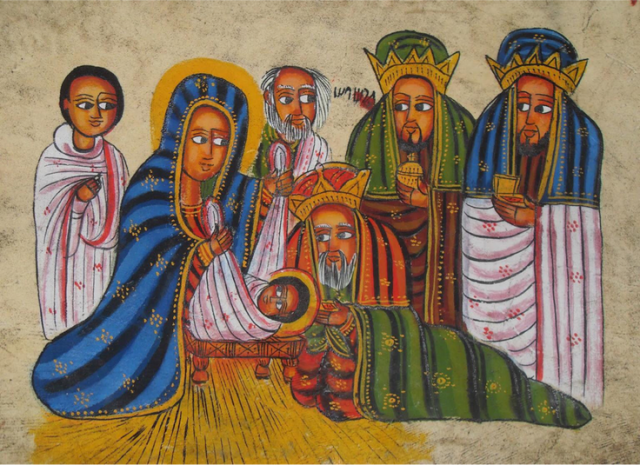
The Three Kings, Ethiopian Orthodox Church

It is a celebration of light – that Christ came to this earth as a child and became like us. Epiphany helps to bring a vision and understanding of God’s glory to all kinds of people in the world.

“Epiphany” literally means “manifestation” or “appearance.” The event most closely associated with this season is the visit of the Magi to Jesus. Included in this time of the year between the seasons of Christmas and Lent is a special emphasis on the teaching and healing ministry of Jesus. 

The people walking in darkness
    have seen a great light;
on those living in the land of deep darkness
    a light has dawned. (Isaiah 9:2; Matthew 4:16, NIV)

The great celebration and focus of these weeks is that salvation is not limited to Israel but extends to the Gentiles, as well.

“I will also make you a light for the Gentiles, that my salvation may reach to the ends of the earth.” (Isaiah 49:6; Luke 2:32; Acts 13:47, NIV)

In this season of Epiphany, the manifestation of God’s grace is one of the most scandalous truths of Christianity: God graces common ordinary people, who seem far from God, with the gift of Jesus. 

God grants repentance that leads to life for all kinds of people, no matter what their race, ethnicity, class, or background. It is a wondrous and astounding spiritual truth that God’s merciful concern is not limited to a certain type of person or a particular group of people.

Grace is (and ought to be) the guiding factor in how we interact with people. 

Losing sight of grace leads to being critical and defensive. Like King Herod of old, a graceless person becomes enamored with earthly power and control. But embracing grace, leads to humility, so that we see the image of God in people very different from ourselves. 

Like the Apostle Peter, who learned in a vision to bring the gospel to non-Jews, old legalisms begin to wear away so that people from all walks of life can have access to Jesus and his gracious saving and healing ministry. 

Grace brings down barriers and causes us to do away with unnecessary distinctions between others. And so, the appropriate response to such a grace is to glorify God for this marvelous and amazing work.

It is a gracious and merciful reality that the Magi, or Wise Men, who were really pagan astrologers, were directed to the Messiah. A light was provided to lead them to Jesus. Apart from God’s care and intervention they would have remained in darkness. 

And it is no less true for people today. This old broken world has a lot of shadowy places to it; there is darkness all around.  All kinds of people have no light at the end of the tunnel of their lives for hope and new life. But the gospel of Jesus Christ brings that light to those walking around with no ability to see. And Jesus exhorted his followers to be the reflectors of divine light for the world.

“Let your light shine before others, that they may see your good deeds and glorify your Father in heaven.”

Jesus (Matthew 5:16, NIV)

Sometimes, maybe oftentimes, the best way to bring resolution to our own troubles and problems is through helping others make sense of their lives through the gracious light of Christ so that they can see an appearance, an epiphany, of what their lives can be in the gracious rule of the kingdom of God. 

As we celebrate Epiphany and journey with Jesus through his earthly upbringing and into his gracious ministry to people, let us keep vigilance to not let our light grow dim. Instead, let us hunger and thirst after Christ’s righteousness so that our joy is full and our light is bright.

God of radiant light, your love illumines our hopes before we know them, and our needs before we ask. Kindle your flame within us, that in our prayers and service, we may know your transforming presence at work in the world around us. All this we ask through Jesus Christ, our Lord. Amen.

Paul the Missionary (Acts 13:1-12)

Elymas the sorcerer is struck blind by Paul, before Sergius Paulus. painting by Raphael (1483-1520)

Now in the church at Antioch there were prophets and teachers: Barnabas, Simeon called Niger, Lucius of Cyrene, Manaen (who had been brought up with Herod the tetrarch) and Saul. While they were worshiping the Lord and fasting, the Holy Spirit said, “Set apart for me Barnabas and Saul for the work to which I have called them.” So after they had fasted and prayed, they placed their hands on them and sent them off.

The two of them, sent on their way by the Holy Spirit, went down to Seleucia and sailed from there to Cyprus. When they arrived at Salamis, they proclaimed the word of God in the Jewish synagogues. John was with them as their helper.

They traveled through the whole island until they came to Paphos. There they met a Jewish sorcerer and false prophet named Bar-Jesus, who was an attendant of the proconsul, Sergius Paulus. The proconsul, an intelligent man, sent for Barnabas and Saul because he wanted to hear the word of God. But Elymas the sorcerer (for that is what his name means) opposed them and tried to turn the proconsul from the faith. Then Saul, who was also called Paul, filled with the Holy Spirit, looked straight at Elymas and said, “You are a child of the devil and an enemy of everything that is right! You are full of all kinds of deceit and trickery. Will you never stop perverting the right ways of the Lord? Now the hand of the Lord is against you. You are going to be blind for a time, not even able to see the light of the sun.”

Immediately mist and darkness came over him, and he groped about, seeking someone to lead him by the hand. When the proconsul saw what had happened, he believed, for he was amazed at the teaching about the Lord. (New International Version)

Most, if not every, follower of Jesus wants to hear the voice of God’s Spirit. Yet, many don’t. Why? Because they have not yet put themselves in a position to listen and learn.

We can only hear if we are attentive. We cannot hear if we are distracted doing other things.

The Antioch Church heard the Holy Spirit speak to them because they deliberately arranged their Christian lives so that they could learn God’s Word and clearly hear God’s voice. Notice what helped them:

  1. A diversity of leaders. The Church purposely had Christians from various backgrounds, races, ethnicities, and cultures, including Barnabas, a Jewish Levite from the island of Cyprus; Simeon, a Black man from sub-Saharan Africa; Lucius, a Roman from North Africa; and Manaen, an upper class Jew from Judea. They knew that the Spirit’s voice was not limited to one particular group of people, and could come to anyone.
  2. Worship and fasting. Together, the prophets and teachers worshipped the Lord and committed themselves to the spiritual practice of fasting. They knew that focusing on God by abstaining from food for a time, and using that time for prayer, would help them be ready to hear and respond to the Spirit.

As a result, the Church heard the Holy Spirit’s instructions for them to send Barnabas and Saul [Paul] as missionaries to the Gentiles. The Christians obeyed God, blessed the team, and sent them off to do their work.

It was the missionaries practice to find the Jewish synagogues wherever they went. There they would proclaim the good news of God’s grace in Jesus Christ as the fulfillment of divine promises to the people. Early on, Barnabas and Paul encountered Elymas, an esoteric individual who had the ear of the Roman authority in Paphos, a city in Cyprus.

Elymas was, frankly, a spiritual pest who kept interfering with Paul’s ministry to the Roman official. Paul, having many gifts of the Spirit, saw exactly who Elymas was – a windbag who deceived and cheated people for his own advantage.

Paul got down to it with Elymas, bluntly informing him that he has finally come up against God himself, and his trickery is over. Paul declared that Elymas was about to go blind for a good long time. And sure enough, the supposed magician was plunged immediately into a shadowy mist; he stumbled around, begging people to take his hand and show him the way.

It was only fitting that a person who promoted dark ways and crooked paths should be subject to that darkness and have to grope around for a time.

When the Roman official saw what happened, he became a believer on the spot, full of enthusiasm over what Barnabas and Paul were saying about Jesus.

So began years of ministry for the Apostle Paul, missionary to the Gentiles. There never seemed to be a dull moment with him around, making gracious waves of good news for those coming to God; and a tsunami of judgment for people, like Elymas, who were stuck in their selfish ways.

Paul, like Jesus, demonstrated his authority over the forces of darkness. He thus proved himself in Christian mission. The conversion experience and the commissioning of Paul became real and complete at the beginning of this missionary journey.

It is from this point on that the former Saul is now consistently referred to as Paul – signifying his change of status as a person who once opposed Christ to one who is dedicated to serving Christ and making him known throughout the Roman Empire.

Years of mature learning, spiritual growth, and discovering Jesus went into Saul’s life before he then became the missionary Paul. Although Paul was an extremely gifted person with a large intellect, he still needed to go through what we all must go through in the Christian life – put the time and effort into spiritual growth and maturity needed within the church, in order to go out and change the world with the good news of Jesus.

Gracious and almighty God, you have given pastors and teachers to equip us to do your work and to build up the church, the Body of Christ. Help us all together to realize unity in the faith, and knowledge of your Son, so that we will be spiritually mature in Christ, in whose name we are bold to pray. Amen.

The Light of the World (John 8:12-19)

Jesus spoke to the Pharisees again. “I am the light of the world,” he said. “Whoever follows me will have the light of life and will never walk in darkness.”

The Pharisees said to him, “Now you are testifying on your own behalf; what you say proves nothing.”

“No,” Jesus answered, “even though I do testify on my own behalf, what I say is true, because I know where I came from and where I am going. You do not know where I came from or where I am going. You make judgments in a purely human way; I pass judgment on no one. But if I were to do so, my judgment would be true, because I am not alone in this; the Father who sent me is with me. It is written in your Law that when two witnesses agree, what they say is true. I testify on my own behalf, and the Father who sent me also testifies on my behalf.”

 “Where is your father?” they asked him.

“You know neither me nor my Father,” Jesus answered. “If you knew me, you would know my Father also.” (Good News Translation)

Light has many uses and a lot of facets to it. The sun’s light gives life; without it we wouldn’t survive. In the form of a fixture or flashlight, it illumines the way so that we can function. The gift of light allows us not to remain in darkness.

The Son, Jesus, is also the Light which gives life. Throughout Holy Scripture, light represents awareness and deliverance; it represents God’s ability to guide us and save us. Jesus helps us find our way in this world.

The Apostle John talked a great deal about light in his Gospel and Epistles:

The Word was the source of life, and this life brought light to people. The light shines in the darkness, and the darkness has never put it out. (John 1:4-5, GNT)

Jesus said, “The light will be among you a little longer. Continue on your way while you have the light, so that the darkness will not come upon you; for the one who walks in the dark does not know where he is going. (John 12:35, GNT)

Now the message that we have heard from his Son and announce is this: God is light, and there is no darkness at all in him. If then, we say that we have fellowship with him, yet at the same time live in the darkness, we are lying both in our words and in our actions. But if we live in the light—just as he is in the light—then we have fellowship with one another, and the blood of Jesus, his Son, purifies us from every sin. (1 John 1:5-7, GNT)

Light is life, and Jesus, as the Light of the World, is eternal life.

As our Light and our Life, Jesus fulfills the prophetic role, as described by the prophet Isaiah:

“I, the Lord, have called you and given you power
    to see that justice is done on earth.
Through you I will make a covenant with all peoples;
    through you I will bring light to the nations.” (Isaiah 42:6, GNT)

As people of the Light, we are to let that light shine in the darkness so that others can also find direction and deliverance:

“You are like light for the whole world. A city built on a hill cannot be hid. No one lights a lamp and puts it under a bowl; instead it is put on the lampstand, where it gives light for everyone in the house. In the same way your light must shine before people, so that they will see the good things you do and praise your Father in heaven.” (Matthew 5:14-16, GNT)

Not everyone, of course, buys into this distinctively Christian way of seeing things – which is why it’s important for all Christians and Churches everywhere to be characterized by the Light and not by the darkness.

Humanity is a strange alchemy of both light and dark, hopefulness and hopelessness, awareness and ignorance, love and hate. We must acknowledge the light, bring it out, let it shine. Hiding the light only gives the dark forces of this world an opportunity to grip people in the shadows of guilt and shame.

Light must be respected. Long exposure to the sun brings a nasty sunburn to the skin. Being drawn to the fire’s light will also get you burnt if you get too close. And some light masquerades as good when it really isn’t.

False apostles lie about their work and disguise themselves to look like real apostles of Christ. Well, no wonder! Even Satan can disguise himself to look like an angel of light! So it is no great thing if his servants disguise themselves to look like servants of righteousness. In the end they will get exactly what their actions deserve. (2 Corinthians 11:13-15, GNT)

The deception typically happens whenever one lacks awareness of their own light, or forgotten, like a misplaced sock under the bed. Then, there’s no means by which to discern the bogus righteousness.

There are many ways of becoming more self-aware and recognizing the light of Christ, such as:

  • Keep a daily journal. Answer for yourself questions like, “What did you do well today?” “What didn’t go so well?” “Why?” and “How will you be and do things differently next time?”

“If I don’t write to empty my mind, I go mad.” Lord Byron (1788-1824)

  • Debrief with others about your experiences. Merely interrogating yourself all the time leads to twisted thinking.

“We do not learn from experience…we learn from reflecting on experience.” John Dewey (1859-1952)

  • Fight evil. Read books. Meditatively read Scripture. Reading not only helps one to become more knowledgeable and well-rounded, but it also builds empathy and emotional intelligence.

“To read without reflecting is like eating without digesting.” Edmund Burke (1729-1797)

  • Practice gratitude. Giving thanks illumines the path. A critical spirit makes others small and limits your own spiritual eyesight. So, be gracious, all the time, every day, no matter what.

“Gratitude, like faith, is a muscle. The more you use it, the stronger it grows.” Alan Cohen

O Lord, your Word is a lamp to our feet and a light to our path. Give us grace to receive your truth in faith and love, and strength to follow on the path you set before us; through Jesus Christ, Amen.