The Light of the World (John 8:12-19)

The Light of the World, by the Jyoti Art Ashram

Again Jesus spoke to them, saying, “I am the light of the world. Whoever follows me will never walk in darkness but will have the light of life.” 

Then the Pharisees said to him, “You are testifying on your own behalf; your testimony is not valid.” 

Jesus answered, “Even if I testify on my own behalf, my testimony is valid because I know where I have come from and where I am going, but you do not know where I come from or where I am going. You judge by human standards; I judge no one. Yet even if I do judge, my judgment is valid, for it is not I alone who judge but I and the Father who sent me. In your law it is written that the testimony of two witnesses is valid. I testify on my own behalf, and the Father who sent me testifies on my behalf.” 

Then they said to him, “Where is your Father?”

Jesus answered, “You know neither me nor my Father. If you knew me, you would know my Father also.” (New Revised Standard Version)

In this season of Christmastide, I am reminded that my own joy over the birth of Jesus as the incarnation of God upon this earth, is not shared by everyone. Where I see good news, there are others who feel threatened. As I bask in glorious light, some prefer to remain in the shadows.

Not everyone, of course, buys into this distinctively Christian way of seeing things – which is why it’s important for all Christians and Churches everywhere to be characterized by the Light and not by the darkness.

Humanity is a strange alchemy of both light and dark, hopefulness and hopelessness, awareness and ignorance, love and hate. We must acknowledge the light, bring it out, and let it shine.

Hiding the light only gives the dark forces of this world an opportunity to hold a sinister and shadowy grip of guilt and shame on the people of this world.

I find that most people want truth and authenticity. They want to discover, know, and be told the truth from a genuine place of care and attention.

There are, however, those few persons who only want what they want, and don’t care much about truth and authenticity, that is, unless they can use it as leverage for their personal agenda.

Jesus Christ, Light of the World, by William Holman Hunt (1827-1910)

One of the reasons I like Jesus so much, is that he lived and spoke truth from a good place, and actually worked to better the human condition in its most awful situation.

It doesn’t take a biblical scholar to see that most of the religious leaders, especially the Pharisees, rejected the words of Jesus. They brought up a legitimate legal issue (after all, they were the experts in the Mosaic law) of Jesus bearing witness to himself. How could Jesus possibly be Messiah without the proper testimony of two or three witnesses to his messiahship?

Put another way, why should anyone believe anything Jesus was saying? What stamp of authenticity is upon his ministry? The Pharisees wanted legal evidence, so they confronted Jesus. Most of all, they wanted to expose him as an illegal.

Christ’s response to the religious leaders was consistent with most all of his responses, whenever he was queried about his authenticity. And those responses rarely made sense to most of the people hearing it – largely because they were jerks to begin with.

What I’m getting at is that whenever our hearts are oriented toward humility, gentleness, empathy, good relations, mercy, and peacemaking, then Jesus makes a whole lot of sense.

But whenever the heart is full of shadows and darkness, the person is then driven by unconscious forces which never consciously understand what in the world Jesus is saying to them.

A well-oriented heart is a gift obtained from God. A disoriented heart and a fragmented mind are the result of arrogant pride and selfish agendas.

Therefore, what Jesus said makes perfect sense when he stated that, because of his divine connection, anything and everything he says and does is true, no matter what the issue is.

The problem with the Pharisees speaking with Jesus is that they were not familiar with the two witnesses which he provided for them. Since they didn’t know the Father, the Father’s witness meant nothing to the religious leaders.

Notice that in the banter between Jesus and the Pharisees, Christ seemed to understand that he was not going to convince the unconvinced.

That’s one of the reasons Christ spoke in parables and answered questions other than what people asked of him. Jesus was not going to waste his time with folks who already had their minds made up.

“Do not give what is holy to dogs, and do not throw your pearls before swine, or they will trample them under foot and turn and maul you.”

Jesus (Matthew 7:6, NRSV)

Jesus wants people to make right judgments, instead of ignoring all of the epistemic knowledge which is available to them. If you desire the real deal, and want the truth, then open yourself to the means of authenticating it.

Why do you see the speck in your neighbor’s eye but do not notice the log in your own eye? Or how can you say to your neighbor, ‘Let me take the speck out of your eye,’ while the log is in your own eye? You hypocrite, first take the log out of your own eye, and then you will see clearly to take the speck out of your neighbor’s eye. (Matthew 7:3-5, NRSV)

It’s hard to see the light whenever there is a problem with your eyesight. Jesus claims to be the Light of the World. In order to test that claim, you’d better first have your eyes examined.

For those with the eyes to see, the Light illumines the way. Trust the Light. Take it where it leads you.

Almighty God, whose Son our Savior Jesus Christ is the light of the world: Grant that your people, illumined by Word and Sacrament, may shine with the radiance of Christ’s glory. May you bless us with the brightness of Christ’s glory! And, may you enable us to keep seeking the light of Christ. Amen.

The Almighty Has Dealt Bitterly with Me (Ruth 1:18-22)

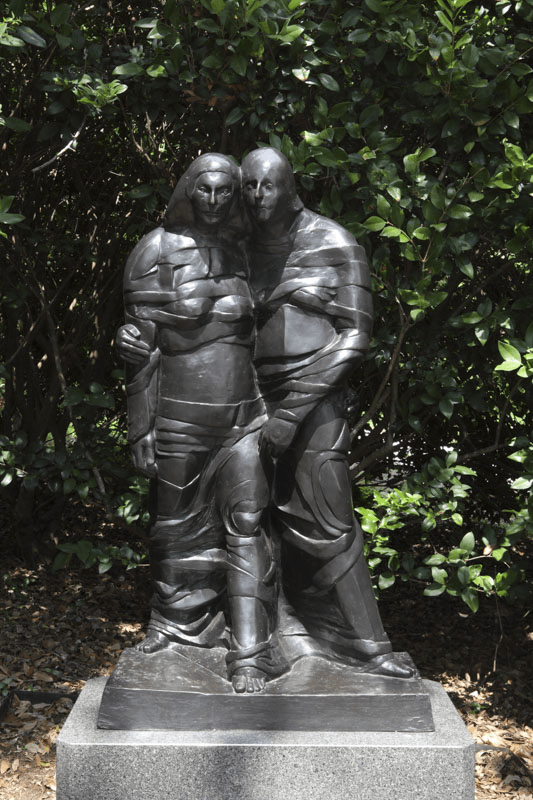
Statue of Ruth and Naomi, by Leonard Baskin (1922-2000)

When Naomi saw that she was determined to go with her, she said no more to her.

So the two of them went on until they came to Bethlehem. When they came to Bethlehem, the whole town was stirred because of them, and the women said, “Is this Naomi?” She said to them,

“Call me no longer Naomi;
    call me Mara,
    for the Almighty has dealt bitterly with me.
I went away full,
    but the Lord has brought me back empty;
why call me Naomi
    when the Lord has dealt harshly with me
    and the Almighty has brought calamity upon me?”

So Naomi returned together with Ruth the Moabite, her daughter-in-law, who came back with her from the country of Moab. They came to Bethlehem at the beginning of the barley harvest. (New Revised Standard Version)

A famine in Judah had brought Naomi and her husband Elimelech to the country of Moab. While there, they had two sons who eventually married two Moabite women: Orpah and Ruth. Over time, each of the husbands died, leaving Naomi and her two daughters-in-law as widows.

Naomi heard that things were finally better in her native Judah. So, she decided to go there, alone. Naomi encouraged her daughters-in-law to remain with their own people and remarry. Orpah did so. Ruth, however, wasn’t having it.

Ruth was determined to stay with her mother-in-law – which meant that she would enter Judah as a foreigner. Despite Naomi’s insistence that Ruth do what is best for herself, Ruth stuck with Naomi.

Once they arrived, the people of Naomi’s hometown were surprised to see the two of them. Naomi was not shy about communicating her bitterness in losing a husband and two sons. She commented that God had turned against her and made her life hard and bitter.

In saying that the Lord had emptied her and brought calamity, Naomi was not speaking against God. Rather, Naomi was expressing some significant theology that has become lost to many modern day Christians around the globe.

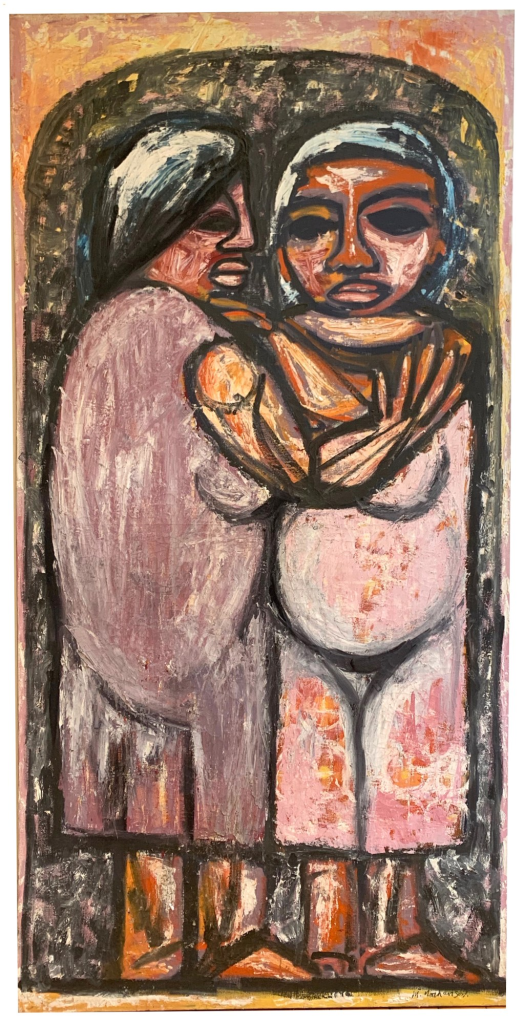
Ruth and Naomi, by Morris Nathanson (1927-2022)

I believe that Ruth was not expressing something malevolent about God, but rather made a statement of faithful recognition, not unlike what Job had to say when he lost his family and his health:

“Naked I came from my mother’s womb, and naked shall I return there; the Lord gave, and the Lord has taken away; blessed be the name of the Lord.” (Job 1:21, NRSV)

No one can escape the dark side of life. Yet, we can deal with that darkness intelligently. It is most necessary to be aware that light creates a shadow that was not there before. The bigger and brighter the light, the bigger and darker the shadow.

There is a centuries old idiom which says, “You can’t have your cake, and eat it, too!” This is a proverbial way of saying that we cannot expect everything to always be good in this life; we must also accept that we cannot always have our way, and that we will go without, experiencing loss.

Whether we want to acknowledge it, or not, an integral part of life is receiving some bad things from God. The Lord does not just go around dispensing everyone’s wishes and making everything a utopia of unicorns and butterflies.

God is most certainly benevolent; yet God also brings darkness to people. We cannot have the Light of the world without experiencing the world’s darkness. Another way of stating this is that a very big God creates quite a large shadow.

In Christianity, the predominant symbol is the cross. The Cross of Christ is both light and dark. Christians may reflexively associate the cross with salvation from sin, while forgetting that the cross is an instrument of torture and death, a tool of execution, like an electric chair.

We must honor the axis crossing at the center of the cross. It is the place of equilibrium, the place of wholeness, where we have the opportunity of integrating all of that unwanted grief and loss into our lives. Failing to do this, let alone neglecting to acknowledge the shadowy places of our hearts, brings harm and hurt to ourselves and to the world.

Naomi acknowledged the shadow. She accepted the darkness, which enabled her to return to her homeland of Judah, the very place where the God of light and dark is worshiped.

I’m not talking about the sort of darkness that is malevolent and mean-spirited, the darkness which comes from Satan. I’m talking about the darkness which weans us away from all things and the ways that hinder us from knowing God.

This is what St. John of the Cross was referring to in naming the dark night of the soul. In our quest to experience union with God, we journey through the darkness, and learn that purification isn’t simply putting something impure away. Purity of heart comes through joining with the God who is pure love itself.

“In the dark night of the soul, bright flows the river of God.”

St. John of the Cross

God loves us so much as to be nailed to a cross and suffer darkness. The Christian is to take up their cross and follow Jesus. That is, we embrace the darkness with an honest engagement of God and God’s world, and through a vulnerable assessment of our own shadow.

For if we fail to acknowledge our shadow, we shall fail to be in union with God.

Not only do many people disown the parts of themselves they don’t like, but they do the same with God – thus making God into their own image of how God should be, instead of taking God as God is.

If you have ears to hear, take this to heart: To accept and honor your own shadow is a profound and necessary spiritual discipline. By “shadow” I mean all of the characteristics of myself that I withhold from others, so that they will only see what I want them to see.

We often put a false self out into the world, for others to see. It is a sort of psychological clothing we wear, much as we have actual clothing. Whether the clothes are real or metaphorical, we dress ourselves in the particular way we want to be seen.

Naomi was a true Israelite, showing her honest true self. There was no separation or division between the inner self and the self she presented to others.

I tend to think that Naomi knew something about God that many don’t know today – and was therefore able to be faithful to both her people and her God.

It is no wonder, then, that Ruth wanted to remain with her mother-in-law Naomi, who was a real person acknowledging the real God.

Almighty God and Father, maker of heaven and earth, of all that is seen and unseen: You are the God of light who illumines our way. And You are the God of darkness who is shadowed in mystery. In knowing You, may I know myself; and in knowing myself, may I more fully know You. Amen.

For the Life of the World (John 6:1-21)

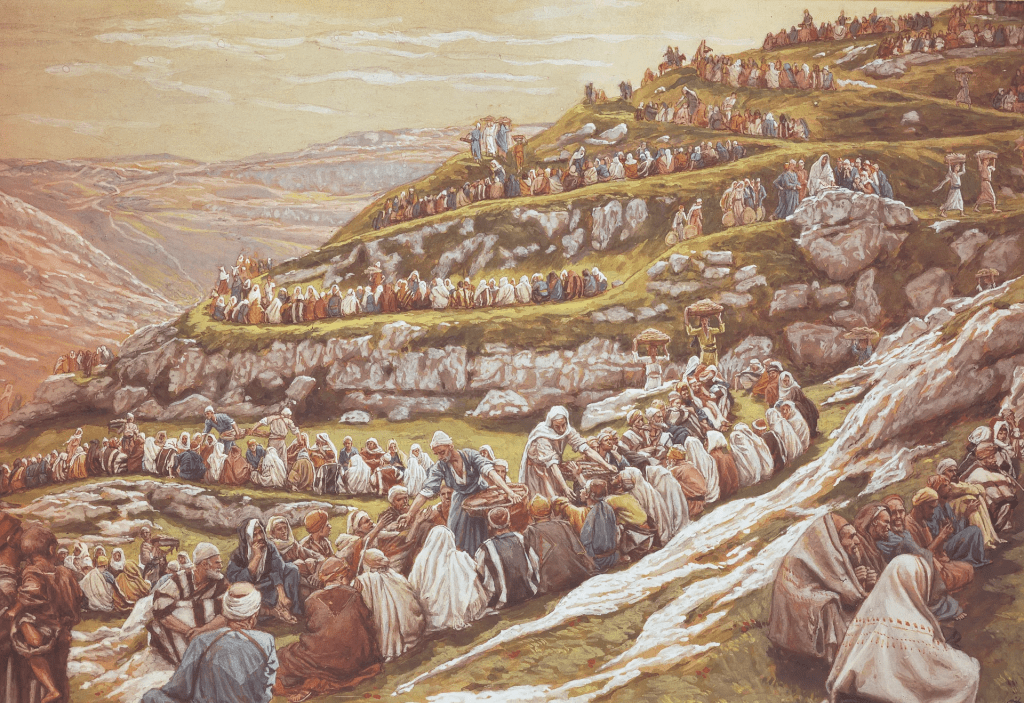
The Miracle of the Loaves and Fishes, by James Tissot, 1886

After this Jesus went to the other side of the Sea of Galilee, also called the Sea of Tiberias. A large crowd kept following him because they saw the signs that he was doing for the sick. Jesus went up the mountain and sat down there with his disciples. 

Now the Passover, the festival of the Jews, was near. When he looked up and saw a large crowd coming toward him, Jesus said to Philip, “Where are we to buy bread for these people to eat?” He said this to test him, for he himself knew what he was going to do. 

Philip answered him, “Two hundred denarii would not buy enough bread for each of them to get a little.” One of his disciples, Andrew, Simon Peter’s brother, said to him, “There is a boy here who has five barley loaves and two fish. But what are they among so many people?” 

Jesus said, “Make the people sit down.” Now there was a great deal of grass in the place, so they sat down, about five thousand in all. Then Jesus took the loaves, and when he had given thanks he distributed them to those who were seated; so also the fish, as much as they wanted. 

When they were satisfied, he told his disciples, “Gather up the fragments left over, so that nothing may be lost.” So they gathered them up, and from the fragments of the five barley loaves, left by those who had eaten, they filled twelve baskets. When the people saw the sign that he had done, they began to say, “This is indeed the prophet who is to come into the world.”

When Jesus realized that they were about to come and take him by force to make him king, he withdrew again to the mountain by himself.

When evening came, his disciples went down to the sea, got into a boat, and started across the sea to Capernaum. It was now dark, and Jesus had not yet come to them. The sea became rough because a strong wind was blowing. When they had rowed about three or four miles, they saw Jesus walking on the sea and coming near the boat, and they were terrified. But he said to them, “It is I; do not be afraid.” Then they wanted to take him into the boat, and immediately the boat reached the land toward which they were going. (New Revised Standard Version)

Christ Walking on the Waters, by Julius Sergius Von Klever, c.1880

The Deliverers Moses and Jesus

The Apostle John intended us to see the link between Moses and Jesus. God used Moses to bring deliverance of the people from slavery through a miracle at the Red Sea. The Lord also used him for a divine provision of manna in the wilderness.

And the Lord Jesus brought about a deliverance of the disciples from anxiety through a miracle on the Sea of Galilee. Christ also brought a divine provision of food in the middle of nowhere for thousands of people.

The miraculous displays by Jesus happened at the time of Passover, the very time that Jews celebrate the deliverance from Egypt. Just as divine power was exerted at the time of Moses in the original Passover, so also divine power likewise showed itself with Jesus in the supply of food and control of the sea.

What’s more, today Christians everywhere around the world remember God’s saving events with the elements of bread and cup, recalling divine deliverance and provision, and finding relief from their fears and anxieties.

A Miraculous Provision and Distribution of Food

It’s no coincidence that Jesus is pictured as sitting on a mountain – reminiscent of Moses on a mountain receiving the divine law and wisdom. The gathering of people around Christ was so great (thousands of them) and the need for food equally as great, that Jesus questioned his disciples concerning resources for such a large crowd.

Christ, of course, could have circumvented his disciples and simply provided the needed foodstuffs without them. Yet, he didn’t, on purpose. Always the rabbi and teacher, Jesus intended to give the disciples a lesson they wouldn’t forget.

After ascertaining that the only food available was a boy’s five barley loaves and two dried fish, Jesus knew that this was plenty, in order to feed up to 5,000 people. It was enough, because Jesus is enough. Only a small amount is needed to fill the bellies of thousands.

Sacramental Living, by Charissa Jaeger-Sanders

And, what is more, for those with the faith to see it, a little communion wafer and a small swallow from a cup is more than enough to satisfy and satiate the hungriest of faithful and penitent people.

Not only did the people eat as much as they needed and wanted, but there was also so much remaining food that the twelve disciples collected twelve baskets of bread. They could keep on ministering, providing, and distributing for people because little is much when God is in it. Long after Christ’s death and resurrection, his followers continued to give with the divine largess from Jesus.

Walking on Water

It had been a full day of teaching and miraculous ministry, in the full light for all to see. Christ’s power, however, is also operative at night. The darkness is not able to subdue continued miracles from Jesus.

For the Apostle John’s writings, darkness is almost always a theological statement, denoting that there are dark forces operative on this earth. And those powers definitely did not like Christ’s effective day of ministry.

The actual physical storm symbolized the chaotic and angry response of the sinister elements in the world. But despite the terrible conditions, Jesus calmly walked on the sea as the new Moses who takes charge of the water.

The disciples abject fear turned on a dime into exuberant joy, as they realized it was indeed Jesus who entered the boat. In addition, they experienced an immediate place of safe harbor.

Christ was standing in the divine tradition of bringing people from stormy circumstances and evil situations to the safe haven of God’s presence.

Jesus saves people from their fears and anxieties, their travails and ills, and their guilt and shame. Christ also provides everything we need, both material and immaterial. And he does it for the life of the world, for everyone who comes by faith.

Gracious Lord, you are the Sustainer of the hungry. Like a mother, you long to feed your children until each is satisfied. Turn our eyes to you alone, so that, aware of our own deepest longings, we will reach out with Christ to feed others with the miracle of your love. Amen.

From Darkness and Death to Light and Life (Acts 20:1-16)

St. Paul Restoring Eutychus to Life, by Taddeo Zuccaro (1529-1566)

When the uproar had ended, Paul sent for the disciples and, after encouraging them, said goodbye and set out for Macedonia. He traveled through that area, speaking many words of encouragement to the people, and finally arrived in Greece, where he stayed three months.

Because some Jews had plotted against him just as he was about to sail for Syria, he decided to go back through Macedonia. He was accompanied by Sopater son of Pyrrhus from Berea, Aristarchus and Secundus from Thessalonica, Gaius from Derbe, Timothy also, and Tychicus and Trophimus from the province of Asia. These men went on ahead and waited for us at Troas. But we sailed from Philippi after the Festival of Unleavened Bread, and five days later joined the others at Troas, where we stayed seven days.

On the first day of the week we came together to break bread. Paul spoke to the people and, because he intended to leave the next day, kept on talking until midnight. There were many lamps in the upstairs room where we were meeting. Seated in a window was a young man named Eutychus, who was sinking into a deep sleep as Paul talked on and on. When he was sound asleep, he fell to the ground from the third story and was picked up dead. 

Paul went down, threw himself on the young man and put his arms around him. “Don’t be alarmed,” he said. “He’s alive!” Then he went upstairs again and broke bread and ate. After talking until daylight, he left. The people took the young man home alive and were greatly comforted.

We went on ahead to the ship and sailed for Assos, where we were going to take Paul aboard. He had made this arrangement because he was going there on foot. When he met us at Assos, we took him aboard and went on to Mitylene. The next day we set sail from there and arrived off Chios. The day after that we crossed over to Samos, and on the following day arrived at Miletus. Paul had decided to sail past Ephesus to avoid spending time in the province of Asia, for he was in a hurry to reach Jerusalem, if possible, by the day of Pentecost. (New International Version)

Paul Raises Eutychus to Life, by Gerard Hoet, 1728

The Apostle Paul was fresh off a riot in the city of Ephesus. Reading through the book of Acts in the New Testament, this almost seems like another day in the office for Paul. Everywhere he went, Paul created a stir – not on purpose – but just for being himself. Much like the Lord Jesus he served, Paul was a guy people either loved or hated.

We pick up Paul’s journey as he was heading to Macedonia. There were several companions who accompanied him, as was usual. The Apostle rarely, if ever, traveled alone; he was always in an entourage and mentoring others in the ways of Christian ministry.

This journey was different than the others. Paul knew what was coming for him. He was beginning a farewell tour, knowing that he would end up back in Judea – which may mean death for him.

One of the reasons there was such a commotion everywhere Paul went was because the Jews continually opposed him. But Paul was not deterred; he was determined to persevere, and especially to encourage the churches he had formed.

While in Troas, Paul met with the believers on a Sunday. Since this was a final message to those gathered, Paul did the longwinded preacher thing by talking until midnight. Apparently, all the young people were sitting in the back (some things never change) and one of them, Eutychus, fell asleep in the window where he was seated, and fell out of the window to the ground.

By the time Paul got to Eutychus, he was pronounced dead. But the Apostle wasn’t having it. He scooped up the young man into his arms and declared that life is still in him. Like the Lord Jesus before him, Paul restored the presumably dead person back to life.

This is the power of resurrection, specifically the spiritual power of Christ’s resurrection: Death doesn’t have the last word.

Paul was speaking at night, which is why there were many lamps lit in the place. Despite the light, Eutychus closed his eyes and succumbed to shutting out the light. He quite literally fell into darkness, and into the place of death.

Yet, it doesn’t take much light to dispel the darkness. A small candle is enough to luminate a way forward. Paul had more than a candle available to him; he had enough to literally light up Eutychus.

And then everybody went back upstairs and Paul did what any preacher worth their salt would do next: He kept preaching.

I’m sure Paul’s everlasting long sermon after that dramatic event with Eutychus centered on the message to “stay awake!” And indeed, that’s exactly what believers in Jesus are to do.

Then Jesus returned to his disciples and found them sleeping. “Simon,” he said to Peter, “are you asleep? Couldn’t you keep watch for one hour? Watch and pray so that you will not fall into temptation. The spirit is willing, but the flesh is weak.” (Mark 14:37-38, NIV)

Paul wanted to sail past the port of Ephesus in order to get to Jerusalem quicker. When he was previously in the city, and established a church of new believers out of their old paganism, he said to them:

For you were once darkness, but now you are light in the Lord. Live as children of light (for the fruit of the light consists in all goodness, righteousness and truth) and find out what pleases the Lord. (Ephesians 5:8-10, NIV)

The Apostle Paul was an intense guy. And that’s a good thing, when it’s channeled in ways of encouraging others, supporting them spiritually, and even raising someone from death.

Fortunately, the intensity of his light can still be seen these two millennia later.

O God, who for our redemption gave your only-begotten Son to the death of the cross, and by his glorious resurrection delivered us from the power of our enemy: Grant us so to die daily to sin, that we may evermore live with him in the joy of his resurrection; through Jesus Christ your Son our Lord, who lives and reigns with you and the Holy Spirit, one God, now and forever. Amen.