Some Needed Encouragement (Revelation 15:1-4)

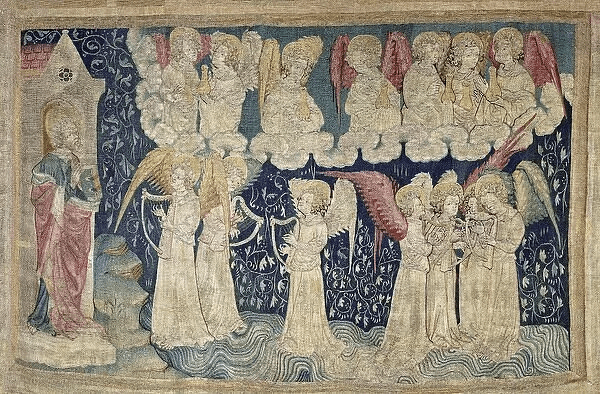
The Seven Last Plagues and the Harps of God, by Nicolas Bataille, c.1380 C.E.

I saw in heaven another great and marvelous sign: seven angels with the seven last plagues—last, because with them God’s wrath is completed. And I saw what looked like a sea of glass glowing with fire and, standing beside the sea, those who had been victorious over the beast and its image and over the number of its name. They held harps given them by God and sang the song of God’s servant Moses and of the Lamb:

“Great and marvelous are your deeds,
    Lord God Almighty.
Just and true are your ways,
    King of the nations.
Who will not fear you, Lord,
    and bring glory to your name?
For you alone are holy.
All nations will come
    and worship before you,
for your righteous acts have been revealed.” (New International Version)

Let’s keep in mind that the book of Revelation (also known as The Apocalypse of John) is a vision of the Apostle John about how things shake out in the end. The purpose of the vision is not for us to get lost in esoteric speculations about the future and try to figure out specific dates and times of God’s judgment.

Rather, John’s Revelation was primarily meant to give believers a future hope that their hardships and suffering will not last forever; there is a time coming, soon, when Judge Jesus will make all things right and all things new. In other words, the vision of John was designed to provide needed encouragement to followers of Jesus.

The believers needed a connection to their spiritual heritage – a way to see that they weren’t an isolated faith island in the middle of the world’s crud. The heavenly beings were singing a song of Moses and of the Lamb (Jesus). The two are connected, thus bringing together the saints of ages past with the struggling Christians of the present.

The song of Moses is a song of triumph, sung after the Israelites passed through the Red Sea unharmed and the Egyptian army was eradicated:

“I will sing to the Lord,
    for he is highly exalted.
Both horse and driver
    he has hurled into the sea.

“The Lord is my strength and my defense;
    he has become my salvation.
He is my God, and I will praise him,
    my father’s God, and I will exalt him.
The Lord is a warrior;
    the Lord is his name.
Pharaoh’s chariots and his army
    he has hurled into the sea.
The best of Pharaoh’s officers
    are drowned in the Red Sea.
The deep waters have covered them;
    they sank to the depths like a stone.
Your right hand, Lord,
    was majestic in power.
Your right hand, Lord,
    shattered the enemy.

Flee From Egypt, by Rev. Albert Lee Wagner, 1975

“In the greatness of your majesty
    you threw down those who opposed you.
You unleashed your burning anger;
    it consumed them like stubble.
By the blast of your nostrils
    the waters piled up.
The surging waters stood up like a wall;
    the deep waters congealed in the heart of the sea.
The enemy boasted,
    ‘I will pursue, I will overtake them.
I will divide the spoils;
    I will gorge myself on them.
I will draw my sword
    and my hand will destroy them.’
But you blew with your breath,
    and the sea covered them.
They sank like lead
    in the mighty waters.
Who among the gods
    is like you, Lord?
Who is like you—
    majestic in holiness,
awesome in glory,
    working wonders?

“You stretch out your right hand,
    and the earth swallows your enemies.
In your unfailing love you will lead
    the people you have redeemed.
In your strength you will guide them
    to your holy dwelling.
The nations will hear and tremble;
    anguish will grip the people of Philistia.
The chiefs of Edom will be terrified,
    the leaders of Moab will be seized with trembling,
the people of Canaan will melt away;
    terror and dread will fall on them.
By the power of your arm
    they will be as still as a stone—
until your people pass by, Lord,
    until the people you bought pass by.
You will bring them in and plant them
    on the mountain of your inheritance—
the place, Lord, you made for your dwelling,
    the sanctuary, Lord, your hands established.

“The Lord reigns
    for ever and ever.” (Exodus 15:1-18, NIV)

Throughout the millennia, this deliverance from harsh slavery to freedom is annually recalled and remembered in the Passover. The original Passover in Egypt involved a lamb being slain and it’s blood applied to the doorposts of each Jewish home. The avenging angel “passed over” those homes and instead dealt with the Egyptian houses which had no lamb’s blood over the door.

The song of Moses and the song of the Lamb (Jesus) are really the same song. Both the deliverance out of Egypt and through the Red Sea, as well as the deliverance from guilt and shame through the cross and resurrection, was real salvation from all that oppressed and hindered the people from living into their true selves.

This connection to salvation history was a great boon to the early believers undergoing their own brand of injustice, oppression, and persecution – just for being followers of Jesus.

So, we all need to apply the death of the Lamb to our present situations, so that we can endure through hardship and not give up and experience a failure of faith. We continually need a strengthening of faith, to recall and remember who we are and to whom we belong, so that we will sing our own song of hope and deliverance.

“Awake and Sing the Song,” by English hymnist William Hammond (1719-1783)

Awake, and sing the song
Of Moses and the Lamb;
Tune every heart and every tongue
To praise the Savior’s name.

Sing of His dying love;
Sing of His rising power;
Sing how He intercedes above
For those whose sins He bore.

Tell, in seraphic strains,
What He has done for you;
How He has taken off your chains
And formed your hearts anew.

His faithfulness proclaim
While life to you is given:
Join hands and hearts to praise His name
Till we all meet in heaven.

Amen.

Victory Celebration (Exodus 15:1-18)

The Songs of Moses and Miriam, by Laura James

Then Moses and the Israelites sang this song to the Lord:

“I will sing to the Lord, for he has triumphed gloriously;
    horse and rider he has thrown into the sea.
The Lord is my strength and my might,
    and he has become my salvation;
this is my God, and I will praise him;
    my father’s God, and I will exalt him.
The Lord is a warrior;
    the Lord is his name.

Pharaoh’s chariots and his army he cast into the sea;
    his elite officers were sunk in the Red Sea.
The floods covered them;
    they went down into the depths like a stone.
Your right hand, O Lord, glorious in power—
    your right hand, O Lord, shattered the enemy.
In the greatness of your majesty you overthrew your adversaries;
    you sent out your fury; it consumed them like stubble.
At the blast of your nostrils the waters piled up;
    the floods stood up in a heap;
    the deeps congealed in the heart of the sea.
The enemy said, ‘I will pursue; I will overtake;
    I will divide the spoil; my desire shall have its fill of them.
    I will draw my sword; my hand shall destroy them.’
You blew with your wind; the sea covered them;
    they sank like lead in the mighty waters.

Who is like you, O Lord, among the gods?
    Who is like you, majestic in holiness,
    awesome in splendor, doing wonders?
You stretched out your right hand;
    the earth swallowed them.

In your steadfast love you led the people whom you redeemed;
    you guided them by your strength to your holy abode.
The peoples heard; they trembled;
    pangs seized the inhabitants of Philistia.
Then the chiefs of Edom were dismayed;
    trembling seized the leaders of Moab;
    all the inhabitants of Canaan melted away.
Terror and dread fell upon them;
    by the might of your arm, they became still as a stone
until your people, O Lord, passed by,
    until the people whom you acquired passed by.
You brought them in and planted them on the mountain of your own possession,
    the place, O Lord, that you made your abode,
    the sanctuary, O Lord, that your hands have established.
The Lord will reign forever and ever.” (New Revised Standard Version)

The ancient Israelites were freed from four hundred years of Egyptian bondage through the miraculous work of God. Then, as they were leaving Egypt, Pharaoh had a change of heart and decided to take his army and pursue the Israelites.

Literally sandwiched between the army and the sea, yet another miracle happened: God parted the Red Sea, allowing the Israelites to pass through on dry ground; and then God closed the sea up on the pursuing army. Today’s Old Testament lesson is the people’s victory chant of deliverance.

Portrayed here is Yahweh’s incomparable power over the mighty Egyptians, and protective presence with the Israelites. God was fulfilling the divine promise to bring the people out from bondage and into the Promised Land. Nothing can stand in the way of the Lord’s purpose.

By Stushie Art

God Rescues

Throughout the Bible, deliverance and celebration go hand in hand. For the Christian, this time of year is full of celebrating the resurrection of Christ from death. Because our redemption is secured, we rejoice in the once for all sacrifice of Jesus.

God rescued us from dead-end alleys and dark dungeons. He’s set us up in the kingdom of the Son he loves so much; the Son who got us out of the pit we were in, got rid of the sins we were doomed to keep repeating. (Colossians 1:13-14, MSG)

God Protects

The Lord showed up and wondrously delivered the Israelites from certain annihilation. And God has also entered into humanity’s world and brought emancipation from sin, death, and hell through Christ’s redemptive events of cross and resurrection. We are shielded by God’s glorious grace and goodness.

Praise be to the God and Father of our Lord Jesus Christ! In his great mercy he has given us new birth into a living hope through the resurrection of Jesus Christ from the dead, and into an inheritance that can never perish, spoil or fade. This inheritance is kept in heaven for you, who through faith are shielded by God’s power until the coming of the salvation that is ready to be revealed in the last time. (1 Peter 1:3-5, NIV)

God Establishes

Deliverance is provided, and then the divine presence is with us throughout life. God doesn’t expect us to be on our own after we are saved from a calamitous situation. Grace is given for all things, not just some things. So, the Lord helps to establish us in faith and perseverance for a lifetime.

His divine power has given us everything needed for life and godliness, through the knowledge of him who called us by his own glory and excellence. Thus he has given us, through these things, his precious and very great promises, so that through them you may escape from the corruption that is in the world because of lust and may become participants of the divine nature…. Therefore I intend to keep on reminding you of these things, though you know them already and are established in the truth that has come to you. (2 Peter 1:3-4, 12, NRSV)

Our victory chant comes from God’s redemptive events. For the Christian, we are rescued from our precarious spiritual plight, protected and established by divine power, through the person and work of Jesus Christ.

“Victory in Jesus” by E.M. Bartlett, 1939

I heard an old, old story
How a Savior came from glory
How He gave His life on Calvary
To save a wretch like me
I heard about His groaning
Of His precious blood’s atoning
Then I repented of my sins
And won the victory

Oh, victory in Jesus, my Savior forever
He sought me and bought me with His redeeming blood
He loved me ‘ere I knew Him and all my love is due Him
He plunged me to victory beneath the cleansing flood

I heard about His healing
Of His cleansing power revealing
How He made the lame to walk again
And caused the blind to see
And then I cried, “Dear Jesus, come and heal my broken spirit”
And somehow Jesus came and brought to me the victory

Victory in Jesus, my Savior forever
He sought me, and He bought me with His redeeming blood
He loved me ‘ere I knew Him and all my love is due Him
He plunged me to victory beneath the cleansing flood

Good Friday (Psalm 22)

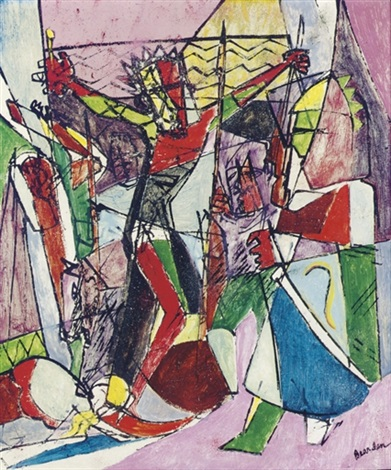
Golgotha – Crucifixion, by Romare Bearden, 1945

My God, my God, why have you forsaken me?
    Why are you so far from helping me, from the words of my groaning?
O my God, I cry by day, but you do not answer;
    and by night but find no rest.

Yet you are holy,
    enthroned on the praises of Israel.
In you our ancestors trusted;
    they trusted, and you delivered them.
To you they cried and were saved;
    in you they trusted and were not put to shame.

But I am a worm and not human,
    scorned by others and despised by the people.
All who see me mock me;
    they sneer at me; they shake their heads;
“Commit your cause to the Lord; let him deliver—
    let him rescue the one in whom he delights!”

Yet it was you who took me from the womb;
    you kept me safe on my mother’s breast.
On you I was cast from my birth,
    and since my mother bore me you have been my God.
Do not be far from me,
    for trouble is near,
    and there is no one to help.

Many bulls encircle me;
    strong bulls of Bashan surround me;
they open wide their mouths at me,
    like a ravening and roaring lion.

I am poured out like water,
    and all my bones are out of joint;
my heart is like wax;
    it is melted within my breast;
my mouth is dried up like a potsherd,
    and my tongue sticks to my jaws;
    you lay me in the dust of death.

For dogs are all around me;
    a company of evildoers encircles me;
they bound my hands and feet.
I can count all my bones.
They stare and gloat over me;
they divide my clothes among themselves,
    and for my clothing they cast lots.

But you, O Lord, do not be far away!
    O my help, come quickly to my aid!
Deliver my soul from the sword,
    my life from the power of the dog!
    Save me from the mouth of the lion!

From the horns of the wild oxen you have rescued me.
I will tell of your name to my brothers and sisters;
    in the midst of the congregation I will praise you:
You who fear the Lord, praise him!
    All you offspring of Jacob, glorify him;
    stand in awe of him, all you offspring of Israel!
For he did not despise or abhor
    the affliction of the afflicted;
he did not hide his face from me
    but heard when I cried to him.

From you comes my praise in the great congregation;
    my vows I will pay before those who fear him.
The poor shall eat and be satisfied;
    those who seek him shall praise the Lord.
    May your hearts live forever!

All the ends of the earth shall remember
    and turn to the Lord,
and all the families of the nations
    shall worship before him.
For dominion belongs to the Lord,
    and he rules over the nations.

To him, indeed, shall all who sleep in the earth bow down;
    before him shall bow all who go down to the dust,
    and I shall live for him.
Posterity will serve him;
    future generations will be told about the Lord
and proclaim his deliverance to a people yet unborn,
    saying that he has done it. (New Revised Standard Version)

Crucifixion, by Romare Bearden, 1947

It’s one thing to be alone because of other’s mocking, yelling, spitting at you, even physically beating you; that, in and of itself, is terribly traumatic. Yet, it’s quite another thing altogether to feel forsaken by one’s God, to experience a deafening divine silence amidst all the human commotion.

There are levels of suffering – and physical suffering is the least of our agony; the experiences of mental, emotional – and I insist, spiritual suffering – is worse than a hundred kidney stones.

“Suffering” is a word many would like to avoid. Simply seeing or hearing the word might make us cringe. Suffering? No thanks. I’ll pass. Yet, something inside us instinctively knows we cannot get around it. Everyone suffers in some way; it’s endemic to the human condition. 

Sometimes, maybe even most times, we are not immediately relieved of suffering because it is meant to have a redemptive purpose to it – that somehow, some way, the awful affliction shall result in eventual blessing to either oneself, another, or perhaps to many.

Miracles are miracles not because they fall from heaven with no connection to what’s happening on this earth. No, miracles occur because of suffering, because something gut-wrenching is happening, because someone or many people are tragically hurt.

Jesus intimately knows suffering, first hand. And he knows what suffering can produce: the deliverance of many.

For Christians everywhere, today is “Good” not because of the pain experienced but because the crucifixion of Jesus Christ means the redemption of the world.

On this Good Friday, followers of Jesus remember and commemorate the events that led up to the cross; unpack those events and interpret them with profound meaning and significance; and worship Jesus with heartfelt gratitude because of the redeeming work of the cross.

It is today that Christians remember the last words of Christ, and recognize the significant impact his death had on the immediate persons around him. Believers also contemplate the lasting results of that singular death as an atoning sacrifice; perfect love; reconciliation between God and humanity; victory over evil; and the redemption of all creation.

For believers, there’s the recognition that something deeply impactful is happening in the egregious suffering of Jesus. Therefore, we acknowledge and remember the anguish of Christ; and also what that horrible torment accomplished.

With such profound meaning, one would think that Good Friday is a hugely observed day for all Christians in every tradition. Yet, for a chunk of churches and Christians, it is not. The cross is not a popular subject. It could be because neither Christian nor non-Christian wants to ponder something so tragically bloody and sad.

“Religious people want visionary experiences and spiritual uplift; secular people want proofs, arguments, demonstrations, philosophy, and science. The striking fact is that neither one of these groups wants to hear about the cross.” 

Fleming Rutledge, The Crucifixion: Understanding the Death of Christ

Indeed, as the Apostle Paul has said, the cross of Christ is “a stumbling block to Jews and folly to Gentiles.” (1 Corinthians 1:23)

A personalized religion which leaves the cross out of the picture (too much violence and sacrifice) might seem appealing, yet will only leave us bereft of the communion of the saints both past and present. Consider the confessional witness of the Church:

Christ suffered “in both body and soul – in such a way that when he sensed the horrible punishment required by our sins ‘his sweat became like great drops of blood falling down on the ground.’ He cried, ‘My God, my God, why have you forsaken me?’ And he endured all this for the forgiveness of our sins. Therefore, we rightly say with the Apostle Paul that we know nothing ‘except Jesus Christ, and him crucified;’ we ‘regard everything as loss because of the surpassing value of knowing Christ Jesus our Lord.’ We find all comforts in his wounds and have no need to seek or invent any other means than this one and only sacrifice, once made, which renders believers perfect forever.”

Belgic Confession, Article 21

And let us consider further the New Testament witness:

“Jesus suffered outside the gate in order to sanctify the people through his own blood. Therefore, let us go forth to him outside the camp, and bear the abuse he endured.” (Hebrews 13:12-13, NIV)

“May I never boast of anything except the cross of our Lord Jesus Christ, by which the world has been crucified to me, and I to the world.” (Galatians 6:14, NRSV)

The extent of Good Friday goes far beyond a day on the calendar; it is the fulcrum upon which all of Christianity hinges.

Because Christ suffered, our suffering has meaning. Each situation of trauma; every case of disease; all suffering, abuse, and hardship makes sense, in the Christian tradition, when they are viewed in solidarity with the cross of Jesus Christ.

So, today, let Christians everywhere contemplate the cross, observe the salvation accomplished through Christ’s death, and offer prayers and petitions for those who need deliverance from the power of evil.

A Call for Unity (1 Corinthians 10:1-4)

For I do not want you to be ignorant of the fact, brothers and sisters, that our ancestors were all under the cloud and that they all passed through the sea. They were all baptized into Moses in the cloud and in the sea. They all ate the same spiritual food and drank the same spiritual drink; for they drank from the spiritual rock that accompanied them, and that rock was Christ. (New International Version)

We are all on spaceship earth together. Everyone has the similar experiences of birth, life, death, and the joys and sorrows of it all.

But what we don’t all share is our individual responses to all those events. Some folks do better than others with the ups and downs of life in this world.

So there are two pledges that are most helpful to make to God and to each other, especially when it comes to Christ’s Church:

  1. I will be a unifying person.
  2. I will not make everything about my personal preferences.

Christians need to get along and work together; and that cannot happen if all we want is what we want. 

“Love one another. As I have loved you, so you must love one another. By this everyone will know that you are my disciples if you love one another.” Jesus (John 13:34-35, NIV) 

Unity, forgiveness, reconciliation, love, and communicating the gospel message of forgiveness happens by people being gracious to each other so that a watching world can see the validity of Christ within us.

Followers of Jesus have a responsibility to be a source of unity, not division. 

Make every effort to keep the unity of the Spirit through the bond of peace. There is one body and one Spirit, just as you were called to one hope when you were called; one Lord, one faith, one baptism; one God and Father of all, who is over all and through all and in all. (Ephesians 4:3-6, NIV) 

Unity doesn’t merely happen; it must be pursued and be a common value of all. 

As God’s chosen people, holy and dearly loved, clothe yourselves with compassion, kindness, humility, gentleness and patience. Bear with each other and forgive one another if any of you has a grievance against someone. Forgive as the Lord forgave you. And over all these virtues put on love, which binds them all together in perfect unity. (Colossians 3:12-14, NIV) 

We are to be like-minded, having the same love for one another that we have for Jesus, being united in spirit and purpose. 

Do nothing out of selfish ambition or vain conceit. Rather, in humility value others above yourselves, not looking to your own interests but each of you to the interests of the others. (Philippians 2:3-4, NIV) 

The specific problem in the Corinthian Church was their allegiance to different individuals; each person and clique had their favorite preacher. And they grouped themselves around how that particular pastor taught and ministered. 

The situation was a classic case of church folk saying to each other, “That’s not how so-and-so did it!” But that approach of following pet preachers ends up in division – the focus becomes on the methods of ministry rather than the substance of the ministry itself. 

Christians must keep in mind that the heart of all Christian ministry is the cross of Christ that saves us from our pettiness and transforms us into forgiven people who spread forgiveness and healing. Therefore, our primary loyalty is to Christ and the message of the cross, and not to particular personalities or programs.

The sin of the Corinthians was misguided loyalties; and the answer to wrong priorities is to have Jesus and the cross as our central and guiding allegiance. 

The Corinthian believers were emotionally tied to the leader who baptized them and who was a significant force for good in their lives. Its more than understandable to have a special relationship with someone who was there for you. However, what’s not okay is following that person as if they’re Jesus himself, and then insisting that everything be done the way my favorite does it. 

Christian unity means to agree with one another about the good news of Christ, and let everything else be a matter of lesser importance. Can you live with that?

A sobering reality is this: Not everyone in every church is there to follow Jesus. And as long as that’s a reality, there will be schisms, factions, cliques, divisions and disunity. The visible church always has a mix of righteous and unrighteous people within it, concerned more about power politics than humbly following Jesus and spreading the gospel. 

At the same time, yet another reality is that the church has taken unity and purity seriously throughout its history and sought to preserve the collective integrity of its fellowship. Sin was discerned as the community’s responsibility to address. It’s only been in the past 300 years that sin has been viewed as something which is only a matter between the individual and God. 

In the early centuries of the Church, believers desiring to repent of their sins would typically spend a period of time fasting and praying, then appearing before the entire church to make a public confession. 

Don’t freak out. I’m not necessarily endorsing that method for us, but nevertheless, the message remains essential: Agree with one another, make peace, and bring spiritual healing to all. The power of Christianity is in the blood of Jesus to forgive sins, and not by trying to ensure things get done, the way we think they ought to get done, in the way our favorite people do them.

Maybe you recognize or can relate to some of these common behavior patterns in many churches:

  1. Worship wars. One or more factions in the church want the music and the liturgy just the way they like it. Any deviation is met with anger and complaining.
  2. Preservation of the church building as of the highest priority (above spiritual growth and maturity).
  3. Protection of programs and ministries held in such high regard that, even if they are not effective, the church keeps doing them.
  4. Attitudes of entitlement. A sense of deserving special treatment and attention.
  5. Concerns about changing things, and yet, no real concern about changing lives.
  6. Apathy and avarice. A lack of motivation and energy to build relationships with outsiders and share the gospel; and hoarding spiritual resources for the insiders.

There is to be unity around the things most important to God. 

Christian unity isn’t about keeping everyone happy; it’s about the good news of Jesus and being anchored to the Rock of our salvation, Christ. All the practical and important stuff of human life must be shaped and governed by the cross of Jesus, because that’s where God’s power saved the world, and where hope is found. 

Lord Jesus, you prayed that we might all be one. We pray for the unity of Christians everywhere, according to your will and your methods. May your Spirit enable us to experience the suffering caused by division, to see our sin for what it is, and to hope beyond all hope. Amen.