Life (Genesis 1:20-2:4a)

The Creation of Heaven and Earth, by Unknown artist, c.18th century

God said, “Let the waters swarm with living things, and let birds fly above the earth up in the dome of the sky.” God created the great sea animals and all the tiny living things that swarm in the waters, each according to its kind, and all the winged birds, each according to its kind. God saw how good it was. Then God blessed them: “Be fertile and multiply and fill the waters in the seas, and let the birds multiply on the earth.”

There was evening and there was morning: the fifth day.

God said, “Let the earth produce every kind of living thing: livestock, crawling things, and wildlife.” And that’s what happened. God made every kind of wildlife, every kind of livestock, and every kind of creature that crawls on the ground. God saw how good it was. Then God said, “Let us make humanity in our image to resemble us so that they may take charge of the fish of the sea, the birds in the sky, the livestock, all the earth, and all the crawling things on earth.”

God created humanity in God’s own image,
        in the divine image God created them,
            male and female God created them.

God blessed them and said to them, “Be fertile and multiply; fill the earth and master it. Take charge of the fish of the sea, the birds in the sky, and everything crawling on the ground.” Then God said, “I now give to you all the plants on the earth that yield seeds and all the trees whose fruit produces its seeds within it. These will be your food. To all wildlife, to all the birds in the sky, and to everything crawling on the ground—to everything that breathes—I give all the green grasses for food.” And that’s what happened. God saw everything he had made; it was supremely good.

There was evening and there was morning: the sixth day.

The heavens and the earth and all who live in them were completed. On the sixth day God completed all the work that he had done, and on the seventh day God rested from all the work that he had done. God blessed the seventh day and made it holy, because on it God rested from all the work of creation. This is the account of the heavens and the earth when they were created. (Common English Bible)
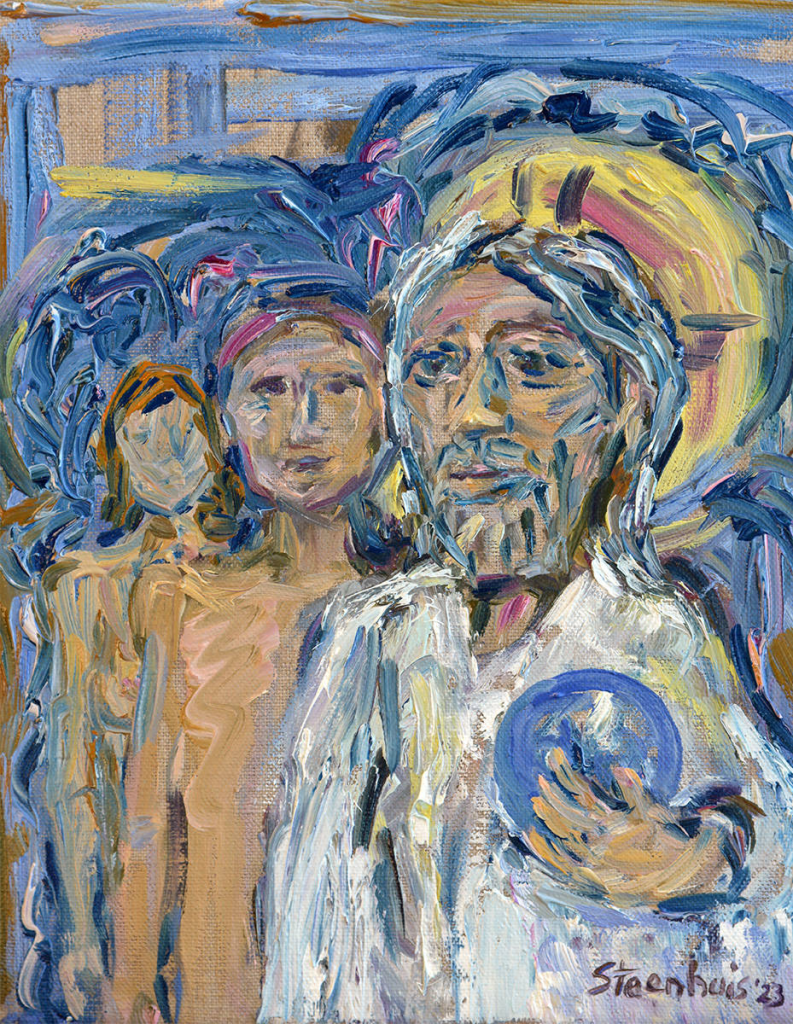
God Created Man in His Image – Male and Female, by Jill Steenhuis

In this Christian season of Eastertide, believers remember and celebrate new life in Jesus Christ. In today’s Old Testament lesson, the lectionary reminds us of original life – when God created the heavens and the earth.

The Beginning of Life

This was the beginning, before there were any words like sin, disobedience, guilt, and shame. This was the time when the original people, Adam and Eve, knew nothing about trying to chase after unconditional love. They had no concept of estrangement or heartache. Everything was fresh and alive and shiny. Disappointment, hurt, and sadness were unknown to them. Everywhere, the earth was teeming with abundant life.

God made it all; and all that was created was very good, supremely reflecting the goodness of the Creator. Life existed everywhere. The predictable and consistent rhythms of the universe were in place. Day and night, work and rest, creation and care, were all woven into the fabric of the world’s sights and seasons. The possibilities for growth were incredible. Life was indeed good.

“New” was simply part of all there was. Without any want or need, every day was an adventure of discovering all the newness which existed.

The Complicated Life

We all, however, know that it did not remain this way. People are now all too familiar with the myriad ways of injustice, and with the film of sin that covers the entire world like a noxious pollutant. And it is this situation, of course, which created the need for a “new” life, because the present life had become a moldy old leftover in the refrigerator of a life that doesn’t keep anything cold nor fresh.

People were created as good human beings. Even though sin has profoundly touched everything in creation, goodness is still within us as God’s image-bearers. The later introduction of human sin into the world in no way whatsoever removes the inherent stamp of the divine image upon us.

Humanity is the only creature who bears this likeness to God. We are related to the animal world, having been created on the same day, and sharing the same blessings of life. Yet, people are distinctive, set above all other creatures.

The Responsible Life

This is why people are given dominion over all other creatures. This is not a claim to privilege; it is, however, very much a claim to responsibility. People have been tasked with being faithful stewards of creation, entrusted with caring for other creatures and the created order.

And humanity was created as both male and female, together expressing the will and character of God in creation as they tend to it and care for it. Together with God, we are relational beings, and not just a race of individuals inhabiting the same earth.

God is a social being, existing as a community within the Godhead. Therefore, to exist as an image-bearer of God means that people are social creatures who need community – with both God and other people.

After God did all the work of creating the world with all its plants and animals and birds and fishes and people, God “rested.” This is why the seventh day is set aside as sacred; its different than the other days, sort of like how people are similar but different from the other creation.

God is clearly separated from the work and the creation itself, that is, God is transcendent and above all things as the Creator. The world is good, but the world is not divine. In the same way, by observing a day of rest, humanity recognizes and affirms and remembers that the work they have done is not divine.

Our human works, good as they may be, are not a thing to be worshiped or equated with God. Therefore, the Sabbath both celebrates the creation and the created order of things, as well as separates us from the idol worship of our hands.

To live into our inherent image of God means that we will work hard and tend to the gardens that are around us. Yet, at the same time, we will understand that in doing our responsible tasks, people are to live in community and love one another, without idolizing any other part of creation or what we creatively build with our own two hands. That is for God alone, who is distinct from all that God has created.

God our Father, you created the world and sent your own Son to live among us, made of the same stuff, breathing the same air, marveling at sunrise and sunset just as we do. Help us to participate in the life around and within us as your life, as you living in us and we living in you and in each other.

God of love and life, restore us to your peace, renew us through your power and teach us to love all that you have created and to care for the earth as your gift and our home. Amen.


God’s Glory Is Everywhere (Psalm 19)

The heavens declare the glory of God,
and the sky displays what his hands have made.
One day tells a story to the next.
One night shares knowledge with the next
without talking,
without words,
without their voices being heard.
Yet, their sound has gone out into the entire world,
their message to the ends of the earth.
He has set up a tent in the heavens for the sun,
which comes out of its chamber like a bridegroom.
Like a champion, it is eager to run its course.
It rises from one end of the heavens.
It circles around to the other.
Nothing is hidden from its heat.

The teachings of the Lord are perfect.
They renew the soul.
The testimony of the Lord is dependable.
It makes gullible people wise.
The instructions of the Lord are correct.
They make the heart rejoice.
The command of the Lord is radiant.
It makes the eyes shine.
The fear of the Lord is pure.
It endures forever.
The decisions of the Lord are true.
They are completely fair.
They are more desirable than gold, even the finest gold.
They are sweeter than honey, even the drippings from a honeycomb.
As your servant I am warned by them.
There is a great reward in following them.

Who can notice every mistake?
Forgive my hidden faults.
Keep me from sinning.
Do not let anyone gain control over me.
Then I will be blameless,
and I will be free from any great offense.

May the words from my mouth and the thoughts from my heart
be acceptable to you, O Lord, my rock and my defender. (God’s Word Translation)

Today’s psalm is a celebration of God’s self-revelation. Through both nature and law, the Lord has graciously made the divine life known to humanity. What’s more, God’s moral and ethical teachings provide insight for living a good life. All of this is for the common good of everyone.

The vision of the psalm is of a personal God, not an abstract deity who is aloof from creation. Through both land and law, there is the Lord of life, desiring humanity to know the divinity which infuses it all and has people’s best interests continually at the forefront of providence and goodwill.

The created world witnesses to God. Creation manifests the glory of its Creator. Each creature and every created thing have the capacity to acknowledge and declare their Originator. That which has no mouth can speak. Those with no vocal cords have a voice. We can hear them, that is, if our ears are open to listen.

The creation is not God. Yet the created world and order knows the Lord so intimately that it sometimes seems as if the sun, the trees, the mountains, and the meadows are divine. The divine stamp is there, testifying with mysterious unspoken words to a glorious God who desires to be known.

So, the Lord graciously gave us law. God’s righteous and good law flows seamlessly from God’s good character. Law is the divine medium for humanity, a guide for human life toward thriving and flourishing on God’s good earth.

We were put on this planet with instructions on how to get along on it. It is when we throw out the rulebook and improvise that we tend to get into all kinds of trouble.

Yet, even when we go our own way and dig our own grave, and end up falling into it, God is there. Grace is available for the asking, redeeming the wayward life.

Deliverance is a real possibility, to set us aright again, and restore us to our full luster as people created in the image of God. Law and land converge to guide us into grateful living, into the wisdom of dealing rightly in all things.

Wisdom in the Old Testament is the combination of knowledge and practice. It is the application of God’s self-revelation to concrete situations in life. We live wisely when we get to know the sovereign God of creation and use the Lord’s revealed mores and ethos as our guide in daily experiences.

We need God’s gracious revealed law. It’s not just for theology nerds or spiritual eggheads; God’s law is for everyone – the learned and the unlearned. Every one of us needs the guidance and direction of God’s Holy Word, and the careful application of it to all our circumstances. That’s wisdom.

You and I are shaped and formed as godly people as we allow God’s Word to awash us and seep into our souls.  Reading this psalm out loud slowly and contemplatively more than once is an opportunity to let our common ordinary experiences transform into divine appointments.

God’s glory is everywhere. We just need the deep spirituality given to us to help us see divine glory in all the myriad ways it comes to us every day.

Clean the slate, God, so we can start the day fresh! Keep me from stupid and idiotic sins, from thinking I can take over your work. Then I can start each day sun-washed, scrubbed clean of sin’s awful grime. Let me not be found in the dominion of darkness but bask in the glorious light of your glory. Accept both my words and my life when I place them on the morning altar, O God, my Rock, my Deliverer, my Redeemer, my All. Amen.

Known by God (Psalm 139:13-18)

You are the one
who put me together
    inside my mother’s body,
and I praise you because of
the wonderful way
    you created me.
Everything you do is marvelous!
    Of this I have no doubt.

Nothing about me
    is hidden from you!
I was secretly woven together
    out of human sight,
but with your own eyes you saw
    my body being formed.
Even before I was born,
you had written in your book
    everything about me.

Your thoughts are far beyond
    my understanding,
much more than I
    could ever imagine.
I try to count your thoughts,
but they outnumber the grains
    of sand on the beach.
And when I awake,
    I will find you nearby. (Contemporary English Version)

We don’t really know God, as much as we are known by God.

And God knows us intimately, down to each individual chromosome in our DNA strand.

For me, the incredible thing about this very detailed knowledge about each one of us is that God still wants to discover even more about us, as well as to be known by us.

Yes, the cosmic Ruler of the universe wants to share in a relationship with you and me – to be known and to know – and delights in the whole process of perceiving us.

Perhaps this is why my highest aspiration in life is to know Christ better. This has been true of me throughout the entirety of my Christian life across the decades. Which is why one of my favorite places in the Bible (which, by the way, is God’s self-revealing knowledge of the divine nature) is from a fellow believer who aims for the same thing:

“Nothing is as wonderful as knowing Christ Jesus my Lord. I have given up everything else and count it all as garbage. All I want is Christ and to know that I belong to him…. All I want is to know Christ and the power that raised him to life. I want to suffer and die as he did, so that somehow I also may be raised to life.” (Philippians 3:8-11, CEV)

This sort of knowing is much more than intellectual understanding or cerebral information; it’s an experiential knowledge that requires the dialogue and interaction of a lived relationship with another. Love is the glue which bonds this kind of reciprocal knowing of two persons. Sheer learning, without love – which fuels relational discovery – is counterproductive.

“All of us know something…. But knowledge makes us proud of ourselves, while love makes us helpful to others. In fact, people who think they know so much don’t know anything at all. But God has no doubts about who loves him.” (1 Corinthians 8:1-3, CEV)

What we know about ourselves is weird and conflicting. Many of us know we are good persons doing good work in the world. And yet, we also know many of the dark places in our hearts, and this knowledge is a source of shame to us.

This was also true of the psalmist. He knew that he was a bundle of contradictions within a single person. However, he was willing to be vulnerable before God, knowing that the Lord sees him completely for who he is – including all of those shadowy places within.

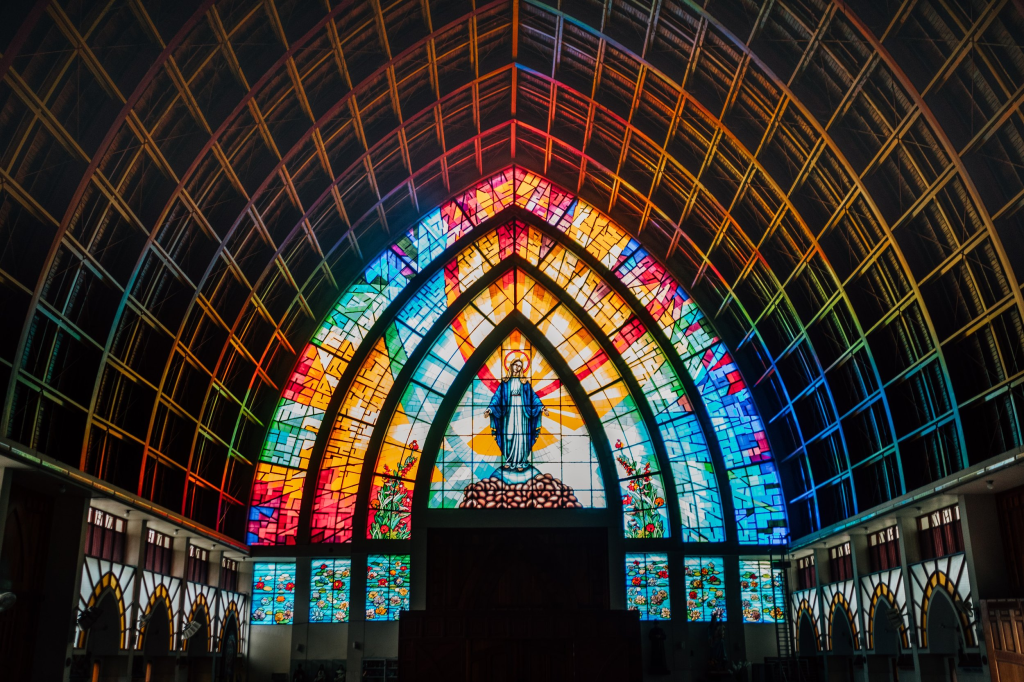
Immaculate Conception Cathedral in Pucallpa, Peru

In fact, God does some of the best divine work in the dark. A masterful weaving of your body and soul was done in the deepest part of your mother’s physical self. Life truly is a hand crafted one-of-a-kind gift, given to us by God.

There are, of course, parts of us we really like – and parts of us we don’t like and maybe even despise – which may cause us to question the goodness and/or care of God by the way we were formed. It’s easy to fixate on what’s wrong, as if we have the right to a particular body. Yet, none of us are owed anything from the Creator.

But, my friend, I ask, “Who do you think you are to question God? Does the clay have the right to ask the potter why he shaped it the way he did? Doesn’t a potter have the right to make a fancy bowl and a plain bowl out of the same lump of clay?” (Romans 9:20-21, CEV)

Today’s psalm suggests to us that each individual human person, you and me, are God’s best work of art. There is no beauty quite like that designed and made by God. Beauty takes our breath away and elicits awe and wonder from us. We are made in the image and likeness of a beautiful God – so beautiful that if we were to actually see God, the sheer beauty would undo us.

God even treasures us at our worst. Although spiritual growth and development is a lifetime project, we don’t engage in it in order for God to take notice and accept us. It isn’t a self-improvement plan. Rather, our spiritual growth is to help us be in a position to know Christ better – just as flower opens to the sun for energy. God delights in spiritually forming us, as well as the creative process in physically making us.

The Lord’s thoughts of us are continual. God is immanently near and close to us. And this is the bedrock foundation of our faith – that we are known by a good God who cares about every hair on our head, or in my case, every molecule of my being.

The psalmist’s God is a God worth getting to know. This is a God who is with us when we fall asleep at night, and who is there when we awake, having kept watch over us throughout the dark after-hours. “I am awake. I’m still with you!” says the Lord as we are greeted for each new day.

So, may you truly know this God who knows you deeply and intimately.

May you come to know and love yourself, just as you are known and loved by God.

And may the grace of Jesus Christ, the love of God the Father, and the abiding encouragement of the Holy Spirit be with you, now and forever. Amen.

The Who, What, When, Why, Where, and How of Praise (Psalm 148)

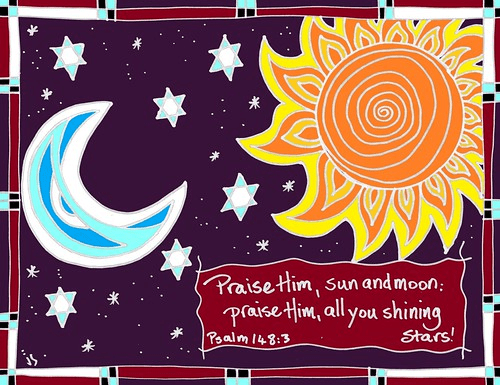
By Stushie Art

Praise the Lord!
Praise the Lord from the heavens;
    praise him in the heights!
Praise him, all his angels;
    praise him, all his host!

Praise him, sun and moon;
    praise him, all you shining stars!
Praise him, you highest heavens
    and you waters above the heavens!

Let them praise the name of the Lord,
    for he commanded, and they were created.
He established them forever and ever;
    he fixed their bounds, which cannot be passed.

Praise the Lord from the earth,
    you sea monsters and all deeps,
fire and hail, snow and frost,
    stormy wind fulfilling his command!

Mountains and all hills,
    fruit trees and all cedars!
Wild animals and all cattle,
    creeping things and flying birds!

Kings of the earth and all peoples,
    princes and all rulers of the earth!
Young men and women alike,
    old and young together!

Let them praise the name of the Lord,
    for his name alone is exalted;
    his glory is above earth and heaven.
He has raised up a horn for his people,
    praise for all his faithful,
    for the people of Israel who are close to him.
Praise the Lord! (New Revised Standard Version)

By Stushie Art

Everything in all creation points to a Creator who cares for us. The 12 days of Christmas (December 25–January 5) are a great celebration. King Jesus has come; he is the rightful Sovereign over all creation. Believers recognize Christ’s incarnation – affirming the identity of Jesus as both full human and fully divine. 

Worshipers praise the Lord. It’s in our spiritual DNA to give adoration, praise, and honor to God. Today’s Psalm is not only meant for good times; it’s also for the despondent, difficult, and downright hard times. There’s always an open season on praising the Lord, no matter what’s going on in and around us. 

Psalm 148 helps to re-orient us around praise to God, instead of remaining stuck in being disoriented.  Whether in good times or bad, we praise the Lord. 

Who should praise the Lord?

Everyone. Everything. 

God has created and continues to impact every nook and cranny of creation. Therefore, the entire universe – every creature and all humanity – acknowledge the Lord with praise. 

The outer reaches of the universe, on everything out there which we cannot even see, praise the Lord. 

The earth and everything in it praise the Lord. 

The forces of nature praise the Lord. 

The landscape, the flora and fauna, animals and humans, together with all creation, praise the Lord. 

Young people, old people, men and women – no matter who they are or where they come from – praise the Lord. 

The proper purpose of everything and everyone that exists is giving adoration and praise to God.

In the Ancient Near East, the sun, moon, and stars were considered gods by the various people groups. This Psalm was, therefore, more than a summons to praise – this was a call to recognize the One true God as the sovereign and the rightful ruler of all. Thus, the ancient peoples understood this psalm as a claim that their gods must bow to Israel’s God.

What is praise to the Lord?

Praise to the Lord is a recognition that God deserves praise from everyone and everything. Praise is physical posture and a heart stance of bowing, yielding, and submitting to God. “Praise the Lord” in the Hebrew language is “hallelujah.” And “hallelujah literally means “to raise the hands.”

We are told 10 times in the 14 verses of Psalm 148 to praise the Lord, that is, to raise our hands. It’s a symbol of submission and joy. To have open hands lifted toward heaven conveys our obedience and commitment to God. 

When do we praise the Lord?

Praising the Lord and lifting the hands, is not only to occur in church or worship setting; praise happens everywhere.

We lift our arms in reverent submission at our workplaces when we land a client or have a good day; and when cranky and critical people demean us. Praising the Lord isn’t limited to good circumstances.

We raise our hands and praise the Lord when our neighbors care about us and look out for us, as well as when they make noise and irritate us with their less than kept up yards and houses. Yielding to God’s purposes for our lives is not dependent upon whether we have good neighbors or not. 

We praise the Lord and raise our hands when our marriages are life-giving and thriving, as well as when our relationship with our spouse is dry, dull, and going nowhere. It’s always open season on praising the Lord and reflecting his image through love. 

By Stushie Art

We praise the Lord for our kids, not only when they do what’s right; but also when they’re complete stinkers and drive us nuts. We are to use our hands for praise and enact obedience, and not for violence through finger pointing or physical punishment.

In adversity, we praise the Lord because it gives us a chance to put our faith into action. In times when someone is being insensitive and callous, it provides the opportunity to praise the Lord and love them because God loves us.

At all times, in all places, in every circumstance, and with each situation we raise our hands in hallelujah to Jesus for saving us from our misguided ways and bringing us back into fellowship with God. 

Lift your hands, always! And when, like Moses, we can no longer lift them, let others help hold them up we so that we can keep praising God. (Exodus 17:11-12)

Why praise the Lord?

Because God created everything and everyone. 

The Lord designed every living thing and fashioned a man and a woman in the divine image as the pinnacle of creative work. 

Adam and Eve walked with God and had perfect praise of the Lord and fellowship with each other. Yet, tragedy happened. The people God formed were deceived into thinking that the Lord was holding out on them by not letting them eat from a certain tree in the garden. So, they disobeyed, ate the fruit, and so plunged the world into darkness.

However, God did not turn away from humanity. Holy Scripture is the revelation of a God who goes out of the way to do whatever it takes to reclaim people back to fellowship so that they can fulfill their original design to praise the Lord. 

The height of God’s love is sending the Son, the Lord Jesus. God became one of us so that he could save us from ourselves. 

Whenever we have exhausted all the avenues this world has to offer in bringing fulfillment, satisfaction, and peace to our lives – there stands Jesus, crucified, risen, ascended, and waiting with open arms for you and me to lift our hands and see that he has the only way for us to live. 

The reason you have felt for so long that you are a square peg in a round hole is that your life is meant to praise the Lord. You are not meant to fit into the world; you are meant for God.

Where do we praise the Lord?

From the heavens and the earth. From everywhere in all creation, and from everyone as creatures, there is to be praise to the Lord.

Humanity is one part of a big grand chorus of praise that arises from all creation. Some of the psalmist’s pairings of praise are quite informative. 

The sun that praises God during the daytime and the moon that offers its praise at night, reminds us that God’s praise is never silenced. 

The highest heavens and waters above the sky, along with the earth and what’s under its waters, helps us recall that God’s creation, from top to bottom, praises the Lord. 

The mountains and hills, with creatures and flying birds on them and circling them, communicates to us that both the noticeable and scarcely noticeable offer their praises to our God and King.

All creation burps out their praise – which means that some folk really are dumber than rocks because even the rocks know enough to praise the Lord. 

We praise the Lord – outdoors, indoors, at home, at work, in the neighborhood, with family, church, from every place there is to be a lifting of the hands to God.

How do we praise the Lord?

Of course, we raise our hands in adoration for the God who gives us life and watches over us in such a way that not a hair on our heads can fall apart from the divine will. 

We praise the Lord by being the people God created us to be – walking in fellowship with the Lord and enjoying the divine/human relationship forever.

No matter our current situation, every day and every situation is a summons to praise the Lord. God’s claim upon our lives leads us toward raising our hands to heaven. 

The person who praises God is marked by a deep humility of understanding that they are not God; expressive gratitude for God’s actions; patient confidence in God’s promises; and a sense of unity, participating in harmony with God, others, and all creation in praising the Lord!

Most High, all-powerful, all-good Lord,
All praise is Yours, all glory, honor and blessings.
To you alone, Most High, do they belong;
no mortal lips are worthy to pronounce Your Name.

We praise You for all Your creatures,
especially for Brother Sun,
who is the day through whom You give us light.
He is beautiful and radiant with great splendor,
of You Most High, he bears Your likeness.

We praise You for Sister Moon and the stars,
in the heavens You have made them bright, precious and fair.

We praise You for Brothers Wind and Air,
fair and stormy, all weather’s moods,
by which You cherish all that You have made.

We praise You, for Sister Water,
so useful, humble, precious and pure.

We praise You for Brother Fire,
through whom You light the night.
He is beautiful, playful, robust, and strong.

We praise You for Sister Earth,
who sustains us
with her fruits, colored flowers and herbs.

We praise You for those who pardon,
or who for love of You bear sickness and trial.

Blessed are those who endure in peace,
by You they will be crowned.

We praise You for Sister Death,
from whom no-one living can escape.
Woe to those who die in their sins!
Blessed are those that She finds doing Your Will.
No second death can do them harm.

We praise and bless You Lord,
give You thanks,
and humbly serve You. Amen.

 – A canticle of praise from St. Francis of Assisi