Hang In There (1 Corinthians 7:17-24)

Nevertheless, each person should live as a believer in whatever situation the Lord has assigned to them, just as God has called them. This is the rule I lay down in all the churches. Was a man already circumcised when he was called? He should not become uncircumcised. Was a man uncircumcised when he was called? He should not be circumcised. Circumcision is nothing and uncircumcision is nothing. Keeping God’s commands is what counts. Each person should remain in the situation they were in when God called them.

Were you a slave when you were called? Don’t let it trouble you—although if you can gain your freedom, do so. For the one who was a slave when called to faith in the Lord is the Lord’s freed person; similarly, the one who was free when called is Christ’s slave. You were bought at a price; do not become slaves of human beings. Brothers and sisters, each person, as responsible to God, should remain in the situation they were in when God called them. (New International Version)

Whenever a person converts to Christianity and becomes a follower of Jesus, they experience new life. They don’t, however, experience reincarnation. They’re still the same person – not a different one altogether.

If the convert was married, it doesn’t matter if their spouse is a convert, or not; they’re still married and need to hang in there and remain married, albeit with a new way of being with them.

There is no magical wiping away of situations, circumstances, jobs, family, and relationships with becoming a Christian. Hopefully, a new orientation of grace, truth, and love begins to permeate it all. But all those people and situations are still there, and need to be dealt with.

So, the Apostle Paul gave some very practical social instruction to the Corinthian converts to Christ. He was rather pointed in communicating to them in not using the occasion of conversion to go someplace else and/or be with someone else. Nor is it proper to daydream of a reincarnated life; stick with the new redeemed life you have received.

The place where you became a Christian is the place to start living the Christian life. Obey God, follow the Lord’s words and ways, live out your redemption right there. Why? Because your new identity as belonging to God – not your marital status, vocation, or anything else – defines your life and determines how you are to live. And Paul was consistent on that instruction in all of the churches he established.

For the Jew in Paul’s day, circumcision was the defining mark of religion and identity. To marry an uncircumcised non-Jewish person was unthinkable; it defiled a relationship and made it impure. But the Apostle insisted that Jewishness (or non-Jewishness) isn’t actually the point of living the Christian life. What’s really important is obeying God’s call and following Christ’s commands, period.

Therefore, the convert ought to stay where they are – no matter what their marital status or social position is. Believing in Christ and following Jesus transcends all of it. Whether one is a slave, or not, faith obliterates any and all obstacles to God. If a person comes to faith and converts to Christianity, they still might be in human bondage; but they have freedom in Christ.

Hopefully, the slave’s spiritual freedom will work itself out in actual physical freedom. The point, however, is that – whether slave or free – the person belongs to God and neither bondage nor freedom will ever hinder the individual from realizing spiritual redemption.

In many different ways, we are all both slaves and free persons. The best situation is to be a bondservant of Christ and a slave to no one else. Yet, if circumstances are not ideal, the reality is that one’s union with Christ can never be severed by any human institution or authority.

Once we convert, and enter into a life-giving free relationship with God in Christ, Paul exhorts all believers to be vigilant: Don’t slip back into old ways of spiritual bondage and capitulate to a shameful society. After all, Christ – whom the convert serves – has paid the true ultimate sacrifice of himself on the cross for the sake of all humanity.

So, hang in there, stay in the place and position where you were called by God, and reorient your life with Christ in the middle of it. In doing this, every believer can persevere through adversity, hold onto the gift of faith, and make a difference in the society to which one belongs.

Blessed and holy God, grant us the Spirit of wisdom and discernment so that we may know Christ better and love you more. Give us an understanding heart so that we may be open to hear your divine voice, and the courage to walk in the way of your commands.

Use us, your people who belong to Christ, to be your hands and feet – your voice and heart, so that we may be a channel through which you pour out your grace to help others – may we decrease and Christ increase, so that Jesus is seen in our lives, through the power of the Holy Spirit. Amen.


A Great Number of People Believe (Acts 11:19-26)

Now those who had been scattered by the persecution that broke out when Stephen was killed traveled as far as Phoenicia, Cyprus and Antioch, spreading the word only among Jews. Some of them, however, men from Cyprus and Cyrene, went to Antioch and began to speak to Greeks also, telling them the good news about the Lord Jesus. The Lord’s hand was with them, and a great number of people believed and turned to the Lord.

News of this reached the church in Jerusalem, and they sent Barnabas to Antioch. When he arrived and saw what the grace of God had done, he was glad and encouraged them all to remain true to the Lord with all their hearts. He was a good man, full of the Holy Spirit and faith, and a great number of people were brought to the Lord.

Then Barnabas went to Tarsus to look for Saul, and when he found him, he brought him to Antioch. So for a whole year Barnabas and Saul met with the church and taught great numbers of people. The disciples were called Christians first at Antioch. (New International Version)

The earliest of believers in Jesus Christ were Jews. Jewish converts to Christianity were not typically received well amongst their families, communities, and culture. So, when Stephen, one of those converts, retold Jewish history emphasizing a stubborn lack of awareness amongst their ancestors – and then connected it with present day attitudes – a full fledged persecution of Christians broke out.

As a result, the Church – located almost exclusively in Jerusalem – was scattered throughout Judea and across the Roman Empire in a Christian diaspora. In Christ’s ascension, he told the disciples that they would be witnesses beginning at Jerusalem, and then to Judea and outside the Middle East. Little did the small band of believers know, at the time, how that plan would come about.

As it turns out, although life was hard being a Christian refugee in a strange location, the believers spread the good news of Jesus wherever they went. Thus, gospel seeds were planted all across the land.

There is no place we can go where God is not already there.

And so, the displaced Christians discovered God was with them in their sojourning. Their faithful proclamation of good news was the impetus to bringing about many more converts to Jesus Christ.

What was happening in Judea and the Empire came back to the church leaders in Jerusalem. They then, smartly, sent one of their own, Barnabas, to Antioch in order to check out the scene and bring the new believers some encouragement. Since Barnabas was the consummate encourager, the church was emboldened, with even more converts entering into faith in Christ.

Barnabas, as an encourager, had the knack for knowing what he could do and not do; he also knew someone who could supply what he couldn’t do. He was so sure that Saul (Paul) was the right person for the job that he went to Tarsus – which was about 400 miles from Antioch – in order to find him and get him to the new believers as soon as possible. The result was an explosion of fresh converts coming to faith and into the church.

It’s no coincidence that the man with the biggest heart in the church is described in today’s text as a good man who was filled with the Holy Spirit. The Spirit is the One who makes all the difference with the growth of Christianity and the establishment of the Church.

Barnabas could see the evidence of God’s grace in the city of Antioch because he was filled to the full, with God’s own Spirit. He observed people with changed lives; an incredibly diverse and connected international community of believers; and so, encouraged them all in this good work brought about by the Spirit of God.

More and more people were added to the fellowship because of the robust spiritual dynamic that took place. This was not a matter of people using slick marketing strategies to make the name of Jesus Christ known; instead, the adding was all God. The Lord added to the Lord, and not people adding people to the Church. In other words, God is both the subject and the object, the source and the goal, of all good Christian ministry.

Then, when the Lord connected Barnabas together with Saul (Paul) who was also filled with the Holy Spirit and many spiritual gifts from God, the result was nothing less than large numbers of persons coming to faith in Christ and being added to the Church.

The believers in Antioch were so chatty about their faith that the first reference of being called “Christians” were to these converted Jewish believers in Jesus. Even though the moniker of “Christian” was probably a term of derision and meant to mock the Antiochene Church, it stuck, and was held up proudly by the believers. They were completely okay with being called “little Christ’s.”

After all, since they were truly Christ-centered in all they did, it was a fitting title for the fledging and growing Church. It clearly identified them as the people who serve and follow Christ. We, too, these many centuries later, have the very same Spirit of God that they did – and therefore, the same opportunity to speak of Jesus and see the Holy Spirit do the work of adding to the Church.

We pray, almighty God, that all who confess your Name may
be united in your truth, live together in your love, and reveal
your glory in the world.

Guide people everywhere, and of all the nations, in the
ways of justice and peace; that we may honor one another
and serve the common good.

Give us all a reverence for the earth as your own creation,
that we may use its resources rightly in the service of others
and to your honor and glory.

Bless all whose lives are closely linked with ours, and grant
that we may serve Christ in them, and love one another as he
loves us.

Comfort and heal all those who suffer in body, mind, or
spirit; give them courage and hope in their troubles, and
bring them the joy of your salvation.

Lord, in your mercy, hear our prayer. Amen.

Anxiety In the System (Acts 9:1-20)

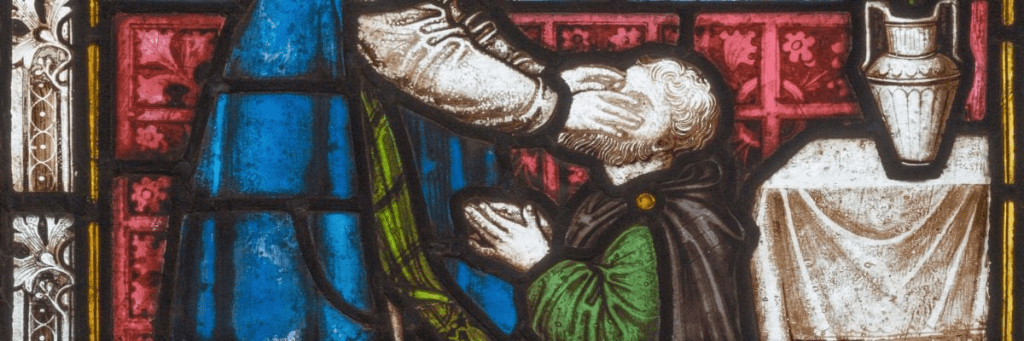
Ananias restoring sight to Saul, stained glass in St Mary Abbot`s Church, London, UK

Meanwhile, Saul was still spewing out murderous threats against the Lord’s disciples. He went to the high priest, seeking letters to the synagogues in Damascus. If he found persons who belonged to the Way, whether men or women, these letters would authorize him to take them as prisoners to Jerusalem. During the journey, as he approached Damascus, suddenly a light from heaven encircled him. He fell to the ground and heard a voice asking him, “Saul, Saul, why are you harassing me?”

Saul asked, “Who are you, Lord?”

“I am Jesus, whom you are harassing,” came the reply. “Now get up and enter the city. You will be told what you must do.”

Those traveling with him stood there speechless; they heard the voice but saw no one. After they picked Saul up from the ground, he opened his eyes but he couldn’t see. So they led him by the hand into Damascus. For three days he was blind and neither ate nor drank anything.

In Damascus there was a certain disciple named Ananias. The Lord spoke to him in a vision, “Ananias!”

He answered, “Yes, Lord.”

The Lord instructed him, “Go to Judas’ house on Straight Street and ask for a man from Tarsus named Saul. He is praying. In a vision he has seen a man named Ananias enter and put his hands on him to restore his sight.”

Ananias countered, “Lord, I have heard many reports about this man. People say he has done horrible things to your holy people in Jerusalem. He’s here with authority from the chief priests to arrest everyone who calls on your name.”

The Lord replied, “Go! This man is the agent I have chosen to carry my name before Gentiles, kings, and Israelites. I will show him how much he must suffer for the sake of my name.”

Ananias went to the house. He placed his hands on Saul and said, “Brother Saul, the Lord sent me—Jesus, who appeared to you on the way as you were coming here. He sent me so that you could see again and be filled with the Holy Spirit.” Instantly, flakes fell from Saul’s eyes and he could see again. He got up and was baptized. After eating, he regained his strength.

He stayed with the disciples in Damascus for several days. Right away, he began to preach about Jesus in the synagogues. “He is God’s Son,” he declared. (Common English Bible)

A telltale sign of spiritual blindness, a lack of awareness, and an unwillingness to change is to put all the focus on another person or group as the real problem of a society.

That’s exactly what Saul did. And that’s precisely why he needed a conversion.

Family Systems Theory

Murray Bowen was an influential psychiatrist of the twentieth century. His family systems theory, also known as Bowen theory, views a family (or any group of persons) as an emotional unit. Within this unit, a change in any of the individual persons results in the others compensating for the emotional functioning that’s been altered. 

Like touching one part of a spider web, the entire thing shakes. Bowen’s focus was that, rather than trying to change the other person, one can change themselves without becoming part of the problem. The theory states that if any family or group member can change their emotional functioning within the system, the whole family will improve its corporate functioning in response to that change. 

In short, we must learn to function in a healthy way within the group system. Personal transformation becomes the best approach to handling family crises and problems.

Saul the Pharisee to Paul the Apostle

Bowen’s statement of the human condition could be said of Saul and his conversion:

“The human is a narcissistic creature who lives in the present and who is more interested in his own square inch of real estate, and more devoted to fighting for his rights than in the multigenerational meaning of life itself. As the human throng becomes more violent and unruly, there will be those who survive it all….  I think the differentiation of self (remaining connected to others, yet separate from their problems) may well be one concept that lives into the future.”

Murray Bowen

Saul the Pharisee was an anxious soul. He was determined to keep the Christian sect from infecting his Jewish way of life. As the followers of Jesus grew, so did the anxiety of Saul and the Pharisees. Saul turned his attention to unhealthy ways of handling the situation – to the point that Christ himself showed up and let Saul know that his harassment needed to stop.

Our Need for Change

Whatever you think of Bowen’s theory, it’s easy to see that anxiety plays a major role in many individuals, families, and even churches. Whenever worry, fear, and anxiety take over a person or group of people, things become emotionally charged. 

The church is an emotional unit. Typically, the response to anything we don’t like is to try and change the other person who is rocking the boat or upsetting the status quo. The converted and changed Apostle Paul learned his lesson about the intricate web of anxious emotions: 

Don’t be anxious about anything; rather, bring up all of your requests to God in your prayers and petitions, along with giving thanks. Then the peace of God that exceeds all understanding will keep your hearts and minds safe in Christ Jesus. (Philippians 4:6-7, CEB)

Learning to manage our own anxiety, and cope with the incessant worry within ourselves, is imperative to dealing with relational problems in the group. The peace of God, not the peace of others, is what makes the difference. 

People are all for change, that is, we want others to change so that we don’t have to. The Christian, however, is to conform to Jesus, and not the other way around. Because the Lord is near to us, we have a consistent and continual presence to anchor ourselves, no matter whether the circumstances are to my liking, or not. 

Prayer becomes the means of casting anxiety away so that peace can take its place. Sounds easy – it’s anything but.

It’s only human to want everyone else to change when there are problems, adversity, or challenge. Yet the change most needed is quite personal, perhaps even an outright conversion.

Our focus must be on finding ways to remain connected to God and others without resorting to passive-aggressive tactics, cutting-off relationships altogether, or bullying others into changing with our violent or manipulative words.

Faced with unwanted change and/or difficult circumstances, rather than looking for others to alter their lives, try asking yourself one of these questions: 

  • What is one small step I can take to improve my situation?
  • If I were guaranteed not to make the situation worse, what would I do differently?
  • Is there a person in my life whose voice and input I haven’t heard in a long time?
  • What is one positive trait I possess that can serve me well in this situation?

Are there other questions you could ask that would be helpful? A journey that seems a thousand miles must begin with one step. What will that step be?

A Changed Life (Galatians 1:11-24)

A mosaic of the Apostle Paul in St Isaac’s Cathedral, St. Petersburg, Russia

I want you to know, brothers and sisters, that the gospel I preached is not of human origin. I did not receive it from any man, nor was I taught it; rather, I received it by revelation from Jesus Christ.

For you have heard of my previous way of life in Judaism, how intensely I persecuted the church of God and tried to destroy it. I was advancing in Judaism beyond many of my own age among my people and was extremely zealous for the traditions of my fathers. But when God, who set me apart from my mother’s womb and called me by his grace, was pleased to reveal his Son in me so that I might preach him among the Gentiles, my immediate response was not to consult any human being. I did not go up to Jerusalem to see those who were apostles before I was, but I went into Arabia. Later I returned to Damascus.

Then after three years, I went up to Jerusalem to get acquainted with Cephas and stayed with him fifteen days. I saw none of the other apostles—only James, the Lord’s brother. I assure you before God that what I am writing you is no lie.

Then I went to Syria and Cilicia. I was personally unknown to the churches of Judea that are in Christ. They only heard the report: “The man who formerly persecuted us is now preaching the faith he once tried to destroy.” And they praised God because of me. (New International Version)

I didn’t ask God for this

Saul wasn’t looking to change anything – except maybe to keep those confounded Christians, the group known as “The Way,” out of his beloved religion. He didn’t wake up one morning, sit on the edge of his bed and say, “Well, now, gee-whillikers, I think I’ll become the Apostle Paul, follow Jesus, and rankle a bunch of my fellow Jews with establishing churches all over the place.”

The only well-thought out plan Saul had was to ensure that Christians stayed away by any means possible. He had quite the turn around by actually joining the Christian movement. (Acts 9:1-19)

From the very get-go of his conversion, the new Paul faced skepticism, doubts, and opposition from both church and synagogue. Christians knew how Saul breathed all kinds of threats against them; so, understandably, they were reticent to receive him, perhaps wondering if it were some sort of ruse to topple the church. If it were not for the insight and encouragement of Barnabas, Paul may not have ever entered the ranks of the church. (Acts 9:26-27)

Paul’s fellow devout Jews were so upset with him for becoming a turncoat that they sought to kill him – which became a theme of Paul’s life – getting rocks thrown at him, whipped, beaten, and left for dead more than once. (Acts 9:23-24; 2 Corinthians 11:24-29)

Although Paul never asked for a dramatic conversion to Christianity, a missionary life, and continual suffering at the hands of others, he nevertheless embraced it with all the gusto of faith God gave him.

So, the gospel that the Apostle Paul proclaimed wasn’t something he sought; it was given to him. God graciously revealed the good news to Paul. For three years, he received it. Considering Paul’s background and former life, we can see why it might not be a good idea for him to hang out in Jerusalem and learn about Jesus.

Arabia is a desert. That is precisely where Paul needed to be in his early life as a Christian. Eventually, the churches and believers came around to seeing the authenticity of Paul’s faith and embraced him as a disciple. Paul is considered an Apostle because he had direct contact with Jesus himself in the Arabian desert.

God called me through the grace of Jesus

That phrase is Paul’s spiritual autobiography in a nutshell. It represents his dramatic transformation — from persecutor to preacher — and gives evidence of the hand of God at work in his life.

The fundamental conviction of being called by God, anchors Paul’s faith story. He tells that story in order to remind the Galatian Church of their own experience of being called by God’s grace.

Paul wrote his letter to the Church to help keep them on the track of grace; they were saved by grace, so therefore, they needed to also be sanctified by grace (and not law). He feared they were being led astray by believers who twisted the gospel for their own ends in order to avoid suffering. (Galatians 6:12)

The question Paul tackled head on was: Do the Gentiles have to become Jewish in order to be Christians? “Absolutely not!” Paul insisted. Neither circumcision nor uncircumcision counts for anything; the only thing that counts is faith working through love. (Galatians 5:6)

I connected with God, and you can, too

Paul was arguably the most influential Christian who ever lived. He shared his faith story in order to encourage the Galatians to examine their own experiences for signs of God’s call.

How has God called you?

It matters little whether it’s a dramatic call, like Paul’s, or whether it seems mundane, as if you don’t remember a time that you didn’t believe. And everything in between.

The important point is that we all need moments, events, and experiences of life transformation; and God’s grace must be the defining center of our personal and collective narratives.

Grace makes all the difference and is what leads to a changed life.

Once you were separated from God. The evil things you did showed your hostile attitude. But now Christ has brought you back to God by dying in his physical body. He did this so that you could come into God’s presence without sin, fault, or blame. (Colossians 1:21-22, GW)

Almighty God, transform us – not for our benefit, but for the benefit of the world. Do your work in changing us to be the new creation you have called us to be in Jesus Christ.  

Holy Spirit of God, do your sanctifying work in the church and help us to be the Body of Christ – engaged in mission, testifying to our faith, and bearing witness to the presence of our Savior, Jesus Christ. 

Lord Jesus, enable us to surrender the church back to you. It is yours, not ours. Help us lay aside our personal agendas and preferences so we can be fully committed to your calling for us. 

Blessed Holy Trinity – Father, Son, and Spirit – the God whom we serve: Do your work in our world and give to us a vision of transformed lives, renewed neighborhoods, and restored communities – bringing blessings and redemption for the glory of God. Amen.