Embrace the Change, Slowly (Exodus 24:12-18)

Moses receives the law from God on Mount Sinai, by Unknown artist, 1877

The Lord said to Moses, “Come up to me on the mountain and wait there; I will give you the tablets of stone, with the law and the commandment, which I have written for their instruction.” So Moses set out with his assistant Joshua, and Moses went up onto the mountain of God. To the elders he had said, “Wait here for us, until we come back to you. Look, Aaron and Hur are with you; whoever has a dispute may go to them.”

Then Moses went up on the mountain, and the cloud covered the mountain. The glory of the Lord settled on Mount Sinai, and the cloud covered it for six days; on the seventh day he called to Moses out of the cloud. Now the appearance of the glory of the Lord was like a devouring fire on the top of the mountain in the sight of the Israelites. Moses entered the cloud and went up on the mountain. Moses was on the mountain for forty days and forty nights. (New Revised Standard Version)

The Lord graciously entered into a covenant with the ancient Israelites. Following this, Moses was summoned to come up the mountain into God’s presence. There he would receive the tablets of stone with the law and the commandment on it. Yahweh was providing the people with instruction on how to live in the covenant relationship.

The scene was set for the Lord to give an extended revelation to Moses. Moses ascended the mountain, into the cloud, so that the people did not see him. For the next forty days and nights, God’s law and commandments were relayed and taught to Moses.

What did not happen is God tossing some stone tablets containing the law to Moses and then going on God’s merry way. The whole encounter unfolds over an extended period of time. That’s because we are people; we need time to wrap our heads and hearts around new realities. Humans require the gift of slowness to learn and absorb.

Western society, however, does not operate that way. More, faster, and better seems to be our cultural creed. And it’s found everywhere around us. Speed reading. More money. Bigger stuff.

Hogs and chickens are raised on factory farms in large confinement buildings. They never see the light of day. Instead, they are given steroids and growth hormones to grow faster and bigger, so that they can get to the market more quickly and get a better price.

Churches and faith communities in financial trouble look for quick solutions and fast turnarounds by expecting pastors to work more, faster, and better. Sports teams hire and fire coaches with dizzying frequency, believing that if the athletes aren’t faster and better with more wins, then there’s something wrong with them, the coach, or both.

But we have no further than the end of our nose to look for change.

People are in control of very little in this world, and so, a great deal of life is the ability to respond in changing circumstances – both wanted and unwanted. Resilience and flexibility are needed.

Moses receives the Ten Commandments, by Julius Schnorr von Carolsfeld, 1860

The Lord brought about the end of Egyptian slavery for the Israelites through a series of plagues against Egypt. God miraculously delivered the people from the Egyptian army by parting the Red Sea. And Yahweh graciously entered into covenant with them at the mountain. All of this was a major change of life.

It was the people’s responsibility to respond in faith and obedience to the actions and words of God. The Lord was allowing them the space and the time to come to grips with their new reality – which is one reason why Moses met with God for forty days and nights on the mountain.

The Israelites needed to spend their time adjusting to their new life, and contemplating the giving of the law, which was about to happen. Since we are privy to the end of the story, we know that the people did not do this. They became impatient, and experienced a failure of faith and obedience.

Aaron and Hur were the leaders who needed to step up and guide the people in the special opportunity of preparation for receiving the law. Whatever it is they did, it wasn’t that.

Murmuring, complaining, and arguing are the initial signs of impatience and wanting things to happen faster, even immediately. But faith is not forged this way. Faith is developed through dealing with adversity by looking to God, listening, and obeying. Faith knows that all things can be faced with joy.

My brothers and sisters, whenever you face various trials, consider it all joy, because you know that the testing of your faith produces endurance. And let endurance complete its work, so that you may be complete and whole, lacking in nothing. (James 1:2-4, NRSV)

Waiting, patience, and the stretching of faith is not typically what people sign up for. Whenever there are circumstances which warrant endurance and perseverance, it’s far too easy to become antsy and begin grumbling about the situation.

That’s what happened to the ancient Israelites. They had a stiff price to pay for their impatience and impertinence. Don’t be like them. Instead, decide now for encouragement, in and through, all circumstances.

Watch out, brothers and sisters, so that none of you have an evil, unfaithful heart that abandons the living God. Instead, encourage each other every day, as long as it’s called “today,” so that none of you become insensitive to God because of sin’s deception. We are partners with Christ, but only if we hold on to the confidence we had in the beginning until the end. (Hebrews 3:12-13, CEB)

May almighty God give you grace to persevere with joy, so that the Spirit may complete the work begun in you, through Jesus Christ our Lord. Amen.

The Parable of the Vineyard Workers (Matthew 20:1-16)

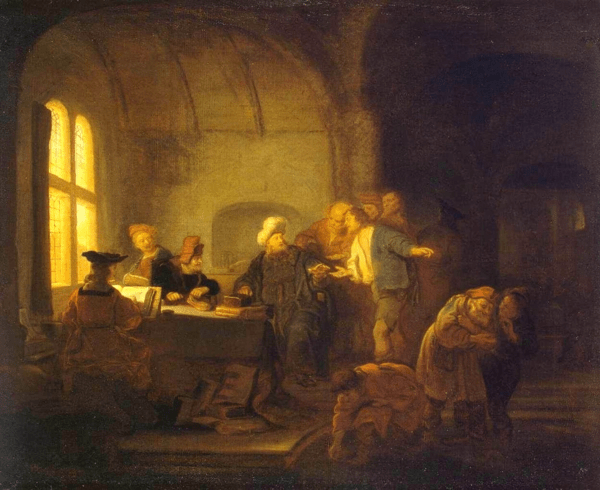
The Workers in the Vineyard, by Rembrandt, 1637

“For the kingdom of heaven is like a landowner who went out early in the morning to hire workers for his vineyard. He agreed to pay them a denarius for the day and sent them into his vineyard.

“About nine in the morning he went out and saw others standing in the marketplace doing nothing. He told them, ‘You also go and work in my vineyard, and I will pay you whatever is right.’So they went.

“He went out again about noon and about three in the afternoon and did the same thing. About five in the afternoon he went out and found still others standing around. He asked them, ‘Why have you been standing here all day long doing nothing?’

“‘Because no one has hired us,’ they answered.

“He said to them, ‘You also go and work in my vineyard.’

“When evening came, the owner of the vineyard said to his foreman, ‘Call the workers and pay them their wages, beginning with the last ones hired and going on to the first.’

“The workers who were hired about five in the afternoon came and each received a denarius. So when those came who were hired first, they expected to receive more. But each one of them also received a denarius.When they received it, they began to grumble against the landowner. ‘These who were hired last worked only one hour,’ they said, ‘and you have made them equal to us who have borne the burden of the work and the heat of the day.’

“But he answered one of them, ‘I am not being unfair to you, friend. Didn’t you agree to work for a denarius? Take your pay and go. I want to give the one who was hired last the same as I gave you. Don’t I have the right to do what I want with my own money? Or are you envious because I am generous?’

“So the last will be first, and the first will be last.” (New International Version)

Fairness

We humans have an innate sense of right and wrong, justice and injustice. We want life to be fair. It disturbs us when there is favoritism, discrimination, and preferential treatment. When things seem off, and others seem more privileged, envy can easily creep in and settle in our bones.

The envy can go even deeper. For example, is it fair that any child should struggle with health issues like cancer, epilepsy, and mental disorders? Is it fair to have healthcare disparities? Is it fair to have a spouse taken from you before their time? Is it fair to lose your job through no fault of your own? Is it ever fair to be treated like a second-class citizen?

Pat answers to people’s genuine struggles will not do, such as “You just need to work hard and hope for the best;” “We have to take what is given us and accept these things;” “Think of all those starving children in India;” or the more crass, “Suck it up buttercup; life was never meant to be a rose garden.”  Those statements are simply unhelpful.      

At the heart of envy is the belief that others are getting something that I deserve. “It isn’t fair!” we cry. Yet, God does not always operate according to our standards of fairness. God’s very nature is to be generous and full of grace. The parable which Jesus told about the vineyard workers is a story not of unfairness, but a story of generosity and grace. It’s all in how you look at it.

A normal workday in the ancient world was ten hours, not counting breaks. The workday began at 6:00am. A denarius was a typical day’s wage for laborers. The landowner went out at the third hour, 9:00am; the sixth hour, noon, etc. He kept returning to hire more workers even up to the last hour of the workday. Laborers were always paid at the end of the day.

In this parable, the last workers were paid first, which prompted the first workers hired to think they would be getting more, even though they had been promised a denarius. So, they grumbled about not getting more. They thought the landowner was not being fair.

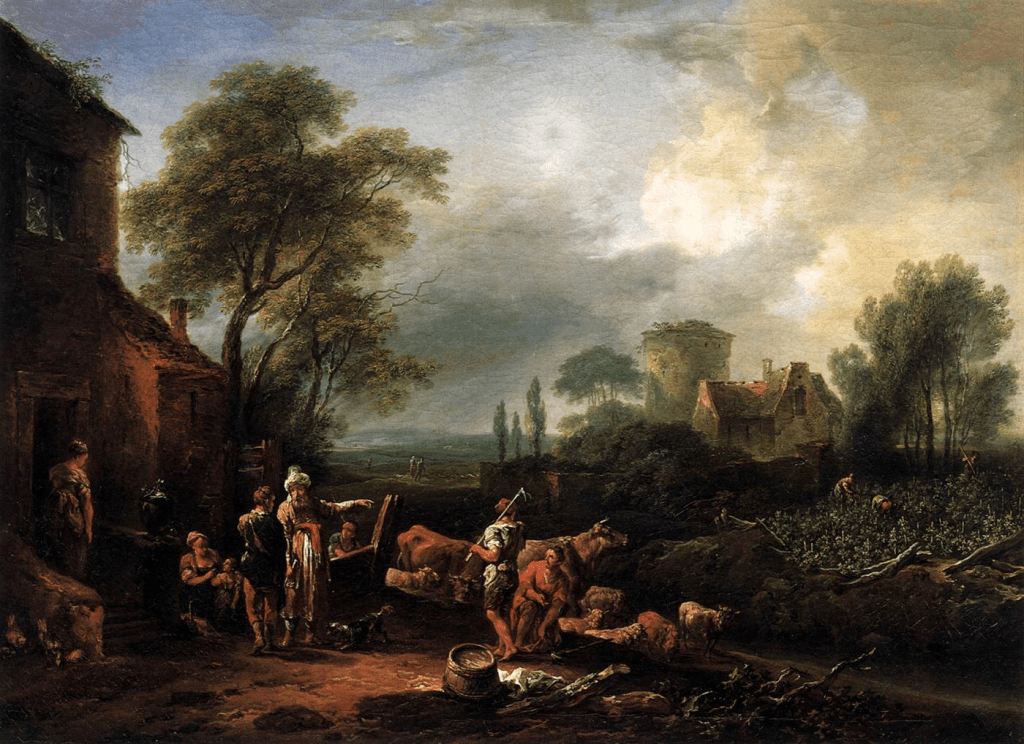
Parable of the Workers in the Vineyard, by Johann Christian Brand, 1769

Complaining

Grumbling. Complaining. Murmuring. It is the bane of our existence. Decades ago, when gas station attendants still filled tanks for customers, I was working at a station and had a lady go berserk on me for not checking her oil and cleaning her windshield, because I did it for the car in front of her. Even though there was a sign right in front of her that said checking oil and cleaning windshields is only done upon request, the lady thought she was getting gypped. 

In truth, the landowner did not cheat nor defraud the workers in any way. He paid the agreed upon wage, just like he promised. Should he want to pay everyone the same even though the amount of work was different was his own business.

The problem was not with the owner, it was with the worker’s envy of the owner’s generosity toward the others. God distributes gifts because God is gracious, not because we have earned anything. Our standard of fairness is not the rule of the kingdom of God – grace is.

Grace

Deep down many believe we control our destiny, and that we save ourselves by what we do. We discern that if we serve God all our lives, in the end, God will reward us. We believe that our pious activities, our acts of service and our work for the Lord, will bring us salvation, or, at least a leg up in the kingdom of God over others who have not worked as hard or as long as we have. After all, we do the right thing.

So, what about those who have not figured out Christianity… those who do not have the correct or proper beliefs… or those who have not straightened out their lives? According to a worldview of human fairness, they are out of luck. They should be in church. They should work harder, faster, and better. Then, they could get their lives in order. If they would only understand fairness, we reason, then all would be well.

But there is a problem, because the parable of the workers told by Jesus seems to be saying that is not how it works at all.  Jesus seems to be saying that grace and grace alone saves, that God’s amazingly naïve and irresponsible grace is available to anyone and everybody. And that troubles the workers to no end. 

Parable of the Workers in the Vineyard, by Solomon Koninck, c.1648

What’s in it for me?

Whenever we run headlong into God’s unfair grace and see that God’s way of doing things is so far removed from our way, there is bound to be grumbling. After all, if God is going to run a vineyard like the one in the gospel lesson and give everybody the same pay regardless of their actual work hours, then what’s the use of getting up early in the morning to work? 

What is the good of sitting in church, listening to sermons from a crazy preacher who is no better than us, if these outsiders, these Johnny-and Jane-come-lately’s can waltz in at the last minute and receive the same treatment as the rest of us? For many church folks who diligently serve, it’s not fair to pay so much attention to outsiders and build ministry around people who aren’t even here, who don’t yet know Jesus.

The conclusion and point of the parable: The last will be first, and the first will be last. In Luke’s prodigal story, the elder brother grumbles and gripes: “All these years I’ve been slaving for you and never disobeyed your orders.  But when this son of yours who has squandered your property with prostitutes comes home, you kill the fatted calf!”  It is the firstborn son that complains. (Luke 15:11-32)

In both the parable of the prodigal son and the parable in today’s lesson, “good” people are the ones who fail to see the heart of the Father and of the landowner. The “firsts” got off track because, over time, they forgot the kingdom hinges on grace, not effort, on not simply doing the right things over a long period of time.

Who’s in control?

God controls the flow of mercy, not us. 

We might be surprised in heaven with those already sitting at God’s banquet table, and equally surprised with who is not there. Resentment can move us away from the table of mercy God is preparing. The problem comes whenever we think we are above other people.  We might be sinners, but we are not as bad as some other people are!  We commit ordinary sins, not mass murder!

Here is the unvarnished truth: God does not owe you nor I a thing, and God cares about all kinds of people, not just us and people who think and live like we do. Our hearts need to be big enough to center ministry around other people who are different than us.

If our hearts are small, we easily get jealous when God pays attention to prodigals and profligates. Grace becomes too repugnant a doctrine for us.

The gospel of Jesus Christ is about grace. Life is not all about being decent or even moral; and it is certainly not about our own goodness. The gospel is about being steeped in and surrounded by the grace of God in Christ, so that we, in turn, can show others grace. Grace is the way God deals with us beyond what we deserve or feel we have earned. 

Grace is unfair; we get what we do not deserve. 

May we allow God’s grace to so permeate our hearts and lives so that we will give it to others as freely as we have received.

Praise be to you, almighty and everlasting Father of our Lord Jesus Christ. In Christ, you have given us every spiritual blessing in heaven – you chose us before the world was made, and in love, to be your holy people. It pleased you to make us your own children through Jesus Christ. 

So we praise you because of your wonderful grace, given to us freely, in Christ, the one you love. We have forgiveness of sins because of this lavishly rich grace. Amen.

Let Go (Exodus 11:1-10)

Now the Lord had said to Moses, “I will bring one more plague on Pharaoh and on Egypt. After that, he will let you go from here, and when he does, he will drive you out completely. Tell the people that men and women alike are to ask their neighbors for articles of silver and gold.” (The Lord made the Egyptians favorably disposed toward the people, and Moses himself was highly regarded in Egypt by Pharaoh’s officials and by the people.)

So Moses said, “This is what the Lord says: ‘About midnight I will go throughout Egypt. Every firstborn son in Egypt will die, from the firstborn son of Pharaoh, who sits on the throne, to the firstborn son of the female slave, who is at her hand mill, and all the firstborn of the cattle as well. There will be loud wailing throughout Egypt—worse than there has ever been or ever will be again. But among the Israelites not a dog will bark at any person or animal.’ Then you will know that the Lord makes a distinction between Egypt and Israel. All these officials of yours will come to me, bowing down before me and saying, ‘Go, you and all the people who follow you!’ After that I will leave.” Then Moses, hot with anger, left Pharaoh.

The Lord had said to Moses, “Pharaoh will refuse to listen to you—so that my wonders may be multiplied in Egypt.” Moses and Aaron performed all these wonders before Pharaoh, but the Lord hardened Pharaoh’s heart, and he would not let the Israelites go out of his country. (New International Version)

It takes a lot for the status quo to die, to let go of something that has been relied on for centuries. In the case of ancient Egypt, it took the deaths of every Egyptian first born son.

The Israelites had been slaves in Egypt for 400 years. The vast Egyptian Empire was literally built on the backs of Jews. After so long, their cry about being in bondage was heard by God – who sent Moses to deliver them. But Pharaoh, the King of Egypt, was not about to let go of this large labor force.

So, a series of 10 plagues came upon the Egyptians from God. Today’s Old Testament lesson is the tenth and final plague – the one most devastating to Egypt. Although Pharaoh was determined to keep the Israelites in bondage, not even mighty Egypt could keep it’s grip on the people when God was determined to free them and bring them to the Promised Land.

God graciously informed Moses that this was the final plague. After nine others, and hearing Pharaoh say he would let the people go multiple times, it must have been a relief to hear that this would not keep going any longer.

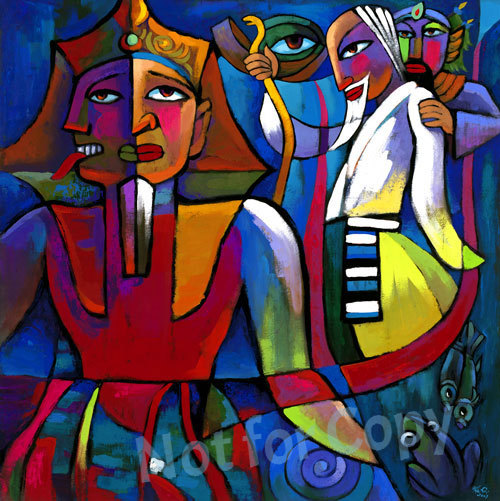
Moses and Aaron debating with Pharaoh, by He Qi

What’s more, the Lord added that not only would Pharaoh finally change and not hinder the people from leaving, but also that they should ask the Egyptians for what they needed when going. Indeed, the people of Egypt became so eager to have the Israelites away from them that they would give them anything to get them out.

The Israelites had worked hard and labored intensely for hundreds of years without any compensation. Now, they would leave the world of slavery and receive the riches of Egypt from which they were defrauded. Whereas Pharaoh’s heart became exceedingly hard, the Egyptians hearts became disposed to give – even though it was to be rid of the Israelites once and for all.

And so, God would deliver the Jews from their bondage and enrich them with many needed possessions, as if they were carrying away plunder from an enemy. The Lord both frees and empowers; God delivers from one situation and enables for another. When God closes a door, then another door is opened.

Indeed, the first will be last, and the last shall be first. In God’s upside-down kingdom, the oppressors eventually become the oppressed, and the poor become rich.

With this last and final plague, there would be no next generation to rise up and take back the Israelites into slavery again. A distinction was made between the first born of the Egyptians and the Israelites. Only the Egyptians experienced the awful deaths of so many.

After four centuries of keeping the Jews enslaved, maybe the Egyptians thought it would always be this way. Perhaps they even believed what they were doing was perfectly acceptable and right. So, when Moses comes along, speaking on behalf of God to Pharaoh, the great king of the empire thought things will not change; the Israelites ought to always be in subservience to Egyptians.

Why is it so hard to let go? Why do people keep holding on, even when it costs them nearly everything?

Whenever we cannot envision a different world or an alternative to what we are currently experiencing, then we hold on – even if it hurts to keep grasping it. Just because there was no divine judgment in hundreds of years, does not mean that God was okay with the situation in ancient Egypt. So, when the Egyptians experienced the judgment, it was absolutely devastating.

If ever we need to control other people in order to realize or maintain our own happiness or contentment, then we are in a very unhealthy place and need immediate help – before the providence of God steps in and pries that control from your clenched fists.

Conversely, if we have been in a place of oppression for a long time, it will not last forever. God sees the injustice. And God hears the cries which are uttered to heaven. A time is coming when all things will be made right.

Also, there are various sorts of traumas that people have endured. Sometimes, people don’t want to talk about any of it, and never do. But eventually, it overwhelms them. Without help, they will be in bondage. None of us can change on our own. We need others. Not everyone is going to harm us or shame us. There are people that God is ready to use in order to extend hope, healing, wholeness, and help. We should let them in, and keep the slave masters out.

Gracious and merciful God, help us to overcome the menace of evil in this world, and to be a part of freeing those weighed down with sinful oppression to realize a future of health and hope.

From famine and war, deliver us.

From hatred and from the demeaning of the dignity of others, deliver us.

From every kind of injustice in the life of society, both national and international, deliver us.

From the loss of awareness of good and evil, deliver us.

Accept our cry on behalf of the sufferings of all humanity, and of entire societies of people.

Empower us by your Spirit to resist evil in all its insidious manifestations.

May the saving grace and the redemption of Jesus put a stop to cruel bondage everywhere; and may hope be kindled in every heart. Amen.

Who’s In Charge? (Romans 9:6-13)

I am not saying that the promise of God has failed; for not all the people of Israel are the people of God. Nor are all of Abraham’s descendants the children of God. God said to Abraham, “It is through Isaac that you will have the descendants I promised you.” This means that the children born in the usual way are not the children of God; instead, the children born as a result of God’s promise are regarded as the true descendants. For God’s promise was made in these words: “At the right time I will come back, and Sarah will have a son.”

And this is not all. For Rebecca’s two sons had the same father, our ancestor Isaac. But in order that the choice of one son might be completely the result of God’s own purpose, God said to her, “The older will serve the younger.” He said this before they were born, before they had done anything either good or bad; so God’s choice was based on his call, and not on anything they had done. As the scripture says, “I loved Jacob, but I hated Esau.” (Good News Translation)

My friend, I want to break this to you as gently as possible yet as straightforward as I can: Neither you nor I are in control or in charge! 

Any semblance of control we think we have is merely a delusion. Now, before you push back, its important to make the distinction between control and responsibility. We are to own our decisions and take responsibility for their outcome. The Bible describes this as “self-control.”

God’s saving kindness has appeared for the benefit of all people. It trains us to avoid ungodly lives filled with worldly desires so that we can live self-controlled, moral, and godly lives in this present world. (Titus 2:11-12, GW)

Attempting to control others is not our job – never was, isn’t now, and never will be – that’s God’s business. 

God makes choices. This was the Apostle Paul’s point to the church at Rome. The congregation was a volatile mix of Jew and Gentile. There was some bad history between them that stretched back centuries. Yet, here they were together in one church worshiping Jesus. 

Paul made a responsible choice to step into the mess between them and let each group know something important: It is neither their choice about who’s in and who’s out as God’s people, nor their choice about how someone gets in to start with. Those sorts of decisions are God’s choice. 

The Jews needed to know that Gentiles are in the kingdom because God does the work of choosing, calling, and including Gentiles just as much as Jews. 

The Gentiles needed to know that they were not replacing Jews as chosen people. The point? God chooses whomever he darn well pleases to choose, and the choice is not up to you or me.

This speaks on so many levels about how to conduct ourselves with one another in the church. The foundation of all good church dynamics is the recognition that God is the one who calls and gathers people together. That always needs to be the starting point in our relations with each other. The church is not a random collection of persons who happen to be in the same place at the same time. God puts us where we are.

He has made everything beautiful in its time. He has also set eternity in the human heart; yet no one can fathom what God has done from beginning to end. (Ecclesiastes 3:11, NIV)

The Church is a covenantal community. Believers in Jesus are receiving the blessings first promised by God’s covenant relationship with Abraham in the Old Testament that all nations would be blessed by grace through faith. God is committed to acting on their behalf through election, adoption, and redemption. The new covenant community, the Church, receives the promises of God and exists to follow Jesus Christ in all things. 

The Church is not a voluntary society, like every other human institution. Rather, the Church is the divinely called community of the redeemed whom God has joined through the Spirit to Christ. Therefore, an individual, theologically speaking, does not join a church; instead, God joins the Church to Jesus.

The Nicene Creed (325 C.E.) describes the Church with four identifying marks:

  1. The Church is one.  The unity of the Church comes from God’s covenant people being in fellowship with the Lord through Jesus in the Spirit. This unity is expressed through the bond of love and a common worship that includes the spiritually forming practices of preaching, liturgy, and sacraments.  Since believers serve a triune God of Father, Son, and Spirit who exists in unity, so Christians are to work toward maintaining their unity through the bond of peace.
  2. The Church is holy.  The Church is holy by virtue of Christ’s finished work. Therefore, the members of the Church are saints, called by God to live in holiness and participate with him in carrying out his purposes on earth. As God is holy, so believers are to be holy in all they do. Since Christians are holy through God’s justification in Christ, so the Church as saints must uphold justice in the world.
  3. The Church is catholic.  This means that God’s people are found in all parts of the world throughout all times in history, including every race, class, gender, and ethnicity. Since the Church includes all kinds of people from different cultures, these believers must work together. The Church, across all kinds of denominations, ought to minister together to the total life of all people through gospel proclamation and good works done in the Spirit.
  4. The Church is apostolic.  Apostolic means “to be sent.” The Church is not only a people who are gathered for worship and teaching; they are also sent into the world as salt and light to those who are in darkness. Where the Church goes, the rule and reign of Jesus goes with them so that the gospel is spread to all nations.

Sovereign God, you choose whomever you want to include in your kingdom. Allow me to see Jesus in each person you call and save so that I can love and encourage them in the faith which is mutually and graciously given to us all; through Christ our Lord, and the ministry of the Holy Spirit. Amen.