Work and Family (Psalm 127)

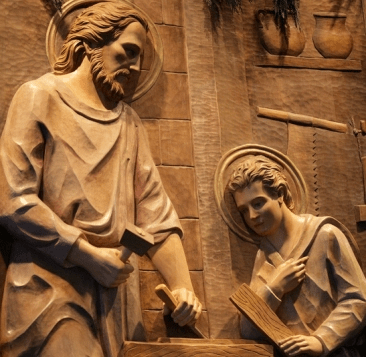
The Carpenter’s Son, Holy Cross Chapel, Houston, Texas

Unless the Lord builds the house,
    those who build it labor in vain.
Unless the Lord guards the city,
    the guard keeps watch in vain.
It is in vain that you rise up early
    and go late to rest,
eating the bread of anxious toil,
    for he gives sleep to his beloved.

Sons are indeed a heritage from the Lord,
    the fruit of the womb a reward.
Like arrows in the hand of a warrior
    are the sons of one’s youth.
Happy is the man who has
    his quiver full of them.
He shall not be put to shame
    when he speaks with his enemies in the gate. (New Revised Standard Version)

God is the Creator. We humans are creatures, created in the image and likeness of God. Therefore, we are inextricably tied to God, and quite dependent upon the Lord.

For the activities of our daily human life, we need God. When it comes to establishing a home, protecting our community, daily work, and raising children, we very much need God’s help to do all of this in a way that is successful and good.

Unless God is with us, in the center of all that we do, then our work in building a good life shall be in vain. How we go about living our lives with work and family, and who we look to as role models, makes a significant difference in the quality and effectiveness of our labor and relationships.

When my wife was growing up, her family had a prominent portrait of John Wayne in the living room above the television. That picture spoke volumes about the family ethos. They had horses and loved to ride and enjoy the outdoors. Hard work was a daily reality of life, as well as a rugged individualism that often suppressed all else in order to engage in work. 

Doing your best, striving for excellence, and learning responsibility are good things that mature people do every day. Yet, there is a fine line between hard work that provides and enriches, and lonely work that is frenetic and fueled by anxiety about the future.

The motives behind why we burn the candle at both ends are just as important to the Lord as the work itself. The psalm for today is a wake-up call for us to consider the frenetic pace of work and family life.

If we independently believe that our life is in our own hands, and we work with a worry that animates our every task, then we have lost touch with the understanding that it is God who ultimately provides us with every good thing in life. 

However, if we begin to relax and let go of our stubborn independent streak, then we work hard with the strength God gives. We let the Lord watch over us.

Trusting God in our work is connected to children being a heritage from the Lord. In the ancient world, children worked alongside their parents. Fathers and mothers did not go it alone – work was a family affair, as well as a community endeavor. 

Whenever we slip into a groove of worshiping individualism, rather than simply taking personal responsibility, then we must come back to the inter-dependence we were designed for as created human beings. 

The ethos the psalmist espoused is trust in God, reliance on others, and working together for the common good of all. 

Here are a few ways of working together and not carrying the load of work on our own:

Ask for what you want and need to accomplish the task. Whenever we don’t ask, we inevitably go the route of hustling for help through manipulation, guilt, and shaming others.

If someone says, “no,” simply ask another person or persons. Asking once just won’t do. And neither is commanding others to get things done. We have the ability to ask calmly, confidently, and compassionately. Accept the “no” which you might get, without retreating back to manipulation. This is especially needful when it comes to asking family members.

Ask God to help you in your work. Each day as I enter the hospital for which I am a Chaplain, I say a prayer, “God almighty, blessed Father, Son, and Spirit, please go before me, with me, and after me to each patient, their family members, and every team member I encounter today, with the love and compassion of Jesus Christ.”

Delegate, if possible. This is not the same thing as barking orders. Delegating is a realization that we are finite creatures with limitations of time, energy, and resources. It’s okay to share the load with others. In fact, most people are more than willing to help, if we but ask. It enables them to feel needed and important.

Be vulnerable and gracious. We all mess up our work, at times. And it’s important to own mistakes without heaping unnecessary criticism on ourselves, or others. Offering an apology, recognizing that you’ve bit off more than you can chew, and admitting your lack of energy are healthy, not sinful. Also, whenever others fall short of their responsibilities, it’s our job to handle it with grace – seeking to understand and help, rather than criticize and judge.

Working together, consulting, collaborating, and engaging in fellowship enable us to speak with those who may oppose, misunderstand, or misinterpret us. It’s also a more joyful way to live.

Sovereign God, you created all things and in you everything holds together. Preserve me with your mighty power that I may not fall into disconnection with you and others, nor be overcome by anxiety. In all I do direct me to the fulfilling of your purpose, through Jesus Christ my Lord. Amen.

Some Relational Wisdom (Proverbs 25:1-28)

Here are some more
    of Solomon’s proverbs.
They were copied by the officials
    of King Hezekiah of Judah.
God is praised
    for being mysterious;
rulers are praised
    for explaining mysteries.
Who can fully understand
    the thoughts of a ruler?
They reach beyond the sky
    and go deep in the earth.

Silver must be purified
before it can be used
    to make something of value.
Evil people must be removed
before anyone can rule
    with justice.

Don’t try to seem important
    in the court of a ruler.
It’s better for the ruler
    to give you a high position
than for you to be embarrassed
    in front of royal officials.
Be sure you are right
    before you sue someone,
or you might lose your case
    and be embarrassed.

When you and someone else
can’t get along,
    don’t gossip about it.
Others will find out,
and your reputation
    will then be ruined.

The right word
    at the right time
is like precious gold
    set in silver.
Listening to good advice
is worth much more
    than jewelry made of gold.
A messenger you can trust
is just as refreshing
    as cool water in summer.
Broken promises
are worse than rain clouds
    that don’t bring rain.
Patience and gentle talk
can convince a ruler
    and overcome any problem.

Eating too much honey
    can make you sick.
Don’t visit friends too often,
or they will get tired of it
    and start hating you.
Telling lies about friends
    is like attacking them
with clubs and swords
    and sharp arrows.
A friend you can’t trust
    in times of trouble
is like having a toothache
    or a sore foot.
Singing to someone
    in deep sorrow
is like pouring vinegar
    in an open cut.

If your enemies are hungry,
    give them something to eat.
And if they are thirsty,
give them something
    to drink.
This will be the same
as piling burning coals
    on their heads.
And the Lord
    will reward you.
As surely as rain blows in
    from the north,
anger is caused
    by cruel words.
It’s better to stay outside
    on the roof of your house
than to live inside
    with a nagging wife.

Good news from far away
refreshes like cold water
    when you are thirsty.
When a good person gives in
    to the wicked,
it’s like dumping garbage
    in a stream of clear water.
Don’t eat too much honey
    or always want praise.
Losing self-control
leaves you as helpless
    as a city without a wall. (Contemporary English Version)

The wise sayings in this chapter of the Book of Proverbs have to do with relational topics such as: relating to a leader; relating to others; and relating to oneself (self-control).

Relating To a Leader

When it comes to relating to any sort of leader above us, it is best to avoid arrogance and embrace humility.

Whether we realize it, or not, or like it, or not, leaders have a perspective that others don’t. They see the big picture of what is happening, and ideally, make wise decisions based upon all the factors and people involved.

This means that we are not always, maybe not even usually, going to understand what a leader or ruler is doing. This is why it is so important for leaders themselves to consult and collaborate with others, and choose wisely.

Humility isn’t only for followers, it is just as much, perhaps even more, necessary for the leader. Making decisions in a vacuum, or just trusting in one’s own counsel, usually doesn’t work out well. Everyone has character flaws, yet a leader’s flaws, weaknesses, and sins can stick out rather easily to others.

That doesn’t mean, however, that anyone has a right to believe they themselves can do a better job, or know more about how to lead, or have all the information. Because they don’t.

The ways of God are mysterious because it is a very big picture that only the Lord sees. And there are a lot of moving parts and people to all of God’s choices and movements in this world.

The important part, for us, is to recognize the goodness and wisdom of God, and to trust that the Lord – as the God of Love – always does what is right, just, and good, even though it may not always seem that way.

Relating To Others

When it comes to how we generally relate to our fellow humanity, we are to show some empathy and deference. The ability to put yourself in another’s shoes is quite important and necessary, in order to relate well to others.

In failing to do this, and only thinking of oneself, we end up overstaying a welcome from someone who was thinking of us; or not paying attention that my morning blessing feels more like a curse to the night owl; or sharing some juicy tidbit of information that isn’t ours to share, so that others listen and pay attention to me.

Today, in this day and age, many persons fail to think of others when they are driving. Far too many people drive as if they own the road, and as if the traffic laws don’t apply to them. If they think of another driver at all, it’s only to curse them for hindering their ability to get to where they want to go.

Relating to Self

In contrast to all of that, we ourselves are to practice self-control and choose to live differently. Instead of cursing, we bless; and rather than selfishness, we practice selflessness.

If we would but all learn to exercise kindness over revenge, our world would be a very different place than it is today. And if we would but choose to speak the truth in love, rather than tell lies in hate or indifference, then there would be a lot less harm and hurt in this old fallen world.

By practicing self-control, we stop the cycle of hate, injustice, and unkindness. But if we choose the path of escalating verbal and/or physical violence, then this only leaves us vulnerable to harm. And it may open a way of having those you care about be harmed, as well.

I myself am the only person I’m in control of. And so I choose to:

  • be honest, trustworthy, and let God provide the judgment and justice needed for others
  • consider others, and think before talking
  • listen to wise counsel, and not entertain the manipulative words of the foolish
  • walk the patient path of wisdom

O God, grant me the wisdom I need in all my relationships. Help me recognize when things may be unsafe. I pray your protection over me and my family when we feel vulnerable. Thank you for having the power to heal broken relationships. Amen.

Work Together (Acts 18:24-28)

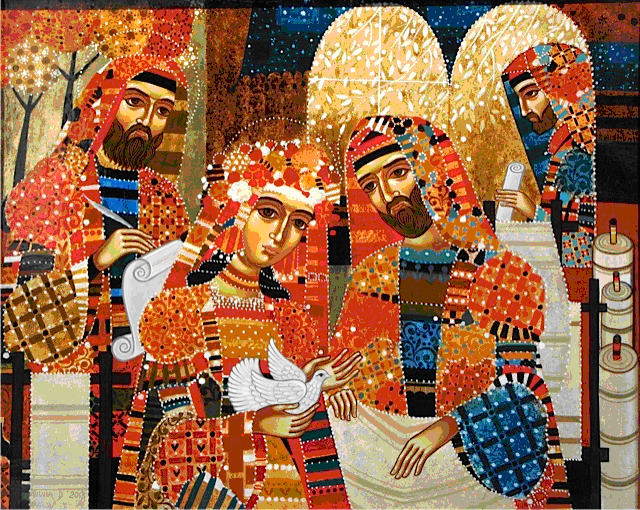
Priscila and Aquila host Paul and train Apollos, Unknown artist

Meanwhile a Jew named Apollos, a native of Alexandria, came to Ephesus. He was a learned man, with a thorough knowledge of the Scriptures. He had been instructed in the way of the Lord, and he spoke with great fervor and taught about Jesus accurately, though he knew only the baptism of John. He began to speak boldly in the synagogue. When Priscilla and Aquila heard him, they invited him to their home and explained to him the way of God more adequately.

When Apollos wanted to go to Achaia, the brothers and sisters encouraged him and wrote to the disciples there to welcome him. When he arrived, he was a great help to those who by grace had believed. For he vigorously refuted his Jewish opponents in public debate, proving from the Scriptures that Jesus was the Messiah. (New International Version)

I really like this story. I like it for two reasons:

  1. Apollos, although a very learned and gifted guy, nonetheless had the humility to listen and accept the counsel of the couple, Priscilla and Aquila. He had a teachable spirit and a submissive heart.
  2. Priscilla and Aquila, a woman and a man, wife and husband, shared equally in taking the initiative to practice hospitality and make a significant contribution to the learning of Apollos. They had teachers’ spirits and caring hearts.

An intelligent mind doesn’t do much good if it isn’t accompanied by humility – a willingness to be taught, and a heart that is open to receive.

And instructing others accomplishes nothing if it isn’t directed by an egalitarian mindset – a desire to love strangers of all backgrounds and walks of life, and give, in any sort of way that is helpful to the other.

Who was Apollos?

Apollos was an educated man from the city of Alexandria in Egypt. He was well acquainted with Old Testament Scripture and familiar with John the Baptist’s teachings. In the middle of the first century C.E. he came to the city of Ephesus in Asia Minor (present day Turkey) where he began to teach in the Jewish synagogue.

Priscilla, and her husband Aquila, were followers of Jesus in Ephesus and they heard Apollos speaking. They hospitably took him aside and told him the rest of the story. After this, Apollos went to preach in Achaia, having been highly recommended by the Ephesian Christians. His effectiveness was unprecedented.

Apollos was in Corinth (Acts 19:1) where he was useful in watering the spiritual seed which the Apostle Paul had planted (1 Corinthians 3:6). He was such a skilled teacher and so much appreciated by the believers there that, unfortunately, many of the Corinthian believers became attached to him in an unhealthy way, creating schisms within the church, much to the chagrin of Apollos (and Paul). (1 Corinthians 1:12, 16:12)

Who were Priscilla and Aquila?

Priscilla and Aquila were tentmakers native to Rome. After the persecution of the Jewish people under the Emperor Claudius, they made their way to Greece, where they encountered the Apostle Paul and tutored Apollos. Their impact on these Christian leaders – and the bravery they demonstrated within the early church—became legendary, and Priscilla and Aquila are referenced in four different New Testament books.

What’s interesting about the references to this couple in Holy Scripture is the order in which their names are mentioned. In the seven references to the married couple, the wife is mentioned before the husband five times. This is somewhat uncharacteristic of the naming conventions in the Bible and suggests that Priscilla played a leading role in their ministry work.

It was in Corinth that Priscilla and Aquila first encountered the Apostle Paul. They welcomed him into their workplace, providing him with meaningful employment that facilitated his missionary activities. When Paul determined to return to Syria, they accompanied him across the Aegean Sea to Ephesus, where their ministry continued – and it was there that Priscilla and Aquila met Apollos.

In his catalog of greetings to the Roman church, Paul sent his regards to Priscilla and Aquila, indicating that they eventually returned to Rome – which was quite a risky thing to do considering the political climate of the time. Paul notes that Priscilla and Aquila stuck out their necks for him. (Romans16:3)

What do we learn from Priscilla, Aquila, and Apollos?

The story of Priscilla and Aquila holds out a cache of important truths. For one, it demonstrates the added value of men and women partnering over the long term for the cause of Christ. It’s important to collaborate and be willing to consult each other and accept instruction and even correction.

The interaction of these early believers points to the importance of true Christian hospitality. When Paul arrived in their community, they gathered in a worn-out traveler. They provided shelter, company, and income for him, advancing his missionary ventures.

In Ephesus, they followed the same template with Apollos, perhaps sharing what they had learned from Paul to strengthen the witness of this remarkable young preacher. Their table and living room became sources of encouragement and instruction for those who would teach the church at large.

Priscilla, Aquila, and Apollos are good models for all men and women called to Christian mission and service. They longed to serve Christ and the Church in whatever ways they could. They sought to help the next generations of believers in their walk with Christ. And they displayed the sort of qualities needed for the burgeoning church to work together and reach the world with good news.

God of grace and might, who gave to your servants Apollos, Priscilla, and Aquila gifts of zeal and eloquence to make known the truth of the Gospel: Raise up, we pray, in every country, heralds and evangelists of your kingdom, so that the world may know the immeasurable riches of our Savior Jesus Christ; who lives and reigns with you and the Holy Spirit, one God, now and forever. Amen.

1 Chronicles 10:1-14 – Faithfulness Matters

The Philistines fought against Israel in a battle at Mount Gilboa. Israel’s soldiers ran from the Philistines, and many of them were killed. The Philistines closed in on Saul and his sons and killed three of them: Jonathan, Abinadab, and Malchishua. The fighting was fierce around Saul, and he was gravely wounded by enemy arrows.

Saul told the soldier who carried his weapons, “Kill me with your sword! I don’t want those godless Philistines to torture and make fun of me.”

But the soldier was afraid to kill him. Then Saul stuck himself in the stomach with his own sword and fell on the blade. When the soldier realized that Saul was dead, he killed himself in the same way.

Saul, three of his sons, and all his male relatives were dead. The Israelites who lived in Jezreel Valley learned that their army had run away, and that Saul and his sons were dead. They ran away too, and the Philistines moved into the towns the Israelites left behind.

The next day the Philistines came back to the battlefield to carry away the weapons of the dead Israelite soldiers. When they found the bodies of Saul and his sons on Mount Gilboa, they took Saul’s weapons, pulled off his armor, and cut off his head. Then they sent messengers everywhere in Philistia to spread the news among their people and to thank the idols of their gods. They put Saul’s armor in the temple of their gods and hung his head in the temple of their god Dagon.

When the people who lived in Jabesh in Gilead heard what the Philistines had done to Saul, some brave men went to get his body and the bodies of his three sons. The men brought the bodies back to Jabesh, where they buried them under an oak tree. Then for seven days, they went without eating to show their sorrow.

Saul died because he was unfaithful and disobeyed the Lord. He even asked advice from a woman who talked to spirits of the dead, instead of asking the Lord. So, the Lord had Saul killed and gave his kingdom to David, the son of Jesse. (Contemporary English Version)

The books of Samuel and Chronicles contain similar content and material concerning the kings of Israel and Judah. Yet, whereas 1 & 2 Samuel gives a more straightforward narrative, 1 & 2 Chronicles often provides the narrative with explanatory comments. 

We have such a story in today’s Old Testament lesson. The last chapter of 1 Samuel gives an account of King Saul’s death, along with his sons. However, in 1 Chronicles 10, we get the narration of their deaths along with a clear concise note on why King Saul perished in battle:

Saul died because he was unfaithful to the Lord and hadn’t followed the Lord’s word. He even consulted a medium for guidance. He didn’t consult the Lord, so the Lord killed him and gave the kingdom to David, Jesse’s son. (1 Chronicles 10:14, CEB)

The original compiler of Chronicles did so for the Jewish exiles who were returning to Palestine. He did not want to simply recount the important stories of the kings of Israel; he wanted the exiles to know exactly why they went into exile to begin with, and how in the future they could keep it from happening again. So, Saul served as Exhibit A of the kind of person that erodes the true worship of God and lives against the grain of faithfulness to the Lord.

The true measure of a godly person is not in titles, positions, or membership. The real test of a faithful person is obedience to, and observance of, the revealed will of God contained in Holy Scripture. Thus, to read it, know it, and live it is one of the highest callings as God’s people.

Faith in the Bible is a complete trust in who God is and what God has done. The Lord shows faithfulness through steadfast love, gifting people with faith to obey, and remaining true to divine promises for humanity.

In the New Testament, the height of faith is to place one’s life completely in God’s hands, believing in the person and work of Jesus Christ. Faith involves both information and action.

For example, the Mackinac Bridge, connecting the upper and lower regions of Michigan, is an imposing structure. It’s the longest suspension bridge in the Western hemisphere at 26,372 feet. At its mid-point, the bridge’s roadway towers 200 feet above the Mackinac Straight.

The wind on the bridge can be punishing. In 1989, a woman died when her small car flew over the 3-foot-high railing and plunged into the water due to an excessively high gust of wind. I have crossed the bridge many times. Sometimes the bridge is open to road traffic, and sometimes not, due to the wind conditions. The bridge authorities even have a protocol about how to cross the bridge when it is windy but not excessively so (driving beside a truck).

This is all important and necessary information for crossing the Mackinac Bridge. Yet, knowledge alone is not enough. At some point, one needs to actually drive across the bridge. Information must lead to action. I couldn’t just cross the Straight between the two regions of Michigan at any point along the land with a blind faith that believes I’ll make it to the other side. I needed some knowledge. Then, I needed the courage to act on that knowledge.

The person who is scared crossing the bridge, and the person who thinks nothing of it, both make it to the other side. It isn’t the amount of faith that is important; it’s in what (or who) that faith is placed. Faith in the Bible is having some important and useful information about God, then putting that knowledge into action with a trust and commitment that you’ll make it to the other side.

Saul tried to cross over on his own terms. It didn’t go so well for him. His car was picked up and thrown into the Straight.

We need to be careful what and whom we consult when we are stressed. Not collaborating with God isn’t going to end well. Being faithful matters.

Who are you faithful to? Where is your trust placed? Because the answer to those questions determines which actions we will take.

Eternal God, you remain the same throughout the ages of time. Help me to be faithful to your standard of righteousness and live faithfully into the ways of Jesus, my Lord. Amen.