There Are Consequences to Injustice (Exodus 12:29-42)

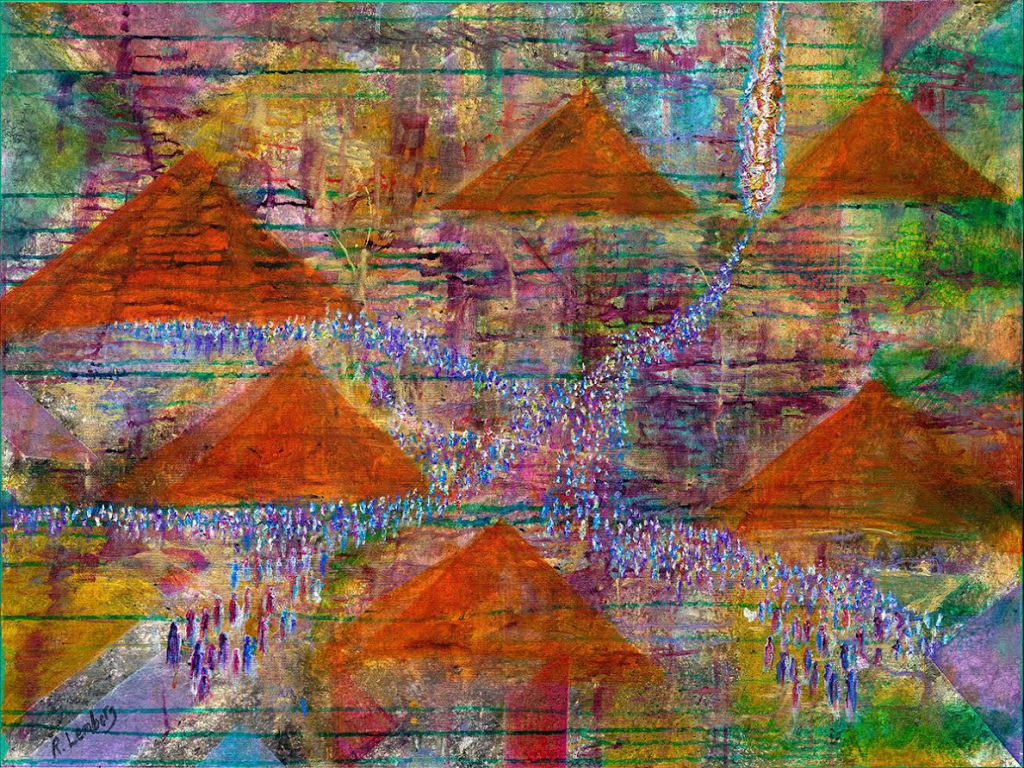
Exodus Out of Egypt, by Rivka Lemberg

At midnight the Lord struck down all the firstborn in Egypt, from the firstborn of Pharaoh, who sat on the throne, to the firstborn of the prisoner, who was in the dungeon, and the firstborn of all the livestock as well. Pharaoh and all his officials and all the Egyptians got up during the night, and there was loud wailing in Egypt, for there was not a house without someone dead.

During the night Pharaoh summoned Moses and Aaron and said, “Up! Leave my people, you and the Israelites! Go, worship the Lord as you have requested. Take your flocks and herds, as you have said, and go. And also bless me.”

The Egyptians urged the people to hurry and leave the country. “For otherwise,” they said, “we will all die!” So the people took their dough before the yeast was added, and carried it on their shoulders in kneading troughs wrapped in clothing. The Israelites did as Moses instructed and asked the Egyptians for articles of silver and gold and for clothing. The Lord had made the Egyptians favorably disposed toward the people, and they gave them what they asked for; so they plundered the Egyptians.

The Israelites journeyed from Rameses to Sukkoth. There were about six hundred thousand men on foot, besides women and children. Many other people went up with them, and also large droves of livestock, both flocks and herds. With the dough the Israelites had brought from Egypt, they baked loaves of unleavened bread. The dough was without yeast because they had been driven out of Egypt and did not have time to prepare food for themselves.

Now the length of time the Israelite people lived in Egypt was 430 years. At the end of the 430 years, to the very day, all the Lord’s divisions left Egypt. Because the Lord kept vigil that night to bring them out of Egypt, on this night all the Israelites are to keep vigil to honor the Lord for the generations to come. (New International Version)

“A horse may run quickly but it cannot escape its tail.”

Russian proverb

The ancient Israelites were in bondage to the Egyptians for hundreds of years. Their oppression finally came to and end with the Lord’s dramatic deliverance of them in the tenth and final plague directed against Egypt.

The actions of the Egyptians eventually and finally caught up with them. Their making slaves of the Israelites was not going to last forever. Even though it took a while, Egypt was held accountable and experienced divine judgment. The empire’s internal moral emptiness would not be able to hold up under the justice of God.

“Empty sacks will never stand upright.”

Italian proverb

Pharaoh was a hard man. The more Moses talked to him the more stubborn Pharaoh got. Eventually, Pharaoh’s heart became like stone; he and his empire fell because they were bent toward the way of injustice. Oppression had been Pharaoh’s proclivity by instructing the Jewish midwifes to kill firstborn sons of Israelite mothers. Now the Egyptians would fall into the very trouble they created for others.

The death of so many on one night, all at once, was too much for Pharaoh and the Egyptians. In such a grief, Pharaoh’s dogged resolve in holding onto Israelite slavery and ostracizing Moses was loosened. He summoned Moses in the middle of the night and commanded the Israelite slaves to be gone – without any conditions or strings attached to it.

The Egyptians wanted them gone, and so, urged them to leave in a hurry – just as God had predicted. All sorts of articles – including silver and gold – were willingly given to the fleeing Israelites by the lamenting Egyptians. No matter how hard and stubborn any earthly ruler is, the plans and purposes of a sovereign God cannot be thwarted.

Finally, the deliverance out of Egyptian bondage happened. The Israelites were free. It was a hasty departure. It was as if the Hebrew people had become so upsetting to the great Egyptian empire, that they vomited them out of their land, projecting the former slaves as far away as they could.

Sometimes people get the notion that if they do something bad, they will be struck by lightning or have some sort of tragedy occur. And when it doesn’t happen, they might reason further in their misguided notions by believing they can get away with bad behavior. So, they keep doing it. But, eventually, this all has a terrible effect.

“Those who lie down with the dogs, rise with the fleas.” English proverb

Actions and inactions have consequences. Those consequences may not happen immediately. However, all of us shall someday harvest the fruit of decisions that were made months, even years or decades, ago.

Make no mistake, God is not mocked. A person will harvest what they plant. Those who plant only for their own benefit will harvest devastation from their selfishness, but those who plant for the benefit of the Spirit will harvest eternal life from the Spirit. Let’s not get tired of doing good, because in time we’ll have a harvest if we don’t give up. (Galatians 6:7-9, CEB)

Almighty God, Creator and Preserver of all humanity, we humbly ask that you make your ways known to people everywhere, and bring saving help to all nations. We pray for Christ’s Church, and all faith communities across the earth, that they be guided and governed by your good, gracious, and benevolent Spirit; and that all who profess and call themselves Christians may be led into truth, and hold the faith in unity, peace, and righteousness.

Blessed Lord, we pray for all who are afflicted or distressed in mind, body, or spirit. May your divine mercy bring them comfort and relief, according to their need. Give them patience through their sufferings, and a joyful outcome from their distress. This we pray through Jesus Christ our Savior and Lord. Amen.

Impatience and Grumbling Are Poisonous (Numbers 21:4-9)

Moses and the Serpent on the Rod

The Israelites left Mount Hor and went on the road toward the Red Sea, in order to go around the country of Edom. But the people became impatient on the way and grumbled at God and Moses. They said, “Why did you bring us out of Egypt to die in this desert? There is no bread and no water, and we hate this terrible food!”

So the Lord sent them poisonous snakes; they bit the people, and many of the Israelites died. The people came to Moses and said, “We sinned when we grumbled at you and the Lord. Pray that the Lord will take away these snakes.” So Moses prayed for the people.

The Lord said to Moses, “Make a bronze snake, and put it on a pole. When anyone who is bitten looks at it, that person will live.” So Moses made a bronze snake and put it on a pole. Then when a snake bit anyone, that person looked at the bronze snake and lived. (New Century Version)

Impatience and irritability. Grumbling and complaining. Show me a person with ants-in-their-pants and I will show you a person who bellyaches and squawks like an old chicken. The antsy person sticks their hand in the glove of criticism, loudly griping about missed expectations for all to hear. Little do they realize that venomous snakes are slithering toward them, attracted by the continual vibrations of complaint.

The ancient Israelites were miraculously delivered from Egyptian bondage by the mighty hand of God. But the celebration soon turned sour. Millions of people were out in the desert, discovering they had no food or water.

There is no account of the people using their spiritual connection with God to ask for help. Instead, their reflexive response was to grumble against God and God’s appointed leader Moses.

God had enough of their constant complaints. The Lord had repeatedly shown mercy and committed love to the people over-and-over again. Yet, they kept putting on their grumpy faces any time something didn’t go their way.

God kept showing patience toward the people, but the people kept demonstrating impatience toward God.

A mosaic of the serpent in the desert in All Saints Church, London, England, by Matthew Digby Wyatt (1820-1877)

If you stop and think about the pathology of our own impatience and complaining (which we all do – come on, admit it) you’ll likely discover that at the heart of it all is a picture in your mind of how you think circumstances ought to go for you to be happy. 

The Israelites expected a nice clean break from Egypt with a smooth transition into the Promised Land. They didn’t sign up for hard circumstances and a bunch of adversity and trouble getting there.

We aren’t so different. Believers go to faith gatherings expecting to be fed and encouraged. Students expect that school will be enjoyable and that they’ll get a good paying job after graduation. Employees expect to go to work and have healthy working relationships and a good boss. Parents expect their kids to listen and obey. You expect your friend or spouse to give you focused attention, the weather to be better, the drivers on the road to be respectful, the little plastic things on the end of your shoelaces to last for the life of your shoes….

And it doesn’t happen, or at least fails to go as planned. So, what happens when all those expectations aren’t realized? 

In a perfect world, we would always respond in a reasoned, wise, and healthy manner. But if we’re feeling like we’re in an emotional place of insecurity out in the desert, our response is more likely to be an impatient and complaint-filled litany about how things are all screwed up.

A great deal of disobedience, bad behavior, angry speech, and poor decision-making has its origins in impatience.

The minute you become impatient, take a long deep breath before you make your next mental decision. Check-in with yourself. Be mindful of what your real expectations are for the circumstance or person in the present moment of becoming upset. Make the decision, from the very beginning, not to complain or argue. Instead, choose to say what you want without grumbling.

It is truly possible to stand for holiness, live for righteousness, and uphold the words and ways of Jesus without being a jerk about it through impatient sighs, annoying facial expressions, and terse words of carping at another person who is made in God’s image.

Monitor yourself throughout the day today. Notice the times you become annoyed. Stop and take a minute to analyze what you are expecting to unfold throughout the day. Instead of grumbling, ask God to strengthen your faith through your upcoming events and encounters. 

God is there to help you, and not to pick on you. If you find yourself having made a poor decision and are suffering the consequences of it, the way of dealing with it isn’t to avoid it. One of the reasons God instructed Moses to make a snake is to clearly demonstrate to the people that they must go through their problems and not try and get around them.

Fortunately, in Christianity, Jesus becomes our bronze snake of deliverance:

In the same way that Moses lifted the serpent in the desert so people could have something to see and then believe, it is necessary for the Son of Man to be lifted up—and everyone who looks up to him, trusting and expectant, will gain a real life, eternal life. (John 3:14-15, MSG)

Holy God, your patience is incredible in the face of human impatience. Yet, your boundaries are firm, and you will not put up with our petulant ways forever. Help me to live into the model of your Son, the Lord Jesus, who with you and the Holy Spirit are attentive to come alongside me to your own glory and honor. Amen.

Who’s the Greatest? (Matthew 18:1-7)

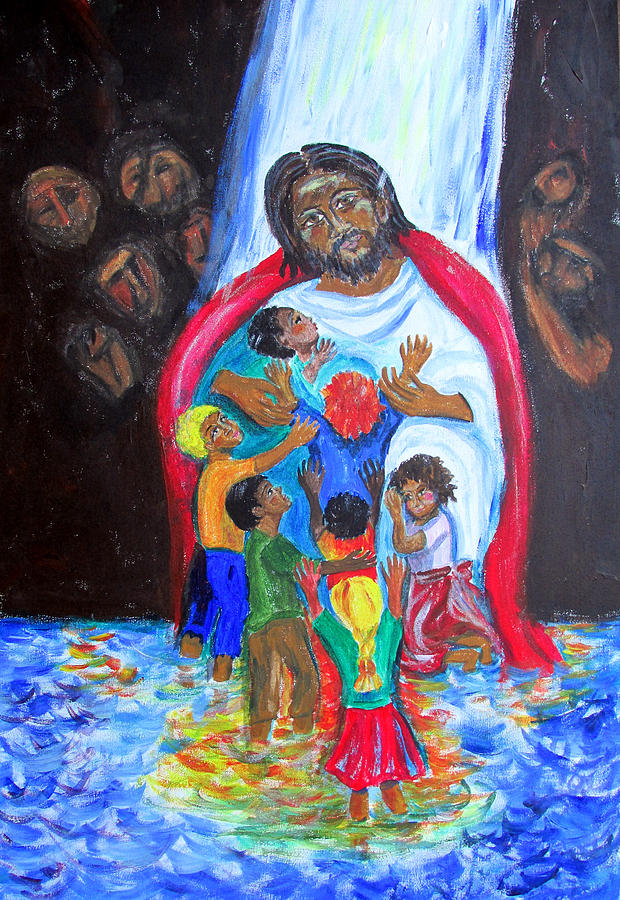
Jesus Loves the Children by Sarah Hornsby

At that time the disciples came to Jesus and asked, “Who is the greatest in the kingdom of heaven?”

Then he called a little child over to sit among the disciples, and said, “I assure you that if you don’t turn your lives around and become like this little child, you will definitely not enter the kingdom of heaven. Those who humble themselves like this little child will be the greatest in the kingdom of heaven. Whoever   one such child in my name welcomes me.

“As for whoever causes these little ones who believe in me to trip and fall into sin, it would be better for them to have a huge stone hung around their necks and be drowned in the bottom of the lake. How terrible it is for the world because of the things that cause people to trip and fall into sin! Such things have to happen, but how terrible it is for the person who causes those things to happen! (Common English Bible)

How would you answer the disciples’ question of who is the greatest in God’s kingdom?

Jesus answered the question by essentially stating that the least among us are the greatest. To be little is to be big. The kingdom hinges on being humble, gentle, meek, and lowly.

That definitely isn’t the way Western society looks at greatness – even the Western Church typically devalues the importance of such virtues and spiritual qualities.

In particular, many Americans takes pride in their can-do spirit. They seem always on the lookout for those who are assertive and can get things done efficiently and quickly. The tragedy of this is that, even though intentions may be noble, such a spirit often ends in causing others to stumble over their prideful beliefs of being hardworking and right.

Methinks Jesus and Horton the elephant would get along well together. In Dr. Seuss’s book, Horton Hears a Who, Horton exalted the littlest of persons whom others could neither see nor hear.

“A person’s a person no matter how small” said Horton to the people completely unconcerned for all the residents of Who Ville, living on a clover. They were unconcerned because the Who’s were invisible to them. 

Dr. Seuss chose to make Horton an elephant, a large creature able to hear with big ears and be attentive to the small. Largeness of heart comes from being attentive to the smallest ones among us – so small that the big people are unaware of them.

People who no one sees or notices, nonetheless matter to Jesus; and so, they should matter to us, too. 

Jesus often mingled with the little people of his time – children, women who had no rights, social misfits like lepers, the chronically ill, religious outsiders, tax collectors, and prostitutes. 

Our world is filled with similar people – angry adolescents, unwanted babies, forgotten old people, the mentally ill, moral failures, immigrants and refugees, and, if we have eyes to see and big ears to hear, lots of poor people who reside on the dark underbelly of society. They are around us, even if we fail to see or hear them.

The way to become great in the kingdom of God is to descend, not ascend, into greatness. The main enemy of any community is a desire to be prominent – it’s called “pride” and it will give us a terrible end if we hold onto it.

The disciples’ question is dripping with a desire for position and prestige. It’s a question meant to posture themselves into prominence and power. They want to know how to climb the ladder in God’s kingdom and be the important people.

I admire Christ’s grace for not throwing up his hands and going off on these guys: “What!? You’ve been with me how long and you ask me a stupid question like that?  Where have you been?  Have you learned nothing from me?” 

But instead, Jesus calmly called a child to him and used them as an example of his answer: Unless you become like this little child you will have no future at all with God. The way to have what you want is through humility.

In Jesus’ day children had no status or rights. Ancient culture was not kid oriented and there was no such thing as a youth culture. Children were, for the most part, viewed as potential adults – weak, small, and unable to contribute much of anything until they grew up. 

Christ’s disciples are to become like children, to become lowly; they are to give up their status and a desire to be important. They can only be big if they become small.

There’s another thing about the smallness of children that we ought to notice: Kids see what adults don’t. Whereas adults make distinctions between people on the basis of race, class, ethnicity, and gender, children see children and will play with just about anyone.

Only by getting on the same level as little people can we ever welcome Jesus; a person who is attentive to the lowly is attentive to Jesus. 

We are not to welcome people because they are great, wise, rich, powerful, good-looking, and just like you and me – but because they are noticed by Jesus. Christ stands for those we may tend to overlook.

The proud person who seeks prominence is forever looking for greener pastures, to do things that will impress others and help them advance up the ladder of success. In such a frame of mind, the proud person pays no attention to who they step on along the way. 

Christians, however, are to be different – giving socially insignificant people the time of day and treating them as important – because they are important to Jesus.

Here’s how Christ’s argument unfolds to the disciples:

  • Humility. Those who become like little children enter God’s kingdom, because it is only accessed through humility.
  • Attention. Those who pay attention and receive these little ones receive Jesus.
  • Rejection. Those who reject these little ones reject Jesus, and by their lack of loving them cause them to sin. 
  • Consequences. Leeching the poor and needy, ignoring the insignificant around us, and devaluing the littlest ones is damnable behavior, according to Jesus.

A person’s a person no matter how small. 

We need humility, to lower our sights in order to see and hear little people. No one is to be overlooked or to fall through the cracks under Christ’s rule and reign.

Loving Lord Jesus, you gave honor to the least, the forgotten, the overlooked, and the misunderstood and misjudged. You came to give first place to the last, those left behind and undervalued. You seek to provide a warm welcome to the lost, to the abandoned and the destitute.

Help us to be your ears to listen to their cries; your voice to speak love and acceptance; your feet to walk beside those in need; and your hands to clothe, feed and shelter them. Lord, in your mercy, hear our prayer. Amen.

How To Deal with Temptation (James 1:12-16)

Eve reaching for the forbidden fruit, by S.J. Grove, 1995

Blessed is the one who perseveres under trial because, having stood the test, that person will receive the crown of life that the Lord has promised to those who love him.

When tempted, no one should say, “God is tempting me.” For God cannot be tempted by evil, nor does he tempt anyone; but each person is tempted when they are dragged away by their own evil desire and enticed. Then, after desire has conceived, it gives birth to sin; and sin, when it is full-grown, gives birth to death.

Don’t be deceived, my dear brothers and sisters. (New International Version)

The slow slog of uphill adversity, at various times, is a common experience of us all. We must deal with circumstances we didn’t choose, and situations that are out of our control. Throw into the mix that many people have few resources, and you have a feeling of being totally overwhelmed.

In this state of being, it’s challenging to maintain solid decision-making, emotional stability, and spiritual support. We need both encouragement and warning so that we can be strengthened in faith.

The Apostle James sought to encourage and warn a small struggling church who were enduring difficult and unwanted situations. He reminded the believers that the person who perseveres under a time of trial and testing of faith is blessed. 

To be “blessed” is to have God’s stamp of approval. God approves of learning, enduring, and maturing through hardship. For such people, God has promised to give “the crown of life.” All the hard lessons we have under our belts, puts us in the position to connect with Jesus and enjoy God.

Don’t blame others

Sometimes, however, we face suffering not because of the circumstances which God brings in our lives, but because of our own unwise response to difficulty. 

Problems are compounded whenever we blame our troubles on others, and refuse to learn what God is trying to teach us. This sort of response has it’s origins in the Garden.  

Adam said to God, “The woman whom you gave to be with me, she gave me fruit of the tree, and I ate.” (Genesis 3:12) The implication of Adam is that he would have remained innocent, if God had not put Eve in the Garden with him. 

Ever since, blame-shifting has been a staple of human behavior. Our bruised hearts and damaged egos send us desperately looking for someone else to blame when we are confronted with our own trouble. 

“There are two eras in American history: the passing of the buffalo and the passing of the buck.”

Will Rogers

Some folks can be so desperate to justify themselves, they end up saying illogical things, such as: 

  • “I wouldn’t lose my temper if my co-workers were easier to get along with, my kids behaved better, and my spouse were more considerate.” 
  • “I would be a patient person if I didn’t have so many things to do, and if the people around me weren’t so slow and incompetent!” 
  • “I would have a pure mind if there were not so many sexual images in our culture.”
  • “I wouldn’t worry about the future if I had more money, and no health problems.”
  • “My spiritual life would be much better if the pastor did a better job.”
  • “I would follow if there were some decent leadership around here.”
  • “I could never forgive that person [or God].”
  • “My neighbor is an incredible cook; I can’t lose weight with such good food.”
  • “I’ll never be happy, as long as that person is in my life.”

So, I ask us, “What will it take?”…

  1. To stop making excuses? 
  2. To quit blame-shifting onto others? 
  3. To trust God and step out in faith?
  4. To cease worrying about what other people think and start doing what God thinks? 
  5. To look at faith as a dynamic relationship with the Lord, instead of just a static thing you possess? 
  6. To read Holy Scripture as if your life depended on it? 
  7. To minister with initiative and confidence? 
  8. To be humble, do justice, and act with mercy? 
  9. To spiritually grow?
  10. To truly enjoy life?

Don’t blame God

It seems that to err is human; to blame it on the divine is even more human.

God cannot be tempted; it’s not an option. God hates sin and disobedience; the Lord has no appeal for it, at all. It’s a moral impossibility for God to even consider attempting to do evil. Therefore, since God cannot be tempted by evil, God cannot tempt people toward evil.

Then why in the Sam Hill would we ever blame anything on God? Because it’s a cheap easy (and pathetic) way of absolving ourselves from responsibility for our own unwise choices, words, and actions. 

Certainly, God tests us, in order to improve our character, and to bring us toward greater spiritual maturity. Yet, God never forces us to make bad, immoral, or evil choices. God may have brought the trial and testing into our lives; but how we respond to it is up to us.

Take responsibility for yourself

The real culprit behind temptation is one’s own personal and strong desire. It’s the intense motive to have-to-do-it, have-to-say-it, and have-to-have-it, which are at the root of temptation. 

We all have legitimate needs, wants, and desires for love, security, companionship, and to make a difference in the world. Yet we may seek illegitimate means to satisfy those needs. We are lured to the hook by the enticing bait of temptation, and if we bite, that’s on us. Our own temptations lure us to satisfy our legitimate needs in illegitimate ways. 

And when we get ourselves in a pickle because of following our own temptations, the internal push to blame others and/or God becomes strong. It doesn’t help that blame-shifting feels good; it gets the monkey off my back – at least for a time. 

But like a bad addiction, blame-shifting needs to occur in a bigger dose, after a shorter duration of time. Before you know it, we’re caught in a destructive cycle. The temptation has enticed us and we have taken the bait.  Like a fish-eyed follower of evil, we succumb to the lust for ambition, revenge, sex, power, fame, or money.

Know the consequences of blaming others

Temptation, like a smooth operator, comes along and gives a slick pitch about how our troubles can be managed or taken away through blaming others, even God. Then, all of sudden, like a star-struck fan seeking to be satisfied, we take the bait and go to bed with the idea. 

We let sin’s temptation have its way with us. Now, it’s inside us. Like a fetus, the small sin grows within. Eventually, this pregnancy will come to full term. But instead of giving birth to life, there is the terrible agony of death.

Conclusion

Everyone struggles in some way with some sort of temptation. We don’t all wrestle with the same demons, but we’re all tempted in some manner. However, the cycle of guilt and separation from God can be broken. The glory of the gospel is that it breaks the power of sin.

So, hear the good news: 

Don’t let anyone fool you by using senseless arguments [blame-shifting]. These arguments may sound wise, but they are only human teachings. They come from the powers of this world and not from Christ… Christ has taken away your selfish desires… God let Christ make you alive when he forgave all our sins.

God wiped out the charges that were against us for disobeying. He took them away and nailed them to the cross. There Christ defeated all powers and forces… Now the forces of the universe don’t have any power over you….

Kill every selfish desire. Don’t be immoral or indecent or have evil thoughts. Don’t be greedy, which is the same as worshiping idols….  You must quit being angry, hateful, and evil. You must no longer say insulting or cruel things about others. And stop lying to each other. You have given up your old way of life with its habits….

God loves you and has chosen you as his own special people. So be gentle, kind, humble, meek, and patient. Put up with each other, and forgive anyone who does you wrong, just as Christ has forgiven you. Love is more important than anything else. It is what ties everything completely together.

Let the peace that comes from Christ control your thoughts. And be grateful. Let the message about Christ completely fill your lives, while you use all your wisdom to teach and instruct each other. With thankful hearts, sing psalms, hymns, and spiritual songs to God. Whatever you say or do should be done in the name of the Lord Jesus, as you give thanks to God the Father because of him. (Colossians 2:8-3:17, CEV)

Amen.