Morality Matters (2 Kings 9:14-26)

Then Jehu, Jehoshaphat’s son and Nimshi’s grandson, plotted against Joram. Now Joram along with all of Israel had been guarding Ramoth-Gilead against Aram’s King Hazael, but King Joram had gone back to Jezreel to recover from wounds that the Arameans had given him when he fought Hazael.

So Jehu said, “If this is the way you feel, then don’t let anyone escape from the city to talk about it in Jezreel.” Then Jehu got on a chariot and drove to Jezreel because Joram was resting there. Judah’s King Ahaziah had also come to visit Joram.

The guard standing on the tower at Jezreel saw a crowd of people coming with Jehu. He said, “I see a crowd of people.”

Joram said, “Take a chariot driver. Send him out to meet them to ask, ‘Do you come in peace?’”

So the driver went to meet him and said, “The king asks, ‘Do you come in peace?’”

Jehu replied, “What do you care about peace? Come around and follow me.”

Meanwhile, the tower guard reported, “The messenger met them, but he isn’t returning.”

The king sent a second driver. He came to them and said, “The king asks, ‘Do you come in peace?’”

Jehu said, “What do you care about peace? Come around and follow me.”

The tower guard reported, “The messenger met them, but he isn’t returning. And the style of chariot driving is like Jehu, Nimshi’s son. Jehu drives like a madman.”

Joram said, “Hitch up the chariot!” So they hitched up his chariot. Then Israel’s King Joram and Judah’s King Ahaziah—each in his own chariot—went out to meet Jehu. They happened to meet him at the plot of ground that belonged to Naboth the Jezreelite.

When Joram saw Jehu, he said, “Do you come in peace, Jehu?”

He said, “How can there be peace as long as the immoralities of your mother Jezebel and her many acts of sorcery continue?”

Then Joram turned his chariot around and fled. He shouted to Ahaziah, “It’s a trap, Ahaziah!”

Jehu took his bow and shot Joram in the back. The arrow went through his heart, and he fell down in his chariot. Jehu said to Bidkar his chariot officer, “Pick him up, and throw him on the plot of ground belonging to Naboth the Jezreelite. Remember how you and I were driving chariot teams behind his father Ahab when the Lord spoke this prophecy about him: Yesterday I saw Naboth’s blood and his sons’ blood, declares the Lord. I swear that I will pay you back on this very plot of ground, declares the Lord. Now pick him up, and throw him on that plot of ground, in agreement with the Lord’s word.” (Common English Bible)

Jehu shoots an arrow that strikes Joram in the back, by Jan Luyken, 1712

Ancient storytelling often had a moral to it. Historical writing was typically less concerned for objective details and much more interested to point out, in narrative form, how people morally lived and what happened to them. Rather than commenting on what the moral(s) are, the storyteller lets the story speak for itself.

Today’s Old Testament lesson brings several kings into the story (Jehu, Joram, Ahaziah, and Ahab). We are meant to contrast Jehu’s zeal for justice and living into God’s call with the others kings’ injustice and living for power and wealth. The final end of the kings is designed for us to see the ultimate consequence of injustice.

Elisha the prophet had given a non-descript Israelite military man, Jehu, instructions from the Lord about carrying out divine judgment against the unjust royal house of Omri – and more specifically, against King Ahab and Queen Jezebel.

After Jehu’s prophetic call and anointing, the soldiers under his command immediately acclaimed him as king. Jehu wasted no time in going after the people responsible for years of abusive power.

Rather than simply giving orders to his soldiers and remaining in back of his army, Jehu led his men into the thick of battle. We get the picture of a person with single-minded determination, aggressively going after unjust leaders; and seeking to upend a royal system of power which strayed far from their original mandate of upholding God’s system of law and covenant.

Jehu’s zeal is exemplified in his chariot driving: He was going to speedily get to where he needed to go, and do what he needed to do.

The story emphasizes the increasing drama of messengers sent to enquire of Jehu’s intentions: Are they peaceful? Clearly, no. There was betrayal afoot, as Jehu boldly drove against his own king of Israel, as well as the king of Judah.

The unjust kings had created a situation in their nations of peace for themselves, but not necessarily others. So, Jehu would take that peace from them.

The two kings of Israel and Judah personally went out to Jehu, not realizing what was about to happen. Ironically, it took place on land which Naboth had previously owned, and of which Ahab and Jezebel diabolically stole. It is a powerful depiction of what goes around comes around.

Jehu quickly got to the nub of the issue: There cannot be peace as long as Jezebel’s idolatry and witchcraft abound in the land. Her wicked ways had become thoroughly imbued throughout both Israel and Judah, and was supported by both of the kings.

From the perspective of Jehu, there was no peace that could exist between a follower of Yahweh and a practitioner of the Baal and Asherah cults. Jehu’s intent was to fulfill the prophecy that was announced by Elijah twelve years earlier. And he went about it with violent zeal.

Whenever the Lord begins to exact judgment and ensconce justice, there’s no way anyone is going to stop it. Joram went out to face an enemy that he could not stop. There was no escaping the inexorable force of God.

Divine providence brought the kings together on the very piece of land that was once Naboth’s vineyard – the place where Ahab took sinister control of it. (1 Kings 21). Murderous theft was the inevitable result of spiritual fornication; Ahab and Jezebel had prostituted themselves with the gods Baal and Asherah.

Spiritual adultery never ends well. Because God is a jealous Lover. Peace is not achieved by letting everyone do whatever they want. Instead, it is established through integrity, justice, truth, and ethical morality.

Eternal God, in whose perfect kingdom the sword of righteousness is drawn: Spread abroad your mighty Spirit, so that all peoples may be gathered under the banner of the Prince of Peace, as children of one Father; to whom be dominion and glory, now and forever. Amen.

Finding the Book of the Law (2 Kings 22:1-10)

Josiah was eight years old when he became king, and he reigned in Jerusalem thirty-one years. His mother’s name was Jedidah daughter of Adaiah; she was from Bozkath. He did what was right in the eyes of the Lord and followed completely the ways of his father David, not turning aside to the right or to the left.

In the eighteenth year of his reign, King Josiah sent the secretary, Shaphan son of Azaliah, the son of Meshullam, to the temple of the Lord. He said: “Go up to Hilkiah the high priest and have him get ready the money that has been brought into the temple of the Lord, which the doorkeepers have collected from the people. Have them entrust it to the men appointed to supervise the work on the temple. And have these men pay the workers who repair the temple of the Lord—the carpenters, the builders and the masons. Also have them purchase timber and dressed stone to repair the temple. But they need not account for the money entrusted to them, because they are honest in their dealings.”

Hilkiah the high priest said to Shaphan the secretary, “I have found the Book of the Law in the temple of the Lord.” He gave it to Shaphan, who read it. Then Shaphan the secretary went to the king and reported to him: “Your officials have paid out the money that was in the temple of the Lord and have entrusted it to the workers and supervisors at the temple.” Then Shaphan the secretary informed the king, “Hilkiah the priest has given me a book.” And Shaphan read from it in the presence of the king. (New International Version)

Imagine the Book of the Law, the covenant code given to Moses and handed down to the people over the centuries, was simply lost. And nobody missed it.

God’s Law was neglected and not consulted for such a long time, that it was forgotten, hidden within the Temple of the Lord. No wonder there was such a string of kings before Josiah that were labeled as doing evil in the sight of the Lord.

It’s quite difficult to follow God’s Law if you don’t know what it is.

King Josiah hears the Book of the Law, by Julius Schnorr von Carolsfeld (1794-1872)

Today’s Old Testament lesson is a cautionary story of what happens when an entire people drift so far from the commandments of God, that they are ignorant about what is most important for them as a nation.

Josiah, contrary to the kings before him, did what was right. The spirit of old King David was still there. The desire to know God and God’s law was still within the line of David’s progeny.

Because the many kings before Josiah were negligent to the things of God, the Temple had fallen into a terrible state of disrepair. Much like an old abandoned Victorian house from another century, one could only imagine what the grandeur of place was once like.

King Josiah decided that the house of the Lord needed a lot of attention and tender loving care. So he commissioned the priests to ensure that skilled workers would bring the building back to life again. The place would once again, Josiah reasoned, be the sign of God’s presence amongst the people.

Then, lo and behold, once the repairs and restoration began, Hilkiah the high priest went to Shaphan the secretary and told him that, while engaging in the cleanup and the work, the Book of the Law (which was literally a large scroll) was discovered.

The very Torah of God had been lost, and then was discovered by accident when renovating the Temple. It seems inconceivable that such important documents could be unaccounted for.

I suppose it’s possible that the previous King Manasseh – a nasty guy who worshiped other gods – may have wanted it destroyed. So perhaps it was hidden by some priest.

It seems, however, that the Torah scroll was simply unused, then forgotten, and thus, eventually lost.

It apparently was gone long enough that Shaphan the secretary seemed clueless as to what it actually was. The scroll was like some sort of antique object that no one uses anymore, as if it were an old cuckoo clock, or a vintage hand crank pencil sharpener.

Almost in passing, while Shaphan was reporting about the progress of the repairs, he mentioned that the Book of the Law, the Torah, had been found in the Temple. He nonchalantly presented it, like a nice old novelty item to gawk over. But then he proceeded to open the scroll, and read its contents aloud to King Josiah….

Hearing the words of the law – the ordinances, commands, and precepts of God – would undo Josiah and set him on a grand project of thorough reformation within the nation of Judah.

Little did the inhabitants of Judea know, however, that God had already set in motion a plan for events which would change Jewish history forever. And it was coming because generations of people had ignored the justice, righteousness, and goodness which God intended for them to follow.

When purposeful ignorance goes on for too long, even when a people makes a concerted effort to change and do what they should have been doing all along, sometimes that effort is too little, too late. And many will suffer the consequences of their past failures.

Instead of worrying about what the world is coming to, and what it might become tomorrow, today is the day to make the choice to do justice, to love mercy, and to walk humbly with your God.

What are you waiting for!?

God of faithfulness, your servant Josiah restored your holy words to a people longing for your guidance. Help us learn your Scriptures so that we might carry your words in our hearts, in our words and in our actions. Amen.

Accountability Is Real, and It Matters (Ezekiel 14:12-23)

The word of the Lord came to me: “Son of man, if a country sins against me by being unfaithful and I stretch out my hand against it to cut off its food supply and send famine upon it and kill its people and their animals, even if these three men—Noah, Daniel and Job—were in it, they could save only themselves by their righteousness, declares the Sovereign Lord.

“Or if I send wild beasts through that country and they leave it childless and it becomes desolate so that no one can pass through it because of the beasts, as surely as I live, declares the Sovereign Lord, even if these three men were in it, they could not save their own sons or daughters. They alone would be saved, but the land would be desolate.

“Or if I bring a sword against that country and say, ‘Let the sword pass throughout the land,’ and I kill its people and their animals, as surely as I live, declares the Sovereign Lord, even if these three men were in it, they could not save their own sons or daughters. They alone would be saved.

“Or if I send a plague into that land and pour out my wrath on it through bloodshed, killing its people and their animals, as surely as I live, declares the Sovereign Lord, even if Noah, Daniel and Job were in it, they could save neither son nor daughter. They would save only themselves by their righteousness.

“For this is what the Sovereign Lord says: How much worse will it be when I send against Jerusalem my four dreadful judgments—sword and famine and wild beasts and plague—to kill its men and their animals! 

“Yet there will be some survivors—sons and daughters who will be brought out of it. They will come to you, and when you see their conduct and their actions, you will be consoled regarding the disaster I have brought on Jerusalem—every disaster I have brought on it. You will be consoled when you see their conduct and their actions, for you will know that I have done nothing in it without cause, declares the Sovereign Lord.” (New International Version)

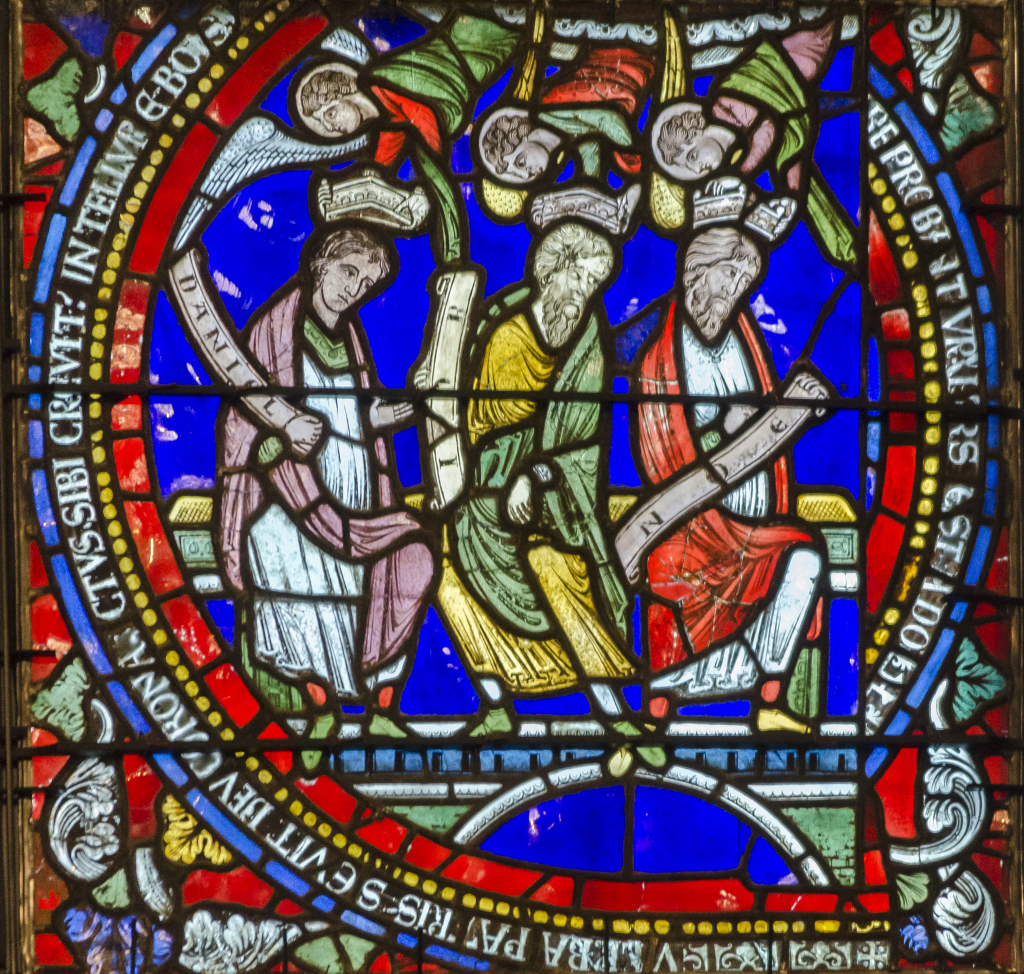
Stained glass of the three righteous men: Daniel, Job, and Noah

No person, group, institution, or nation can act unjustly forever. The prophet Ezekiel made it clear that everyone will be held accountable for injustice and wickedness, for crimes against humanity and against God.

Furthermore, there is no nation or group which can rely on a few persons who do right, while the rest of the people swim in injustice and unrighteousness. Righteous persons save only themselves; they cannot make decisions and take over the life of another person.

Ezekiel wanted to make sure his listeners got the message of individuals only saving themselves, and not riding on the coattails of others. The prophet went out of his way to communicate that each individual person will be held responsible for their own actions; they will be judged on what they themselves have done, and not what another has or has not done.

Even the family of a righteous person will not be spared divine judgment because of that individual’s righteousness. One shall be held accountable for what that one has done, period.

Specifically, in the text, God was ready to execute judgment on Jerusalem. War, wild animals, famine, and disease would come upon them because of unfaithfulness, injustice, and unrighteousness.

Just because the city had the temple, this would not save them. Just because there are a few righteous persons in the city, they would not save it. Just because a close loved one is faithful and righteous, will not mean that God would spare the city.

A few good works of a few people, do not cancel out pervasive and consistent evil which is perpetrated by many people. Each person is responsible for their own behavior. No one gets a pass, simply because they know certain people and are well-connected.

Evil is evil, no matter whether it is perpetrated by believers or unbelievers. No nation, and no person, is off the hook; all persons will be held accountable for doing justice, loving mercy, and walking humbly with God.

Even if three of the most righteous persons show up – Noah, Daniel, and Job, who were famous for their moral integrity – their combined righteousness and faithfulness would not keep away divine judgment from happening in an immoral and unethical society. Only those three alone would be delivered.

There is no such thing as salvation by proxy. Each individual person must work on themselves, without blaming others, inordinately depending on others, nor ignoring God and wishing God did not see, or does not exist at all.

Evil persons do not get any preferential treatment from God, just because they have a prominent position or are famous. The Lord, as Sovereign of the universe, has every right to exact divine retribution. And God will do it without showing favoritism.

Just as God shows mercy without prejudice, so will God extend judgment without any prejudice.

The presence of great light means that there is also the presence of great darkness. If we want a great God of love and mercy, then we must also accept the God of wrath and judgment; and vice versa.

We are made in God’s image, and not the other way around. It is our task to submit to the high, holy, and sovereign Lord of all. It is not God’s job to be the divine Santa Claus who submits to us. The Lord is no divine genie who we can keep in a bottle, and summon whenever we so desire.

No matter one’s theology or spirituality, everyone discerns that they are to be responsible in this life, and are accountable to forces greater than themselves.

This is one of those universal realities that all of us need to sync our lives with – or suffer the consequences.

Almighty God and Sovereign Lord of all, I embrace my accountability to you. Forgive me for when I live as though I need not give an account of what I said and did. I affirm that I am accountable for how I treat others; and I realize that what I do to others, positive or negative, I am doing to you, their Creator. Sustain me in faith and patience, I pray. Amen.

Have Enough Sense to Learn Some Life Lessons (Proverbs 19:24-29)

Some people are too lazy to put food in their own mouths.

Arrogance should be punished, so that people who don’t know any better can learn a lesson. If you are wise, you will learn when you are corrected.

Only a shameful, disgraceful person would mistreat his father or turn his mother away from his home.

My child, when you stop learning, you will soon neglect what you already know.

There is no justice where a witness is determined to hurt someone. Wicked people love the taste of evil.

A conceited fool is sure to get a beating. (Good News Translation)

I believe one good practice is to ponder the biblical proverbs and write them in our own words. So, here is today’s Proverbs lesson in my own colloquial words, with a brief bit of commentary:

There are folks who have gotten so used to laziness that they don’t even use their hands to feed themselves.

It’s important not to enable such persons to be this way by bringing them food and feeding them. It reinforces bad behavior, and will only frustrate you if you give-in to the rationalizations from the lazy person.

Arrogant fools need sense enough to see that foolish stupidity leads to punishable consequences; but a person with good sense learns the humility of being corrected without having to be harshly punished.

Part of what makes a person foolish and arrogant is that they honestly believe they’re an exception to the rules, that they can do what they want and not suffer the consequences. Conversely, the wise person doesn’t always need to learn the hard way. They listen to correction and accept it, thus avoiding adverse consequences from continuing in a particular way.

Kids without any sense at all are a disgrace to their parents; they steal from mom and dad and refuse to care for them in their need.

A parent’s greatest shame is when one of their children ignore what they’ve been taught and use the parents to get what they want. And then when mom and dad have a need, the kid has every excuse in the book to not help them. Unfortunately, there are times when a parent must take action to protect themselves from a wayward child. It isn’t healthy to let your children use you with impunity.

If you have no inclination to learn, you will eventually become as dumb as a brick.

Anyone who doesn’t take the stance of being a life-long learner will end up losing what little knowledge they have. That’s because memory is tied to actionable learning. If you don’t use it, you’ll lose it.

A witness who lies brings harm to both the court system and the persons involved; he is just like a criminal who commits crimes and revels in a lie as if it was a delicious meal.

Sadly, there are some people in this old fallen world who take delight in lying, cheating, and stealing. It gives them a twisted feeling of superiority and control to manipulate a person or a system. So, beware of the one who has no conscience.

The only thing an arrogant fool can expect to get in this life (and the next) is punishment.

A fool is a fool because they neither learn a lesson from observing what happens to others, nor learn from their own mistakes, misplaced words, and bad behavior. Although they shouldn’t be surprised whenever they are fired from a job, arrested by the police, or have a spouse leave them, they are; somehow they feel entitled to live as they please and have others accommodate to their life.

The biggest chunk of the Book of Proverbs (chapters 10-22) are wise sayings framed mostly in couplets. The majority of the verses are a contrast between the wise and the foolish, the righteous and the wicked, the good and the bad.

The contrasts are meant to demonstrate consequences. If we make decisions and live our lives in a good and right way, then it is likely that we will be successful and have some overall happiness.

However, if we choose to go through life like the fool, then we should expect some rather adverse consequences.

For example, both parents and children need to make some responsible choices in order to live well. Parents are to put a great deal of effort into raising, training, and loving their children so that they can be successful in life. Children are to respond by accepting parental teaching and seeking to live into the wisdom taught to them.

And yet, there are parents who are uncommitted to preparing their children for adulthood. And there are adult children who want nothing to do with anything their parents tell them, believing their mom or dad to be stupid or out of touch. However, sooner or later, they will learn a hard lesson.

A happy family is a beautiful thing; a contentious bunch of relatives always walks away hurt.

Every day is an opportunity to build on a wise foundation of life. The sorts of decisions we make, and why we make them, is of upmost significance for a good, right, and just way of living. And this wisdom, ideally, is to be passed on by both words and actions.

No matter who we are – whether parents or children, community leaders or citizens, managers or employees, neighbors or nations, we are all to grow in maturity by learning to make wise choices in life which bless others, and thus, bless yourself.

We are neither to live arrogantly and selfishly, nor are we to allow bad attitudes and behaviors to exist within our families, communities, and workplaces.

The beginning of wisdom in living a good life is to know God and be a life-long learner of sacred wisdom literature. This is the first and most important choice of all.

All-wise and all-powerful God of the universe, you have given dominion over this earth, in order that we may steward good and right living which allows all life to thrive and flourish. Give us wisdom to use all that you have given, so that no one may suffer from our foolish stupidity, and that the generations yet to come may know that there is a good God in heaven who blesses those who do right and forsake evil. Amen.