
I Concede (Job 42:1-6, 10-17)

By Bible Art

Then Job answered the Lord:

“I know that you can do all things
    and that no purpose of yours can be thwarted.
‘Who is this that hides counsel without knowledge?’
Therefore I have uttered what I did not understand,
    things too wonderful for me that I did not know.
‘Hear, and I will speak;
    I will question you, and you declare to me.’
I had heard of you by the hearing of the ear,
    but now my eye sees you;
therefore I despise myself
    and repent in dust and ashes.”

…And the Lord restored the fortunes of Job when he had prayed for his friends, and the Lord gave Job twice as much as he had before. 

Then all his brothers and sisters came to him, and all who had known him before, and they ate bread with him in his house; they showed him sympathy and comforted him for all the evil that the Lord had brought upon him; and each of them gave him a piece of money and a gold ring. 

The Lord blessed the latter days of Job more than his beginning, and he had fourteen thousand sheep, six thousand camels, a thousand yoke of oxen, and a thousand donkeys. He also had seven sons and three daughters. He named the first Jemimah, the second Keziah, and the third Keren-happuch. In all the land there were no women so beautiful as Job’s daughters, and their father gave them an inheritance along with their brothers. 

After this Job lived one hundred and forty years and saw his children and his children’s children, four generations. And Job died, old and full of days. (New Revised Standard Version)
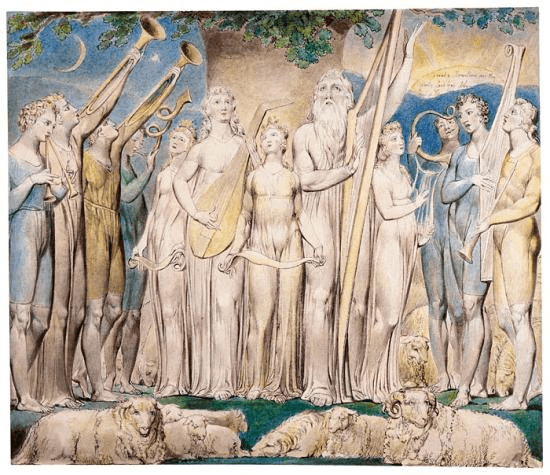
Job is restored, by William Blake (1757-1827)

Job was in awful suffering. He contended with God about it. Job’s friends contended with Job. In the end, God never gave a humanly suitable answer to the problem of suffering. Namely, because we cannot understand the answer, even if it is provided.

Indeed, the gap between God and humanity is quite pronounced. God is the Creator. We are creatures. Yet, God did vindicate Job.

That’s right God affirmed Job – and not Job’s companions. Even though Job did what many a believer in God today believes is wrong, perhaps even sacrilegious or sinful.

Job argued, confronted, grappled with, and even opposed God for the terrible troubles he faced in losing his family, his wealth, and his health. He fully engaged God.

Job’s friends, however, did no such thing. Instead, they argued, confronted, grappled with, and even opposed their friend Job. They fully avoided God.

In the end, Job conceded that he himself knows nothing. Yet, there is still the hint of complaint within him. This is good. Job did not stop engaging God. He remained faithful and devoted.

Let us never believe that faithfulness and devotion to God involves putting up a false front and nice polite piety. Prayer, in truth, is a hard wrestling with God, a struggling and working through all the difficulties of this unfair life.

God is not the least offended by our full, real, and raw engagement of him. But God is offended by avoiding such engagement altogether.

All of us, in reality, speak mostly in ignorance. We talk about things we don’t really understand. The only thing we can be 100% truthful about, however, is ourselves – about how we are really doing, feeling, experiencing, believing, struggling with, etc.

I myself am the true expert on me – and you, the expert on you. And this truth I can bring to God anytime, anywhere. The Book of Job affirms to me that this is the sort of devotion and sacrifice which the Lord is pleased with.

Job gained some knowledge and understanding through personally encountering God. The Lord God almighty, Creator of heaven and earth, actually spoke to Job in a direct revelation of the Divine presence.

This is an affirmation of Job’s integrity. But the godless, disintegrated, and fragmented person cannot see God or expect a personal audience with God.

Through all that Job had been through, he held to his integrity, and held onto God, both at the same time. In the end, he still did not understand why he had to go through such horrible suffering.

English translations of the Hebrew text don’t do it justice. There is always something lost in translation of any language to another. And it seems what is lost here is that Job was perhaps still protesting at the end. Yet, it comes across in English as Job despising and abhorring himself, as if he had done something very wrong.

“I despise myself,” misses the mark. Without getting into some deep grammatical Hebrew waters, I wonder if the phrase might better be rendered, “I protest.” What is meant to be conveyed is that Job still acknowledges what he originally held onto. Namely, that he has done nothing wrong, did not deserve what he went through, yet has never rejected God, nor lost faith in God.

Job did not need to repent of some secret sin, as his friends supposed. Job repenting does not mean because of sin; Job’s repentance was a change of position from mourner and complainer, to accepting the situation as it is, without answers.

So, this brings us back to the beginning of the book. God is God. There are celestial forces and operations in play we know nothing about. Humans are not God. Humans are never going to get most of what is happening in this world. And humans will inevitably experience hard and bad things – and not know why.

No answers given. No change of situation (yet). But Job changed. He changed his mind about how to live with what he was experiencing. He relinquished his complaint, and decided to keep living, even though he did not get answers.

Honestly, this response of Job is more consistent with my own experience of awful suffering, and more faithful to the text of Scripture. Much like Jacob wrestling with the angel, Job had to finally concede and relent, and continue on his life journey, come what may.

Following Job’s intercession for his friends, God restored Job to wealth and family. A significant piece of this restoration was Job’s wider community of friends and family who gathered around him, giving Job the consolation and comfort that the three “friends” in the book did not provide.

The community cared for Job, not through nice theological phrases, but with genuine fellowship. They shared together around the table, the community giving both a meal and contributing monetary gifts for Job’s needs.

The Book of Job ends, perhaps with as many, or more, questions than when it started. Answers, however, are not the point.

Rather, Job’s incredible and awful experience of suffering and redemption becomes an invitation for you and me to have a more expansive view of what a relationship with the living God truly looks like.

May God bless you with discomfort
At easy answers, half-truths, and superficial relationships,
So that you may live deep within your heart.

May God bless you with anger
At injustice, oppression and exploitation of people,
So that you may work for justice, freedom and peace.

May God bless you with tears
To shed for those who suffer pain, rejection, hunger, and war,
So that you may reach out your hand to comfort them
And turn their pain into joy.

And may God bless you with enough foolishness
To believe that you can make a difference in the world,
So that you can do what others claim cannot be done
To bring justice and kindness to all our children and the poor. Amen.

Be Honest (Job 42:7-9)

Job’s Sacrifice, by William Blake (1757-1827)

After the Lord had finished speaking to Job, he said to Eliphaz, “I am angry with you and your two friends, because you did not speak the truth about me, the way my servant Job did. Now take seven bulls and seven rams to Job and offer them as a sacrifice for yourselves. Job will pray for you, and I will answer his prayer and not disgrace you the way you deserve. You did not speak the truth about me as he did.”

Eliphaz, Bildad, and Zophar did what the Lord had told them to do, and the Lord answered Job’s prayer. (Good News Translation)

After all of Job’s terrible trouble in losing everything and everyone he cared about; after all of the longwinded speeches of his supposed friends; and after God’s breaking of silence through unanswerable questions; the epilogue of the story brings us God’s verdict concerning Job and his situation.

God finally dispenses his assessment, and renders his judgment. The Lord was not at all happy with Job’s companions; and was pleased with Job. Therefore, God made a decision against the companions, and for Job.

Four times in three verses, God refers to Job as “my servant,” but does not describe the friends as such. It is Job, and not Job’s friends, who spoke truth. Only Job spoke words consistent with reality.

At best, the friends spoke unhelpful words. At the worst, their words were hurtful and full of hubris. In retrospect, they probably should have at least kept their mouths shut. And ideally, they could have been true comforters, and consoled Job in his agony.

This gets at something which I believe we all need to get a firm hold upon: Not extending help, mercy, and consolation to those in dire straits, pisses-off God.

It irks God because it is a misrepresentation of God’s basic character, and distorts God’s true nature.

Being dishonest and pretending to be okay when one is not…

telling someone who is hurting to suck it up and confess their sin…

believing that the world operates according to good guys getting health and wealth, and bad guys getting sickness and poverty…

downright angers the holy and merciful God of the universe.

Job, unlike the Three Stooges he had as friends, affirmed what is right and true:

  • God is the Sovereign of the universe who dispenses both good and bad (Job 2:10)
  • God is the One who gives and who takes away (Job 1:21)
  • God is the Lord to whom we must bow in willing submission (Job 42:5-6)

In the dialogue with his friends, Job rightly insisted that God is sometimes an enemy, and that God’s inexplicable silence and absence is unjust and destructive.

I don’t want you to easily pass over what I just referred to, or to flip-out over it. In truth, God is both present and absent. And God’s absence hurts. Sometimes, it hurts like hell. We must affirm that God is sometimes silent. There are times when it feels like God is on vacation and is paying no attention.

I want you to get ahold of this important dimension to the spiritual life:

Human pretentions and posturing only present a false self to God and the world. That sort of behavior angers God. The Lord wants honest vulnerability.

Whereas Job’s friends insisted on maintaining theological respectability and an ordered theological system, Job essentially said, “To hell with all that!”

And Job was right.

Job contended with God. He cried, yelled, and exposed his innermost thoughts and feelings to God. Job was real. No phoniness existed with him. Yet, Job did not forsake God, curse God, or say there was no God.

The genuine spiritual life is always a tricky and risky combination of devotion and confrontation toward God.

Job presented his true self to God.

Job’s friends presented to God what they believed God wanted to see and hear.

There is a big difference between those two approaches.

God affirmed Job. God was against Job’s friends.

Maybe today it is necessary to rethink what you have always believed it is which gets God’s affirmation, and what raises God’s ire.

If we cannot be honest about what we are really thinking, and about how we are really doing, then we are hopeless people. In that state, no one can help us. And God is not pleased.

The final verdict of God is that only the prayers of one who speaks truth, like Job, will be effectively heard. Less honest prayers, like those of Job’s wife and friends, are foolish and ineffective.

One of the big overall messages of the Book of Job is this: For God’s sake, be honest!

My own culture is one of Midwest nice. That’s a nice way of saying that Midwesterners are mostly dishonest creatures. Every Midwesterner I know, understands being nice and polite to someone’s face, and then speaking gossip and slander to their back.

Ask any Midwestern American how they are doing, and they’ll tell you, “Just fine,” or “Great!” or “The sun is shining,” or some other deflection or blathering lie about how they are really doing. More than once, I have actually heard a depressed person with suicidal ideation tell another person that they are “doing fine today.”

That sort of claptrap gets us nowhere, especially with God. The Lord is okay with you and I telling him what we really think, even if we are extremely upset with God. God isn’t bothered by our anger, yelling, or messed-up thinking. But God is bothered by our pretending, our dishonesty, and our false presentations.

None of this means that we must wear our heart on our sleeve. In fact, I have found that persons who declare to me that they “tell it like it is,” are some of the most false people on the planet. It’s usually a sign that I’m not going to get from them how they are really feeling. It usually means they’re angry, and want to talk smack against someone, without ever examining themselves.

Don’t be a jerk. There are nice jerks, and obnoxious jerks, but in the end, they’re all just jerks. You and I really can speak honest words of truth, without being a jerk about it.

Job was honest, real, raw, hurt, angry, sad, lonely, and grieving out of his mind. And he was no jerk. And God affirmed him.

Personally, I’d rather have God’s affirmation than anyone else’s. How about you?

Almighty God, help us to speak and act truthfully in all situations. May we be honest with ourselves and with others, building trust and integrity in our relationships. Thank you for your example of truth and honesty. Help us to follow in your footsteps and to live with authenticity.

Guide us to be honest even when it is difficult, recognizing that honesty is the foundation of trust and respect. Help us to confront our own falsehoods and to seek the truth in all aspects of our lives. May we create environments where honesty is valued and encouraged, fostering open and transparent communication.

We pray for those who struggle with honesty, asking for your guidance and support in their journey towards truthfulness. Thank you for the clarity and peace that comes from living honestly. Help us to embrace and uphold this value every day. Amen.

Confronting the Evil in Front of Us (Mark 6:14-29)

St. John the Baptist rebuking Herod, by Giovanni Fattori (1825-1908)

King Herod heard of it, for Jesus’s name had become known. Some were saying, “John the baptizer has been raised from the dead, and for this reason these powers are at work in him.” But others said, “It is Elijah.” And others said, “It is a prophet, like one of the prophets of old.” But when Herod heard of it, he said, “John, whom I beheaded, has been raised.”

For Herod himself had sent men who arrested John, bound him, and put him in prison on account of Herodias, his brother Philip’s wife, because Herod had married her. For John had been telling Herod, “It is not lawful for you to have your brother’s wife.” 

And Herodias had a grudge against him and wanted to kill him. But she could not, for Herod feared John, knowing that he was a righteous and holy man, and he protected him. When he heard him, he was greatly perplexed, and yet he liked to listen to him. 

But an opportunity came when Herod on his birthday gave a banquet for his courtiers and officers and for the leaders of Galilee. When his daughter Herodias came in and danced, she pleased Herod and his guests, and the king said to the girl, “Ask me for whatever you wish, and I will give it.” And he swore to her, “Whatever you ask me, I will give you, even half of my kingdom.” 

She went out and said to her mother, “What should I ask for?” She replied, “The head of John the baptizer.” Immediately she rushed back to the king and requested, “I want you to give me at once the head of John the Baptist on a platter.” The king was deeply grieved, yet out of regard for his oaths and for the guests, he did not want to refuse her. 

Immediately the king sent a soldier of the guard with orders to bring John’s head. He went and beheaded him in the prison, brought his head on a platter, and gave it to the girl. Then the girl gave it to her mother. When his disciples heard about it, they came and took his body and laid it in a tomb. (New Revised Standard Version)

Feast of Herod with the Beheading of St John the Baptist, in the Museo del Prado, Madrid, Spain

The earthly life and mission of Jesus was connected to the social and political affairs of Judea and the Roman Empire. In truth, Christ’s impact is never only ethereal; rather, it smacks against every system and organization in this world.

John the Baptist’s death was closely connected to Christ’s mission and ministry; and it was also a result of the social and political forces John was subjected to. This would explain why Herod thought of Jesus as a resurrected John, after killing him. Both the messages of John and Jesus were met with resistance by the powers that be.

Marriages in the ancient world, especially among governmental officials, were primarily political affairs, and not love arrangements. The more authority and power a person had, the greater the political implications and impact there was. And marriage was one way of consolidating more power.

Herod’s marriage to Herodias may have been politically expedient, but was ethically repugnant, and John let him know about it. Herod was both a Jew and a Roman official, with his actual allegiance being to himself.

Herodias considered John as politically repugnant and found it unethically expedient to silence him once and for all when she had the opportunity. John the Baptist discovered first-hand that hell hath no fury like a woman’s scorn. Herodias hated him and waited for an opportune time to be rid of him once and for all.

But not only did Herodias orchestrate John’s demise, she did it in a way that sought to humiliate him. To die in battle at the hand of an enemy soldier was an honorable death; but to be executed because of a woman’s handiwork was a mark of shame.

Anyone who lives for God and speaks truth to power will nearly always suffer deep consequences. Hence, this is why a great many prophets ended up dead, often by tortuous methods – including Jesus and nearly all his original disciples.

Unfortunately, there are individuals in this world who are incapable of doing good.

Whenever such persons talk a good line, or do a good deed, it’s always in the service of a larger evil agenda. They often end up in positions of authority, simply because they have no scruples and will lie to you with a straight face.

And they will do anything to not only hold on to their power, but to acquire more so that they can be in control of everything around them. Of course, the people around such a person are miserable. They typically feel powerless to change the situation.

So, if there’s going to be transformation, there will need to be a prophet – someone like John the Baptist – who has the courage to speak truth to power and remind the world that God is the sovereign of the universe.

The Gospel writer Mark presents Herodias as a person with influence and power who only cares about her own interests. She had no scruples in using her daughter for malevolent purposes.

Whereas the young daughter of the synagogue ruler Jairus was (earlier in Mark’s account) raised to life by Jesus, in today’s story the young daughter of Herodias became the vehicle of a grisly murder. And, of all things, it’s this girl who brought the severed head of John the Baptist on a platter to her mother.

We are meant to see the impact and consequence when those in power have self-centered objectives and dark hearts. This is in direct contrast to both Jesus Christ and John the Baptist, both of whom gave their lives for that which is right, just, and good.

God’s mercy and redemption will eventually overwhelm all of creation. The cross and resurrection of Christ have won the victory over evil. Yet, until Christ returns, the dark forces of this old world know their time is short; and they are doing everything they can to throw a monkey wrench into the benevolent machine of grace, before the demonic forces themselves are thrown into the pit forever.

Christian mission and ministry was never designed to be easy nor pain-free. But it is meant to bring hope, love, redemption, peace, and satisfaction to all who believe.

Christ has connected himself to us. Let’s keep that gracious connection going by doing what is right and living a good and just life, and confronting the evil in front of us – to the glory of God. Amen.

Luke 10:13-16 – Confronting Hard Hearts

“Woe unto You” by French painter James Tissot (1836-1902)

“Woe to you, Chorazin! Woe to you, Bethsaida! For if the miracles that were performed in you had been performed in Tyre and Sidon, they would have repented long ago, sitting in sackcloth and ashes. But it will be more bearable for Tyre and Sidon at the judgment than for you. And you, Capernaum, will you be lifted to the heavens? No, you will go down to Hades.

“Whoever listens to you listens to me; whoever rejects you rejects me; but whoever rejects me rejects him who sent me.” (New International Version)

Hardness of heart is the greatest malady and the most serious condition which could ever afflict a spiritual person.

A soft heart needs only gentle words and humble responses in order to continue learning and growing in life. Not so with the hard heart. It needs a mighty chisel from God to scrape the encrusted barnacles off the heart so that it might receive goodness.

This is why today’s Gospel lesson recounts some rather harsh words from Jesus. Christ had some hard things to say in order to get at the hardness of heart he was experiencing from the people. His scathing words were specifically leveled at the towns in which he had performed miraculous healings. Their inability to accept what was happening in front of their very faces testified to how hard their hearts truly were.

The miracles of Jesus, in addition to being gracious restorations of individual lives, were also meant to demonstrate that the kingdom of God has broken into history in the person of Jesus Christ. The crowd refused to acknowledge this reality. So, Jesus began leveling a rebuke to the towns who observed his ministry firsthand, and yet did nothing in response to those good works.

A hard heart observing Christ’s ministry will likely be unresponsive to Jesus. A soft heart will likely reply with humility by forsaking everything to follow him. For Jesus, the height of hubris was to simply ignore his righteous works of merciful teaching and benevolent healing.

Christ’s denunciation of the particular towns came not because he was experiencing opposition or persecution; rather, he was denouncing them for their bonehead lack of response and refusal to change their lives to conform to what they were seeing and experiencing from God.

The crowd heard Christ’s teaching and saw his miracles, and it had no effect on them. So, Jesus gave them a big “C’mon, man!”

Judgment becomes the lot of someone who is unaffected and unresponsive to the vast sea of human need around them, viewing Jesus as just another voice, and living a life of mediocrity in the face of opportunity.

The Holy Spirit has been provided, who is the power source of the Christian life. We possess all the resources of grace necessary to step into this world and make a difference, yet so many do nothing but occupy a place in the pew [or couch] because they are too afraid to sacrifice their time in meaningful ministry.

There are neighbors, relatives, and co-workers who are lost and lonely, in need of the kind of grace Jesus gives, yet too many of us are oblivious to them and instead are constantly worried about things that, in the end, don’t really matter at all.

We have opportunities to grow in the grace and knowledge of Jesus Christ through a vast array of available ministries, yet many do not take the chance to change and be spiritually stretched. For these situations and more, the words of Jesus are there in front of our faces, and yet some, out of hardness of heart, will have the audacity to read them and remain unchanged, unchallenged, and unresponsive.

If our highest values in life are sameness, stability, and security, we may very well, at the least, miss Jesus altogether, and, at worst, find ourselves under his condemnation. These verses are for those whom Jesus has become all too familiar, as if he is just another piece of furniture in the living room – the coffee table with a dusty Bible resting on it.

There are times when nice gets us nowhere and we must have hard conversations because of hard hearts.

Yes, conversations, and not verbal rockets launched from one group to another. Jesus did not denounce from a distance; he did it up close and personal. Furthermore, he was specific and not generic about why he was speaking in the way he did.

So, may you be able to pray this prayer of repentance today with heartfelt conviction:

Almighty God, Father of our Lord Jesus Christ, Sovereign Lord of the universe, Creator of humanity, we, your unfaithful children, are sorry for our sins and the lives that we have lived apart from your grace. We sincerely believe and confess in our hearts that only through the precious blood of our Lord Jesus Christ on the cross, can we obtain your forgiveness.

We repent that: in thought, word, and deed, we have committed serious offences against you and our neighbors. Through spiritual laziness and prideful lust for power, we have provoked hatred, division, despair, and hurt within our communities.

Through our greed, deceit, and indifference, we have inflicted serious damage, unnecessary conflict, and aggravated destruction to those different than us.

Through our selfishness, insensitivity, and bias (both conscious and unconscious) we have encouraged and emboldened those who inflict hurt, pain, and sorrow on those who are already oppressed and poor.

In the name of religion, doctrine, and even of Christ himself, we have wounded fellow believers and those who genuinely pursue a faith different than ours.

In stubbornness, pride, and arrogance, we have caused division and strife within your church and among your people.

Mercifully send your Holy Spirit, the Spirit of order and comfort, to cleanse us from all unrighteousness; to restore in us true faith in Christ which brings truth, peace and harmony; and, to help us walk together
with our brothers and sisters in the peace of our Lord Jesus Christ, to the glory of your name. Amen.