1 John 2:18-28 – Who Is the Real Enemy?

Dear children, this is the last hour; and as you have heard that the antichrist is coming, even now many antichrists have come. This is how we know it is the last hour. They went out from us, but they did not really belong to us. For if they had belonged to us, they would have remained with us; but their going showed that none of them belonged to us.

But you have an anointing from the Holy One, and all of you know the truth.I do not write to you because you do not know the truth, but because you do know it and because no lie comes from the truth. Who is the liar? It is whoever denies that Jesus is the Christ. Such a person is the antichrist—denying the Father and the Son. No one who denies the Son has the Father; whoever acknowledges the Son has the Father also.

As for you, see that what you have heard from the beginning remains in you. If it does, you also will remain in the Son and in the Father. And this is what he promised us—eternal life.

I am writing these things to you about those who are trying to lead you astray. As for you, the anointing you received from him remains in you, and you do not need anyone to teach you. But as his anointing teaches you about all things and as that anointing is real, not counterfeit—just as it has taught you, remain in him. (New International Version)

Identifying the Antichrist is almost a spectator sport amongst some Christians. They seem to enjoy advancing particular persons as the archenemy of Christ and the Church.

Throughout Christian history, bloodthirsty kings and ruthless dictators have typically received the moniker of Antichrist. When the Protestant Reformation came along, five-hundred years ago, the Catholic Church often got labeled as the great enemy of Christianity.

The mudslinging that has gone on between different Christian traditions throughout the centuries can make any contemporary political war look like a powder puff football game.

Although some Christian groups tend to view the antichrist as a single enemy, setting-off a bomb of world-ending trauma, the earliest Church, following the teaching of the Apostle John, understood antichrist not as an individual, but as a class of people who deny Jesus is the Christ. 

It has become much too vogue in some circles of Christianity to identify and label enemies outside their small groups, leading to a xenophobic attitude of distrust and finger-pointing toward all kinds of people.

 

The fingers, however, must first be directed within our own house. It behooves us all to take up the instruction of John to let what we have heard from the beginning abide in us. If what you heard from the beginning abides in you, then you too will abide in the Son and in the Father. 

We are to embrace basic core cardinal truth given us. Then we will not be deceived by some supposed enlightened teacher who detracts from Trinitarian theology.

It is the last hour – but not because of some politician, tyrant, or religious figure. It is the end-times because Jesus has accomplished redemption for us, and the only event left is the return of Jesus to judge the living and the dead. 

Therefore, we must all live with the possibility and tension that it could be today. We are to be prepared. Proper preparation comes through proclaiming Jesus in all we say and do – not by obnoxiously ginning up fearmongering through pointing fingers at those we don’t like. Rather, we emulate our Lord in the way of loving God and neighbor.

When a person or group gets labeled by us as “enemy” or “antichrist” then our hate for them seems divinely justified and sanctioned. God, however, is the judge; not us. We are to follow the ethical instruction of Jesus to love our enemies, not curse them through declaring certain persons a “monster,” “devil,” “animal,” or some other non-human label.

Weaponizing words in a verbal war, which supposedly defends Christianity, only shifts the focus off Jesus and onto how horrible another is.

One of the great problems in our world, including many corners of Christianity, is that we assume we already know what another believes. So, we fail to listen. We cannot care as we ought because we’ve already formed our judgment.

“The moment someone attaches you to a philosophy or a movement, then they assign all the baggage and all the rest of the philosophy that goes with it to you. And when you want to have a conversation, they will assert that they already know everything important there is to know about you because of that association. And that’s not the way to have a conversation.”

Neil deGrasse Tyson

Within Christianity, there is more we have in common across the various traditions, than that which is different. Yes, spiritual charlatans exist. Let’s just make sure we have done our due diligence in listening to another and being curious before we form our opinions.

Despite the differences, the exchange of ideas and debate among various Christian groups in the early centuries of the church helped to clarify and form a sound Christology. While it may be difficult to avoid labeling individuals in an increasingly complex society, we must act in good faith and make the effort.

Perhaps we have already met the real enemy… us.

Gracious God, you are the Divine Gardener who cares for us with love. You call us to see the beauty of each branch united to the vine, the beauty of each person united to you in Christ through the Holy Spirit.

And yet, too often the differences in others make us afraid. We withdraw into ourselves. Our trust in you is forsaken. Enmity develops between us. Come and direct our hearts. Help us to live from your forgiveness so that we may be together and praise your name.

Lord Jesus, Prince of Peace, light the fire of your love in us so that suspicions, contempt and misunderstanding cease in the church. May the walls that separate us fall. Amen.

Genesis 33:1-17 – Reconciled

Meeting Between Jacob and Esau by Italian painter Bottalla Raffaellino (1613-1644)

Later that day Jacob met Esau coming with his four hundred men. So, Jacob had his children walk with their mothers. The two servant women, Zilpah and Bilhah, together with their children went first, followed by Leah and her children, then by Rachel and Joseph. Jacob himself walked in front of them all, bowing to the ground seven times as he came near his brother.

But Esau ran toward Jacob and hugged and kissed him. Then the two brothers started crying.

When Esau noticed the women and children he asked, “Whose children are these?”

Jacob answered, “These are the ones the Lord has been kind enough to give to me, your servant.”

Then the two servant women and their children came and bowed down to Esau. Next, Leah and her children came and bowed down; finally, Joseph and Rachel also came and bowed down.

Esau asked Jacob, “What did you mean by these herds I met along the road?”

“Master,” Jacob answered, “I sent them so that you would be friendly to me.”

“But, brother, I already have plenty,” Esau replied. “Keep them for yourself.”

“No!” Jacob said. “Please accept these gifts as a sign of your friendship for me. When you welcomed me and I saw your face, it was like seeing the face of God. Please accept these gifts I brought to you. God has been good to me, and I have everything I need.” Jacob kept insisting until Esau accepted the gifts.

“Let’s get ready to travel,” Esau said. “I’ll go along with you.”

But Jacob answered, “Master, you know traveling is hard on children, and I have to look after the sheep and goats that are nursing their young. If my animals travel too much in one day, they will all die. Why don’t you go on ahead and let me travel along slowly with the children, the herds, and the flocks. We can meet again in the country of Edom.”

Esau replied, “Let me leave some of my men with you.”

“You don’t have to do that,” Jacob answered. “I am happy, simply knowing that you are friendly to me.”

So, Esau left for Edom. But Jacob went to Succoth, where he built a house for himself and set up shelters for his animals. That’s why the place is called Succoth. (Contemporary English Version)

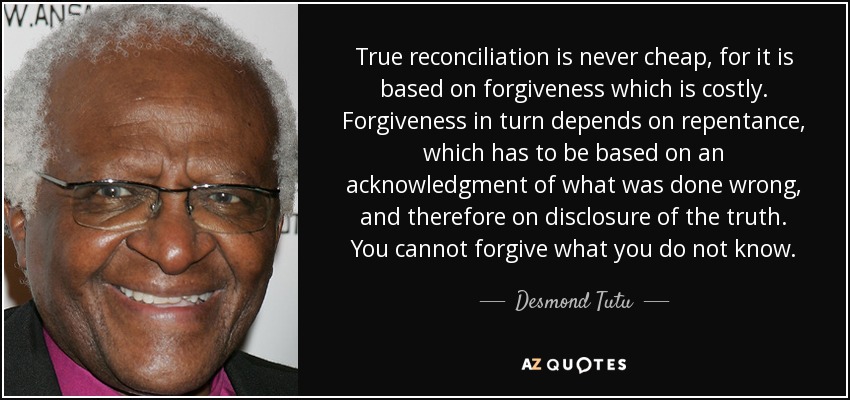
Repentance includes more than saying sorry. It also involves admitting wrong and making things right. Turning from erroneous thinking and forsaking past hurtful actions, lays the groundwork for an earnest attempt at reconciliation. 

For example, the Christian does more than a simple acceptance and acquiescence of Jesus, as if merely adding a bit of Christ to life will dash it up and make it better. Rather, we are invited into the very life of Christ. This life turns us upside-down and inside-out in a new and radical allegiance.

Repentance and reconciliation are a way of life. They are necessary skills requiring development through continual practice and use.

Broken relationships are the stuff of life. So, we need gracious approaches to deal with them so that bitterness does not take root in our souls. Connection and peace between two people are a beautiful thing. They bring emotional health, spiritual wholeness, and life enrichment.

From the get-go, twin brothers Jacob and Esau in the Old Testament book of Genesis had a contentious relationship. Their relations became so bad that Esau had homicidal ideation toward his brother. Neither Esau nor Jacob handled things well. Jacob ended up leaving, finding a wife, growing a family, and becoming wealthy.

Twenty years passed before they came together again.

Jacob, knowing he was about to meet his brother, had an encounter with God. It changed his identity from the old deceiver to the new Israel (Genesis 32:22-31).  In a demonstration of his new identity as Israel, Jacob worked at making amends for his old cheating ways. He sought to give the blessing he had stolen from his brother.

Jacob understandably had some dread in meeting Esau. He had connived and manipulated to take the family birthright and blessing from his brother. Fresh from wrestling with God, Jacob demonstrated a newfound courage and humility. He offered Esau respect, gifts, and honor – reversing his past pattern of disrespect, stealing, and dishonor.

True repentance is making things right. Merely having feelings of remorse is not repentance. To repent involves genuine sorrow; an earnestness to make restitution and reconciliation; an indignation over what happened; and, perhaps most importantly, a deep concern for the person(s) harmed by our wrongdoing (2 Corinthians 7:8-11).

The reconciliation between the brothers was a surprise. Jacob was not expecting Esau’s response. It seems Jacob was bracing for the worse, which explains his high anxiety before the encounter.

Esau’s gracious response was an answer to Jacob’s prayer.  For Jacob, seeing Esau’s face was like seeing the face of God. In fact, he saw both faces and lived! Jacob likely would not have seen his brother’s face until he had first seen God’s. His divine experience prepared the way for the human encounter.

We all experience times when relationships unravel and need to be mended. Jacob procrastinated for twenty years before working at reconciliation with his brother. What made the difference for Jacob was trusting God, who always works out divine promises, despite our human foibles. 

May you know and experience the God who reconciles and restores, and in so doing, extend that same earnestness to others.

Merciful God, I confess that I have sinned against you and against others through my own fault by thought, word and deed in things done and left undone. Especially I confess that I have _____.  I therefore repent; for these and all my sins I am terribly sorry and pray for forgiveness. I firmly intend to make amends and seek for help. I ask for strength to serve you in newness of life through Jesus Christ, my Lord, in the power of your Holy Spirit. Amen.

Luke 12:57-59 – Seek Reconciliation

“Why don’t you judge for yourselves what is right? As you are going with your adversary to the magistrate, try hard to be reconciled on the way, or your adversary may drag you off to the judge, and the judge turn you over to the officer, and the officer throw you into prison. I tell you, you will not get out, until you have paid the last penny.” (New International Version)

Relational problems and conflicts are endemic to the human condition. And, along with it, comes our anger.

Sometimes, I wonder if some church buildings have an aisle down the middle, is so that one group of people can avoid associating with the other group, like some childhood bedroom squabble where a line is drawn that the other is not to cross.

I also wonder if all schoolteachers’ lounges are a hot mess of anger. I’ve certainly been in plenty that are. And I don’t really have to wonder if most families have relatives they are estranged from – sometimes for years, even decades. Lord knows I’ve counseled plenty of them.

It’s inevitable that any group of people, complete with individual sinful natures, whether a church, a neighborhood, a family, or a workplace, will experience relational difficulties. After all, we live in a fallen world with a bunch of fallen people.

Relationships are important to God. And we need them. We cannot live without them because we’ve been created in the image and likeness of a relational God. So, God is concerned that we have good relations with one another.

Jesus is in the business of stripping away the layers of self-righteousness and peeling back the built up human rationalizations toward our sour relations with one another. At the heart of it all is our contempt for others and our misplaced anger. The only real solution to it is reconciliation.

Anger in and of itself is neither bad nor good; it just is. It’s a normal human emotional response to injustice. Yet, how we express our anger is very much an ethical affair.

Bitterness, nursing a grudge, bearing resentment, saying speeches to somebody in our heads we will never give, and flipping the finger at someone behind their back is the sort of angry response that completely sours relationships and drives wedges between folks.

Those inner attitudes are the factory where the anger will eventually come out sideways in verbal or even physical violence toward another.

Harboring resentment that comes out in name-calling kills people. And when we verbally decapitate people, there is a mess to clean up. Judgement is the lot for people-bashing. (Matthew 5:21-26)

“The holiness of God is at war with all bitterness and hatred and hurting. And where this holiness collides with our hostility the crash is called the wrath of God. God’s wrath is God’s war of love against everything that unnecessarily hurts others. God’s love would not be love if it did not work to remove all that ungraciously hurts. The wrath of God is the proof of the love of God; God’s love is a love that is not merely sentimental, for it grapples with inhumane forces.”

Frederick Dale Bruner

If you think to yourself that you have a right to nurse a grudge because that other person deserves it, you need to know that your hatred will not go unnoticed by God. 

If you have ever wished anyone was dead, hated anyone, treated anyone with contempt and belittled them; then, you have assassinated that person in your heart and come under the judgment of God.

And that’s the reason why we are to work hard at making things right with others.

There is no need for you to live with regret for the rest of your life because of stubbornly refusing to reconcile, and to have to stand before your Creator someday with nothing but hatred and contempt for another person.

Whenever personal relations go wrong, nine cases out of ten, immediate action will usually mend the problem.  But the longer it goes, the harder it is to reconcile. The problem grows and festers. Eventually, if reconciliation is not sought, it eventually spirals out of control. Then, there is full blown bitterness in which more people will be hurt. 

Make sure that no one misses out on God’s grace. Make sure that no root of bitterness grows up that might cause trouble and pollute many people.

Hebrews 12:15, CEB

Bitterness becomes gangrene of the soul. It poisons us within and ends up making trouble for others. Its better to reconcile than to have God amputate a part of you. So, seek amends.

If you become angry, do not let your anger lead you into sin, and do not stay angry all day. Don’t give the Devil a chance…. Get rid of all bitterness, passion, and anger. No more shouting or insults, no more hateful feelings of any sort. (Ephesians 4:26-27, 31, GNT)

We always have a choice when relationships are strained: Deal with it immediately, or let it fester. Maybe the reason why so many folks live without peace is that they have chosen unwisely.

Choose wisely, my friend.

Lord God, bring us together as one people, reconciled with you and reconciled with each other – healed, forgiven, and spreading peace rather than enmity, as you called us to do, through Jesus Christ our Lord. Amen.

Psalm 120 – Gaslighting Trouble

Ingrid Bergman and Charles Boyer in the 1944 film, “Gaslight”

I’m in trouble. I cry to God,
    desperate for an answer:
“Deliver me from the liars, God!
    They smile so sweetly but lie through their teeth.”

Do you know what’s next, can you see what’s coming,
    all you bold-faced liars?
Pointed arrows and burning coals
    will be your reward.

I’m doomed to live in Meshech,
    cursed with a home in Kedar,
My whole life lived camping
    among quarreling neighbors.
I’m all for peace, but the minute
    I tell them so, they go to war! (The Message)

I wish we lived in a world where people always speak and live the truth in love, without lying, pretense, or posturing. But we don’t. Not everyone embraces a life of encouraging others through truthful affirmation and selfless acts of service.

In reading today’s psalm, I immediately think of all the patients I’ve seen as a chaplain on my behavioral health unit who have been gaslighted.

“Gaslighting” is a recent term, yet the concept is as old as Satan’s interaction with Adam and Eve in the Garden. The word comes from the 1944 movie, “Gaslight,” starring Charles Boyer and Ingrid Bergman. In the attempt to drive his wife insane, the husband rigs the gaslights of the house so they will flicker at night. Whenever his wife comments on it, her husband flat-out lies and says the lights are not flickering at all. I’ll let you watch the film yourself to see what happens.

A person who “gaslights” uses psychological manipulation to gain and assert control over someone or some group. Gaslighters actively undermine others, using their words against them, plotting nefarious plans for them behind their backs, lying without so much of a blink of an eye, and turning family or friends against someone – all with the insidious agenda of increasing their power over that person and solidifying their dependence from the victim.

All of this gaslighting behavior is done with a smile, said with syrupy words to hook you, rather than help you. That, of course, makes it hard to spot – which is why it is so devilish. If the gaslighter can get you to doubt yourself, your abilities, or your perception of reality, then they can worm themselves into your life and plant their thoughts inside you.

Gaslighters don’t want peace. They want conflict. People at war give them an opportunity to gain more influence and power. Plus, they just plain like to watch others fight amongst themselves. It gives them a sense of control.

Today’s psalm is part of the psalms of ascent – songs used by the community as they walk their pilgrimage to Jerusalem and up the temple mount. The people collectively lament the gaslighting activity of those who oppose and hate them. And they turn to God, who abhors gaslighters, seeking solace and safety from their evil ways.

The gaslighter’s end is certain. They will have to contend with the God who will not be manipulated by anyone. Although it is not our job to punish sinners, it very much is our responsibility to see and avoid gaslighting as much as possible, as well as, God forbid, becoming a gaslighter ourselves. To that end, take note of some of the manipulative marks of gaslighters and patterns of gaslighting:

  • Pitting people against one another. This is done a variety of ways through gossip masked as trying to help, subtle slander, and carefully placed lies.
  • Avoiding responsibility. The gaslighter never owns their words and actions but are experts at blaming others for whatever goes awry.
  • Creating fights and conflicts. Gaslighters chronically avoid the dirty work. They get others riled-up at each other, then sit back and look for an opportunity to seize control over the warring parties.
  • Sucking-up to others. Flattery is a well-worn tool of gaslighters. They are masters at buttering-up people to get what they want.
  • Comparing people. This is just another way of driving a wedge between people. “Why can’t you be like ___?”
  • Mistreating the weak and powerless. The weak have no value for the gaslighter because the powerless have nothing to offer them. So, oppression becomes a means of getting the weak out of the way, like they’re some pesky insect to get rid of.
  • Bragging about accomplishments and stealing other’s. Gaslighters will always take the credit for an accomplishment and then boast about it, all the while badgering the victim.
  • Not keeping promises. Usually there’s a bait and switch where the gaslighter will promise something, then switch the rules or tell a bold-faced lie that they never promised that.

There is much more gaslighting behavior, but you get the drift. The best way to deal with a gaslighter? Get as far away from them as you can, find genuine supportive relationships, and leave them to God.

Today’s psalm can be your prayer to the Lord, offering a heartfelt plea to the Divine Being who does the opposite of gaslighting: strengthening you, giving you power, listening to your voice, and loving you with complete altruistic motives.

Eternal Father, you created us in your own image and likeness, but sin has warped the minds of humanity so that there is much injustice and much carelessness of the rights of other people in this fallen world. I pray you will right every wrong and vindicate those being treated unjustly. Keep us, your people, from trying to take matters into our own hands for vengeance. Give justice and peace to all those who have been cruelly and unfairly treated. May the injustice they have endured be the means to draw them into the saving arms of your grace, through Jesus Christ our Lord. Amen.