Resolving a Problem (Acts 6:1-7)

In those days when the number of disciples was increasing, the Hellenistic Jews among them complained against the Hebraic Jews because their widows were being overlooked in the daily distribution of food. 

So the Twelve gathered all the disciples together and said, “It would not be right for us to neglect the ministry of the word of God in order to wait on tables. Brothers and sisters, choose seven men from among you who are known to be full of the Spirit and wisdom. We will turn this responsibility over to them and will give our attention to prayer and the ministry of the word.”

This proposal pleased the whole group. They chose Stephen, a man full of faith and of the Holy Spirit; also Philip, Procorus, Nicanor, Timon, Parmenas, and Nicolas from Antioch, a convert to Judaism. They presented these men to the apostles, who prayed and laid their hands on them.

So the word of God spread. The number of disciples in Jerusalem increased rapidly, and a large number of priests became obedient to the faith. (New International Version)

Growing Pains

The burgeoning new church grew both spiritually and numerically. The apostolic ministry proclaimed the good news of Jesus Christ every day in the Jerusalem temple, and from house to house.

Anytime a group gets larger, there are growing pains. Problems arise which need to be addressed. In the earliest church, a conflict developed because the Greek-speaking widows were being neglected and overlooked in the distribution of food, whereas the Hebrew-speaking widows were not.

You can easily see how all sorts of feelings and judgments could pop up from that situation. Just because the church ministry was growing and thriving, did not mean that there would never be problems. Quite the contrary.

A Bad Approach

We can observe what the apostles did, and did not, do when the conflict came to their attention. The apostles did not:

Work harder

They didn’t simply add more work to what they were already doing with the old philosophy that “if you want something done right, do it yourself.” The apostles were clearly not control freaks. They appear to understand that God has ultimate control of all things, and that they themselves were practice self-control.

Operate in their weakness

The apostles weren’t experts on food distribution. Some of them, like Peter and John, knew how to get food to a market; but they likely knew nothing of keeping hundreds of widows daily fed. After all, there were no government food programs for needy people to rely upon. Everyone relied on family. And if there was no family to help, then the church stepped in to fill the gap.

Do everything themselves

Not every problem or situation has to be handled by an apostle (or a church clergyperson). God has gifted every believer with spiritual gifts of various kinds. Having skills, abilities, and talents wasted because the top leadership does everything, not only makes no sense, but it is also bad spiritual theology.

Attack the complainers

It’s one thing to grumble out of a sense of selfishness and ingratitude; it’s another thing altogether to complain because of grief, of being neglected and overlooked as a legitimate person to receive something you need. This is what we call “justice,” that everyone has what they need to thrive and flourish in this life. The apostles listened; they didn’t belittle the complaints or simply tell the people to stop complaining.

Take a vote

Leaders lead. Apostles engage in apostolic ministry. They don’t vote. Oftentimes, voting is a cop out for leaders to not make a decision that they ought to be making. In their insecurity, they’ll do anything but be decisive. They’ll ask for more information, and promise to take care of it sooner than later. But they won’t make a decision. Putting that on the congregation or the group as a whole is unnecessary.

Form committees and subcommittees

The apostles did not research the problem to death. They didn’t commission a group of people to study the issue and come up with at least three options to choose from. The issue of widows not getting food was serious. A matter of health, and life, and death. The problem needed to be handled quickly and efficiently. Leaders are given authority to make decisions and get things done – not to keep vital issues in a committee for months on end.

Start a new church

It was never a thought in any of the apostle’s heads to have two churches: one Greek, and the other Hebrew. No, they were determined to maintain the unity of the church through the bond of peace. The apostles didn’t ask anyone to leave and start a new ministry on the other side of Jerusalem.

A Good Approach

Instead of doing any of that goofy stuff, here is what the original apostles of Christ did do:

Came up with a practical solution

Instead of commissioning committees, the apostles commissioned faithful people to ensure that the work of distributing food would be carried out with integrity and competence.

Had people with skin in the game do the work

The men the apostles commissioned for the work were Greek Christians. These guys were likely familiar with the widows and knew their situations. And they were the best people for the job of making sure the ladies got needed food. Ministry is always personal, not impersonal.

Kept doing their important work

The apostles decided that their ministry of the word and prayer was too important to neglect for even a moment. They kept up the teaching, praying, mentoring, and encouraging ministry to which they were called. It is possible to affirm the good work of others and let them do it, while also affirming one’s own good work and sticking to it.

Focused on people and relationships

The presenting problem was food distribution. Yet, the real issue was widows in need. They were hungry. The apostles implemented a system based upon people and relationships, and not just on solving a problem.

Impacted the community

The way in which the conflict of food distribution was handled made a big difference – both in the church community, and also in the city of Jerusalem. As a result of the apostles and their decision in this matter, their ministry became even more effective, and people were added to the church – including a number of priests, who likely understood better than anyone how an internal issue can get out of control. They wanted in, as they heard the good news, and saw it demonstrated in the life of the church.

Conclusion

Dealing with church problems and internal issues within a group of people is not about being right and winning arguments. It’s about meeting the needs of people, and glorifying God. It matters how we treat one another within the church. Christians are meant to be the light of the world, and not the dark underbelly of detached systems, policies, and doctrinal statements.

The choices we make, how we go about making those decisions, and the way in which we implement them, reflects whether the life of Christ is within us, or not.

Blessed God, may the humility, wisdom, and compassion of Jesus Christ flow powerfully within me, so that what comes out of me is thoroughly loving, in my words, affect, tone of voice, gestures, and actions. Amen.

How To Respond In a Conflict (1 Samuel 19:1-7)

David and Jonathan, by He Qi

Saul told his son Jonathan and all the attendants to kill David. But Jonathan had taken a great liking to David and warned him, “My father Saul is looking for a chance to kill you. Be on your guard tomorrow morning; go into hiding and stay there. I will go out and stand with my father in the field where you are. I’ll speak to him about you and will tell you what I find out.”

Jonathan spoke well of David to Saul his father and said to him, “Let not the king do wrong to his servant David; he has not wronged you, and what he has done has benefited you greatly. He took his life in his hands when he killed the Philistine. The Lord won a great victory for all Israel, and you saw it and were glad. Why then would you do wrong to an innocent man like David by killing him for no reason?”

Saul listened to Jonathan and took this oath: “As surely as the Lord lives, David will not be put to death.”

So Jonathan called David and told him the whole conversation. He brought him to Saul, and David was with Saul as before. (New International Version)

King Saul was a two-faced, fickle, and disintegrated soul who continually had divided loyalties between Israel and himself. Unfortunately, himself usually won out.

In today’s story, Saul was not so far gone into his self-centeredness that he couldn’t hear the voice of reason. Yet, that voice never lasted too long for him.

As for David, he was the runt of the family, the youngest of eight sons. The runt is always given the grunt work in the family. So, David spent a lot of time out with the sheep by himself, tending to their needs, and protecting them from predators. He eventually found himself in the court of King Saul and distinguished himself as an ideal soldier and leader in the Philistine wars with Israel.

Saul and David, by Rembrandt (1606-1669)

But all of David’s success only increased Saul’s jealousy. On several occasions, the paranoid Saul tried to kill David – who was faithful and did not deserve such treatment from the king.

Saul eventually abandoned all pretense and ordered his son Jonathan and the soldiers to put David to death. He went public with his attacks against David. Saul felt driven to desperate measures, feeling that his authority, popularity, and position were threatened.

This situation, of course, created a conflict of loyalties for Jonathan who wanted to honor his father and king, but who also loved David as himself (1 Samuel 18:1-3). Jonathan was that voice of reason, appealing to his father’s rational self, urging him not to go down such a dark path in killing a righteous person.

Jonathan let Saul know that it was in his best interest to let David live. He reminded Saul that David was the Lord’s instrument who had defeated Israel’s enemies and that Saul had rejoiced in his success. What’s more, Jonathan appealed to justice; David’s death would be totally unwarranted.

Saul would prove to be a guy who continually reneged on his promises with impunity. He was Exhibit A of the person with a divided mind who swayed back and forth in his decisions.

King Saul could not accept the fact that God was with David, and not with him. Saul’s initial jealousy came out in subtle plans to diminish David so that he himself would remain the popular one with power and control.

But, as biblical readers and listeners, we know where this sort of attitude is headed. God is concerned with a humble attitude and obedient actions – which David had, and Saul increasingly didn’t.

So, Saul began openly announcing plans for David’s demise. Although he would not be successful, trying again and again to do so, David’s life was turned upside-down.

David did nothing wrong. In fact, he did everything right and actually helped soothe Saul with harp music when he was not doing well. Even though David is exactly who the nation of Israel needed, and precisely the person Saul needed, he was the target of assassination.

Just because we may go about our work, and the way we live our life, with unassuming humility and quiet obedience, does not mean everything will be unicorns and butterflies. There always seems to be a jealous person lurking in the shadows planning for our downfall.

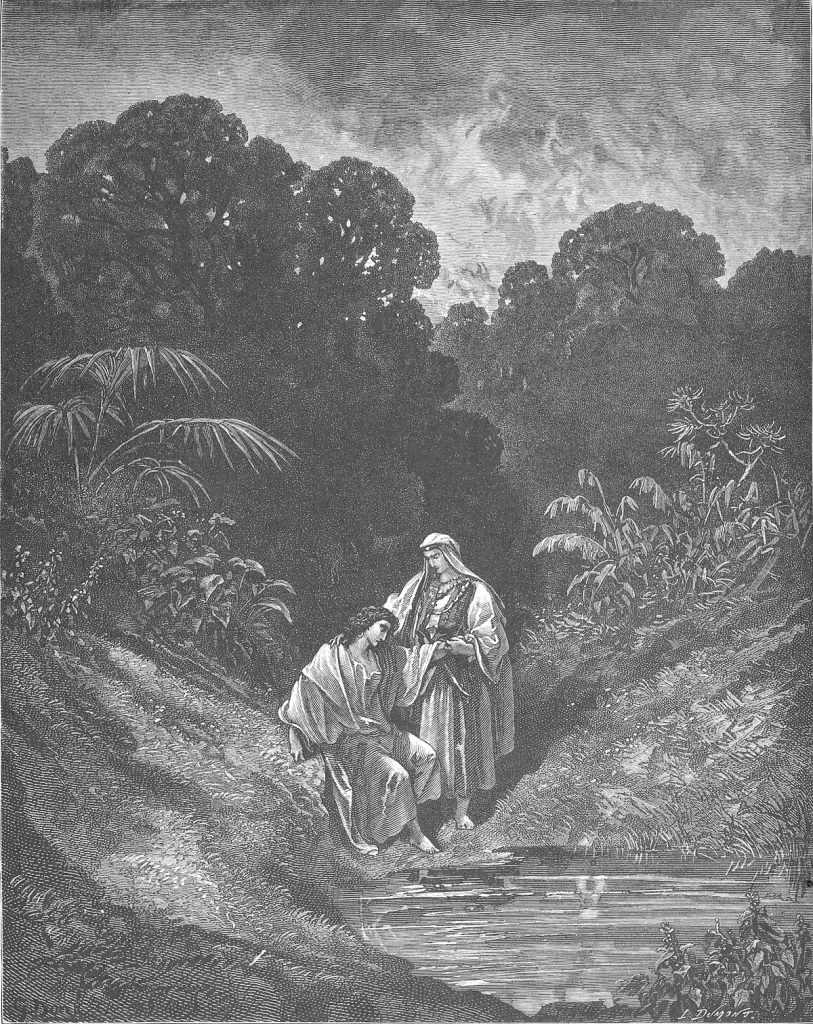
David and Jonathan, by Gustave Doré (1832-1883)

In such times, we are in solidarity with our Lord. And it is of great practical help whenever we have a person like Jonathan in our life who is willing to be a peacemaker.

Jonathan willingly stepped into the situation between his father Saul and his best friend David. Despite the family pressure, Jonathan urged Saul not to sin against an innocent man of integrity. David had risked his life for Israel and Saul’s kingdom.

Saul was persuaded, at least temporarily, to lift the death sentence and restore David to his rightful place in the court – all because of Jonathan’s efforts.

Notice that Jonathan did not exacerbate the situation by taking sides or using harsh language. In truth, we all need a friend who is willing to help us in difficult times, with careful and deft words which brings calm instead of chaos.

A gentle answer turns away wrath, but a harsh word stirs up anger.

Proverbs 15:1, NIV

Conflict only escalates out of control without a non-anxious presence to diffuse things.

For David’s part, he wisely didn’t try to vindicate himself by responding to Saul’s anger with more anger. Instead, he trusted God and let the person who could make the difference, Jonathan, do so.

It is important whenever someone comes to us in order to vent about another person, or makes irrational pronouncements about what they’re going to do to them, to help the situation and not add fuel to the fire.

If we take some relational cues from Jonathan, we will seek to be calm and respond with sensitivity and gentleness to the nonsensical wrath of the person speaking offensive words.

What’s more, when being the target of someone’s verbal assault, we must be careful not to fight fire with fire. Let’s remember that our humble and gentle words put us in good company with the righteous throughout history who have responded with faith and patience to trouble.

O God, the source of all spiritual and emotional health: So fill my heart with faith in your love, that with calm expectancy I may make room for your power to possess me, and gracefully accept your presence to make all the difference in my hardship. Amen.

Genesis 33:1-17 – Reconciled

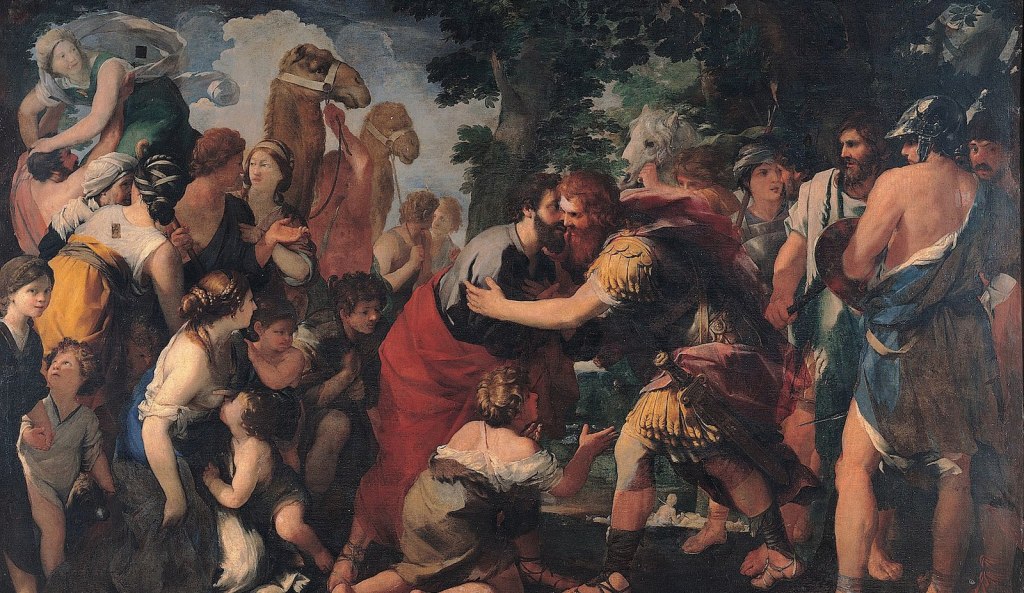
Meeting Between Jacob and Esau by Italian painter Bottalla Raffaellino (1613-1644)

Later that day Jacob met Esau coming with his four hundred men. So, Jacob had his children walk with their mothers. The two servant women, Zilpah and Bilhah, together with their children went first, followed by Leah and her children, then by Rachel and Joseph. Jacob himself walked in front of them all, bowing to the ground seven times as he came near his brother.

But Esau ran toward Jacob and hugged and kissed him. Then the two brothers started crying.

When Esau noticed the women and children he asked, “Whose children are these?”

Jacob answered, “These are the ones the Lord has been kind enough to give to me, your servant.”

Then the two servant women and their children came and bowed down to Esau. Next, Leah and her children came and bowed down; finally, Joseph and Rachel also came and bowed down.

Esau asked Jacob, “What did you mean by these herds I met along the road?”

“Master,” Jacob answered, “I sent them so that you would be friendly to me.”

“But, brother, I already have plenty,” Esau replied. “Keep them for yourself.”

“No!” Jacob said. “Please accept these gifts as a sign of your friendship for me. When you welcomed me and I saw your face, it was like seeing the face of God. Please accept these gifts I brought to you. God has been good to me, and I have everything I need.” Jacob kept insisting until Esau accepted the gifts.

“Let’s get ready to travel,” Esau said. “I’ll go along with you.”

But Jacob answered, “Master, you know traveling is hard on children, and I have to look after the sheep and goats that are nursing their young. If my animals travel too much in one day, they will all die. Why don’t you go on ahead and let me travel along slowly with the children, the herds, and the flocks. We can meet again in the country of Edom.”

Esau replied, “Let me leave some of my men with you.”

“You don’t have to do that,” Jacob answered. “I am happy, simply knowing that you are friendly to me.”

So, Esau left for Edom. But Jacob went to Succoth, where he built a house for himself and set up shelters for his animals. That’s why the place is called Succoth. (Contemporary English Version)

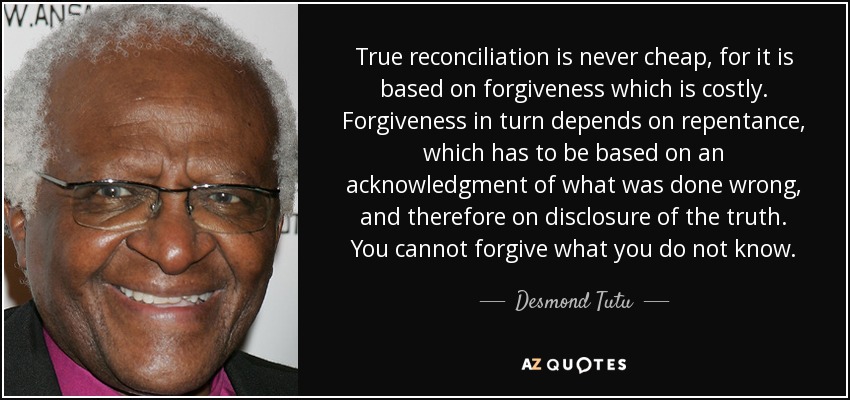
Repentance includes more than saying sorry. It also involves admitting wrong and making things right. Turning from erroneous thinking and forsaking past hurtful actions, lays the groundwork for an earnest attempt at reconciliation. 

For example, the Christian does more than a simple acceptance and acquiescence of Jesus, as if merely adding a bit of Christ to life will dash it up and make it better. Rather, we are invited into the very life of Christ. This life turns us upside-down and inside-out in a new and radical allegiance.

Repentance and reconciliation are a way of life. They are necessary skills requiring development through continual practice and use.

Broken relationships are the stuff of life. So, we need gracious approaches to deal with them so that bitterness does not take root in our souls. Connection and peace between two people are a beautiful thing. They bring emotional health, spiritual wholeness, and life enrichment.

From the get-go, twin brothers Jacob and Esau in the Old Testament book of Genesis had a contentious relationship. Their relations became so bad that Esau had homicidal ideation toward his brother. Neither Esau nor Jacob handled things well. Jacob ended up leaving, finding a wife, growing a family, and becoming wealthy.

Twenty years passed before they came together again.

Jacob, knowing he was about to meet his brother, had an encounter with God. It changed his identity from the old deceiver to the new Israel (Genesis 32:22-31).  In a demonstration of his new identity as Israel, Jacob worked at making amends for his old cheating ways. He sought to give the blessing he had stolen from his brother.

Jacob understandably had some dread in meeting Esau. He had connived and manipulated to take the family birthright and blessing from his brother. Fresh from wrestling with God, Jacob demonstrated a newfound courage and humility. He offered Esau respect, gifts, and honor – reversing his past pattern of disrespect, stealing, and dishonor.

True repentance is making things right. Merely having feelings of remorse is not repentance. To repent involves genuine sorrow; an earnestness to make restitution and reconciliation; an indignation over what happened; and, perhaps most importantly, a deep concern for the person(s) harmed by our wrongdoing (2 Corinthians 7:8-11).

The reconciliation between the brothers was a surprise. Jacob was not expecting Esau’s response. It seems Jacob was bracing for the worse, which explains his high anxiety before the encounter.

Esau’s gracious response was an answer to Jacob’s prayer.  For Jacob, seeing Esau’s face was like seeing the face of God. In fact, he saw both faces and lived! Jacob likely would not have seen his brother’s face until he had first seen God’s. His divine experience prepared the way for the human encounter.

We all experience times when relationships unravel and need to be mended. Jacob procrastinated for twenty years before working at reconciliation with his brother. What made the difference for Jacob was trusting God, who always works out divine promises, despite our human foibles. 

May you know and experience the God who reconciles and restores, and in so doing, extend that same earnestness to others.

Merciful God, I confess that I have sinned against you and against others through my own fault by thought, word and deed in things done and left undone. Especially I confess that I have _____.  I therefore repent; for these and all my sins I am terribly sorry and pray for forgiveness. I firmly intend to make amends and seek for help. I ask for strength to serve you in newness of life through Jesus Christ, my Lord, in the power of your Holy Spirit. Amen.

Nehemiah 5:1-13 – Real Problem-Solving

Orthodox icon of Nehemiah

Now the men and their wives raised a great outcry against their fellow Jews. Some were saying, “We and our sons and daughters are numerous; in order for us to eat and stay alive, we must get grain.”

Others were saying, “We are mortgaging our fields, our vineyards and our homes to get grain during the famine.”

Still others were saying, “We have had to borrow money to pay the king’s tax on our fields and vineyards. Although we are of the same flesh and blood as our fellow Jews and though our children are as good as theirs, yet we have to subject our sons and daughters to slavery. Some of our daughters have already been enslaved, but we are powerless, because our fields and our vineyards belong to others.”

When I heard their outcry and these charges, I was very angry. I pondered them in my mind and then accused the nobles and officials. I told them, “You are charging your own people interest!” So, I called together a large meeting to deal with them and said: “As far as possible, we have bought back our fellow Jews who were sold to the Gentiles. Now you are selling your own people, only for them to be sold back to us!” They kept quiet because they could find nothing to say.

So, I continued, “What you are doing is not right. Shouldn’t you walk in the fear of our God to avoid the reproach of our Gentile enemies?I and my brothers and my men are also lending the people money and grain. But let us stop charging interest! Give back to them immediately their fields, vineyards, olive groves and houses, and also the interest you are charging them—one percent of the money, grain, new wine and olive oil.”

“We will give it back,” they said. “And we will not demand anything more from them. We will do as you say.”

Then I summoned the priests and made the nobles and officials take an oath to do what they had promised. I also shook out the folds of my robe and said, “In this way may God shake out of their house and possessions anyone who does not keep this promise. So may such a person be shaken out and emptied!”

At this the whole assembly said, “Amen,” and praised the Lord. And the people did as they had promised. (New International Version)

There is nothing pleasant about poverty – especially the circumstances and events which create it. Probably worse than being poor is feeling locked into poverty with no way out.

Nehemiah was a faithful follower of God. He was taken into exile, along with many of his fellow countrymen, when the Babylonians conquered Jerusalem and Judah. Yet, through his prayerful initiative, Nehemiah laid plans for a return to his homeland and rebuild the broken down wall which surrounded the city of Jerusalem. 

Once Nehemiah arrived and arranged for work teams to busy themselves on the wall, he discovered there was a whole lot more to rebuild than just a physical wall. A wall of separation existed between fellow Jews based on economics. There were some very real class differences. The poor were being taken advantage of. Their fellow Jews were exacting usury from them.

The response of Nehemiah to such a sticky situation is instructive for us. Notice how he handled it:

  • Nehemiah did not ignore the people problems and only focus on the physical wall. He firmly and squarely addressed what was happening and was downright angry about the circumstance of Jewish families essentially living in a state of slavery. 
  • Nehemiah was clear, concise, and direct about the nature of the problem. He threw himself into being part of the solution instead of only complaining about what was happening.
  • Nehemiah did not over-involve others in the process of handling the conflict but handled the issue by taking counsel with himself. 
  • Nehemiah attacked the problem without alienating others, while holding people accountable for their actions and their promises.

Today’s Old Testament lesson is something of a leadership case study in how to engage significant problems and conflict. So, it’s a lesson for us not to quickly skim over but to ponder, examine, and absorb Nehemiah’s dealing with the situation. 

We all need some guidance and direction when it comes to confronting the problems which surround us. Let this story serve us well in approaching issues with wisdom and sagacity.

Holy God, you have a special concern for those who are poor and needy. Enable us to live and speak wisely into the crucial needs which exist around us, so that justice is done, mercy is demonstrated, and humility is practiced, through Jesus Christ our Lord in the power of the Holy Spirit. Amen.