Fear or Faith? (1 Samuel 13:23-14:23)

The pass at Micmash had meanwhile been secured by a contingent of the Philistine army.

One day Jonathan said to his armor bearer, “Come on, let’s go over to where the Philistines have their outpost.” But Jonathan did not tell his father what he was doing.

Meanwhile, Saul and his 600 men were camped on the outskirts of Gibeah, around the pomegranate tree at Migron. Among Saul’s men was Ahijah the priest, who was wearing the ephod, the priestly vest. Ahijah was the son of Ichabod’s brother Ahitub, son of Phinehas, son of Eli, the priest of the Lord who had served at Shiloh.

No one realized that Jonathan had left the Israelite camp. To reach the Philistine outpost, Jonathan had to go down between two rocky cliffs that were called Bozez and Seneh. The cliff on the north was in front of Micmash, and the one on the south was in front of Geba.“Let’s go across to the outpost of those pagans,” Jonathan said to his armor bearer. “Perhaps the Lord will help us, for nothing can hinder the Lord. He can win a battle whether he has many warriors or only a few!”

“Do what you think is best,” the armor bearer replied. “I’m with you completely, whatever you decide.”

“All right, then,” Jonathan told him. “We will cross over and let them see us. If they say to us, ‘Stay where you are or we’ll kill you,’ then we will stop and not go up to them. But if they say, ‘Come on up and fight,’ then we will go up. That will be the Lord’s sign that he will help us defeat them.”

When the Philistines saw them coming, they shouted, “Look! The Hebrews are crawling out of their holes!” Then the men from the outpost shouted to Jonathan, “Come on up here, and we’ll teach you a lesson!”

“Come on, climb right behind me,” Jonathan said to his armor bearer, “for the Lord will help us defeat them!”

So they climbed up using both hands and feet, and the Philistines fell before Jonathan, and his armor bearer killed those who came behind them. They killed some twenty men in all, and their bodies were scattered over about half an acre.

Suddenly, panic broke out in the Philistine army, both in the camp and in the field, including even the outposts and raiding parties. And just then an earthquake struck, and everyone was terrified.

Saul’s lookouts in Gibeah of Benjamin saw a strange sight—the vast army of Philistines began to melt away in every direction. “Call the roll and find out who’s missing,” Saul ordered. And when they checked, they found that Jonathan and his armor bearer were gone.

Then Saul shouted to Ahijah, “Bring the ephod here!” For at that time Ahijah was wearing the ephod in front of the Israelites. But while Saul was talking to the priest, the confusion in the Philistine camp grew louder and louder. So Saul said to the priest, “Never mind; let’s get going!”

Then Saul and all his men rushed out to the battle and found the Philistines killing each other. There was terrible confusion everywhere. Even the Hebrews who had previously gone over to the Philistine army revolted and joined in with Saul, Jonathan, and the rest of the Israelites. Likewise, the men of Israel who were hiding in the hill country of Ephraim joined the chase when they saw the Philistines running away. So the Lord saved Israel that day, and the battle continued to rage even beyond Beth-aven. (New Living Translation)

The vicinity of Micmash (modern Mukmas) in Israel

Israel had demanded a king. The people wanted to be like everyone else in the world. All the other nations had a king. The Israelites believed that they needed one, too. (1 Samuel 8)

Not unlike today, Israel got a king who looked the part. Saul was tall, dark, and handsome. The only problem was that he didn’t act much like a king at all.

On the day he was anointed king, Saul hid in the baggage, like some guy ducking into a dumpster to avoid people chasing him. If the kings of other nations acted boldly on behalf of their subjects, Saul was not that sort of king. He seemed bent toward cowardice, and more concerned about his reputation than actually accomplishing anything.

Saul could have distinguished his royal kingship through listening to God and obeying the Lord; instead, his rule and reign was often marked by a half obedience, if he obeyed at all.

Old Testament stories are filled with contrasting characters. And in the narrative for today, there is a clear difference between King Saul and his son Jonathan. Saul was supposed to be leading the charge against the Philistine threat to Israel, but he was hiding out.

But Jonathan was determined to deal with the arrogant Philistines, even though it meant going against an entire garrison of troops with only his armor-bearer alongside him.

In the story, we find Saul and the army cowering in secrecy. But we find Jonathan in the bright light of day for the entire Philistine army to see. The contrast couldn’t be any more obvious:

  • Saul is afraid, and Jonathan is brave
  • Saul is fearfully passive; Jonathan is faithfully aggressive
  • Saul could only see reasons not to face the Philistines; Jonathan saw no obstacles to facing them, even though he had to scale crags and thorns in order to get to the Philistines

The opposite of faith is not unbelief; it’s fear. All of the Israelite soldiers were afraid, except Jonathan and his armor-bearer. The two of them had remarkable faith.

Jonathan had full confidence in the power of God. It wasn’t stupidity that led him toward an entire army by himself; it was the firm conviction that nothing is too difficult for the Lord.

It was neither pride nor glory-seeking that caused Jonathan to go, against all odds, to fight the Philistine army. He simply reasoned by faith that perhaps God would work on their behalf and bring about a great deliverance for Israel.

What’s more, Jonathan trusted the Lord without making assumptions that God would act in a particular way. There wasn’t any ‘name-it-and-claim-it’ theology happening with him.

Indeed, God did intend to defeat the Philistines. Maybe the Philistines thought Jonathan was bluffing by coming up to them; and they were going to teach this guy a lesson! But false confidence is typically shown through talking smack, whereas real confidence is born of faith.

Trust fully expects God to show up and take on injustice, unrighteousness, and arrogant pride.

Jonathan did some damage; and God got into the thick of it by directly intervening. The Lord turned the tables by bringing great fear on the Philistines. This turning of the tables emboldened the Israelites. The result was a decisive victory for Israel, leaving Philistia slack-jawed and confused.

We may be uncertain about the future; but if we are pursuing a good thing, and are confident in God’s power, there’s no need to be afraid in pursuing it.

We are free to step out in faith and attempt great things for the sake of the Lord, knowing that God may indeed bless our trusting initiative.

Almighty and everlasting Father, you have given the Holy Spirit to abide with us forever: Bless us with divine grace and presence so that, being preserved in true faith and confident hope, we may fulfill all the good that is in our mind and heart to do; through Jesus Christ your Son, our Lord, who lives and reigns with you, in the unity of the Holy Spirit, one God, today and always. Amen.

Encouragement for Today (1 Thessalonians 4:13-18)

Brothers and sisters, we do not want you to be uninformed about those who sleep in death, so that you do not grieve like the rest of mankind, who have no hope. 

For we believe that Jesus died and rose again, and so we believe that God will bring with Jesus those who have fallen asleep in him. According to the Lord’s word, we tell you that we who are still alive, who are left until the coming of the Lord, will certainly not precede those who have fallen asleep. 

For the Lord himself will come down from heaven, with a loud command, with the voice of the archangel and with the trumpet call of God, and the dead in Christ will rise first. After that, we who are still alive and are left will be caught up together with them in the clouds to meet the Lord in the air. And so we will be with the Lord forever. Therefore encourage one another with these words. (New International Version)

Everyone needs encouragement. Everybody wants some good news in their lives. People must not only have food, drink, clothing, and shelter, but also words that they can live by – words that can sustain them and help to make ends meet for their daily lives.

The Thessalonian Christians needed some good words of encouragement. They believed the Lord Jesus was coming soon. Any day now, at any time, Christ will return and take us to be with him forever. And yet, day after day, there was nothing but the anticipation, along with the expectations that weren’t realized.

On top of it all, some of the believing brothers and sisters died. So, what happens to them when they die? Will they somehow be excluded from enjoying Christ’s return? And, by the way, are we missing out on something here? Did Jesus come, and we somehow missed it?

The believers in the Thessalonian Church were left with concerns – not only for those who had died, but for those who were still alive. Perhaps somebody, even themselves, were being excluded from the gracious visitation of God. They were curious, but most of all confused.

Hope needed to be clarified for the Christians. A confident expectation would help sustain them in this life. They can keep laboring in the Lord with faith, have hope for the future, and realize love in both this life and in the life to come.

Christ will descend from the clouds with a cry of command, the sound of a trumpet, and lift the faithful into heaven. In other words, for those people who were living in the Roman Empire, Christ will arrive with the fanfare and pageantry of any Roman Emperor. Peace and security are here – not from Ceasar – but from a Sovereign who is greater than any earthly ruler.

I realize that many believers today see this vision of the coming Christ as a literal description. Maybe it is, and maybe it isn’t. But whatever it is, the Apostle Paul intended to assure the Thessalonian faithful that the promises of God were backed up by a power even greater than that of Rome.

Furthermore, true peace, security, and hope are not found in the Pax Romana of Rome, but in the gracious rule and reign of God. Christ is the Lord; Ceasar is not. The Thessalonians, therefore, were encouraged to let God be the source of their peace. For the One who calls you is faithful.

The encouragement we need is really not so different from what the Thessalonians needed to hear. Two thousand years later, like them, we continue to look for signs that assure us that God has not forgotten us; that we will not be left behind; and that we will not be separated from those who have already died.

As world problems continue, and as time marches on, we may grow weary. We might then place more hope and confidence in the power of a national government that offers us peace and security, as we patiently wait for God. Like the Thessalonians, all we really need is the assurance that God’s power and God’s promise is real.

We might not see Christ coming down from the sky today, or even next week, or next year. But we can still embrace the hope we need in order to get by every single day.

Although an apocalypse is coming, it is actually in the little things of life that helps sustain us till then. An encouraging and timely word from a friend; praying with a fellow believer; giving thanks to God for all things; and living with an awareness of the spiritual throughout the world all these things strengthen us and enable us to see God at work.

Through a consistent walk with God, day after day, the power and presence of God becomes real to us – maybe just as real as a dramatic scene of Christ coming down from the clouds – and offers us hope to face each new day with courage and compassion for a world in desperate need of salvation.

Almighty and all-sufficient God, give me strength to live another day.

Let me not be a coward in difficult circumstances, or to turn tail and run in the face of hard responsibilities.

Help me not lose faith in other people.

Keep my heart tender and wise, in spite of others’ ingratitude, treachery, or meanness.

Preserve me from minding the little stings of life, or of giving them to others.

May my heart be pure; and may I live honestly and fearlessly, so that no outward failure can dishearten me or take away the joy of inward integrity.

Open wide the eyes of my soul that I may see good in all things.

Grant me today some new vision of your truth.

Inspire me with a spirit of joy and gladness.

Make me the cup of strength to suffering souls.

I ask all of this in the name of my Deliverer, Lord, and Friend, Jesus Christ. Amen.

A Solemn Pledge of Hope (Hebrews 6:13-20)

When God gave Abraham his promise, he swore by himself since he couldn’t swear by anyone greater. He said, “I will certainly bless you and multiply your descendants.” So Abraham obtained the promise by showing patience. People pledge by something greater than themselves. A solemn pledge guarantees what they say and shuts down any argument.When God wanted to further demonstrate to the heirs of the promise that his purpose doesn’t change, he guaranteed it with a solemn pledge. So these are two things that don’t change, because it’s impossible for God to lie.

He did this so that we, who have taken refuge in him, can be encouraged to grasp the hope that is lying in front of us. This hope, which is a safe and secure anchor for our whole being, enters the sanctuary behind the curtain. That’s where Jesus went in advance and entered for us, since he became a high priest according to the order of Melchizedek. (Common English Bible)

“We must accept finite disappointment, but never lose infinite hope.”

Martin Luther King, Jr.

Humanity needs hope. We all require a confident expectation that things will be different or better. Hope is what our ancestors in the faith possessed in abundance.

How did Abraham receive what was promised by God?

Abraham latched onto hope. He believed God’s promise of having a place to belong. His faith caused him to make a major move from the city where he had always lived. What’s more, Abraham understood that the promises of God don’t end in this life. He looked forward to being a permanent resident in the eternal city.

By faith Abraham obeyed when he was called to go out to a place that he was going to receive as an inheritance. He went out without knowing where he was going. By faith he lived in the land he had been promised as a stranger. He lived in tents along with Isaac and Jacob, who were coheirs of the same promise. He was looking forward to a city that has foundations, whose architect and builder is God. (Hebrews 11:8-10, CEB)

Why did God make a solemn pledge, a sacred oath, to Abraham?

The Lord wanted to reinforce Abraham’s faith and encourage him. God desired to convincingly show that divine promises are sure.

The Lord spoke to Abram in a vision and said to him, “Do not be afraid, Abram, for I will protect you, and your reward will be great.” But Abram replied, “O Sovereign Lord, what good are all your blessings when I don’t even have a son?…. You have given me no descendants of my own, so one of my servants will be my heir.”

Then the Lord said to him, “No, your servant will not be your heir, for you will have a son of your own who will be your heir.” Then the Lord took Abram outside and said to him, “Look up into the sky and count the stars if you can. That’s how many descendants you will have!” And Abram believed the Lord, and the Lord counted him as righteous because of his faith. (Genesis 15:1-6, NLT)

What are two things that do not change?

God’s promise and God’s solemn pledge. God promised Abraham:

“I will make you into a great nation,
    and I will bless you;
I will make your name great,
    and you will be a blessing.
I will bless those who bless you,
    and whoever curses you I will curse;
and all peoples on earth
    will be blessed through you.”(Genesis 12:2-3, NIV)

God confirmed the promise with a sacred oath:

“I swear by myself, declares the Lord, that because you have done this and have not withheld your son, your only son, I will surely bless you and make your descendants as numerous as the stars in the sky and as the sand on the seashore. Your descendants will take possession of the cities of their enemies, and through your offspring all nations on earth will be blessed, because you have obeyed me.” (Genesis 22:16-18, NIV)

Is there a way to be motivated and encouraged in the Christian life?

Yes. Hope in God’s promises. Confidence that our efforts to live for Christ are being seen. Knowledge that our labor in the Lord is not in vain.

To remain encouraged, and to keep persevering in faith and hope, we need one another. So, it is important to maintain significant relationships with other believers so that we will not lose our spiritual vitality and become discouraged. The author of Hebrews stated:

We should keep on encouraging each other to be thoughtful and to do helpful things. Some people have gotten out of the habit of meeting for worship, but we must not do that. We should keep on encouraging each other, especially since you know that the day of the Lord’s coming is getting closer. (Hebrews 10:24-25, CEV)

Faith and patience, fueled by an unshakable hope, has always been the way believers have lived their lives. For the Christian, we have a promised inheritance. And that promise is focused on the person and work of Christ – because all of God’s good promises are fulfilled in Jesus.

Our energy, resources, time, and work are finite. Yet God is infinite. God has always been and always will be. And Jesus is the same yesterday, today, and forever. As we tether ourselves to these unchangeable realities, we have a sure foundation of hope in which to build a solid life of confidence.

God of hope, in these times of change, unite us and encourage us with your promise and oath. Help us overcome our fears and enable us to build a future in which all may prosper and share, through Jesus Christ our Lord. Amen.

Take the Long View (Genesis 49:1-2, 8-13, 21-26)

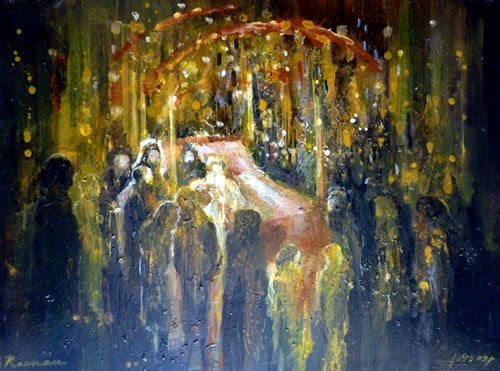
Jacob blesses his sons on his deathbed by Yoram Raanan

Jacob called his sons together and said:

My sons, I am Jacob,
    your father Israel.
Come, gather around,
    as I tell your future….

Judah, you will be praised
    by your brothers;
they will bow down to you,
    as you defeat your enemies.
My son, you are a lion
    ready to eat your victim!
You are terribly fierce;
    no one will bother you.
You will have power and rule
until nations obey you
    and come bringing gifts.
You will tie your donkey
    to a choice grapevine
and wash your clothes
    in wine from those grapes.
Your eyes are darker than wine,
    your teeth whiter than milk.

Zebulun, you will settle
    along the seashore
and provide safe harbors
    as far north as Sidon….

Naphtali, you are a wild deer
    with lovely fawns.

Joseph, you are a fruitful vine
growing near a stream
    and climbing a wall.
Enemies attacked with arrows,
    refusing to show mercy.
But you stood your ground,
    swiftly shooting back
with the help of Jacob’s God,
    the All-Powerful One—
his name is the Shepherd,
    Israel’s mighty rock.
25 Your help came from the God
your father worshiped,
    from God All-Powerful.
God will bless you with rain
    and streams from the earth;
he will bless you
    with many descendants.
My son, the blessings I give
are better than the promise
    of ancient mountains
    or eternal hills.
Joseph, I pray these blessings
    will come to you,
because you are the leader
    of your brothers. (Contemporary English Version)

Where does confidence come from?

The theme of confidence works its way through the patriarch Jacob’s deathbed prophecies and blessings – a resolute conviction in the promises of God – that the Lord will accomplish exactly what was promised.

Jacob expressed the hope and sure belief that God would bring the Israelites out of Egypt and into the land of Canaan as their inheritance – and, ultimately to the City of God, the eternal inheritance.

The Christian will find much in the blessing of Judah concerning the promises surrounding the coming of Christ. Mentioning the implements of “staff” and “scepter” are symbols of authority. And the reference to a donkey communicated a ruler was coming, as donkeys were the preferred mounts of royalty in ancient times.

What’s more, the washing of garments in wine, and eyes darker than wine, are allusions to the future blessing and abundance that will occur through the tribe of Judah. In fact, the first miracle of Jesus was turning water into wine – a deliberate attempt by the Apostle John to connect Jesus with Old Testament messianic prophecies of abundance and blessing. (John 2:1-12)

It’s important to adopt a long view of life. We must keep in mind that it took eighteen centuries for Jacob’s prophecy of Judah to occur. This long view is what gives us our confidence in life and provides the patience and perseverance we need for the here and now.

Seeing the big picture of God’s work in this world is necessary, because if we do not, we will likely become discouraged with the circumstances we face right now.

The reason Jacob makes it into the great Hall of Faith in the New Testament book of Hebrews is not because he was squeaky clean and perfect in how he lived his life; it was because he took the long view, the big picture, and saw that God was going to fulfill divine promises to Israel:

By an act of faith, Jacob on his deathbed blessed each of Joseph’s sons in turn, blessing them with God’s blessing, not his own—as he bowed worshipfully upon his staff. (Hebrews 11:21, MSG)

Furthermore, when we string the following three verses together across both Old and New Testaments of the Bible, we see the long view of God’s purposes:

It is true that you planned to do something bad to me. But really, God was planning good things. God’s plan was to use me to save the lives of many people. And that is what happened. (Genesis 50:20, ERV)

For I know the plans I have for you,” declares the Lord, “plans to prosper you and not to harm you, plans to give you hope and a future. (Jeremiah 29:11, NIV)       

And we know that all things work together for good to those who love God, to those who are the called according to his purpose. (Romans 8:28, NKJV)

In the Christian faith tradition, all of God’s promises come together and are fulfilled in the person and work of Jesus.

Christ is our salvation, our inheritance, and our hope. To give our lives to following Jesus in complete trust of faith is both our challenge and our privilege.

May we live by faith, and not by fear. And may we have patience and persevere through the most challenging of situations because we have adopted the long view of understanding the God is bringing all divine promises to fruition, all in good time.

Our confidence comes from the Lord.

Be present, O merciful God, and protect us through anxious times, so that we who are wearied by the changes of this life may rest in your eternal steadiness. Keep watch, dear God, with those who work, or watch, or weep this night, and give your angels charge over those who sleep. Tend the sick, Lord Christ; give rest to the weary, bless the dying, soothe the suffering, pity the afflicted, shield the joyous; and all for your love’s sake. Amen.