Psalm 51:1-12 – Facing Our Darkness

Photo by cottonbro on Pexels.com

Have mercy on me, O God,
    according to your steadfast love;
according to your abundant mercy
    blot out my transgressions.
Wash me thoroughly from my iniquity,
    and cleanse me from my sin.

For I know my transgressions,
    and my sin is ever before me.
Against you, you alone, have I sinned,
    and done what is evil in your sight,
so that you are justified in your sentence
    and blameless when you pass judgment.
Indeed, I was born guilty,
    a sinner when my mother conceived me.

You desire truth in the inward being;
    therefore teach me wisdom in my secret heart.
Purge me with hyssop, and I shall be clean;
    wash me, and I shall be whiter than snow.
Let me hear joy and gladness;
    let the bones that you have crushed rejoice.
Hide your face from my sins,
    and blot out all my iniquities.

Create in me a clean heart, O God,
    and put a new and right spirit within me.
Do not cast me away from your presence,
    and do not take your holy spirit from me.
Restore to me the joy of your salvation,
    and sustain in me a willing spirit. (NRSV)

David experienced a lot of hard things. Through it all, he held fast to walking with God. Eventually, David became king. He used his power and authority to do exactly what God likes – showing grace and kindness to those in need. Except in the case of Bathsheba, another man’s wife. He made one unwise decision, which led to a bad decision, and then to another and another – until the prophet Nathan came and called David on the carpet.

Whereas King David began his reign using his royal position to show kindness, he ended up acting like any other worldly king by giving orders and using his authority to get what he wanted. Just as David sent others to do his personal bidding, God finally sent Nathan for a divine intervention.

If we confess our sins, God will forgive us. We can trust God to do this. He always does what is right. He will make us clean from all the wrong things we have done.

1 John 1:9, ERV

Nathan wisely helped David see his sin for what it really was. Irresponsibility, adultery, and murder are serious matters. The mental and spiritual gymnastics people make to justify their poor decisions always ends up devaluing what is right and making sin less heinous than it really is.

Good news can only be properly understood considering the bad news.

Without seeing our true predicament of being held in the vice grip of sin and unable to move, we will go on wondering why nothing ever goes like we want. A person who is lost, and doesn’t know it, is in the worst of situations. Calamity is just around the corner.

Like a restaurant owner who fails to see the health violations all around him, the business is about to be shut down with him scratching his head or blaming others for his misfortune. Only when the owner comes to recognize and agree with established health standards will there be a turn around and a renewed existence for the establishment.

We must agree and comply with God about how bad things really are without sugar coating any of it.

Only then can best practices be put into place which help everyone to be safe, healthy, and happy. To King David’s credit, he saw his terrible decisions and actions for what they were and faced them squarely with a repentant heart and a renovated life.

Thus, we have today’s psalm, crafted by David as a response to his own egregious wandering from how God wanted him to reign as king. David’s sin was mercifully outdone by God’s grace. The main event to the psalm is not David’s wrongs but God’s forgiveness. Prayer is the mechanism which accesses divine pardon to even the most awful of transgressions.

The appropriate posture of the devout Christian is to pray.

Specifically, to confess our great and many sins, shortcomings, and moral failures. This might sound negative and a major downer. Yet, to not look evil square in the face and call it out for what it is, is at best denial, and at worst, allows a bitter seed of unforgiveness to gestate in the depths of your soul. 

I believe one of the best ways to confront the darkness within is by using the ancient prayer book, the Old Testament Psalms. Sometimes when we pray apart from considering the psalms, our prayers go along the lines of something like, “Change my situation so I can praise you, God.” Rather, the psalms guide us toward a shift in direction by praying:

“Change me, God, because I am the problem.”

I encourage you to pray Psalm 51 out loud, slowly, with a generous amount of emotional flavor – even, and especially, if you don’t feel like it. Pray it over more than once, and perhaps several times punctuated throughout the day today. In doing so, you will be joining the faithful across the world who today offer God a prayer of subversion against the blackness on this earth.

What places in your life allow you the freedom to confess your sins?  What places seem to keep you from confession? How might a regular practice of repentance help you beyond this season of Lent?

May almighty God, who has promised forgiveness of sins to all who turn in faith, pardon you and set you free from all your sins, strengthen you for right living, and keep you in eternal life, through Jesus Christ our Lord. Amen.

Hebrews 9:23-28 – Once for All

Ethiopian Orthodox Church icon of Christ’s crucifixion

It was necessary for the sketches of the heavenly things to be purified with these rites, but the heavenly things themselves need better sacrifices than these. For Christ did not enter a sanctuary made by human hands, a mere copy of the true one, but he entered heaven itself, now to appear in the presence of God on our behalf. Nor was it to offer himself again and again, as the high priest enters the Holy Place year after year with blood that is not his own; for then he would have had to suffer again and again since the foundation of the world.

But as it is, he has appeared once for all at the end of the age to remove sin by the sacrifice of himself. And just as it is appointed for mortals to die once, and after that the judgment, so Christ, having been offered once to bear the sins of many, will appear a second time, not to deal with sin, but to save those who are eagerly waiting for him. (NRSV)

Once for all. Those few words are some of the most gruesome and beautiful in the entirety of Holy Scripture.  The sacrifices of bulls and goats in the Old Testament had its place. Yet, those were mere shadows pointing to the reality of the Messiah – the one whose sacrifice is so potent as to do away with sacrifice forever.

The cross of Christ was the once for all sacrifice that has settled the sin issue forever.

This is the heart of New Testament good news. Forgiveness of sins comes through the sheer grace of God in Christ. Through faith, we have the privilege of entering new life. Jesus has paved the way for eternal life, everlasting salvation, and complete remission of sins.

If it has not yet become self-apparent as to why Christ’s once for all sacrifice is such a game changer, then let’s perceive the cross from this angle: guilt is done away with, forever. Do you believe your life would change forever if you never had guilt hanging over your head?  What if all your past indiscretions, unhealthy life decisions, failures to speak or act when needed, overt things done which you cannot take back, or even the little things said or done in anger or hate were all washed away, forever?

Just as Jesus was nailed to a cruel cross, so guilt and shame was nailed there – once for all. There are three options of dealing with a guilty conscience when it happens…

Rationalize

First, you can rationalize it away, as if you have no responsibility or no culpability. One simply ignores their conscience. This is a one-way path to hardness of heart. Whenever we sin in speech or in action, and do not acknowledge it as our fault, then there is a little piece of us which hardens. The next time it happens, it’s a bit easier to respond with callousness. If you’ve ever encountered someone who seems utterly unfeeling to your situation, then there has likely been a pattern in that person’s life of keeping distance from pain. It only leads to hardness of heart.

Punish

A second way of facing guilt is just the opposite of rationalization. It is to punish and beat yourself for your faults and sins. Heaping abuse on ourselves for our sins takes two different tracks with either: discouragement, defeat, and depression resulting in inaction; or, working like crazy to try and earn God’s favor with hyper-activity. Both ways are a kind of self-imposed penance to try and atone for one’s sins or failures.

Confess

Fortunately, there is a better way to face and deal with our guilt. When there is true guilt for things done or undone, said, or unsaid, we must confess it, repent of it, and believe God has taken care of it. Unlike dealing with guilt in unhealthy ways resulting in callousness, discouragement, and hyperactivity, the path of confession and repentance allows the person to have a clear conscience, resulting in freedom. Christ’s once for all sacrifice is completely able to clear the conscience of the worshiper so that they may live into the grace and freedom of an enjoyable daily life. 

Nothing needs to hang over the believer’s head because Jesus Christ, the pioneer of our salvation, has accomplished deliverance from and forgiveness of sin, once and for all. Jesus didn’t just put a nice-looking veneer over sin; he took care of it, thoroughly and completely. Jesus didn’t whitewash things so that we looked okay; the salvation he offers is permanent.

The cross which held Christ’s naked and tortured body exposed the true violence and injustice of sin. The cross revealed what kind of world we have and what kind of God we have: a world of gross unfairness and sin, and, a God of extreme sacrificial love and grace.

What I believe this world, including you and me, need more than anything else is forgiveness – not a cheap sentimental forgiving, but a real forgiveness which lasts forever.

To justify or to judge is God’s business. Our business is to believe in the once-for-all sacrifice of Jesus that brings permanent and lasting forgiveness; and, to share that life-giving message with others so that they, too, might experience deliverance from sin and its horrible effects.

“For he delivered us from the domain of darkness and transferred us to the kingdom of his beloved Son, in whom we have redemption, the forgiveness of sins.” (Colossians 1:13-14, NIV)

May you know the freedom and joy today which comes from knowing Christ as Savior.

Nehemiah 9:9-15 – Memory and Confession

“You saw the suffering of our ancestors in Egypt; you heard their cry at the Red Sea. You sent signs and wonders against Pharaoh, against all his officials and all the people of his land, for you knew how arrogantly the Egyptians treated them. You made a name for yourself, which remains to this day. You divided the sea before them, so that they passed through it on dry ground, but you hurled their pursuers into the depths, like a stone into mighty waters. By day you led them with a pillar of cloud, and by night with a pillar of fire to give them light on the way they were to take.

“You came down on Mount Sinai; you spoke to them from heaven. You gave them regulations and laws that are just and right, and decrees and commands that are good. You made known to them your holy Sabbath and gave them commands, decrees, and laws through your servant Moses. In their hunger you gave them bread from heaven and in their thirst you brought them water from the rock; you told them to go in and take possession of the land you had sworn with uplifted hand to give them. (NIV)

Memory is precious and valuable. Having once worked as a chaplain in a memory care unit, I can testify that Alzheimer’s and dementia are tragic. The residents and patients for whom I interacted with were wonderful people. They just did not remember much – even their own names, sometimes. It is especially hard for family members. Spouses, children, grandchildren, and friends still remember – and, at times, not being remembered by this person they love is a deep sadness.

I wonder if this is the same kind of sadness which God felt. Having delivered his people from Egyptian bondage and sending them to the Promised Land, over the generations the people of God eventually forgot. With their memories far from them, the people lapsed into living as if they no longer knew who they were anymore.

To make a long biblical story short, God’s people were taken from their homes and exiled to Babylon. Yet, God still remembered them even though many of them forgot him. God sent Ezra the teacher and Nehemiah the leader to remind the people and help make the memories stick.

In today’s Old Testament lesson, we pick up Ezra and Nehemiah’s teaching and leading of the people in a collective and prayerful confession of their sins. At the heart of it all was a failed memory of God’s deliverance. Unlike Alzheimer’s and dementia folks who do not choose their condition, and who experience memory issues through no fault of their own, God’s people allowed themselves to forget.

The people needed to come back to remembrance and recall the mighty acts of God on their behalf in history. Those memories were meant to serve the people well, to enable them to always live by faith and trust in a benevolent God’s all-seeing care.

The path to renewal always begins with awareness and memory.

So, then, that is why Jews remember the Sabbath and the Passover. That is why Christians memorialize the death of Jesus through Holy Communion. We are to always remember the redemptive events of God in bringing us from bondage to liberation.

We can only know where we are going if we are served with full cognitive abilities of memory and history. For the Christian, a failure to remember inevitably leads to a failure of faith. And an ignorance of history will only lead us to an exile of the soul, putting us at risk of listening to hucksters who claim knowledge, but who themselves suffer from major memory issues.

Memory and remembrance are beautiful things, that is, when we have wonderful things to remember. Even traumatic events need to be remembered – not for experiencing re-traumatization – but to unburden the spirit of its heavy weight, and to bring a loving God’s healing power to bear on those memories.

Confessional prayer helps us to do just that: Acknowledge the past, receive grace in the present, and have direction and hope for the future. God still desires to take us from cruel bondage and bring us to a land flowing with milk and honey.

Recollection brings awareness; and awareness allows us the power to make choices of faith, hope, and love.

Blessed heavenly Father, we come to you in remembrance that our Lord Jesus Christ was sent from you into the world to assume our flesh and blood and to fulfill for us all obedience to the divine law, even to the bitter and shameful death of the cross. By Christ’s death, resurrection, and ascension he established a new and eternal covenant of grace and reconciliation that we might be accepted and never forsaken nor forgotten by you. Most righteous God, we remember the perfect sacrifice offered once on the cross by our Lord Jesus for the sin of the whole world. In the joy of his resurrection and in expectation of his coming again, we offer ourselves to you as holy and living sacrifices. Amen.

How to Handle a Sinner, Part 2

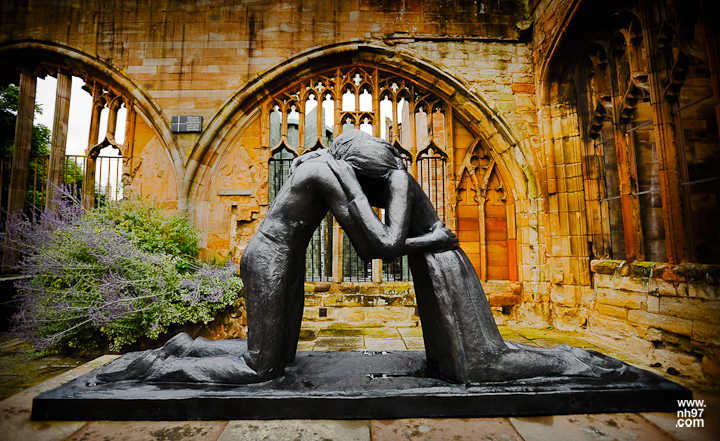
Reconciliation Statue
Reconciliation Statue, placed in the ruins of Coventry Cathedral, England, bombed by the Nazis in World War II.

Being emotionally and/or spiritually wounded by another downright hurts. So, what do we do when it happens? Gratefully, Jesus provided some clear teaching on how to handle a victimizing person. (Matthew 18:15-20)

In part one, we considered the initial step to be taken when a person has been offensive and brought damage to another and/or the community. In their straying from the law of love, we are to respond by speaking to the person privately, to attempt a one-on-one reconciliation and restoration. This effort may be repeated several times over.

These next two steps are only to be undertaken when it has become evident that the person’s intransigence about hurting others will not budge.

The Second Step – Take One or Two Others (Matthew 18:16).

Reconciliation Statue Berlin
Statue outside of the Church of Reconciliation in Berlin, Germany.

“If they will not listen, take one or two others along, so that ‘every matter may be established by the testimony of two or three witnesses.'” –Jesus

The idea here is not to get a few buddies together who agree with our assessment. Rather, we seek others who know the person and can provide loving and objective help. This upholds the ethics of the Old Testament:

A solitary witness against someone in any crime, wrongdoing, or in any sort of misdeed that might be done is not sufficient. The decision must stand by two or three witnesses. (Deuteronomy 19:15, CEB)

When a person fails to respond to reproof privately, then others need to get involved so that there is not a situation of “he said, she said.”  The witnesses are to help establish the nature of the problem. This is purposely meant to be a rather drawn out process because the goal is restoration. We are to give the person every chance to respond to correction.  People need to be given the grace of time to be effectively wooed back to the flock.

The Third Step – Tell It to the Church (Matthew 18:17-18).

Reconciliation Statue Hiroshima
Reconciliation Statue in Hiroshima, Japan

“If they still refuse to listen, tell it to the church; and if they refuse to listen even to the church, treat them as you would a pagan or a tax collector.” –Jesus

If the person ignores the group of witnesses, the group is to report the problem to the church. If the person still refuses to listen, then the person is to be treated like “a pagan or tax collector,” that is, the person is to be excommunicated and treated as though they are an unbeliever who has different needs. Jesus did not mean that we never talk to the person again. It is just the opposite: We communicate to them the need for grace just as we would to anyone.

The sixteenth-century Reformed Confession, the Heidelberg Catechism, took up this this matter (Question and Answer 85):

Q: How is the kingdom of heaven closed and opened by Christian discipline?

            A: According to the command of Christ:

Those who, though called Christians, profess unchristian teachings or live unchristian lives, and after repeated and loving counsel refuse to abandon their errors and wickedness, and after being reported to the church, that is, to its officers, fail to respond also to their admonition – such persons the officers exclude from the Christian fellowship by withholding the sacraments from them, and God himself excludes them from the kingdom of Christ.  Such persons, when promising and demonstrating genuine reform, are received again as members of Christ and of his church.

This approach is also germane with groups of people, churches, or Christian organizations. In the last century, churches around the world ostracized the South African Dutch Reformed Church for their refusal to bend concerning their racism and stance on apartheid.  Restoration did occur.  Not only that, but the Belhar Confession was eventually crafted from this church, a document which stands as a thorough biblical stand against structural racism and racist actions.

The Power of the Small Group (Matthew 18:19-20).

“Again, truly I tell you that if two of you on earth agree about anything they ask for, it will be done for them by my Father in heaven. For where two or three gather in my name, there am I with them.” –Jesus

Jesus reiterated his point about binding and loosing; opening and closing; banning and forgiving. One of the great Reformation teachings is the priesthood of all believers.  The beauty of this is that we may confess our sins to one another in a close, intimate setting so that the steps do not need be done. Small gatherings of believers coming together to confess sin and pray together is the most powerful setting there is.  If we neglect this, we are missing out on the power of God.

Conclusion

Once upon a time, there were two brothers. Their father had a large farm and when he became too old to work, he called his sons to him. “I am too old to work anymore,” he said. “I will divide my farm in half and give each of you one half. I know that you will always work together and will be good friends.”

When the brothers first started farming on their adjoining farms, they were the best of friends and would share everything together. Then, one day there was an argument between the two brothers, and they stopped speaking to one another. For many years, not a word was spoken between them.

One day, one of the brothers was at his house when a carpenter came to his door and said, “I would like to do some work. Do you have any work that I can do?” The brother thought for a moment and then replied, “I would like for you to build a fence on my property. Build it down near the stream that separates my farm from my brother’s. I do not want to see my brother and I would like for you to build a high fence there. I am going into town and I will return this evening.

Bridge over stream

When he came back that evening, he was shocked to see that the carpenter had not followed his instructions. Instead of building a high fence he built a bridge over the stream. The man walked down to look at the bridge, and as he did, his brother walked toward him from the other side. His brother said, “After all the terrible things I’ve done to you over the years, I can’t believe that you would build a bridge and welcome me back.” He reached out to his brother and gave him a big hug.

The brother then walked back up to his farmhouse to talk to the carpenter. “Can you stay?” he asked. “I have more work for you to do.” The carpenter answered, “I’m sorry but I can’t stay. I have to go, for I have many other bridges to build.”

Sometimes you and I have hurts and wounds from our brothers and sisters in Christ. When that happens, we often build a fence between ourselves and them. We stop talking to them. We do not want to see them. We do not want to be around them. However, Jesus wants something different. Instead of fences, he wants us to build a bridge of love.  He wants us to connect and work it out.