The Church that Makes a Difference (Matthew 16:13-20)

Photo by Felix Mittermeier on Pexels.com

When Jesus came to the region of Caesarea Philippi, he asked his disciples, “Who do people say the Son of Man is?”

They replied, “Some say John the Baptist; others say Elijah; and still others, Jeremiah or one of the prophets.”

“But what about you?” he asked. “Who do you say I am?”

Simon Peter answered, “You are the Messiah, the Son of the living God.”

Jesus replied, “Blessed are you, Simon son of Jonah, for this was not revealed to you by flesh and blood, but by my Father in heaven. And I tell you that you are Peter, and on this rock I will build my church, and the gates of Hades will not overcome it. I will give you the keys of the kingdom of heaven; whatever you bind on earth will be bound in heaven, and whatever you loose on earth will be loosed in heaven.” Then he ordered his disciples not to tell anyone that he was the Messiah. (New International Version)

A lot of research studies have come out in the past 20 years demonstrating that legions of adults, especially between the ages of 18-29, are leaving the Church in droves. This confirms my own anecdotal evidence over the years that about 80% of twenty-somethings drop out of church altogether. So, why are people leaving? Can anything be done about it?

Most of the studies can be boiled down to three major reasons: 

  1. The Church is irrelevant to my life and doesn’t talk about things important to me
  2. The Church is judgmental toward others not like themselves
  3. The Church is hypocritical by saying one thing and yet living another way

A good, right, and real confession of Jesus will speak a relevant word into the culture and into various generations, will proclaim the gospel of grace (not judgment), and will live what it believes.

In today’s Gospel lesson, Jesus and his disciples are in the Gentile (non-Jewish) territory of Caesarea Philippi, a city 25 miles north of the Sea of Galilee. Up to this point, the disciples encountered a lot of people and heard a lot of things said. So, Jesus asked them two questions: 

Who do people say the Son of Man is?

The disciples gave a variety of answers, which is to be expected, with some of them being a bit esoteric. John the Baptist raised from the dead is a stretch. Elijah was a man who never died, but was just taken to heaven; maybe he’s back. Maybe Jeremiah or one of the other prophets got sent back. 

When asking this question to folks today, you will also get a variety of answers as to whom Jesus is – a good teacher, a model humanitarian, a myth or a legend who didn’t really exist. A few times I have been told that Jesus was an alien from another planet. My personal favorite when I asked who Jesus, a guy answered that he was a nudist, and that if we all just took off our clothes, there would be peace in the world.

Who do you say I am?

Peter acted as the spokesperson for the group. Given the disciples’ track record of scratching their heads over nearly everything Jesus said or did, one might expect to hear another crazy answer. But Peter got it right by confessing, “You are the Christ, the Son of the Living God.” 

“Christ” is another way of saying “Messiah,” or “Savior.” It literally means, in the Greek language, “Answer.”  Peter confessed Jesus as being The Answer, the person for whom everything comes down to. Peter may not have fully understood what he was saying, but he said it.

The reason that craziness didn’t come out of Peter’s mouth is that “The Answer” was divinely revealed to him.  Faith in Jesus Christ is a gift given to us by God. 

“All things have been committed to me by my Father. No one knows the Son except the Father, and no one knows the Father except the Son and those to whom the Son chooses to reveal him.” Jesus (Matthew 11:27, NIV)

Peter was blessed – not necessarily because of sincerity, openness, or deserving it – but because of God’s grace which revealed to him that Jesus is the “Answer.”

The Apostle Peter put himself in a position to know by obeying the voice of Jesus to follow him. It took him and the other disciples a while to “get it,” but eventually they did. And if it took years of being with Jesus for the disciples to make a right and good confession of faith, then it’s important that we have a great deal of patience for our friends and relatives.

Jesus proclaimed Peter (which means “rock”) the immovable object from which the Church would be built.  The Apostle Paul framed it this way:

You are no longer foreigners and strangers, but fellow citizens with God’s people and also members of his household, built on the foundation of the apostles and prophets, with Christ Jesus himself as the chief cornerstone. In him the whole building is joined together and rises to become a holy temple in the Lord. (Ephesians 2:19-21, NIV)

Christ is the one who builds the Church – and not me,  nor you. This reality is encouraging and comforting to me. If it was up to me to build the Church, I would screw it up so badly that it would actually be overcome by hell. But I can’t screw it up, because it’s Christ’s Church, not mine. 

So, we can move forward and storm the gates of hell, we can move and work and act and call others to confess, all with the confidence and security of knowing that Jesus is building his Church. There’s no need to worry whether we’re getting it right, or not, because we aren’t the ones in control of the project.

However, I admit what Jesus says next isn’t very comforting to me. Christ told Peter that he will give him the “keys of the kingdom of heaven,” and that whatever he binds on earth will be bound in heaven, and whatever he lets loose on earth will be loosed in heaven.

Giving Peter the keys of the kingdom seems akin to giving an 8 year old the keys to the car and saying, “Go ahead, take it for a spin, you can drive it!” 

What are the keys of the kingdom? 

The preaching of the holy gospel and Christian discipline toward repentance. Both preaching and discipline open the kingdom of heaven to believers and close it to unbelievers. 

How does the preaching of the gospel open and close the kingdom of heaven? 

The kingdom of heaven is opened by proclaiming and publicly declaring to all believers, each and every one, that, as often as they accept the gospel promise in true faith, God, because of what Christ has done, truly forgives all their sins. The kingdom of heaven is closed, however, by proclaiming and publicly declaring to unbelievers and hypocrites that, as long as they do not repent, the anger of God and eternal condemnation rest on them. (The Heidelberg Catechism, Q&A 83, 84 )

The Church is true to its mission when it proclaims the good news of God’s grace in Christ. We possess the keys of the kingdom. Jesus knew exactly what he was doing, that is, the risks and the problems of letting people do the task of proclaiming the gospel. Yet, Christ still tossed us the keys to his Mercedes.

Conclusion

A Church that makes a difference is made up of people who confess Jesus, are called by God, and call others to confess Jesus, too. The de-churched and the disaffected want to see a Church that seeks to understand the world, to provide relevant ministry to others, and to tackle the injustice that exists everywhere.

We must use the power given us with the keys of the kingdom to bestow mercy to the weak, the oppressed, and the lost. We need to live what we believe with a passionate heart and an unashamed faith.

Together, as God’s people, we can extend the hospitality and the kindness to make a difference in the church and the world. 

May our confession of Christ shape our words and our actions. And may it give us the confidence and boldness to live as Jesus did, and to enjoy him forever. Amen.

It’s Not Over Till It’s Over (Ezekiel 33:10-16)

The Lord said:

Ezekiel, son of man, the people of Israel are complaining that the punishment for their sins is more than they can stand. They have lost all hope for survival, and they blame me. Tell them that as surely as I am the living Lord God, I don’t like to see wicked people die. I enjoy seeing them turn from their sins and live. So if the Israelites want to live, they must stop sinning and turn back to me.

Tell them that when good people start sinning, all the good they did in the past cannot save them from being punished. And remind them that when wicked people stop sinning, their past sins will be completely forgiven, and they won’t be punished.

Suppose I promise good people that they will live, then later they start sinning and believe they will be saved by the good they did in the past. These people will certainly be put to death because of their sins. Their good deeds will be forgotten.

Suppose I warn wicked people that they will die because of their sins, and they stop sinning and start doing right. For example, they need to return anything they have taken as security for a loan and anything they have stolen. Then if they stop doing evil and start obeying my Law, they will live. Their past sins will be forgiven, and they will live because they have done right. (Contemporary English Version)

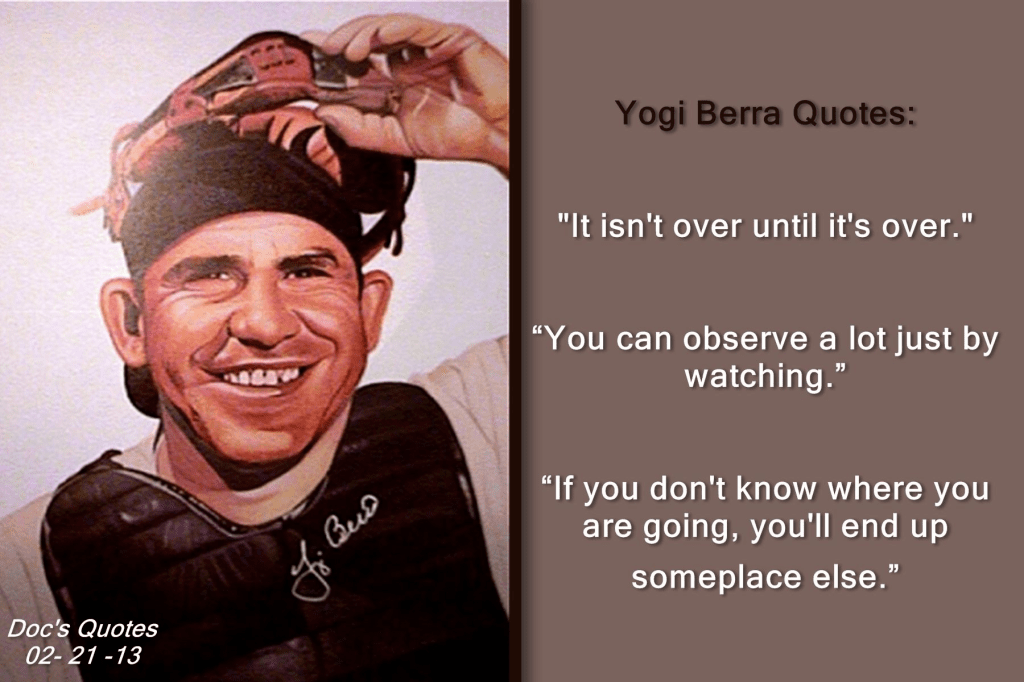
“It ain’t over till the fat lady sings,” is an old adage which means one should not presume to know the outcome of something that’s still in progress. In more contemporary language, we might say, “It’s not over till it’s over.”

Those sorts of proverbs are asking us, “What are you doing today? How are you living your life, right now?”

We need to be present to the time we are inhabiting at this moment. There are two opposite temptations for us in relating to time.

  1. “I did a lot of good things in the past. I worked hard. I was generous. Now it’s time for me to do whatever the heck I want. Nobody is going to tell me what to do or how to live my life.”
  2. “I did a lot of bad things in the past. I partied hard. I took advantage of people. Now it’s time for me to do good. I don’t know, though, whether it will ever be enough.”

In other words, the temptations are either to rely on all the good I’ve done, earning me a license to do what I want; or to believe I can never overcome my bad past. In both cases, it’s to keep thinking our past is the controlling factor.

But it’s not.

Just as there was a flip-flop of living, it could very well happen again. The guy who did good in the past, then didn’t, now responds to overtures to stop living a selfish life. He begins doing the good he used to do. And the guy who had a sordid past, then changed and did good, now goes back to his old life, like a dog returning to its vomit.

It’s never over, till it’s over. As long as we’re still breathing on this earth and walking on it, the outcome of life is still yet to be determined. There is always the opportunity for new life. And it begins with identifying and confessing where we are in this present time.

If we confess our sins, God is faithful and just to forgive us our sins and cleanse us from everything we’ve done wrong. (1 John 1:9, CEB) 

Being right with God means assessing our relationship at all times. Forgiveness and reconciliation are activated by admitting one’s true condition. Secret sins tucked away deep in the soul will only fester and boil. The result of un-confessed sin is spiritual blindness, darkness, and death. 

There cannot be new life and renewal, revival, or revitalization of life and ministry apart from real honest tell-it-like-it-is biblical confession. 

If this scares the hell out of you, it really should. Dealing with sin in a radical straightforward manner is what Jesus talked about in his Sermon on the Mount, in saying we should pluck our eyes out if they offend, and cut our hands off if they cause us to sin; because it’s better to be in God’s kingdom with no eyes and hands than to burn in hell with our parts intact. (Matthew 5:29-30) 

Confession is more than simply mouthing some words about not being perfect and a sinner like everybody else; it is to lead to a complete turn-around and change of how we live our lives. We can change. We are neither fated to be a screw-up forever nor a good person till the end.

Instead, we have to put the work in – mentally, emotionally, and spiritually.

Change is what the biblical word “repentance” means. It happens by dealing squarely with our past thinking, choices, and behavior. This is why some form of a prayer of confession really needs to happen at every church worship service. 

Ignoring such a vital liturgical prayer and practice will, at best, leave people with no guidance for confronting sin; and, at worst, will teach people that confession is not necessary to Christianity and leave them a spiritual mess. 

Yet a carefully constructed prayer of confession can lead believers to unburden the things they have done, and the things they have left undone – which opens us to the advocacy of Jesus Christ who speaks on our behalf because of his once-for-all atoning sacrifice for sins.

Confession, repentance, and change are more than single events; they are a way of life for the believer. As long as you are still able to read this, there’s still the opportunity to live the good life and forsake the wicked life.

Today, if you hear his voice, do not harden your hearts. (Hebrews 4:7, NIV)

It ain’t over till it’s over.

Creator God, you made us in your image: may we discern your goodness in all that we see, and serve you with all goodness in everything we do, through Jesus Christ our Lord. Amen.

Pain, Stress, and Chickens (Psalm 32)

A modern mosaic of a mother hen protecting her chicks—on the altar of Dominus Flevit Church on the Mount of Olives, Jerusalem

Oh, what joy for those
    whose disobedience is forgiven,
    whose sin is put out of sight!
Yes, what joy for those
    whose record the Lord has cleared of guilt,
    whose lives are lived in complete honesty!
When I refused to confess my sin,
    my body wasted away,
    and I groaned all day long.
Day and night your hand of discipline was heavy on me.
    My strength evaporated like water in the summer heat.

Finally, I confessed all my sins to you
    and stopped trying to hide my guilt.
I said to myself, “I will confess my rebellion to the Lord.”
    And you forgave me! All my guilt is gone.

Therefore, let all the godly pray to you while there is still time,
    that they may not drown in the floodwaters of judgment.
For you are my hiding place;
    you protect me from trouble.
    You surround me with songs of victory.

The Lord says, “I will guide you along the best pathway for your life.
    I will advise you and watch over you.
Do not be like a senseless horse or mule
    that needs a bit and bridle to keep it under control.”

Many sorrows come to the wicked,
    but unfailing love surrounds those who trust the Lord.
So rejoice in the Lord and be glad, all you who obey him!
    Shout for joy, all you whose hearts are pure! (New Living Translation)

The body knows the truth of what is happening in the spirit. Our physical selves carry the weight of our mental thoughts and emotional feelings.

Our bodies have their way of making sounds of protest and pain if our spirits are silent. For example, physical weariness and tiredness can be a lighthouse, alerting us to pay attention to our inner suffering.

In other words, stated positively, pain and stress are a gift.

“I imagine one of the reasons people cling to their hates so stubbornly is because they sense, once hate is gone, they will be forced to deal with pain.”

James Baldwin

What is stress?

Stress is any type of change that causes physical, emotional, mental, or spiritual strain. Stress is a normal reaction to everyday pressures. However, stress can become unhealthy when it upsets our daily functioning and ability to live well. Stress itself is neither good nor bad. The issue is the appropriate amount of tension we need to live a healthy life.

Where do you typically carry stress in your body?

Whenever we are under a great deal of stress – and are having difficulty either recognizing it or managing it – the body gives us clues about how to pay attention to that stress. Our mental, emotional, relational, and spiritual issues usually show up in the body as physical problems.

Why do individuals handle stress differently?

The combination of past trauma, abuse, and neglect within families and communities is unique to the individual – as well as variations in personality traits and inherited genetics.  In other words, how we deal with stress is a result of both nature and nurture.

What are some common connections between stress and the body?

  • Shoulders: Feeling overwhelmed through carrying the weight of the world’s problems.
  • Gut (stomach and intestines): Feeling anxious for not letting go of a problem.
  • Vomiting or diarrhea: Feeling emotionally sick about a situation and wanting to be rid of it once and for all.
  • Hemorrhoids or constipation: Straining or working very hard to make something happen in your life and it doesn’t come to pass.
  • Headache: Feeling afraid through overthinking that something bad will happen.
  • Chest/heart: Feeling angry or sad through either trauma or secondary trauma.
  • Lungs: Feeling suffocated, like you cannot breathe, because of difficult circumstances, e.g. asthma
  • Spine/knees/hips: Feeling discouraged and wanting to give up because you cannot take one more step.
  •  

How can I deal with my stress in a healthy way?

  1. Let go. Ask for help. Talk to God, as well as a friend, faith leader, or other about why you are stressed.
  2. Reach out. Connect with family members. Get involved in a faith community. Volunteer in an organization you care about.
  3. Eat well. Make healthy choices about food. Find someone or a group of people who share your nutrition goals.
  4. Meditate. Focus on the present moment because there is only now. Read Scripture. Pray.
  5. Walk. Take daily strolls through nature. Walk the dog. Walk with a friend. Walk with the Lord.
  6. Read. Read or listen to a good book. Do it with a cup of coffee or tea.

“The truth is that stress doesn’t come from your boss, your kids, your spouse, traffic jams, health challenges, or other circumstances. It comes from your thoughts about your circumstances.”

Andrew Bernstein

The psalmist went on to release his silence and give voice to his spiritual stress and emotional pain, thus finding relief.

Who is the stress reliever?

God. The Lord is akin to a mother hen who protects her chicks.

My youngest daughter once had a pet chicken named “Gina” (I have no idea why she named the chicken this). Gina would lay an egg or two and keep them warm and nestled underneath herself. Indeed, the eggs were in a special hiding place, protected from outside forces.

My daughter also sang to Gina (which helped her to lay more eggs) and made sure she had plenty of space to find grubs, worms, shrews, and other delectables from the ground. Gina wasn’t the only pet chicken; there were others, too. Chickens are very social and require other chickens to be happy; a solitary hen is likely to not lay any eggs, at all.

Whenever we are “chicken” and run about with anxiety and fear, God gathers us together with other believers, protects us from trouble, surrounds us with songs of deliverance, and makes sure we have everything we need for life and godliness in this present age.

The Lord will take care of us – no matter the situation, the stress, or the pain it produces.

Blessed heavenly Father and Mother Hen, your Divine presence, power, provision, and protection gives us grace and truth. May this season of Lent – a time of repentance and faith – bring us the blessing of your forgiveness and the joy of salvation, through Jesus Christ our Lord. Amen.

There’s a Price to Pay (Leviticus 26:34-46)

At that time, while it is devastated and you are in enemy territory, the land will enjoy its sabbaths. At that time, the land will rest and enjoy its sabbaths. During the whole time it is devastated, it will have the rest it didn’t have during the sabbaths you lived in it.

I will bring despair into the hearts of those of you who survive in enemy territory. Just the sound of a windblown leaf will put them to running, and they will run scared as if running from a sword! They will fall even when no one is chasing them! They will stumble over each other as they would before a sword, even though no one is chasing them!

You will have no power to stand before your enemies. You will disappear among the nations—the land of your enemies will devour you. Any of you who do survive will rot in enemy territory on account of their guilty deeds. And they will rot too on account of their ancestors’ guilty deeds.

But if they confess their and their ancestors’ guilt for the wrongdoing they did to me, and for their continued opposition to me—which made me oppose them, so I took them into enemy territory—or if their uncircumcised hearts are humbled and they make up for their guilt, then I will remember my covenant with Jacob. I will also remember my covenant with Isaac. And my covenant with Abraham.

And I will remember the land. The land will be absent of them and will be enjoying its sabbaths while it lies devastated, free of them. They will be making up for their guilty deeds for no other reason than the fact that they rejected my regulations and despised my rules. 

But despite all that, when they are in enemy territory, I will not reject them or despise them to the point of totally destroying them, breaking my covenant with them by doing so, because I am the Lord their God. But for their sake I will remember the covenant with the first generation, the ones I brought out of Egypt’s land in the sight of all the nations, in order to be their God; I am the Lord.

These are the rules, regulations, and instructions between the Lord and the Israelites that he gave through Moses on Mount Sinai. (Common English Bible)

Disobedience has a price. Within God’s household, the Lord isn’t some geriatric or decrepit deity who let’s the kids run around and do whatever the heck they want. Instead, God has certain rules so that the children can grow and thrive within loving boundaries. The fences aren’t there in order to be a divine killjoy; rather, the rules and boundaries exist for the flourishing and enjoying of life.

The price of disobedience is brokenness and devastation. To continually buck our basic design as humans will eventually catch up to us. If we eat with impunity, spending copious amounts of time consuming food, we’ll one day collect a host of heart-related issues and diseases. If we drive the car and never maintain it through regular oil changes and inspections, someday it will break down, perhaps permanently.

And if we live our lives without punctuating our weeks with needed rest – and use the land as if it were an infinite resource – then everything will eventually go awry and not work or produce like it should. That’s not God being mean, as if the Lord is to blame; it’s us being stupid, not practicing our God-given wisdom.

“Because we do not rest, we lose our way.”

Wayne Muller

Everything and everyone needs rest. It’s vital to us, just as much as water to drink and air to breathe. So, if we ignore it, we’ll pay the price of our neglect.

Sabbath was built into the universal scheme of things because it’s necessary. Our bodies neither work right nor live right without regular sabbath rests. It’s not optional. Try telling your body that you’re too busy to go to the bathroom and see how that works out for you. Sooner than later, you’re going to have to submit, or there will be a hefty price to pay.

If we stray from wise ways of living, or even stubbornly refuse to obey, there’s hope; we won’t be left to wallow in our own foolishness. Grace is too big and strong for any of our puny human backsliding. The Lord is always ready and willing to receive the humble and penitent heart.

God’s expertise is in restoration; the Lord gives a new lease on life to people who could never do it themselves. In fact, from a New Testament perspective, God even goes so far as to pay the price of human waywardness with his own Son.

A loving God ensures that all of creation will have what it needs to survive and thrive. An unloving god turns a blind eye to it all. If we don’t learn to play well with the creation around us, we’ll be called into the house and not be allowed to be outside for quite some time.

We are meant to practice good self-care, be good caregivers for others, and concern ourselves with caring for all creation.

So, pay the price of caring for self, others, and the land. Accept and submit to the rhythms of life which are required to live well. You’ll be glad you did because the alternative may be something a whole lot harder.

Creator God, you made the goodness of the land, the riches of the sea and the rhythm of the seasons; as we thank you for your gracious providing may we cherish and respect this planet and its peoples, through Jesus Christ our Lord. Amen.