God Will Make a Way (Exodus 2:1-10)

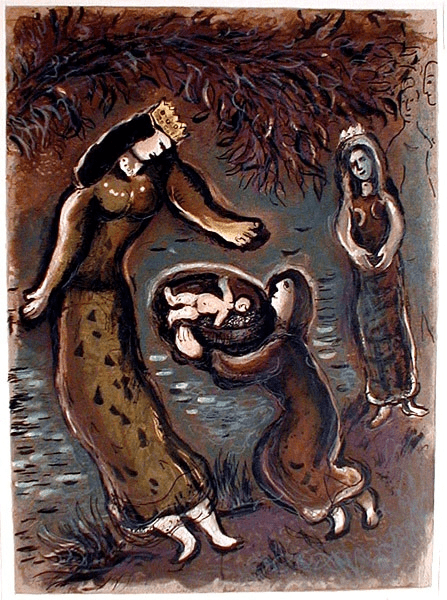
Moses is saved from the water by Pharaoh’s daughter, by Marc Chagall, 1966

Now a man from Levi’s household married a Levite woman. The woman became pregnant and gave birth to a son. She saw that the baby was healthy and beautiful, so she hid him for three months. When she couldn’t hide him any longer, she took a reed basket and sealed it up with black tar. She put the child in the basket and set the basket among the reeds at the riverbank. The baby’s older sister stood watch nearby to see what would happen to him.

Pharaoh’s daughter came down to bathe in the river, while her women servants walked along beside the river. She saw the basket among the reeds, and she sent one of her servants to bring it to her. When she opened it, she saw the child. The boy was crying, and she felt sorry for him. She said, “This must be one of the Hebrews’ children.”

Then the baby’s sister said to Pharaoh’s daughter, “Would you like me to go and find one of the Hebrew women to nurse the child for you?”

Pharaoh’s daughter agreed, “Yes, do that.” So the girl went and called the child’s mother. Pharaoh’s daughter said to her, “Take this child and nurse it for me, and I’ll pay you for your work.” So the woman took the child and nursed it. After the child had grown up, she brought him back to Pharaoh’s daughter, who adopted him as her son. She named him Moses, “because,” she said, “I pulled him out of the water.” (Common English Bible)

A new Pharaoh was enthroned in Egypt. Enough time had gone by that the legacy of Joseph as the administrator in saving many Egyptian people was lost. So, because the Israelites had grown to such large numbers, Pharaoh was afraid.

The politics of fear typically results in somebody getting oppressed. Indeed, fear became the driving force to a series of escalating oppressive policies initiated by Pharaoh, even to the point of planned infanticide. The Jewish midwives were instructed toward this end.

But the midwives did not fear the Egyptian Pharaoh. Instead they had a healthy fear of God (Exodus 1:17, 21). With such rightly ordered fear, the Jewish midwives defied the order of Pharaoh and openly disobeyed the royal command to murder Hebrew boys.

Here then, we have the setting for a special Hebrew baby to be born named Moses. He is the healthy child of two devout Levites. And although God’s name is not referenced in the verses for today, we can nonetheless see the providence and protection of the Lord within the narrative.

Through a complex chain of events, both the birth mother and the royal daughter care for this baby, protecting his life, with a divine provision for the needs of the infant Moses. Most stories in the Old Testament have contrasting characters within them, and today’s is no exception.

Pharaoh was the ruler over all of Egypt, and yet, he feared a loss of power and the status quo because of the Israelites – even though he reigned during a time of political peace, with hegemony reaching into the Middle East. As Pharaoh’s paranoid fear rose, so did God’s response of divine sovereignty over him, by providing protection against his diabolical intentions.

In contrast to Pharaoh, a powerless and non-descript Hebrew couple were married, conceived and bore a family of a daughter and two sons – Moses being the youngest. They had nothing, yet everything; whereas Pharaoh had everything, yet nothing. Thriving and flourishing has to do with a lot more than wealth and material resources.

Maternal care is powerful. And it finds a way to win the day and not only save a baby, but also to ensure that the baby grows, lives, and thrives. No royal edict can defeat the resilient strength of maternal compassion.

Despite Pharaoh’s increasing oppression, the compassion of several women ends up raising the very one who will lead the Israelites into liberation from this oppression.

With the Lord, a way will be found where there is no way. God + nothing = everything.

For us today, there is often a tendency to look back on the good old days when God did great things, and to look ahead when the Lord will return and make all things new and right. Yet we too often neglect to be mindful and live in the present moment, and know the God who is present with us right now.

We may remember the awesome deeds that God once did; and rejoice in biblical stories which demonstrate the Lord’s power, provision, and protection. We may look forward to the fulfillment of God’s promises in the person of Jesus when he returns, and gain hope from that.

Now, in this present evil age, and in this messed up world, we also have the God of the present tense. God will make a way, in this present time, where there seems to be no way. God is doing something new and amazing for us today.

And that way will be clear enough for us to know – and incredible enough for us to not predict or imagine. For God’s watch-care and deliverance can (and does) take many forms. When the Lord fulfills divine plans, it sometimes comes in the most creative and incredible way possible, so that we will have no doubt where it came from.

“God Will Make a Way” by Don Moen

God will make a way, Where there seems to be no way
He works in ways we cannot see, He will make a way for me
He will be my guide, Hold me closely to His side
With love and strength, For each new day
He will make a way He will make a way

By a roadway in the wilderness, He’ll lead me
And rivers in the desert will I see
Heaven and earth will fade
But His Word will still remain
He will do something new today

Communicate with Clarity and Care (Genesis 35:1-4)

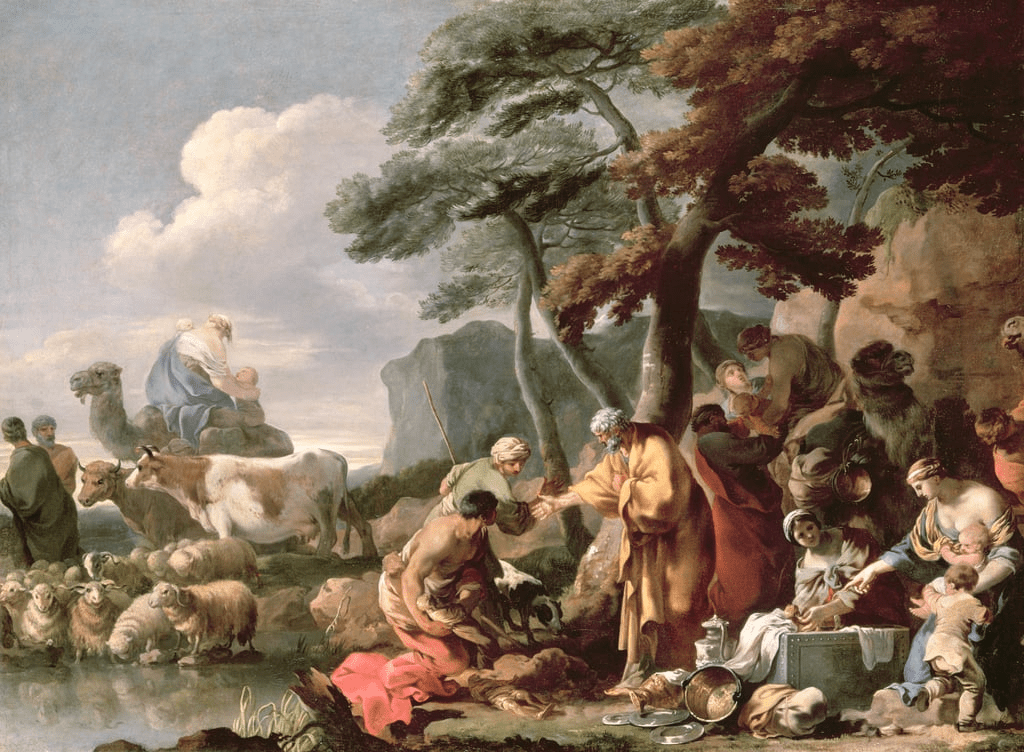
Jacob burying the false gods under the oak by Shechem, by Sébastien Bourdon (1616-1671)

Then God said to Jacob, “Go to Bethel and live there. Make an altar there. I am the God who appeared to you when you were fleeing from your brother Esau.”

So Jacob said to his family and those who were with him, “Get rid of the foreign gods which you have, wash yourselves until you are ritually clean, and change your clothes. Then let’s go to Bethel. I will make an altar there to God, who answered me when I was troubled and who has been with me wherever I’ve gone.” So they gave Jacob all the foreign gods that they had in their possession as well as the earrings that they had on. Jacob buried these things under the oak tree near Shechem. (God’s Word Translation)

Christianity has existed for 2,000 years; Judaism for 4,000 years or more. That’s a long time. On the one hand, this is a tremendous legacy of faith, grounded in several millennia of solid religious tradition. And on the other hand, something existing for so long is bound to accumulate some barnacles that get encrusted on the faith.

And if those barnacles are there for too long, it becomes assumed that they’re just part of the ship of faith. But they’re not; they need to be removed so we can see the real thing and move through life unencumbered and not dragged by extraneous stuff.

The familiar, over time, is taken for granted. And when that happens, we lose sight of what is most important, of what is most needed.

God helped Jacob – the son of Isaac, the son of Abraham – to reconnect with a seminal experience from earlier in his life. That experience was a vison of God, and an assurance that God was with Jacob. He was not alone.

But, years later, after accumulating two wives, twelve sons, and many flocks of sheep and other animals, it was time to move and make a home and an altar elsewhere. Instead of taking the Lord for granted, and forgetting the difficulties of the past, God intervened and called the whole crew to go and live in another place.

The communication from God brought Jacob to a spiritual place of realizing what had happened over the years; slowly and perhaps imperceptibly, the barnacles of idolatry had become encrusted amongst his family. And they were obstacles which needed to be jettisoned before they could move on.

Jacob needed to hear from God. Jacob’s family needed to hear from him. And that communication had to be a helpful way of scraping the barnacles off from decades of misplaced living.

Our world today is marked by unfeeling meanness to strangers, a profound lack of empathy, respect, and basic human kindness toward one another. Individuals, groups, communities, and entire nations don’t know how to talk to each other in a way that is helpful and life-giving.

We need a process which helps us have a way of being with others that is compassionate. It is imperative that we have communication that guides us in both expressing ourselves and listening to others. And that process must focus on what we are observing, feeling, and needing.

It is essential that humanity creates deeper personal relationships and maintains them. If not, we will be overcome by the barnacles of suspicion, hate, distrust of others, as well as distance from God.

Unless we are with each other in helpful ways, we will devolve into judgmental and critical speech directed toward others or even ourselves. Violent words are the main obstacle to having compassion on others.

Comparisons and classifications of people, denial of responsibility for words and behaviors, and making demands, leads to estranged relationships. Instead, we can do better. We can be with one another and talk to each other by communicating observations, feelings, needs, and requests.

Observation

  • Observe, rather than evaluate. Whenever we observe something, and then quickly evaluate it, the other person will tend to hear criticism and resist what we are saying.
  • Be specific, not general. It’s helpful to make a specific observation instead of a general one. For example, God was specific about what Jacob was to do. And Jacob was quite specific about the situation of idolatry and what to do about it before the family could move to Bethel.

Feeling

  • Acknowledge and express your emotion. Clearly and specifically identify and name your emotions because this is the way we connect more easily with others. Jacob told his family of feeling troubled in the past and that God helped him deal with it.
  • Be vulnerable. Expressing our feelings can help resolve conflicts. The old adage is true: People don’t care how much you know until they know how much you care.

Need

  • What do you need? Take responsibility for your feelings. Connect your feeling with your need. Jacob was devoted to God because his emotions were tethered with how God had met his needs throughout his life.
  • Others do not cause our feelings, and they are not responsible for our emotions. Jacob’s family did exactly what Jacob told them to do – and did not buck him or resist him – mainly because he let them know how he was feeling, and why he was telling them to rid themselves of idols and move on with him to Bethel.
  • Listen to yourself. Judgments of others are projections of our own unmet needs; and conversely, being kind to ourselves, listening to our thoughts, and paying attention to how we carry stress in our bodies, allows us to be helpful to others and present to them in whatever they are going through.
  • We are not responsible for other people’s feelings. We can never meet our own needs by trying to make others feel guilt or shame.

Request

  • Ask for what you need and want. We honor ourselves by making requests in clear, positive, and concrete language of what we really need. The clearer we are about what we want, the more likely it is that we’ll get it.
  • The message we send is not always the message which is received by another. Be clear about the response you want so that there is no confusion about what we truly need.

The objective of communication is not to change people and their behavior in order to get our way. Rather, it is to establish relationships based on honesty and empathy that will eventually fulfill everyone’s needs.

There is a need to express honestly and clearly our observations, feelings, needs, and requests, as well as receive another’s communication with focused attention and empathy.

So then, how we talk to and about God, and how we talk to ourselves, becomes a template for how we talk to others. A lack of clear communication is a surefire way of allowing the barnacles of displeasure and disappointment to attach to our souls.

However, clear communication is life-giving and even lifesaving. It’s worth putting significant effort into it.

Blessed Lord, in your infinite wisdom, you created us with the gift of communication. May we use this gift to foster love, understanding, and unity amongst ourselves and with you.

Guide our hearts to speak words of kindness and encouragement. May our tongues be instruments of love, grace and compassion to those around us.

Open our ears, so that we may truly listen and understand the needs and desires of our fellow humanity. Grant us the patience to hear their stories and the wisdom to respond with love and empathy.

Enlighten our minds to be clear and thoughtful in our affect and speech. As we share our thoughts and ideas, may we be ever mindful of your presence, seeking your holy and good will in all we say and do.

Fill our conversations with honesty and vulnerability. May we find the strength and courage to speak our truth while always remaining respectful and considerate of the feelings of others.

Bind us together in unity and love through our shared communication. May our words build bridges and forge bonds that reflect your divine love and mercy. Amen.

A Life of Compassion (Matthew 9:35-10:23)

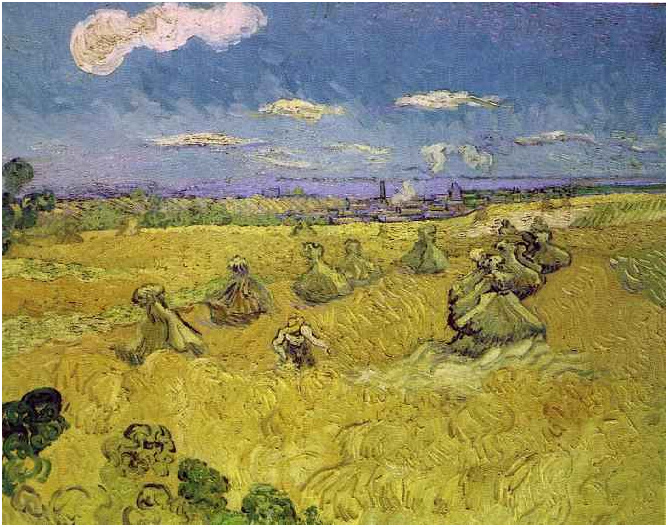
Wheat Stacks with Reaper, by Vincent Van Gogh, 1888

Jesus went through all the towns and villages, teaching in their synagogues, proclaiming the good news of the kingdom and healing every disease and sickness. When he saw the crowds, he had compassion on them, because they were harassed and helpless, like sheep without a shepherd. Then he said to his disciples, “The harvest is plentiful but the workers are few. Ask the Lord of the harvest, therefore, to send out workers into his harvest field.”

Jesus called his twelve disciples to him and gave them authority to drive out impure spirits and to heal every disease and sickness.

These are the names of the twelve apostles: first, Simon (who is called Peter) and his brother Andrew; James son of Zebedee, and his brother John; Philip and Bartholomew; Thomas and Matthew the tax collector; James son of Alphaeus, and Thaddaeus; Simon the Zealot and Judas Iscariot, who betrayed him.

These twelve Jesus sent out with the following instructions: “Do not go among the Gentiles or enter any town of the Samaritans. Go rather to the lost sheep of Israel. As you go, proclaim this message: ‘The kingdom of heaven has come near.’ Heal the sick, raise the dead, cleanse those who have leprosy, drive out demons. Freely you have received; freely give.

“Do not get any gold or silver or copper to take with you in your belts—no bag for the journey or extra shirt or sandals or a staff, for the worker is worth his keep. Whatever town or village you enter, search there for some worthy person and stay at their house until you leave. As you enter the home, give it your greeting. If the home is deserving, let your peace rest on it; if it is not, let your peace return to you. If anyone will not welcome you or listen to your words, leave that home or town and shake the dust off your feet. Truly I tell you, it will be more bearable for Sodom and Gomorrah on the day of judgment than for that town.

“I am sending you out like sheep among wolves. Therefore be as shrewd as snakes and as innocent as doves. Be on your guard; you will be handed over to the local councils and be flogged in the synagogues. On my account you will be brought before governors and kings as witnesses to them and to the Gentiles. But when they arrest you, do not worry about what to say or how to say it. At that time you will be given what to say, for it will not be you speaking, but the Spirit of your Father speaking through you.

“Brother will betray brother to death, and a father his child; children will rebel against their parents and have them put to death. You will be hated by everyone because of me, but the one who stands firm to the end will be saved. When you are persecuted in one place, flee to another. Truly I tell you, you will not finish going through the towns of Israel before the Son of Man comes. (New International Version)

Use your voice for kindness, your ears for compassion, your hands for charity, your mind for truth, and your heart for love.

We need compassion; humanity cannot survive without it.

Compassion is…

  • a concern for the well-being of others
  • the basis for altruism and the most virtuous motive one can possess
  • activated within the human heart when witnessing another person’s suffering
  • helping other people feel seen, heard, and known
  • the bridge that connects us with another in need
  • life

While on this earth, I believe Jesus was the very embodiment of compassion. To reflect on Christ’s compassion helps us to raise our own compassion quotient, and thus, avoid succumbing to the whims of indifference concerning human need.

Compassion responds to human need

In his earthly ministry of preaching, teaching, and healing, Jesus went through all the towns and villages. He neither waited for people to come to him nor wanted anyone to fall through the cracks. Doing this compassionate work, Jesus was moved by the depth of people’s needs.

The word for “compassion” in the Bible means “to be moved in the pit of your gut.” It is to be filled with pity and heartbroken over the unmet needs of people.

So, what moves and stirs compassion deep down in your gut?

Jesus went into towns and was broken-hearted over people who were harassed and helpless, locked into patterns of life that were harmful and damaging. 

Jesus came to this earth to seek and save people, offering forgiveness and a new life. Jesus willingly brought compassion – and his motivation for doing so was neither from duty nor guilt. Compassion is the proper motivation for all things.

Just as Jesus went out and ministered, then was moved by what he saw, so our compassion is aroused whenever we go out and enter people’s lives, seeing first-hand the depth of human need.

Compassion results in prayer

Christ saw the masses of people and told his disciples to ask God to send workers because the harvest is plentiful. Jesus knows there are large numbers of people waiting to hear good news. So, he said to pray earnestly and compassionately.

Compassion brings us to prayer and impels us to pray that workers be sent to people who are ripe for hearing good news. We must not listen to the hellish lie: That certain people don’t really want the good news of the kingdom of God; that my neighbor, or co-worker, or family member is not spiritual and doesn’t care about forgiveness or grace – that there is nothing within them to respond to compassion.

The devil does not want us to have merciful compassion for them, to be moved to intercede for them in prayer, nor to become a harvester in the field of people. Jesus said the harvest is plentiful; and it is through compassionate prayer that the work will be done.

Compassion sends us out

The call to prayer is central, but it’s not everything. As faith without works is dead, so prayer without mission is empty.

The people Jesus authorized for ministry were a collection of twelve motley disciples who thought differently about a great many things. Yet, the compassion of Jesus changes lives and brings people together from diverse backgrounds and viewpoints.

The disciples were told, in their initial mission as followers of Jesus, to go only to the house of Israel. Israel’s house needed to be put in order first before they could ever think of going to Gentiles. We begin by reaching out to people in our own backyard.

“You will be my witnesses in Jerusalem, and in all Judea and Samaria, and to the ends of the earth.” Jesus (Acts 1:8, NIV)

Jesus told the disciples to do exactly what he had been doing: preaching and healing, proclaiming the message that “the kingdom of God is near.” 

The kingdom is not only something in the future; the kingdom of God has already broken into the present time, and the evidence of it is the transformation of people’s lives now. The blessings and promises of kingdom life are presently available.

Jesus sent the disciples out and told them not to take anything with them. They were to leave all their baggage behind. The disciples were to be stripped of everything so that they had the ability to see people and their needs and be moved with compassion as Jesus was.

The kingdom of God was near to them, so they did not need to add anything for the mission. Jesus did not want his disciples assuming they already knew what people needed. Instead, they must be present to people and discover their needs without bias. As compassion is freely received, it is to be freely given.

Cultivating Compassion

Compassion is the appropriate response to human need. Yet, we do not always react with compassion. The following are a few approaches which prevent us from becoming compassionate, along with some ways of cultivating a compassionate life:

  1. A defeating and discouraging environment. Contempt, anger, hatred, and abuse drives out compassion. The environment around us makes a difference. If we find we must check our hearts at the door and avoid compassion to just make it, then we need a change of environment. Life is too short, and the world too compassion-starved, to maintain a situation that drags us down and hinders the kingdom of God within us.
  2. An unhealthy pace of life.  A person cannot have a compassionate heart if they are running too fast to see other people’s needs. When spare moments are used to try and figure out how to keep all the balls in the air and all the plates spinning, there’s no way to dole out compassion to others. So, slow down. No one comes to the end of life and wishes they had logged more hours of work at their job. Develop a plan on how to slow down enough to tune into the needs of others and have emotional energy for them.
  3. Excessive caregiving. Compassion fatigue is a real thing. Resentment can build toward the very people we care for because of constant giving without receiving. When the emotional gas tank is empty, it is possible to become cold-hearted. Yet, some keep going anyway – and ruin their engine. Caring for others must be meticulously balanced with caring for self. There is a time for everything, including rest and recuperation. Jesus regularly practiced the disciplines of solitude and silence. If he needed those restorative practices, so do we.
  4. Objectifying people. Whenever we put adjectives in front of people, compassion is lacking. Referring to “those” people, “lesbian” neighbors, “black” folks at work, my “obnoxious” relative, or, the “poor” family down the street, are all examples of objectifying people and putting them at a distance from ourselves. Your neighbors are your neighbors, your family is your family, and the people in your life are just people, period. Compassion arises as we look for what is common among us, not different. Compassion brings solidarity with others, not separation and division.

May you allow God the time to form a compassionate heart within through being with Jesus. May compassion toward others be the defining characteristic of your life.

Pastoral Care (Ezekiel 34:17-23)

“Now then, my flock, I, the Sovereign Lord, tell you that I will judge each of you and separate the good from the bad, the sheep from the goats. Some of you are not satisfied with eating the best grass; you even trample down what you don’t eat! You drink the clear water and muddy what you don’t drink! My other sheep have to eat the grass you trample down and drink the water you muddy.

“So now, I, the Sovereign Lord, tell you that I will judge between you strong sheep and the weak sheep. You pushed the sick ones aside and butted them away from the flock. But I will rescue my sheep and not let them be mistreated any more. I will judge each of my sheep and separate the good from the bad. I will give them a king like my servant David to be their one shepherd, and he will take care of them. (Good News Translation)

“Only through love can we obtain communion with God.”

Albert Schweitzer

I have a zero tolerance for bullying. And, I believe, this is a conviction which must be shared together with everyone. If not, we will continue to see spiritual abuse in the news, so-called Christians and churches throwing their weight around, and a world enveloped in the darkness of mean-spirited persons who only care about themselves and getting their way.

It is most necessary that spiritual folk let compassionate pastoral care have its way in the world.

Pastoral care, for me, is rooted in the compassion of Jesus Christ. It is my connection and relationship with this living Savior, Teacher, Healer, and Lord which enables me to extend genuine care to others. 

I believe that it is the grace and mercy of God in Christ through the enablement of the Holy Spirit which brings comfort, hope, and encouragement to people in need. My philosophy of pastoral care addresses three significant factors, in this order:

  1. Being in a safe environment is paramount. Building trust and connection is important. The caring relationship needs confidence so that the pastor can compassionately encourage and help the person to pursue being in a secure place – whether that is a physical moving away or out, or finding a safe and sacred place within one’s own soul from which healing and holistic health can begin. Bullying can be physical, verbal, emotional, mental, or personal in talking abusively to oneself; and it must be stood up to and stopped.
  2. Grieving is necessary. Mourning and lamenting a significant change or loss must occur to learn to thrive and flourish again in a new situation. This requires being open about one’s feelings, communing freely with God, and being vulnerable with a pastor, therapist, church group, or some other secure human connection. It is common to get “stuck” in grief and believe our situation can never change. But it can, so we must not remain there. 
  3. Reconnecting with the world is vital. Bullying and belligerent people can take a lot out of us and from us. Therefore, we need to find joy in the simple pleasures of life again; to reach out and relate to others who have gone through similar experiences; and, to regain ordinary rhythms and routines of life are all crucial to being alive. The compassionate pastor gently assists, encourages, exhorts, and walks with others toward relating well with the world once again.

Recovery is not an event, and not even a process; it is a way of life. 

All of us are vulnerable to the brokenness of this fallen world. We must learn to navigate troubled times with someone who cares, and not by ourselves. 

We all struggle to live out our faith commitments in a complex web of various family, work, social, and neighborhood relationships.

“If I were to wish for anything, I should not wish for wealth and power, but for the passionate sense of the potential, for the eye which, ever young and ardent, sees the possible. Pleasure disappoints, possibility never. And what wine is so sparkling, what so fragrant, what so intoxicating as possibility!”

Søren Kierkegaard

I am passionate about a biblical understanding of living in the world for its betterment and blessing as a pastoral minister. The following is a kind of manifesto of what I feel called to be and to do….

With God as my help, and with the Old and New Testaments of the Bible as my guide for grateful living, I seek with all my heart, soul, mind, and strength:

  • To foster, support, and realize spiritual healing in the world
  • To cultivate the human spirit and do the work of soul-craft deliberately, carefully, and patiently
  • To consult and collaborate with others who share a spiritual vision for blessing the world
  • To engage in spiritual practices which strengthen faith, enlarge a compassionate heart, and expand the soul’s capacity for growth
  • To walk in the way of Jesus through engrafting silence, solitude, fasting, giving, and prayer into regular and habitual rhythms of life
  • To wed integration of learning with an alignment of head, heart, and gut.
  • To embrace suffering and adversity as sacred Teachers of the soul
  • To continually pursue self-awareness and utilize that awareness for the common good of all persons
  • To liberally use the spiritual tools of faith, hope, and love; and, to sharpen those implements with great care
  • To weep with those who weep
  • To keep vigilant presence with the dying
  • To extend mercy, respect, and hospitality to those considered by society as the least, the last, and the lost
  • To eradicate loneliness in all its forms
  • To extend basic human dignity and divine grace to all with mental illness, cognitive disorders, soul-sucking addictions, and suicidal ideation
  • To embody the Beatitudes of Jesus and live by Christ’s Sermon on the Mount (Matthew 5-7)
  • To embrace humble service as demonstrated and taught by Jesus in his Upper Room Discourse (John 13-17)
  • To picture a world without poverty, racism, patriarchy, gender bigotry, verbal and physical violence, religious wars, and emotional immaturity
  • To imagine a future with an abundance of the Fruit of the Spirit, clean water, creativity, beauty, and equity of resources
  • To promote an egalitarian spirit and social justice, especially for those without power and/or privilege in the world
  • To see the image of God in persons very different from me
  • To grieve and lament my unwanted changes and losses
  • To express daily affirmations of faith
  • To exercise gratitude in all circumstances
  • To live in a healthy rhythm of receiving and giving
  • To encourage the telling and listening of stories
  • To champion women everywhere and alleviate all barriers to their voice in the world
  • To reform and keep reforming
  • To choose vulnerability and courage in life and leadership
  • To perpetuate, in both word and deed, the ancient Scriptures and ecumenical Creeds, paying attention to the worldwide church’s contribution to scriptural understanding
  • To use Holy Scripture for the encouragement of others and the strengthening of faith, and not as a weapon to damage others and create divisions
  • To observe the Christian Year and conform to its liturgical rhythms.
  • To die well, with no regrets and with a legacy of faith