The Blessing of Unity (Psalm 133)

How very good and pleasant it is
    when kindred live together in unity!
It is like the precious oil on the head,
    running down upon the beard,
on the beard of Aaron,
    running down over the collar of his robes.
It is like the dew of Hermon,
    which falls on the mountains of Zion.
For there the Lord ordained his blessing,
    life forevermore. (New Revised Standard Version)

In the ancient world, the temple in Jerusalem sat at the highest point of the city. In fact, Jerusalem itself sits relatively high in its geographic region – about 2,500 feet above sea level. A person walking literally goes up to Jerusalem, and up even higher to the temple mount. It was here, at the highest point, that the worship of God happened.

And as the worshipers made their pilgrimage to Jerusalem, and then to the temple, they sang the psalms, including today’s psalm, where they anticipated meeting with God. The Psalms of Ascent (Psalms 120-134) all express a joy of coming together in faith to worship Yahweh.

To meet with God is to experience an abundant life and joyous unity. It is to be blessed, having a settled peace in being with God and God’s people.

From the vantage of Christianity, the great high place for Christians is the Easter celebration of Christ’s resurrection. Since Jesus rose from death, he raises us up from unbelief to faith, and from death to eternal life.

Everything for the believer in Jesus flows from this infinite and powerful fount of resurrection grace. And everything unites and galvanizes around the center of the person and work of Christ. Because of the resurrection, believers are united into one spiritual family; we are all brothers and sisters.

It is a very good thing that Christ has united us, and it is a very pleasant thing when we consider one another as kindred and maintain the unity that we have been given. And not only are we joined by the gracious action of God, but today’s psalm calls all people to worship God and be united together.

The abundant blessing of unity with each other is maintained by allowing it to flow. The psalm lets us know that the two liquid elements of oil and dew help us to keep things moving and flowing in the right direction for our sense of family and working together. And when those elements flow from the top of Mount Calvary, the result is a world of blessing.

Oil provides the lubrication for our unity here on this earth. This sort of oil was used to consecrate a priest for service.

Moses poured some of the anointing oil on Aaron’s head and anointed him, to consecrate him. (Leviticus 8:12, NRSV)

The consecrated oil was special, to be used for the purpose of anointing the priests. It was both expensive and precious, yet God encouraged liberality with it in the consecration ritual. The oil is poured out so lavishly on the priest’s head that it ran down over the beard and onto the collar of the robe.

This was, indeed, symbolic that God is not stingy, but generous; and that unity with both God and others is pleasant, and not an onerous chore. For the Christian, this recalls the Gospel story of Mary liberally pouring out an entire bottle of perfume on Jesus:

Then turning toward the woman, Jesus said to Simon, “Do you see this woman? I entered your house; you gave me no water for my feet, but she has bathed my feet with her tears and dried them with her hair. You gave me no kiss, but from the time I came in she has not stopped kissing my feet. You did not anoint my head with oil, but she has anointed my feet with ointment.” (Luke 7:44-46, NRSV) 

The Lord has always been a generous God. And because of Christ’s resurrection, a new life of abundance and generosity is possible. It’s like the dew of Mount Hermon.
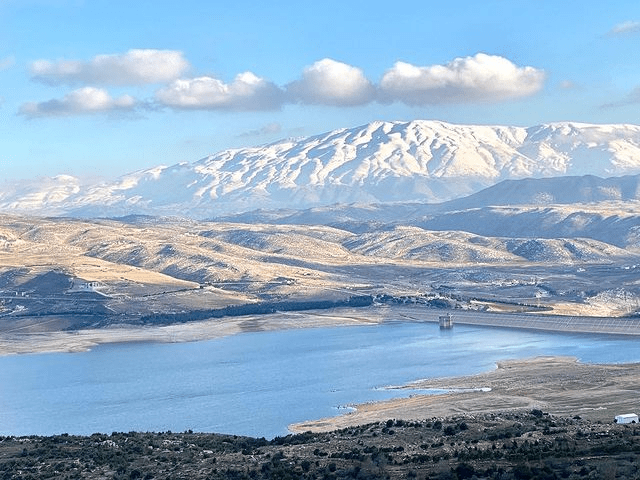
Mount Hermon is on the border between Lebanon and Syria

Mount Hermon is well north of the temple mount in Jerusalem. It too, is high up. Mount Hermon  rises to 9,232 feet and is the highest point on the east coast of the Mediterranean Sea. When the snow-capped ridge of the mountain melts, it liberally flows down and feeds the Jordan River, providing life for the valley.

Without Mount Hermon, there would be nothing and no one in the valley, which is why this water source is so important. Just like the oil flowing down Aaron’s beard, so the dew of Mount Hermon flows well beyond the mountain’s peak to provide abundant life. It enables us to come together united as one family in one place together.

Life and unity are not scarce. The resurrection of Christ opened the floodgates of heaven with life-giving grace, instead of death-dealing judgment, as in Noah’s day. Jesus is the wellspring of life who makes us one big family of faith by providing people with living water.

“Those who drink of the water that I will give them will never be thirsty. The water that I will give will become in them a spring of water gushing up to eternal life.” (John 4:14, NRSV)

No longer does life need to be quantified and measured in terms of years of time. Yes, we are mortal. But this will give way to immortality because a resurrected life is an everlasting life – made possible by Jesus.

My prayer and my hope is that our psalm for today will be like a glass of cold water on hot day when you are feeling parched. And this water will keep coming, as much of it as you need. The oil will keep flowing, with as much love and grace as you need for today. And there will be plenty more when tomorrow comes. It never runs out.

Perhaps you are encouraged with your own faith walk, but are awfully discouraged with the lack of unity in your family, neighborhood, church, workplace, nation, and world. Unity is not a piece of pie in which some get only a sliver, if any at all. In reality, there is plenty to go around. The power of the resurrection has made it possible.

In this present evil age, there are times of angry conflict and emotional distress, along with periods of great separation and sorrow. People everywhere who are divided and estranged from one another can hear God’s call to live together in unity. It is a call of love which beckons us to participate in the generous overflowing love of the Savior who has paved the way for an abundant life by bringing people together in faith.

Jesus prayed, “Holy Father, protect them in your name that you have given me, so that they may be one, as we are one.” (John 17:11)

Life (Genesis 1:20-2:4a)

The Creation of Heaven and Earth, by Unknown artist, c.18th century

God said, “Let the waters swarm with living things, and let birds fly above the earth up in the dome of the sky.” God created the great sea animals and all the tiny living things that swarm in the waters, each according to its kind, and all the winged birds, each according to its kind. God saw how good it was. Then God blessed them: “Be fertile and multiply and fill the waters in the seas, and let the birds multiply on the earth.”

There was evening and there was morning: the fifth day.

God said, “Let the earth produce every kind of living thing: livestock, crawling things, and wildlife.” And that’s what happened. God made every kind of wildlife, every kind of livestock, and every kind of creature that crawls on the ground. God saw how good it was. Then God said, “Let us make humanity in our image to resemble us so that they may take charge of the fish of the sea, the birds in the sky, the livestock, all the earth, and all the crawling things on earth.”

God created humanity in God’s own image,
        in the divine image God created them,
            male and female God created them.

God blessed them and said to them, “Be fertile and multiply; fill the earth and master it. Take charge of the fish of the sea, the birds in the sky, and everything crawling on the ground.” Then God said, “I now give to you all the plants on the earth that yield seeds and all the trees whose fruit produces its seeds within it. These will be your food. To all wildlife, to all the birds in the sky, and to everything crawling on the ground—to everything that breathes—I give all the green grasses for food.” And that’s what happened. God saw everything he had made; it was supremely good.

There was evening and there was morning: the sixth day.

The heavens and the earth and all who live in them were completed. On the sixth day God completed all the work that he had done, and on the seventh day God rested from all the work that he had done. God blessed the seventh day and made it holy, because on it God rested from all the work of creation. This is the account of the heavens and the earth when they were created. (Common English Bible)

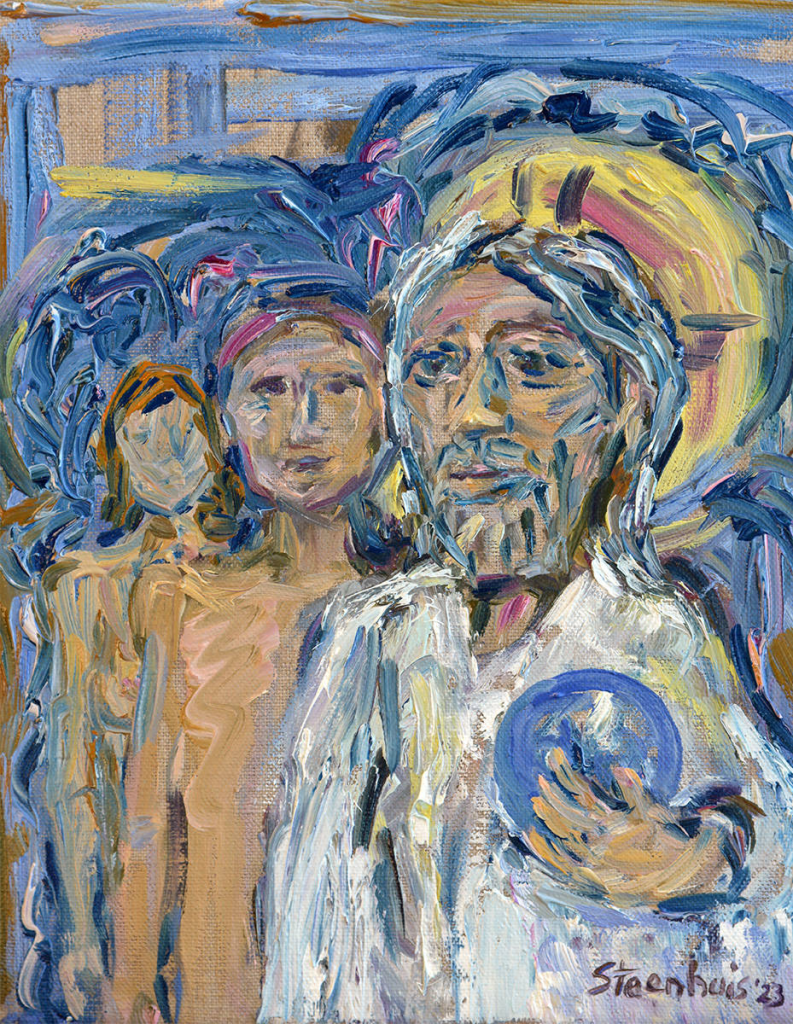
God Created Man in His Image – Male and Female, by Jill Steenhuis

In this Christian season of Eastertide, believers remember and celebrate new life in Jesus Christ. In today’s Old Testament lesson, the lectionary reminds us of original life – when God created the heavens and the earth.

The Beginning of Life

This was the beginning, before there were any words like sin, disobedience, guilt, and shame. This was the time when the original people, Adam and Eve, knew nothing about trying to chase after unconditional love. They had no concept of estrangement or heartache. Everything was fresh and alive and shiny. Disappointment, hurt, and sadness were unknown to them. Everywhere, the earth was teeming with abundant life.

God made it all; and all that was created was very good, supremely reflecting the goodness of the Creator. Life existed everywhere. The predictable and consistent rhythms of the universe were in place. Day and night, work and rest, creation and care, were all woven into the fabric of the world’s sights and seasons. The possibilities for growth were incredible. Life was indeed good.

“New” was simply part of all there was. Without any want or need, every day was an adventure of discovering all the newness which existed.

The Complicated Life

We all, however, know that it did not remain this way. People are now all too familiar with the myriad ways of injustice, and with the film of sin that covers the entire world like a noxious pollutant. And it is this situation, of course, which created the need for a “new” life, because the present life had become a moldy old leftover in the refrigerator of a life that doesn’t keep anything cold nor fresh.

People were created as good human beings. Even though sin has profoundly touched everything in creation, goodness is still within us as God’s image-bearers. The later introduction of human sin into the world in no way whatsoever removes the inherent stamp of the divine image upon us.

Humanity is the only creature who bears this likeness to God. We are related to the animal world, having been created on the same day, and sharing the same blessings of life. Yet, people are distinctive, set above all other creatures.

The Responsible Life

This is why people are given dominion over all other creatures. This is not a claim to privilege; it is, however, very much a claim to responsibility. People have been tasked with being faithful stewards of creation, entrusted with caring for other creatures and the created order.

And humanity was created as both male and female, together expressing the will and character of God in creation as they tend to it and care for it. Together with God, we are relational beings, and not just a race of individuals inhabiting the same earth.

God is a social being, existing as a community within the Godhead. Therefore, to exist as an image-bearer of God means that people are social creatures who need community – with both God and other people.

After God did all the work of creating the world with all its plants and animals and birds and fishes and people, God “rested.” This is why the seventh day is set aside as sacred; its different than the other days, sort of like how people are similar but different from the other creation.

God is clearly separated from the work and the creation itself, that is, God is transcendent and above all things as the Creator. The world is good, but the world is not divine. In the same way, by observing a day of rest, humanity recognizes and affirms and remembers that the work they have done is not divine.

Our human works, good as they may be, are not a thing to be worshiped or equated with God. Therefore, the Sabbath both celebrates the creation and the created order of things, as well as separates us from the idol worship of our hands.

To live into our inherent image of God means that we will work hard and tend to the gardens that are around us. Yet, at the same time, we will understand that in doing our responsible tasks, people are to live in community and love one another, without idolizing any other part of creation or what we creatively build with our own two hands. That is for God alone, who is distinct from all that God has created.

God our Father, you created the world and sent your own Son to live among us, made of the same stuff, breathing the same air, marveling at sunrise and sunset just as we do. Help us to participate in the life around and within us as your life, as you living in us and we living in you and in each other.

God of love and life, restore us to your peace, renew us through your power and teach us to love all that you have created and to care for the earth as your gift and our home. Amen.

Take Responsibility (Deuteronomy 3:23-29)

It was also at that same time that I begged the Lord: Please, Lord God! You have only begun to show your servant your greatness and your mighty hand. What god in heaven or on earth can act as you do or can perform your deeds and powerful acts? Please let me cross over the Jordan River so I can see the wonderful land that lies beyond it: those beautiful highlands, even the Lebanon region.

But the Lord was angry with me because of you! He wouldn’t listen to me. He said to me: That’s enough from you! Don’t ever ask me about this again! Go up to the top of Mount Pisgah. Look west, north, south, and east. Have a good look, but you will not cross the Jordan River. Instead, command Joshua, strengthen him, and encourage him because he’s the one who will cross the river before this people. He’s the one who will make sure they inherit the land you will see.

After that, we stayed in the valley across from Beth-peor. (Common English Bible)

I wonder if God ever feels like the parents of elementary aged children. “Please, please, puh-leeeze let me have it!” It’s a good thing God is spirit, because there may be some divine eye rolling happening with certain people’s requests.

When Moses pleaded God to allow him to cross the Jordan River into the Promised Land, the Lord forbade him to do so. The reason God gave is that Moses had to bear the brunt of the Lord’s anger on behalf of the community.

But you [Israel] had no faith in the Lord your God about this matter, even though he went ahead of you, scouting places where you should camp, in fire by night, so you could see the road you were taking, and in cloud during the daytime.

The Lord heard what you said. He was angry and he swore: Not even one of these people—this wicked generation!—will see the wonderful land that I promised to give to your ancestors… (The Lord was even angry with me [Moses] because of what you did. “You won’t enter the land either,” God said. “But Nun’s son Joshua, your assistant, will enter it. Strengthen him because he’s the one who will help Israel inherit the land.”) (Deuteronomy 1:32-38, CEB)

Not allowing Moses to enter the land may seem strange to us whose culture prizes individualism and self-reliance. But that was not the culture of ancient Israel. There was a common core belief in corporate responsibility. The leader acted as the representative of the people, and so, Moses was answerable for the community’s sins.

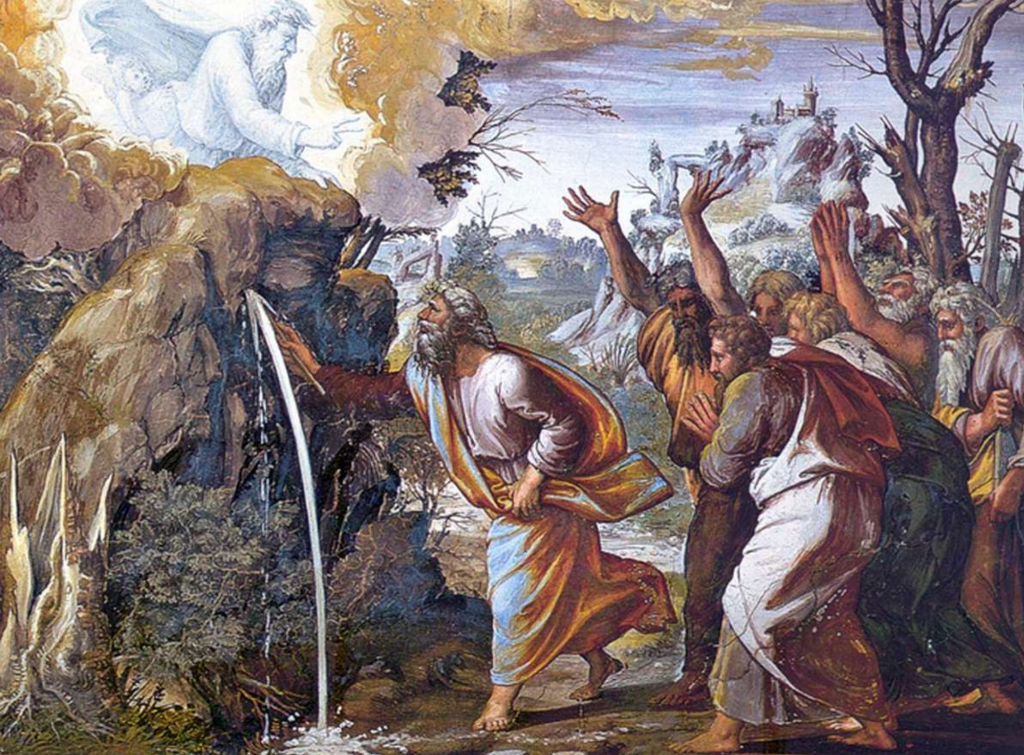
Fresco of Moses and water from the rock, by Raffaello Sanzio da Urbino (Raphael), 1519

Lest we still don’t like what’s going on here, elsewhere in scripture we get a perspective that it was also the lack of faith by Moses that caused him to lose privilege in entering the land:

Moses and Aaron gathered the assembly before the rock. He said to them, “Listen, you rebels! Should we produce water from the rock for you?” Then Moses raised his hand and struck the rock with his staff twice. Out flooded water so that the community and their animals could drink.

The Lord said to Moses and Aaron, “Because you didn’t trust me to show my holiness before the Israelites, you will not bring this assembly into the land that I am giving them.” These were the waters of Meribah, where the Israelites confronted the Lord with controversy and he showed his holiness to them. (Numbers 20:10-13, CEB)

The fact of the matter is that we are responsible for both our personal selves and the entire community of people we are a part of. Indeed, we truly are our brother’s and sister’s keeper.

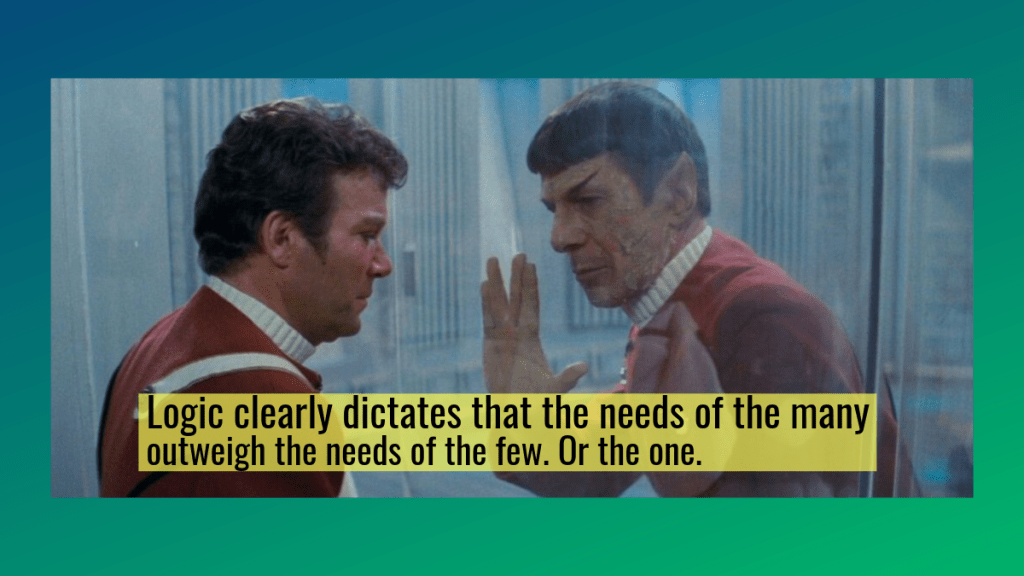
It’s important that everyone considers what the Lord’s will is – not only personally – but for the common good of all the people. Perhaps this idea is captured best in the fictitious Star Trek adage of the alien Vulcans who would logically examine a decision and say, “The needs of the many outweigh the needs of the few (or the one).”

What’s more, believers in God are meant to consider what is pleasing to the Lord, and not only to one’s personal or communal pleasure. The Lord is God and we are not. Sovereignty belongs to God. Servanthood belongs to us; and our ultimate service is to the Lord.

The bottom line for me is believing that the Lord God is good, all the time, and truly has our best interests at mind and at heart. Since God did not allow Moses into the land, I reason that it was for a greater good that transcended the individual request of Moses to enter.

Maybe that’s a difficult perspective to find whenever we are in the middle of strong desires for something, but it is one that we must struggle to find. Since the Lord is high and holy above everyone and everything, God is able to see the big picture and every angle of a situation.

We, however, only see a very small slice of the total view. So, it only makes sound spiritual sense that we learn to entrust ourselves to the One who sees all and acts according to what is right, just, and good.

Gracious and generous God, Creator and Giver of all that is good, we thank you for our many blessings. We acknowledge that all that we have is from you. We offer you thanks and praise for the beauty of the earth, our work, our family, our loved ones, and all the gifts we have been given.

You are with us always. In each dark hour, you are here. In each bright hour, you are here. Blessed by your grace, may we show gratitude by sharing what we have been given. For by serving our brothers and sisters, we serve you.

We remain ever grateful for your constant love, the gift of your Son Jesus, and the presence of your Holy Spirit with us. Protect and guide us on our personal and collective journeys, as we seek to be your faithful stewards. Amen.

A Spiritual Check-Up (2 Corinthians 13:5-10)

Examine yourselves to see if your faith is genuine. Test yourselves. Surely you know that Jesus Christ is among you; if not, you have failed the test of genuine faith. As you test yourselves, I hope you will recognize that we have not failed the test of apostolic authority.

We pray to God that you will not do what is wrong by refusing our correction. I hope we won’t need to demonstrate our authority when we arrive. Do the right thing before we come—even if that makes it look like we have failed to demonstrate our authority. For we cannot oppose the truth, but must always stand for the truth. We are glad to seem weak if it helps show that you are actually strong. We pray that you will become mature.

I am writing this to you before I come, hoping that I won’t need to deal severely with you when I do come. For I want to use the authority the Lord has given me to strengthen you, not to tear you down. (New Living Translation)

God is concerned about our spiritual health and vitality. And so, it’s important that we have regular spiritual check-ups and tests to evaluate the vitality of our faith. If we are spiritually sick or debilitated, the Lord seeks to restore us back to health.

In the Gospels, whenever Jesus miraculously healed a person, it was for far more than taking away a disease or correcting a disability. The Lord sought to make them well in order to restore a person’s life by including them in the community. For example:

  • Leprosy put a person on the outside, both literally and relationally. Ceasing to be a leper meant that a person now had no obstacles to full participation in communal life.
  • Blindness reduced a person to being a beggar in order to survive. Having sight restored meant that the person can now work with others, make a living, and contribute to the needs of others.
  • Incarceration was (and still is) a complete removal of a person from society. Being in prison severs many human connections. Release from jail opens the way to reconnection and an opportunity to have a different way of being with others.
  • Poverty encumbers a person and weighs them down so heavily that it limits their ability to function socially and relationally. Without poverty, a person is able to establish healthy patterns of giving and receiving within the community.

Those who are physically whole, mentally sharp, emotionally satisfied, and spiritually redeemed are free of obstacles and impediments to communal life.

So, it is a travesty whenever the people who enjoy full inclusion in the community, turn around and separate themselves, keeping relational distance from certain persons, and do not participate in the common good of all. They makes themselves sick and weaken their faith because of their lifestyle.

The type of spiritual examination of faith the Apostle Paul was talking about was not to obsess over whether one is a true believer, or not. He was referring to the person who claims faith yet maintains separation from others. In other words, to exclude others is the kind of behavior that unbelievers do, not Christians.

Yet, there are many sections of Christianity and entire Protestant denominations who pride themselves on such separation. They believe they’re being holy and keeping themselves from impurity. However, far too many of them are really putting a sanctified spin on their own sinful predilections to avoid people they don’t like.

Paul has no tolerance for calling exclusion of others “holiness” and naming the maintenance of an insider/outsider status as “sanctification.” The Apostle knew this was all poppycock and wanted nothing to do with it.

Christ didn’t die on a cruel cross, take away the obstacles to faith, open the way to know God, and create peace through his blood for a pack of so-called “Christians” to then erect imaginary concrete border walls to keep others out of Christian community and fellowship.

In God’s upside-down kingdom, the privileged insiders are really the outsiders; and the underprivileged outsiders are actually the insiders.

The privileged believers are just as sick as the leper, the blind, the poor, and the prisoner; and just as much in need of restoration. The path to their inclusion is solidarity with the entire community of the redeemed – rather than picking and choosing who is in and who is out.

All this, of course, is another way of stating that Christianity is as beset with cliques as anywhere else – with individual believers, local churches, and particular traditions following their pet theologians and pastors and not associating with others who follow a different set of folks.

The ancient Corinthian church was a train wreck of opposing groups and cliques. The Apostle Paul had had enough of it and called the people to do some serious self-examination. And he was careful not to degrade or discourage them but to try and encourage the church to tap into the Christ which dwells within them.

Spiritual health and restoration, for Paul, meant specific behaviors which intentionally include people. To be inclusive means we actively work toward grafting people into community, as well as discourage behaviors that create division, and thus, spiritual illness. Here are three ways of including others:

  • Practice hospitality. The word hospitality literally means, “love of stranger.” A hospitable believer goes out of their way to invite another into their life, to give them the gift of relationship and fellowship.

Take care of God’s needy people and welcome strangers into your home. (Romans 12:13, CEV)

Above all, show sincere love to each other, because love brings about the forgiveness of many sins. Open your homes to each other without complaining. And serve each other according to the gift each person has received, as good managers of God’s diverse gifts. (1 Peter 4:8-10, CEB)

  • Nip bitterness in the bud. In an ideal world, everyone holds hands and sings kumbaya together. We live, however, in a fallen world. Harmony, unity, and peace take copious amounts of energy. Like an attentive gardener, we must do the work of identifying weeds and uprooting them, so they don’t take over the garden.

Make every effort to live in peace with everyone and to be holy; without holiness no one will see the Lord. See to it that no one falls short of the grace of God and that no bitter root grows up to cause trouble and defile many. (Hebrews 12:14-15, NIV)

  • Seek to encourage others, and learn how to do it. Encouragement is both a gift and a skill to be developed. To encourage another is to come alongside and help someone with both affirming words and willing hands. It’s what Jesus did (and does) for us.

Christ died for us so that, whether we are dead or alive when he returns, we can live with him forever. So, encourage each other and build each other up, just as you are already doing. (1 Thessalonians 5:10-11, NLT)

Hospitality, harmony, and help are all forms of love. And love is to be the guiding principle and practice of church and community. Love is always the prescription for a healthy spiritual life and a restored community of faith. It prevents truth decay.

Lord, make me an instrument of your peace:
where there is hatred, let me sow love;
where there is injury, pardon;
where there is doubt, faith;
where there is despair, hope;
where there is darkness, light;
where there is sadness, joy.

O divine Master, grant that I may not so much seek
to be consoled as to console,
to be understood as to understand,
to be loved as to love.
For it is in giving that we receive,
it is in pardoning that we are pardoned,
and it is in dying that we are born to eternal life.
Amen.