The Lord’s Table proclaims the gospel to us, and the good news of Jesus Christ is what we need to be molded and shaped into disciples. Just as the simple routines of eating breakfast and getting ready in the morning shape our daily lives, so the ritual of the Lord’s Table is to set the tone for our lives by orienting us around healthy routines of learning to follow Jesus. We need the Lord’s Table because our hearts are often thorny with cares and worries which leads to a weakening of faith. A sermon is words; the Table is tangible. Preaching may say the words “I love you!” but the Table seals those words and makes them real, like a kiss.

The purpose of the Lord’s Table is to participate in the blessings of Christ by visually re-creating the story of Jesus. There are three different terms for the Table in the New Testament, and each term is meant to convey a different aspect of the Table’s significance. One of those terms is The Lord’s Supper. The focus of The Lord’s Supper is remembrance, a memorial of Christ’s death that is deeply reflective and contemplative. Paul said to the Corinthians: A man ought to examine himself before he eats of the bread and drinks of the cup. For anyone who eats and drinks without recognizing the body of the Lord eats and drinks judgment on himself. Paul said this because at the Table whenever you eat this bread and drink this cup, you proclaim the Lord’s death until he comes (1 Corinthians 11:26).
A second term for the Lord’s Table is called The Eucharist. Eucharist literally means “thanksgiving.” The focus of seeing the Lord’s Table as The Eucharist means that we are celebrating our victory over sin, death, and hell through Christ’s death. At the Last Supper, the Gospel writer Mark said that Jesus took bread, gave thanks (Eucharist), and broke it, and gave it to his disciples, saying, “Take it; this is my body.” Then he took the cup, gave thanks (Eucharist) and offered it to them, and they all drank from it (Mark 14:22-23). We might say that observing the Table as both The Lord’s Supper and The Eucharist means that we will engage in a sober celebration.
The third term describing the Lord’s Table is the term “communion.” Communion means to participate in Christ and with other Christians. Is not the cup of thanksgiving for which we give thanks a participation in the blood of Christ? And is not the bread that we break a participation in the body of Christ? Because there is one loaf, we, who are many, are one body, for we all partake of the one loaf (1 Corinthians 10:16-17). This emphasizes that when we partake of the Lord’s Table, we ought to do so with unity and fellowship; we do not just participate as individuals, but together as the community of the redeemed.
As we allow the Table to be a remembrance, a celebration, and participation with each other, we engage in a ritual that helps us to know Christ better and we are better able to realize his grace to us.
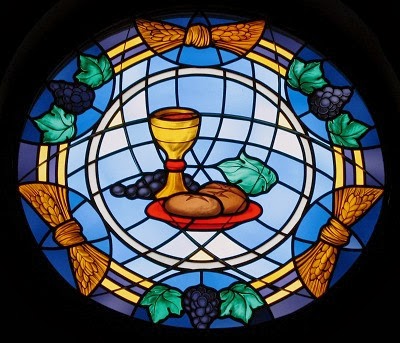
One of the wonderful realities about communion is that believers all over the planet share in Christ together. Communion and participation is important because we can easily be fragmented and not fellowship with one another, both in the local church, and the world-wide church. Paul wrote his first letter to the Corinthians because they were divided among themselves. He emphasized the work of Jesus on the cross as bringing reconciliation between God and people. Christ’s work of reconciliation has restored a broken relationship between us and God, and also between one another. The relations between the Corinthians were not good; they existed as a network of special interest groups, instead of being aware of each other and intentionally participating with each other. They did not necessarily fight among each other, but simply ignored other people in the church. Each group wanted their own way, and they had not yet learned how to talk to one another and work together in a unity and fellowship that reflects the gospel.
One of the things we need to be aware of as we think of sharing in communion together is that we are not to approach the Table to be with people who are like us in the way we want them to be. We come because we have staked our souls on the fact that Christ is the Way, the Truth, and the Life, and the church is the best place, the only place, to be while we all struggle to figure out what that means. We come because we’d be hard pressed to say which is the bigger of the two scandals of God: that he loves me—or that he loves everyone else. The Lord’s Table is the great leveler, where we all have equal footing and accept one another according to a common confession of Christ.
So when we talk about the Lord’s Table as being communion, we are emphasizing that it is not just a remembrance, but a participation in the body and blood of Christ. And since that is true, communion is participation with all Christians everywhere. The Lord’s Table is not just to be an individual experience in isolation from others. There is solidarity not only between the individual and God, but between all believers.
Therefore, we are not alone. Communion lets us know that God is with us, and that he has so closely identified with us that he took our place on the cross. As a result, every believer in Jesus is linked to all the others so that, when one suffers or rejoices, all suffer or rejoice, whether it is an African pastor rejoicing over newly saved persons out of animism, or a suffering Syrian Christian trying to survive in a refugee camp.
We must live up to what we profess. Our participation in Christ results in participation and unity with each other. Since we are God’s forgiven people, we are to work at living the Christian life together. This unity is symbolized by partaking together of the same loaf of bread, and drinking from a common cup.
On one Sunday, a group of missionaries and believers in Papua New Guinea were gathered to observe communion together. After one young man sat down, one of the missionaries recognized that he seemed to be quite upset. But, then, in a while, the young man seemed to be fine. The missionary leaned over and whispered to him, “What was it that troubled you?” The young man replied, “The man who just came in happens to be the man who killed and ate the body of my father. And now he has come in to observe communion with us. At first I didn’t think I could do that. But it is all right now. He is washed in the same precious blood as I am.” And so together they had Communion.
We have peace because of Jesus. His death has brought reconciliation not only between us and God, but between each other. As we approach the Lord’s Table, let us be aware not only of our personal relationship with God, but our relationships with one another in the local church, and our unity with the world-wide church. May our lives be shaped and formed around the cross of Jesus Christ, as we remember, celebrate, and participate together.




 Rev. Tim Ehrhardt