My heart is unwavering, God. I will sing and make music— yes, with my whole being! Wake up, harp and lyre! I will wake the dawn itself! I will give thanks to you, Lord, among all the peoples; I will make music to you among the nations, because your faithful love is higher than heaven; your faithfulness reaches the clouds. Exalt yourself, God, higher than heaven! Let your glory be over all the earth! Save me by your power and answer me so that the people you love might be rescued.
God has spoken in his sanctuary: “I will celebrate as I divide up Shechem and portion out the Succoth Valley. Gilead is mine, Manasseh is mine; Ephraim is my helmet, Judah is my scepter. But Moab is my washbowl; I’ll throw my shoe at Edom. I shout in triumph over Philistia! I wish someone would bring me to a fortified city! I wish someone would lead me to Edom!”
But you have rejected us, God, haven’t you? You, God, no longer accompany our armies. Give us help against the enemy— human help is worthless. With God we will triumph: God is the one who will trample our adversaries. (Common English Bible)
“Our faith is not meant to get us out of a hard place or change our painful condition. Rather, it is meant to reveal God’s faithfulness to us in the midst of our dire situation.”
David Wilkerson
Little did my wife and I know when we were married decades ago that our vows to one another would be put to the test time and time again over the years: a commitment to be with each for better or for worse; to hang in there whether rich or poor; to persevere in sickness or in health till the very end. Through all the ups and the downs, I am tremendously thankful that we are close and together. We have truly taken the stance that, no matter the circumstance, we will face it together.
Just as in a marriage, where there are times that stretch the relationship and the couple must make choices for the benefit of each other, so the follower of God will face difficulty as a believer and must decide to remain faithful.
The psalmist decided on a steadfast heart toward, a committed and faithful stance which would stick to the Lord, no matter the circumstances. The psalmist also recognized God is forever faithful, that steadfast love would continually mark the relationship toward humanity.
If we lived by the whims of our feelings, many of us would never get out of bed in the morning, and not even bother to put on pants when we do. Yet, many believers take such an approach in their relationship with God: praying whenever it might fancy them to do so; and praising the Lord only when things are going their way.
Yet, the psalmist chose to give thanks because of who God is. David, the psalmist, made the daily decision of being faithful by choosing to look at the faithfulness of God. The truth is that God is with us, and the Lord longs for us to recognize and enjoy it because that is the nature of a committed relationship.
It makes sense to tether oneself wholly and completely to a God who is consistently faithful and loving. The vicissitudes of life are unrelenting, having us ride waves of ups and downs. No one living in 2019 saw a pandemic coming in 2020 with all the changes associated with it. And who knows what the rest of this year will be like? Or next year?
There are a great many things we do not know. Yet, there are two unchangeable truths for which we can anchor our souls: God loves us; and God is with us. When all else is going to hell around us, the rock of the Lord’s presence and mercy is unfazed and endures.
So, in those times, when we feel like giving up or giving in, we can come back to a psalm like today’s, and choose to give thanks, sing, pray, and affirm our vows to God.
Remember your baptism. Remember to whom you belong. Remember the steadfast love of God and allow such love to shape your life – even when every circumstance around you is off and awry. Our relationship with the Lord will be tested time and time again, yet God is steadfast and will not let go.
For you Jesus Christ came into the world; for you he died and for you he conquered death. All this he did for you. We love because God first loved us.
Gracious God, bless and strengthen your people daily with the gift of your Holy Spirit; unfold to us the riches of your love, deepen our faith, keep us from the power of evil and enable us to live a holy and blameless life until your kingdom comes. Amen.
In the year that King Uzziah died, I saw the Lord, high and exalted, seated on a throne; and the train of his robe filled the temple. Above him were seraphim, each with six wings: With two wings they covered their faces, with two they covered their feet, and with two they were flying. And they were calling to one another:
“Holy, holy, holy is the Lord Almighty; the whole earth is full of his glory.”
At the sound of their voices the doorposts and thresholds shook, and the temple was filled with smoke.
“Woe to me!” I cried. “I am ruined! For I am a man of unclean lips, and I live among a people of unclean lips, and my eyes have seen the King, the Lord Almighty.”
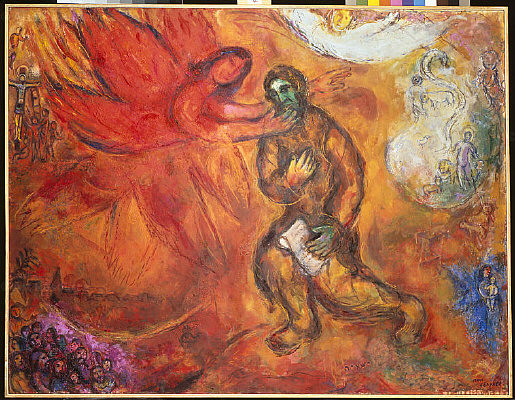
Then one of the seraphim flew to me with a live coal in his hand, which he had taken with tongs from the altar. With it he touched my mouth and said, “See, this has touched your lips; your guilt is taken away and your sin atoned for.”
Then I heard the voice of the Lord saying, “Whom shall I send? And who will go for us?”
And I said, “Here am I. Send me!” (Isaiah 6:1-8, NIV)
Uzziah was a king of Judah who reigned for fifty-two years. For most of his rule, he followed God faithfully. Under Uzziah the Jews had enjoyed the best political stability, economic security, and consistent worship of God since the days of King Solomon, hundreds of years before.
Yet, if one were to look below the surface of Judah, it was also a time of spiritual complacency, apathy in worship, taking prosperity for granted, and self-centered – often oppressing others. The nation needed a fresh experience of God, and it came through the prophet Isaiah.
The essence of worship is a recognition and celebration of the triune God. Worship is a relational rhythm between God and humanity in which God self-reveals and people respond.
Worship is an experience of seeing and hearing divine revelation; repenting from wayward actions; and renewing missional service.
Worshiping the triune God ideally happens every day. It’s a lifestyle – not the result of one cleverly planned hour on Sunday. The people of Isaiah’s day were going through the ritual motions of worship without having their hearts in it. Worship was a kind of rabbit’s foot for them in which, if they had regular attendance within the temple, they believed they could do whatever they wanted with their lives outside the temple.
As a result, the people did not see or hear God in their worship. Authentic worship of God does not have to do with the environment, the fellowship, or the music. True worship of the triune God is a heart desire to see and hear God.
If worship does not happen in the sanctuary, that is because worship fails to occur daily life. Real worship is a life-changing encounter with Father, Son, and Holy Spirit. It experiences God’s revelation and changes our view of him. Bona fide worship leads to repentance and changes our view of self. True worship brings spiritual renewal and changes our view of mission and service.
Revelation: Worship Changes Our View of God
Isaiah saw a vision of God in the majestic divine throne room. It was a grand and transcendent vision of a God who dominates the entire setting. The train of God’s robe filled the temple. This is Isaiah’s way of saying the vision was incredibly large. If the train of his robe fills up the temple, then God is an immense Being. Gaining a vision of God’s hugeness is what causes our human problems to be seen as small.
One time the Assyrian King Sennacherib invaded the land and approached Jerusalem during the reign of Uzziah’s great grandson, Hezekiah. The Assyrians were the dreaded horde of the ancient world, and it seemed no one could withstand them. So, the people prayed:
King Hezekiah and the prophet Isaiah son of Amoz cried out in prayer to heaven about this. And the Lord sent an angel, who annihilated all the fighting men and the commanders and officers in the camp of the Assyrian king… So, the Lord saved Hezekiah and the people of Jerusalem from the hand of Sennacherib king of Assyria and from the hand of all others. God took care of them on every side. (2 Chronicles 32:20-22, NIV)
Isaiah’s vision included seraphs – angels with the job description to glorify God with ceaseless praise. Their physical description symbolizes their function: covering their face symbolizes humility in God’s presence; covering their feet identifies it as holy ground; and flying symbolizes their work to do God’s will.
The seraphs have two-thirds wing power for worship, and one-third wing power for work. If this is any indication how God’s creatures are to conduct their lives, we as humans have a great deal of adjusting to do to accommodate the worship of God.
The sound of worship that came from the seraphs was proclaiming God’s holiness. Isaiah’s view of God changed as a result. As he saw God’s glory, Isaiah saw God as much bigger than he had before. For example, European visitors who come to the United States sometimes have no frame of reference as to how spacious the geography of our country is.
Some have a notion they can make day trips to places like San Francisco, Houston, or New York City because where they live is much more geographically compact. But once they get here, they experience the land in all its glory, and they gain an appreciation for the bigness of America. We all need to experience God’s glory and see God’s holiness because it will cause us to repent of old ways of seeing.
Repentance: Worship Changes Our View of Self
Isaiah was reduced to nothing after seeing a vision of the holy God. Humans cannot see God’s glory without also seeing their sinful selves. Isaiah’s response to God was not praise, but confession. Show me a proud, self-centered, and arrogant person and I will show you a person who has not seen God. Isaiah was unable to cleanse his own sin. Isaiah needed God to purge and purify his uncleanness. The New Testament says:
If we live in the light in the same way as he is in the light, we have fellowship with each other, and the blood of Jesus, his Son, cleanses us from every sin… If we confess our sins, he is faithful and just to forgive us our sins and cleanse us from everything we’ve done wrong. (1 John 1:7, 9, CEB)
Seeing God completely unravels us, for we see our depravity for what it truly is:
When the Apostle Peter saw the Lord’s immensity and power through a miraculous catch of fish he fell at Jesus’ knees and said, “Go away from me, Lord; I am a sinful man.” (Luke 5:8)
When the Apostle John had a vision of Christ’s glory, and heard his voice, he fell at the Lord’s feet as though dead. (Revelation 1:12-17)
When the prophet Ezekiel had a vision of God and saw the appearance of God’s glory, he fell facedown. (Ezekiel 1:25-28)
Even Daniel, perhaps the most righteous prophet of all time, when seeing a vision of God’s glory, fell prostrate with his face to the ground, totally overwhelmed with God’s holiness and his own human sinfulness. (Daniel 8:15-18)
There is wickedness and indifference in the world. People do not see God’s glory and holiness. Because, if they did, they would be totally undone and see the foulness and degradation of hate and injustice. They would turn from apathetic and complacent ways of living. The world and the church need a vision of a holy God that comes from meeting with God. Isaiah saw the Lord. And because he repented, he was then able to hear the voice of God.
Renewal: Worship Changes Our View of Service
God is calling us. God’s voice has gone out. If we do not hear it, it’s because we have not experienced God’s self-revealing and have not responded with repentance. Apart from worship, we are unable to hear God. While Isaiah was worshiping God, he saw, responded, and heard the Lord. The early church heard the voice of God to service and mission:
The church at Antioch had several prophets and teachers…. While they were worshiping the Lord and fasting, the Holy Spirit told them, “Appoint Barnabas and Saul to do the work for which I have chosen them.” Everyone prayed and fasted for a while longer. Next, they placed their hands on Barnabas and Saul to show that they had been appointed to do this work. Then everyone sent them on their way. (Acts 13:1-3, CEV)
Isaiah was willing. He didn’t ask any clarifying questions. He neither inquired what the mission would be nor questioned God as to the plan. Isaiah plainly said, “Here I am, send me.” It was an unconditional response to hearing God. Isaiah made no deals with God, did not try and negotiate terms of service. Isaiah simply told God he was willing to be sent.
Many people fill their lives with stuff and activity. And they are unable to hear the voice of God. There’s just too much noise drowning out God. We have uncritically, without any discernment through prayer and worship, filled our lives to overflowing with never-ending things to do. And we have even sanctified it and called it holy, as if God’s will for us is to be constantly on the go.
Someday, we must give an account of our lives. God will ask why we did not take a risk, get involved, and go out into the world with a deep sense of mission. Too many people will say, “I never heard the call!” Yet, God was calling. “Whom shall I send? And who will go for us?” says the triune God.
Conclusion
God’s glory was revealed to Isaiah. Isaiah responded to that vision with confession and repentance. This brought a renewed sense of mission to his life. Isaiah was then able to hear God’s voice calling him to service. It is not our ability God cares about. Because God can equip anybody for any type of work. Instead, it is our availability God cares about.
We need to put ourselves in a position to see and hear God. The obstacles to visioning God’s glory and hearing God’s voice are legion: inattention to God’s Word and God’s creation; no mindfulness to the Holy Spirit; intense, constant, and prolonged preoccupations; lack of availability to the ways of Jesus; little sleep; unhealthy habits; a dull spiritual sense; lack of personal and divine awareness; a paucity of spiritual practices and disciplines; and a failure to be able to experience a vision of God.
God has graciously revealed himself to us as Father, Son, and Spirit. The Trinity is not so much a doctrine to believe as it is a powerful reality to live into. If we see and hear God today it will cause us to repent and be renewed in mission and service.
*Above painting of the prophet Isaiah by Marc Chagall, 1968
A mosaic of the Apostle Paul in St Isaac’s Cathedral, St. Petersburg, Russia
Christ has shown me that what I once thought was valuable is worthless. Nothing is as wonderful as knowing Christ Jesus my Lord. I have given up everything else and count it all as garbage. All I want is Christ and to know that I belong to him. I could not make myself acceptable to God by obeying the Law of Moses. God accepted me simply because of my faith in Christ. All I want is to know Christ and the power that raised him to life. I want to suffer and die as he did, so that somehow, I also may be raised to life. (CEV)
As I looked at today’s date, I realized that it was on this day thirty-six years ago that my now dear wife told me, “I love you.” Two months previous, I had told her, “I love you.” She did not reciprocate. Instead, this lovely girl whom I had come to love (it was not love at first sight for either of us, which is a much longer story for another time) flat out retorted back to me, “Well, I don’t love you. Listen, Mr., I’ve heard every line in the book. What’s your angle? What do you want from me?”
For me, I knew I what I had was genuine love and not infatuation because I found myself responding matter-of-factly, “There’s no angle. I love you. If you choose not to love me back, I’ll just keep loving you.” This threw her into a two-month long sort of existential angst in which she explored the depths of her own spirit to see if her best friend was her love, as well.
So, when the love of my life said to me on that day, “I love you,” I knew it came from a place of soul-searching, prayer, trepidation, deliberate resolve, and genuine sincerity. For my wife, to say those words meant she was committed to me. They were not said lightly. It took a lot for those words to be formed.
On that day thirty-six years ago, the both of us had amazing clarity about the direction of our lives. We were going to be together, and no other person would ever have the primary place we each now enjoyed with one another. To me, every other girl seemed like nothing compared to my beloved. And, I will still admit, my feelings have not changed one iota.
I picture the Apostle Paul going through a similar struggle and process of coming to Christ. And once he did commit, no one was ever going to usurp the place of Jesus in his life.
I honestly believe that the primary reason my dear wife and I have been together all this time and still love each other as if it were December 10, 1984 is because of our shared commitment and ultimate value of knowing Christ. For each of us, Jesus is everything. Our lives center around him. The grace of God in Christ shapes all our worldview and animates every action we take.
Together with the Apostle Paul, we want to know Christ and we will take whatever situation is necessary to realize a continual growth in grace with Jesus at our side. Just as the adversity, hardship, and difficulties we have faced together over the decades has caused to bring us even closer together, so facing all of it with Christ in the middle of it has brought us closer to God.
Although it may seem counter-intuitive, power and suffering go together. For example, weightlifting causes fibers of the muscles to sustain injury. So, the body repairs those damaged fibers by fusing them, which then increases the mass and size of the muscles. It is through suffering, even trauma, that muscles grow bigger and stronger.
Spiritual power results from undergoing suffering. Through hard circumstances, our spirits experience hurt. Yet, through the process of healing we become stronger, more resilient, and our faith grows. A deeper experience of Christ and a greater intimacy with Jesus results from identifying with him in his suffering. Show me a person with vigorous faith and I will show you a person who has been strengthened through suffering.
When Jesus Christ is our surpassing value, everything else is viewed differently – the past, present, and future take on new meaning. We tell ourselves an alternate story, based in the person and work of Christ. In this Christian season of Advent, we look back to the first advent of Christ’s incarnation; look forward to the second advent of Christ coming again; and, this shapes how we live in the present between the two advents accepting suffering as a gift and embracing fresh power as a means to serve others.
Yes, this is a special day for me. Yet, everyday is a special day when I can enjoy fellowship with my Lord together with my wife.
Almighty and eternal God, so draw my heart to Christ, so guide my mind, so fill my imagination, so control my will, that I may be wholly yours, utterly dedicated to you; and then use me, I pray you, as you will, and always to your glory and the welfare of your people; through the sufferings of my Lord and Savior Jesus Christ and in the his great resurrection power I pray. Amen.
We prepare for things we really care about; we anticipate things that are important to us. This was the point of Christ’s parable about ten bridesmaids. (Matthew 25:1-13)
People who really care about hunting make careful preparations for the season and anticipate opening day. Those who care about Green Bay Packers football look forward to game-day, plan for special food to eat, and set aside normal activities to watch them play. And, of course, weddings are events which take lots of preparation because families care about the upcoming marriage. Since I have raised three girls, I can testify first-hand that wedding plans begin in third grade for many females.
Some folks show up to things late and unprepared because they simply do not value the event enough to be ready for it. Casual hunters and fair-weather football fans go home when it gets too cold because they are not adequately prepared for the conditions. Quickie weddings happen in Las Vegas when two people are not prepared to have a marriage for a lifetime. People drop out of impromptu events when there is no fun or gets too hard. However, if they really care about it, they prepare for it, have patience through it, and persevere in it when things get tough.
The true test of authentic commitment comes when things are not easy and it takes blood, sweat, and tears to see something through. A Christian is one who professes Christ as Lord and Savior, and backs the words up with a resolve to live into their baptism; to avail themselves of Holy Communion; to plan and prepare for both personal and public worship; and to make it their aim to love God, one another, and neighbor.
There are few human events more freighted with emotion and preparation than weddings. Parents invest a lot of time, energy, resources, and love to have a meaningful wedding for their kids. There is also the potential for disaster at a wedding. Since I have done my share of weddings, I can tell you that a lot of things go sideways in the preparation process and even at the wedding itself. I have seen bridesmaids pass out, grooms forget the ring, and families fight like cats and dogs in the narthex just as the bride is ready to come down the aisle. All kinds of crazy stuff can happen with a wedding.
At my own wedding, the bridesmaids were literally sown into their dresses by the seamstress just hours before the wedding; one of my groomsman did not show up because, I later found out, he was in jail; and, we were married on the hottest and most humid day of the year – 100 degrees – which did not go so well for a bunch of women trying to have their best ever hair day.
Yet, we got married anyway. The wedding happened because it was important to us. I think it is interesting that Jesus chose to tell a parable using a wedding to tell us what the kingdom of God is like. Weddings in Christ’s day were just as prone to mishap, maybe even more so, than weddings today.
In ancient Israel, a couple would become engaged but not set a wedding date. The groom took the time to busily prepare a home for himself and his bride to live. It might take days, or weeks, or months, even years. It is this imagery that Jesus picked up to communicate his point of being prepared for things we care about.
No one knew when the groom would be finished with preparations. (Note: Jesus the bridegroom is busy making preparations for a great wedding feast at the end of the age when he will come back and take us to be with him forever, John 14:1-4). When the groom was ready, he left the home he had prepared and went to the bride’s house. Then, the two of them, along with their wedding party, would have a grand procession through the streets of the town, almost always after dark, and then back to the home of the groom. So, oil lamps were important to have ready and on standby.
Ten Bridesmaids by Dinah Rau, 20
Here is the parable of the bridesmaid’s setting: The groom has left his house and begun his trek through town. He might come right away, and he might not, depending on what route he takes. The bridesmaids (or virgins) have their oil lamps ready. Five of them have plenty of oil, and five of them do not. The groom took a circuitous route, so the virgins fell asleep waiting. At midnight, the groom finally showed up at the bride’s house. Five virgins were ready and five were not ready.
The five bridesmaids without enough oil went to find or buy some more, while the five virgins with plenty of oil joined the celebration. The procession returned to the groom’s house, posthaste, before the five bridesmaids who were not part of the procession finally caught up to them at the house. They knocked on the door and expected to get in. But the door was shut and was not going to be opened. The marriage happened without them.
Bottom line of the story: The five foolish bridesmaids were not ready because they did not care enough to be prepared. This, at face value, might seem harsh. Yet, in Christ’s time, not having the oil needed for the lamps would be akin, in our day, to half the bridesmaids showing up at the wedding at the last minute in jeans and t-shirts without having done their hair and expecting to stand up with the bride. No bride or groom and their family in our culture is going to roll with that kind of behavior because it is deeply offensive.
As in all of Christ’s parables, the characters represent the people listening. The five wise and five foolish bridesmaids point to the various characters who were following Jesus. Those folks consisted of both faithful disciples of Jesus, as well as wedding crashers who were not there because they valued and respected Jesus.
Jesus told us to keep watch, because we do not know the day or the hour when he will return. So, the big question for every professing believer in Jesus is: Are you prepared? We are to maintain constant vigilance, being always alert for Jesus to show up. It is one thing to profess Christ; it is quite another thing to live each day doing God’s will and being prepared for Jesus to return. In short, Jesus wants more than fair-weather Christians.
We cannot assume someone else will give us oil, or simply rely on another person to have everything we need to live the Christian life. Each one of us must listen and learn from God’s Word for ourselves; cultivate a life of prayer; serve the church and the world in ways God has called us to, without relying on someone else to do the work I should be doing.
For those whom Jesus is the most important person in their lives, you will see preparations to serve him every day. It is my personal practice to rise each morning by 5:00am. I light a candle and spend some quiet unhindered time reading Scripture, reflecting on it, and praying. Throughout the day I pause to intentionally connect with God in prayer and worship (Yes, even a Pastor must do this!).
I get up early in the morning regardless of how I feel. I engage in spiritual disciplines even when it does not strike my fancy. I go to work and do what it takes to get myself in a position to be a blessing to others, despite the times when I am less than 100%. I do it because God has called me, and I care about that.
Let us come back to Christ’s message of the parable: We prepare for things we really care about, and we anticipate things that are important to us. For the first three hundred years of the church, believers in Jesus met in cramped places with few resources other than the Holy Spirit of God. When Christianity became the official religion of the Roman Empire under Constantine, everything literally changed overnight. Emperor Constantine built St. Peter’s Basilica and instituted state-funded support for bishops. Suddenly, Christianity was cool. At this point, the church began a moral and spiritual slide into worldliness and decadence.
It seems throughout the history of Christianity that the church flourishes most when it is under some sort of persecution or adversity. And when it is not, it flounders and lapses into worldliness. Sometimes, the primary values and goals of Christians are ensuring that we get our way through politicians, as if our hope is ultimately tied to political elections. Instead, our goal must be to live for Jesus, no matter the circumstances. In fact, the church’s faith grows more genuine when it is proven through great trials.
The return of Jesus is a future reality which needs to be constantly on our spiritual radars. Jesus wants us to watch and pray, to be prepared, because it could be today that the bridegroom shows up at our house!







 Rev. Tim Ehrhardt