Making a Vow (1 Samuel 1:19-27)

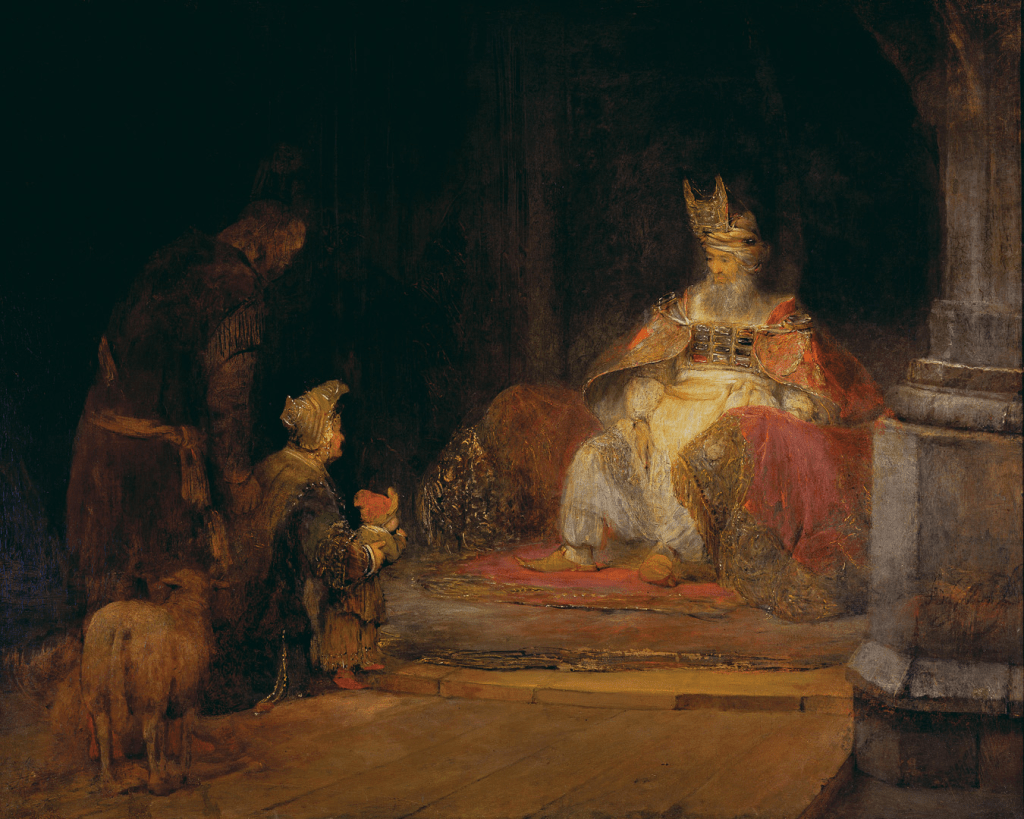
Hannah Presenting Samuel to Eli, by Arent de Gelder, 1710

The entire family got up early the next morning and went to worship the Lord once more. Then they returned home to Ramah. When Elkanah slept with Hannah, the Lord remembered her plea, and in due time she gave birth to a son. She named him Samuel, for she said, “I asked the Lord for him.”

The next year Elkanah and his family went on their annual trip to offer a sacrifice to the Lord and to keep his vow. But Hannah did not go. She told her husband, “Wait until the boy is weaned. Then I will take him to the Tabernacle and leave him there with the Lord permanently.”

“Whatever you think is best,” Elkanah agreed. “Stay here for now, and may the Lord help you keep your promise.” So she stayed home and nursed the boy until he was weaned.

When the child was weaned, Hannah took him to the Tabernacle in Shiloh. They brought along a three-year-old bull for the sacrifice and a basket of flour and some wine. After sacrificing the bull, they brought the boy to Eli. “Sir, do you remember me?” Hannah asked. “I am the very woman who stood here several years ago praying to the Lord. I asked the Lord to give me this boy, and he has granted my request. (New Living Translation)

Hannah had no children. In an era of patriarchy and polygamy, she had to put up with a rival wife verbally attacking her – not to mention a husband who seemed somewhat clueless to what was going on.

The piety of Hannah was unmatched. When worshiping the Lord in the tabernacle at Shiloh, Hannah offered a heartfelt prayer to God. She not only asked for help in her distressing situation, but also promised that if the Lord would give her a son, she would return to the Giver; thus, making the child a double gift to both herself and God.

God listened to Hannah and remembered her. Through her pregnancy and birth of a son, there is even more going on than displaying the Lord’s power over infertility. In taking divine initiative to do what Hannah asked, God demonstrated care and vindication for one of the least valued members of an ancient society that looked askance on infertile women.

Hannah and Samuel in the Temple, by Rembrandt, 1650

In the patriarchal society, Hannah’s husband, Elkanah, could have nullified her vow to the Lord. But he allowed her promise to stand, and even encouraged it. Perhaps this was yet another sort of miracle, to have a husband move the great distance from unaware and aloof to aware and connected.

Hannah and Elkanah went to Shiloh, and back to the old priest Eli, not only making a typical animal sacrifice, but also offering their son, in fulfillment of Hannah’s vow to the Lord. Hannah very much took her vow to God seriously.

As you enter the house of God, keep your ears open and your mouth shut. It is evil to make mindless offerings to God. Don’t make rash promises, and don’t be hasty in bringing matters before God. After all, God is in heaven, and you are here on earth. So let your words be few.

Too much activity gives you restless dreams; too many words make you a fool.

When you make a promise to God, don’t delay in following through, for God takes no pleasure in fools. Keep all the promises you make to him. It is better to say nothing than to make a promise and not keep it. Don’t let your mouth make you sin. And don’t defend yourself by telling the Temple messenger that the promise you made was a mistake. That would make God angry, and he might wipe out everything you have achieved.

Talk is cheap, like daydreams and other useless activities. Fear God instead. (Ecclesiastes 5:1-7, NLT)

Any sort of commitment we express to God, no matter what, is to be taken seriously. Making vows to the Lord isn’t simply a way of helping us feel good about our relationship to God; rather, vows have important implications for our daily life and decisions.

What’s more, vows are not bribes. We don’t make deals with God. That’s because we have nothing to offer in any sort of human understanding of contractual obligations. A vow is a promise, a commitment to follow through with something. And the Lord will hold us accountable to our promises.

Hannah offered her son willingly and gladly to the Lord, and not begrudgingly. In fact, this may have been her thought all along to dedicate a child to God. In other words, giving up her son was not a sorrowful grief but a deep joy. Hannah raised the boy until he was weaned – which was likely, in that day and age, around 3 or 4 years old.

It’s quite possible that Hannah spent those formative years preparing her son for a life of service and doing all she could to help him get a good beginning in the Lord’s Tabernacle.

The biblical character of Hannah has a lot to teach us in our own journey of faith. She was completely devoted to God, found ways to honor and obey God, made a carefully crafted vow to God, persevered and never lost sight of what was important, and did it all with a spirit of obedience, initiative, spunk, gratitude, and gladness.

Hannah was motivated, principled, and sincere. Her good intentions developed into a focused vow, and she organized her life around her promise to God. Hannah did not overpromise or act impulsively; she knew what she was doing. And we have no record of her putting it all in her rival’s face.

God isn’t looking for grand ornate vows from us. The Lord just wants us to live obediently, with a good attitude, and follow through on our expressed commitments. And that’s one of the simplest paths to living a joyful and satisfied life.

Gracious and holy God, who creates, saves, blesses, and sustains us, these things we promise for this day and forevermore:

Never again shall we see another person as an enemy.
Never again shall we place our hope in power.
Never again shall we use violence against another person.
Never again shall we build walls to keep others out.
Never again shall we raise our hand in anger against others.
Never again shall we rob others of their dignity.
Never again shall we treat people differently based on the color of their skin or ethnicity.
Never again shall we take from others what is rightfully theirs.
Never again shall we make judgments about another’s gender identity.
Never again shall we blame another person or group for our own failings.
Never again shall we forget that we are all brothers and sisters.
Never again shall we refuse to listen to one another’s stories.
Never again shall we forget to love others as you love us.
Never again shall we forget that we belong to you.
Never again shall we forget to see ourselves caretakers of your whole creation.
Never again, Creator, shall we forget that you made us as we are, all colors,
shapes and sizes, and said, “Wow! Look at that. Now that is good!” Amen.

The Call (Psalm 118:1-2, 19-29)

Call to Worship, by Darrell Black

Confess Yahweh, because he is good,

            because his commitment is permanent.

Yisrael is pleased to say,

            “His commitment is permanent”…

Open the faithful gateways to me;

            when I come through them, I shall confess Yahweh.

This is Yahweh’s gateway;

            faithful people come through it.

I will confess you because you answered me

            and became deliverance for me.

The stone that the builders spurned

            became the head cornerstone.

This came about from Yahweh;

            it’s been extraordinary in our eyes.

This was the day that Yahweh made;

            so that we would celebrate and rejoice in it.

Oh, Yahweh, will you deliver us, please?

            oh, Yahweh enable us to succeed, please.

Blessed be the one who comes in Yahweh’s name;

            we are blessing you from Yahweh’s house.

Yahweh is God; he has shone light to us

– tie the festal offering with cords to the horns of the altar.

You are my God and I will confess you;

            my God, I will exalt you.

Confess Yahweh, because he is good,

            because his commitment is permanent.

(The First Testament, A New Translation by John Goldingay)

This psalm is the last of the Hallel (praise) psalms (Psalms 113-118) used at the Passover meal. It includes a summons for the entire community to praise God; an individual thanksgiving to the Lord; and a communal speech.

The Call to Confession

We are invited and called upon to recognize and confess Yahweh’s enduring steadfast love, which is a lasting and permanent commitment toward God’s people. Why? Because it is through a tenacious love that never gives up that brings healing, wholeness, and health to the community. Our relatedness to God makes all the difference in life.

“The unrelated human being lacks wholeness, for he can achieve wholeness only through the soul, and the soul cannot exist without its other side, which is always found in a ‘You.’ Wholeness is a combination of I and You, and these show themselves to be parts of a transcendent unity.”

Carl Jung, The Psychology of Transference

When it comes to healing – whether it be physical, emotional, or spiritual – love must be involved. The need for healing implies brokenness. And love is relational. Therefore, in order to experience the wholeness of healing, there needs to be another.

Love extended to one who requires mercy creates the opportunity to see light in the other, and to feel it in your own. And that energy brings the healing wholeness of both body and soul.

Every divine/human encounter, and each gracious intervention of God to people, is the chance to bring wholeness through the power of love by means of relationship. Communal worship affords us the opportunity to experience the steadfast love and commitment of God – as well as to steward that love well, for others who need it.

The Call to Thanksgiving

Everyone is on board for thanksgiving, right? Well, not so much. Like most things, it’s complicated. On the one hand, we have those persons who seem to never express gratitude for anything; it appears they are only capable of cynicism and sarcasm. And, on the other hand, are those who are incessantly positive, always thankful, no matter the circumstance; for them, it seems they are never living in the reality of a messed up world.

A reflexive response of gratitude to everything is merely a cheap thanksgiving. And a constant stream of ingratitude is simply taking the easy road of complaint. Thanksgiving ought to be thoughtful and well-placed. Gratitude is really a spiritual discipline that requires constant practice until it becomes a solid life skill.

The psalmist pictures the king, David, leading a procession of worshipers as they approach Yahweh. It’s as if the king is teaching the people how to go about entering God’s presence, and what role thanksgiving has in this relationship between God and humanity.

Central to that relationship are offerings of praise and thanksgiving for divine deliverance. Specifically, it is acknowledging gratitude from the place of a spiritual cornerstone. This is the foundation from which an individual’s and an entire community’s faith is rested upon.

The New Testament locates this vital cornerstone as Christ. Jesus is,

“‘the stone you builders rejected,
    which has become the cornerstone.’

Salvation is found in no one else, for there is no other name under heaven given to mankind by which we must be saved.” (Acts 4:11-12, NIV)

Consequently, you are no longer foreigners and strangers, but fellow citizens with God’s people and also members of his household, built on the foundation of the apostles and prophets, with Christ Jesus himself as the chief cornerstone. (Ephesians 2:19-20, NIV)

The Call to Commitment

The permanence of God’s steadfast love and loyalty toward people demands a response. In Christianity, because of the Lord’s commitment to us – through the person and work of Jesus Christ – there is opportunity for a reciprocal response of commitment to God in Christ through the Spirit.

This response of genuine worship and thanksgiving avoids the crush of the constant critic, on the one hand, and on the other hand, steers clear of ignoring suffering.

As you come to him, the living Stone—rejected by humans but chosen by God and precious to him—you also, like living stones, are being built into a spiritual house to be a holy priesthood, offering spiritual sacrifices acceptable to God through Jesus Christ. For in Scripture it says:

“See, I lay a stone in Zion,
    a chosen and precious cornerstone,
and the one who trusts in him
    will never be put to shame.”

Now to you who believe, this stone is precious. But to those who do not believe,

“The stone the builders rejected
    has become the cornerstone,”

and,

“A stone that causes people to stumble
    and a rock that makes them fall.”

They stumble because they disobey the message—which is also what they were destined for.

But you are a chosen people, a royal priesthood, a holy nation, God’s special possession, that you may declare the praises of him who called you out of darkness into his wonderful light. Once you were not a people, but now you are the people of God; once you had not received mercy, but now you have received mercy. (1 Peter 2:4-10, NIV)

Holy Week is nearly upon us. The celebration and praise of Palm Sunday is coming, along with the suffering and death of Good Friday. This all sets the scene for a victorious resurrection which solidifies the Christian’s faith with the mortar of God’s steadfast love in Christ.

As we enter the Week, let us be open to the full range of thoughts and emotions that arise because of God’s loyal and loving commitment to us, and our reciprocal commitment to Christ. Let us be receptive to the call of love.

God of compassion and love, you know our faults and yet you call us to forgiveness instead of leveling judgment upon us. Keep us in your gracious presence, and give us your wisdom. Open our hearts to gratitude and commitment, and restore to us the joy of our salvation. Amen.

Go and Serve the Lord (Genesis 24:1-9)

Abraham was now a very old man. The Lord had made him rich, and he was successful in everything he did. One day, Abraham called in his most trusted servant and said to him, “Solemnly promise me in the name of the Lord, who rules heaven and earth, that you won’t choose a wife for my son Isaac from the people here in the land of Canaan. Instead, go back to the land where I was born and find a wife for him from among my relatives.”

But the servant asked, “What if the young woman I choose refuses to leave home and come here with me? Should I send Isaac there to look for a wife?”

“No!” Abraham answered. “Don’t ever do that, no matter what. The Lord who rules heaven brought me here from the land where I was born and promised that he would give this land to my descendants forever. When you go back there, the Lord will send his angel ahead of you to help you find a wife for my son. If the woman refuses to come along, you don’t have to keep this promise. But don’t ever take my son back there.” So the servant gave Abraham his word that he would do everything he had been told to do. (Contemporary English Version)

The Spirit of God operates through us, God’s people. Although the Lord could do everything without us, God chooses to use us as servants doing the divine will. All of life is really and ideally a divine/human cooperative of the Lord working in and through us to accomplish good and divine purposes.

The spotlight of today’s Old Testament lesson follows Abraham’s servant – which is a picture of the Holy Spirit’s work. God has given us the responsibility and privilege of being humble servants in the world. Much like Abraham’s faithful and trusted servant, we are to fulfill God’s expectations to leave and go do the Lord’s bidding.

We have both the duty and delight of giving ourselves to the task of going out and finding the person(s) for whom the Lord sends us to find.

Jesus once said to his disciples:

“If any of you wants to be my follower, you must give up your own way, take up your cross, and follow me. If you try to hang on to your life, you will lose it. But if you give up your life for my sake and for the sake of the Good News, you will save it.” (Mark 8:34-35, NLT) 

Blessing from God happens when we leave everything and follow Jesus. God is still holding out this promise of blessing that can be realized through leaving and going. As Abraham sent out his servant, the Lord sends out so that divine promises are realized and humanity is blessed. Consider some biblical examples:

  • In order to experience marital blessing, God said in the beginning that a man must “leave his mother and father and cleave to his wife.” (Genesis 2:24) 
  • The writer of Proverbs says that if we want to see blessing, to experience God’s presence and approval, you must “leave your simple ways.” (Proverbs 9:6) 
  • Jesus said that if you have relational problems and are getting ready to worship you must “leave your gift at the altar.” Then, “first go and be reconciled to your brother.” (Matthew 5:23-24)  
  • Christ stated that, as the Great Shepherd, he will leave the ninety-nine sheep to go after one lost one. (Luke 15:4) 
  • The Lord Jesus commissioned us to do the business of leaving: “Go, and make disciples of all nations.” (Matthew 28:19). 
  • Jesus also said, “If you want to be perfect, go, sell your possessions and give to the poor, and you will have treasure in heaven.”(Matthew 19:21) 
  • The invitation has gone out concerning God’s great banquet of blessing: “Go to the street corners and invite to the banquet anyone you find.” (Matthew 22:9)

Being sent, leaving and blessing, go together.

I “leave” you with some thoughts on stepping out of our friendly and familiar environment to know the blessing of God:

  1. Hang around with others who want the blessing of God. Spend time with those who are eager to do God’s will and be God’s servant. Light each other’s fire, and let the Holy Spirit kindle a fresh flame in your heart by being around passionate Christian people. Don’t be a lone ranger, but instead consult and collaborate with others.
  2. Walk across the room. God may not be calling all of us to leave this country and go to an unreached people-group, but he is calling us all to leave our seats and walk across the room to encourage another person in their faith; or across the street to strike up a spiritual conversation with a lost neighbor; or across town to a lonely or hurting elderly person; or down the street to hang out at the laundry mat to meet new people who need the good news of grace. And, by all means, we are to walk across the pages of Scripture to follow Jesus in obedience to the Holy Spirit’s promptings.
  3. Step out in faith, no matter who you are. We might all consider Mother Teresa, who died in 1997, to be a super-Christian. She once stated, “By blood, I am Albanian. By citizenship, an Indian. By faith, I am a Catholic nun. As to my calling, I belong to the world. As to my heart, I belong entirely to the Heart of Jesus. God still loves the world and He sends you and me to be His love and His compassion to the poor to quench His thirst for love and for souls.”  Yet, at the same time, Teresa struggled in her faith for most of her life and often felt like her own soul was desolate. She once confessed, “In my soul, I feel just the terrible pain of loss, of God not wanting me, of God not being God, of God not really existing.” Even in this, her dark night of the soul was still the salvation for thousands.
  4. Don’t talk it to death. There is always more research and information and counsel to obtain. At some point you need to act. We have no need to create a sub-committee to investigate the findings of that other committee in order to decide. Frederick Buechner said, “The place God calls you to is the place where your deep gladness and the world’s deep hunger meet.” Where does your passion and the world’s great need meet? Leave, and go there. 

We are servants, meant to fulfill the instructions of a God who is calling us and sending us to do good work in this world.

Lord Jesus Christ, you stretched out your arms of love on the hard wood of the cross that everyone might come within the reach of your saving embrace. Clothe us in your Spirit so that, reaching forth our hands in love, we may bring those who do not know you to the knowledge and love of you; for the honor of your Name. Amen.

A Word of Faith (Genesis 15:1-20)

After this, the word of the Lord came to Abram in a vision:

“Do not be afraid, Abram.
    I am your shield,
    your very great reward.”

But Abram said, “Sovereign Lord, what can you give me since I remain childless and the one who will inherit my estate is Eliezer of Damascus?” And Abram said, “You have given me no children; so a servant in my household will be my heir.”

Then the word of the Lord came to him: “This man will not be your heir, but a son who is your own flesh and blood will be your heir.” He took him outside and said, “Look up at the sky and count the stars—if indeed you can count them.” Then he said to him, “So shall your offspring be.”

Abram believed the Lord, and he credited it to him as righteousness.

He also said to him, “I am the Lord, who brought you out of Ur of the Chaldeans to give you this land to take possession of it.”

But Abram said, “Sovereign Lord, how can I know that I will gain possession of it?”

So the Lord said to him, “Bring me a heifer, a goat and a ram, each three years old, along with a dove and a young pigeon.”

Abram brought all these to him, cut them in two and arranged the halves opposite each other; the birds, however, he did not cut them in half. Then birds of prey came down on the carcasses, but Abram drove them away.

As the sun was setting, Abram fell into a deep sleep, and a thick and dreadful darkness came over him. Then the Lord said to him, “Know for certain that for four hundred years your descendants will be strangers in a country not their own and that they will be enslaved and mistreated there. But I will punish the nation they serve as slaves, and afterward they will come out with great possessions. You, however, will go to your ancestors in peace and be buried at a good old age. In the fourth generation your descendants will come back here, for the sin of the Amorites has not yet reached its full measure.”

When the sun had set and darkness had fallen, a smoking firepot with a blazing torch appeared and passed between the pieces. On that day the Lord made a covenant with Abram and said, “To your descendants I give this land, from the Wadi of Egypt to the great river, the Euphrates—the land of the Kenites, Kenizzites, Kadmonites, Hittites, Perizzites, Rephaites, (New International Version)

Abrahamic Covenant II, by Wayne Forte, 2007

A Word about Abram and Sarai

We meet Abram and Sarai (later to be known as Abraham and Sarah) as a non-descript couple from a place called Ur of the Chaldees, a few chapters earlier in the opening biblical book of Genesis. It’s noted that Sarai is barren, or childless. (Genesis 11:30)

The Lord decided to choose a people for God’s own name, a singular people to become a kingdom of priest and a holy nation. The idea was that God would bless all the other nations through this one nation.

So, in what becomes something of a divine pattern, God chooses a most unlikely couple (old and childless) to become father and mother of this new nation to bless all other nations on earth. The Lord called them from their country of origin to leave and go to a new place. (Genesis 12:1-3)

Lo and behold, Abram and Sarai did just that. They left all they ever knew and journeyed to the new land, believing the promise of God, even though it didn’t make much sense. And there, they waited for a child, who would become the first of their many descendants, the child of promise.

And they waited. Time passed. They made a few sojourns into Egypt and back. But still no child. More time went by. Abram and Sarai were old when they came to the new land. Now, they’re really old! And still, no child. Then, finally, the Lord broke the silence.

The Word of the Lord

God’s initial words after all this time were, “Don’t be afraid.” We discover that anytime we hear that phrase spoken by the Lord, something good is about to happen. In fact, it’s great news.

But Abram seems discouraged, even with a fresh heart-to-heart with God. He and Sarai are still without a child. Instead of joy over God’s speech, Abram laments the ache of childlessness. Even though, by this time, Abram was wealthy, prosperous, and of good reputation, he feels the sting of a promise yet unfulfilled. God has still not granted him progeny for blessing the world.

A Word of Lament

Lament is, at its core, a complaint – an expression of grief in losing something or someone, or as in Abram’s case, of never having that something or someone to begin with.

It’s actually important for us to essentially make our problems into God’s problems. To tell God about our deepest hurts and unmet hopes is to implicate God in those hurts and hopes. It is to involve God in our disappointment.

In lament, we cry out to God in the belief that the Lord can and will respond to our painful cries and our deep desires. We believe God has the power and ability to respond. To complain to God is to have faith that God is faithful to divine promises—in spite of any nonsensical present circumstances.

Concerning matters about which God has made a promise, to complain is to remind the Lord of those unmet promises. In his lament, Abram was implying that God had not kept the promise, and had not yet proven faithful.

A Word of Response

Far from feeling perturbed that Abram laments instead of rejoices, God, in fact, responds by doubling-down on the original promise. Not only will there be a child, but that child’s descendants will be too many to even begin counting.

The Lord invited Abram to move his head from looking down at the bare ground to looking up at the magnificent stars. And in gazing upon the heavens, listening to the God whom he serves, Abram believed the Lord. And it was this faith which was credited to him as righteousness.

God is okay with being implicated in our problems. In fact, God welcomes it. Our deep grief, and our prayerful complaints, are a way of speaking which reminds God that God has promised to be faithful to divine promises. God doesn’t at all mind being held accountable to promises made.

Then, the Lord further responds by making a tangible expression of the intangible promise by means of a special sacrifice. God instructed Abram to involve some animal sacrifices and arrange them a certain way. When the sun had gone down and it was dark, a smoking fire pot and a flaming torch passed between the arranged pieces of the sacrifice.

A Covenant Word

On that day, through a ritual observance, God made a covenant with Abram.

To make a covenant in the ancient world, animals were cut in half, and then the persons making the covenantal commitment walked down the middle between the animals.

In Abram’s ritual, however, it was the Lord—in the form of a smoking pot and a flaming torch—who passed down the middle and thus was the one making the promise.

The symbolism of the covenant ritual is this: The one making the promise passes between dead animals as a ritual promise that, if they should be unfaithful to the terms of the covenant, they are to be cut in half just as the sacrificed animal.

In other words, when the Lord passed between the cleaved goat, sheep, ram and birds, God was pledging complete commitment to Abram.

A New Covenant Word

In Christianity, the gospel is a free promise by God that requires the death of God. The promise of God to Abram, Christians believe, ultimately led to the very death of the Son of God, Jesus.

In order to be faithful to the divine promise, to Abraham and Sarah and their descendants, and to David, God took on human flesh, walked between the pieces, and died so that we might have life.

Therefore, the promise comes by faith, so that it may be by grace and may be guaranteed to all Abraham’s offspring—not only to those who are of the law but also to those who have the faith of Abraham. He is the father of us all. As it is written: “I have made you a father of many nations.” He is our father in the sight of God, in whom he believed—the God who gives life to the dead and calls into being things that were not. (Romans 4:16-17, NIV)

Amen.