Philippians 1:3-14 – Unity Through Shared Purpose

I thank my God every time I remember you. In all my prayers for all of you, I always pray with joy because of your partnership in the gospel from the first day until now, being confident of this, that he who began a good work in you will carry it on to completion until the day of Christ Jesus.

It is right for me to feel this way about all of you, since I have you in my heart and, whether I am in chains or defending and confirming the gospel, all of you share in God’s grace with me. God can testify how I long for all of you with the affection of Christ Jesus.

And this is my prayer: that your love may abound more and more in knowledge and depth of insight, so that you may be able to discern what is best and may be pure and blameless for the day of Christ,filled with the fruit of righteousness that comes through Jesus Christ—to the glory and praise of God.

Now I want you to know, brothers and sisters, that what has happened to me has served to advance the gospel. As a result, it has become clear throughout the whole palace guard and to everyone else that I am in chains for Christ. And because of my chains, most of the brothers and sisters have become confident in the Lord and dare even more to proclaim the gospel without fear. (NIV)

Physical health does not just happen. Care of the body is necessary through eating well, exercising, and coping adequately with stress. In the same way, spiritual health and care for the Body of Christ occurs when we put every effort to keep the unity of the Spirit through the bond of peace (Ephesians 4:3).

When spiritual health breaks down in the Body of Christ there are divided loyalties, unhappiness, and disunity. And this is precisely what happened in the ancient Philippian Church. They were spiritually sick and relationally fragmented through inattention to one another.

Unity is much more than the absence of division. It is a common community, sharing life together, working on supporting one another and reaching out to others. In our New Testament lesson for today, the Apostle Paul begins his letter with emphasizing that the Body of Christ realizes unity through a shared purpose of embracing the good news of Jesus Christ and proclaiming it to others.

Every pronoun, each “you” used in these verses is not singular but plural. We are meant to establish our common life together around a shared mission of gospel proclamation: The kingdom of God is near. Through repentance and faith in the person and work of Jesus there is forgiveness of sins, new life, and participation in the life of God. The mission is not for larger church attendance, although that is nice and may happen; it isn’t to do more, or to get other people to stop swearing or avoid tattoos.

The Apostle Paul knew that without a focus on mission, on sharing the good news with each other and proclaiming the gospel to others, that the lack of purpose would create spiritual sickness. Apart from a deliberate focus on centering life and mission around the person and work of Christ, a group of people just nit-pick one another to death with all their various opinions and wants.

Wherever there is an absence of shared purpose, there you will find constant complaining, endless arguing, and a bunch of crotchety curmudgeons who nobody wants to be around.

Conversely, with a polestar on mission, the community of the redeemed work together in close fellowship with the result being joy. Happy people are a breath of fresh air to be around. A good healthy spirit is a delight to others. In fact, folks will find hope and healing through a common purpose of life together which imbibes liberally from the redemptive events of Jesus.

Good news is fun to share. It is joyful. The gospel of Jesus Christ is wonderful news, worthy of exuberant celebration. The Apostle Paul had fond memories of his partnership in the gospel with the Philippian believers. Although he had been jailed and beaten, Paul joyously sang in the prison – to the point where the jailer took notice and listened to the good news of new life in Christ. The jailer and his entire family became followers of Jesus. (Acts 16:16-34)

The Philippians were Paul’s spiritual children. They had sacrificed with Paul toward the shared vision of proclaiming good news. So, Paul wanted them to remember their own significant events of coming to faith, enjoying fellowship together, and working toward common objectives. In reminding the Philippian believers, Paul hoped to help get their heads screwed on straight again. He was confident this would happen, having an unshakable belief that God would continue the good work started within them.

This confidence was the basis of Paul’s prayers for the church. He beseeched God to unleash the Philippians’ collective love in a grand experiential knowledge of the divine so that they might discern well, making solid decisions which place the gospel as central to all of life.

There is an incredible depth to human need – a deep spiritual longing for what is good and beautiful. Relational unity brings out the beauty and majesty of humanity. Sometimes we just need to recall past days when this was true of us when we are facing animosity and acrimony.

In times of frustration, anger, demonstrations, riots, violence (both physical and verbal) and injustice, we desperately need a vision of humanity which locks arms in unity without vilifying one another.

When we place priority on the good news, I believe we will again discover the joy of life, of knowing Christ. Perhaps, with a watching world observing basic human kindness and joyful relations, we will find ways of being better together and working toward the common good of all persons. And methinks, Jesus wants to help with this, if we will only let him.

May the risen and ascended Lord strengthen our efforts to mend the ruptures of the past and to meet the challenges of the present with hope in the future. May we embrace the grace which a sovereign God holds out to us and to our world. Amen.

Matthew 20:1-16 – The Parable of the Vineyard Workers

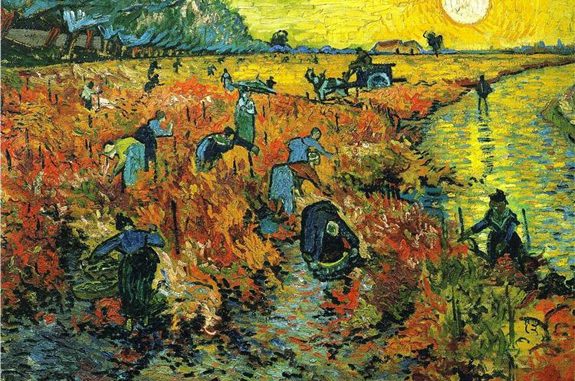
The Red Vineyard by Vincent Van Gogh, 1888

“For the kingdom of heaven is like a landowner who went out early in the morning to hire workers for his vineyard. He agreed to pay them a denarius for the day and sent them into his vineyard.

“About nine in the morning he went out and saw others standing in the marketplace doing nothing. He told them, ‘You also go and work in my vineyard, and I will pay you whatever is right.’ So, they went.

“He went out again about noon and about three in the afternoon and did the same thing. About five in the afternoon he went out and found still others standing around. He asked them, ‘Why have you been standing here all day long doing nothing?’

“‘Because no one has hired us,’ they answered.

“He said to them, ‘You also go and work in my vineyard.’

“When evening came, the owner of the vineyard said to his foreman, ‘Call the workers and pay them their wages, beginning with the last ones hired and going on to the first.’

“The workers who were hired about five in the afternoon came and each received a denarius. So, when those came who were hired first, they expected to receive more. But each one of them also received a denarius. When they received it, they began to grumble against the landowner. ‘These who were hired last worked only one hour,’ they said, ‘and you have made them equal to us who have borne the burden of the work and the heat of the day.’

“But he answered one of them, ‘I am not being unfair to you, friend. Didn’t you agree to work for a denarius? Take your pay and go. I want to give the one who was hired last the same as I gave you. Don’t I have the right to do what I want with my own money? Or are you envious because I am generous?’

“So, the last will be first, and the first will be last.” (NIV)

We as humans have an innate sense of right and wrong, justice and injustice. We want life to be fair. It disturbs us when there is favoritism, discrimination, and preferential treatment. When things seem askew and others seem more privileged, envy can creep in and settle in our bones.

The envy can go even deeper. For example, is it fair that any child should struggle with health issues like cancer, epilepsy, and mental disorders?  Is it fair to have healthcare disparities? Is it fair to have a spouse taken from you before their time?  Is it fair to lose your job because of a pandemic? Is it ever fair to be treated like a second-class citizen?

Pat answers to people’s genuine struggles will not do, such as “Well, you just need to work hard and hope for the best;” “We have to take what is given us and accept these things;” “Think of all those starving children in India;” or the more crass, “Suck it up buttercup; life was never meant to be a rose garden.”  Those statements simply do not help.

At the heart of envy is the belief that others are getting something that I deserve.

Plenty of jerks have healthy grandkids, grow old with their spouses, and retire in comfort with plenty of money. “It isn’t fair!” we cry.

God does not always operate according to our standards of fairness. God’s very nature is to be generous and full of grace. The parable which Jesus told about the vineyard workers is a story not of unfairness, but a story of generosity and grace. It is all in how you look at it.

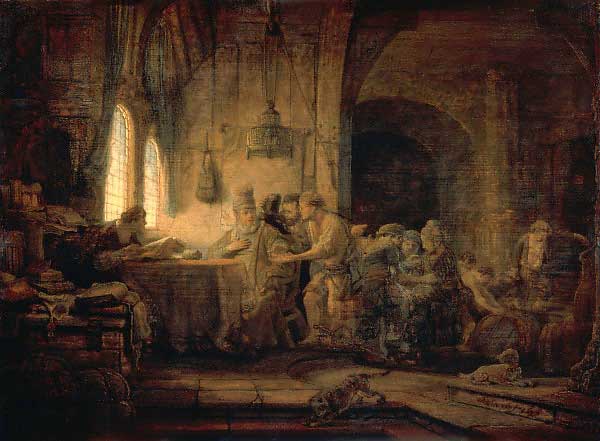
Parable of the Workers in the Vineyard by Rembrandt, 1637

A normal workday in the ancient world was ten hours, not counting breaks. The workday began at 6:00am. A denarius was a typical day’s wage for laborers. The landowner went out at the third hour, 9:00am; the sixth hour, noon, etc. He kept returning to hire more workers even up to the last hour of the workday. Laborers were always paid at the end of the day. In this parable, the last workers were paid first, which prompted the first workers hired to think they would be getting more, even though they had been promised a denarius. So, they grumbled about not getting more. They thought the landowner was not being fair.

Grumbling. Complaining. Murmuring. It is the bane of our existence. Decades ago, when gas station attendants still filled tanks for customers, I was working at a station and had a lady go berserk on me for not checking her oil and cleaning her windshield, because I did it for the car in front of her. Even though there was a sign right in front of her that said checking oil and cleaning windshields is only done upon request, the lady thought she was getting gypped. 

In truth, the landowner did not cheat or defraud the workers in any way. He paid the agreed upon wage, just like he promised. Should he want to pay everyone the same even though the amount of work was different was his own business. The problem was not with the owner, it was with the worker’s envy of the owner’s generosity toward the others. God distributes gifts because he is gracious, not because we have earned anything.

Our standard of fairness is not the rule of the kingdom of God – grace is.

The founder of Methodism, John Wesley, was physically thrown out of a church one Sunday because of a sermon he was preaching on the grace of God. Afterwards, when Wesley wrote about this to a friend, he said, “There is no Christian Doctrine more repugnant than the affirmation that we are saved by the grace of God through faith.”

Deep down many believe we control our destiny, and that we save ourselves by what we do. We discern that if we serve God all our lives, in the end, God will reward us. We believe that our pious activities, our acts of service and our work for the Lord, will bring us salvation, or, at least a leg up in the kingdom of God over others who have not worked as hard or as long as we have. After all, we do the right thing.

So, what about those who have not figured out Christianity… those who do not have the correct or proper beliefs… or those who have not straightened out their lives? According to a worldview of human fairness, they are out of luck. They should be in church. They should work harder, faster, and better. Then, they could get their lives in order. If they would only understand fairness, we reason, then all would be well.

Parable of the Vineyard Workers from unknown artist in the Middle Ages

But there is a problem, because the parable of the workers told by Jesus seems to be saying that is not how it works, at all.  Jesus seems to be saying that grace and grace alone saves, that God’s amazingly naive and irresponsible grace is available to anyone and everybody. And that troubles the workers to no end. 

Whenever we run headlong into God’s unfair grace and see that God’s way of doing things is so far removed from our way, there is bound to be grumbling.  After all, if God is going to run a vineyard like the one in the gospel lesson and give everybody the same pay regardless of their actual work hours, then what’s the use of getting up early in the morning to work? 

What is the good of sitting in church, listening to sermons from a crazy preacher who is no better than us, if these outsiders, these Johnny-and Jane-come-lately’s can waltz in at the last minute and receive the same treatment as the rest of us?  For many church folks who diligently serve, it is not fair to pay so much attention to outsiders and build ministry around people who aren’t even here, who don’t yet know Jesus.

The conclusion and point of the parable: The last will be first, and the first will be last. In Luke’s prodigal story, the elder brother grumbles and gripes: “All these years I’ve been slaving for you and never disobeyed your orders.  But when this son of yours who has squandered your property with prostitutes comes home, you kill the fatted calf!”  It is the firstborn son that complains. (Luke 15:11-32)

In both the parable of the prodigal son and the parable in today’s lesson, “good” people are the ones who fail to see the heart of the Father and of the landowner. The “firsts” got off track because, over time, they forgot the kingdom hinges on grace, not effort, on not simply doing the right things over a long period of time.

God controls the flow of mercy, not us. 

We will likely be surprised in heaven with those already sitting at God’s banquet table, and equally surprised with who is not there. Resentment can move us away from the table of mercy God is preparing. The problem comes whenever we think we are above other people.  We might be sinners, but we are not as bad as some other people are!  We commit ordinary sins, not mass murder!

Here is the unvarnished truth: God does not owe you or I a thing, and God cares about all kinds of people, not just us and people who think and live like we do. Our hearts need to be big enough to center ministry around other people who are different than us.

If our hearts are small, we easily get jealous when God pays attention to prodigals and profligates. Grace becomes too repugnant a doctrine for us.

The gospel of Jesus Christ is about grace. Life is not all about being decent. It is not all about morality, and it is certainly not about our own goodness. The gospel is about being steeped in and surrounded by the grace of God in Christ, so that we, in turn, can show others grace. Grace is the way God deals with us beyond what we deserve or feel we have earned. 

Grace is unfair; we get what we do not deserve. 

May we allow God’s grace to so permeate our hearts and lives so that we will give it to others as freely as we have received.Praise be to you, almighty and everlasting Father of our Lord Jesus Christ. In Christ, you have given us every spiritual blessing in heaven. In Christ, you chose us before the world was made. You chose us in love to be your holy people—people who could stand before you without any fault. And before the world was made, you decided to make us your own children through Jesus Christ. It pleased you to do it. And this brings praise from us because of your wonderful grace, given to us freely, in Christ, the one you love. We have forgiveness of sins because of this lavishly rich grace. Thank you, O my Father, for your grace extending to me in Christ! Amen

Guilt, Grace, and Debt-Collecting: The Parable of the Unmerciful Servant

Parable of the Unforgiving Servant by Nikola Saric
Parable of the Unforgiving Servant by Serbian German painter Nikola Saric

Then Peter came to Jesus and asked, “Lord, how many times shall I forgive my brother or sister who sins against me? Up to seven times?”

Jesus answered, “I tell you, not seven times, but seventy-seven times.

“Therefore, the kingdom of heaven is like a king who wanted to settle accounts with his servants. As he began the settlement, a man who owed him ten thousand bags of gold was brought to him. Since he was not able to pay, the master ordered that he and his wife and his children and all that he had be sold to repay the debt.

“At this the servant fell on his knees before him. ‘Be patient with me,’ he begged, ‘and I will pay back everything.’ The servant’s master took pity on him, canceled the debt, and let him go.

“But when that servant went out, he found one of his fellow servants who owed him a hundred silver coins. He grabbed him and began to choke him. ‘Pay back what you owe me!’ he demanded.

“His fellow servant fell to his knees and begged him, ‘Be patient with me, and I will pay it back.’

“But he refused. Instead, he went off and had the man thrown into prison until he could pay the debt. When the other servants saw what had happened, they were outraged and went and told their master everything that had happened.

“Then the master called the servant in. ‘You wicked servant,’ he said, ‘I canceled all that debt of yours because you begged me to. Shouldn’t you have had mercy on your fellow servant just as I had on you?’ In anger his master handed him over to the jailers to be tortured, until he should pay back all he owed.

“This is how my heavenly Father will treat each of you unless you forgive your brother or sister from your heart.” (Matthew 18:21-35, NIV)

It is unfortunate that one of the few guarantees in life is that someone will hurt you, and that hurt will tear a hole in your heart and last a long time.

When the hurt comes, we all must decide how to handle the issue of forgiveness. Oh, it’s easy to talk about forgiveness when you are doing fine – its another thing when you are hurt. One man, during a conversation with his Pastor, had this story:

“Nineteen years ago, this guy stole my wife away from me. They got married and moved to Florida while my life unraveled.  After I was arrested for assaulting a police officer, this guy smirked through the entire hearing.  When I was convicted, he flipped me the finger. I’ve hated him for nineteen years. He’s coming up here next week. I have a thirty-two-caliber pistol strapped around my ankle, and when I see him, I will kill him. I’ve thought about it. I’m sixty-three years old. I’ll get a life sentence, but I’ll also get free medical, a warm bed, and three meals a day.  I’m ready to end my life this way.”

We may wonder: “Why even bother to forgive?  Why even care about that person?” Emotional pain and angry hurt can be so deep that we see no need for forgiveness. “After all,” we might reason, “look at what that person has done to me!”

Jesus does not want bitterness to be the last word; he wants it to be forgiveness. The parable of the unmerciful servant is a piece of Christ’s teaching concerning “little people,” that is, people who are, by status, lowly and unimportant to others. The heavenly Father’s heart is one that cares deeply for them. They are lost, lonely, and languishing in pain. They need help. Jesus clearly explained what to do, giving a three-step process to privately go to others who have hurt us and win them back through reconciliation (Matthew 18:15).

The disciple Peter, ever the wondering, if not wandering disciple knows that if a person hurts someone, they might do it again. So, if a lost sheep is brought back to the fold, and then is offensive again-and-again, at what point do we say enough-is-enough and stop forgiving?

We as people can often feel a keen sense of “ought to.” We feel we ought to pay the debt we owe to others, and that others must pay us the debt they owe. This works on the emotional level just as much or more than any other arena of life. If we offend someone and they become angry, we believe we ought to make them feel better.  If someone angers us, we expect them to make it right and make us feel better.

The late Methodist scholar and author, Dr. David Seamands, said the two major causes of most emotional problems among Christians are: 1) The failure to understand, receive, and live out God’s unconditional grace and forgiveness; and, 2) The failure to give that grace and forgiveness to other people. I wholeheartedly agree with Dr. Seamands.

We have grace available to us in Jesus Christ through his death and resurrection. We cannot earn forgiveness.  Grace is free.  Equally true is the fact that no one owes us anything.  Grace is free for others, as well.

The Failure to Receive Forgiveness

In the end, was the unmerciful man in Christ’s parable forgiven?… No…. Why not?… Because he failed to understand forgiveness and receive it.  It was not the master’s fault; it was the man’s own fault. So, why did he react so mercilessly to a fellow person in debt? (The man’s debt was in the billions and could not be paid off, but the other man’s debt was just a few dollars). The unmerciful guy failed to grasp the master’s grace; he didn’t get it.  He thought he could work it off, and when the debt was canceled, he could not wrap his heart around such mercy. None of us can repay grace – it is free.

The inability to know and receive grace drives many Christians to the tragic treadmill of constant striving for perfection, achievement, and recognition from others. Many people refuse grace and instead try to get rid of their guilt through endless work – fueling the workaholic, motivating the addict, and animating much of the service done in the church and the world. The problem is not a lack of understanding sin or acknowledging personal sinful actions among Christians; the problem is what to do about it. Too many believers are trying to work-off their debt.

The Unforgiving Servant by American artist James B. Jangknegt

Here is a little test: Why do you do what you do? Why do you do good and right things?  Be honest.  Is it to truly worship and celebrate the Lord who has erased such a great debt of sin in our lives? Or, are we working to pay off a debt to God?  Am I striving to assuage my guilt? Are we searching to feel better through our service to others?

We can be so accustomed to operating according to guilt instead of grace that we don’t know what to with the absence of guilt – so we just go back to guilt as our default setting, like a dog returning to its vomit. Furthermore, the tragedy is compounded by insisting that others operate out of guilt, too.

Another little test: Are we content to simply ask people to help or to serve, or do we believe that there must be arm-twisting with some guilt to motivate them? Guilt and arm-twisting are inconsistent with the gospel of grace.  If we believe we must guilt our kids, family, co-workers, neighbors, or anyone else before they will do anything, then it is us who have a spiritual problem.

Ideally, we live and work out of a sense of gratitude toward God and not by guilt. Yet, there are always folks who continue to work out their unhappiness on other people by insisting they get on the guilt train along with them. We are unable to forgive ourselves, so we live with the guilt and try to pay off our debt, making ourselves and everyone else miserable in the process.

The Failure to Give Forgiveness

The unforgiven are the unforgiving. The reason the guy in the story responded so violently to a person who only owes him a few bucks is because he never really believed he was forgiven by the master in the first place. He could not envision a world in which his debt was paid. The unmerciful man was still operating as though life were a matter of collecting debts.

At the heart of many broken relationships and emotional conflicts is an insistence on debt-collecting. We want from others something they cannot give us. God in Christ erases the great debt we have, not some other person.  Yet, we go out and seek from others what only God provides. People are good at being people – but they make lousy gods. It is God who meets the deepest needs of our hearts – your spouse, children, friends, church, and community cannot do it. That is a job for Jesus. The watershed issue is grace – whether we can receive it, or not.  We cannot give something we have not first received.

It would be weird if a marriage vow went something like this: “I have a lot of terrific inner needs and inner emptiness and debts to pay, and I’m going to give you a marvelous opportunity to fill my Grand Canyon of insecurity and take care of me!”

Sometimes people have a nasty tendency to make idols of other people and look at them as though they owe us a debt of happiness, joy, and peace. For example, the weird marriage vow, if followed through with, inevitably will result in debt-collecting. A few years down the road the spouse says, “This is not what you were like when I married you… You owe me!” Our insecurity comes from the inability to receive grace. It is all about grace. Everything is about grace, not guilt and not debt-collecting because the debt has already been paid and the guilt has been erased.

Let us draw near to God with a sincere heart in full assurance of faith, having our hearts sprinkled (with the blood of Christ) to cleanse us from a guilty conscience. (Hebrews 10:22)

Conclusion

You and I are forgiven. There is no need to collect a debt which is already paid. The cross of Jesus Christ has taken care of the sin issue once for all, and not one person reading this is an exception to grace. Here is a final exam, to determine if there is someone we need to forgive:

  1. The Resentment Test: Is there someone you resent? Is there someone who has wronged you?  When you see them or think about them, do you have resentment in your heart?
  2. The Responsibility Test: You say to yourself, “I wouldn’t have this problem if it wasn’t for ________.”  This is passing the buck and believing that my happiness is dependent on another person. The truth is that no one is responsible for your emotional well-being and happiness except you.
  3. The Reminder and Reaction Test: Is there someone who “presses your buttons?” This is when we see or talk to a person who reminds us of someone else who hurt us, and we react to that person by transferring our anger and/or pain onto them.

The Pastor responded to the man mentioned earlier who had lost his wife to another man by saying, “Well, I guess it doesn’t matter if you go to jail because you’re already in jail.  The guy who stole your wife and smirked at your hearing isn’t in jail. You are. You are a prisoner of your own hate, and you are slowly killing yourself.”  A week after that conversation the man called the Pastor and said, “You know, I get your point.  I put the gun away.  I don’t want to spend the rest of my life in jail – and I want to get rid of this bitterness.”

The way to do deal with bitterness is through forgiveness. To forgive involves a long journey, just like every other aspect of following Jesus. Hopefully, by retelling the gospel of grace to one another week after week our hearts will be soft.  We will want to begin the journey to forgive others, stumbling forward with hearts torn by hurts, yet set free by grace.

May it be so to the glory of God.

How to Handle a Sinner, Part 2

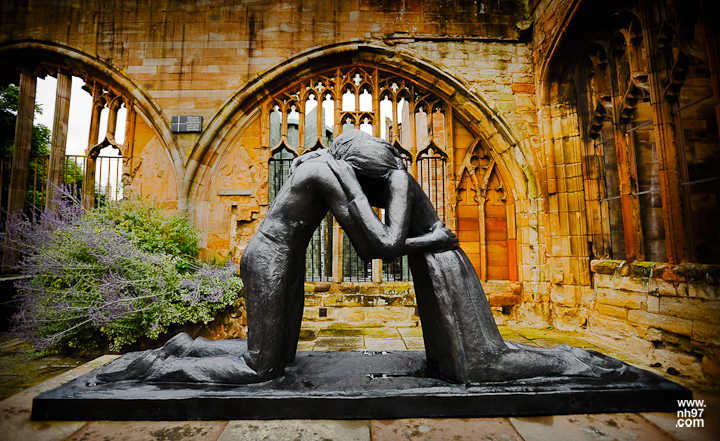
Reconciliation Statue
Reconciliation Statue, placed in the ruins of Coventry Cathedral, England, bombed by the Nazis in World War II.

Being emotionally and/or spiritually wounded by another downright hurts. So, what do we do when it happens? Gratefully, Jesus provided some clear teaching on how to handle a victimizing person. (Matthew 18:15-20)

In part one, we considered the initial step to be taken when a person has been offensive and brought damage to another and/or the community. In their straying from the law of love, we are to respond by speaking to the person privately, to attempt a one-on-one reconciliation and restoration. This effort may be repeated several times over.

These next two steps are only to be undertaken when it has become evident that the person’s intransigence about hurting others will not budge.

The Second Step – Take One or Two Others (Matthew 18:16).

Reconciliation Statue Berlin
Statue outside of the Church of Reconciliation in Berlin, Germany.

“If they will not listen, take one or two others along, so that ‘every matter may be established by the testimony of two or three witnesses.'” –Jesus

The idea here is not to get a few buddies together who agree with our assessment. Rather, we seek others who know the person and can provide loving and objective help. This upholds the ethics of the Old Testament:

A solitary witness against someone in any crime, wrongdoing, or in any sort of misdeed that might be done is not sufficient. The decision must stand by two or three witnesses. (Deuteronomy 19:15, CEB)

When a person fails to respond to reproof privately, then others need to get involved so that there is not a situation of “he said, she said.”  The witnesses are to help establish the nature of the problem. This is purposely meant to be a rather drawn out process because the goal is restoration. We are to give the person every chance to respond to correction.  People need to be given the grace of time to be effectively wooed back to the flock.

The Third Step – Tell It to the Church (Matthew 18:17-18).

Reconciliation Statue Hiroshima
Reconciliation Statue in Hiroshima, Japan

“If they still refuse to listen, tell it to the church; and if they refuse to listen even to the church, treat them as you would a pagan or a tax collector.” –Jesus

If the person ignores the group of witnesses, the group is to report the problem to the church. If the person still refuses to listen, then the person is to be treated like “a pagan or tax collector,” that is, the person is to be excommunicated and treated as though they are an unbeliever who has different needs. Jesus did not mean that we never talk to the person again. It is just the opposite: We communicate to them the need for grace just as we would to anyone.

The sixteenth-century Reformed Confession, the Heidelberg Catechism, took up this this matter (Question and Answer 85):

Q: How is the kingdom of heaven closed and opened by Christian discipline?

            A: According to the command of Christ:

Those who, though called Christians, profess unchristian teachings or live unchristian lives, and after repeated and loving counsel refuse to abandon their errors and wickedness, and after being reported to the church, that is, to its officers, fail to respond also to their admonition – such persons the officers exclude from the Christian fellowship by withholding the sacraments from them, and God himself excludes them from the kingdom of Christ.  Such persons, when promising and demonstrating genuine reform, are received again as members of Christ and of his church.

This approach is also germane with groups of people, churches, or Christian organizations. In the last century, churches around the world ostracized the South African Dutch Reformed Church for their refusal to bend concerning their racism and stance on apartheid.  Restoration did occur.  Not only that, but the Belhar Confession was eventually crafted from this church, a document which stands as a thorough biblical stand against structural racism and racist actions.

The Power of the Small Group (Matthew 18:19-20).

“Again, truly I tell you that if two of you on earth agree about anything they ask for, it will be done for them by my Father in heaven. For where two or three gather in my name, there am I with them.” –Jesus

Jesus reiterated his point about binding and loosing; opening and closing; banning and forgiving. One of the great Reformation teachings is the priesthood of all believers.  The beauty of this is that we may confess our sins to one another in a close, intimate setting so that the steps do not need be done. Small gatherings of believers coming together to confess sin and pray together is the most powerful setting there is.  If we neglect this, we are missing out on the power of God.

Conclusion

Once upon a time, there were two brothers. Their father had a large farm and when he became too old to work, he called his sons to him. “I am too old to work anymore,” he said. “I will divide my farm in half and give each of you one half. I know that you will always work together and will be good friends.”

When the brothers first started farming on their adjoining farms, they were the best of friends and would share everything together. Then, one day there was an argument between the two brothers, and they stopped speaking to one another. For many years, not a word was spoken between them.

One day, one of the brothers was at his house when a carpenter came to his door and said, “I would like to do some work. Do you have any work that I can do?” The brother thought for a moment and then replied, “I would like for you to build a fence on my property. Build it down near the stream that separates my farm from my brother’s. I do not want to see my brother and I would like for you to build a high fence there. I am going into town and I will return this evening.

Bridge over stream

When he came back that evening, he was shocked to see that the carpenter had not followed his instructions. Instead of building a high fence he built a bridge over the stream. The man walked down to look at the bridge, and as he did, his brother walked toward him from the other side. His brother said, “After all the terrible things I’ve done to you over the years, I can’t believe that you would build a bridge and welcome me back.” He reached out to his brother and gave him a big hug.

The brother then walked back up to his farmhouse to talk to the carpenter. “Can you stay?” he asked. “I have more work for you to do.” The carpenter answered, “I’m sorry but I can’t stay. I have to go, for I have many other bridges to build.”

Sometimes you and I have hurts and wounds from our brothers and sisters in Christ. When that happens, we often build a fence between ourselves and them. We stop talking to them. We do not want to see them. We do not want to be around them. However, Jesus wants something different. Instead of fences, he wants us to build a bridge of love.  He wants us to connect and work it out.