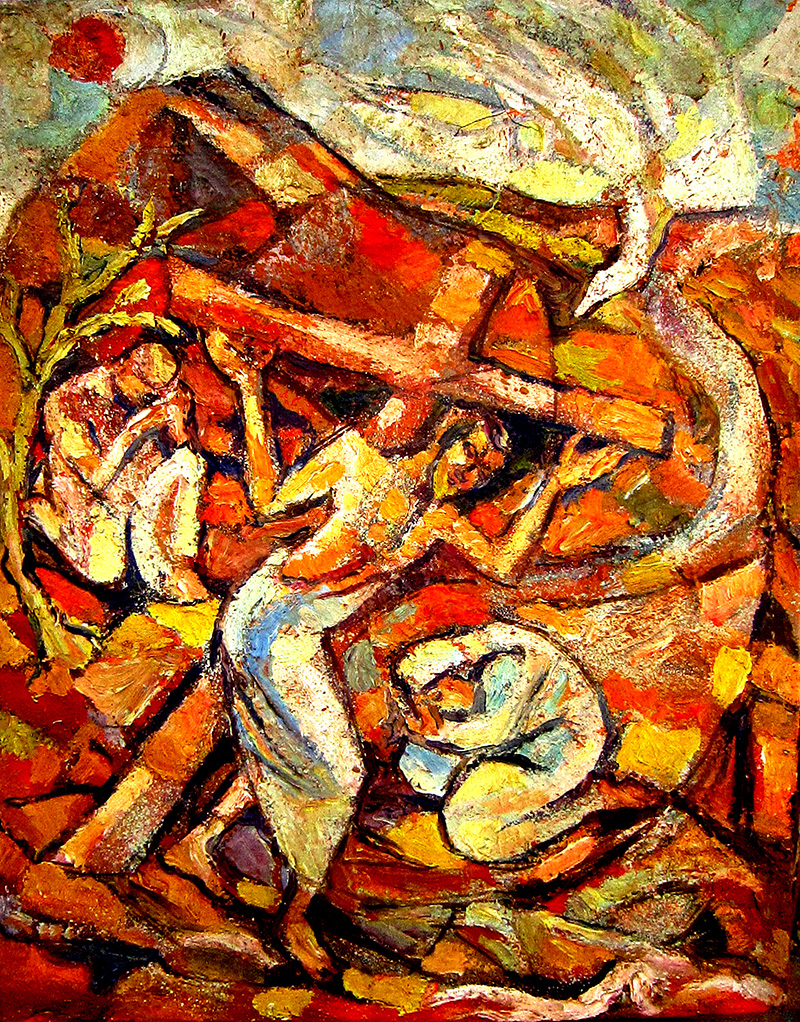
Power in Weakness (2 Corinthians 13:1-4)

Way of the Cross, by Jyoti Sahi, 2009

This will be my third visit to you. “Every matter must be established by the testimony of two or three witnesses.” I already gave you a warning when I was with you the second time. I now repeat it while absent: On my return I will not spare those who sinned earlier or any of the others, since you are demanding proof that Christ is speaking through me. He is not weak in dealing with you, but is powerful among you. For to be sure, he was crucified in weakness, yet he lives by God’s power. Likewise, we are weak in him, yet by God’s power we will live with him in our dealing with you. (New International Version)

One witness is not enough to convict anyone accused of any crime or offense they may have committed. A matter must be established by the testimony of two or three witnesses. (Deuteronomy 19:15, NIV)

The missionary Apostle Paul had already visited Corinth twice. Citing his upcoming third visit in the context of establishing a crime, this was a warning to the Corinthian Christians: When I get there, it won’t be a pleasure cruise. Paul would flex his apostolic muscles toward the church.

The Apostle was accustomed to people opposing his ministry and generally making a stink of things against him. The Corinthians were being rather stubborn and unrepentant. They were unwilling to change their ways nor their attitudes.

In order to discredit Paul, his opponents labeled him as weak and ineffective. They challenged him as to whether Christ was actually animating his words, or not. But Paul was no weakling, nor was he a simpleton. He used their own language against them by pointing out that Jesus was accused of the very same things – Christ was crucified in weakness, but lives by the power of God.

Christianity is an inherently paradoxical religion. It’s not going to make sense to the ungodly and the unbeliever. The cross – the place of submission, torture, death, and apparent weakness – was actually the supreme demonstration of God’s power. This was proven by the resurrection of Christ from death.

In the same way, although Paul seemed weak, unimposing, always engaged in suffering service, these very things were the ultimate sign that God’s power was at work in his ministry. The Apostle shared in the sufferings of Christ and gloried in the reality that he was weak.

And since Paul also shares in Christ’s resurrection, he therefore shares in the power of Christ. He will use this power, given to him by Christ in the form of apostolic authority, and deal with the recalcitrant Corinthians forthwith.

The Corinthian Church, not knowing who they were really dealing with, had a tiger by the tail. There is a time for gentle and compassionate pastoral care, and then there is the time for using the shepherd’s crook for some tough loving discipline.

If the sin-busting strength of the cross, and the spiritual power of the resurrection, are truly fueling Christian ministry, then it is a fool’s errand to oppose it. Chastisement and a lesson in humility are in store for the haughty opponent working against authentic Christian service.

We really have to get this wrongheaded notion out of our noggins, that power and strength are all about an aggressive exercise of authority. If I see one more church put out an advertisement for a pastor who has “strong leadership” I think I’m going to puke. Because what they typically mean by strength is a command-and-control sort of stereotypical military Sargent type of person.

That’s diametrically opposed to the leadership and authority Jesus exercised, and the kind of values which characterize the kingdom of God. In God’s economy, humility and meekness are the true demonstrations of power. Real power in this world is the power of self-control – and not the control of manipulating others to get and keep power that won’t last.

Little wonder that pastors of churches these days can be some of the worst immoral and unsavory characters around. Congregations hungry for “strong leadership” inevitably hire narcissistic persons. And then when things go sideways, the church wonders what the heck happened.

But the signs were continually there, all along. When the church leaders pray, they’re not addressing God, but publicly telling those listening what they should be doing. In speaking, they tend to preface their comments with “The Bible says…” which is really a clue that they’re about to spout a bunch of opinionated nonsense cloaked in religious garb.

Until we embrace the mystery of the faith, expressed in paradoxical ways, with the weak displaying the real strength and power of the gospel, then we can expect Jesus to show up with a whip and give people what they’ve really wanted all along – and they won’t like it one bit.

Paul, a mentor to many first generation Christian pastors, encouraged them this way:

I solemnly call on you in the presence of God and Christ Jesus, who is going to judge those who are living and those who are dead. I do this because Christ Jesus will come to rule the world. Be ready to spread the word whether or not the time is right. Point out errors, warn people, and encourage them. Be very patient when you teach.

A time will come when people will not listen to accurate teachings. Instead, they will follow their own desires and surround themselves with teachers who tell them what they want to hear. People will refuse to listen to the truth and turn to myths.

But you must keep a clear head in everything. Endure suffering. Do the work of a missionary. Devote yourself completely to your work. (2 Timothy 4:1-5, GW)

Weakness, hardship, suffering, and opposition are part of the work of Christian ministry. In this, there is eternal power, which shall never be overcome.

Almighty God, may your grace be sufficient for me, and my power made perfect in weakness. Help me to rely upon and use my weaknesses, so that Christ’s power may rest on me. For Christ’s sake, I delight in weaknesses, insults, hardships, persecutions, and difficulties. For when I am weak, then I am strong, through Jesus Christ my Lord, in the enablement of the Holy Spirit. Amen.

The Church that Makes a Difference (Matthew 16:13-20)

Photo by Felix Mittermeier on Pexels.com

When Jesus came to the region of Caesarea Philippi, he asked his disciples, “Who do people say the Son of Man is?”

They replied, “Some say John the Baptist; others say Elijah; and still others, Jeremiah or one of the prophets.”

“But what about you?” he asked. “Who do you say I am?”

Simon Peter answered, “You are the Messiah, the Son of the living God.”

Jesus replied, “Blessed are you, Simon son of Jonah, for this was not revealed to you by flesh and blood, but by my Father in heaven. And I tell you that you are Peter, and on this rock I will build my church, and the gates of Hades will not overcome it. I will give you the keys of the kingdom of heaven; whatever you bind on earth will be bound in heaven, and whatever you loose on earth will be loosed in heaven.” Then he ordered his disciples not to tell anyone that he was the Messiah. (New International Version)

A lot of research studies have come out in the past 20 years demonstrating that legions of adults, especially between the ages of 18-29, are leaving the Church in droves. This confirms my own anecdotal evidence over the years that about 80% of twenty-somethings drop out of church altogether. So, why are people leaving? Can anything be done about it?

Most of the studies can be boiled down to three major reasons: 

  1. The Church is irrelevant to my life and doesn’t talk about things important to me
  2. The Church is judgmental toward others not like themselves
  3. The Church is hypocritical by saying one thing and yet living another way

A good, right, and real confession of Jesus will speak a relevant word into the culture and into various generations, will proclaim the gospel of grace (not judgment), and will live what it believes.

In today’s Gospel lesson, Jesus and his disciples are in the Gentile (non-Jewish) territory of Caesarea Philippi, a city 25 miles north of the Sea of Galilee. Up to this point, the disciples encountered a lot of people and heard a lot of things said. So, Jesus asked them two questions: 

Who do people say the Son of Man is?

The disciples gave a variety of answers, which is to be expected, with some of them being a bit esoteric. John the Baptist raised from the dead is a stretch. Elijah was a man who never died, but was just taken to heaven; maybe he’s back. Maybe Jeremiah or one of the other prophets got sent back. 

When asking this question to folks today, you will also get a variety of answers as to whom Jesus is – a good teacher, a model humanitarian, a myth or a legend who didn’t really exist. A few times I have been told that Jesus was an alien from another planet. My personal favorite when I asked who Jesus, a guy answered that he was a nudist, and that if we all just took off our clothes, there would be peace in the world.

Who do you say I am?

Peter acted as the spokesperson for the group. Given the disciples’ track record of scratching their heads over nearly everything Jesus said or did, one might expect to hear another crazy answer. But Peter got it right by confessing, “You are the Christ, the Son of the Living God.” 

“Christ” is another way of saying “Messiah,” or “Savior.” It literally means, in the Greek language, “Answer.”  Peter confessed Jesus as being The Answer, the person for whom everything comes down to. Peter may not have fully understood what he was saying, but he said it.

The reason that craziness didn’t come out of Peter’s mouth is that “The Answer” was divinely revealed to him.  Faith in Jesus Christ is a gift given to us by God. 

“All things have been committed to me by my Father. No one knows the Son except the Father, and no one knows the Father except the Son and those to whom the Son chooses to reveal him.” Jesus (Matthew 11:27, NIV)

Peter was blessed – not necessarily because of sincerity, openness, or deserving it – but because of God’s grace which revealed to him that Jesus is the “Answer.”

The Apostle Peter put himself in a position to know by obeying the voice of Jesus to follow him. It took him and the other disciples a while to “get it,” but eventually they did. And if it took years of being with Jesus for the disciples to make a right and good confession of faith, then it’s important that we have a great deal of patience for our friends and relatives.

Jesus proclaimed Peter (which means “rock”) the immovable object from which the Church would be built.  The Apostle Paul framed it this way:

You are no longer foreigners and strangers, but fellow citizens with God’s people and also members of his household, built on the foundation of the apostles and prophets, with Christ Jesus himself as the chief cornerstone. In him the whole building is joined together and rises to become a holy temple in the Lord. (Ephesians 2:19-21, NIV)

Christ is the one who builds the Church – and not me,  nor you. This reality is encouraging and comforting to me. If it was up to me to build the Church, I would screw it up so badly that it would actually be overcome by hell. But I can’t screw it up, because it’s Christ’s Church, not mine. 

So, we can move forward and storm the gates of hell, we can move and work and act and call others to confess, all with the confidence and security of knowing that Jesus is building his Church. There’s no need to worry whether we’re getting it right, or not, because we aren’t the ones in control of the project.

However, I admit what Jesus says next isn’t very comforting to me. Christ told Peter that he will give him the “keys of the kingdom of heaven,” and that whatever he binds on earth will be bound in heaven, and whatever he lets loose on earth will be loosed in heaven.

Giving Peter the keys of the kingdom seems akin to giving an 8 year old the keys to the car and saying, “Go ahead, take it for a spin, you can drive it!” 

What are the keys of the kingdom? 

The preaching of the holy gospel and Christian discipline toward repentance. Both preaching and discipline open the kingdom of heaven to believers and close it to unbelievers. 

How does the preaching of the gospel open and close the kingdom of heaven? 

The kingdom of heaven is opened by proclaiming and publicly declaring to all believers, each and every one, that, as often as they accept the gospel promise in true faith, God, because of what Christ has done, truly forgives all their sins. The kingdom of heaven is closed, however, by proclaiming and publicly declaring to unbelievers and hypocrites that, as long as they do not repent, the anger of God and eternal condemnation rest on them. (The Heidelberg Catechism, Q&A 83, 84 )

The Church is true to its mission when it proclaims the good news of God’s grace in Christ. We possess the keys of the kingdom. Jesus knew exactly what he was doing, that is, the risks and the problems of letting people do the task of proclaiming the gospel. Yet, Christ still tossed us the keys to his Mercedes.

Conclusion

A Church that makes a difference is made up of people who confess Jesus, are called by God, and call others to confess Jesus, too. The de-churched and the disaffected want to see a Church that seeks to understand the world, to provide relevant ministry to others, and to tackle the injustice that exists everywhere.

We must use the power given us with the keys of the kingdom to bestow mercy to the weak, the oppressed, and the lost. We need to live what we believe with a passionate heart and an unashamed faith.

Together, as God’s people, we can extend the hospitality and the kindness to make a difference in the church and the world. 

May our confession of Christ shape our words and our actions. And may it give us the confidence and boldness to live as Jesus did, and to enjoy him forever. Amen.

The Day of Pentecost (Acts 2:1-21)

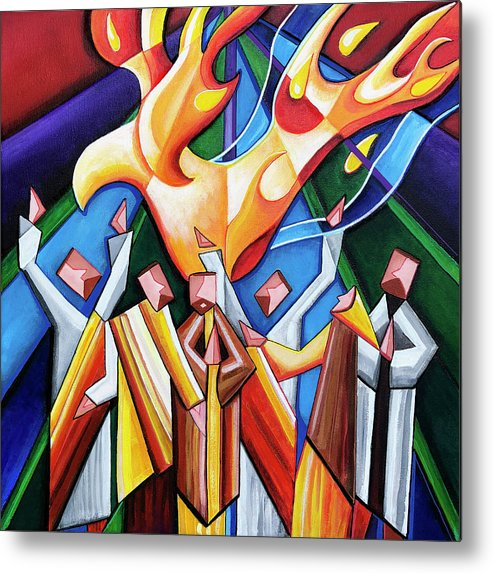
Pentecost, by Jennifer Allison

Now when the day of Pentecost had come, they were all together in one place. Suddenly a sound like a violent wind blowing came from heaven and filled the entire house where they were sitting. And tongues spreading out like a fire appeared to them and came to rest on each one of them. All of them were filled with the Holy Spirit, and they began to speak in other languages as the Spirit enabled them.

Now there were devout Jews from every nation under heaven residing in Jerusalem. When this sound occurred, a crowd gathered and was in confusion, because each one heard them speaking in his own language. 

Completely baffled, they said, “Aren’t all these who are speaking Galileans? And how is it that each one of us hears them in our own native language? Parthians, Medes, Elamites, and residents of Mesopotamia, Judea and Cappadocia, Pontus and the province of Asia, Phrygia and Pamphylia, Egypt and the parts of Libya near Cyrene, and visitors from Rome, both Jews and proselytes, Cretans and Arabs—we hear them speaking in our own languages about the great deeds God has done!”

All were astounded and greatly confused, saying to one another, “What does this mean?” But others jeered at the speakers, saying, “They are drunk on new wine!”

But Peter stood up with the eleven, raised his voice, and addressed them: “You men of Judea and all you who live in Jerusalem, know this and listen carefully to what I say. In spite of what you think, these men are not drunk, for it is only nine o’clock in the morning. But this is what was spoken about through the prophet Joel:

And in the last days it will be,’ God says,
that I will pour out my Spirit on all people,
and your sons and your daughters will prophesy,
and your young men will see visions,
and your old men will dream dreams.

Even on my servants, both men and women,
I will pour out my Spirit in those days, and they will prophesy.
And I will perform wonders in the sky above
and miraculous signs on the earth below,
blood and fire and clouds of smoke.

The sun will be changed to darkness
and the moon to blood
before the great and glorious day of the Lord comes.
And then everyone who calls on the name of the Lord will be saved.’ (New English Translation)

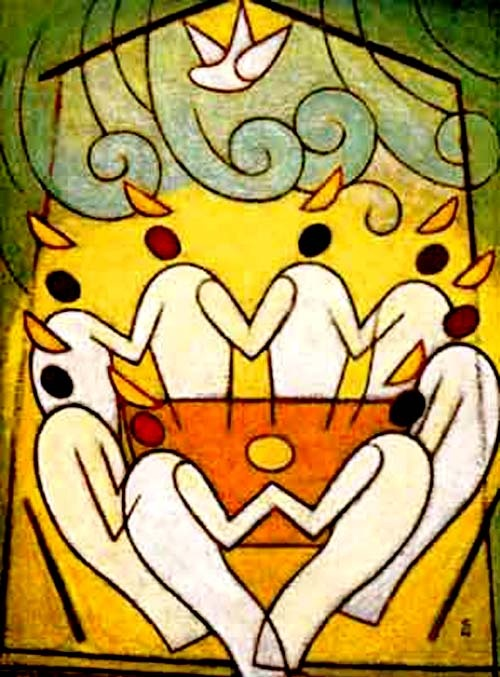
The Coming of the Holy Spirit, by Soichi Watanabe, 1996

Tornadoes are powerful. So is fire. They both have an immense potential for awe and destruction.  It’s interesting that when the little band of Christ’s followers experienced the Holy Spirit for the very first time, they likened what they encountered as wind and as fire. 

There is power in the Spirit – for both life and in destruction. It is the Spirit of God who dismantles and rearranges lives to make something different or new altogether. Most certainly, when the Spirit gets involved, nothing is going to be the same again.

On the Day of Pentecost, the Spirit upset the status quo and formed a new band of believers into the community of the redeemed (the Church). The presence of God’s Holy Spirit brings energy, strength, and ability to spread the good news of Jesus, heal broken lives, and bring an egalitarian way of life that sees no distinction based on race, class, gender, or ethnicity. 

The giving of the Spirit to the people of God is a whole lot more than a day set aside on a calendar, or a by-gone ancient thing that happened and has no significance for today. In fact, it is more than true to say that an authentic follower of Jesus Christ is a Pentecostal believer.  The New Testament knows nothing of a Christian who isn’t given the Spirit to accomplish the will of God on this earth.

Therefore, this time of the year is hugely significant when we attune ourselves to Holy Time because it is the age of the Spirit, the time of Pentecostal life and power. 

Ten days after recognizing Christ’s Ascension, and fifty days after our Lord’s resurrection from death, the Christian Calendar observes the day of Pentecost (which literally means “fifty” in Greek).  The day coincides with an established Jewish festival, the Feast of Weeks. Back in the day, Jerusalem would be filled with all kinds of different nationalities and ethnicities during the festival.

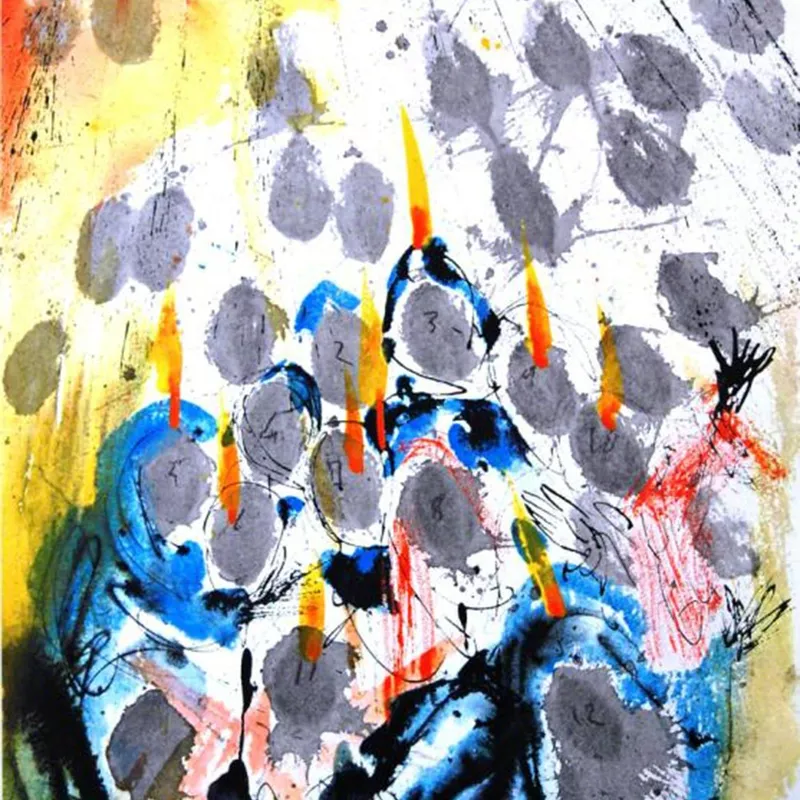
“There Appeared To Them Separated Tongues,” by Salvador Dali, 1967

Pentecost is often known as the birthday of the Church. It marks the time when the Holy Spirit came upon the fledgling believers in power. The disciple Peter, once a flaky up-and-down follower, was filled with the Spirit and spoke the Word of God boldly. His bold proclamation of repentance and faith in Jesus led directly to three-thousand persons added to the little band of one-hundred twenty.

And it didn’t stop there.

We live in an age where all believers in Jesus have the same Holy Spirit as our spiritual ancestors did. It’s an era of spiritual empowerment. The Church is called to reach the world with good news of forgiveness and grace through the person and work of Christ. 

So, then, the Church possesses confidence and security in knowing that the Spirit’s enablement and power is available for mission and spiritual care to the nations. It’s an immense calling that befits the bigness of God.

There are a wide range of Christian celebrations of Pentecost. Some churches do not recognize the holiday at all. Most churches at least mention it in prayer, song, or sermon. Other churches go all out, with worship focused on remembering the first Pentecost and praying for a similar outpouring of divine power. Churches that employ liturgical colors generally use red on Pentecost as a symbol of fiery spiritual power.

Pentecost reminds us that Christians are meant to live in the presence and power of the Holy Spirit, all the time. This day is a chance to confess our shortcomings and failures because of fear, apathy, and selfishness; and to ask for a fresh infusing and infilling of God’s wonderful Spirit. 

The Day of Pentecost flings every single believer into a congregational whole, the Church, and lets us know that we are not to be rugged individualists acting alone but are part of the Body of Christ. Therefore, we must renew our commitment to the Church for whom Christ died. 

The Spirit is ready to use us in forging spiritual bonds of kinship and solidarity. Pentecost throws disparate people together in a unified whole, made up of every kind of language, nationality, ethnicity, gender, and race.  We are all to use the gifts of the Spirit given to us for the benefit of building up one another.

We exist because of the Holy Spirit. Without the Spirit, there is no power source because the Spirit is the battery, the generator of the Christian life. We are to do all life and ministry through the power of the Spirit, equipping and encouraging each other, displaying the fruit of the Spirit, and worshiping the person of the Spirit in always being present with us.

Pentecost was (and is!) a watershed event. Worship, community, and outreach are the logical and collective responsibilities of each believer and every church around the globe.

Let us, then, recognize Pentecost and observe this day with heartfelt thanksgiving and a renewed impulse to exercise our spiritual abilities – graciously given to us by the Holy Spirit. Amen.

The Sheep Need Boundaries (Jeremiah 23:1-8)

“What sorrow awaits the leaders of my people—the shepherds of my sheep—for they have destroyed and scattered the very ones they were expected to care for,” says the Lord.

Therefore, this is what the Lord, the God of Israel, says to these shepherds: “Instead of caring for my flock and leading them to safety, you have deserted them and driven them to destruction. Now I will pour out judgment on you for the evil you have done to them. But I will gather together the remnant of my flock from the countries where I have driven them. I will bring them back to their own sheepfold, and they will be fruitful and increase in number. Then I will appoint responsible shepherds who will care for them, and they will never be afraid again. Not a single one will be lost or missing. I, the Lord, have spoken!

“For the time is coming,”
    says the Lord,
“when I will raise up a righteous descendant
    from King David’s line.
He will be a King who rules with wisdom.
    He will do what is just and right throughout the land.
And this will be his name:
    ‘The Lord Is Our Righteousness.’
In that day Judah will be saved,
    and Israel will live in safety.

“In that day,” says the Lord, “when people are taking an oath, they will no longer say, ‘As surely as the Lord lives, who rescued the people of Israel from the land of Egypt.’ Instead, they will say, ‘As surely as the Lord lives, who brought the people of Israel back to their own land from the land of the north and from all the countries to which he had exiled them.’ Then they will live in their own land.” (New Living Translation)

All of the Old Testament prophets have something to say on the subject of caring for the flock, that is, on the religious leaders of the people and their sacred responsibility to spiritually meet the needs of others.

God cares for each and every sheep (person) and will do whatever it takes to ensure the flock has everything they need for life and godliness.

So, the Lord’s ire is raised whenever shepherd-leaders don’t do their proper job and fail to live into their vocation of responsibly caring for the flock by watching over it and providing for them.

One of the modern forms this takes is expecting worshipers to serve the institution, rather than the institution existing to serve the worshiper. The telltale signs of institutional centrality in the Church (instead of Christo-centric religion) is continually pursuing the priorities of attendance, money, and the church building.

To put it more crassly, some churches seem to only care about buildings, budgets, and butts in the pew. This makes the people the burden-bearers of supporting the system, rather than the system of leaders supporting the people.

“You get what you tolerate.”

Henry Cloud

Admittedly, I just painted a picture with a broad stroke; furthermore, there is nothing inherently wrong with institutional religion (after all, I’m part of the established religion scene). It’s just that shepherds need to be continually vigilant about focusing their pastoral goals and efforts in ways which spiritually care for the common good of all the flock.

A major reason why there is so much fear and anxiety amongst believers is twofold:

  1. Spiritual leaders have too much power and responsibility over too many things, and so, less time and effort is put into pastoral care and compassionately ministering to the flock of God
  2. Churches give spiritual leaders too much power and responsibility, having unreasonable expectations for pastors
  3. Believers aplenty have given up on church

You might conclude (wrongly) that institutional forms of religion, such as churches, just need to be avoided. However, none of us can completely avoid systemic sin because it resides everywhere. Instead, we need to clarify what we will tolerate and not tolerate.

Abusive situations occur when there are no fences to keep everyone safe, secure, and well-fed. It’s important to have boundaries in place for the life and health of everyone.

What are “boundaries?”

Boundaries define who we are. A boundary shows me where I end and someone else begins, leading me to a sense of ownership. Knowing what I am to take and not take responsibility for gives me freedom.

No is a complete sentence.”

Anne Lamott

Why is it important to set boundaries?

  • Boundaries help us keep the good in and the bad out. Setting boundaries involves taking responsibility for your choices. You are the one who makes them, and the one who must live with their consequences.
  • Boundaries help protect us from “gaslighting.” Gaslighting is a form of emotional abuse in which one person manipulates another into doubting their thoughts, feelings, judgments, perceptions, and/or memories. Gaslighting convinces someone to accept the gaslighter’s version of reality at the expense of their own.
  • Boundaries hold people accountable for their words and actions. Without boundaries, we can easily feel used and mistreated.

What are some ways to set healthy boundaries?

  1. Clarify your values. Is this about preserving personal space? Do you want to make sure your emotions are not dismissed or invalidated? Are you trying to take back control of your time, energy, or resources?
  2. Decide where the fence will go. Where is your boundary line? What behaviors can you tolerate?  At what point does someone cross the line with you?
  3. Identify specific, problematic behaviors. What specific behaviors constitute unwanted trespassing on your life?
  4. Identify how a boundary violation is handled. Will you remove yourself from the situation, or step away from an unfinished argument?
  5. Follow through on the consequences. This is essential. If you’ve stated clearly what your boundaries are and they are crossed, make sure to do what you said you will do.

God makes and keeps boundaries and puts up reasonable fences in order that God’s people will be safe and cared for. The Lord also enforces those boundaries and has clear consequences when they are crossed.

The sooner we respect those divine fences, the better off we will be.

Almighty and everlasting God, breathe your Holy Spirit into our hearts and inspire us with love for goodness and truth. May we respect and honor you, and have no fear to hinder us from doing your will. Help us to be compassionate leaders and followers, knowing your compassion, being mindful of your love, and serving you faithfully, through Jesus Christ our Lord. Amen.