Burt Ward as Robin, and Adam West as Batman, in the 1960’s TV show
In some Christian traditions, Holy Week – observing the last earthly week of Christ’s life on earth – is either forgotten or neglected. And those that do recognize and observe it, this week can too easily become just something we do every year, without much meaning behind it. The following is a tongue-in-cheek way of reminding us of it’s importance, and recapturing it for the life of the Church…
“Robin, there is something seriously sinister afoot. It seems the people of Gotham have lost their sense of the story of Christ’s life, death, and resurrection.”
“Holy Holy Week, Batman! It must be the work of that arch-villain the Joker who has turned the narrative of Jesus into a by-gone joke… or maybe the Riddler who has made the redemptive events of Jesus into a complicated riddle that no one can solve… or maybe that fiend, Cat Woman, has finally found the purr-fect way to foil attention to the Lord Jesus.”
“I fear, Boy Wonder, that you have stumbled upon who is behind the loss of Holy Week… they are all conspiring together not just to create a spin on the life and death of Jesus, but to form a new narrative that doesn’t even include Christ at all.”
“Those dastardly demons of disaster! Let’s go get them, Batman! How could they have done such an ugly underhanded umbrage as that!?”
“Let’s use the Bat computer to analyze the evidence found at the crime scene churches…. Look, Robin, it seems a feculent film of gross gas has rendered the believers prone to the noxious notion that the Christian observance of Holy Week is optional, as if the journey with Jesus to the cross doesn’t need special attention. They are attempting to rewrite it all so that Christians will pass through this week without even a thought about Jesus… until it’s too late. Then they will sweep in and make all of Christianity into something that’s merely an accessory to life, like a petty plastic purse.”
Burgess Meredith as the Penguin, Frank Gorshin as the Riddler, Lee Meriwether as the Catwoman, and Cesar Romero as the Joker, in the 1960s TV show Batman.
“Holy evisceration, Batman! They’re trying to do away with the Christian life and the story of Jesus altogether and replace it with their fiendish focus on the foul festering faith of fecund followers!”
“That’s right, Robin. It’s our job to stop them from following through with their platitudinous plot before it’s too late.”
“But how, Batman? Their vile villainy has already voiced a vacuous votum of veneered viciousness to any observance of the last week of Christ’s life on this earth.”
“Yes, Robin, but you are forgetting the one “v” word which has already spelled doom for our culprits of crime… “victory.”
“Holy resurrection, Batman! You’re right! All we need to do is voice the victory of Jesus and those bungling bandits of belief will get another “v” word: “vanquished!”
“Holy Week and all the major Christian seasons of the Church Year are meant to help us remember Jesus and follow Christ in our daily life. When strayed souls begin berating believers for observing obedience to Palm Sunday, Maundy Thursday, Good Friday, Holy (or Black) Saturday, and Easter Sunday then you can bet, Boy Wonder, that the gangsters’ gross gas of gullibility has fumigated their faith.”
“So, you’re saying, Batman, that the forgetting of faith festivals can be reversed through setting our sites on the contempt of the cross and the resplendence of the resurrection?”
“The cross is the mid-point of history, Robin, the very center of faithful followers. From it flows the flowering of all faith.”
“Holy forgiveness, Batman. I see it now. The sin issue has been taken care of once-for-all through the death of Jesus Christ. And his rising again has enabled us ignorant idiots of ignominy to live a new life of love through the words and ways of Christ.”
“And, don’t forget, Boy Wonder, that we get our faith focused through walking into those ways and words by highlighting holidays as eminently important to our crowded calendars.”
“Holy, holy, holy, is the Lord God Almighty, creator of heaven and earth; and, Jesus Christ his only Son, our Savior; who, with the Holy Spirit lives and reigns forever and ever!”
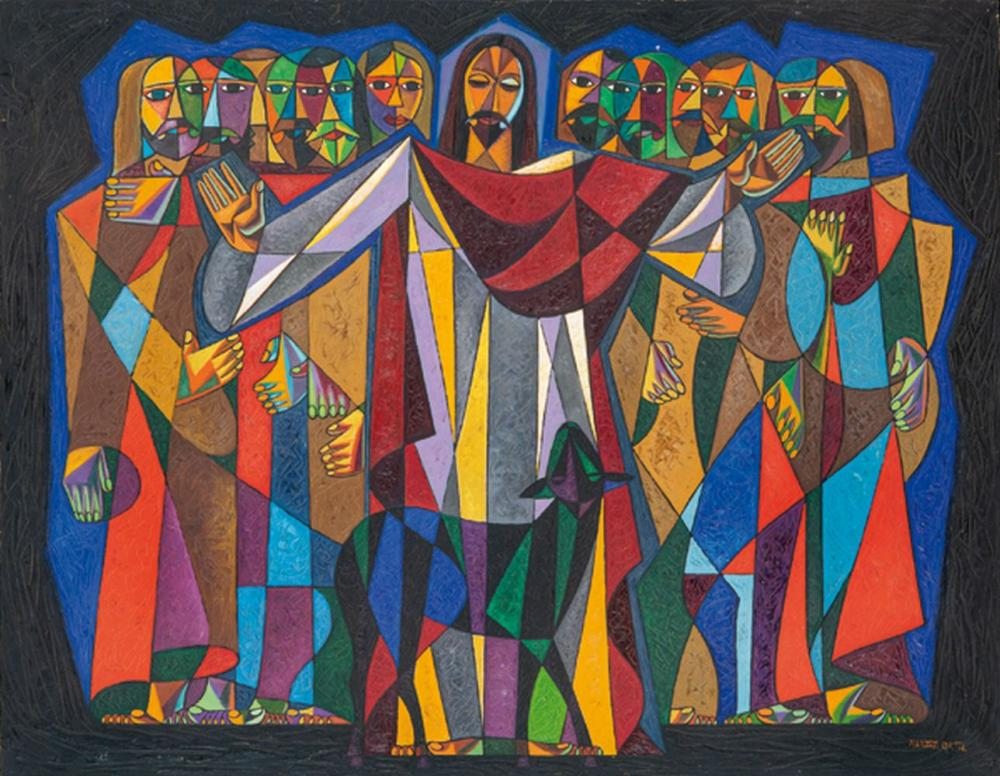
Jesus Christ and the Apostles, by Nicolás Martínez Ortiz (1907-1990)
Although I hope to come to you soon, I am writing you these instructions so that, if I am delayed, you will know how people ought to conduct themselves in God’s household, which is the church of the living God, the pillar and foundation of the truth. Beyond all question, the mystery from which true godliness springs is great:
He appeared in the flesh, was vindicated by the Spirit, was seen by angels, was preached among the nations, was believed on in the world, was taken up in glory. (New International Version)
Godliness is an important thing for those who seek to follow God.
So, the Apostle Paul wrote to his young protégé, Timothy, who was leading the church in Ephesus. Paul gave Timothy some sound practical instructions regarding how things ought to be conducted between pastor and people. Paul did this because he wasn’t quite sure how long it would be before he could show up in person, and he wanted to ensure that the ministry would go forward in a way that honored Christ.
Christian ministry is important because it doesn’t simply have to do with one’s private abilities and affairs. Rather, Christian leaders and pastors are entrusted with the household of God, the church. Believers are a holy sanctuary of the soul, the place where God dwells by means of the Spirit.
The Church is not a brick and mortar building, but the place of the living God, the pillar and foundation of the truth. Pastor and parishioners alike are to support the truth of the gospel, that is, the good news about the person and work of Jesus Christ.
Both believers and bishops who make up the Church support gospel truth by doing the following:
Hear and heed the truth.“Whoever has ears to hear, let them hear… This is the meaning of the parable: The seed is the word of God. Those along the path are the ones who hear, and then the devil comes and takes away the word from their hearts, so that they may not believe and be saved. Those on the rocky ground are the ones who receive the word with joy when they hear it, but they have no root. They believe for a while, but in the time of testing they fall away. The seed that fell among thorns stands for those who hear, but as they go on their way they are choked by life’s worries, riches and pleasures, and they do not mature. But the seed on good soil stands for those with a noble and good heart, who hear the word, retain it, and by persevering produce a crop.” (Luke 8:8, 11-15, NIV)
Handle the truth rightly.Make an effort to present yourself to God as a tried-and-true worker, who doesn’t need to be ashamed but is one who interprets the message of truth correctly. (2 Timothy 2:15, CEB)
Hide the truth in your heart.I have hidden your word in my heart that I might not sin against you. (Psalm 119:11, NIV)
Hold the truth as the Word of Life.Hold firmly to the word of life; then, on the day of Christ’s return, I will be proud that I did not run the race in vain and that my work was not useless. (Philippians 2:16, NLT)
Ingest and digest the truth. Study, meditate, and devote yourself to God’s Word. Your words were found, and I ate them, and Your word was to me the joy and rejoicing of my heart. (Jeremiah 15:16, NKJV) You must not depend on bread alone to sustain you, but on everything that the Lord says. (Deuteronomy 8:3, GNT)
Interest yourself in the truth, and defend it.“I have been put here for the defense of the gospel.” (Philippians 1:16, NRSV) I must write and ask you to defend the faith that God has once for all given to his people. (Jude 1:3, CEV)
Impart the truth and disseminate it to others.The unfolding of your words gives light; it imparts understanding to the simple. (Psalm 119:130, NRSV) Teach these new disciples to obey all the commands I have given you. (Matthew 28:20, NLT)
Indicate and demonstrate the power of the truth in the way you live your life.Let the message about Christ completely fill your lives, while you use all your wisdom to teach and instruct each other. With thankful hearts, sing psalms, hymns, and spiritual songs to God. Whatever you say or do should be done in the name of the Lord Jesus, as you give thanks to God the Father because of him. (Colossians 3:16-17, CEV)
The Church is a big deal because the head of the Church, Jesus Christ, is a big deal.
In many quarters of the world, the Church no longer has much influence or impact. For some, the Church is nothing more than an outdated antiquarian club that’s irrelevant to us today. For others, the Church is an abusive institution that looks to extend selfish power over others. And for many, the Church is simply not something they want to be a part of, having neither strong opinions one way nor the other.
Yet, the Apostle Paul, in his letters to all the churches, presents the Church as united to Christ and an extension of his person and work on this earth. Now, that’s a big deal!
Therefore, the Church is meant to confess Christ in its daily witness in all it says and does. In other words, the Church is to embody the words and ways of Jesus, and even Christ himself, by means of God’s Holy Spirit.
Everything about the Christian is to exude the very life of Christ.
How we can possess such a vital union and connection with Jesus is a mystery. Rather than trying to understand it, we embrace it and live it with all the energy the Spirit of God grants us.
We do, however, seek to know Jesus Christ ever more, every day. The more we know Christ, the better we will be able to know the height and depth of love, and to extend that love in all the places of this fallen planet that lack it. This is where true godliness and goodness spring from.
The Church everywhere and for all time confesses and proclaims that Jesus Christ descended to this earth, was visibly seen in a human body by both people and angels, proved right by the invisible Spirit, proclaimed among all kinds of peoples, believed in all over the world, and ascended into heavenly glory.
After two thousand years of church history, Christians are still unpacking the incredible richness and mystery of what all that means for us and for our salvation. And it is a spiritual journey worth taking for the rest of our lives.
May I walk this day, O Christ, in the realm of grace, walking with you, my feet firmly on your earth-path, my heart loving all as kindred, my words and deeds alive with justice. Amen.
I commend to you our sister Phoebe, a deacon of the church in Cenchreae. I ask you to receive her in the Lord in a way worthy of his people and to give her any help she may need from you, for she has been the benefactor of many people, including me.
Greet Priscilla and Aquila, my co-workers in Christ Jesus. They risked their lives for me. Not only I but all the churches of the Gentiles are grateful to them.
Greet, also, the church that meets at their house.
Greet my dear friend Epenetus, who was the first convert to Christ in the province of Asia.
Greet Mary, who worked very hard for you.
Greet Andronicus and Junia, my fellow Jews who have been in prison with me. They are outstanding among the apostles, and they were in Christ before I was.
Greet Ampliatus, my dear friend in the Lord.
Greet Urbanus, our co-worker in Christ, and my dear friend Stachys.
Greet Apelles, whose fidelity to Christ has stood the test.
Greet those who belong to the household of Aristobulus.
Greet Herodion, my fellow Jew.
Greet those in the household of Narcissus who are in the Lord.
Greet Tryphena and Tryphosa, those women who work hard in the Lord.
Greet my dear friend Persis, another woman who has worked very hard in the Lord.
Greet Rufus, chosen in the Lord, and his mother, who has been a mother to me, too.
Greet Asyncritus, Phlegon, Hermes, Patrobas, Hermas and the other brothers and sisters with them.
Greet Philologus, Julia, Nereus and his sister, and Olympas and all the Lord’s people who are with them.
Greet one another with a holy kiss.
All the churches of Christ send greetings. (Romans 16:1-16, NIV)
The reason we have the “Captain Obvious” people in our lives, is that they simply point out something that is right under our noses we might miss. I’m playing the role of Captain Obvious. In today’s New Testament lesson are a group of women. Paul names, greets, thanks, and encourages several church leaders, and they are not all men:
Phoebe is a deacon. She’s actually the representative who was sent to take Paul’s letter to the church at Rome and read it to the congregation.
Priscilla is co-equal with her husband Aquila. Together they co-pastored a house church. She helped teach and mentor Apollos in Corinth.
Mary
Junia is an apostle. Paul states that she’s outstanding amongst them, of which also he is one.
Tryphena and Tryphosa
Persis is a dear friend of Paul.
Julia
In the earliest church, within the New Testament Scriptures, women are mentioned as serving in every sort of capacity. And yet, women are the greatest and largest untapped resource in the church today.
You might wonder why I would say such a thing, being that more women attend church than men. However, still in this day and age – removed 2,000 years from the biblical text – the reality for many churches around the world is that only men can hold positions of authority.
The reasoning goes something like this: “The Bible says women can’t serve over men, so women can’t hold those positions.” Really?
So, a woman can serve as a CEO of a Fortune 500 company, can be elected as governor of a state, and can manage men on a factory floor, but that same woman cannot serve as an elder in many churches? I once asked a pastor that very question, and he answered with “Yes, because the Bible says so.”
I guess he never read Romans 16.
If you are of the belief that a church office is based on gender instead of the calling and gifting of the Spirit, then, methinks, it behooves us to ask these questions of the biblical text:
If women are not to exercise authority over men in the church, how do we account for actual women leaders in the Bible, such as Deborah, Huldah, Philip’s daughters, Priscilla’s role in Apollos’ life, not to mention the list of women leaders in Romans 16? If our impulse is to say that these are exceptions because there were no men to “step up,” then what does that say about our theology? Is God not big enough to find a man to put into a position of leadership?
If we insist that women ought not to teach and be silent based on Paul’s letter to Timothy (1 Timothy 3:11-15) then why do we ignore Paul’s instruction that women are to publicly prophecy and pray? (1 Corinthians 11:5; Acts 21:9)
Doesn’t the prominence of women in the ministry of Jesus and Paul suggest something different than just having women tag along to teach children?
Just when does a boy become too old for a woman to legitimately teach him? If women can’t teach men, why in the world would we ever think that they are the best teachers for boys?
How can we apply Galatians 3:26-28 (there is no male or female in Christ)? Are women the exception?
Does the Reformation doctrine of the priesthood of all believers only apply to men? Doesn’t the absence of women in church leadership go against this?
Isn’t it weird and confusing that women have an equal vote in congregational decisions, even when a male leader is being elected and/or disciplined, when they aren’t supposed to exercise authority?
I could go on, but I think you get the picture; the absence of women in leadership is problematic, at best. It’s a problem because there are actually women leaders in the Bible. So, here is my unabashed, dogmatic, and biblical belief:
All individuals are equally created in God’s image, and, therefore, have equal worth, privilege, and opportunity in Christ’s Church without any limitation, including gender.
In some churches and Christian denominations today, there are far too many wonderful Christian women who are exhausted and depressed because they are trying to live up to a certain expectation of being someone they are not. They suppress their gifts and calling because they believe they must prop-up the fragile male egos around them.
They aren’t free to serve in leadership positions; and it’s eating them from the inside-out. These women think there is something wrong with them, but the reality is that there is something wrong with the whole system of male-only authority. And, what’s more, we are missing out on the blessing of God. It is high time we value all women, even those with gifts of leadership, by allowing them to serve without limitation.
I have a wife and three daughters. All of them are more intelligent, more gifted, and better leaders than me, the lone family male. To have them using their superior talents in the church by leading and serving is the least threatening thing to me on this earth. I love it that they can outdo me; it is my joy!
Even more than that, I believe it is Christ’s joy, as well. We must be proactive in cultivating and nurturing the gifts and calling we see in women. They don’t need to be put in their place; instead, the good-old-boy system of the church needs to be put in its place so that men are practicing a leadership that sacrifices on behalf of making women’s leadership a priority.
Lord God, bless all women who daily strive to bring peace to their communities, their homes and their hearts. Give them strength to continue to turn swords into ploughshares. We pray for all women who face prejudice, inequality and gender disparities. Help us to see and to face the discrimination against women in all the many forms it may take.
Forgive all women and men who let differences breed hate and discrimination. Let your example of valuing all of creation help us to see that we are equal partners in the stewardship of your world. Help us to see the strength and goodness in all women and men. Amen.
But I don’t want to go on about them [the Jews]. It’s you, the outsiders, that I’m concerned with now. Because my personal assignment is focused on the so-called outsiders, I make as much of this as I can when I’m among my Israelite kin, the so-called insiders, hoping they’ll realize what they’re missing and want to get in on what God is doing. If their falling out initiated this worldwide coming together, their recovery is going to set off something even better: mass homecoming! If the first thing the Jews did, even though it was wrong for them, turned out for your good, just think what’s going to happen when they get it right!
Behind and underneath all this there is a holy, God-planted, God-tended root. If the primary root of the tree is holy, there’s bound to be some holy fruit. Some of the tree’s branches were pruned and you wild olive shoots were grafted in. Yet the fact that you are now fed by that rich and holy root gives you no cause to gloat over the pruned branches. Remember, you aren’t feeding the root; the root is feeding you.
It’s certainly possible to say, “Other branches were pruned so that I could be grafted in!” Well and good. But they were pruned because they were deadwood, no longer connected by belief and commitment to the root. The only reason you’re on the tree is because your graft “took” when you believed, and because you’re connected to that belief-nurturing root. So don’t get cocky and strut your branch. Be humbly mindful of the root that keeps you lithe and green.
If God didn’t think twice about taking pruning shears to the natural branches, why would he hesitate over you? He wouldn’t give it a second thought. Make sure you stay alert to these qualities of gentle kindness and ruthless severity that exist side by side in God—ruthless with the deadwood, gentle with the grafted shoot. But don’t presume on this gentleness. The moment you become deadwood, it’s game over.
And don’t get to feeling superior to those pruned branches down on the ground. If they don’t persist in remaining deadwood, they could very well get grafted back in. God can do that. He can perform miracle grafts. Why, if he could graft you—branches cut from a tree out in the wild—into an orchard tree, he certainly isn’t going to have any trouble grafting branches back into the tree they grew from in the first place. Just be glad you’re in the tree, and hope for the best for the others.
I want to lay all this out on the table as clearly as I can, friends. This is complicated. It would be easy to misinterpret what’s going on and arrogantly assume that you’re royalty and they’re just rabble, out on their ears for good. But that’s not it at all. This hardness on the part of insider Israel toward God is temporary. Its effect is to open things up to all the outsiders so that we end up with a full house. Before it’s all over, there will be a complete Israel. As it is written,
A champion will stride down from the mountain of Zion; he’ll clean house in Jacob. And this is my commitment to my people: removal of their sins.
From your point of view as you hear and embrace the good news of the Message, it looks like the Jews are God’s enemies. But looked at from the long-range perspective of God’s overall purpose, they remain God’s oldest friends. God’s gifts and God’s call are under full warranty—never canceled, never rescinded. (The Message)
A big reason a lot of people don’t go to church anymore, is that they can’t stand the bickering, backbiting, and belligerence amongst the people. It’s sad that so many have had a bad experience of Christians squabbling with each other. It’s not supposed to be this way.
Paul disputing with both Gentiles and Jews, c.1175 C.E., (Victoria and Albert Museum, London)
The letter to the Romans reminds me of two siblings going at it, always at odds with each other. Gentile and Jew both together in one church, constantly arguing, and never stopping to listen to the other. The Apostle Paul, their spiritual parent, had enough of it. So, he wrote a lengthy tome, often alternating between speaking directly to Brother Gentile and then to Brother Jew.
Wisely, Paul never took sides and avoided favoritism even though he himself was Jewish. In today’s New Testament lesson, Paul speaks pointedly and forthrightly to the Gentiles in the church. He gets to the issue of Brother Gentile’s attitude and view toward Brother Jew. Father Paul’s instruction to Brother Gentile is also instructive for us, as we navigate a pluralistic world and a diverse church.
Brother Gentile tended to look down on Brother Jew as stuck in the past, too concerned for tradition, and unwilling to change. Brother Gentile thought it was high time Brother Jew understood that all that Jewish stuff is no longer needed; Gentiles were the future of the church.
For Brother Gentile, God has accepted him, and Brother Jew has been rejected as an unwanted anachronism. But Father Paul would have none of it; he was not going to allow Brother Gentile to eviscerate Brother Jew of his identity.
Notice Father Paul’s reasoning to his son, Brother Gentile, utilizing the lesser to the greater argument:
Brother Jew’s stumbling and bumbling has already caused Brother Gentile to come to faith in Christ.
Brother Gentile’s deliverance and acceptance will cause Brother Jew’s jealousy to kick in.
Brother Jew’s response will bring even greater spiritual blessing to the world.
Paul insisted that Brother Jew still has a prominent place in the family, and that a time is coming when the entire human family will have their socks blessed off because of him. Just as an olive tree is pruned and has branches grafted in, Brother Gentile needs to understand he’s a graft, and not part of the original tree.
Therefore, there is no place for arrogant pride. Grafted branches get broken off and pruned, too! And pruned branches can also be grafted back on the tree.
So, Father Paul wanted his sons to understand and appreciate one another as the one tree in God’s family. There is room for neither Brother Gentile’s complacency nor Brother Jew’s despair. Both brothers share together in one equitable tree of life, enjoying the blessings of renewal and restoration.
Let us take these lessons to heart in our interactions with folks who are different from ourselves! There is no room in God’s benevolent kingdom for simpletons who fail to see beyond the end of their noses. Instead, we are to appreciate our brother who looks, thinks, and lives differently than us.
God is only intolerant about intolerance. The Lord desires mercy and justice toward those distinctly offbeat from our own path. Just because Jesus is the way, the truth, and the life does not give any follower of Christ a license to misinterpret, misrepresent, and mistreat another group of people who subscribe to various jots and tittles other than me.
Neither you nor I are the Gardener. We do not get to do the pruning and grafting. That is God’s job, not ours. Love is our business, while the Lord will show both his kindness and sternness when and to whom he will.
Simply assuming we are always on the right side of things only produces a lack of listening, a lack of like-mindedness, and a lack of love. It creates a worldly system of demagoguery, inattention to suffering, and narrow policies, procedures, and laws which benefit only one brother, and not all the siblings.
Father Paul said earlier in his letter, “God doesn’t have any favorites!” (Romans 2:11, CEV)
Father James said in his letter, “Don’t treat some people better than others.” (James 2:1, ERV)
Father Peter said, “I really am learning that God doesn’t show partiality to one group of people over another. Rather, in every nation, whoever worships him and does what is right is acceptable to him.” (Acts 10:34-35, CEB)
And the witness of the Old Testament says, “Cut away the thick calluses from your heart and stop being so willfully hardheaded. God, your God, is the God of all gods, he is the Master of all masters, a God immense and powerful and awesome. He doesn’t play favorites, takes no bribes, makes sure orphans and widows are treated fairly, takes loving care of foreigners by seeing that they get food and clothing.” (Deuteronomy 10:17-18, MSG)
For our failure to realize that the whole world is a family, that Christ is all and in all: O Lord, forgive.
For our prejudice and self-consciousness of race, color, or language: O Lord, forgive.
For our indifference and lack of concern for our neighbors living in poverty and unemployment and for children who are ill-clothed, illiterate, and ill: O Lord, forgive.
For our unwillingness to understand the needs and problems of other people, the bitterness of those without power, and the groans of the oppressed: O Lord, forgive.
For our readiness to acquiesce in the ways of the majority, to seek the path of least resistance, and to prefer popularity to fairness: O Lord, forgive. Christ have mercy on us all. Amen.









 Rev. Tim Ehrhardt