It’s About Love (1 Corinthians 8:1-13)

Now concerning meat that has been sacrificed to a false god: We know that we all have knowledge. Knowledge makes people arrogant, but love builds people up. If anyone thinks they know something, they don’t yet know as much as they should know. But if someone loves God, then they are known by God.

So concerning the actual food involved in these sacrifices to false gods, we know that a false god isn’t anything in this world, and that there is no God except for the one God. Granted, there are so-called “gods,” in heaven and on the earth, as there are many gods and many lords. However, for us believers,

There is one God the Father.
        All things come from him, and we belong to him.
And there is one Lord Jesus Christ.
        All things exist through him, and we live through him.

But not everybody knows this. Some are eating this food as though it really is food sacrificed to a real idol, because they were used to idol worship until now. Their conscience is weak because it has been damaged. Food won’t bring us close to God. We’re not missing out if we don’t eat, and we don’t have any advantage if we do eat.But watch out or else this freedom of yours might be a problem for those who are weak. 

Suppose someone sees you (the person who has knowledge) eating in an idol’s temple. Won’t the person with a weak conscience be encouraged to eat the meat sacrificed to false gods? The weak brother or sister for whom Christ died is destroyed by your knowledge. You sin against Christ if you sin against your brothers and sisters and hurt their weak consciences this way. This is why, if food causes the downfall of my brother or sister, I won’t eat meat ever again, or else I may cause my brother or sister to fall. (Common English Bible)

Consider an issue you care about… 

Likely, one of the big reasons you care is that you either see some abuse, neglect, inattention, or lack of love applied toward someone or a group of people. So, you want to see it be different. 

Now, here comes the interesting part: We are motivated by love, but we often end up addressing the problem or issue in the realm of thought and/or belief. We may rely on the political, theoretical, and intellectual to solve the problem.

Our hearts might be open and attuned, and yet we may turn to knowledge and rules to achieve the change we deeply desire.

The Apostle Paul knew that we are primarily lovers – not thinkers or believers. Thinkers and believers traffic in knowledge and belief systems. Although these are important, they are not the primary or ultimate ends for the Apostle. 

Instead of leading with the head, Paul led with the heart. He tackled the divisive issue in the Corinthian Church about whether one can eat food sourced from a pagan temple and originally sacrificed to idols by saying:

“Knowledge makes us proud of ourselves, while love makes us helpful to others.”

Paul began with love and ended with love. The issue of particular kinds of food was neither an intellectual nor a faith issue – it was a love issue. 

Paul’s answer to the problem dividing the Christian believers on food was that food is a secondary issue. Rather, to look at the food issue through the lenses of love, makes it clear what you ought to, or ought not to do. In coming at the issue from this angle, it doesn’t make our thinking and our believing somehow irrelevant; it just places it in its proper place, and supports love.

Whenever our opinions and thoughts, and our faith and beliefs are handled without love, then special interest groups begin to form. A division occurs based upon what we think and believe about certain things. But when love is supreme, knowledge is no longer the tail wagging the dog.

Love is meant to enlighten us. Love illumines not only to the problems among us, but love is also the answer to those issues we care about most. And if we will keep this in both our minds and in our hearts, then we have both added to our knowledge so that we can encourage and build-up others, without discouraging others and tearing them down. 

It really is all about love.

Love rejoices in the truth,
    but not in evil.
Love is always supportive,
loyal, hopeful,
    and trusting.
Love never fails! (1 Corinthians 13:6-8a, CEV)

Loving God, you demonstrated your own love for us through sending us your Son, the Lord Jesus, who is the perfect embodiment of love. May Christ be so manifested within me that love becomes not only the motivator to change, but also the answer to change; through the power and help of the Holy Spirit. Amen.


Get Along with Each Other (Romans 3:1-8)

So, what difference does it make who’s a Jew and who isn’t, who has been trained in God’s ways and who hasn’t? As it turns out, it makes a lot of difference—but not the difference so many have assumed.

First, there’s the matter of being put in charge of writing down and caring for God’s revelation, these Holy Scriptures. So, what if, in the course of doing that, some of those Jews abandoned their post? God didn’t abandon them. Do you think their faithlessness cancels out his faithfulness? Not on your life! Depend on it: God keeps his word even when the whole world is lying through its teeth. Scripture says the same:

Your words stand fast and true;
Rejection doesn’t faze you.

But if our wrongdoing only underlines and confirms God’s right-doing, shouldn’t we be commended for helping out? Since our lies don’t even make a dent in his truth, isn’t it wrong of God to back us to the wall and hold us to our word? These questions come up. The answer to such questions is no, a most emphatic No! How else would things ever get straightened out if God didn’t do the straightening?

It’s simply perverse to say, “If my lies serve to show off God’s truth all the more gloriously, why blame me? I’m doing God a favor.” Some people are actually trying to put such words in our mouths, claiming that we go around saying, “The more evil we do, the more good God does, so let’s just do it!” That’s pure slander, as I’m sure you’ll agree. (The Message)

The Apostle Paul’s letter to the Roman Church is a hefty sixteen chapters of dense material and extended arguments of intense reasoning. Likely,

Likely, Paul felt compelled to be so verbose because of the church’s situation.

The Roman Church, at the time of Paul’s writing, was made up of both Jewish and Gentile believers in Jesus. Jews and Gentiles have a complicated history together, to say the least.

The Roman Empire was firmly in control of Palestine and did not always treat the Jewish people well. In addition, the religious backgrounds of Jew and Gentile were as different as you can get.

Whereas the Jewish Christians had a long and rich history with God and the Old Testament, the Gentile Christians were green believers, fresh from centuries of paganism and esoteric rituals. Now, the two of them were together in one place, worshiping Jesus together.

Jews and Gentiles together made for a potentially combustible situation.

Throughout the letter to the Romans, Paul goes back and forth addressing the two groups of Jews and Gentiles. The overarching problem was this:

  • The Jewish believers tended to look down on the Gentile Christians and thought they needed to become Jewish to really be the kind of Christians God was looking for.
  • The Gentile believers tended to dismiss their Jewish brothers and sisters as backward and stuck in tradition.

Each group thought the other must become like them. So, Paul, bless his apostolic heart, had a hot mess in the making with these believers.

In our New Testament lesson for today, Paul is directing his comments toward the Gentile Christians. He wanted them to gain some appreciation for the Jewish people. After all, they were chosen by God to become a nation of priests and prophets for the world. Discounting that history would be to neglect and even invalidate their shared salvation.

For Paul, to have two churches, one Jew and the other Gentile, would be a complete travesty of Christ’s redemption for humanity.

Jesus sought to bring disparate peoples together and not keep them divided. The cross freed us by eliminating the barriers which separate us. The Roman Church needed to work together at being one people under the lordship of Christ.

There was to be no ethnic, religious, or political one-upmanship on Paul’s watch.

Truth be told, both Jew and Gentile did not always do so well with their respective histories. So, there is no ground for boasting or trying to argue for their own way. In fact, the unfaithfulness of people simply shows the incredible faithfulness of God in greater relief. 

If there were no sin, grace would not be needed; no cross would have existed. Just because the foulness and degradation of sin brings out the gracious, faithful, and forgiving character of God in Christ, does not mean that sin is okay or that we can flippantly wave it off with uttering some mumbo-jumbo cheap grace which devalues the majesty of God.

For example, when antebellum southern slaveholders in nineteenth-century America argued for their peculiar institution by saying that snatching black Africans from their homes was a good thing so that they could get out of their religious animistic worldview and be exposed to Christianity, I am positively sure that the Apostle Paul rolled over in his grave and begged Jesus to resurrect him early and send him to tackle such an affront to the cross of Christ!

Sin is never to be excused through twisted human mental gymnastics.

Paul worked laboriously to unite the churches he established and bring differing people groups together under Christ.

  • This does not mean is that all cultural and personal distinctions are ignored or erased.
  • This does mean that we value one another’s differences and gather around the shared value of knowing Jesus Christ.

The Church was neither going to become Jewish nor Gentile but something altogether new – one new people out of the two. Paul framed the matter this way to the Ephesian Church:

Therefore, remember that formerly you who are Gentiles by birth and called “uncircumcised” by those who call themselves “the circumcision” (which is done in the body by human hands)— remember that at that time you were separate from Christ, excluded from citizenship in Israel and foreigners to the covenants of the promise, without hope and without God in the world. But now in Christ Jesus you who once were far away have been brought near by the blood of Christ.

For he himself is our peace, who has made the two groups one and has destroyed the barrier, the dividing wall of hostility, by setting aside in his flesh the law with its commands and regulations. His purpose was to create in himself one new humanity out of the two, thus making peace, 16 and in one body to reconcile both of them to God through the cross, by which he put to death their hostility. He came and preached peace to you who were far away and peace to those who were near. For through him we both have access to the Father by one Spirit. (Ephesians 2:11-18, NIV)

Solitary righteousness is an oxymoron. Righteousness can only be truly lived and expressed with other people.

Yes, there is freedom in Christ. Yet, that freedom must be continually applied through making every effort to keep the unity of the Spirit through the bond of peace.

So, get along with one another.

O God, the Father of our Lord Jesus Christ, our only Savior, the Prince of Peace: Give us grace to seriously lay aside all unhappy divisions. Take away all hatred and prejudice, and whatsoever else may hinder us from godly union and harmony: that, as there is but one Body, and one Spirit, and one hope of our calling, one Lord, one faith, one baptism, one God and Father of us all; so, may we be forever all of one heart, and of one soul, united in one holy bond of truth and peace, faith and love, with one mind and one mouth, glorify Jesus Christ our Lord. Amen.

How to Handle a Sinner, Part 1

Christ teaching the disciples
A medieval portrait of Christ teaching his disciples.

We live in a fundamentally broken world.  It is filled with broken people. And broken people tend to hurt each other. None of us are immune.  What do you do when you are hurt?

Jesus had something to say on the subject (Matthew 18:15-20). It would be good to hear him out on it because all of us get hurt at some time or another and we need to know how to handle the offending person. We need to get this right. If we do not, the cycle of pain, hurt, damage, and brokenness gets perpetuated.

Just before Jesus offered some teaching on how to handle a sinner, he a parable about a lost sheep – communicating that he is not willing that any sheep should be lost to the sheepfold (Matthew 18:10-14). The teaching on dealing with a person who wounds us is simply the logical extension of the parable. That is, Jesus told us in clear terms what must be done to bring the straying sheep back into the fold.

When attempting to retrieve a wandering person, the tools of guilt, gossip, nagging, and punishment are not consistent with the gospel of grace. Standing at a distance and lobbing verbal grenades toward an erring person is not mentioned by Jesus as an acceptable means of proceeding with those who have caused us suffering.

Jesus offered a three-step process of gracious intervention and a compassionate confrontation with the aim to rescue and restore. Radical independence has no place in the Church.  Strays must be lovingly pursued, carefully rescued, and gently restored.  Anytime someone wanders from the Lord, they hurt another or a group of people, and that wayfaring sheep’s life gets worse. We are not to add to their misery by going to the extremes of either being obnoxiously passive-aggressive to get them to change, or simply ignoring the person altogether, doing nothing, and just hanging back and licking our own wounds.

What others call an “intervention” Christians call “church discipline.”  It seems to be rarely practiced today, which is one reason why we have growing legions of de-churched people. In this post, I focus on step one of this process, because nine out of ten times this first step takes care of the situation. A subsequent post shall deal with the second and third steps.

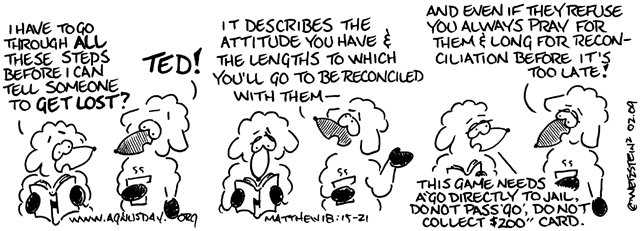
Cartoon Matthew 18

The First Step – One on One (Matthew 18:15). 

Here are several observations about this step:

  • Approach the person privately. We are never to confront an individual in a group, having not first talked to the offending person one on one. We do not start with step two because these are progressive steps.  Furthermore, we are to avoid what I call the “Middle School adolescent way” of confrontation by having someone else do it for you and report back.
  • Focus on the sin event. We are to show the person their fault, and not make a list of all the things the person has done wrong in the last ten years; or, talk about how terrible they are. We must stick to the offense.  What is more, confrontation is not to be done simply with something we do not like. A person’s individual idiosyncrasies or personality is just that, and we need to have the maturity to allow people to be who they are.
  • Be vigilant to avoid overreactions. Steer clear of accusing others of wrongdoing based in some disputable matter. Let us be sure to face the person about a clear sin which has been committed. On the contrary, if we tend to dodge conflict at all costs, we must watch for our own denial and rationalization by saying “it wasn’t so bad.” The health of the church, not to mention our own personal well-being, may very well require that we do the risky thing and talk directly to the one who has affronted us.
  • Pay attention to the approach. The manner in which we oppose another person is critical. The bull-in-the-china-shop approach is nothing more than responding to a sin with another sin. For example, rather than saying, “You need to stop and get right with God or you’ll go to hell,” you could say instead, “When you did that I felt sad and upset because I need to be in a place that values love. Will you please stop this unloving action?” In other words, knee-jerk reactions rarely go over well. But well-placed words said in love and wisdom go a long way toward restoration.
  • Confront our brother or sister. No one is to be the self-appointed ethics Nazi for people outside the church.
  • Confrontation is commanded. If we are to take the words of Jesus seriously, this is not a matter which is open for debate on whether we do it or not. We are to take the attitude that I am my brother’s keeper.  I am not to let a person run rampant with their sin over myself or others. When we are abused and offended, we do not wait for the person to come to us. Even as the victim, we are to initiate the reconciliation and restoration. “Go” to the person, Jesus said. Face-to-face is the way, without reliance on email or voice mail.  It is to be a conversation, not a drive-by comment or accusation.
  • Confrontation is not negotiation. This is a matter of restoring a person who has sinned.  Having differing positions on certain issues in a church or Christian community is a matter for negotiating, not confronting.
  • Do it more than once. This first can (and should) be repeated many times over. The goal is restoration, not get-this-step-out-of-the-way-so-I-can-see-you-get-in-trouble attitude.

Jesus did not invent something new with his teaching but upheld and restated Old Testament ethics about our attitudes in reproving others:

Do not secretly hate your neighbor. If you have something against him, get it out into the open; otherwise you are an accomplice in his guilt. Do not seek revenge or carry a grudge against any of your people. Love your neighbor as yourself. I am God.” (Leviticus 19:17-18, MSG).

In most situations, this first step takes care of the issue and mends the problem with a genuinely restored relationship. If, however, this does not occur, yet other steps ought to be taken. These will be handled in the next post.

May the grace of the Lord Jesus, the love of God our heavenly Father, and the encouragement of the Holy Spirit be with you, today and always. Amen.

Gays and the Church?

It is possible to stand for truth without being a jerk about it.  It is equally true that we can love another person deeply and still hold firm to the truth.  Somehow speaking the truth in love doesn’t seem to apply to the church when it comes to homosexuality.

I must admit that over the years, and particularly now as my own denomination is having a conversation about gays in the church, that I am genuinely grieved and lament over how people talk to one another about this.  On the one hand, there is the truth tellers.  They have a passion for holiness, a zeal for the righteousness of God.  They point out that Jesus got angry over sin, and did not put up with people watering down the gospel.  Jesus, for them, is the Divine Warrior who is ready and armed to nuke every GLBT that gets near him.  On the other hand there are the lovers.  They are sincerely and often hurt by the constant chatter about how gays are sinners bound for hell.  For them, Jesus loves, period.  He wouldn’t hurt a fly, and drives a Prius around trying to leave the most loving impact he can on the earth without a harmful spiritual footprint or a rebuke from anyone.

I, of course, have painted the extremes on both sides.  But therein lies the point:  all the rhetoric that gets spewed on each side of the fence is extreme.  Somehow love and truth don’t co-exist.

The problem is that few want to take the time to listen.  Few are interested in understanding the other.  There isn’t much poverty of spirit, little mourning over sin, and even less meekness.  Instead, we look down our noses at each other.  But listening, really?  Yep, listening is really that important.  “If your brother or sister sins against you, go and show him his fault, just between the two of you.  If the person listens to you, you have won your brother or sister over.”  (Matthew 18:15).  I guess it is kind of hard to listen when people are taking pot shots at each other through social media and huddling together in their own little world.  Matthew 18 presupposes relationship, and there seems to be little of it going around.

So, how about this:  truth teller, will you take the time and the effort to build a relationship with a gay person?  Will you seek to ask questions, listen, and understand without making comments?  Are you able to see the image of God in someone very different from yourself?  And, lover of all, do you have room to love someone who is at opposite ends of your understanding?  Are you willing to take the time and effort to see why this is such a passionate issue for someone else without thinking that you already know why they think the way they do?  Can you see that God’s love is big enough to extend to truth tellers?

The reality is that there are hot button issues for every church in which people are at very different ends of the spectrum of thinking.  We in the church must take the lead and have the maturity to learn how to talk to one another without assuming we already know what the other side is all about.  We don’t.  We won’t know unless we listen.  We won’t listen unless we are humble.  We won’t be humble unless we become poor in spirit before our heavenly Father.

Think about having a conversation night in your church, not a debate night.  Have two godly people who don’t agree on an important subject speak with the intent of promoting information and understanding – no other agenda.  Allow the audience to ask write-in questions, and screen the best ones to be answered by the presenters.  It has to start somewhere.  Let it start with listening.