Magic vs. Miracle (Acts 8:9-25)

Peter’s Conflict with Simon the Sorcerer, by Avanzino Nucci, 1620. Simon is on the right, wearing black.

Now for some time a man named Simon had practiced sorcery in the city and amazed all the people of Samaria. He boasted that he was someone great, and all the people, both high and low, gave him their attention and exclaimed, “This man is rightly called the Great Power of God.” They followed him because he had amazed them for a long time with his sorcery. 

But when they believed Philip as he proclaimed the good news of the kingdom of God and the name of Jesus Christ, they were baptized, both men and women. Simon himself believed and was baptized. And he followed Philip everywhere, astonished by the great signs and miracles he saw.

When the apostles in Jerusalem heard that Samaria had accepted the word of God, they sent Peter and John to Samaria. When they arrived, they prayed for the new believers there that they might receive the Holy Spirit, because the Holy Spirit had not yet come on any of them; they had simply been baptized in the name of the Lord Jesus. Then Peter and John placed their hands on them, and they received the Holy Spirit.

When Simon saw that the Spirit was given at the laying on of the apostles’ hands, he offered them money and said, “Give me also this ability so that everyone on whom I lay my hands may receive the Holy Spirit.”

Peter answered: “May your money perish with you, because you thought you could buy the gift of God with money! You have no part or share in this ministry, because your heart is not right before God. Repent of this wickedness and pray to the Lord in the hope that he may forgive you for having such a thought in your heart. For I see that you are full of bitterness and captive to sin.”

Then Simon answered, “Pray to the Lord for me so that nothing you have said may happen to me.”

After they had further proclaimed the word of the Lord and testified about Jesus, Peter and John returned to Jerusalem, preaching the gospel in many Samaritan villages. (New International Version)

Simon the Sorcerer was quite a character. For that matter, so was Simon Peter. The contrast between them, however, shows that there were really no similarities between the two – even though the Sorcerer tried to make it so.

The Sorcerer reminds me of the church elder who is a continual suck-up to the pastor. Those sorts of parishioners always drive me nuts in the ministry. I have known plenty of them over the years, who put on a façade of politeness and speak with flattery; but their real agenda is to have power, by any means possible.

People like Simon the Sorcerer have always existed, ever since the fall of humanity into sin. They aren’t committed to anything but themselves. Their actions are motivated by the accumulation of information so that they can use that knowledge to leverage for more power and control.

What is so sad about the Simon the Sorcerer sort of people is that they actually believe that everyone else is motivated by the very same things they are; and that the world operates on acquiring more and more control and power over it.

They need money because they believe everyone has a price. They compulsively follow influential individuals because they believe anyone can be manipulated. They continually boast (and even lie) about their importance and all the great things they have done in the past.

Perhaps most of all, the Simon the Sorcerer type person obsessively seeks attention because they believe their sense of security and self-worth are determined by how many other people like them.

The Apostles of Christ, Philip and John and Peter, saw right through the false discipleship of the Sorcerer. They didn’t need to know all the events of Simon’s past to clearly see that he was a bitter man who was a prisoner to the guilt and shame he carried around in his heart.

simony: The buying or selling of advantages for positions in the Church, or for religious pardons

The difference between Simon the Sorcerer and Simon Peter the Apostle is the difference between manipulative magic and divine miracles. Like the Egyptian magicians of Pharaoh, and the divinely inspired Moses, the ability to perform a great wonder of power, or spiritual sign of power, seem rather similar – that is, at first.

But the similarities of the supernatural powers are merely superficial. There are always limits to what the Sorcerer can do versus the unlimited abilities of the true believer possessing spiritual power – or even between supposed Christian faith healers and the godly believer who is gifted with being a healer.

The bottom line of it all is that the deeds of Simon the Sorcerer pointed to himself in selfish acts of self-glorification. The signs and wonders of Simon Peter – and all the other Christian Apostles – consistently pointed to the kingdom of God and validated the message of repentance and new life, faith and forgiveness, in Jesus Christ.

In other words, the Apostles did not really do any of the miracles of bringing a changed life to people; Christ himself did that, through the ministry and power of the Holy Spirit. It was a message about release and freedom from the dark forces of Satan, and the ability to live a good, just, and right life without having to pay for it in any way.

Today, although few people practice an overt form of magic as the ancients once did, we still must be wary of those who promise magical results for whatever we need or what ails us.

One could argue that much of contemporary marketing and consumerism are a modern form of buying into the magical thinking that my life can be mystically and unexplainedly improved through using a particular product (or a certain church consultant!).

The easy way is most typically the approach of the Sorcerer and charlatan; it doesn’t really change anything, or require anything of us, especially when it comes to the human heart. It never truly brings about a better world.

The way of the cross, however, is a hard road – the narrow way – and few end up finding it. The old life must go in order to make way for the new life. There must be a crucifixion before there can ever be a resurrection.

God, you sent your Son into the world that we might live through him. May we abide in his risen life so that we may bear the fruit of love for one another and know the fullness of joy. Amen.

Grateful to God (1 Thessalonians 2:13-20)

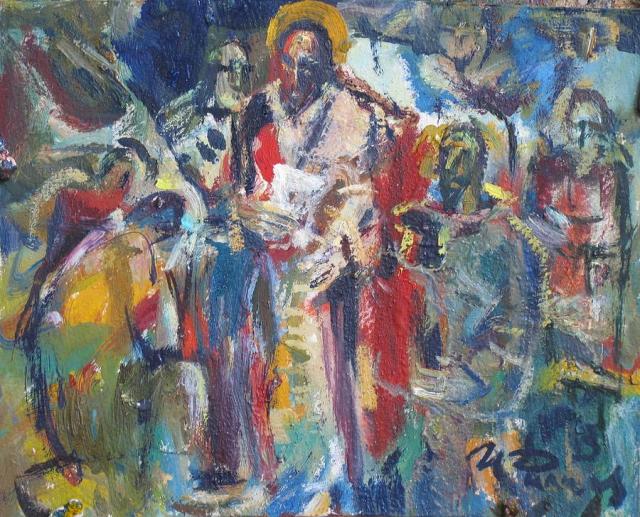
Apostle Paul, by Ivan Filichev

And we also thank God continually because, when you received the word of God, which you heard from us, you accepted it not as a human word, but as it actually is, the word of God, which is indeed at work in you who believe. For you, brothers and sisters, became imitators of God’s churches in Judea, which are in Christ Jesus: You suffered from your own people the same things those churches suffered from the Jews who killed the Lord Jesus and the prophets and also drove us out. They displease God and are hostile to everyone in their effort to keep us from speaking to the Gentiles so that they may be saved. In this way they always heap up their sins to the limit. The wrath of God has come upon them at last.

But, brothers and sisters, when we were orphaned by being separated from you for a short time (in person, not in thought), out of our intense longing we made every effort to see you. For we wanted to come to you—certainly I, Paul, did, again and again—but Satan blocked our way.For what is our hope, our joy, or the crown in which we will glory in the presence of our Lord Jesus when he comes? Is it not you? Indeed, you are our glory and joy. (New International Version)

Reception and Acceptance of God’s Word

The Apostle Paul, in all of his letters to the churches, was attentive to affirming those things which are good amongst the believers; and not only the aspects of church life that needed change and/or repentance.

For the Thessalonians, Paul was profoundly grateful to God for the people’s receiving of the Word and their accepting it as from God. Perhaps there is no greater affirmation than this for the Christian.

In order to receive and accept God’s Word, people must know it. And people cannot know God’s Word unless they take the time and effort to read it and discover it for themselves.

Scripture reading is a foundational spiritual practice for Christians everywhere, and for all of Christ’s Church throughout the earth. Church worship liturgies, as well as individual Christians’ daily disciplines of faith, ought to be thoroughly saturated with Holy Scripture. Yet, many churches are believers, sadly, are not.

I am specifically calling out the conservative evangelical church on this. Although they claim to be Bible-centered, with an extended time for the sermon, there is a paucity of actual Scripture contained within those gathered times.

Too much of the preaching fails to truly explain Scripture, and there are virtually no Scripture readings or references outside the sermon and in the worship service. This is a travesty, and also a testament to the biblical ignorance of so many evangelicals.

What’s more, the evangelical impulse for a “personal quiet time with the Lord” is, in reality, practiced by precious few believers – and usually consists of little more than a daily crumb of the Bible.

I perhaps sound cranky and crotchety. Yet in a previous life, I was an evangelical Pastor for many years, and know the frustrations and challenges of attempting to bring biblical literacy to such churches and Christians. There’s a better way, but alas, that is a topic for another time and another post.

Imitators and Sufferers with God’s Churches

The true muster of a Christian and any Christian Church is the desire, speech, and action of actually following the words and ways of Jesus. It was the Lord Jesus himself who said:

“Remember what I told you: ‘A servant is not greater than his master.’ If they persecuted me, they will persecute you also.” (John 15:20, NIV)

“In this world you will have trouble. But take heart! I have overcome the world.”

Jesus (John 16:33, NIV)

Paul was thankful for the Thessalonians because of their solidarity with the other churches; and their willingness to suffer as Jesus did. What’s more, they did not try to reinvent the wheel, but affirmed the sound practices they saw in the original churches of Judea and imitated those good things.

This was not a matter of pragmatism, that is, just doing something that worked somewhere else and adopting it for yourself. Instead, Paul was talking about following the example of the first and earliest of churches. Those churches were made up of Jewish Christians who received a lot of persecution from their fellow Jews.

The Thessalonians, too, received grief and belligerence from the same sort of people, trying to bully them around and tell them what to do. But the believers held fast to the pattern of teaching and living they observed from both Paul and the churches who endured suffering in Judea.

It’s one thing to express belief. It’s quite another thing to suffer for those beliefs and experience persecution for them. God will handle the persecutors on Judgment Day, not us. It’s our job to remain faithful and persevere in the Christian life until that Day comes.

Glory and Joy in God’s Presence

For the Apostle Paul, glory and joy was not found in his great intellect and persuading many people, or his many accomplishments of planting churches and defending the faith. Paul’s highest joy was found in people coming to know Christ and living for Jesus.

His glory was in the hundreds of relationships established with people, and all the believers he mentored. In other words, Paul’s glory and joy was the real names and faces of people he encountered and gathered into the one Church, for whom Christ died and sacrificed himself.

It wasn’t even a thought in the Apostle’s big old head to gain glory for himself, or to pursue joy for it’s own sake. Rather, Paul discovered that real joy and glory comes in fulfilling the mission give to him by Christ:

To make disciples of all nations, baptizing them in the name of the Father, and of the Son, and of the Holy Spirit; teaching them to receive and accept God’s Word, to become imitators and sufferers with God, and to glory and joy in God’s presence.

Almighty God, Father of all mercies, we your unworthy servants give you humble thanks for all your goodness and loving-kindness to us and to all whom you have made.

We bless you for our creation, preservation, and all the blessings of this life; but above all for your immeasurable love in the redemption of the world by our Lord Jesus Christ; for the means of grace, and for the hope of glory.

And, we pray, give us such an awareness of your mercies, that with truly thankful hearts we may show forth your praise, not only with our lips, but in our lives, by giving up ourselves to your service, and by walking before you in holiness and righteousness all our days, through Jesus Christ our Lord, to whom, with you and the Holy Spirit, be honor and glory throughout all ages. Amen.

Dealing with Opposing Views (Romans 14:1-12)

Accept the one whose faith is weak, without quarreling over disputable matters. One person’s faith allows them to eat anything, but another, whose faith is weak, eats only vegetables. The one who eats everything must not treat with contempt the one who does not, and the one who does not eat everything must not judge the one who does, for God has accepted them. Who are you to judge someone else’s servant? To their own master, servants stand or fall. And they will stand, for the Lord is able to make them stand.

One person considers one day more sacred than another; another considers every day alike. Each of them should be fully convinced in their own mind. Whoever regards one day as special does so to the Lord. Whoever eats meat does so to the Lord, for they give thanks to God; and whoever abstains does so to the Lord and gives thanks to God. For none of us lives for ourselves alone, and none of us dies for ourselves alone. If we live, we live for the Lord; and if we die, we die for the Lord. So, whether we live or die, we belong to the Lord. For this very reason, Christ died and returned to life so that he might be the Lord of both the dead and the living.

You, then, why do you judge your brother or sister? Or why do you treat them with contempt? For we will all stand before God’s judgment seat. It is written:

“‘As surely as I live,’ says the Lord,
‘every knee will bow before me;
    every tongue will acknowledge God.’”

So then, each of us will give an account of ourselves to God. (New International Version)

Within the church at Rome were Jewish believers who had come to faith in Christ from their background steeped in the Old Testament. They had a rich two-thousand year history of a covenant with God that included ritual food laws, the keeping of certain feast days, and observing a calendar of events, especially the Sabbath.

Also within the Roman church were Gentiles (non-Jewish people) having come to faith in Christ from a background of paganism. They had no history with the God of the Bible. There were no previous generations of faithful believers in God. They were first generation Christians and basked in their newfound freedom.

The Apostle Paul’s vision was for one church, unified together around Jesus. And this unity would need to be worked on. Jew and Gentile were very different from one another; and here they were in the same church together, not understanding each other. 

The Jewish believers were appalled at Gentile thinking and behavior. Even though the Jewish Christians had come to embrace Jesus, they did not abandon their two-thousand year history of being with God. They still held to their food laws and special days. The Jewish members believed the Gentiles should be like them; the Jews wanted the Gentiles to embrace the same ritualistic behavior that they had done for centuries.

But the Gentiles did not comply. So, the Jewish believers passed judgment and condemnation on them for not being sensitive to the things of God.

On the other hand, the Gentile believers felt no compulsion to have such rules and regulations concerning their Christian lives. They ate what they pleased and saw no need to hold to special days. They could not understand why the Jewish Christians were so stuck in their traditions. So the Gentiles looked down on the Jews as hopelessly misguided. This was a potentially explosive situation that Paul was deeply concerned about.

The Apostle Paul’s message was to accept the person whose faith is weak without passing judgment on disputable matters. Sounds like easy counsel to follow. But the problem was that the people did not distinguish between what is a non-negotiable matter and what was a disputable matter. 

The guiding principle is that Christ died and returned to life so that he might be the Lord of both the dead and the living. The non-negotiable matter is Jesus Christ, his person and work.  Jesus is our core belief. Nothing else is to be in the center except him.

Therefore, we are to celebrate our unity around Jesus, our center. Anything outside of that center is a “disputable matter” and not worthy of Christians condemning each other or looking down on one another.

The root problem of any church conflict is the de-throning of Jesus and setting up our particular views as the center of Christianity.

The church has struggled with this teaching for its long two-thousand year history. Every church I have served had their particular issues that they felt so strongly about that it crowded Jesus out of the center. 

In one church, education was the big issue. Some believed in Christian schools as the only way to educate their kids. Others felt that home-schooling was the way to go because of the culture. Yet others thought public education needed the light of Christians participating in it, and sent their kids to public schools. The problem was that each group sincerely believed they were right and everyone else was wrong.

In another church I served, there were hard feelings about the place of men and women in the church who had been divorced and remarried. In yet another church, the issue was about whether church members could drink alcohol or not. And yet another church’s issue dealt with how we dress and what our attire is at church. 

I still remember one lady in that church talking with a woman who had recently given her life to Christ out of a life of prostitution. The woman was wearing jeans and a t-shirt. The church lady was giving her a lecture about how she should be “dressing up for Jesus.” As I heard this, I thought to myself, “Lady, I’m not sure you are going to like the woman’s idea of dressing up for Jesus….”

Whenever we want to place disputable matters on people’s “must-do” list, then there will be trouble. We will judge others who do not think as we think, and do as we do, because of the mistaken notion that our way is equal to the death and resurrection of Christ. If it isn’t done my way, the church will be lost.

We do not necessarily need to change our views on disputable matters; but we do need to change our attitude and our behavior toward those we disagree with.

Intolerance of others’ views and behaviors causes a lack of dialogue, to create special interest groups and cabals against others, to stereotype others, and to seek to get their way no matter what. Such intolerance moves church members from a concern for the Great Commission of Jesus to the Great Commode of Satan’s bathroom.

For the Apostle Paul, the issues that divide Christians are very important, not because he championed one over the other, but because the church’s identity was at stake. Paul was concerned for two questions:

  1. Will the church be, at its core, a community of redeemed persons by the grace of God who center all their lives around the person and work of Jesus?
  2. Or will the church be a community of opinionated individuals and groups all jockeying for position to have their way on how they believe things should go?

This is really a heart issue: humility versus pride, and gentleness versus stubbornness. You can tell what a person’s identity is by their “identity markers.”

For the Jewish Christians, Sabbath-keeping, circumcision, food laws, and holding to certain days on the calendar marked their identity as God’s people. Those issues were so important that if you took them away, there would be an identity crisis; the people felt totally lost without their traditions.

For Gentile Christians, their identity was built around being more free-thinking. So, if you take away their freedom and ability to choose, the Gentiles will go nuts and have an identity meltdown. 

Paul’s answer was for both Jew and Gentile to accept each other and build their unity around Jesus, period. They needed to be sensitive to one another and focus on their shared identity of Jesus as the center of the Christian life.

Both the church and the society need some civility. In a nation where we feel free to say whatever we want, we do. In doing so, we elevate self-expression and our opinions over self-control and the mission of the church.

We need some generous spaciousness which allows room for us to discuss issues and disputable matters in an atmosphere of generosity, hospitality, and acceptance, seeking to first listen and understand, before responding. 

The goal of the Christian is not to win an argument or have our way, but to uphold Jesus as Lord of everything and maintain our center in him. On that basis alone, we will be held accountable by God. So, let us live wisely and well, knowing and pursuing Jesus with heart, soul, mind, and strength.

Gracious God, it’s both settling and centering to focus on the assurance of your acceptance. You know everything about us, and despite our failures, fickleness, foolishness, and faithlessness, yet still we are fully and eternally accepted. As you have accepted us, help us to accept others. Grant us grace to love those whom we disagree with.

Merciful and mighty God, enlarge our hearts. Enable us to show kindness without compromising our convictions. Teach us the difference between essential and non-essential matters. Free us from the limitations of our individual perspectives, the prejudices of our heritage, the insecurities of our comfort zone, insincere niceness,and the need to be right. 

Blessed Holy Spirit, burn your holy Word indelibly into us so that we accept all things and everyone you give us, through Jesus Christ our Lord. Amen.

How to Handle Criticism (2 Corinthians 12:11-21)

A mosaic of the Apostle Paul in St Isaac’s Cathedral, St. Petersburg, Russia

Well, now I’ve done it! I’ve made a complete fool of myself by going on like this. But it’s not all my fault; you put me up to it. You should have been doing this for me, sticking up for me and commending me instead of making me do it for myself. You know from personal experience that even if I’m a nobody, a nothing, I wasn’t second-rate compared to those big-shot apostles you’re so taken with. All the signs that mark a true apostle were in evidence while I was with you through both good times and bad: signs of portent, signs of wonder, signs of power. Did you get less of me or of God than any of the other churches? The only thing you got less of was less responsibility for my upkeep. Well, I’m sorry. Forgive me for depriving you.

Everything is in readiness now for this, my third visit to you. But don’t worry about it; you won’t have to put yourselves out. I’ll be no more of a bother to you this time than on the other visits. I have no interest in what you have—only in you. Children shouldn’t have to look out for their parents; parents look out for the children. I’d be most happy to empty my pockets, even mortgage my life, for your good. So how does it happen that the more I love you, the less I’m loved?

And why is it that I keep coming across these whiffs of gossip about how my self-support was a front behind which I worked an elaborate scam? Where’s the evidence? Did I cheat or trick you through anyone I sent? I asked Titus to visit, and sent some brothers along. Did they swindle you out of anything? And haven’t we always been just as aboveboard, just as honest?

I hope you don’t think that all along we’ve been making our defense before you, the jury. You’re not the jury; God is the jury—God revealed in Christ—and we make our case before him. And we’ve gone to all the trouble of supporting ourselves so that we won’t be in the way or get in the way of your growing up.

I do admit that I have fears that when I come you’ll disappoint me and I’ll disappoint you, and in frustration with each other everything will fall to pieces—quarrels, jealousy, flaring tempers, taking sides, angry words, vicious rumors, swelled heads, and general bedlam. I don’t look forward to a second humiliation by God among you, compounded by hot tears over that crowd that keeps sinning over and over in the same old ways, who refuse to turn away from the pigsty of evil, sexual disorder, and indecency in which they wallow. (The Message)

Apostle Paul by Ivan Filichev

Criticism is hard to take. It’s even tougher when the criticism is off because you have been misinterpreted or misunderstood. And it’s more difficult to deal with criticism whenever you know you’ve done your best and accomplished good things. There are people who ought to have your back, but instead they do just the opposite and throw you under the bus.

This was the situation with the Apostle Paul. He had spent a good deal of time in the city of Corinth proclaiming the good news of Jesus and establishing a church. It was a rough ministry, filled with plenty of relational drama. (Acts 18:1-18)

Perhaps then, it is no surprise that as the church developed and grew, the people gathered themselves into special interest groups according to both their class and their affinity for particular preachers. Add to this the reality that many of the new Christians continued to embrace some of their old unhealthy practices, and you have the makings of a contentious and critical group of people. (1 Corinthians 1:10-12; 3:1-4; 11:17-22)

It is oddly surreal for Paul to have to defend himself – especially since he put so much ministry effort and wise exhortation into their church and their spiritual lives. Yet here he is needing to remind the Corinthians of his abilities, what he has done, and his credentials as a legitimate Apostle.

The following are some ways I observe how the Apostle Paul dealt with criticism:

  1. Accepting that criticism is going to happen. Paul knew that his life as an Apostle was on full display for all to see and evaluate. He did not always get things right. No one does. Yet Paul was on target about most things. He rarely got stuck on any one leadership decision. And he never let criticism, pushback, or even persecution deter him from his missionary purpose.
  2. Evaluating all things according to Christian standards. The farther people are from the problem, the less context and understanding they have. That’s why Paul planned to see them face to face. The story the Corinthians were telling themselves was inaccurate – filled with perceived motives and false conjectures about Paul and his ministry. Paul stayed focused on the gospel and the values it espouses.
  3. Keeping shame out of the conversation. We all naturally feel defensive when attacked, especially if it feels unjust, exaggerated, or inaccurate. And we may want to shame people into feeling guilt and becoming repentant. But any defensiveness on our part will only fuel people’s derision.
  4. Being transparent and vulnerable. Paul told them how he felt without making it a guilt trip. He was even sarcastic, at times. Maybe it seems counterintuitive, but more transparency works in our favor, and not against it. People get frustrated, hurt, angry, and confused about what we do and say. Our job isn’t to determine whether those feelings are legitimate or not, but instead to demonstrate empathy and concern. Doing anything that conveys dismissiveness risks making people feel like you’re gaslighting them.
  5. Acting on the problem. Paul doubled down on his commitment to transmitting Christian core values, and ensuring that a culture of Christian ethics reached every corner of the church.

It doesn’t feel good to get criticized, especially when it seems unwarranted. If we can stay focused on caring about our values and other people, we will likely handle it well. Because it’s not a matter of if we get criticized, but when.

Almighty and everlasting God, help me to have no corrupt communication proceed out of my mouth, but only words which are good, gracious, and edifying. And I pray for Christ’s Church everywhere, that all of our conversations will influence others for good and build up one another in the faith, through Jesus our Lord, in the strength of the Holy Spirit. Amen.