The Transfiguration of Jesus (Mark 9:2-9)

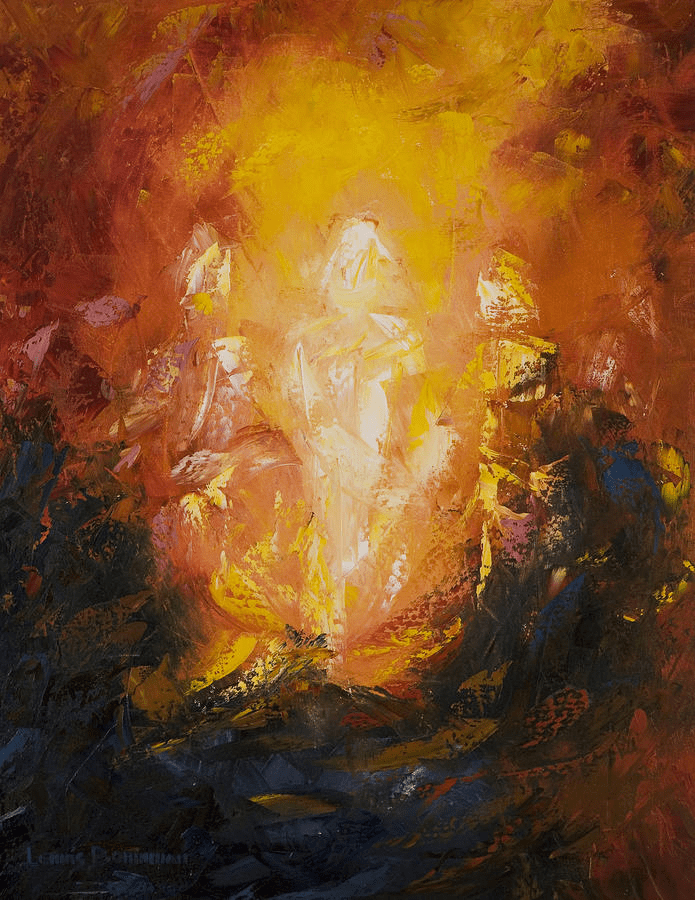
The Transfiguration of Jesus, by Armando Alemdar Ara, 2004

After six days Jesus took Peter, James and John with him and led them up a high mountain, where they were all alone. There he was transfigured before them. His clothes became dazzling white, whiter than anyone in the world could bleach them. And there appeared before them Elijah and Moses, who were talking with Jesus.

Peter said to Jesus, “Rabbi, it is good for us to be here. Let us put up three shelters—one for you, one for Moses and one for Elijah.” (He did not know what to say, they were so frightened.)

Then a cloud appeared and covered them, and a voice came from the cloud: “This is my Son, whom I love. Listen to him!”

Suddenly, when they looked around, they no longer saw anyone with them except Jesus.

As they were coming down the mountain, Jesus gave them orders not to tell anyone what they had seen until the Son of Man had risen from the dead. (New International Version)

It may be that reading this account of Christ’s transfiguration (metamorphosis) seems a bit strange, even confusing. Perhaps you have no categories of thought to explain such an encounter.

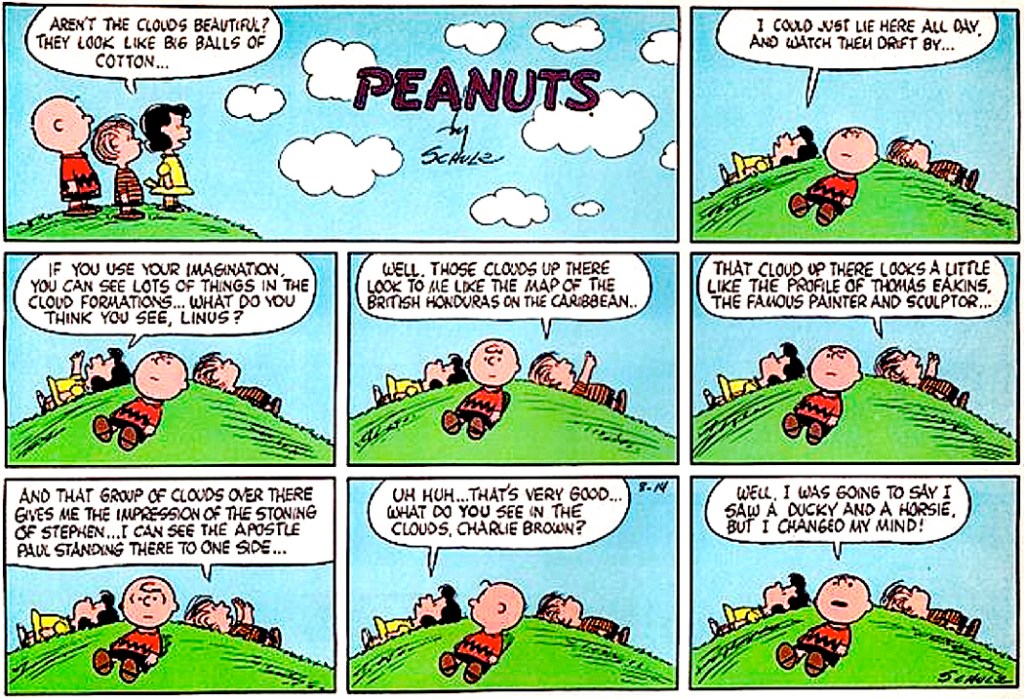
In a Peanuts cartoon, Charlie Brown, Lucy, and Linus were lying on their backs looking at the sky. Lucy says, “If you use your imagination you can see lots of things in the cloud formations. What do you think you see, Linus?” 

Linus replied, “Well, those clouds up there look to me like the map of the British Honduras on the Caribbean… That cloud up there looks a little like the profile of Thomas Eakins, the famous painter and sculptor… And that group of clouds over there gives me the impression of the stoning of Stephen… I can see the Apostle Paul standing there to one side…” 

Lucy responds, “Uh huh… that’s very good… what do you see in the clouds, Charlie Brown?”

To which Charlie Brown replied, “Well, I was going to say a ducky and a horsy, but I changed my mind.”

Maybe your spiritual life seems more like Charlie Brown than Linus. Compared to the experiences of others, you have not had any defining moments of ecstasy; no shining Jesus in front of you; or no spectacular vision of Christ.

Perhaps your life seems rather mundane and ordinary in light of the many stories we have in the Gospels of Jesus doing the miraculous. 

Most of life is lived in the daily grind. In the monotony of life, we need some hope, an occasional mountain top experience that helps us glimpse into the future of what it will be like someday when the kingdom of God comes in its fullness.

Christ’s transfiguration came after a hard frank discussion Jesus had with the disciples about his impending death. Jesus was up front with them, saying that he must suffer, be rejected, and killed. But in three days he will rise again. The disciples did not want to hear that; Peter even rebuked Jesus for saying it. In response, Jesus said:

“If anyone would come after me, he must deny himself and take up his cross and follow me. For whoever wants to save his life will lose it, but whoever loses his life for me and for the gospel will save it.”

Jesus (Mark 8:34-35, NIV)

Jesus identified himself as the Suffering Servant, the One who must suffer and die. Yet, he is also the One to be glorified. For Jesus, there has to be suffering before glory. And it is the same for us.

The Christian life includes walking through the valley of the shadow of death. But it is also punctuated with mountain top experiences that give us hope. The nature of the Christian journey is up and down, with both the mountain and the valley as spiritual realities of great importance.

We may have a lot of questions about Christ’s transfiguration. Jesus had a metamorphosis smack in front of the disciples’ eyes. Why? What’s the significance of this? Was it just a demonstration to get their attention? Why are Moses and Elijah there? What’s really going on?
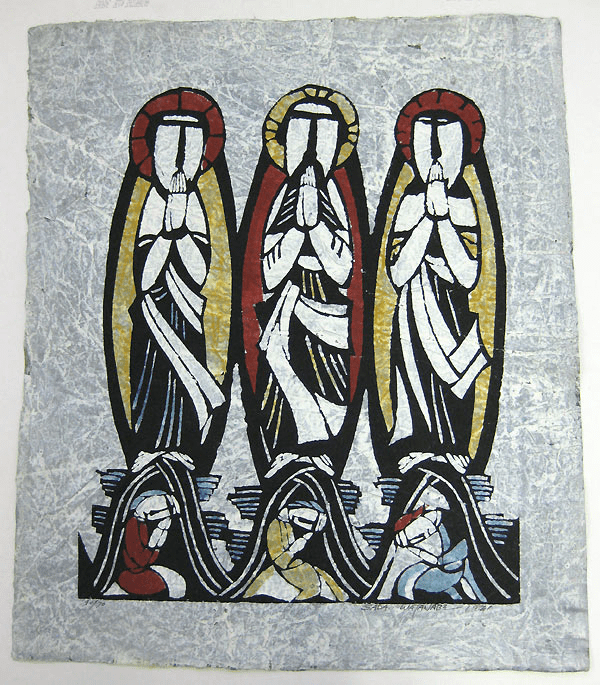
Transfiguration, by Sadao Watanabe, 1971

Jesus intentionally took Peter, James, and John up the mountain to have this experience. Up to that point, a lot of rumors were circulating about Jesus – that maybe he was Elijah come back, or some other prophet, perhaps even Moses himself. But Moses and Elijah showing up next to Jesus, meant that Jesus is not them. 

In the Old Testament, Moses was used by God to deliver the Israelites out of slavery in Egypt and to bring them to the Promised Land. Centuries later, Elijah was used by God to bring about a great repentance of the people from the false god Baal, and a mighty revival to the exclusive worship of the Lord.

As good as Moses and Elijah were, having them with Jesus on the mountain meant that it gets even better with Christ. Jesus is the Messiah, the True Deliverer, who saves people from their sins. What’s more, Jesus is the ultimate revivalist, bringing truth, grace, and the love of God to people, calling them from legalistic religion back to the true worship of God.

Deliverance and revival were integral to Christ’s earthly ministry. And Jesus expects his followers to do the same. In Christian ministry, there will be suffering, because we must take up our cross. There will also be glory, experiencing and seeing deliverance from sin that comes with revival. 

When I was in college, a group of us Christians met each week for encouragement and prayer. For a two year period, at least one person a week was added to our group, having had a dramatic conversion to Christ. That was an incredible time of being on the mountain with Jesus, seeing him manifested in all his glory through changing people’s lives.

Yet, inevitably, we descend to the valley. What goes up must come down. And how we handle the valley is crucial. On the mountain, things seemed effortless; but in the valley, it’s all different.

Coming off the mountain may lead to various temptations, like wishing you were back on the mountain – looking back to some Golden Age where everything seemed so great, and people were enthused and excited about God and the group you were in. Yet, there are times when the revival fires wane, and the glory departs. Then what?…

God’s Word to us today, given by God the Father, is: “This is my Son, whom I love. Listen to him!”

A 12th century Mosaic of Christ’s Transfiguration

Here is what Jesus has said to us, as recorded by the Evangelist Mark:

“The time has come. The kingdom of God is near. Repent and believe the good news!” (Mark 1:15)

“Come, follow me, and I will make you fishers of men.” (Mark 1:17)

“It is not the healthy who need a doctor, but the sick. I have not come to call the righteous, but sinners.” (Mark 2:17)

“Why are you so afraid? Do you still have no faith?” (Mark 4:40)

“Everything is possible for him who believes.” (Mark 9:23)

“If anyone wants to be first, he must be the very last, and the servant of all.” (Mark 9:35)

“I tell you the truth, anyone who will not receive the kingdom of God like a little child will never enter it.” (Mark 10:15)

“…the Son of Man will be betrayed to the chief priests and teachers of the law. They will condemn him to death and will hand him over to the Gentiles, who will mock him and spit on him, flog him and kill him….” (Mark 10:33-34)

“For even the Son of Man did not come to be served, but to serve, and to give his life as a ransom for many.” (Mark 10:45)

“I tell you, whatever you ask for in prayer, believe that you have received it, and it will be yours. And when you stand praying, if you hold anything against anyone, forgive him, so that your Father in heaven may forgive you your sins.” (Mark 11:24-25)

“My God, my God, why have you forsaken me?” (Mark 15:34)

“Go into all the world and preach the good news to all creation.” (Mark 16:15)

If you have had a mountain top experience with Jesus, let that encounter give you the drive and the hope to keep carrying the bucket through the valley, without living in the past.

If you have never been on the mountain, then today, listen to Jesus and follow what he says.

If you are vexed in your spirit, go to Jesus. Listen to him. Do what he says.

Know the word of the Lord, and bank on it. For our light and momentary sufferings will result in praise, honor, and glory when Jesus Christ is revealed. Amen.

The Radiant Face of Moses (Exodus 32:29-35)

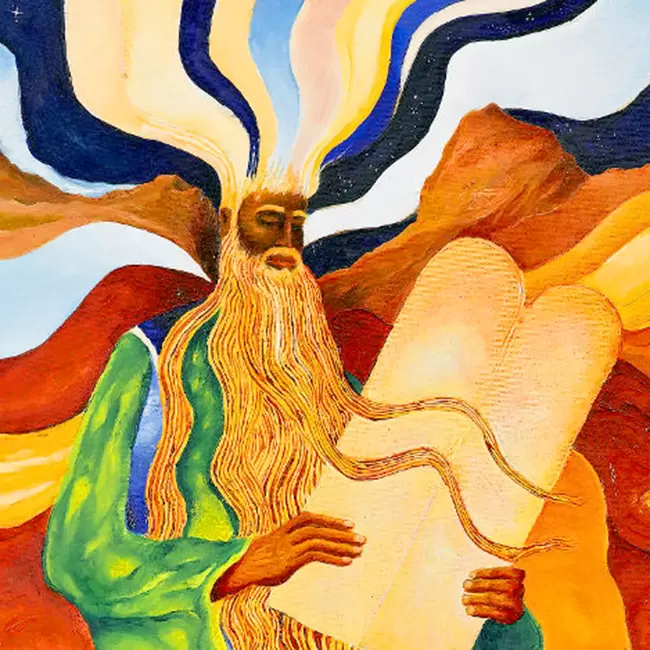
Moses and the Fire of Sinai, by Darius Gilmont

When Moses came down from Mount Sinai with the two tablets of the covenant law in his hands, he was not aware that his face was radiant because he had spoken with the Lord. When Aaron and all the Israelites saw Moses, his face was radiant, and they were afraid to come near him. But Moses called to them; so Aaron and all the leaders of the community came back to him, and he spoke to them. Afterward all the Israelites came near him, and he gave them all the commands the Lord had given him on Mount Sinai.

When Moses finished speaking to them, he put a veil over his face. But whenever he entered the Lord’s presence to speak with him, he removed the veil until he came out. And when he came out and told the Israelites what he had been commanded, they saw that his face was radiant. Then Moses would put the veil back over his face until he went in to speak with the Lord. (New International Version)

I’ve never seen anyone on Halloween dressed like Moses, complete with a shiny glowing face – even though the sight of Moses as he came down the mountain made the Israelites afraid to come near him. The face of Moses had been transformed in a way that made him appear haunted house scary to them.

Moses had actual face-to-face time with God on the mountain. And this seems to have changed his visage. Yet, Moses had stood before God previously without any change to his face. Moses had even interceded with God on other occasions with no special Halloween effect.

God made the new covenant and gave the new tablets because Moses smashed the old ones at the golden calf experience (see Exodus 32, especially verse 19). It could be that, with the radiant face of Moses, God was displaying before the people a tangible sign of God’s presence.

After all, the people had doubted God’s presence again and again during their time in the desert. So, when God’s seemingly ghostly presence was offered this time around, they were too afraid to be that closely connected to the divine.

Just as the loincloth that God made for the disobedient Adam and Eve in the Garden of Eden; and just as the sign of the rainbow God put in the sky after the world wide flood, so the Lord was making a new way for the people, a visible sign and demonstration of God’s presence – which was both reassuring and frightening.

It seems God wanted to show that Moses was still the leader, still God’s man, and that the people needed to not give him a hard time or rebel against God’s commands. At the same time, the Lord was assuring the Israelites that they were not abandoned, that Yahweh remains their God, full of mercy and grace, slow to anger, and abounding in steadfast love.

Transfiguration, by Lewis Bowman

In a similar way, the Transfiguration of Jesus in the New Testament Gospels does the same. The disciples were frightened on the mountain, seeing Jesus changed and probably much brighter than the face of Moses. And yet, they were also reassured that God was present with them in the person of Jesus Christ.

Just like the doubting people in Exodus, the disciples caught a glimpse of the great and awesome God, up close and personal. And like the people in the wilderness, the disciples did not understand everything that was going on. Both the ancient Israelites, and Christ’s disciples, did not fully comprehend what God was showing them. Each showed the fear of humanity, while God demonstrated God’s own character of love, faithfulness, and patience with frail humanity.

Certainly, when the face of Moses shone, it was an affirmation of the covenant’s renewal by God. The shiny face is also an indicator of the sort of relationship Moses had with God – and of his openness and vulnerability before God and before the community. It was a sign that Moses trusted God and that Israel, in turn, could trust God and Moses as their leader.

Whether veiled or unveiled, the face of Moses is a reminder of his unique relationship with God and with Israel. It’s a sign of God’s care and continual presence, and that God’s grace prevailed, even in the midst of Israel’s sin.

Another way of putting it, is that the radiant face of Moses represents a reversal of outcome concerning the golden calf idolatrous episode. It represents hope in the midst of a disaster in which all seemed hopeless.

In our own contemporary day and time of national upheavals and national disasters, it’s no wonder that many people would question whether there is any hope for our world, or not. Yet, no matter how dismal it may look; and no matter how unpromising the times we presently live in, today’s story about ancient Israel is a reminder to all of us to keep persevering and hold onto our confident hope that God is with us. There are better days ahead.

It might be Halloween, but the Advent of Christ is just around the corner.

Lord Jesus, Son of Man, Son of God, you encouraged us to come to you, all of us who labor and are heavy laden, and that you will give us rest. So, I now take your yoke upon myself, and learn from you because you are gentle and lowly in heart, and I know I will find rest for my soul. For your yoke is easy, and your burden is light. Help me to refocus from all that’s wrong in this old fallen world, and trust in you, through the enablement of the Holy Spirit. Amen.

Mark 9:2-9 – The Transfiguration of Jesus

Welcome, friends! On this Transfiguration Sunday for Christians everywhere around the world, let us celebrate the good changes which come from our Lord Jesus Christ, who is our ultimate Deliverer and Revivalist to new hope and new life. Click the videos below to worship Christ and listen to Jesus…

Mark 9:2-9, Pastor Tim Ehrhardt
“Transfiguration” by Hillsong Worship. From the album “Open Heaven / River Wild”. Written by Scott Ligertwood, Aodhan King, Brooke Ligertwood, and Taya Smith. Worship leader is Taya Smith.

Not all is as it seems. There is glory hidden in everything, waiting to be revealed to the eyes of those who believe, beyond what seems inevitable, who do not want to live in the status quo but in the promises of God.

Hold onto this vision as we turn towards Lent and walk the more difficult path. There is yet a greater glory still to be revealed. Go in peace. Go in hope. Go in love, to serve the Lord Jesus, who is love incarnate. Amen.

The Transfiguration of Christ

Transfiguration of Jesus by Macedonian artist Armando Alemdar

After six days Jesus took Peter, James, and John with him and led them up a high mountain, where they were all alone. There he was transfigured before them. His clothes became dazzling white, whiter than anyone in the world could bleach them. And there appeared before them Elijah and Moses, who were talking with Jesus.

Peter said to Jesus, “Rabbi, it is good for us to be here. Let us put up three shelters—one for you, one for Moses and one for Elijah.” (He did not know what to say, they were so frightened.)

Then a cloud appeared and covered them, and a voice came from the cloud: “This is my Son, whom I love. Listen to him!”

Suddenly, when they looked around, they no longer saw anyone with them except Jesus.

As they were coming down the mountain, Jesus gave them orders not to tell anyone what they had seen until the Son of Man had risen from the dead. (Mark 9:2-9, NIV)

It is quite possible that in reading this account of Christ’s transfiguration (or metamorphosis) that this all seems very strange, even confusing.  Maybe you just have no categories of thought to explain such an encounter.

In a Peanuts cartoon Charlie Brown, Lucy, and Linus were lying on their backs looking at the sky. Lucy says, “If you use your imagination you can see lots of things in the cloud formations. What do you think you see, Linus?”  Linus replies, “Well, those clouds up there look to me like the map of the British Honduras on the Caribbean… That cloud up there looks a little like the profile of Thomas Eakins, the famous painter and sculptor… And that group of clouds over there gives me the impression of the stoning of Stephen… I can see the Apostle Paul standing there to one side…”  Lucy responds, “Uh huh… that’s very good… what do you see in the clouds, Charlie Brown?” Charlie Brown sheepishly says, “Well, I was going to say a ducky and a horsie, but I changed my mind.”

Perhaps your spiritual life seems more like Charlie Brown than Linus. Compared to the experiences of others, you may not have had any defining moments of ecstasy, no shining Jesus right in front of you, or no spectacular vision of Christ. Maybe your life seems rather mundane and ordinary considering the many stories we have in the Gospels of Jesus doing the miraculous. 

Most of life is lived in the daily grind. In the week in and week out monotony of life, especially when one is sheltering in place, we need a bit of hope, maybe even a lot of hope. In fact, we need an occasional mountain top experience because those are glimpses into the future of what it will be like someday when the kingdom of God comes in all its fullness.

The account of Christ’s transfiguration comes after a hard frank discussion Jesus had with the disciples about his impending death. Jesus clearly taught them that he must suffer, be rejected, and killed. But in three days he would rise again. The disciples did not want to hear that, and Peter even rebuked Jesus for saying it. In response, Jesus said to them all:

“Whoever wants to be my disciple must deny themselves and take up their cross and follow me. For whoever wants to save their life will lose it, but whoever loses their life for me and for the gospel will save it. (Mark 8:34-35, NIV)

Jesus identified himself as the Suffering Servant, as the One who must suffer and die. However, he is also the One to be glorified. For Jesus, there had to be suffering before glory. And it is the same for us: There must be suffering before glory. The Christian life is filled with the difficulty of walking through the valley of the shadow of death but is also punctuated with mountain top experiences that give us hope to keep doing what Jesus did. In other words, we must listen to Jesus and follow him. The nature of our Christian walk is up and down. Both the mountain and the valley are spiritual realities of great importance.

We may have a lot of questions about Christ’s transfiguration. Jesus had a metamorphosis in front of the disciples’ eyes. Why?  What is the significance of this?  Was it just a demonstration to get the disciples’ attention?  Why are Moses and Elijah there?  What is really going on here?

Jesus intentionally took Peter, James, and John up the mountain to have this experience. Up to this point, a lot of rumors had been circulating about Jesus – that maybe Jesus was really Elijah come back, or some other prophet, perhaps even Moses himself, since no one knows where his body was when he died. Moses and Elijah showing up next to Jesus meant that Jesus is not them. 

In the Old Testament, Moses was the person used by God to deliver the Israelites out of their slavery in Egypt and brought them to the Promised Land.  Centuries later, when the Israelites had been in the land for quite a while, Elijah was the person used by God to bring about a great repentance of the people from the false god Baal, and a mighty revival to the exclusive worship of the Lord. 

As good as Moses and Elijah were back then, having them with Jesus on the mountain meant that it gets even better with Christ. Jesus is the Messiah, the True Deliverer, who saves the people from their sins. What is more, Jesus is the Ultimate Revivalist, bringing the true grace and love of God to people and calling them from legalistic religion back to the true worship of God.

Deliverance and revival were what Jesus was all about in his ministry. And he expects those who follow him to do the same. In the ministry of every believer, there will be suffering because we must take up our crosses; and there will also be glory, experiencing and seeing the deliverance of sin that comes from genuine revival. 

When I was a college student, a group of us Christian brothers met each week for encouragement and prayer. For a solid two-year period, at least one person a week was added to our group, having had a dramatic conversion to Christ. That was an incredible time of being on the mountain with Jesus and seeing him manifest himself in all his glory through changing people’s lives.

Yet, inevitably, the valley must come. What goes up must come down. And what we do when we are in the valley is crucial and important. It seems effortless to be a Christian on the mountain. It is a different thing altogether in the valley. Coming off the mountain can lead to all kinds of temptations, like wishing you were back on the mountain – looking back to some Golden Age where everything seemed to go great and people were enthused and excited about God. But the revival fires may have waned, and the glory departed. Then what?…

“This is my Son, whom I dearly love. Listen to him!”

mark 9:7, ceb

Here is what Jesus said…

“The right time is now here. God’s kingdom is very near. Change your hearts and lives, and believe the Good News!” (Mark 1:15, ERV)

“Come, follow me! I will teach you how to catch people instead of fish.” (Mark 1:17, GW).

 “Those who are well have no need of a physician, but those who are sick; I have come to call not the righteous but sinners.” (Mark 2:17, NRSV)

“The seed that fell on the footpath represents those who hear the message, only to have Satan come at once and take it away. The seed on the rocky soil represents those who hear the message and immediately receive it with joy. But since they do not have deep roots, they do not last long. They fall away as soon as they have problems or are persecuted for believing God’s word. The seed that fell among the thorns represents others who hear God’s word, but all too quickly the message is crowded out by the worries of this life, the lure of wealth, and the desire for other things, so no fruit is produced. And the seed that fell on good soil represents those who hear and accept God’s word and produce a harvest of thirty, sixty, or even a hundred times as much as had been planted!” (Mark 4:15-20, NLT)

“Why are you such cowards? Don’t you have any faith at all?” (Mark 4:40, MSG)

“Don’t you know that nothing from the outside that enters a person has the power to contaminate?… It’s from the inside, from the human heart, that evil thoughts come: sexual sins, thefts, murders, adultery, greed, evil actions, deceit, unrestrained immorality, envy, insults, arrogance, and foolishness. All these evil things come from the inside and contaminate a person in God’s sight.” (Mark 7:18, 21-23, CEB)

“All things are possible for the one who believes.” (Mark 9:23, ERV)

“So, you want first place? Then take the last place. Be the servant of all.” (Mark 9:35, MSG)

“I tell you the truth, you must accept the kingdom of God as if you were a little child, or you will never enter it.” (Mark 10:15, NCV)

“The Son of Man will be betrayed to the religious leaders and scholars. They will sentence him to death. Then they will hand him over to the Romans, who will mock and spit on him, give him the third degree, and kill him. After three days he will rise alive.” (Mark 10:33-34, MSG)

“The Son of Man did not come to be a slave master, but a slave who will give his life to rescue many people.” (Mark 10:45, CEV)

So, I tell you to ask for what you want in prayer. And if you believe that you have received those things, then they will be yours. When you are praying and you remember that you are angry with another person about something, forgive that person. Forgive them so that your Father in heaven will also forgive your sins.” (Mark 11:24-25, ERV)

“Go into all the world and proclaim the good news to the whole creation.” (Mark 16:15, NRSV)

“This is my Son, whom I love. Listen to him!”  If you have had a mountain top experience with Jesus, let that encounter with him give you the drive and the hope to keep carrying the bucket through the valley, without living in the past. If you have never been on the mountain, today is the day to listen to Jesus and follow what he says. For us all, the answer to what is vexing us is found in Jesus Christ. 

May we all go to Jesus, listen to him, and obey what he says. May we know the Word of Christ, and bank on it. May we understand that our light and momentary sufferings will result in praise, honor, and glory when Jesus Christ is revealed.