Christ and Pharisee by Russian artist Ivan Filichev, 1993
“You have your heads in your Bibles constantly because you think you’ll find eternal life there. But you miss the forest for the trees. These Scriptures are all about me! And here I am, standing right before you, and you aren’t willing to receive from me the life you say you want.
“I’m not interested in crowd approval. And do you know why? Because I know you and your crowds. I know that love, especially God’s love, is not on your working agenda. I came with the authority of my Father, and you either dismiss me or avoid me. If another came, acting self-important, you would welcome him with open arms. How do you expect to get anywhere with God when you spend all your time jockeying for position with each other, ranking your rivals and ignoring God?
“But don’t think I’m going to accuse you before my Father. Moses, in whom you put so much stock, is your accuser. If you believed, really believed, what Moses said, you would believe me. He wrote of me. If you won’t take seriously what he wrote, how can I expect you to take seriously what I speak?” (MSG)
I like kids, even Junior High kids. They have not yet learned how to mask their honesty (like Senior High kids). Have a conversation with any early adolescent (other than your own kid) and you will likely get an unfiltered and unvarnished take on whatever topic you are discussing together. If the subject of celebrities comes up, they can quickly rattle off their favorites. There is a reason for that; they are very much in touch with wanting to be impressive, to stand out, even to be famous someday.
I have long contended that if you want to gauge a society’s true values, talk to a young adolescent. They just happen to have an emerging awareness of the world but not yet the sophistication to hide their true thoughts from others. Junior High age kids pretty much reflect what most adults are thinking but would never dare say out loud. After all, why lose prestige in the eyes of others who think I am wonderful? Better not to rock the boat, we reason.
“Vainglory” is an old out-of-style word which few people use anymore, yet perfectly captures exactly what Jesus was talking about when it came to people being unable to discern his divinity. Wherever and whenever you find an inordinate focus on wanting attention, seeking to impress others, and desiring celebrity status, there you will see vainglory digging its talons into a society.
Vainglory is just what it sounds like: an almost narcissistic self-absorption into one’s need for importance and attention so that the personal vanity blocks being able to see others right in front of them. In placing so much energy into becoming a celebrity among peers, the vainglorious person’s vanity fogs them from reality and the truth of another.
Conversely, we are to seek the glory which comes from God. Since so many are programmed to seek honor from others, it can be quite the undertaking to turn the hunt into finding our identity and fame as persons in the image of God. Our Gospel lesson today says our reorientation program begins with faith in Jesus Christ. It is the first step toward the unmasking of egomania and soliciting God’s favor.
The sixteenth-century Reformer, John Calvin, said that “a person is only prepared to obey the heavenly teaching when he is convinced that the chief thing to be sought in all of life is God’s approval.”
Thus, the appropriate response to vainglory is to fly like a bat of hell to the heavenly mercy of God. There is no shame in wanting honor; its just a matter of where we go looking for it. Faith is crippled when we keep trying to discern which way the wind is blowing. Both our identity and our sanity will eventually blow away. However, if we cease prioritizing worldly recognition and cancel our membership in the mutual admiration club, then our conscience clears enough to let divine grace fill our souls with the love of God in Christ.
Give me Jesus and that will be enough, thank you very much. As for recognition and attention, to be adored by the Savior is all I really need. Because at the end of the day, after the hurt of being ignored, overlooked, and forgotten, Jesus is standing at the door knocking, eager to come into the house and grace me with the gift of acceptance, approval, and admiration.
O Lord, in the name of Jesus Christ your Son our God, give me the love which never ceases, that will light my soul with divine grace so that I might be satisfied in you and lessen the darkness of the world. Lord Jesus, I seek your presence and glory. May I see you, desire you, look on you in love, and long after you, for your sake. Amen.
Now John’s disciples and the Pharisees were fasting. Some people came and asked Jesus, “How is it that John’s disciples and the disciples of the Pharisees are fasting, but yours are not?”
Jesus answered, “How can the guests of the bridegroom fast while he is with them? They cannot, so long as they have him with them. But the time will come when the bridegroom will be taken from them, and on that day they will fast.
“No one sews a patch of unshrunk cloth on an old garment. Otherwise, the new piece will pull away from the old, making the tear worse. And no one pours new wine into old wineskins. Otherwise, the wine will burst the skins, and both the wine and the wineskins will be ruined. No, they pour new wine into new wineskins.” (NIV)
The late newspaper columnist, Abigail Van Buren, better known as “Dear Abby,” made famous the phrase, “The church is a hospital for sinners, not a museum of saints.” We occasionally need words like Dear Abby’s to remind, reorient, and reframe our call in this world and our charge for the church. Christ’s Church does not exist on this earth primarily for the healthy Christian’s benefit, any more than a hospital exists for the welfare of doctors or insurance companies.
The Church exists to extend the mission of Jesus through proclamation of the good news of God’s kingdom in both word and deed. Jesus came to restore lost sinners, redeem wayward sons and daughters, renew bodies and souls, and reform calcified religion with grace and truth.
Physical, spiritual, and emotional sickness is ubiquitous throughout the world and even the church. Many people are just not healthy. Some are sick because of destructive coping strategies; some are brokenhearted and dispirited; others are plain sick and tired of being sick and tired. Jesus is the source of healing and change and he invites us to admit our needs and come to him. Conversely, others are healthy, spiritually alive, and well. For those folks, now is the time to roll up our sleeves and participate fully in the mission of Jesus for the church and the world.
Jesus came to this earth to set up a new structure that could embrace his mission. Christ used the occasion of John the Baptist’s disciples asking him about fasting to communicate that his mission of reaching people through mercy and forgiveness will need a significant structural change.
Jesus was letting his followers know that after he leaves this earth, things will need to change for the mission to continue. For example, when my wife and I raised our girls, our family dynamic was a certain way because we had them in the house. But when the empty nest phase of our lives finally came, I can tell you there was plenty of fasting that went on in our home. We live differently now, just the two of us. Our daily life structures have changed significantly.
The two illustrations Jesus used, of cloth and of wineskins, emphasize that old and new wineskins are incompatible – old and new pieces of cloth do not go together. I frame it this way with my own metaphor: You don’t put a new collar on a dead dog.
The incarnation of Christ was neither about perpetuating the status quo, nor to make a few cosmetic changes and minor adjustments to what was already going on. Instead, Christ came to fulfill the old and do something new so that it could accommodate his mission on this earth.
The perspective from the New Testament book of Hebrews is that the entire sacrificial system and ritual laws of the Old Testament were:
“…superficial regulations that are only about food, drink, and various ritual ways to wash with water. They are regulations that have been imposed until the time of the new order.” (Hebrews 9:10, CEB)
“Because Christ offered himself to God, he is able to bring a new promise from God. Through his death he paid the price to set people free from the sins they committed under the first promise. He did this so that those who are called can be guaranteed an inheritance that will last forever.” (Hebrews 9:15, GW)
First, Christ said, “You did not want animal sacrifices or sin offerings or burnt offerings or other offerings for sin, nor were you pleased with them” (though they are required by the law of Moses). Then he said, “Look, I have come to do your will.” He cancels the first covenant in order to put the second into effect. (Hebrews 10:8-9, NLT)
“When it says new, it makes the first obsolete. And if something is old and outdated, it’s close to disappearing.” (Hebrews 8:13, CEB)
The following three activities are necessary for Christians if the mission of Jesus is to occur:
Develop intimacy with Jesus. Engaging in the spiritual disciplines of prayer, giving, fasting, reading, and meditating on Holy Scripture puts us in a position to know Christ better and affords the ability to know and respond to what is important to Jesus.
Establish relationships with one another. That is, relations which avoid shallow interactions and instead help each other to spiritually grow, thrive, and flourish by holding one another accountable for the mission of Jesus.
Build new relationships with those on the rim of society. People on the outside of power structures and lacking any leverage toward advancing their own needs could use some connections. Our world and our communities are filled with sick, underprivileged, hurting, lonely, oppressed, forgotten, and unhealthy persons. They don’t need slight alterations to their lives but the kind of radical change that comes from the strong meat-and-potatoes of God’s gospel of grace working through a wild bunch of sold-out-to-Jesus Christians.
Are there any structural things we need to let go so that mission and care can happen in this world? How might the structure of our prayers change if we were to focus on what is important to Christ’s mission? In what ways will we work toward a structurally just and right society which champions the common good of all persons?
Gracious God of all creation, create generations of people transformed into wholehearted lovers of God, encountered by the living Christ, and empowered by the Holy Spirit. Contend with those who oppress others and multiply the good and the beautiful in us all. Bring the fullness of your benevolent rule and reign to this world. May we exist for the purpose of enjoying God, loving others, and joining Jesus in the restoration of all things. Amen.
At that time, the disciples came to Jesus and asked, “Who, then, is the greatest in the kingdom of heaven?”He called a little child to him and placed the child among them. And he said: “Truly I tell you, unless you change and become like little children, you will never enter the kingdom of heaven. Therefore, whoever takes the lowly position of this child is the greatest in the kingdom of heaven. And whoever welcomes one such child in my name welcomes me. (NIV)
God’s benevolent, gracious, and ethical realm is accessed and rests upon humility. Wherever there are humble hearts, there is change, transformation, and new life. Where there is the presence of pride, there you will find posturing, positioning, and peacocking – nothing changes.
Humility enables a person to see beyond the end of their nose. A humble posture allows an individual to observe the wounds and pains of those with little power and low societal status. A preoccupation with being great and believing we are indispensable is to amble down a blind path.
In the ancient world, children were on the lowest rung of society’s ladder. They were mostly looked upon as potential adults – little people who would someday contribute to the welfare of the family business and the community. Until then, kids were expected to begin learning their future trade with full submission and obedience. They had no power or leverage over others.
So, when Jesus told his disciples to take the lowly position of a child, he was not talking about innocence or cuteness. Christ meant for his followers to divest themselves of prideful positioning for greatness and embrace the helplessness and vulnerability of children. For Jesus, a child was closer to God’s rule and reign because they existed in truly humble circumstances, whereas an adult had too much concern with looking good and seeking every advantage possible.
Life is more upside-down than we sometimes realize. Adults have more to learn from kids than kids do from adults. To listen to a child is about as near to hearing the voice of God as you will get.
Let us consider how pride and humility work out in our daily lives. For example, when down and hurting, maybe you have had the experience of another person trying to one-up your pain, as if what they experienced was worse than you. In their pride, they ignore that pain is personal, as if it’s a one-size-fits-all.
Invalidating a person’s state of being or feelings does no one any good. It happens because of pride and a lack of humility. Imagine going to see a doctor who turns out to be arrogant in his approach. He fails to really listen to you. He just gives a quick exam and offers his diagnosis with a regimen of more pills to take. You are left sitting there while he is off to another patient, colonizing another person’s mind and emotions with his expertise.
I am not giving doctors a hard knock. I work in a hospital and have great respect for medical professionals who provide wise care plans. Yet, it is likely that you, like me, have had that occasional experience of the doctor full of him/herself with all the right answers on your pain and situation.
You may have also had the unfortunate experience of having a pastor, therapist, or counselor assess your situation with little information and even smaller compassion. Like writing a script for pills, they give you a few Bible verses and tell you to quit sinning and live obediently.
If pride and arrogance are the original sin, then the remedy to that malady is humility. No matter who we are – whether doctors, pastors, laypersons, patients, or whomever – we are meant and designed by our Creator God to live a humble life. That means we are to both give and receive humility-based care.
Humility is the cornerstone to every good thing in this life. Jesus said:
“Blessed are the poor in spirit, for theirs is the kingdom of heaven.” (Matthew 5:3, NIV)
The door of God’s kingdom swings-open on the hinges of humility.
The Apostle Paul, seeking to follow his Master Jesus in his teaching and humility said:
“Since God chose you to be the holy people he loves, you must clothe yourselves with tenderhearted mercy, kindness, humility, gentleness, and patience.” (Colossians 3:12, NLT)
Basic human interaction with one another is grounded in humility. The old prophet made his expectations clear:
“He has told you, O mortal, what is good; and what does the Lord require of you but to do justice, and to love kindness, and to walk humbly with your God?” (Micah 6:8, NRSV)
Life is truly life when it is humility-based.
Therefore, caring for another person is not a simple linear matter of offering your opinion or expertise; it is believing that the one needing care is the expert on herself. The caregiver has as much to learn from the care-seeker. The beauty of humility-based care is that two people discover together how to grow, thrive, and flourish in a situation where it is not currently happening.
Breakthroughs occur in the soil of humility when the care-seeker comes out of the darkness and into the light through mutual discovery and insight.
We live with the confidence of the Psalmist:
“God leads humble people to do what is right and teaches them the way.” (Psalm 25:9, GW)
In the end, God saves and heals, not you or me. That God chooses to use us to bring care to others ought to elicit the utmost of humility within us.
Lord God let me have too deep a sense of humor to be proud. Let me know my absurdity before I act absurdly. Let me realize that when I am humble, I am most human, most truthful, and most worthy of your serious consideration. Amen.
“For the kingdom of heaven is like a landowner who went out early in the morning to hire workers for his vineyard. He agreed to pay them a denarius for the day and sent them into his vineyard.
“About nine in the morning he went out and saw others standing in the marketplace doing nothing. He told them, ‘You also go and work in my vineyard, and I will pay you whatever is right.’ So, they went.
“He went out again about noon and about three in the afternoon and did the same thing. About five in the afternoon he went out and found still others standing around. He asked them, ‘Why have you been standing here all day long doing nothing?’
“‘Because no one has hired us,’ they answered.
“He said to them, ‘You also go and work in my vineyard.’
“When evening came, the owner of the vineyard said to his foreman, ‘Call the workers and pay them their wages, beginning with the last ones hired and going on to the first.’
“The workers who were hired about five in the afternoon came and each received a denarius. So, when those came who were hired first, they expected to receive more. But each one of them also received a denarius. When they received it, they began to grumble against the landowner. ‘These who were hired last worked only one hour,’ they said, ‘and you have made them equal to us who have borne the burden of the work and the heat of the day.’
“But he answered one of them, ‘I am not being unfair to you, friend. Didn’t you agree to work for a denarius? Take your pay and go. I want to give the one who was hired last the same as I gave you. Don’t I have the right to do what I want with my own money? Or are you envious because I am generous?’
“So, the last will be first, and the first will be last.” (NIV)
We as humans have an innate sense of right and wrong, justice and injustice. We want life to be fair. It disturbs us when there is favoritism, discrimination, and preferential treatment. When things seem askew and others seem more privileged, envy can creep in and settle in our bones.
The envy can go even deeper. For example, is it fair that any child should struggle with health issues like cancer, epilepsy, and mental disorders? Is it fair to have healthcare disparities? Is it fair to have a spouse taken from you before their time? Is it fair to lose your job because of a pandemic? Is it ever fair to be treated like a second-class citizen?
Pat answers to people’s genuine struggles will not do, such as “Well, you just need to work hard and hope for the best;” “We have to take what is given us and accept these things;” “Think of all those starving children in India;” or the more crass, “Suck it up buttercup; life was never meant to be a rose garden.” Those statements simply do not help.
At the heart of envy is the belief that others are getting something that I deserve.
Plenty of jerks have healthy grandkids, grow old with their spouses, and retire in comfort with plenty of money. “It isn’t fair!” we cry.
God does not always operate according to our standards of fairness. God’s very nature is to be generous and full of grace. The parable which Jesus told about the vineyard workers is a story not of unfairness, but a story of generosity and grace. It is all in how you look at it.
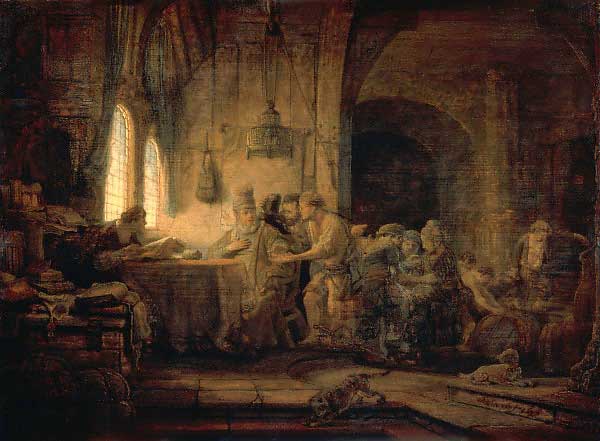
Parable of the Workers in the Vineyard by Rembrandt, 1637
A normal workday in the ancient world was ten hours, not counting breaks. The workday began at 6:00am. A denarius was a typical day’s wage for laborers. The landowner went out at the third hour, 9:00am; the sixth hour, noon, etc. He kept returning to hire more workers even up to the last hour of the workday. Laborers were always paid at the end of the day. In this parable, the last workers were paid first, which prompted the first workers hired to think they would be getting more, even though they had been promised a denarius. So, they grumbled about not getting more. They thought the landowner was not being fair.
Grumbling. Complaining. Murmuring. It is the bane of our existence. Decades ago, when gas station attendants still filled tanks for customers, I was working at a station and had a lady go berserk on me for not checking her oil and cleaning her windshield, because I did it for the car in front of her. Even though there was a sign right in front of her that said checking oil and cleaning windshields is only done upon request, the lady thought she was getting gypped.
In truth, the landowner did not cheat or defraud the workers in any way. He paid the agreed upon wage, just like he promised. Should he want to pay everyone the same even though the amount of work was different was his own business. The problem was not with the owner, it was with the worker’s envy of the owner’s generosity toward the others. God distributes gifts because he is gracious, not because we have earned anything.
Our standard of fairness is not the rule of the kingdom of God – grace is.
The founder of Methodism, John Wesley, was physically thrown out of a church one Sunday because of a sermon he was preaching on the grace of God. Afterwards, when Wesley wrote about this to a friend, he said, “There is no Christian Doctrine more repugnant than the affirmation that we are saved by the grace of God through faith.”
Deep down many believe we control our destiny, and that we save ourselves by what we do. We discern that if we serve God all our lives, in the end, God will reward us. We believe that our pious activities, our acts of service and our work for the Lord, will bring us salvation, or, at least a leg up in the kingdom of God over others who have not worked as hard or as long as we have. After all, we do the right thing.
So, what about those who have not figured out Christianity… those who do not have the correct or proper beliefs… or those who have not straightened out their lives? According to a worldview of human fairness, they are out of luck. They should be in church. They should work harder, faster, and better. Then, they could get their lives in order. If they would only understand fairness, we reason, then all would be well.
Parable of the Vineyard Workers from unknown artist in the Middle Ages
But there is a problem, because the parable of the workers told by Jesus seems to be saying that is not how it works, at all. Jesus seems to be saying that grace and grace alone saves, that God’s amazingly naive and irresponsible grace is available to anyone and everybody. And that troubles the workers to no end.
Whenever we run headlong into God’s unfair grace and see that God’s way of doing things is so far removed from our way, there is bound to be grumbling. After all, if God is going to run a vineyard like the one in the gospel lesson and give everybody the same pay regardless of their actual work hours, then what’s the use of getting up early in the morning to work?
What is the good of sitting in church, listening to sermons from a crazy preacher who is no better than us, if these outsiders, these Johnny-and Jane-come-lately’s can waltz in at the last minute and receive the same treatment as the rest of us? For many church folks who diligently serve, it is not fair to pay so much attention to outsiders and build ministry around people who aren’t even here, who don’t yet know Jesus.
The conclusion and point of the parable: The last will be first, and the first will be last. In Luke’s prodigal story, the elder brother grumbles and gripes: “All these years I’ve been slaving for you and never disobeyed your orders. But when this son of yours who has squandered your property with prostitutes comes home, you kill the fatted calf!” It is the firstborn son that complains. (Luke 15:11-32)
In both the parable of the prodigal son and the parable in today’s lesson, “good” people are the ones who fail to see the heart of the Father and of the landowner. The “firsts” got off track because, over time, they forgot the kingdom hinges on grace, not effort, on not simply doing the right things over a long period of time.
God controls the flow of mercy, not us.
We will likely be surprised in heaven with those already sitting at God’s banquet table, and equally surprised with who is not there. Resentment can move us away from the table of mercy God is preparing. The problem comes whenever we think we are above other people. We might be sinners, but we are not as bad as some other people are! We commit ordinary sins, not mass murder!
Here is the unvarnished truth: God does not owe you or I a thing, and God cares about all kinds of people, not just us and people who think and live like we do. Our hearts need to be big enough to center ministry around other people who are different than us.
If our hearts are small, we easily get jealous when God pays attention to prodigals and profligates. Grace becomes too repugnant a doctrine for us.
The gospel of Jesus Christ is about grace. Life is not all about being decent. It is not all about morality, and it is certainly not about our own goodness. The gospel is about being steeped in and surrounded by the grace of God in Christ, so that we, in turn, can show others grace. Grace is the way God deals with us beyond what we deserve or feel we have earned.
Grace is unfair; we get what we do not deserve.
May we allow God’s grace to so permeate our hearts and lives so that we will give it to others as freely as we have received.Praise be to you, almighty and everlasting Father of our Lord Jesus Christ. In Christ, you have given us every spiritual blessing in heaven. In Christ, you chose us before the world was made. You chose us in love to be your holy people—people who could stand before you without any fault. And before the world was made, you decided to make us your own children through Jesus Christ. It pleased you to do it. And this brings praise from us because of your wonderful grace, given to us freely, in Christ, the one you love. We have forgiveness of sins because of this lavishly rich grace. Thank you, O my Father, for your grace extending to me in Christ! Amen