“So when you see standing in the holy place ‘the abomination that causes desolation,’ spoken of through the prophet Daniel—let the reader understand— then let those who are in Judea flee to the mountains. Let no one on the housetop go down to take anything out of the house. Let no one in the field go back to get their cloak. How dreadful it will be in those days for pregnant women and nursing mothers! Pray that your flight will not take place in winter or on the Sabbath. For then there will be great distress, unequaled from the beginning of the world until now—and never to be equaled again.
“If those days had not been cut short, no one would survive, but for the sake of the elect those days will be shortened. At that time if anyone says to you, ‘Look, here is the Messiah!’ or, ‘There he is!’ do not believe it. For false messiahs and false prophets will appear and perform great signs and wonders to deceive, if possible, even the elect. See, I have told you ahead of time.
“So, if anyone tells you, ‘There he is, out in the wilderness,’ do not go out; or, ‘Here he is, in the inner rooms,’ do not believe it. For as lightning that comes from the east is visible even in the west, so will be the coming of the Son of Man. Wherever there is a carcass, there the vultures will gather.
“Immediately after the distress of those days, the sun will be darkened, and the moon will not give its light; the stars will fall from the sky, and the heavenly bodies will be shaken.“
“Then will appear the sign of the Son of Man in heaven. And then all the peoples of the earth will mourn when they see the Son of Man coming on the clouds of heaven, with power and great glory. And he will send his angels with a loud trumpet call, and they will gather his elect from the four winds, from one end of the heavens to the other. (NIV)
I live in the upper Midwest of the United States. The summers can be brutally hot and humid. The winters can be incredibly frigid and full of snow. Having lived in various university towns and worked with many college students, every Fall there is always at least one international student, or a student from the American Deep South, that has never experienced a Midwest winter and snow. I could tell them repeatedly of the need for a sturdy winter coat before the snow flies. Yet, having never known sub-freezing, let alone sub-zero, temperatures it is difficult to imagine such cold when the weather is warm. At the coming of winter, I, or someone else, had to help ensure they had a suitable coat. Even then, they usually shake all winter and never take their scarves off.
It might be difficult to imagine, because none of us have yet experienced it, that someday Christ will return to judge the living and the dead. Therefore, Jesus told his disciples about using discernment concerning a change of environment around them. Although it may seem improbable now, a time is coming which will be loaded with cosmic and cataclysmic changes. Sometimes, even for myself who has lived through many hard winters, it is incredible to know that the landscape as it is right now will be completely different.
The sky and the earth as we know it now will pass away; yet Christ’s words will endure for all time. If we are attentive and alert, we will be ready. We will have a warm winter parka on hand. And, for now, it means taking off the old clothes of fear, insecurity, hopelessness, and hate, and putting on the new clothes of righteousness, peace, and love in the Holy Spirit. Winter is nearly here. There is a chill in the air.
God Almighty, we long for the coming of your kingdom in Jesus Christ our Lord. We lament before you the signs that your kingdom has not yet come in its fullness. The signs of brokenness and divisions, oppression and abuse, poverty and loneliness, are everywhere present in the world. So, we cry out from the depths of our being, “O come, O come, Immanuel. Bring us comfort. Dispel the shadows of the night and turn our darkness into light.” Through Jesus Christ our Lord. Amen.
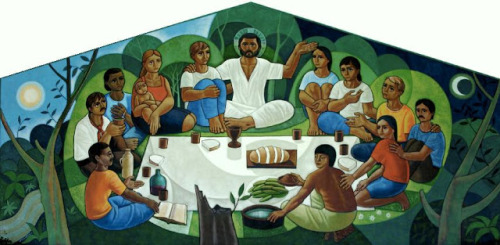
En la Cena ecológica del Reino (At the Ecological Kingdom Dinner) by Spanish artist Cerezo Barredo
While Jesus was still talking to the crowd, his mother and brothers stood outside, wanting to speak to him. Someone told him, “Your mother and brothers are standing outside, wanting to speak to you.”
He replied to him, “Who is my mother, and who are my brothers?” Pointing to his disciples, he said, “Here are my mother and my brothers. For whoever does the will of my Father in heaven is my brother and sister and mother.” (NIV)
Jesus obviously did not get the memo that blood is thicker than water. When his own blood family were waiting outside for him, Jesus used the occasion to speak of what makes up a true follower of God. Christ boldly asserted that his true family is made up of people who do God’s will. By saying this, Jesus brought the point home that the kingdom of God turns on obedience.
Rather than solely confessing belief, or appealing to a family heritage of faith, Jesus said that a genuine believer in God is one who listens to God’s words and then promptly obeys them. Therefore, a Christian is defined by allegiance to Jesus, and not by having a certain bloodline.
Identity determines activity. For example, if I identify myself primarily as a worker at my job, my activity will show it – I will spend long hours at my labor, and will do whatever it takes to please my boss and gain promotions. If I identify myself primarily as an athlete, I will spend long hours honing my skills, and do whatever it takes to please the coach and to win. If my identity is mostly wrapped around being a husband and father, I will focus most of my attention on my family and seek to please my spouse and children in all things.
If my identity is first and foremost as a Christian, I will always seek to please Jesus. I will then view my job as an opportunity to express the ethics of God’s kingdom, as a calling from God, and as a means for God to transform me for his glory. I will view athletics as means to glorify God, and not as an end in and of itself but as a special gift for God to teach me about the importance of community and working together.
If my identity is clearly in Christ, I will view my kids as belonging to God and I will steward the trust of children given me by doing whatever it takes to teach and train them in the way of Jesus. I will thank God for my family and not confuse them with being God by idolizing them.
In today’s Gospel lesson, Jesus was inside a house, with his family on the outside. So, why were the family members of Jesus not inside the house sitting at his feet, taking the posture of a disciple? The disciple Matthew wanted to communicate more than physical distance between Jesus and his physical family – being “outside” was meant to convey the posture of Christ’s family as spiritually distant, skeptical of him, and indecisive about who he was and what he was up to. In fact, the disciple Mark made this spiritual and emotional distance clear:
Jesus entered a house. A crowd gathered again so that it was impossible for him and his followers even to eat. When his family heard what was happening, they came to take control of him. They were saying, “He’s out of his mind!” (Mark 3:20-21, CEB)
Christ’s earthly family were not looking for Jesus to give them warm-fuzzies and have a family group hug. They were there to tell him: “Cut it out, Jesus, because you’re acting like a nut-cake and embarrassing us all!” The kid brothers of Jesus (James and Jude) would go on to become powerful Christian preachers and each pen a New Testament letter, but that does not happen till after Jesus’ resurrection.
Ethiopian Orthodox Church depiction of Christ and his disciples
Jesus was saying that identifying only with a biological family leads to only pleasing that family. However, identifying with Jesus leads to a radical form of following God that seeks to please him instead of submitting to family practices, mores, and beliefs which are inconsistent with the kingdom of God.
For the follower of Christ, the church is the family of God, and we are to act consistent with being in such a family. We are to go hard after God’s will, serve one another, and adopt outsiders into our family. The church is a family, not a restaurant. When we go to a restaurant, we either like the food and the service, or not. If the experience was unpleasant, we might complain to the waitress and may or may not come back. Try doing that with your mother and see where it gets you! As a biological family, we are committed to each other. There is no complaining about mom because of dad’s wrath. Instead, we are expected to clear our plates and put them in the dishwasher, to sweep the floor and clean the table, and to work together for the benefit of the entire family. In the same way, following Jesus means being committed to his family, the church.
Priority is to be given in doing God’s will, regardless of blood, because obedience to Christ identifies us as being in the family of God. Our actions and the way we live points to what we honestly believe and where our commitments truly lie.
The first step of God’s desire for us is quality focused time in sitting at Christ’s feet and listening to him because this is at the heart of all Christian discipleship. We cannot do God’s will until we have clearly heard it; and we cannot hear God’s will unless we take the time to be at the feet of Jesus.
Both listening and doing are necessary. Listening without engaging the world is a failure of mission; and doing without first listening leads to misguided acts and eventual burn-out. Allow Jesus to call the shots and let him instruct us so that we can act wisely and obediently.
Jesus did not devalue blood relatives as irrelevant. Rather, Christ emphasized that our primary allegiance is to him, and not to our biological family. The kingdom of God seeks to restore and redeem all things, including family. Both church and family are important. The relationships within each are to be nurtured.
The family of Jesus, the church, is important because Christ suffered and died for her. So, we are to be committed to the church, love the church, and serve the church because we are family. If we have a good grasp of this, we will make decisions based in what we believe God’s will is, instead of whether a relative will get upset, or not.
Our biological families are important. Jesus never pitted one against the other, because he wants to see families redeemed and work together as the family of God. Every Christian family can do this:
Appoint a time to read Scripture together and listen to Jesus and discuss it.
Show hospitality so that we can eat and drink our way into the kingdom of God.
We need to persistently pray for spiritually lost family members, and those whom we are estranged from. Most families have at least a few toxic persons in their orbit. Here is how we might pray for them:
That God will arrange divine appointments between them and other believers who love Jesus.
That God will draw them to the mercy of Christ.
That God will hinder the devil’s schemes against them.
That they will understand and respond to the good news of God’s grace.
Jesus said, “Who then is the faithful and wise servant, whom the master has put in charge of the servants in his household to give them their food at the proper time? It will be good for that servant whose master finds him doing so when he returns. Truly I tell you, he will put him in charge of all his possessions. But suppose that servant is wicked and says to himself, ‘My master is staying away a long time,’ and he then begins to beat his fellow servants and to eat and drink with drunkards. The master of that servant will come on a day when he does not expect him and at an hour he is not aware of. He will cut him to pieces and assign him a place with the hypocrites, where there will be weeping and gnashing of teeth.” (NIV)
Satan once called on some demons of hell and wanted to send one of them to earth to ruin some souls. One demon came forward and said, “I will go.” The devil said, “If I send you, what will you tell the humans?” He said, “I will tell those humans that there is no heaven.” Satan said, “They will not believe you, for there is a bit of heaven in every human heart. In the end everyone knows that right and good must have the victory. You may not go.”
Then another demon came forward, darker and fouler than the first. The Accuser said, “If I send you, what will you tell humanity?” He said, “I will tell them there is no hell.” Satan looked at him and said, “Oh, no; they will not believe you, for in every human heart there’s a thing called a conscience, an inner voice which testifies to the truth that good will be triumphant and evil defeated. You may not go.”
Then one last demon came forward, this one from the darkest place of all. The devil said to him, “And if I send you, what will you say to women and men to aid in the destruction of their souls?” The demon said, “I will tell them there is no hurry.” Satan said, “Go!”
Most people’s crime in not gross sin but in plain indifference, without much thought to a future judgment day. Jesus said that such persons will not know what hit them because the Day of the Lord is coming, and it may be soon. Therefore, the question for Christians is not “When will Christ return?” because no one knows the answer. Rather, the question for us is:
Are you ready for Christ’s return?
Today’s Gospel lesson is part of what is known as the Olivet Discourse, Christ’s final sermon before he faced the cross. Jesus was looking for his disciples to keep watch, to stay alert, to be ready, like a watchman on a tower scanning the landscape for an invading army. We are to remain vigilant and remember Jesus is coming again. We are to live each moment considering the promise of Christ’s coming, not knowing the day when it will happen.
Keeping watch, being ready, and staying alert means being witnesses to a world going about their merry way unaware that there is a doomsday. We are to be active, like Noah building the ark, anticipating the great flood of coming judgment. We are not to waste time creating prophecy charts and trying to connect current events to the Lord’s return. Instead, we are to prepare for the coming judgment through living godly, upright lives. (2 Peter 2:4-9)
We keep watch by being faithful stewards in God’s household.
We are to avoid being like the unfaithful teenager who, when given the responsibility of watching over the house while his parents are gone for the weekend, has a big party and trashes the house. The parents will come home at a time the teenager does not expect, and then there will certainly be weeping and gnashing of teeth!
The faithful and wise steward is busy doing the master’s business – the mundane work of taking care of the master’s house. Preparing for Christ’s return leads to down-to-earth acts of love and care, without passively or nervously sitting around and waiting. The unfaithful servant in Christ’s story is careless, cruel, and carouses because he pays no attention to the fact that the master could return at any moment.
When Christ returns, none of us knows who will be taken and who will be left – because people might look like the same on the outside, doing the same work side by side, but can be very different persons on the inside.
As believers wait for their Lord’s return, they may become impatient and get caught up in petty day to day problems, losing sight of what is tremendously important. One day, a man named Denis Waitley, was trying to catch a flight but was running late. So, he ran through the airport terminal. He got to the gate the split second the gate agent closed the door. Denis explained his situation, that he had a speaking engagement to get to, but the agent did not budge.
Denis’s frustration turned into fuming. He stormed out of the boarding area and back to the ticket counter to register a complaint and reschedule his flight. The anger intensified as he waited for more than twenty minutes in a line that barely moved. Just before he got to the counter an announcement over the intercom changed his life. The flight he missed, flight 191 from Chicago to Los Angeles, crashed on takeoff and killed every person on board the plane.
Denis Waitley never registered his complaint. In fact, he never returned his invalidated ticket. He took it home and pinned it on a bulletin board in his office to remind him whenever he got frustrated or upset that life is more than day to day impatience, worry, and complaints. It is about serving a lost world destined to slide away from God apart from the grace that can turn judgment into blessing.
We are to keep watch for the Lord’s return because it could be today.
In the meantime, we are to be faithful by serving a world in tremendous need of getting on the ark and being saved from the coming judgment. Perhaps the best way to overcome our own chronic unhappiness and struggles is to serve the world and be the servant God wants us to be.
God Almighty, you are our hope in this life and the life to come, as we wait for Christ’s return, help us to work for the good, as if each day is our last; and let our hope for a new day shape how we live now. We look forward to the time when all will be made right. Even so, come Lord Jesus. Amen.
The Parables of Jesus by Argentine artist Jorge Cocco Santiago, 2018
What would you do with a million dollars?… Maybe you would pay off some debts, finish some work on your house, or quit your job and take a vacation. Perhaps you might invest a good portion of it. However, your investment is only as good as your level of trust.
When I worked at a senior citizen healthcare facility, there was a resident with an apartment in independent living, but he still owned his house. During one conversation, the old man admitted to me that over the past sixty years he owned his house, he had secretly bored holes in every door jamb of the house and had stuffed away $100,000 dollars in cash! This dear resident had personally experienced the run on banks which began the Great Depression in 1929. He had zero trust for investment banking.
A “talent” in Christ’s day was a monetary denomination. A talent was worth 6,000 denarii, and one denarius was worth a day’s wage. So, in Christ’s parable of the talents, Jesus was talking about millions of dollars (in today’s money) with the master who gave his servants five talents, two talents, and one talent. (Matthew 25:14-30)
As Jesus was telling his parable, one of his chief points was to communicate that God is gracious and generous. The three servants responded their master’s generosity according to their view of him. Two of the servants regarded the master as gracious and generous, and so, freely took their talents and confidently invested them to create even more money.
The two faithful servants took risks and acted with the idea that they were secure in their relationship with their master. However, the third servant’s perception of his master was different. This servant discerned his master as stern, serious, and angry, so therefore, he did nothing with his talent – he was afraid.
The man was fearful because his view of the master was off. If we consider God as primarily an angry Being, then we will almost certainly not use the gifts he has given us, for fear of messing up and experiencing his wrath.
However, the truth is, God is gracious and generous. The Lord has mercifully gifted everyone and expects us to use those gifts and not hide them away in a door jamb! God wants us to actively display grace and generosity – which will require addressing our fears. If we want to hear the Lord Jesus say, “Well done, good and faithful servant,” then taking initiative is necessary.
Fear is perhaps the greatest block in preventing God’s people from being productive Christians in serving the church and the world. Beneath our fears are powerful feelings of inferiority, inadequacy, and an inner conviction that we are not enough. Oftentimes, a low view of self can come from a low view of God.
Fear paralyzes our potential to serve God’s kingdom.
Being continually afraid, drains our energy and lessens whatever impact we could have for God in the world, diminishing our resolve to act and leaving us ineffective in service.
Fear destroys our dreams and godly desires.
We are meant to enjoy the gracious and generous God, and in our enjoyment of the Lord, godly dreams will be placed within us that God is pleased to fulfill:
Take delight in the Lord, and he will give you the desires of your heart. (Psalm 37:4, NLT)
Our enjoyment of God gives us the security and confidence to act upon godly desires and produces a generous harvest of righteousness and peace. We then can share the bounty with others, as a way of giving back to God.
Yet, if fear gets thrown into the mix, it dilutes and destroys everything. Fear paralyzes us, and we do nothing, like the third servant in the parable. What is more, fear can force us into hiding, just like the servant hid and buried his talent.
In the Old Testament book of Numbers, the Israelites were immobilized by fear. God had a grand vision and a big dream for the people to enter the Promised Land. But ten of the twelve spies who came back after checking out the land were paralyzed by fear. “The land has giants, and we are like grasshoppers!” they nervously said.
Caleb and Joshua, however, had a different view of taking the land because they had a different view of God. They didn’t see giants – they saw a gracious and generous God who could easily take care of whoever might be in the land, and they wanted to act on the faith they had in a mighty and merciful God. The God of the other spies wasn’t big enough to handle the giants. Their low view of themselves as grasshoppers betrayed their low view of God. (Numbers 13:26-33)
We might wrap a lot of our fears in morbidly sanctified self-belittling. That is, we might feel good about feeling bad and wrap ourselves with a blanket of secret shame. As a result, those self-deprecating feelings stop us from exploring God’s dream and vision for us.
We could use some bold God-sized dreams! We can speak and act in the world with confidence because we serve a God who sees giants as gnats.
Some of the greatest fears that hold back people from exploring their faith is:
Fear of criticism – being afraid of what others may think or say.
Fear of taking a risk – being afraid of going outside the comfort zone of how something has always been done.
Fear of ourselves – being afraid to explore our vast inner world with its guilt, shame, insecurity, and mixed motives.
Fear snatches away God’s dreams for us. If you once had a dream and you think that dream is dead because of your sins and bad habits, you are misguided. Dreams evaporate because of fear, by being duped into believing that we are not enough, and never will be. So, we end up doing nothing.
Fear ruins our relationship with God and others.
Living a spiritual life, meanwhile always looking over our shoulder to see if God is going to sneak up on us and rap our knuckles with a ruler, is no way to live. I think the hardest people to get along with are those who have a low view themselves. Because they do not like themselves, they do not like others. They continually wonder if God is upset with them about something. The man in the parable blamed God for his own lack of investment. Yet, blame shifting is really our own fear and insecurity seeping through onto others – it helps no one, especially ourselves.
God wants us to bloom with the talents given us. God wants us to shine and succeed. God is on our side, has our backs, and wants us to live a good life.
Fear sabotages our service.
“I can’t!” is the cry of the person locked in fear. I cannot stand up in front of people, meet strangers, sing, serve like that other person can or love like Jesus did. I cannot because I am afraid, and I only have one talent!
Perhaps you have observed that God typically uses tongue-tied people, worriers, and those with a sordid past – and not superstars – as servants commissioned with a set of talents. The less a person has, the more God shows up and shows off with generous power and gracious ability through that person.
Nothing sabotages serving more than being afraid, worried, and believing we have so little. Give God a chance! Step out. Take a risk. Act on that dream.
Conclusion
Once in a small village in India, a farmer brought to the open-air market a whole covey of quail, with a string tied around a foot of each bird. The other end of the string was tied to a ring on a central stick. The quail were all walking in a circle because of the strings on their feet. As the day went on no one seemed interested in buying the farmer’s quail.
Finally, an old man came and bought every one of the quail. After he bought the quail, the old man told the farmer to cut the strings and set all the quail free. So, the farmer did. But none of the quail flew away. They kept marching around in a circle as if they were still tied to the string. Finally, the farmer had to shoo them away to get them to move, and even then, the quail landed somewhere else and just started marching in a circle again.
God has freed and forgiven us. Yet, we can so easily remain tethered to imaginary strings and march around in vicious circles of fear, afraid to venture into the unexplored world God has for us, to spread our wings and be free.
God loves you. God has wonderful plans for you. God created you with your unique personality, gave you unparalleled experiences, and gifted you with uncommon abilities. God wants you to tap into that passion and dream placed down deep in your heart to serve the world.
What would you do with a million dollars? You already have it. Now, go and invest it.