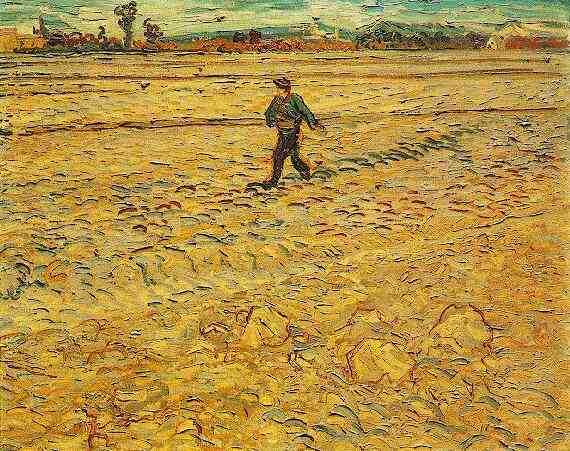
Luke 8:4-15 – Christ’s Parable of the Soils

While a large crowd was gathering and people were coming to Jesus from town after town, he told this parable: “A farmer went out to sow his seed. As he was scattering the seed, some fell along the path; it was trampled on, and the birds ate it up. Some fell on rocky ground, and when it came up, the plants withered because they had no moisture. Other seed fell among thorns, which grew up with it and choked the plants. Still other seed fell on good soil. It came up and yielded a crop, a hundred times more than was sown.”

When he said this, he called out, “Whoever has ears to hear, let them hear.”

His disciples asked him what this parable meant. He said, “The knowledge of the secrets of the kingdom of God has been given to you, but to others I speak in parables, so that,

“‘though seeing, they may not see;
    though hearing, they may not understand.’

“This is the meaning of the parable: The seed is the word of God. Those along the path are the ones who hear, and then the devil comes and takes away the word from their hearts, so that they may not believe and be saved. Those on the rocky ground are the ones who receive the word with joy when they hear it, but they have no root. They believe for a while, but in the time of testing they fall away. The seed that fell among thorns stands for those who hear, but as they go on their way they are choked by life’s worries, riches and pleasures, and they do not mature. But the seed on good soil stands for those with a noble and good heart, who hear the word, retain it, and by persevering produce a crop. (New International Version)

The Parable

“Whoever has ears, let them hear,” said Jesus. Truly hearing Christ’s words and listening with focused attention is paramount to the Christian life. Our ears are the soil of our lives. Ears attentive and devoted to listening to Jesus are good soil; ears distracted, inattentive, and stopped up with ear wax are bad soil. Receptive listening to the Word of God brings a fruitful harvest of righteousness, peace, and joy in the Holy Spirit. Genuinely believing what we hear from Jesus is crucial. God’s Word falls on four different soils….

  1. The seed on the path. A path is for walking, which is why the seed never takes root. Here there is no listening. When we act without listening, our actions will be misguided. 
  2. The seed on rocky soil.  Here there is no deep listening. A lack of attentive hearing results in a shallow person who perhaps relies more on Christian clichés or on their personality or abilities instead of the sown Word.
  3. The seed on the thorny soil. Here there is significant listening. However, there is too much listening to a cacophony of voices and not enough singular listening to the sown Word. Listening to the wrong voices will cause an unfruitful life. So, we must be careful to whom we are listening.
  4. The seed on good soil. A devoted listening to the Word without distraction leads to a productive, fruitful believer.

“There is a difference between listening and waiting for your turn to speak.”

Simon Sinek

The Nature of Parables

A parable is a genre of biblical literature. Parables are as much about concealing truth as they are conveying truth. A person must give focused attention to the story to learn from it, much like a good novel conveys truth about the human condition without being preachy or outright saying the truth. Or it’s much akin to a good movie relying on character development and the power of story for its message, instead of being a straightforward documentary.

Jesus neither strong-arms people nor puts them in a full nelson to force them into God’s will. We will miss out on God’s working, if we are looking for a big dramatic hoo-ha of an event. That’s because it comes as an awareness within people and works its way out. For those not intent on changing, they will find Christ’s words confusing. They might “hear” Jesus, yet fail to really listen, since they have their own ideas about how God ought to operate.

Yet, grace is still present. The very fact that Jesus addressed the crowd of people demonstrates he cared enough to communicate. He could have said, “Hey, you guys, get lost, I’m just going to interact with people who really listen to me.” Instead of coming at the crowd and bursting through the front door, Jesus mercifully came to them through the side door so that they would be able to receive the message. 

Puking the good news of Jesus all over people without really listening is a bad idea. Neither is being worried about saying something offensive, so nothing is said at all. A better approach is asking permission to tell your story of what Jesus means to you, or what you are learning from God’s Word.

The Parable Interpreted

The focus is the experience of the seed in a variety of soils. Outside powers acting on the Word – devouring birds, rocks, the burning sun, choking thorn-bushes – demonstrate the Word is central and needs to be received well:

  1. The path is the inability to hear God’s Word because of hard-heartedness. The devil snatches it before any real understanding can take place.
  2. The rocky soil is hearing just enough to respond with joy. But the person drops out when hard circumstances occur. “I didn’t sign up for this!” is their cry. They needed to count the cost of discipleship before responding to the message. This is merely a professing Christian, nothing more.  Rather than listening and internalizing the Word, there is only positive affirmation without any action or practice. So, tomorrow the message is gone and forgotten. When difficulty comes, there are no supporting words to draw from, so the person fades away, unable to navigate life successfully.
  3. The thorny soil also hears and responds to the message. This person is also a professing Christian, nothing more. The issue here is that they also listen to voices of worry and wealth. In a sort of spiritual attention-deficit-disorder, there is no ability to filter all the voices calling out, and so, no growth.
  4. Listening with the intention of understanding and putting into practice the message heard is what brings about fruit. Receiving the Word through careful listening brings about spiritual growth. God brings the growth when we focus on the Word. And when a whole group does this, then it creates a greenhouse effect in which people cannot help but grow in the Lord.

Conclusion to the Parable

The simple reception of God’s Word leads to fruitfulness. The first soil did not receive the Word, though it listened. The second received it with joy but under pressure let it go. The third received it with only one hand because the other hand was busy. Only the fourth soil received the Word with both hands.

Blessed is the one who does not walk in step with the wicked or stand in the way that sinners take or sit in the company of mockers, but whose delight is in the law of the Lord, and who meditates on his law, day and night. That person is like a tree planted by streams of water, which yields its fruit in season and whose leaf does not wither—whatever they do prospers. (Psalm 1:1-3, NIV)

The old adage that we were created with two ears and one mouth, so that we will listen twice as much talk, is a truism. It’s hard to receive any words of encouragement, help, or reproof if you’re tongue is flapping in the wind.

Careful listening, attention to memory, and patient application are the pathways to realizing an abundant spiritual harvest of righteousness and peace.

*Above paintings, The Sower by Vincent Van Gogh, 1881 & 1888

John 15:18-20, 26-27 – Moving in with Jesus

“If the world hates you, keep in mind that it hated me first. If you belonged to the world, it would love you as its own. As it is, you do not belong to the world, but I have chosen you out of the world. That is why the world hates you. Remember what I told you: ‘A servant is not greater than his master.’ If they persecuted me, they will persecute you also. If they obeyed my teaching, they will obey yours also…

When the Advocate comes, whom I will send to you from the Father—the Spirit of truth who goes out from the Father—he will testify about me. And you also must testify, for you have been with me from the beginning.” (New International Version)

Two characters: Jesus and Emmet

Scene:  Emmet is moving in with Jesus as a roommate.

Emmet enters….

“Nice digs, Jesus. Not quite what I was expecting – looks good and clean – but just ordinary.”

“I’m glad you decided to take up my offer and come live with me in my house, Emmet. Well, it’s actually my Father’s house.”

“Yeah, well, it wasn’t working out so well with my girlfriend, Jezebel. She was into a lot of weird stuff, like some crazy real estate schemes, especially with vineyards – the woman is obsessed with buying up vineyards. Besides, she told me she hates me. That really hurt.”

“Emmet, I think you will find I’m into a different kind of vineyard and real estate. And there isn’t any hate there. It’s called ‘the kingdom of God.’”

“Kingdom, huh?  Sounds like a pretty big gig to me, Jesus.”

“Oh, yes, it is. The biggest. You know, Emmet, by living and abiding with me here you will get to know all about the kingdom.”

Sounds groovy, man… or should I say, ‘Son of Man!’ Hey, Jesus, you got any beer and chips in this joint?  I’m starving.”

“No, sorry, I’m afraid not right now. But I do have some wine and some bread.”

“Well, okay, Jesus. I’m super hungry. I could go for about anything.”

Here you go Emmet.” (Jesus gives Emmet a wafer and communion cup – Emmet just stands there and looks at it). “Make yourself at home in my love, Emmet.”

“Um, hey, Jesus, not to be ungrateful or anything, but is this all you have?”

“Just try it, Emmet. I think you will find it rather satisfying.”

(Emmet takes the bread and drinks the cup). “Holy Communion, Jesus! Whoa! I’m actually full! What in the world is in that stuff, anyway?”

“There’s no world in it, at all, Emmet. I am the vine. You are the branch. When you drank, you ingested me.  You’re joined with me, and I with you. Apart from me you are always going to be hungry and thirsty, no matter how much other food you eat and how much beer you drink. But if you stay here and settle in with me, make this your permanent home and not just a place to hang your hat, you can be sure that I will always listen to you and do whatever you ask of me.”

“That’s heavy, man. Very cool. I can dig it!”

“I have told you this for a purpose, Emmet – that we might enjoy being roommates together. By the way, I have just one rule in my house that I expect to be obeyed, always: Love other people in the same way that I love you.  Never forget, Emmet: If you ever get locked-out of the house, it is love which opens the door to my place.  Remember, Emmet, that love is the key.”

“You know, Jesus, you’re kind of odd, but I like you, dude. I’m glad I chose to come here.”

“Emmet, you did not choose me; I chose you and brought you here because of my love. And I am sending you into the world to love. Remain here with me, abide with me in this place, and you will see things happen beyond what you can even think or imagine. Go, now, and bear the fruit of love in my kingdom, and when you come back, I’ll have a place for you to sleep and you will rest like you have never rested before.”

“I really appreciate your hospitality, Jesus. But what if I mess up? Or forget about your rule?”

“When you came here, Emmet, you probably saw someone standing just outside the door.”

“Yeah… I did see some dude who looked way out there, man, like he was from another universe, like maybe New Jersey, or something.”

“That was the Advocate. He will come whenever you mess up or forget about my love. The Advocate will help you remember the truth.”

(Jesus walks Emmet to the door). “There’s nothing to worry about. Just go and love others like I love you. Good-bye, Emmet.”

“Bye, Jesus. I’ll be back after I go spread some love around, just like you taught me….”

*Above Photo by Amina Filkins on Pexels.com

John 16:16-24 – There Must Be Suffering Before Glory

Jesus went on to say, “In a little while you will see me no more, and then after a little while you will see me.”

At this, some of his disciples said to one another, “What does he mean by saying, ‘In a little while you will see me no more, and then after a little while you will see me,’ and ‘Because I am going to the Father’?” They kept asking, “What does he mean by ‘a little while’? We don’t understand what he is saying.”

Jesus saw that they wanted to ask him about this, so he said to them, “Are you asking one another what I meant when I said, ‘In a little while you will see me no more, and then after a little while you will see me’? Very truly I tell you, you will weep and mourn while the world rejoices. You will grieve, but your grief will turn to joy. A woman giving birth to a child has pain because her time has come; but when her baby is born, she forgets the anguish because of her joy that a child is born into the world. So, with you: Now is your time of grief, but I will see you again and you will rejoice, and no one will take away your joy. In that day you will no longer ask me anything. Very truly I tell you, my Father will give you whatever you ask in my name. Until now you have not asked for anything in my name. Ask and you will receive, and your joy will be complete. (New International Version)

“Even a happy life cannot be without a measure of darkness, and the word happy would lose its meaning if it were not balanced by sadness. It is far better to take things as they come with patience and equanimity.”

Carl Jung

An Unpopular Message

Jesus often said things that were neither expected nor wanted. Jesus consistently told his disciples there must be suffering before glory. The disciples either could not or would not hear of it. They didn’t sign up to follow Jesus into suffering! Trying to get people to pay attention to suffering is like trying to get a bunch of Baptists to put their names down on a sign-up sheet at church.

Christ was speaking to his disciples in the Upper Room, the last meal he had with them before his death. When they were called by Jesus three years earlier, the disciples were not expecting all the gibberish about leaving and grieving. To put this in contemporary terms, the disciples’ response was akin to saying, “I only think positive. I don’t listen to things that are negative.”

Suffering, death, and grief were far from the disciples’ expectations of how things would and should shake-out. They had such a hard time understanding what the heck Jesus was saying because his words were out of alignment with their assumptions. Yes, there would be glory and joy. First, however, there must be suffering and grief.

A Real Message

Just as a woman experiences terrible pain in childbirth, then ecstatic joy over seeing her child for the first time, so the Christian’s excruciating pain in this life points to the inevitable joy at the end of that suffering. In the scope of eternity, adversity and pain last only a moment. Glorious joy, however, will be forever.

In talking with his disciples about their disappointment, even depression, about Christ’s words of leaving and grieving, Jesus graciously gave them the gift of joy. Yes, there can be and is joy even in the mourning. Not every story has a happy ending.

I can say, however, that the grandest story of all – Jesus Christ’s suffering and death – has resulted in resurrection and ascension. It will all be complete when Christ returns to judge the living and the dead. Then, the grand narrative of redemption will realize its conclusion of no more crying, tears, or pain. There will be only unending joy.

For now, however, we still experience heartache along with the great joy of resurrection and new life. It can be confusing, living in the awkward state of simultaneous grief and joy. Yet, keep in mind, the grief is temporary. The despair will not last. Joy, on the other hand, has staying power and will be the permanent state of the believer. It is only the smaller stories which may or may not end well. The big story of redemption already has the ending written – joy without grief.

A Good Message

Christians serve a risen and ascended Lord. Therefore, we need not wait to be happy, and we need not expect everything must go our way. The good news is that there are always fresh opportunities to be happy through asking and receiving. Imagine a Partridge Family sort of bus coming around to all the bus stops of life. Happy times and music arrive around the clock. Chances are the opportunity to be happy has already arrived. Often, it is right in front of us; we just missed the bus because we were daydreaming about a future state of joy.

We are living days of constant change followed by ever new normal. Just as there was no going back to a three-year hiatus of walking with Jesus for the disciples, so we need to embrace new and different ways of life together here on planet earth. We have the gift of joy. Its just a matter of unpacking it.

Now to him who can do immeasurably more than all we ask or imagine, according to his power that is at work within us, to him be glory in the church and in Christ Jesus throughout all generations, for ever and ever! Amen.

John 14:18-31 – I Will Come

16th century depiction of the Last Supper

I will not leave you as orphans; I will come to you. Before long, the world will not see me anymore, but you will see me. Because I live, you also will live. On that day you will realize that I am in my Father, and you are in me, and I am in you. Whoever has my commands and keeps them is the one who loves me. The one who loves me will be loved by my Father, and I too will love them and show myself to them.”

Then Judas (not Judas Iscariot) said, “But, Lord, why do you intend to show yourself to us and not to the world?”

Jesus replied, “Anyone who loves me will obey my teaching. My Father will love them, and we will come to them and make our home with them. Anyone who does not love me will not obey my teaching. These words you hear are not my own; they belong to the Father who sent me.

“All this I have spoken while still with you. But the Advocate, the Holy Spirit, whom the Father will send in my name, will teach you all things and will remind you of everything I have said to you. Peace I leave with you; my peace I give you. I do not give to you as the world gives. Do not let your hearts be troubled and do not be afraid.

“You heard me say, ‘I am going away and I am coming back to you.’ If you loved me, you would be glad that I am going to the Father, for the Father is greater than I. I have told you now before it happens, so that when it does happen you will believe. I will not say much more to you, for the prince of this world is coming. He has no hold over me, but he comes so that the world may learn that I love the Father and do exactly what my Father has commanded me. Come now; let us leave.” (New International Version)

Grief Amongst the Disciples

“He’s leaving!? What!? Huh!?” Although Jesus had tried to prepare the disciples for his impending cross and resurrection, they didn’t quite catch on. It was in the Upper Room, in their final meal together, that Jesus made it plain he was leaving – going back to the Father. (John 14:1-17)

There was both confusion and distress amongst the men. Anticipatory grief had suddenly smacked them like a golf club upside the head. Dizzied and dazed with thoughts their Lord would no longer be with them, Jesus then sought to assure them that this would be temporary. He is coming, again. In fact, they will experience more than one.

Christ is Coming Again, and Again

Three comings were to be realized:

  • Rising from death and appearing to the disciples.
  • Sending the Spirit as the continuing presence of Christ on earth.
  • Returning at the end of the age to judge the living and the dead.

Jesus was caring for his followers, including us, by providing future hope.

That is just what happened with the first two comings. Christians everywhere celebrate the rising of Christ from death, his ascension into heaven, and the giving of the Holy Spirit at Pentecost. The Christian tradition holds that the Spirit – the Paraclete, Advocate, Comforter, and Counselor – is now presently with us.

Although the world no longer sees Jesus, believers see him with eyes of faith, hope, and love. Christians intuitively perceive another spiritual dimension in which Christ is beside them in the person of God’s Spirit. Some things can’t be intellectually explained. They just are.

Meanwhile, while Christians everywhere await the return of Christ to this earth, they are busy loving their Lord through obedience to his commands. And his command is to love one another as he loved them. Love and obedience go hand in hand. To know the love of God in Christ is to willingly give oneself to obey such a merciful Being.

The Spirit’s Help

We are not left alone to fumble around on this earth, trying to love in our own strength or ability. The Spirit is present, helping us to do loving work. There is real spiritual assistance in applying Christ’s teaching to the practical aspects of life in the here-and-now. Such constructive down-to-earth support gives Christians a sense of peace and integrity of living.

“I am leaving you with a gift—peace of mind and heart. And the peace I give is a gift the world cannot give. So don’t be troubled or afraid.”

Jesus (John 14:27, NLT)

Unlike worldly peace, which typically uses war to try and end war, has merely the absence of conflict as its goal. However, the peace of Christ is intensely personal. It is his very own peace. Through Christ’s suffering and death, he absorbed in himself the malice and hatred of others and introduced peace – a new harmony through love.

The profound absence of love, the rebellion of humanity against concern for the common good of all, and the shame of selfishness that damns the world is overthrown by the obedience and self-sacrifice of Jesus. The world will learn this – either by discovering the love of Christ now or, at the end of the age, with the return of Christ.

Jesus has come, is here, and will come again. These comings are for us and for our deliverance from all that is unjust and broken in this world. We are not alone. There is ever-present help. This is the basis of the Christian’s confidence.

Come, Holy Spirit, and fill the hearts of your faithful with divine love. Come as the wind that blows, come as the fire that refines, come as the dew that refreshes. Convict, convert and consecrate us until we are wholly yours, through Jesus Christ, our Lord. Amen.