Colossians 2:16-3:1 – Get Rid of the List

Do not let anyone judge you by what you eat or drink, or with regard to a religious festival, a New Moon celebration or a Sabbath day. These are a shadow of the things that were to come; the reality, however, is found in Christ. Do not let anyone who delights in false humility and the worship of angels disqualify you. Such a person also goes into great detail about what they have seen; they are puffed up with idle notions by their unspiritual mind. They have lost connection with the head, from whom the whole body, supported and held together by its ligaments and sinews, grows as God causes it to grow.

Since you died with Christ to the elemental spiritual forces of this world, why, as though you still belonged to the world, do you submit to its rules: “Do not handle! Do not taste! Do not touch!”? These rules, which have to do with things that are all destined to perish with use, are based on merely human commands and teachings. Such regulations indeed have an appearance of wisdom, with their self-imposed worship, their false humility and their harsh treatment of the body, but they lack any value in restraining sensual indulgence.

Since then, you have been raised with Christ, set your hearts on things above, where Christ is, seated at the right hand of God. (New International Version)

“Moral stupidity comes in two different forms: relativism and legalism. Relativism sees no principles, only people; legalism sees no people, only principles.” – Peter Kreeft

There was once a pastor who found the roads blocked one Sunday morning and was forced to skate on the river to get to church, which he did. When he arrived the elders of the church were horrified that their preacher had skated on the Lord’s day.

After the service they held a meeting where the pastor explained that it was either skate to church or not go at all. Finally, one elder asked, “Did you enjoy it?” When the preacher answered, “No,” the board decided all was good.

Nothing can choke the heart and soul out of true spirituality like legalism – a precise extra-biblical list of do’s and don’ts. For many folks, it seems easier to live by the list than to pursue the harder road of developing character qualities.

Christian discipleship involves growing into spiritual maturity and allowing a seasoned character to shape how we make decisions. We must patiently and consistently follow in the way of Jesus, which is the way of grace and of life.

The Apostle Paul spent a lot of his time and energy trying to keep the churches he established from slipping into a soul-less legalism.

Legalism is a compulsion to spell out every detail of how everyone is to live a godly life, going beyond the stated commands of Holy Scripture.

The problem with this approach to the Christian life is that godliness is merely an outward expression of our ability to hold to the list. This legalistic way feeds human pride and boasting, going against the inner heart values of genuine humility and thoughtful service to others.

Biblical teaching thus gets lost in trying to do everything right or perfect.

There are only two alternatives: Choose the way of life and set your heart on things above – or choose the way of destruction through the legalistic list.

The legalist is like a wolf in sheep’s clothing. We need to be wary of people who seem pious and sincere, yet who do not quite pass the smell test. After all, Satan himself, the Apostle Paul once said, masquerades as an angel of light, appearing righteous, yet is intent on deceiving many (2 Corinthians 11:13-15).

So, how do we recognize a legalistic wolf who spiritually and emotionally devours people by judging them according to a contrived list, instead of altruistically helping them with grace? 

Look at the fruit of the tree. Anyone who fails to uplift others will be seen by the rotten fruit of boasting and pride. A telltale sign of such a person is their lack of connection with any spiritual body of people or faith community.

Bellicose boasters and nit-picking legalists believe they are above others because of their expertise at keeping the list of do’s and don’ts. 

A bogus disciple will always be shown by their profound lack of grace, gentleness, and genuine humility. They inevitably advocate for holding to their brand of religion and keeping the unscriptural list. Steer clear of such persons.

A sobering reality is that many people can be deceived with a devil’s bargain: take the nice handy list and you will become godly; here are twelve principles to change your life; follow these rules, pray this prayer, give your money to this, and all will be well.

It is, however, a highway to the grave. The so called “fruit inspector” comes along and goes on to judge everyone according to the legalistic list.

So, get rid of the extra-biblical and even unbiblical list. Stop judging others on whatever someone has deemed the nasty nine sins to avoid or the terrible ten things that will send you to hell. Don’t waste your time or energy on such persons.

The legalist holding to a contrived list of don’ts is not honest about their struggles. Because the bald fact of list-living is that it cannot be fulfilled; it’s unreasonable. So, when we know we are not measuring up to the list, the temptation is to keep up appearances as if we are. 

List-living eschews showing any weakness or imperfection. The legalist’s self-talk says:

  • Always avoid admitting my sin to anyone because the list pronounces me a failure if I do. 
  • Don’t ever enter a deep and prolonged grief over my loss because the list says I need to stay strong. 
  • I cannot profess my doubts about God because the list says if I doubt, I am not a real Christian.
  • Just tell me what is on the list, and I will do it – even though I cannot.

Here is my response to legalistic list-living: To hell with the list! 

You were raised from death with Christ. So, live for what is in heaven, where Christ is sitting at the right hand of God.

Grace transforms hearts, turns lives around, and provides genuine joy and satisfaction – not list-keeping.

If grace is not the answer, we are not asking the right question.

The greatest anti-legalistic prayer we can pray is the tried and true ancient prayer of the Church:

“Lord Jesus Christ, Son of God, have mercy on me a sinner.”

Luke 11:1-13 – Ask. Seek. Knock.

One day Jesus was praying in a certain place. When he finished, one of his disciples said to him, “Lord, teach us to pray, just as John taught his disciples.”

He said to them, “When you pray, say:

“‘Father,
hallowed be your name,
your kingdom come.
Give us each day our daily bread.
Forgive us our sins,
    for we also forgive everyone who sins against us.
And lead us not into temptation.’”

Then Jesus said to them, “Suppose you have a friend, and you go to him at midnight and say, ‘Friend, lend me three loaves of bread; a friend of mine on a journey has come to me, and I have no food to offer him.’ And suppose the one inside answers, ‘Don’t bother me. The door is already locked, and my children and I are in bed. I can’t get up and give you anything.’I tell you, even though he will not get up and give you the bread because of friendship, yet because of your shameless audacity he will surely get up and give you as much as you need.

“So, I say to you: Ask and it will be given to you; seek and you will find; knock and the door will be opened to you. For everyone who asks receives; the one who seeks finds; and to the one who knocks, the door will be opened.

“Which of you fathers, if your son asks for a fish, will give him a snake instead? Or if he asks for an egg, will give him a scorpion? If you then, though you are evil, know how to give good gifts to your children, how much more will your Father in heaven give the Holy Spirit to those who ask him!” (New International Version)

Jesus, in his teaching ministry on earth, often used the “lesser-to-greater” argument in getting his point across. And that is precisely what he was doing with his disciples in today’s Gospel lesson, instructing them about the nature and motivation of prayer.

The lesser-to-greater argument implies a comparison of values. It’s grounded on a common sense and logical convention that if this lesser thing is true, then, of course, how much more is this greater thing!

If something less likely to happen is true, then something more likely to happen will probably be true as well. The technical phrase for this is the a fortiori argument. It’s a Latin term meaning, “for a still stronger reason.”

So, then, Jesus wanted his followers to understand that prayer has value because God is a loving Father, not a begrudging friend. Whereas the friend in the story was badgered just so the person could get some real necessities, God needs no badgering to generously give good gifts that may or may not be considered as necessities by us.

Prayer has veracity and potency because of whom those prayers are directed to.

In the ancient world, it was common understanding that you needed to get the local gods attention if you wanted something. Which is why, for example, in the prophet Elijah’s showdown with the prophets of Baal, that Baal’s worshipers were yelling, gesticulating, and even cutting themselves for hours. They fully expected to put a lot of work into getting Baal’s attention, to convince him of intervening in their ancient version of a wild West shootout. (1 Kings 18:16-29)

In contrast to the four-hundred prophets of Baal, a single prophet of the Lord utters one simple prayer, then fire comes rushing down from heaven. (1 Kings 18:30-39) Much like the person who badgered the friend for bread, the prophets pestered Baal for hours.

It all comes down to who really cares. The friend? Not enough to jump out of bed right away and meet a need. Baal? Not so much. God? Now we’re talking.

We typically don’t ask, seek, or knock, if we believe we won’t get a response – or if it will take a lot of energy, time, and effort we don’t have.

Yet, if we are confident of being with care, then we are likely to have a habit of asking, seeking, and knocking.

If a friend begrudgingly gives to you because of persistent knocking, how much more will God graciously, generously, and with gaiety give you goodness when you ask? Because God is good, God gives good gifts. The largess of the Lord is willing and ready to dispense grace from an infinite storehouse of mercy.

This is why Jesus encouraged people to not pray like those who don’t know God, babbling on because they think they’ll be heard because of the sheer volume of words. (Matthew 6:7-8)

There are two misconceptions of prayer which existed in Christ’s day, and today. They come from non-Christian sources:

  1. There must be a lot of prayer before prayer “works.” Although I believe repetition is important for forming good habits, praying the same prayers over and over again so as to be heard betrays an ignorance of God, not to mention an actual lack of faith. Many ancient religions were based in learning how to manipulate the spiritual forces out there to get what we need. It’s kind of like a divine version of hustling for love in all the wrong places. Christians need to know they don’t need to have thousands of people praying in order to get God’s attention to answer prayer.
  2. I must convince God of the need to answer my prayer. God is not a reluctant listener. The reason the Lord already knows what we need before we ask is because God has been paying close attention to us well before we got around to asking, seeking, and knocking on the divine door. God’s ear is already inclined to hear us – expectantly awaiting our petitions. This is a tremendously freeing idea, that I can come to God openly and honestly, without wondering if I am heard, or not.

We might too often neglect to ask, seek, and knock because we rely on our own determination, abilities, education, or observations. Life can be hard. So, we keep on asking, seeking, and knocking.

No one enters God’s realm because of sheer determination. God’s kingdom is only accessed through humble prayer. God is the One with the supernatural resources to help us live the Christian life.

And God is pleased to provide what we need to live that life. God delights in hearing our asking’s, responding to our seeking’s, and answering our knocking’s. With God, there is no daydreaming while we ask, no avoiding us when we seek, and no pulling the shades on the windows as the door is being knocked.

In love, God looks forward to our asking, seeking, and knocking.

Repetition is important – not vain repetition which believes that the more prayer is repeated, the greater possibility of the answer we want – but a routine lifestyle of persistently and consistently praying.

Ask

You want something you don’t have, and you will do anything to get it. You will even kill! But you still cannot get what you want, and you won’t get it by fighting and arguing. You should pray for it. Yet even when you do pray, your prayers are not answered, because you pray just for selfish reasons. (James 4:2-3, CEV)

The Apostle James, learning from his brother, Jesus, gets behind the asking to the heart of why we ask and why we do not ask. This, in no way, is to discourage us from asking or to be doubtful whether God cares about our asking, or not. James also said:

Anyone who needs wisdom should ask God, whose very nature is to give to everyone without a second thought, without keeping score. Wisdom will certainly be given to those who ask. Whoever asks shouldn’t hesitate. They should ask in faith, without doubting. (James 1:5-6, CEB)

Seek

If you seek the Lord your God, you will find him if you seek him with all your heart and with all your soul. (Deuteronomy 4:29, NIV)

Seek the Lord while he may be found, call upon him while he is near. (Isaiah 55:6, NRSV)

Prayer is much like a wrestling match. It requires a great deal of effort. In fact, every good thing in life demands blood, sweat, and tears. We are to keep on seeking, to continue searching and looking for God amid our life circumstances. The Lord will be found.

Knock

God has said:

“When you pray, I will answer you. When you call to me, I will respond.” (Isaiah 58:9, GNT)

Prayer isn’t all continual searching and diligently seeking. Sometimes, there is an immediate answer to our knocking on heaven’s door.

God has also said:

“I will answer their prayers before they finish praying.” (Isaiah 65:24, CEV)

It is to God’s glory whether our prayers are answered quickly, or not. It is to our glory that we exercise our ability to enter God’s throne room and ask, seek, and knock. We have the assurance that whatever the answer is from God, it will always be a merciful response.

For God mercifully gives us what we ask for, and also mercifully does not give us what we ask for.

We do not know what tomorrow may hold for us. All we know for certain is that we are known by a God who hears when we ask, is worth seeking, and answers when we knock.

May you be encouraged to pray, to truly connect with God, because the Lord is available without appointment, and is waiting for us to ask with bended ear.

Eternal God, by whose power we are created and by whose love we are redeemed: Guide and strengthen us by your Spirit so that we may give ourselves to your service and live today and every day in love to one another and to you, through Jesus Christ our Lord, in the strength of the Holy Spirit. Amen.

John 6:41-51 – The Bread of Life

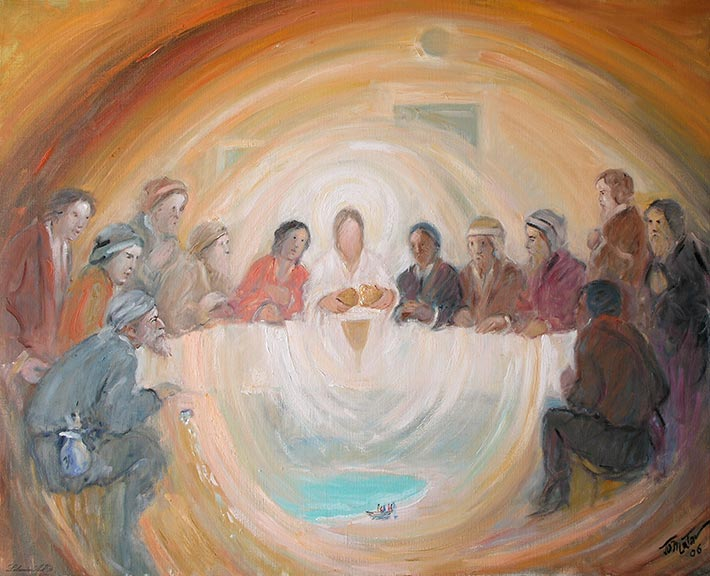
“I Am the Bread of Life” by Lebanese painter Joseph Matar

The Jews there began to grumble about him because he said, “I am the bread that came down from heaven.” They said, “Is this not Jesus, the son of Joseph, whose father and mother we know? How can he now say, ‘I came down from heaven’?”

“Stop grumbling among yourselves,” Jesus answered. “No one can come to me unless the Father who sent me draws them, and I will raise them up at the last day.It is written in the Prophets: ‘They will all be taught by God.’ Everyone who has heard the Father and learned from him comes to me. No one has seen the Father except the one who is from God; only he has seen the Father. Very truly I tell you, the one who believes has eternal life.

I am the bread of life. Your ancestors ate the manna in the wilderness, yet they died. But here is the bread that comes down from heaven, which anyone may eat and not die. I am the living bread that came down from heaven. Whoever eats this bread will live forever. This bread is my flesh, which I will give for the life of the world.” (New International Version)

Christians everywhere hold to Jesus as the Son of God, Lord of the universe, and Savior of all.

However, for most people who were following Jesus around in the first century, this was not their understanding of Christ. In his earthly ministry, Jesus spoke in ways that introduced people to who he really was and sought to bring them to a point of following him based on his identity. 

Jesus wanted the crowds to see him for who he really is – themselves for what they really needed – and follow him based on the deepest needs of their lives.

I believe Jesus is the hope of all nations and all people, and in him humanity’s most basic and profound needs are met for forgiveness, love, and purpose in life. To address this, I ask three basic philosophical and theological questions of life:

What should human beings seek in life?

The responses in history are legion. The ancient Greek philosopher Aristotle thought a proper appreciation for an ethical and virtuous life found in practical wisdom was where people’s most concerted efforts should be. 

Karl Marx, the father of communism and socialism believed the proletariat should use their heads and their hands to rise above their economic conditions and oppression.

In the late 1960’s, Bobby Kennedy said we ought to be working the hardest to achieve justice and not advance ourselves on the misfortunes of others.

In more recent times, the Harvard Business Review is continually on the lookout for the best ways of being efficient, productive, and making the most of time because work itself is paramount.

Jesus insisted that people are not to work for food that spoils, but for food that endures to eternal life. Christ positioned himself as the bread of life – the one who is able to sustain humanity and enable to thrive and flourish in life.

By literally feeding thousands of people, Jesus wanted the people to understand the source of life itself comes from him. Jesus aspired beyond providing a supper for folks – he desired the people to feast on himself – to ingest him, to take him into their lives in a deep and profound way as the fulfillment of all the hope and promises of the Old Testament. 

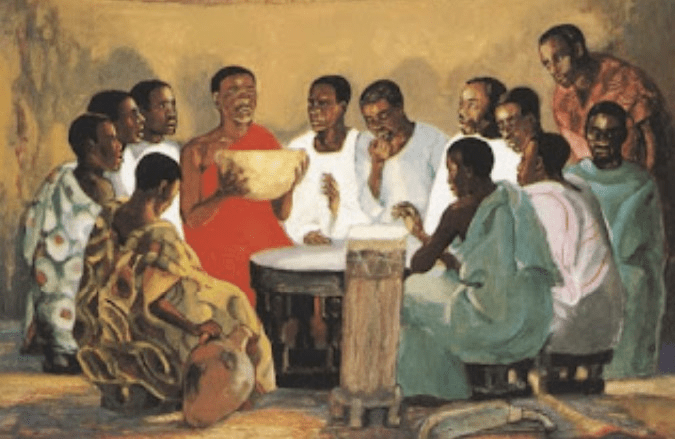
“The Lord’s Supper” by Cameroon artist Jesus Mafa, 1973

Jesus is the bread, the basic staple of life, that meets the cravings and needs of all people everywhere. Starving people, in both body and soul, find in Jesus a meal which keeps on giving, a feast of grace that is both delectable and unending.

The answer to my own question is that, for me, one’s highest pursuit and greatest quest is Jesus. Apart from Christ, I will starve. Furthermore, Jesus is not some cheap fast food off a value menu; he is real soul food to be ingested and enjoyed with others.

I believe people need Jesus. A passionate seeking of Jesus, to follow him, live for him, center life around him, is my most ardent desire. I do not simply desire Jesus for what he can do for me; I vigorously chase after him because if I do not have Jesus, I will die, I will starve to death. 

For me, Jesus is so much more than a nice addition to my life, like a new puppy; Jesus is Lord and Savior. I must consume him, or I will be completely undone, and I will not survive! Jesus is my bread, my food, my life!  I cannot survive on a daily crumb, but I feast on every word that comes from the mouth of Jesus because in Christ there is the life that is truly life.

What should human beings do in life?

Believe. To have and keep faith in the One God has sent, Jesus, is the primary “work” that pleases God.

Jesus communicated to the crowd that they can do so much more than follow him for another earthly meal – they can place their faith and hope in him for food that will last, food that will transcend the three-dimensional world.

Faith is more than an intellectual recognition to some facts about Christianity.

Belief is not about always having clarity and certainty to every facet and loci of Christian doctrine. Rather, Christian faith is a complete trust in Jesus as our hope and our life.

Education, economic uplift, political stability, and institutional peace and justice are important activities for this world. For the Christian, the accomplishment of these and so much more comes from the grace of God in Christ. As people come to the end of themselves with their homebrewed and half-baked attempts at being satisfied, Jesus stands at the door and knocks, the Living Bread who offers himself for humanity’s deepest needs.

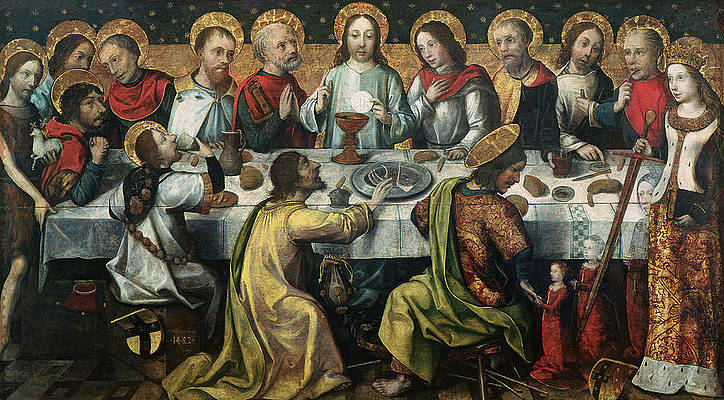
“The Last Supper” by Godefroy, 1482, C.E.

Giving kudos to Jesus might be nice, yet Christ himself cares about folks placing their trust in him for grace, forgiveness, and hope in their world. Jesus longs to reconnect people with God through giving himself as the means of making that happen.

All the works we do in this life, every good deed we accomplish, and each positive action we do are all helpful and necessary… and they all pale in comparison to the greatest work of all, to believe in Jesus Christ as the hope of this world, the hope of your family, the hope of the church, and the hope of your life. It’s all accessed by faith in the Son of God who loved me and gave himself for me.

Church buildings and furniture, stained-glass windows, pews, and even the Bible are not Jesus – they are simply and hopefully signs which point to him. They are all designed to lead us to Christ so that we may come to him. And coming to Christ is what the Lord’s Supper, Holy Communion, the Eucharist, and any other description you want to give about ingesting Jesus is about. The elements of bread and cup bring us to Christ so that we can experience Jesus and be joined to him by faith in a mystical union of human and divine in the unseen heaven.

Conclusion

Where will you find true satisfaction and hope? Probably not in the clearance aisle at Wal-Mart. Likely not in conforming to cultural Christianity or embracing generic forms of Jesus as merely a good teacher and moral example.

Furthermore, life’s ultimate satisfaction and hope are not to be found in a spotless house and perfect kids; in working more hours and making more money. Nor will we find contentment and peace in the radical independence of doing things my way.

Jesus is the Bread of Life. Through ingesting him, passionately pursuing him, believing in him, and coming to him in everything, we find the life that is truly life. Do not settle for any substitutes to Jesus. Come to the real person.

Lord God, you said that when we seek you with all our hearts, you will be found.  As the deer pants for streams of water, so we, your people, long for you in a dry and weary land.  We hunger and thirst for your righteousness.  We deeply desire your presence in all things. So, we die to ourselves and surrender to your will and way for us, by faith trusting you will come into our lives and completely take over. May your blessing rest upon us as we seek Jesus. Amen.

Matthew 25:31-46 – Meeting Jesus

On a bright Sunday morning, Lefty and his wife Goatrude were sitting at home enjoying a leisurely cup of coffee together. Lefty was slowly going through some of his emails.

And then, it happened.

“Oh, my goodness, look at this!” said Lefty to Goatrude. “I got an e-mail from Jesus! It says he will be here at 10am on Sunday. Egad! That’s any minute now!”

“The house is a mess! Hurry! Let’s get this all picked up.” said Goatrude. “And, for God’s sake, where is that big Bible? It needs to be here on the coffee table when Jesus gets here!”

“I think I know where that Bible is….” said Lefty. After rummaging around a junk closet, Lefty found the Bible dusted it off, and placed it prominently on the coffee table as the centerpiece of the living room.

As Goatrude and Lefty were hurriedly trying to make everything just right for Jesus, there was a knock at the door.

“That must be Jesus!” said Goatrude. “Answer it, Lefty. And, for goodness sake, stand up straight and be polite. We want Jesus to see us at our best.”

Lefty answered the door, surprised to see a ragged looking young man on the step.

“I’m sorry to bother you on a Sunday morning, but I haven’t had anything to eat all weekend. Might you have some food to spare?”

Perturbed with this interruption, Lefty answered the young man harshly. “No, I don’t. You need to go, right away. I have an important guest coming, and he’ll be here anytime now.” And he slammed the door shut.

Lefty had barely began getting back to tidying the living room when another knock came at the door.

“He’s here!” said Goatrude, moving quickly toward the door. But when she opened it, there stood a harried looking woman.

“Hello. My car broke down and I can’t get it started. And my cell phone died. Might I come in for just a few minutes so that I can get a bit warmed up and make a phone call?” said the woman.

Goatrude rudely responded, “We all have problems lady. I’ve got my own right now. You try and get ready for a visit from Jesus at the last minute. Try someone else.” And with that, Goatrude shut the door.

Lefty and Goatrude continued their hasty preparations for a visit from Jesus, when yet a third knock came at their door. This time, they answered it together, believing this to be Jesus for sure.

But when they opened the door, a frantic husband immediately said, “My wife just fell on the sidewalk. Please help me!”

“For God’s sake, man, we’re about to have Jesus here! We can’t be seen with a woman lying in front of our house! Get her up and go next door. And make it quick!”

Together, Goatrude and Lefty shut the door. Then, they sat down and anticipated Jesus to show.

Minutes pass… It’s now 10:15 and no Jesus. So, Goatrude, looking at Lefty, says, “I never figured Jesus to be somebody who is late. Maybe he got held up.”

“Hey, how about if I open this Bible and read something. When Jesus gets here, we’ll impress him with some knowledge. We’ll be the talk of the town, hosting Jesus.”

So, Lefty opened the big book, randomly turned to a page, and began reading….

“When the Son of Man comes in his glory, and all the angels with him, he will sit on his glorious throne. All the nations will be gathered before him, and he will separate the people one from another as a shepherd separates the sheep from the goats. He will put the sheep on his right and the goats on his left.

“Then the King will say to those on his right, ‘Come, you who are blessed by my Father; take your inheritance, the kingdom prepared for you since the creation of the world. For I was hungry, and you gave me something to eat, I was thirsty, and you gave me something to drink, I was a stranger and you invited me in, I needed clothes and you clothed me, I was sick, and you looked after me, I was in prison, and you came to visit me.’

“Then the righteous will answer him, ‘Lord, when did we see you hungry and feed you, or thirsty and give you something to drink? When did we see you a stranger and invite you in, or needing clothes and clothe you? When did we see you sick or in prison and go to visit you?’

“The King will reply, ‘Truly I tell you, whatever you did for one of the least of these brothers and sisters of mine, you did for me.’

“Then he will say to those on his left, ‘Depart from me, you who are cursed, into the eternal fire prepared for the devil and his angels. For I was hungry, and you gave me nothing to eat, I was thirsty, and you gave me nothing to drink, I was a stranger, and you did not invite me in, I needed clothes and you did not clothe me, I was sick and in prison and you did not look after me.’

“They also will answer, ‘Lord, when did we see you hungry or thirsty or a stranger or needing clothes or sick or in prison, and did not help you?’

“He will reply, ‘Truly I tell you, whatever you did not do for one of the least of these, you did not do for me.’

“Then they will go away to eternal punishment, but the righteous to eternal life.” (New International Version)