How, Then, Shall We Live? (Luke 16:19-31)

The Rich Man and the Poor Man by Laura Jeanne Grimes, 2005

“There was a rich man who was dressed in purple and fine linen and lived in luxury every day. At his gate was laid a beggar named Lazarus, covered with sores and longing to eat what fell from the rich man’s table. Even the dogs came and licked his sores.

 “The time came when the beggar died, and the angels carried him to Abraham’s side. The rich man also died and was buried.In Hades, where he was in torment, he looked up and saw Abraham far away, with Lazarus by his side. So, he called to him, ‘Father Abraham, have pity on me and send Lazarus to dip the tip of his finger in water and cool my tongue, because I am in agony in this fire.’

 “But Abraham replied, ‘Son, remember that in your lifetime you received your good things, while Lazarus received bad things, but now he is comforted here, and you are in agony. And besides all this, between us and you a great chasm has been set in place, so that those who want to go from here to you cannot, nor can anyone cross over from there to us.’

 “He answered, ‘Then I beg you, father, send Lazarus to my family, for I have five brothers. Let him warn them, so that they will not also come to this place of torment.’

 “Abraham replied, ‘They have Moses and the Prophets; let them listen to them.’

 “‘No, Father Abraham,’ he said, ‘but if someone from the dead goes to them, they will repent.’

 “He said to him, ‘If they do not listen to Moses and the Prophets, they will not be convinced even if someone rises from the dead.’” (New International Version)

Many people look for a miracle at some point in life, especially for family. Whenever we see relatives walking far from God or siblings living without much thought to the words and ways of Jesus, it can be disconcerting. We may reason that if they could just experience or see some great miracle, then they will surely believe and embrace Jesus as Savior and Lord. 

Yet, Christ’s parable to us of the rich man and Lazarus graphically depicts an important message: God has already revealed divinity to humanity through Moses and the Prophets (the Old Testament). 

If people are not convinced by what already exists and what has existed for a long time, they likely will not respond when the miraculous slaps them in the face.

Maybe we too often look for the dramatic because the mundane typically rules the day. Perhaps what we are really looking for is already present in God’s revelation to us. It could be that the greatest task we have is not to beg for a miracle (even though there is nothing wrong with that!) but first to be quiet and listen to the Spirit of God speak through the Word of God so that our prayers to God arise in God’s way and God’s time.

Today’s Gospel story gets at the heart of where we immediately and reflexively turn when in dire straits. There is nothing wrong with turning to others, consulting trusted resources, or even Google. Yet, Holy Scripture is timeless. It contains everything we need for life and godliness in this present age. And I believe it has the answers to life’s most pressing questions.

Everyone has their trusted sources, as well as sources we don’t trust. If a person has a pattern of not consulting or investigating Holy Scripture, then it doesn’t matter who encourages them, even if it is a trusted person who shows up from the grave, to look into the Bible’s contents and believe it’s message.

If we look closely at the story, we are told the poor man’s name: Lazarus. And we are not told the rich man’s name. You see, the poor man, Lazarus, had his name written in the Book of Life. The rich man’s name cannot be spoken because it is not found there.

There are two choices in life, two opposing paths we can take. One is to choose pleasure and overlook the great needs of the earth. Like old Jacob Marley in the Christmas Carol, it is to forge a chain, link by link, day after day, which will eventually leave one in bondage and regret.

The other choice is hope. To look ahead by faith and see the eternal things which are coming, then shaping our existence to act in sync with permanent values, is to choose life. Although this may bring deprivation, even suffering, in this present existence, the decision to forego temporary pleasure for eternal glory shall be rewarded. It is to live for future prosperity through present affliction.

So, how shall we then live?

  • Will we anchor our souls in the good bosom of bettering our fellow humanity?
  • Is there an acknowledgment that the measure we give to others shall eventually be given to us?
  • Do we seek to hold faith with a neighbor in their poverty?
  • Are we trusting so much in our five senses – sight, smell, taste, hearing, touch – that we either cannot or will not trust in the sixth sense of the spirit which tells us to believe Moses and the prophets?

Christ has risen. Christ is coming again. If we align our lives with spiritual truth, we shall find our names written in the Book of Life. Let us actively look for Lazarus in our lives, so that we don’t carelessly step over him day after day while selfishly indulging in the good things of this life.

Mighty God, you have done miraculous things. Help me see what you have already done and teach me to listen so that your revelation becomes alive to me. Holy Spirit, impress the redemptive event of Christ’s resurrection on the hearts of all who do not know you so that they might know your amazing grace. Amen.

Welcome Humility (Luke 9:43b-48)

While everyone was amazed at all that he was doing, he said to his disciples,“Let these words sink into your ears: The Son of Man is going to be betrayed into human hands.” But they did not understand this saying; its meaning remained concealed from them, so that they could not perceive it. And they were afraid to ask him about this saying.

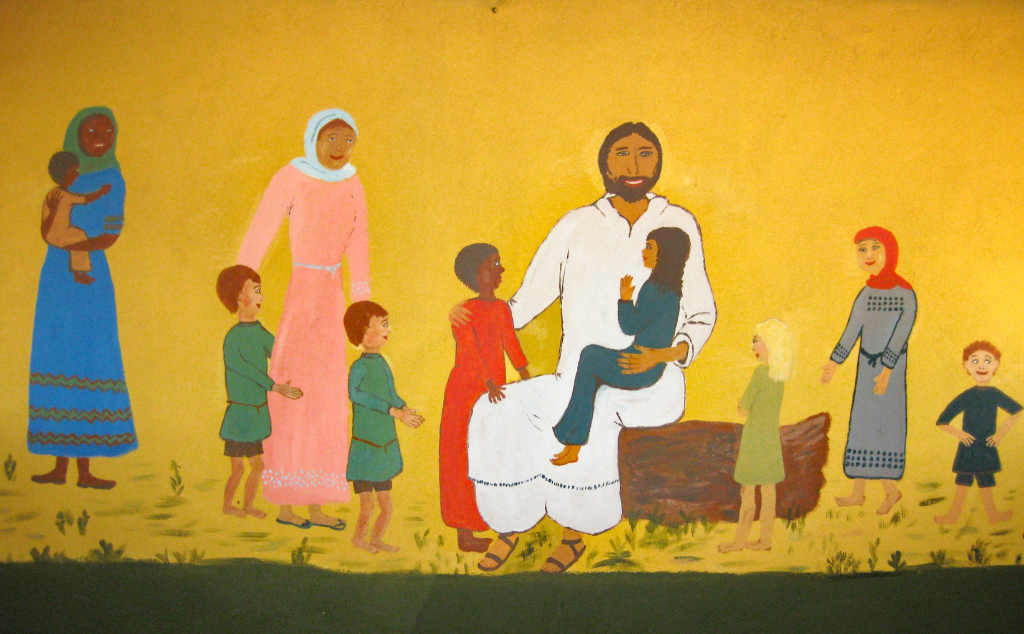
An argument arose among them concerning which one of them was the greatest. But Jesus, aware of their inner thoughts, took a little child and put it by his side and said to them, “Whoever welcomes this child in my name welcomes me, and whoever welcomes me welcomes the one who sent me, for the least among all of you is the greatest.” (New Revised Standard Version)

Pride and Humility

Whenever we are not focused on what is most important, we then tend to focus on trivial matters which help no one. Another way of putting this: Getting stuck in pride makes us concerned for our position, whereas being humble creates opportunities to serve our fellow humanity.

“It was pride that changed angels into devils; it is humility that makes people as angels.”

St. Augustine

The ultimate humility was the cross of Christ. Jesus submitted himself to death, even death on a cross. He emptied himself, taking the posture of a servant. (Philippians 2:7-8) Jesus Christ did not come to be served but to serve; and to give his life as a ransom for many. (Mark 10:45)

God’s benevolent, gracious, and ethical realm is accessed and rests upon humility.

Wherever there are humble hearts, there is change, transformation, and new life. Where there is the presence of pride, there you will find posturing, positioning, and peacocking – nothing changes.

Humility enables a person to see beyond the end of their nose. A humble posture allows an individual to observe the wounds and pains of those with little power and low societal status. A preoccupation with being great and believing we are indispensable is to amble down a blind path.

Children and Humility

In the ancient world, children were on the lowest rung of society’s ladder. They were mostly looked upon as potential adults – little people who would someday contribute to the welfare of the family business and the community.

Until they became adults, kids were expected to begin learning their future trade with full submission and obedience. They had no power or leverage over others.

So, when Jesus told his disciples to take the lowly position of a child, he was not talking about innocence or cuteness. Christ meant for his followers to divest themselves of prideful positioning for greatness and to instead embrace the helplessness and vulnerability of children.

For Jesus, a child was closer to God’s rule and reign because they existed in truly humble circumstances; whereas an adult had too much concern with looking good and seeking every advantage possible.

The Upside-Down of Humility

Life is more upside-down than we sometimes realize. Adults have more to learn from kids than kids do from adults. To listen to a child is about as near to hearing the voice of God as you will get.

Let us consider how pride and humility work out in our daily lives. For example, when down and hurting, maybe you have had the experience of another person trying to one-up your pain, as if what they experienced was worse than you. In their pride, they ignore that pain is personal, as if it’s a one-size-fits-all. 

Invalidating a person’s state of being or feelings does no one any good.  It happens because of pride and a lack of humility.

“All streams flow to the ocean because it is lower than they are. Humility gives it its power.”

Lao Tzu

Imagine going to see a doctor who turns out to be arrogant in his approach. He fails to really listen to you. He just gives a quick exam and offers his diagnosis with a regimen of more pills to take. You are left sitting there while he is off to another patient, colonizing another person’s mind and emotions with his expertise.

I am not giving doctors a hard knock. I work in a hospital and have great respect for medical professionals who provide wise care plans. Yet, it is likely that you, like me, have had that occasional experience of the doctor full of themselves with all the right answers on your pain and situation.

You may have also had the unfortunate experience of having a pastor, therapist, or counselor assess your situation with little information and even smaller compassion.  Like writing a script for pills, they give you a few Bible verses and tell you to quit sinning and live obediently.

The Good Life and Humility

If pride and arrogance are the original sin, then the remedy to that malady is humility.

No matter who we are – whether doctors, pastors, laypersons, patients, or whomever – we are meant and designed by our Creator God to live a humble life. That means we are to both give and receive humility-based care.

Humility is the cornerstone to every good thing in this life.  Jesus said:

“Blessed are the poor in spirit, for theirs is the kingdom of heaven.” (Matthew 5:3, NIV)

The door of God’s kingdom swings-open on the hinges of humility.

The Apostle Paul, seeking to follow the Lord Jesus in his teaching and humility said:

“Since God chose you to be the holy people he loves, you must clothe yourselves with tenderhearted mercy, kindness, humility, gentleness, and patience.” (Colossians 3:12, NLT)

Basic human interactions with one another are to be grounded in humility. The old prophet made his expectations clear:

“He has told you, O mortal, what is good; and what does the Lord require of you but to do justice, and to love kindness, and to walk humbly with your God?” (Micah 6:8, NRSV)

Life is truly life when it is humility-based.

Care and Humility

Caring for another person is not a simple linear matter of offering opinions or expertise; it is believing that the one needing care is the expert on herself. The caregiver has as much to learn from the care-seeker.

The beauty of humility-based care is that two people discover together how to grow, thrive, and flourish in a situation where it is not currently happening.

Breakthroughs occur in the soil of humility when the care-seeker comes out of the darkness and into the light through mutual discovery and insight.

We live with the confidence of the Psalmist:

“God leads humble people to do what is right and teaches them the way.” (Psalm 25:9, GW)

In the end, God saves and heals, not you or me. That God chooses to use us to bring care to others ought to elicit the utmost of humility within us.

Welcome humility into your life and you will find a truly abundant life.

Lord God, let me have too deep a sense of humor to be proud.

Let me know my absurdity before I act absurdly.

Let me realize that when I am humble, I am most human, most truthful, and most worthy of your serious consideration.

Amen.

Be Generous (Mark 12:41-44)

The Widow’s Mite by James Christensen

Jesus sat down opposite the place where the offerings were put and watched the crowd putting their money into the temple treasury. Many rich people threw in large amounts. But a poor widow came and put in two very small copper coins, worth only a few cents.

Calling his disciples to him, Jesus said, “Truly I tell you; this poor widow has put more into the treasury than all the others. They all gave out of their wealth; but she, out of her poverty, put in everything—all she had to live on.” (New International Version)

Money. Can’t live without it; can’t live with it. *Sigh*

If there’s a litmus test of one’s true benevolence and spirituality, it’s how money is handled and/or mishandled. And it isn’t as cut-and-dried as giving large sums of it away.

In today’s short Gospel lesson, the offerings of rich people were unimpressive to Jesus. To him, their big donations are insignificant.

On the other hand, a poor widow’s measly offering is validated as a rich contribution. In giving everything, Jesus holds up the widow as an example for us to follow.

This raises a natural and interesting question: Does this mean everyone should give everything they have? Maybe. Maybe not. Yet perhaps the very question betrays how we tend to think about money – that it’s ours, we earned it, and we can do whatever we want with it.

But the fact of the matter is that we really own nothing. We are merely stewards, entrusted with using that which has been graciously given to us by God. The Lord is the owner of it all. It was never really ours to begin with.

Taken from this perspective, anything we hold onto and refuse to let go, no matter how large or small, is a form of theft. We have taken something that doesn’t belong to us. We aren’t satisfied with being stewards; we want to be owners and masters.

What you do with your money shows your allegiance to the true Owner of it. If it belongs to Caesar, well then, go ahead and give it to him. And if it belongs to God, then there isn’t an issue in distributing money in ways which benefit humanity and uplift the poor.

The widow knew that her money, what little of it she had, belonged to God. She seemed to understand that God’s values are very different from earthly values. The kingdom of heaven expects us to hold all things, money included, with open hands. Whereas the kingdoms of this world fully expect that people will hold their money with tight fists – which is why we have so many layers of cybersecurity around our assets.

Money is a means to an end and not the end itself. It is the means to ensure the welfare of the common good of all persons. It’s a tool to shape a better society, built not on the backs of the poor, but for the benefit of the needy so that everyone can participate fully in the community.

To build a petty kingdom and become master of a small world is nothing more than stealing from God and withholding resources where they are needed.

And to make things more complicated and challenging, in today’s world, time is money. It’s easy to write a check, transfer some funds, or allocate some resources for others. However, it is never easy to grace people with the gift of time. Relational connection takes time and effort – the kind of time many people believe they do not have. Yet, time also belongs to God, and it is to be stewarded with care, just like our money.

The Poor Widow’s Offering by Unknown artist

Let’s come back to the poor widow. After all, she is our example of true generosity.

In ancient Israel, those in poverty were not required to give. So, whenever the poor did so, they simply gave because they believed in the need to maintain all it took for the worship of God to happen. The widow was under no compulsion to give anything, let alone everything she had. She seemed to understand what the Apostle Paul discovered later:

The person who sows sparingly will also reap sparingly, and the person who sows generously will also reap generously. Each one of you should give just as he has decided in his heart, not reluctantly or under compulsion, because God loves a cheerful giver. And God is able to make all grace overflow to you so that because you have enough of everything in every way at all times, you will overflow in every good work. (2 Corinthians 9:6-8, NET)

A spirit of generosity is to be ubiquitous throughout Christianity. It is a spirit that doesn’t let the left hand know what the right hand is giving (Matthew 6:3). A generous spirit rightly discerns that where your treasure is, there your heart will be also (Matthew 6:21).

And the guide of altruistic giving is savvy to the reality that the accumulation of money often leads to the love of money. So, the generous person keeps temptation at bay by withholding love toward things so that love can be lavishly given to people. For some people, eager for money, have wandered from the faith and pierced themselves with many griefs. (1 Timothy 6:10)

Like the poor widow, we are to put our hope in God, who richly provides everything for our enjoyment.

Eternal God, we pray that stewardship will be our way of life. We acknowledge You as the source of all we have and all we are.

Loving Creator, help us to place You first in our lives by being prayerful, loving, and caring for our families neighbors in need, and by becoming less preoccupied with material things.

Sovereign Lord, help us to hear your call to be good stewards, caretakers, and managers of all your gifts by sharing them for your purposes. May Your priorities be our priorities. May we have an active and generous faith.

Blessed God, help us to serve the Church, our communities, and our world with Your good and gracious gifts; and with joyful and grateful heart, through Jesus Christ our Lord. Amen.

The Parables of the Lost Sheep and the Lost Coin (Luke 15:1-10)

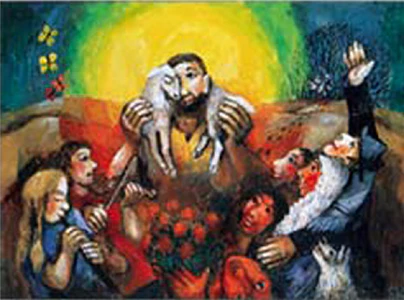
By Sieger Koder (1925-2015)

Now the tax collectors and sinners were all gathering around to hear Jesus. But the Pharisees and the teachers of the law muttered, “This man welcomes sinners and eats with them.”

Then Jesus told them this parable: “Suppose one of you has a hundred sheep and loses one of them. Doesn’t he leave the ninety-nine in the open country and go after the lost sheep until he finds it? And when he finds it, he joyfully puts it on his shoulders and goes home. Then he calls his friends and neighbors together and says, ‘Rejoice with me; I have found my lost sheep.’ I tell you that in the same way there will be more rejoicing in heaven over one sinner who repents than over ninety-nine righteous persons who do not need to repent.“

Or suppose a woman has ten silver coins and loses one. Doesn’t she light a lamp, sweep the house and search carefully until she finds it? And when she finds it, she calls her friends and neighbors together and says, ‘Rejoice with me; I have found my lost coin.’ In the same way, I tell you, there is rejoicing in the presence of the angels of God over one sinner who repents.” (New International Version)

Lost people matter to God… a lot. They matter so much to the Lord that one lost soul who is found is the grounds for a big celestial party. 

Note a simple observation of today’s Gospel lesson: If there is rejoicing in the presence of angels over one sinner who repents, then it is God who is doing the rejoicing. The Lord is absolutely giddy with joy over a lost person being found.

Jesus told two short stories, each teaching the same thing, so that we will be absolutely sure to get it: A loving God has unbounded joy over lost people being found. These parables of Jesus give us a glimpse of God’s own heart. The Lord would do anything to find a lost person, to restore and reconcile that person to right relationships. 

The Lost Sheep by Jorge Cocco Santángelo

God would go dumpster diving and wade through stinky nasty garbage to find just one lost valuable person.

Restoring lost people is such a high priority to God that the Father sent the Son to this earth. Jesus paid the ultimate price of a cruel death on a cross to reconcile a broken lost relationship between people and God.

I have not always been a devoted follower of Christ. I still remember what it felt like to be separated from God and estranged from the Church – it was lonely and awful, like being in a deep black hole with no way of getting out and no one around to help. 

But God mercifully sent people into my life to share good news with me and help me out of my prodigal way of life. I once was lost. But now I am found. When I turned from my path of destruction and embraced Jesus Christ, there was a big party in heaven.

God gathering wayward and lost persons is a gracious activity, seemingly free from criticism. But there was. The rightful Judge of the universe got judged by a group of spiritual simpletons. And because there were complaints leveled at Jesus for purposely going after the lost, it therefore needs to be asked: 

Where do we locate ourselves in these parables? 

The two stories were downright offensive to many of Christ’s original hearers. Those upset with Jesus were so inwardly focused that they believed ministry ought to revolve around them and their needs.

And, what’s more, the religious leaders were offended because they thought all the fuss about sinners would only highlight their sin. In other words, there ought to be no party and no rejoicing for people who have lived an ethically and morally dubious life.

Preaching grace is always offensive to people who work for their salvation. It is scandalous to such persons to hear that Jesus did not come to call the righteous, but sinners to repentance. 

If we hear Christ’s parables and the concern for lost sinners who don’t know Jesus and say, “Well, all this talk about outreach is well and good, but what about us?  What about me? After all, I never went down a path of immorality or hurt anyone. I’m a good person. Where’s my party?” Then, we must locate ourselves as the lost persons in need of being found by God’s grace.

Consider for a moment the worst sinner you can think of – a person for whom you would label as being akin to the devil…. Now picture that person being found by God and becoming a follower of Christ….

Would you attend the party to celebrate that person’s repentance, reconciliation, and recovery? 

If any of us feels justified in our hate, then we are the lost one in need of turning from our sin.

In leaving the ninety-nine sheep in the flock and going after the one sheep, God gave preferential attention to the lost….

Can you live with that? 

These parables of Jesus have significant meaning for church programs, budgets, and committees. By most estimations, only one-in-five lost people in America even knows one Christian. Statistics like that are what keep me up at night; it deeply saddens me. It drives me to prayer.

God’s unconditional mercy and amazing grace is what makes all the difference. 

If we lose the sense of awe and appreciation for what God has done for us in Christ, then there will be no outreach. Finding lost people is not dependent on completing a class on evangelism or getting training in how to answer every question.

Outreach is fueled by passion and desire. Healthy Christians reproduce themselves. I assume you didn’t take a class on how to procreate – you just had the desire and the willingness; and then, you celebrated nine-months later, the birth of new life.

New life always needs to be celebrated because that’s what God does. Yet, the party cannot commence until the lost are found….

O God – blessed Father, Son, and Spirit – sanctify all believers everywhere with your abiding presence. Enlighten the minds of your people more and more with the light of the Gospel. Bring lost people to the knowledge of our Savior Jesus Christ; and those who are walking in the way of life, keep steadfast to the end. Guard those who are strong and prosperous from forgetting you and straying from the flock. Increase in us your grace and love so that we may participate with you in finding the lost. Amen.