Let the Little Children Come (Luke 18:15-17)

People were also bringing babies to Jesus for him to place his hands on them. When the disciples saw this, they rebuked them. But Jesus called the children to him and said, “Let the little children come to me, and do not hinder them, for the kingdom of God belongs to such as these. Truly I tell you, anyone who will not receive the kingdom of God like a little child will never enter it.” (New International Version)

I happen to believe that kids are closer to the kingdom of God than most adults.

Us big people have developed a lot of baggage over the years. And all that stuff tends to obscure God’s kingdom and the light of Christ within us.

Kids, however, especially small children, still haven’t discerned any veil between the seen and unseen worlds. They freely move between them both without any problem.

So, of course, Jesus wanted to be around children. If he had any homesickness at all, I’m sure the presence of kids made him feel at home more than anywhere else on this earth.

Jesus is our Immanuel, God with us.

The kingdom of God is here within us.

The disciples of Jesus had some difficulty with Christ’s branding of the message because it was not exclusive enough for them. They wanted limits on the us part.
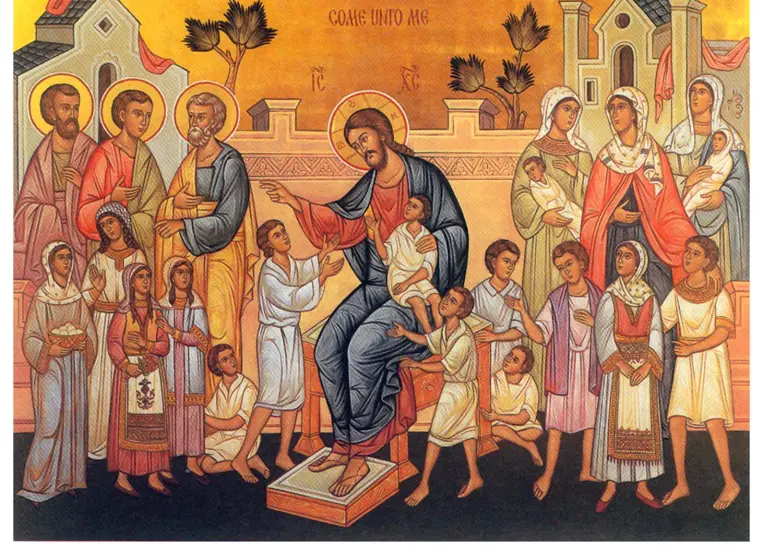
Kids are part of that mass of people that God is with. Children deserve as much or more attention than adults. More than simply saying that we care about kids, we need to be like Jesus. He let the children come to him and was intolerant of anyone preventing kids from doing so.

Since the disciples were, ironically, still living in a small world, they rebuked those who brought little children to Jesus.

We aren’t specifically told why the disciples rebuked the adults bringing children to Jesus. Maybe the children were making a lot of noise and were being a nuisance in the middle of Jesus’ teaching. Perhaps the disciples had Jesus on a tight time schedule and this bringing kids to Christ thing was causing a delay. It could be that the disciples simply saw children as an interruption to the “important” work of ministry. 

I tend to think that the disciples simply failed to appreciate the children. The dominate view of kids in the ancient world was to see them as potential adults. Kids were pretty low on the ladder of society. The disciples likely saw no reason for children to be involved in what was happening.

The babies and toddlers and small children were brought so that Jesus might place his hands on them and pray for them. That still seems to me to be the best reason to bring kids to Jesus. 

“This story teaches us that Christ does not receive only those who voluntarily come to Him of a holy desire and moved by faith, but also those who might not yet be old enough to realize how much they need His grace….  From this we gather that His grace reaches to this age of life also….  It would be cruel to exclude that age from the grace of redemption.”

John Calvin

“Jesus does not only save repentant adults; he also saves dependent children and all those whom we think are incompetent to respond to Jesus.”

Frederick Dale Bruner

Jesus flat out rebuked his disciples for hindering the little children from coming to him. He wanted just the opposite of what was taking place. Why? Because the kingdom of heaven belongs to such little people as these. 

As mentioned, children were at the bottom of the societal pecking order in the ancient world. Their place in that society was to be respectful and quiet, to speak only when spoken to, and to never interrupt an adult.

Yet, Jesus took the time to touch them and pray for them. He invited this interruption to his schedule. Christ bluntly told his disciples that they were the ones being the hindrance, not the kids.

I baptize all sorts of people, including kids and babies. Why? Because in baptism, I recognize that the smallest ones among us can come to this holy sacrament. I understand that in baptism the Holy Spirit begins and initiates the process of salvation that will take that little one from infancy to adulthood and eventual death. I discern that, ideally, the child grows to live into their baptism by recognizing by faith that Jesus died and rose from the dead and grants grace and forgiveness to all who come to him. 

In that process of salvation, of coming to know Jesus, we have the sacrament of the Lord’s Table to strengthen our faith and demonstrate to us that the saving work of Jesus that has been accomplished. It is a Table of grace for all the members of Christ’s Church. 

In my Reformed Christian tradition, we believe that Jesus is not physically, but spiritually present at the Table.  Because Jesus is present, we are able to receive the grace available to us as Christ’s members. So why, in light of this reality, and the words and practice of Jesus toward children, would we ever hinder and prevent the smallest members among us from participating at the Table?

Here’s a thought: If Jesus himself were serving communion in a church, and a group of 2-year-old children came toddling up to the Table to see Jesus, would you stop them from doing so? Or much like the disciples, would you rebuke those bringing children to Jesus?

As for me, I’d rather not be rebuked by my Lord.

Jesus gave children the three gifts they most need: time, touch, and prayer. Parenting and teaching are holy vocations, and we have the wonderful privilege of bestowing these same gifts on our children, grandchildren, and students.

Time, touch, and prayer are ways we bless children. And, what’s more, as God’s children, we are all to approach Jesus and spend time with him, allow him to touch us, and interact with him through prayer. 

May we all have the humility to bend down at eye level to the littlest among us so that we and others will know that the kingdom of God is among us.

The Longing of Christ’s Heart (Matthew 23:37-24:14)

“If Thou Had’st Known” by William Brassey Hole (1846-1917)

“Jerusalem, Jerusalem, you who kill the prophets and stone those sent to you, how often I have longed to gather your children together, as a hen gathers her chicks under her wings, and you were not willing. Look, your house is left to you desolate. For I tell you, you will not see me again until you say, ‘Blessed is he who comes in the name of the Lord.’”

Jesus left the temple and was walking away when his disciples came up to him to call his attention to its buildings. “Do you see all these things?” he asked. “Truly I tell you, not one stone here will be left on another; everyone will be thrown down.”

As Jesus was sitting on the Mount of Olives, the disciples came to him privately. “Tell us,” they said, “when will this happen, and what will be the sign of your coming and of the end of the age?”

Jesus answered: “Watch out that no one deceives you. For many will come in my name, claiming, ‘I am the Messiah,’ and will deceive many. You will hear of wars and rumors of wars but see to it that you are not alarmed. Such things must happen, but the end is still to come. Nation will rise against nation, and kingdom against kingdom. There will be famines and earthquakes in various places. All these are the beginning of birth pains.

“Then you will be handed over to be persecuted and put to death, and you will be hated by all nations because of me. At that time many will turn away from the faith and will betray and hate each other, and many false prophets will appear and deceive many people. Because of the increase of wickedness, the love of most will grow cold, but the one who stands firm to the end will be saved. And this gospel of the kingdom will be preached in the whole world as a testimony to all nations, and then the end will come. (New International Version)

Christ’s cry of love for the city of Jerusalem– the longing to bring the people together and shepherd them with care and compassion – came after a very pointed pronouncement of woes against a distorted religion that was in vogue at the time. Jesus saw the current state of worship, found it to be terribly wanting, gave a scathing rebuke, and saw ahead to its ultimate demise.

Jesus did not just blast the establishment, then humph and walk away disgusted. Instead, he looked with sadness over the city and broke into a tear-filled, heart-wrenching love song for his wayward people. Jesus was both angry and sad because of his deep concern for all people to know the true worship of God and to find their ultimate purpose and meaning in him.

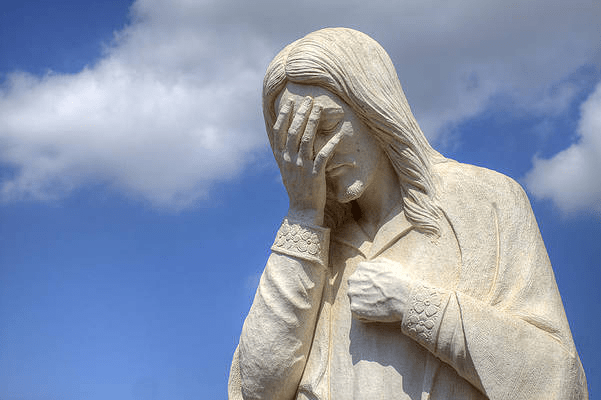
“And Jesus Wept” statue in Oklahoma City, Oklahoma

Any religious fool can rant about the ills of the world, ungodly persons, and defective institutions. However, it takes a person with the heart of Jesus to weep over it all and follow him into suffering on behalf of others so that they might come to the peaceable kingdom of righteousness. 

If our hearts are not unraveled over the sin and injustice of the world, we are in no position to rant about anything. That’s because grace and mercy is the currency of God’s economy. 

Thus, we need to repent like we mean it, pray as if our lives depended on it, and proclaim the good news of Christ as if there is not a tomorrow.

In a results-driven culture, congregations want clear strategy plans for ministry. Yet, a group of people can implement the best of ministries and still not realize their well-laid plans. If Jesus didn’t see what he wanted to happen come to fruition in Jerusalem, then I’m not sure how any of us can always expect success in ministry. We may fail in many ways; but let us not fail to weep over our communities and neighborhoods and long for them to know Christ.

It’s okay that neither every ministry goes as planned nor every person is blessed by what we do. If we find it hard to accept this, and feel out of control, then we want to know the future – how everything is going to shake-out. This is precisely what the disciples wanted to know, since their expectations weren’t realized.

Jesus essentially told them that things were going to get even tougher. Therefore, they need to be ready and persevere through the adversity. And some of that trouble will be downright cataclysmic. Jesus did not give his disciples a seminar on having a successful ministry; he simply told them to endure suffering and focus on proclaiming the gospel.

But for that to happen, we need to accept that we cannot control every variable of ministry and plan for every contingency. The only guarantees we have is that God is with us, and Christ is coming again. That’s it, my friends.

So, instead of control, we must accept our limitations and practice self-control. We can continually monitor our own internal motivations and desires so that they are in constant alignment with the words and ways of Jesus – including a heart of love that weeps over the brokenness and stubbornness of the world. 

Followers of Jesus walk the only true road of Christian discipleship: the path of humility. Out of all the characteristics that Jesus could have described himself, the only two words he ever used were “gentle and humble.” (Matthew 11:29)

Jesus Weeping Over Jerusalem, by Enrique Simonet Lombardo (1866-1927)

Jesus is the perfect example of a leader who always ministered with a complete sense of his divine power, human limitations, and concern for others. Christ never believed he was the reason for his own success, nor thought he was the reason for another’s failure of faith. Instead, Jesus always connected what he was doing to the will of his Father in heaven.

You can only avoid the seduction of arrogant pride when you recognize that you are not God and need the help of others. Truly humble folk dig a hole, throw their ego into it, and pour concrete on top of it. This allows them to listen deeply, give generously, and encourage others liberally.

Standing firm to the end doesn’t come through crafting complicated charts of the end times; it comes through being humble, being grounded in the here-and-now, being attentive to the people around us, and being a guide for the lost. More importantly, it’s what Christ wants us to be.

Loving Lord Jesus, let me have your zeal for God’s house and your heart for lost people! Change my heart, O God, and let it reflect your grace and truth in everything I say and do; through Christ my Savior, who with you and the Holy Spirit, reign now and forever. Amen.

Like Father Like Son (John 5:19-29)

The Trinity, by Ukrainian painter Feodosiy Humeniuk, 1981

Jesus responded to the Jewish leaders: 

“I assure you that the Son can’t do anything by himself except what he sees the Father doing. Whatever the Father does, the Son does likewise. The Father loves the Son and shows him everything that he does. He will show him greater works than these so that you will marvel. 

As the Father raises the dead and gives life, so too does the Son give life to whomever he wishes. The Father doesn’t judge anyone, but he has given all judgment to the Son so that everyone will honor the Son just as they honor the Father. Whoever doesn’t honor the Son doesn’t honor the Father who sent him.

I assure you that whoever hears my word and believes in the one who sent me has eternal life and won’t come under judgment but has passed from death into life.

I assure you that the time is coming—and is here!—when the dead will hear the voice of God’s Son, and those who hear it will live. Just as the Father has life in himself, so he has granted the Son to have life in himself. He gives the Son authority to judge because he is the Human One.

Don’t be surprised by this, because the time is coming when all who are in their graves will hear his voice. Those who did good things will come out into the resurrection of life, and those who did wicked things into the resurrection of judgment.”

(Common English Bible)

So goes the parent, so goes the child. Sons look and act a great deal like their fathers. And there is no mistaking the resemblance between Father of the heavens and Son of the incarnation.

In Christianity, to see Jesus is to see God. To know Christ is to know the Lord. They are distinct, yet inextricably linked as one; each is differentiated from the other in personhood, yet united with the same divine substance.

The deity of the Father and the deity of the Son is one, equal in glory, co-eternal in majesty.

What the Father is, the Son is.

Uncreated, eternal, almighty, and sovereign is the Father; uncreated, eternal, almighty, and sovereign is the Son.

The Father and the Son are not two gods but one God.

There is only one Father; there is only one Son. Each is neither greater nor lesser than the other.

Whoever wants to be saved from guilt, shame, sin, death, and hell – and to be delivered from the injustice of the world, the failings of oneself, and the machinations of evil, should think about the Father and the Son and the Spirit, the Holy Trinity, one God.

– Athanasian Creed

So, why is all this creedal Christian doctrine of any importance? Why pay attention to such things?

Because there are many issues and problems in this world of great importance which must be addressed and dealt with. We need to have some idea of how to go about: 

  • Governing ourselves as a free people
  • Eradicating poverty and disease
  • Educating our children
  • Paying taxes
  • Providing excellent and cost effective healthcare for everyone
  • Dismantling racism
  • Seeking peaceful international relations
  • Building responsible and accountable local community relationships
  • Supporting small businesses
  • Helping workers make a decent contributive living
  • Loving our families and faith communities 

It is my unshakable conviction that all these issues, and many others, need more than our collective mental attention and physical resources; these problems also need spiritual resolutions and solutions.

Seasons, years, centuries, and millennia come and go. People are born, live, and die. Generations exist and then are no more. Civilizations rise and fall. Through it all and above it all is the person of Jesus.

Christ is alive. He brings breath from dust, beauty from ashes, order from chaos, stability from insecurity, dignity from disrespect, and meaning from uncertainty. Jesus gives life, abundant and to the full.

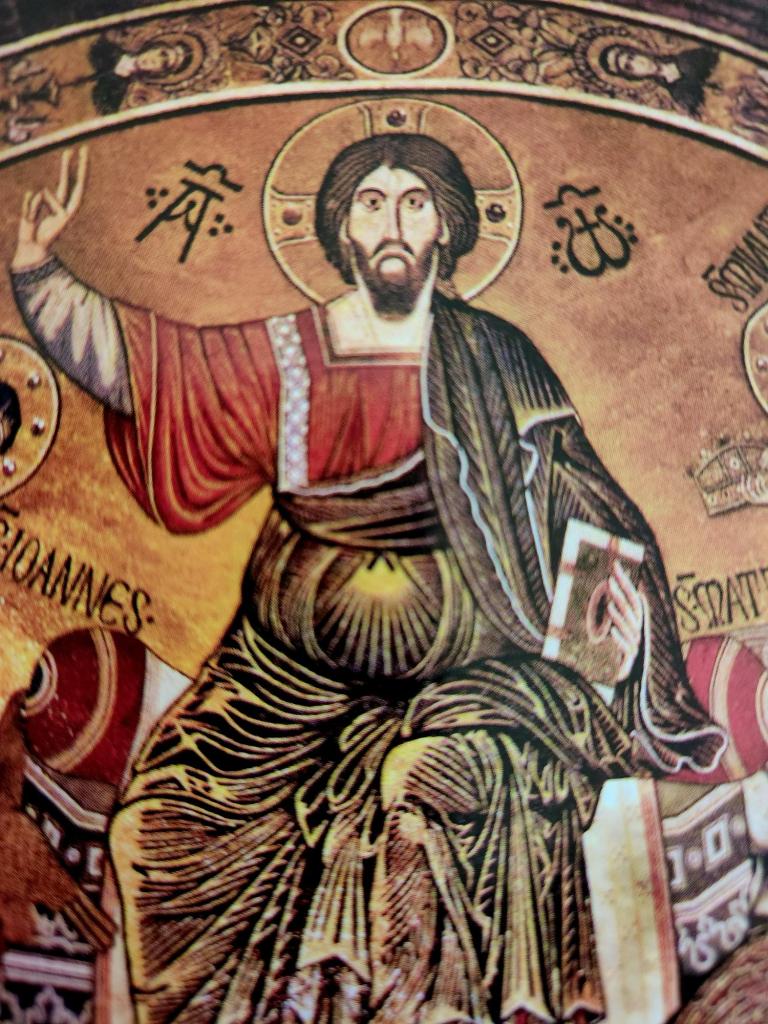
Christ the King, San Miniato al Monte Church, Florence, Italy

Today, this very moment, Christ is still on the throne of all creation. 

Human elections and institutions only have authority as given by Jesus, the Ruler of all.

Presently, Jesus is attentive and vigilant to people, actively interceding for us at the right hand of his Father in heaven. At this very moment, the Holy Spirit is the continuing presence of Christ on this earth, applying Christ’s redemption of humanity to the lives of millions. 

Sometimes we need to remember how important our spiritual resources are to living in this world – and to clarify what’s really of ultimate significance in this old broken world. 

My unwavering spiritual persuasion is this: People need the Lord. Therefore, it only makes good spiritual sense to live in ways that foster a connection with Jesus. 

This morning, I did what I do every morning – whether I’m sick or well, sad or happy, facing a busy day or a relaxed day – I began my day with Scripture reading, prayer, reflection, and gratitude. And I do it with the realization that Christ is King, that as the divine/human Lord of all, his:

  • authority is real
  • rule is benevolent
  • sovereignty is ubiquitous
  • reign is supreme
  • judgments are right and good
  • power is mighty enough to raise the dead

The Christian tradition holds that Jesus Christ is the exalted and glorified Son of God, the Sovereign authority over every dominion. The works of Jesus bear testimony to the cosmic reality that he is Lord of all. And, if that were not enough, Jesus shares his divine power with us, his people.

In the face of Christ’s majesty, the valid and appropriate response is sheer submission to Christ’s authority. 

Just as Jesus listened to the Father and obeyed the Father’s will, so we need to listen to Jesus and carry out his will. 

Just as Jesus enjoyed his relationship with the Father, so we are to bask in our wonderful relationship with Jesus. 

Since Jesus submitted to death on a cross and rose from the dead through God’s power, we now have access to that power by God’s grace through faith in Christ. And we are to use that divine power to take up our own cross and bear the great issues and problems of our day with all the spiritual resources granted to us in Christ Jesus.

Like Father, like Son. Like Christ, like Christians. May all followers of Jesus resemble their Lord in each word and in every way.

Almighty God, to you all hearts are open, all desires known, and from you no secrets are hid: Cleanse the thoughts of our hearts by the inspiration of your Holy Spirit, that we may perfectly love you, and worthily magnify your holy Name; through Christ our Lord. Amen.

A Parable of Two Sons (Matthew 21:28-32)

The Lord of the Parables by Argentine artist Jorge Cocco Santángelo

“What do you think? A man had two sons. Now he came to the first and said, ‘Son, go and work in the vineyard today.’

“‘No, I don’t want to,’ he replied. But later he changed his mind and went.

“The father said the same thing to the other son, who replied, ‘Yes, sir.’ But he didn’t go.

“Which one of these two did his father’s will?”

They said, “The first one.”

Jesus said to them, “I assure you that tax collectors and prostitutes are entering God’s kingdom ahead of you. For John came to you on the righteous road, and you didn’t believe him. But tax collectors and prostitutes believed him. Yet even after you saw this, you didn’t change your hearts and lives and you didn’t believe him. (Common English Bible)

Contemporary persons aren’t the only ones who want to know whose in and whose out; it’s been around forever.

In the ancient world of Jesus, people were always concerned about conformity to the established system and society of the way things are. For religious folk, who gets in and who gets left out was an important issue .So, Jesus decided to tell a parable about entrance into the kingdom of God.

Turns out, there are spiritual insiders on the outside of the kingdom, and spiritual outsiders who are the true inheritors of the kingdom.

The parable, at its core, is a warning to all the spiritually serious insiders: Beware, lest your energies be spent in correctness of behavior, conformity of belonging, and cockiness of belief rather than following Jesus. And, at the same time, the parable encourages spiritually estranged outsiders with the wonderful possibilities of a changed life. 

Far too many people arrogantly assume they have the inside track by what they believe, and not by doing God’s will.

It may be challenging for us to imagine how truly offensive Christ’s story was to the original hearers of the parable, so I restate it in a more contemporary form:

There was a man who was well respected in the community and had two sons. One son grew up and became a respectable member of the community, too. He was a successful businessman and gave lots of money to causes in his community, including new lights for the school football field – which was no small cost. He only asked that appropriate and prominent recognition be given him with a plaque bearing his name on each of the light poles. 

The other son was not so successful. He was the one in school who the teachers said, “Why can’t you be more like your brother?” There was nothing spectacular about this son. In fact, he lived an “alternative lifestyle” and people murmured behind his back. 

The Parable of the Two Sons by Jorge Cocco Santángelo

One day the father said to this son: “Son, go and work at my place of business today; I am going away and need you to do some of the tedious paperwork I have gotten behind on.” “No way!” he answered, but later felt heartsick about the way he spoke to his father and decided to go and do all the grunt work his father needed done.

The father went to the well-respected son and said the same thing about needing him to do all the thankless paperwork that was piled up. That son answered, “Yes, sir, I will; anything you need I will do.” But that son did not go. Instead, he chose to go golfing with some people whom he was trying to coy favor with.

After telling the story, Jesus asked all the upstanding faith leaders and the people listening: “Which of the two did what his father wanted?” “The first,” they answered.

Jesus said, “I tell you the truth, folks with different sexual orientations, unemployed persons on the low rung of society, the religiously different with esoteric beliefs, immigrants from other countries, ex-convicts living in half-way houses, and persons with addictions are all entering the kingdom of God ahead of you.

For you have had heard thousands of sermons about grace and the way of righteousness, yet you did not believe by putting God’s Word into practice; but the others did. And even after you saw how God can change a person’s life from the inside-out, you yourselves did not repent and believe.

It was parables like this that created a religious scandal and eventually got Jesus killed.

The offense for many upstanding citizens is this: that their right doctrine and clean living is not the way of salvation.

Tax collectors and prostitutes were some of the most despised people in Christ’s time. It was simply assumed they were on the outside and would be judged by God.

However, the proof of genuine faith is not lip service but actively obeying God when no one is looking:

My friends, what good is it to say you have faith, when you don’t do anything to show that you really do have faith? Can that kind of faith save you? 

If you know someone who doesn’t have any clothes or food, you shouldn’t just say, “I hope all goes well for you. I hope you will be warm and have plenty to eat.” What good is it to say this, unless you do something to help? 

Faith that doesn’t lead us to do good deeds is all alone and dead!

Suppose someone disagrees and says, “It is possible to have faith without doing kind deeds.” I would answer, “Prove that you have faith without doing kind deeds, and I will prove that I have faith by doing them.” 

You surely believe there is only one God. That’s fine. Even demons believe this, and it makes them shake with fear. (James 2:14-19, CEV)

The Christian life comes down to obedience, not cheap talk. Jesus wants to bless a lost world in need of God’s love and grace.

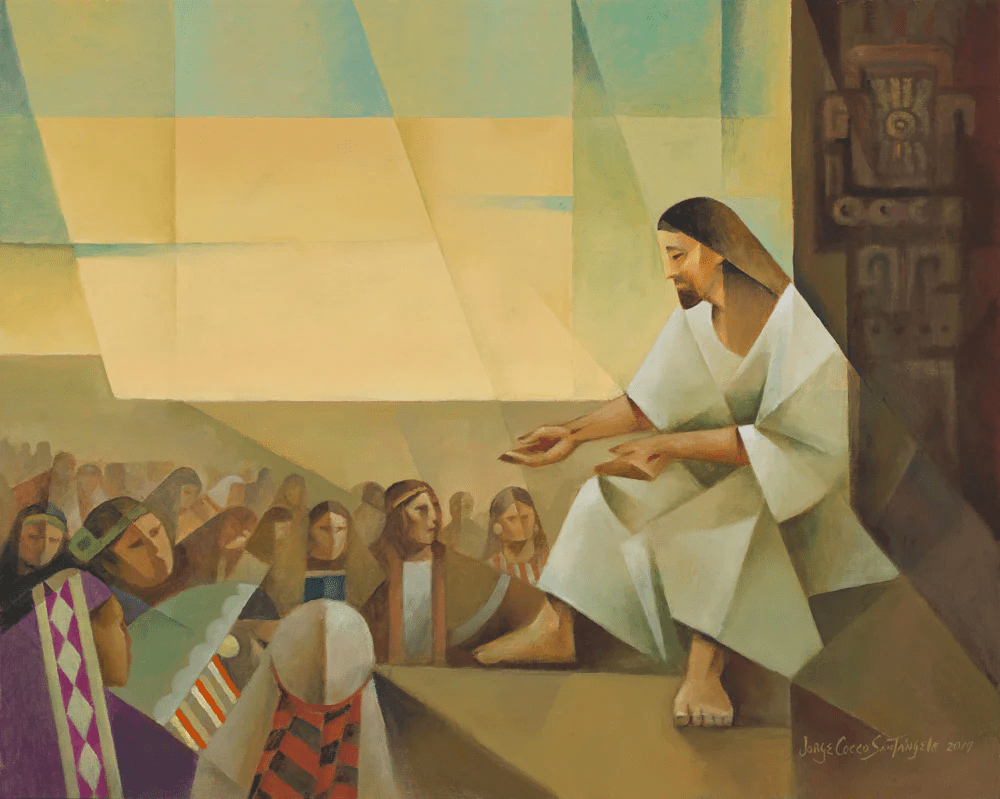
Jesus Preaching to the Multitude by Jorge Cocco Santángelo

If we have the spiritual ears to listen, we can hear numerous lost souls crying in the dark.

If we have the spiritual eyes to see, we can observe people overwhelmed with life circumstances standing in front of us.

If we have the spiritually strengthened hands willing to labor, we can support needy folks around us who can neither help themselves nor ask for it.

Whenever we take the focus off who is in and who is out, then without judgment and a heart full of compassion, we can address the:

  • Loneliness of so many people living alone and dying alone.
  • Shame which thousands secretly carry every day.
  • Pain of broken bodies, broken hearts, broken spirits, and broken minds experienced by individuals everywhere.

The Lord Jesus feels the loneliness, shame, and pain of people – which is why he told a parable like he did. Christ is looking to activate grace through his people, the church, to a world sinking in the depths of incredible human need.

Christ’s parable, however, is more than a warning; it is a story that flings open the door of mercy for unlikely people seemingly far from God – people who ruined their lives by saying “no” to God. The parable is an invitation for all the screw-ups and those with little faith to come to Jesus.

There is a rather obscure Scripture reference, tucked away in the Old Testament. David was on the outside looking in. King Saul was on the inside trying to capture and kill him, even though David had done nothing wrong. Here is what happened:

David got away and escaped to the Cave of Adullam. When his brothers and others associated with his family heard where he was, they came down and joined him. Not only that, but all who were down on their luck came around—losers and vagrants and misfits of all sorts. David became their leader. There were about four hundred in all. (1 Samuel 22:1-2, MSG)

This rag-tag group of outsiders in Israel became Israel’s insiders as David eventually became king and these were the “mighty men,” the ones who helped bring Israel into prominence. 

Jesus Christ came into this world and identified himself as the Savior to the outsider when he quoted the prophet Isaiah:

“The Spirit of the Lord is upon me,
    because he has anointed me
        to bring good news to the poor.
He has sent me to proclaim release to the captives
    and recovery of sight to the blind,
        to let the oppressed go free,
to proclaim the year of the Lord’s favor.”

And he rolled up the scroll, gave it back to the attendant, and sat down. The eyes of all in the synagogue were fixed on him. Then he began to say to them, “Today this scripture has been fulfilled in your hearing.” (Luke 4:18-21, NRSV)

In Christ, there are no lost causes and no persons too far on the outside to be redeemed.

Therefore, now is the time to act on what we believe – to not only affirm right doctrine, but to live out that doctrine in obedience to God’s call. Amen.