Good Friday (Psalm 22)

Golgotha – Crucifixion, by Romare Bearden, 1945

My God, my God, why have you forsaken me?
    Why are you so far from helping me, from the words of my groaning?
O my God, I cry by day, but you do not answer;
    and by night but find no rest.

Yet you are holy,
    enthroned on the praises of Israel.
In you our ancestors trusted;
    they trusted, and you delivered them.
To you they cried and were saved;
    in you they trusted and were not put to shame.

But I am a worm and not human,
    scorned by others and despised by the people.
All who see me mock me;
    they sneer at me; they shake their heads;
“Commit your cause to the Lord; let him deliver—
    let him rescue the one in whom he delights!”

Yet it was you who took me from the womb;
    you kept me safe on my mother’s breast.
On you I was cast from my birth,
    and since my mother bore me you have been my God.
Do not be far from me,
    for trouble is near,
    and there is no one to help.

Many bulls encircle me;
    strong bulls of Bashan surround me;
they open wide their mouths at me,
    like a ravening and roaring lion.

I am poured out like water,
    and all my bones are out of joint;
my heart is like wax;
    it is melted within my breast;
my mouth is dried up like a potsherd,
    and my tongue sticks to my jaws;
    you lay me in the dust of death.

For dogs are all around me;
    a company of evildoers encircles me;
they bound my hands and feet.
I can count all my bones.
They stare and gloat over me;
they divide my clothes among themselves,
    and for my clothing they cast lots.

But you, O Lord, do not be far away!
    O my help, come quickly to my aid!
Deliver my soul from the sword,
    my life from the power of the dog!
    Save me from the mouth of the lion!

From the horns of the wild oxen you have rescued me.
I will tell of your name to my brothers and sisters;
    in the midst of the congregation I will praise you:
You who fear the Lord, praise him!
    All you offspring of Jacob, glorify him;
    stand in awe of him, all you offspring of Israel!
For he did not despise or abhor
    the affliction of the afflicted;
he did not hide his face from me
    but heard when I cried to him.

From you comes my praise in the great congregation;
    my vows I will pay before those who fear him.
The poor shall eat and be satisfied;
    those who seek him shall praise the Lord.
    May your hearts live forever!

All the ends of the earth shall remember
    and turn to the Lord,
and all the families of the nations
    shall worship before him.
For dominion belongs to the Lord,
    and he rules over the nations.

To him, indeed, shall all who sleep in the earth bow down;
    before him shall bow all who go down to the dust,
    and I shall live for him.
Posterity will serve him;
    future generations will be told about the Lord
and proclaim his deliverance to a people yet unborn,
    saying that he has done it. (New Revised Standard Version)

Crucifixion, by Romare Bearden, 1947

It’s one thing to be alone because of other’s mocking, yelling, spitting at you, even physically beating you; that, in and of itself, is terribly traumatic. Yet, it’s quite another thing altogether to feel forsaken by one’s God, to experience a deafening divine silence amidst all the human commotion.

There are levels of suffering – and physical suffering is the least of our agony; the experiences of mental, emotional – and I insist, spiritual suffering – is worse than a hundred kidney stones.

“Suffering” is a word many would like to avoid. Simply seeing or hearing the word might make us cringe. Suffering? No thanks. I’ll pass. Yet, something inside us instinctively knows we cannot get around it. Everyone suffers in some way; it’s endemic to the human condition. 

Sometimes, maybe even most times, we are not immediately relieved of suffering because it is meant to have a redemptive purpose to it – that somehow, some way, the awful affliction shall result in eventual blessing to either oneself, another, or perhaps to many.

Miracles are miracles not because they fall from heaven with no connection to what’s happening on this earth. No, miracles occur because of suffering, because something gut-wrenching is happening, because someone or many people are tragically hurt.

Jesus intimately knows suffering, first hand. And he knows what suffering can produce: the deliverance of many.

For Christians everywhere, today is “Good” not because of the pain experienced but because the crucifixion of Jesus Christ means the redemption of the world.

On this Good Friday, followers of Jesus remember and commemorate the events that led up to the cross; unpack those events and interpret them with profound meaning and significance; and worship Jesus with heartfelt gratitude because of the redeeming work of the cross.

It is today that Christians remember the last words of Christ, and recognize the significant impact his death had on the immediate persons around him. Believers also contemplate the lasting results of that singular death as an atoning sacrifice; perfect love; reconciliation between God and humanity; victory over evil; and the redemption of all creation.

For believers, there’s the recognition that something deeply impactful is happening in the egregious suffering of Jesus. Therefore, we acknowledge and remember the anguish of Christ; and also what that horrible torment accomplished.

With such profound meaning, one would think that Good Friday is a hugely observed day for all Christians in every tradition. Yet, for a chunk of churches and Christians, it is not. The cross is not a popular subject. It could be because neither Christian nor non-Christian wants to ponder something so tragically bloody and sad.

“Religious people want visionary experiences and spiritual uplift; secular people want proofs, arguments, demonstrations, philosophy, and science. The striking fact is that neither one of these groups wants to hear about the cross.” 

Fleming Rutledge, The Crucifixion: Understanding the Death of Christ

Indeed, as the Apostle Paul has said, the cross of Christ is “a stumbling block to Jews and folly to Gentiles.” (1 Corinthians 1:23)

A personalized religion which leaves the cross out of the picture (too much violence and sacrifice) might seem appealing, yet will only leave us bereft of the communion of the saints both past and present. Consider the confessional witness of the Church:

Christ suffered “in both body and soul – in such a way that when he sensed the horrible punishment required by our sins ‘his sweat became like great drops of blood falling down on the ground.’ He cried, ‘My God, my God, why have you forsaken me?’ And he endured all this for the forgiveness of our sins. Therefore, we rightly say with the Apostle Paul that we know nothing ‘except Jesus Christ, and him crucified;’ we ‘regard everything as loss because of the surpassing value of knowing Christ Jesus our Lord.’ We find all comforts in his wounds and have no need to seek or invent any other means than this one and only sacrifice, once made, which renders believers perfect forever.”

Belgic Confession, Article 21

And let us consider further the New Testament witness:

“Jesus suffered outside the gate in order to sanctify the people through his own blood. Therefore, let us go forth to him outside the camp, and bear the abuse he endured.” (Hebrews 13:12-13, NIV)

“May I never boast of anything except the cross of our Lord Jesus Christ, by which the world has been crucified to me, and I to the world.” (Galatians 6:14, NRSV)

The extent of Good Friday goes far beyond a day on the calendar; it is the fulcrum upon which all of Christianity hinges.

Because Christ suffered, our suffering has meaning. Each situation of trauma; every case of disease; all suffering, abuse, and hardship makes sense, in the Christian tradition, when they are viewed in solidarity with the cross of Jesus Christ.

So, today, let Christians everywhere contemplate the cross, observe the salvation accomplished through Christ’s death, and offer prayers and petitions for those who need deliverance from the power of evil.

Maundy Thursday (Psalm 116:1-2, 12-19)

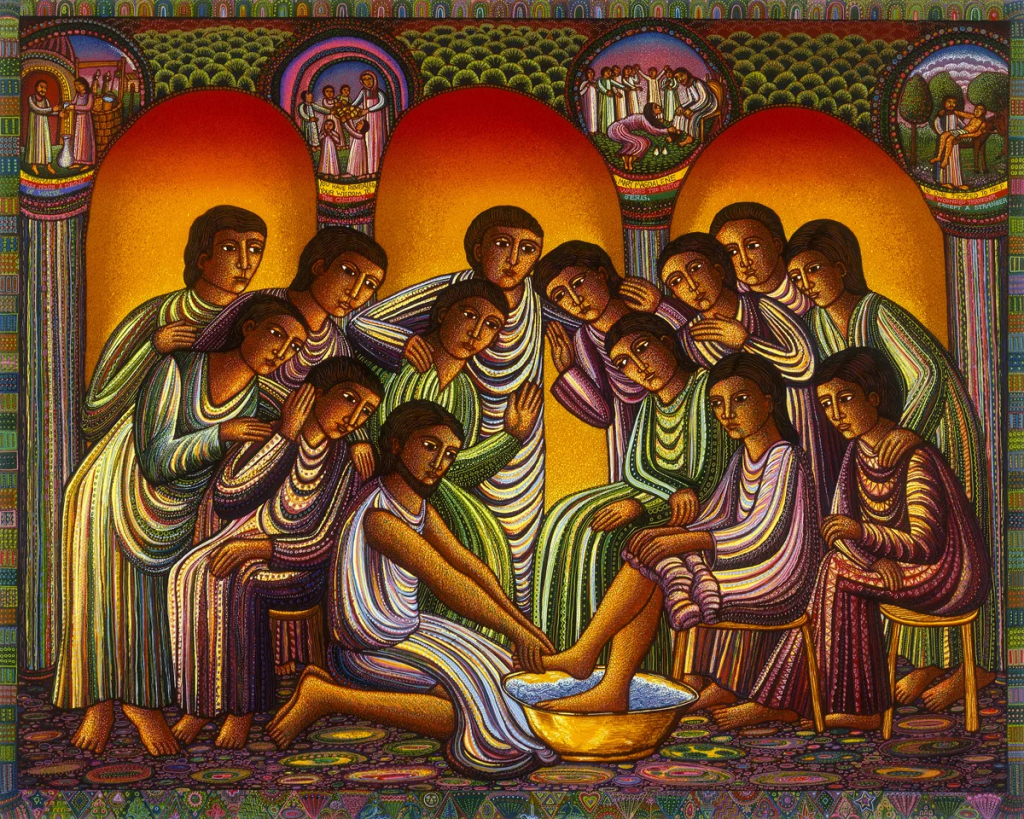
Washing of the Feet, by John August Swanson, 2000

I love the Lord because he has heard
    my voice and my supplications.
Because he inclined his ear to me,
    therefore I will call on him as long as I live….

What shall I return to the Lord
    for all his bounty to me?
I will lift up the cup of salvation
    and call on the name of the Lord;
I will pay my vows to the Lord
    in the presence of all his people.
Precious in the sight of the Lord
    is the death of his faithful ones.
O Lord, I am your servant;
    I am your servant, the child of your serving girl.
    You have loosed my bonds.
I will offer to you a thanksgiving sacrifice
    and call on the name of the Lord.
I will pay my vows to the Lord
    in the presence of all his people,
in the courts of the house of the Lord,
    in your midst, O Jerusalem.
Praise the Lord! (New Revised Standard Version)

“Pain and suffering have come into your life, but remember pain, sorrow, suffering are but the kiss of Jesus — a sign that you have come so close to Him that He can kiss you.”

Mother St. Térèsa of Calcutta (1910-1997)

There is more to the passion of Christ than sheer suffering and sorrow; the Via Dolorosa is, paradoxically, also the road to joy.

Yes, suffering is painful and unpleasant. Yet, since we all must suffer in some way, the real issue is whether our suffering is meaningless or has purpose to it. We are able to bear our suffering if we are confident that a redemptive outcome is at the end of it.

The Lord Jesus submitted to suffering because he knew that all the mockery, torture, and abuse was the pathway to deliverance for humanity.

Because of the joy awaiting him, he endured the cross, disregarding its shame. Now he is seated in the place of honor beside God’s throne. Think of all the hostility he endured from sinful people; then you won’t become weary and give up. (Hebrews 12:2-3, NLT)

Since Jesus has gone before us, enduring shame so that it could be put to death in us, we are able to live free from guilt and the ignominy of sin. What’s more, Christ’s suffering gives shape and meaning to our own suffering.

“I cannot but wonder at the virtue that lies in suffering; we are worth nothing without the cross. I tremble and am in an agony while it lasts, and all my conviction of its salutary effects vanish under the torture, but when it is over, I look back at it with admiration, and am ashamed that I bore it so ill.”

François Fénelon (1651-1715)

On this Maundy Thursday, we remember that in the midst of suffering there is the hope of glory, and in the center of pain there is the confident expectation that it will be used as the fertilizer to help love grow and bloom in the dormant places of this world.

“Love proves itself by deeds, so how am I to show my love? Great deeds have forbidden me. The only way I can prove my love is by scattering flowers and these flowers are every little sacrifice, every glance and word, and the doing of the least actions for love.”

St. Thérèse of Lisieux (1873-1897)

There cannot be love without suffering; to love is to sacrifice on behalf of another.

Because we live in a broken world full of pride and hubris, greed and avarice, hate and envy, we are victims of loveless systems and unjust actions. We need love to rescue and redeem us from the sheer muck of existential guilt and shame, evil and injustice.

Christians around the world are journeying through Holy Week, the most sacred time of the year for followers of Christ. When we think about Holy Week, we are familiar with Good Friday and certainly Easter, but Maundy Thursday? 

On this day, the Church remembers the final evening Jesus shared with his disciples in the upper room before his arrest and crucifixion. The experiences in the upper room were highly significant because this was the last teaching, modeling, and instruction Jesus gave before facing the cross. Jesus was careful and deliberate to communicate exactly what was important to him: to love one another.

“A new command I give you: Love one another. As I have loved you, so you must love one another.  By this everyone will know that you are my disciples if you love one another.” (John 13:34-35, NIV)

Maundy Thursday marks three important events in Christ’s Last Supper with his disciples: 

  1. The washing of the disciples’ feet (the action of loving service)
  2. The instituting of the Lord’s Supper (the remembrance of loving sacrifice)
  3. The giving of a “new” commandment to love one another (the mandate of a loving lifestyle)

The message of Maundy Thursday is this: Jesus Christ loves me just as I am, and not as I should be. He loves me even with my dirty stinky feet, my herky-jerky commitment to him, and my pre-meditated sin. 

Today is a highly significant day on the Church Calendar and in the Christian Year – one which deserves to be observed, and an opportunity to remember the important words and actions of Jesus on our behalf. Through Jesus Christ we are to live always in love, modeling our life and ministry after him. 

“I have found the paradox that if I love until it hurts, then there is no hurt, but only more love.”

Mother Térèsa

In Christ, love is to characterize our life together as we proclaim God’s love in both word and deed. A watching world will take notice and desire to lay down their hate and animosity if the followers of Christ are deeply and profoundly centered in the love of God.

God our Father, you invite us to participate in the life, suffering, death, and resurrection of your Son. Inspire us by his service, and unite us in his love; who lives and reigns with you, in the unity of the Holy Spirit, one God, now and forever. Amen.

Wednesday of Holy Week (Psalm 70)

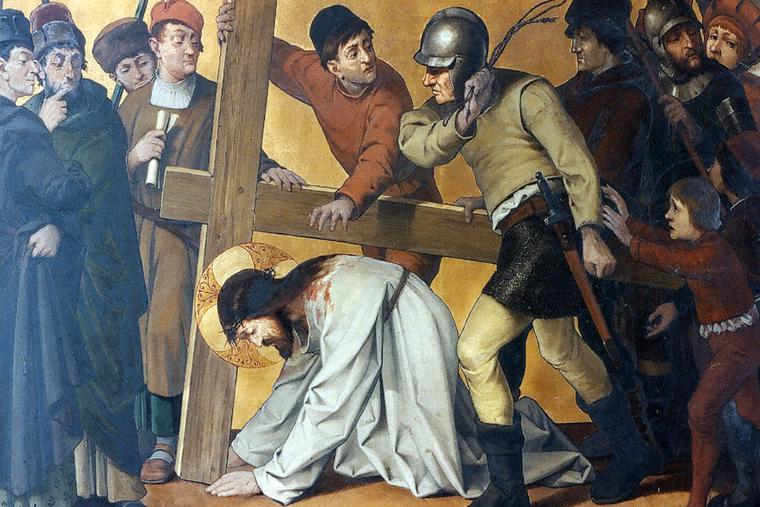
Ninth Station of the Cross, Jesus falls the third time, by Théophile Marie François Lybaert, c.1886

Be pleased, O God, to deliver me.
    O Lord, make haste to help me!
Let those be put to shame and confusion
    who seek my life.
Let those be turned back and brought to dishonor
    who desire to hurt me.
Let those who say, “Aha, Aha!”
    turn back because of their shame.

Let all who seek you
    rejoice and be glad in you.
Let those who love your salvation
    say evermore, “God is great!”
But I am poor and needy;
    hasten to me, O God!
You are my help and my deliverer;
    O Lord, do not delay! (New Revised Standard Version)

We all need help. Even Jesus.

As we journey with Jesus, and walk with him along the Via Dolorosa, we learn to set aside our illusions and delusions of radical independence, and to adopt his sense of dependence upon the heavenly Father. We come around to saying that we need divine help.

Continuing with a deliberate Christological view of the psalms, we are reminded that there was a time that Jesus felt desperation, just like we do. We go with him to the Garden of Gethsemane. And even though, in our own stressed out souls, we end up falling asleep and failing to pray as we ought, nevertheless we remember that the Lord Jesus sweat great drops of blood and agonized over what he was about to face.

There are times when the help we need isn’t for next week or tomorrow, but immediately, now!

I don’t know if you have ever been in such a stressful and dangerous situation in which all you could say is “Help, help me!” The abject feeling is helplessness is palpable and just plain awful. The sense there is nothing you can do to improve your circumstance other than some sort of merciful divine intervention is more than unnerving. It’s downright hard to breathe, let alone cry-out to be rescued.

In today’s psalm, it seems there were people getting a twisted sense of joy over the misfortune of others. It’s as if they were delighting in the confusion and vulnerability of those unable to stop what is happening.

In the throes of such stress and danger, the help we need is to have the evil turned back on the wicked. The psalmist wants such persons off his back – to have God hunt them like they are hunting the poor and needy who have no ability to resist.

It makes sense this psalm is short, just a few verses. Long prayers aren’t necessarily better than short ones, especially when it’s a frantic cry for God’s help. There is nothing in Holy Scripture that dictates how long or short prayer ought to be.

“Help!” just might be one of the best prayers we can pray. One little word. That’s all it takes.

It makes sense to me that this is an honest prayer. When in the throes of some horrible situation, all pretension goes out the window. Honest heartfelt prayers are the best kind of prayer.

If we are hurting badly enough, boldness comes quickly to the tip of our tongues. I once had a kidney stone and walked, doubled over in pain, into the Emergency Department of a hospital. I yelled at the first staff person I encountered, saying, “I need help, NOW!

To confess our great need to a God who listens might just be the best kind of theology we could ever express.

In such a terrible place of agony – of either body, soul, or both – there’s no thought to keeping up appearances, but only an unfiltered expression of need. Our prayers can, and need to be, earnest and urgent.

Prayer can be short, honest, and urgent because emergent situations require it. So, what do you do when you feel desperate? How do you handle your emotions? Where do you go for help?

In this Holy Week we are reminded that Jesus looked to the Father for help. In the worst of circumstances – facing ridicule, torture, and a horrible death – the Lord Jesus let the psalms shape his own prayers of desperation while under severe stress and duress:

“The one who ate my bread has lifted his heel against me.” (John 13:18; Psalm 41:9)

“They hated me without a cause.” (John 15:24; Psalm 69:4)

“I am deeply grieved, even to death; remain here, and stay awake with me.” (Matthew 26:38; Psalm 42:5-6)

“My God, my God, why have you forsaken me?”

Jesus (Matthew 27:46; Psalm 22:1)

Then Jesus, crying with a loud voice, said, “Father, into your hands I commend my spirit.” Having said this, he breathed his last. (Luke 23:46; Psalm 31:16)

There is a God who understands our plight. Jesus, the pioneer of our salvation, has gone before us in the way of suffering. He knows what it’s like to experience the agony and anguish of evil’s weight. He is our great high priest, the one who can intercede effectively and compassionately for us in our great times of need:

Now that we know what we have—Jesus, this great High Priest with ready access to God—let’s not let it slip through our fingers. We don’t have a priest who is out of touch with our reality. He’s been through weakness and testing, experienced it all—all but the sin. So, let’s walk right up to him and get what he is so ready to give. Take the mercy, accept the help. (Hebrews 4:14-16, MSG)

May you find in Jesus the help you so desperately need. Amen.

Monday of Holy Week (Psalm 36:5-11)

The Via Dolorosa (Latin: the way of sorrows) is a narrow path through the streets of the Old Jerusalem, the final route traveled by Jesus of Nazareth on the way to his crucifixion.

Your steadfast love, O Lord, extends to the heavens,
    your faithfulness to the clouds.
Your righteousness is like the mighty mountains;
    your judgments are like the great deep;
    you save humans and animals alike, O Lord.

How precious is your steadfast love, O God!
    All people may take refuge in the shadow of your wings.
They feast on the abundance of your house,
    and you give them drink from the river of your delights.
For with you is the fountain of life;
    in your light we see light.

O continue your steadfast love to those who know you
    and your salvation to the upright of heart!
Do not let the foot of the arrogant tread on me
    or the hand of the wicked drive me away. (New Revised Standard Version)

The desert journey is almost over. The sojourn with Jesus in his life and ministry will soon culminate in the ultimate experience of sorrow and joy. The Christian season of Lent is nearly at the end. We are in it’s final days, known as Holy Week.

We have a Holy Week because of love. There is yet another journey we must take, along the Via Dolorosa to the hill of Golgotha, because of God’s steadfast love.

Love suffers. Every parent knows this. Because of a parent’s committed and faithful love toward a child, they feel not only the joys but also the sorrows and pain of their children. I can say that this feeling does not go away, even with adult children. And it’s compounded with grandchildren. Just as our love is big enough to hold multiple children and grandchildren, so our capacity for experiencing deep emotion for their welfare is equally large.

Holy Week reminds us that God’s committed parental love suffers. It is because of God’s immense and steadfast love that there is a road to the cross and a tortured death for Jesus. The cost of our salvation involves a very bloody affair. Deliverance comes at the price of horrible violence. Jesus Christ lived and died for us, because of love.

He suffered much because he loved much.

God’s people, walking in the way of love, quickly discover that it is simultaneously walking in the way of suffering. From Old Testament times through the New Testament era and into the present day, the faithful have always experienced suffering as a central part of their piety and devotion in showing steadfast love. 

The medieval mystics of the Church understood quite well the connection between suffering and love. They could not imagine a Christian life without hardship, difficulty, and persecution. Thomas à Kempis, a sort of pastor to pastors, wrote in the fifteenth century:

“Sometimes it is to our advantage to endure misfortunes and adversities, for they make us enter into our inner selves and acknowledge that we are in a place of exile and that we ought not to rely on anything in this world.  And sometimes it is good for us to suffer contradictions and know that there are those who think ill and badly of us, even though we do our best and act with every good intention….  When men ridicule and belittle us, we should turn to God, who sees our innermost thoughts, and seek His judgment….  It is when a man of good will is distressed, or tempted, or afflicted with evil that he best understands the overwhelming need he has for God, without whom he can do nothing….  It is in such times of trial that he realizes that perfect security and full peace are not to be found in this world.”

Thomas à Kempis, The Imitation of Christ

And yet, it is because of love that suffering is transformed and endured as something wholly other than sheer pain or hurt. Thomas à Kempis went on to say:

“Love is a mighty power, a great and complete good; Love alone lightens every burden and makes the rough places smooth. It bears every hardship as though it were nothing and renders all bitterness sweet and acceptable. The love of Jesus is noble and inspires us to great deeds; it moves us always to desire perfection. Love aspires to high things and is held back by nothing base. Love longs to be free, a stranger to every worldly desire, lest its inner vision become dimmed, and lest worldly self-interest hinder it, or ill-fortune cast it down…. Love knows no limits, but ardently transcends all bounds. Love feels no burden, takes no account of toil, attempts things beyond its strength; love sees nothing as impossible, for it feels able to achieve all things. Love therefore does great things; it is strange and effective; while he who lacks love faints and fails.”

Thomas à Kempis, The Imitation of Christ

Holy Week’s message is certainly one of suffering love. Jesus went to the greatest lengths possible to give Divine steadfast love to humanity. So, let us not shy away from the cross, but journey with Jesus to Golgotha, embracing the love of God for us. In so doing, we will find the inner resources needed to love the world, even in all its unloveliness.

Grant, we pray, almighty God, that, though in our weakness we fail, we may be revived through the Passion of your Only Begotten Son. Who lives and reigns with you in the unity of the Holy Spirit, God, for ever and ever. Amen.