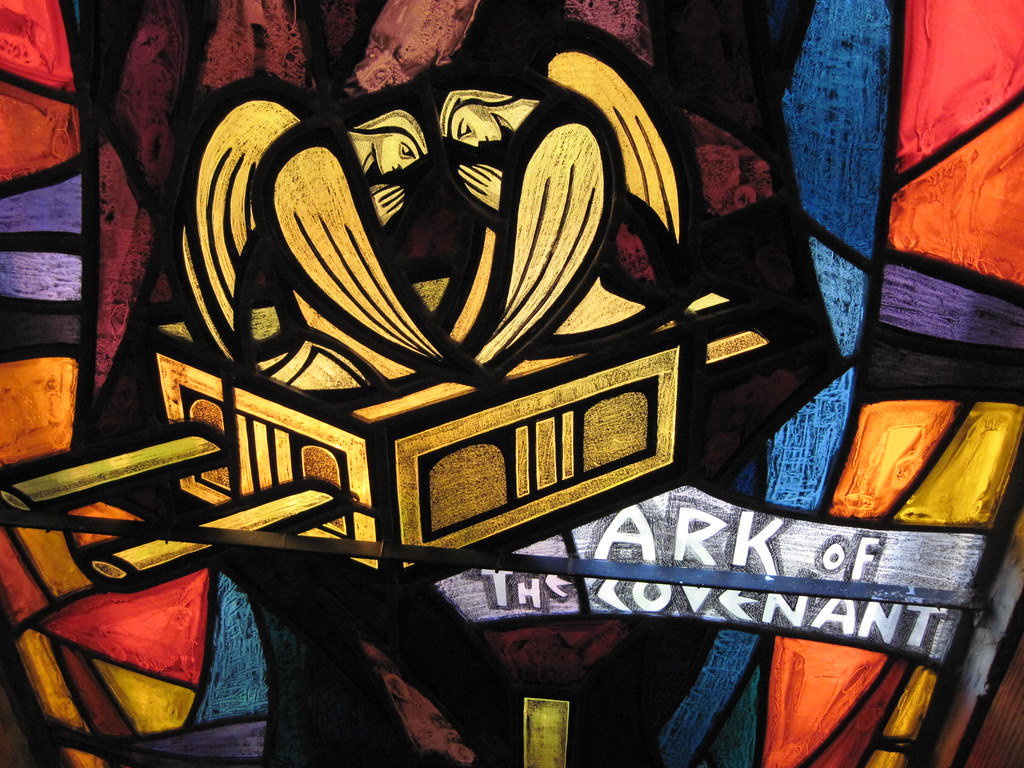
2 Samuel 6:1-15 – Be Careful How You Celebrate

Ark of the Covenant by Isabel Piczek 1982, St. Norbert Catholic Church, Orange, California

David again assembled all the best men in Israel, 30,000 in number. David and all the men who were with him traveled to Baalah in Judah to bring up from there the ark of God which is called by the name of the Lord of Heaven’s Armies, who sits enthroned between the cherubim that are on it. They loaded the ark of God on a new cart and carried it from the house of Abinadab, which was on the hill. Uzzah and Ahio, the sons of Abinadab, were guiding the new cart. They brought it with the ark of God from the house of Abinadab on the hill. Ahio was walking in front of the ark, while David and all Israel were energetically celebrating before the Lord, singing and playing various stringed instruments, tambourines, rattles, and cymbals.

When they arrived at the threshing floor of Nacon, Uzzah reached out and grabbed hold of the ark of God, because the oxen stumbled. The Lord was so furious with Uzzah, he killed him on the spot for his negligence. He died right there beside the ark of God.

David was angry because the Lord attacked Uzzah; so, he called that place Perez Uzzah, which remains its name to this very day. David was afraid of the Lord that day and said, “How will the ark of the Lord ever come to me?” So, David was no longer willing to bring the ark of the Lord to be with him in the City of David. David left it in the house of Obed-Edom the Gittite. The ark of the Lord remained in the house of Obed-Edom the Gittite for three months.

The Lord blessed Obed-Edom and all his family.King David was told, “The Lord has blessed the family of Obed-Edom and everything he owns because of the ark of God.” So, David went and joyfully brought the ark of God from the house of Obed-Edom to the City of David. Those who carried the ark of the Lord took six steps and then David sacrificed an ox and a fatling calf. Now David, wearing a linen ephod, was dancing with all his strength before the Lord. David and all Israel were bringing up the ark of the Lord, shouting and blowing trumpets. (New English Translation)

The Christian season of Eastertide is a grand celebration of Christ’s resurrection and the new life we enjoy in Jesus Christ. Since God is the center of all things, celebrations need to be mindful. Nothing in life is a matter of doing whatever the heck we want to do.

Even celebration has its boundaries and limits.

The narrator who originally compiled, told, and wrote the today’s Old Testament lesson wanted to communicate something significant about God and how to relate to the Lord.

God put the big kibosh on David’s hoedown. At that time in the history of Israel, the ark was the foremost symbol of God’s presence with the people. Within the ark contained the tablets of the Ten Commandments (the symbol of God’s Word); the staff of the first priest, Aaron, (the symbol of God’s choice); and a pot of manna (the symbol of God’s provision). Thus, the ark was a holy object, pointing to a holy God.

The ark of the Lord was built during the time of Moses, when the ritual laws were established concerning offerings and how to approach God in worship. There were detailed prescriptions for how to construct all the sacred articles for worship. (Exodus 35:30-40:33) 

The ark was at the center of worship, representing the presence of God among the people. For nearly five-hundred years before David, the ark had become a familiar object in the life of Israel, always there, continually the symbol of God to the people.

I’ve been a Christian for many decades. One reason I refer to the seasons of the Christian Year in the present tense, is so that it doesn’t become old hat to me. Although I just presided over yet another Easter Sunday in my long tenure as a pastor, I am still in awe of Christ’s resurrection and am eternally grateful and full of joy over new life in Jesus Christ. I always want it to be fresh, as if I’m stepping up to the empty tomb for the first time.

Stained glass in the First Lutheran Church of
Washburn, North Dakota

Yet, we have all likely had the experience of something becoming so familiar, that we begin to lose sight of how important and valuable it really is. Not until we lose it, or something traumatic happens, do we wake up and take stock of its true significance. 

The Israelites had become lethargic and apathetic toward the worship of God, and it led to some disheartening and tragic circumstances. The people of God throughout the ages have always needed to be vigilant against the opiate of familiarity, dulling the senses to the importance of worship.

Moving the ark of the Lord to Jerusalem was one of the first acts David did as the king of Israel and Judah.  God was with David and brought him success against his enemies. David enjoyed a close relationship with God.  Even though David’s heart was in the right place, he made a huge miscalculation, which ended up offending God. 

David had the best of intentions in bringing the ark to Jerusalem and giving it a prominent place in the center of Jewish life. This was an exceptionally good plan. The problem, however, came in the manner the ark was carried from one place to another. 

God’s law laid out in careful detail how the ark was to be transported. Uzzah and Ahio were Levites charged with the ark’s care. Only the Levites could handle the ark and the holy objects of worship that went along with it.

Since it was the job of the Levites for hundreds of years, they knew better than to carry the ark of the Lord on a cart. God clearly told Moses that the ark was to have two long poles of acacia wood overlaid with gold inserted into four gold rings of the ark. The ark was to always be carried on the shoulders of the Levites with the two poles.

We are not told why Uzzah and Ahio were pulling the ark on a cart with oxen instead of carrying it in the prescribed way. Perhaps it was because the ark was incredibly heavy and no easy task to carry.  Maybe they decided it would be easier and more expedient to have the much stronger oxen pull the ark on a nice new cart; it would save a lot of energy transporting it over a long distance.

Or it could be that they were tired of moving the ark in the same old way they had always done it. Maybe it was old hat to them, and they were ready for something different.

For pragmatic people, Uzzah and Ahio’s approach makes a lot of sense. However, God was not okay with this arrangement. When the oxen stumbled and the ark was in danger of falling off the cart, Uzzah reflexively reached out to steady it.  That was the last act Uzzah ever did on this earth. God immediately put him down for his “irreverent act.”

So, here is the not so good idea: Evaluating the worship of God by common sense pragmatism, what we think will work best, and how we feel it ought to be done. Everything about worship is to pay attention to the holiness of God through our obedience. 

Whenever we avoid the prescriptions of Holy Scripture, however best the intentions might be, is not a good thing and people will get hurt. One can never justify an action that goes against God’s Word because people are praising God. Just because the heart is in the right place does not mean what is being done is okay.

David’s first response was anger, then fear. He gave his best effort, and it resulted in God’s disfavor. Perhaps David took for granted that the ark could be moved any old way he wanted to move it. 

Trouble with God happens whenever we value efficiency and expediency over obedience and submission.

The great error of Uzzah, resulting in his death, was trying to manage God. We do not take care of God; God takes care of us. God does not bow to us. The Lord doesn’t allow the creature to manage the Creator.

God wants a pure, unadulterated, and obedient worship celebration from people in the way God wants it to be done, period. It is not up for negotiation.

Holy God, we confess that we have too often forgotten we are yours. Sometimes we carry on our lives as if there was no God and we fall short of being a credible witness to you. For these things we ask your forgiveness and for your strength. Give us clear minds and open hearts so we may bear witness to you in our world. Remind us to be who you would have us to be regardless of what we are doing or who we are with. Hold us close and build our relationship with you and with those you have given us on earth, through Jesus Christ our Lord. Amen.

1 Corinthians 5:6b-8 – Easter Is More Than a Day

All Creation Sings His Praise by Jen Norton

Your boasting is not good. Don’t you know that a little yeast affects the whole batch of dough? Clean out the old yeast so that you may be a new batch of dough—you are, in fact, without yeast. For Christ, our Passover lamb, has been sacrificed. So then, let us celebrate the festival, not with the old yeast, the yeast of vice and evil, but with the bread without yeast, the bread of sincerity and truth. (New English Translation)

Easter is more than one day. It’s as if a massive spiritual 10.0 earthquake occurred on that day with a great tsunami of life powerfully overwhelming all of history.

Today begins the Christian season of Eastertide. It is a time of realizing we are without yeast, that is, without any old unhealthy ingredients which may work through the whole batch of dough. We are to live into the new reality given to us by means of Christ’s resurrection from death.

Eastertide spans the next fifty days until the Day of Pentecost. That’s a hefty seven weeks of bringing the new life we enjoy to the forefront. Eastertide’s intentional focus is to acknowledge and celebrate the resurrection of Jesus Christ, exulting in our own new life in him.

Now, you might say to yourself, “Why do we need to have some liturgical season about Christ’s resurrection? Shouldn’t we be living like we recognize this every day?” Yes, of course we should. 

Yet, consider this: If we only sing songs of resurrection on Easter Sunday and only occasionally think of Christ’s resurrection outside of Easter Sunday, then perhaps, its sage to bring a highlighted focus to the resurrection in a special season. 

Just as it is necessary to take more than one vacation day in the year for renewal, so it is essential to observe more than one day to enjoy Easter. If nothing else, Eastertide gives believers an opportunity to let Christ’s resurrection percolate in our hearts so that we experience new life, as people who exhibit an alive-spirit. And, God knows, we could use much more of that in our congregations and our world!

If eternal life and being fully alive are needed for us, then it only makes sense that we take advantage of what Eastertide has to offer: A deliberate look at Christ’s resurrection, exploring its implications and impact for us. 

Simply assuming we all know about resurrection simply will not do, any more than my wife assuming I love her without looking her straight in the eye and telling her so. 

If Christ has not been raised, your faith is futile (1 Corinthians 15:17). Being people of sincerity and truth comes with a purposeful eye on a new resurrected life. Without an Eastertide, there’s a sin-as-usual kind of approach to life with a shoulder shrug that says, “Meh, what’s a guy to do?” 

Methinks that unhelpful boasting and sinful pride are directly related to moving on from Easter Sunday and backsliding to the old life. Like a dog returning to its vomit, so is a church who puts away sin on a Sunday, then goes back to pre-resurrection living – which is no life, at all.

Instead, with Eastertide’s full focus, we have the hope of life everlasting because Christ has risen from death.  We have the hope of individual renewal, corporate revitalization, and worldwide revival because there is a risen Savior.

Therefore, this is the perfect time of year to engage in some renewal practices, or even make a few simple changes that show signs of life. Here are just a few ideas for lifting Christ’s resurrection into the next few months:

Pray for a revival of spirituality. Christ brings life, so praying to God for revival is a deliberate way of connecting with God.

Squarely address the leaven of harmful and unhelpful bread. Gossip, back-biting, slander, injustice, oppression, gaslighting, and hate are all poisonous yeast that kills those who are hungry. Casually sluffing-off someone’s acerbic speech and actions as “That’s just the way they are,” will not do, unless you want to exist in a pro-death culture.

Serve unleavened bread. Promote healthy practices of living. If guilty acts and shameful actions bring death, using our words and deeds for encouragement, love, mercy, forgiveness, and building up one another promotes growth, health, and life.

Proclaim resurrection.  I believe the church is meant to be the hope of the world because Christ is the risen Lord. Graciously proclaim the resurrected Christ and how the spiritual life makes a difference in daily existence.

Start a new ministry you always believed would make a difference. It is the appropriate season to take a risk. After all, if you have eternal life, can you really fail? Host a new in-person or virtual small group. Take initiative to up your knowledge of technology. Read some significant books and start a book club. I’m willing to bet you have some idea(s) rolling around inside you about blessing the world. Now, during Eastertide, is the time to turn that idea into reality.

Eat spiritually nutritious bread. If you would not think of skipping meals for days at a time, then consider the erosion to your soul and your church which can occur when folks don’t read their Bibles on a regular basis or pray with any kind of consistency. Stick to a plan. It will not only bring growth to your own life but will impact those around you.

Just keeping the word “Eastertide” in front of you for the next few months can be a simple yet powerful way of reminding us that God has called us to new life. Let the reality of Christ’s resurrection strengthen your heart so that new life informs all your thinking, speaking, feeling, and acting.

Holy and righteous God, you raised Christ from the dead and glorified him at your right hand. Let the words of Scripture, fulfilled in Jesus your Son, burn within our hearts and open our minds to recognize him in the breaking of bread. Amen.

The Wonder of Christ’s Resurrection

Welcome, friends! In the New Testament Gospel of Luke 24:1-12, we find an account of women approaching the grave of Jesus, only to find an empty tomb. Today, people search for reality in all kinds of empty places. There is, however, hope, because Christ is risen! He is risen, indeed! Click the videos below and let us enjoy and be in awe that Jesus is alive!

Pastor Tim Ehrhardt, Luke 24:1-12

May the glory and the promise of this joyous time of year bring peace and happiness to you and those you hold most dear.

And may Christ, Our Risen Savior, always be there by your side to bless you most abundantly and be your loving guide. Amen.

Luke 24:1-12 – The Wonder of Christ’s Resurrection

Women at the empty tomb of Jesus encountering an angel

On the first day of the week, very early in the morning, the women took the spices they had prepared and went to the tomb. They found the stone rolled away from the tomb, but when they entered, they did not find the body of the Lord Jesus. 

While they were wondering about this, suddenly two men in clothes that gleamed like lightning stood beside them. In their fright the women bowed down with their faces to the ground, but the men said to them, “Why do you look for the living among the dead? He is not here; he has risen! Remember how he told you, while he was still with you in Galilee: ‘The Son of Man must be delivered into the hands of sinners, be crucified and on the third day be raised again.’” Then they remembered his words.

When they came back from the tomb, they told all these things to the Eleven and to all the others. It was Mary Magdalene, Joanna, Mary the mother of James, and the others with them who told this to the apostles. But they did not believe the women, because their words seemed to them like nonsense. Peter, however, got up and ran to the tomb. Bending over, he saw the strips of linen lying by themselves, and he went away, wondering to himself what had happened. (New International Version)

“The message of Easter is that God’s new world has been unveiled in Jesus Christ and you’re now invited to belong to it.”

N.T. Wright

The disciples were stuck in the yesterday of Holy Saturday and the grief of Good Friday. Christ’s death was nothing but bad news, leaving them with an awful wondering about what could have been.

And now, an empty tomb. What does it mean? The disciples did not yet discern the reality and impact of what had happened. Their perplexity and curiosity eventually turned to a different kind of wondering: The amazement that Christ is alive! That Jesus has taken care of the sin issue once for all. That a new order is now in force that forever changes everything!

We, too, have the chance to be amazed and in wondrous awe over the resurrection of Jesus. Because the resurrection of Jesus is not just a doctrine to be believed; it is a powerful reality to be lived, and a source of eternal wonder and praise.

Women Arriving at the Tomb by He Qi

The Wonder of the Female Disciples

Do you wonder why women were the first disciples to encounter the empty tomb and the risen Lord?

Women are central to Luke’s resurrection account because women are central to the gospel. They play a significant role, along with men, in the ministry of the good news of Jesus. Within an ancient culture, and religious milieu, in which men were prominent and women were not regarded as reliable witnesses to anything, God used the female disciples as the very first witnesses of the empty tomb. 

Women now play an important part alongside men in ministry. 

This fact was not lost on the early church, who commissioned both men and women as apostles, serving in the highest ranks of the ministry. For example, Junia was a female apostle – an eyewitness of Christ’s life, ministry, and death, as well as a leader who helped build the Church. (Romans 16:7) 

If you ever “wonder” what role women ought to play in the church, the answer is: They ought to serve in the highest offices of leadership because the female disciples were prominent witnesses to the resurrection, on purpose.

The female disciples were curious about the empty tomb. While they were wondering about it, a couple of angels show up and ask them a question designed to lead them to a proper interpretation of Christ’s missing body:

“Why do look for the living among the dead?”

He Is Risen by He Qi

Many people today seek Jesus among the dead. They look for him in empty places.

Some look for Jesus in good ideas, as if knowledge or education save us. We may reason: If we have all the right information, express right belief, and sign-off on right doctrine, then we are okay. However, we are not saved by thoughts, even understanding, as if our brains are what deliver us from sin, death, and evil. We are saved by the person and work of Jesus Christ (Romans 6:1-23).

Many look for Jesus through their efforts, as if I can work my way into the good graces of God. We believe that action is the key. So, whenever we mess up, we seek penance by beating ourselves up, in some way, to somehow atone for the mistakes. However, Jesus finished the work! We participate with Christ in his death and resurrection through faith, not by works. We cannot do for ourselves what Christ has already done for us. Our “work” is to believe, and to be in wonder. (John 6:28-29)

Folks might search for Jesus in the heart – feeling that if our belief is sincere, if I’m basically a good person, if my heart is in the right place, that’s what matters. Yet, we are not saved through sincerity, or by warm-fuzzy feelings about God, as if our hearts save us.

Our hearts can be desperately wicked and are in need of redemption. Through repentance and faith, people find Jesus. Since Jesus is in the heart transplant business, you will find him wherever there are people with critically low heart function.

To find Jesus, in the ancient world, one needed to find the tax collectors, the lepers, the blind, the poor, or even a Roman Centurion. Today, if you want to find Jesus, he will still be found among the poor, the diseased, the refugee, the immigrant, the prisoner, and those who are despised by others.

The last place you would look, in Christ’s day, is with the religious leaders. And today, whenever we look for God to show up with all the answers and all the heart transformation in church, we then wonder why we cannot see Jesus. That’s because Jesus is not in the grave but, as the risen Christ, is out bestowing new life to the people with sick and hard hearts.

Why do you look for Jesus in church? Rather than asking Jesus to come to us, let’s go to where he is.

Since Christ is alive, we are alive.

We need not be perplexed about the empty tomb because Jesus is alive!  He is risen!  This reality is to impact our lives forever:

Since then, you have been raised with Christ, set your hearts on things above, where Christ is, seated at the right hand of God. Set your minds on things above, not on earthly things. For you died, and your life is now hidden with Christ in God. When Christ, who is your life, appears, then you also will appear with him in glory. (Colossians 3:1-4, NIV)

This is the gospel, the good news of Christ. It’s no secret. Jesus made this plainly known. The gospel is not insider news. It’s freely available to everyone. Early in his ministry Jesus said to his disciples:

“The Son of Man must suffer many things and be rejected by the elders, the chief priests and the teachers of the law, and he must be killed and on the third day be raised to life.” (Luke 9:22, NIV)

A few years later, before heading for Jerusalem, Jesus laid it out again for them:

“We are going up to Jerusalem, and everything that is written by the prophets about the Son of Man will be fulfilled. He will be delivered over to the Gentiles. They will mock him, insult him and spit on him; they will flog him and kill him. On the third day he will rise again.” (Luke 18:31-33, NIV)

The Wonder of Peter

The women hurried to tell the disciples. But the men were clueless; they didn’t believe the women. Peter, always the impetuous one, hurried to see the tomb for himself. He left wondering (thinking hard about) what all this empty tomb stuff means.

So, why (since the disciples were told what was going to happen) were they left wondering what in the world the empty tomb was all about? 

Its meaning was hidden from them. They did not know what Jesus was really talking about. But this would all change. After appearing to them…

Jesus opened their minds so they could understand the Scriptures. He told them, “This is what is written: The Messiah will suffer and rise from the dead on the third day, and repentance for the forgiveness of sins will be preached in his name to all nations, beginning at Jerusalem. You are witnesses of these things. I am going to send you what my Father has promised; but stay in the city until you have been clothed with power from on high.” (Luke 24:45-49, NIV)

Conclusion

Present-day Christians know of Christ’s redemptive events of cross, resurrection, ascension, and the giving of the Spirit at Pentecost. We do not need to wonder (be perplexed). We are clothed with power from on high to accomplish the mission of Christ on this earth.

We can now revel and rejoice in wonder and awe over the person and work of Jesus.  We possess forgiveness of sins, the Holy Spirit, and one another because of Christ’s mighty resurrection from death. 

Perhaps we need a newfound sense of wonder (awe) about Christ and his rising from death so that the resurrection of Jesus is not only a doctrine to believe, but a source of joy and wonder that impacts our daily lives.

Here are some ways we might cultivate a sense of wonder that will help us better connect with the risen Christ:

  • Watch kids play, learn, or do anything. Kids approach life with a sense of wonder. Everything is new, bright, and exciting – from being excited with a new toy to smiling at the simplest things – and even responding to Holy Scripture.
  • Read Scripture as if it were your first time. A great way to do this is to get together with someone or a group of people who aren’t familiar with the Bible. Spend some regular time reading through a book of God’s Word together, observing the wonder of the biblical characters.
  • Pay attention to God’s creation. All that we see is a window to the unseen. Whether taking a walk in nature, or traveling to other places, observe the changes of seasons and geography that elicits awe, reminding us of Christ’s resurrection.
  • Learn something new. Learn or rediscover a musical instrument. Research a topic you have always wanted to know something about. Take up a new hobby. Learn a new language. Doing anything new helps us to know new life in Christ better.

“Our Lord has written the promise of resurrection, not in books alone, but in every leaf in springtime.”

Martin Luther

All new life is wondrous and points to Easter, Resurrection Day. Whenever we lose our awe, we get stuck. Then, it’s hard to be excited about unseen spiritual realities. So, let us work at cultivating a sense of wonder so that the resurrection of Christ remains existentially fresh and alive.

Christ is risen!  Christ is risen, indeed!