The Power of Deliverance (Exodus 14:10-31, 15:20-21)

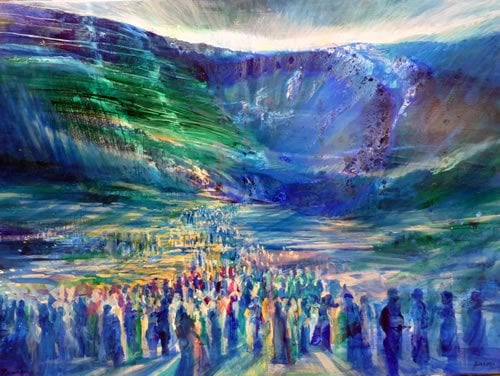
The Parting of the Sea, by Yoram Ranaan

As Pharaoh approached, the Israelites looked up and saw that the Egyptians were coming after them. Terrified, the Israelites cried out to the Lord. They said to Moses, “Did you bring us out into the desert to die because there were no graves in Egypt? Look what you’ve done by bringing us out of Egypt! Didn’t we tell you in Egypt, ‘Leave us alone! Let us go on serving the Egyptians’? It would have been better for us to serve the Egyptians than to die in the desert!”

Moses answered the people, “Don’t be afraid! Stand still, and see what the Lord will do to save you today. You will never see these Egyptians again. The Lord is fighting for you! So be still!”

Then the Lord said to Moses, “Why are you crying out to me? Tell the Israelites to start moving. Raise your staff, stretch out your hand over the sea, and divide the water. Then the Israelites will go through the sea on dry ground. I am making the Egyptians so stubborn that they will follow the Israelites. I will receive honor because of what I will do to Pharaoh, his entire army, his chariots, and cavalry. The Egyptians will know that I am the Lord when I am honored for what I did to Pharaoh, his chariots, and his cavalry.”

The Messenger of God, who had been in front of the Israelites, moved behind them. So the column of smoke moved from in front of the Israelites and stood behind them between the Egyptian camp and the Israelite camp. The column of smoke was there when darkness came, and it lit up the night. Neither side came near the other all night long.

Then Moses stretched out his hand over the sea. All that night the Lord pushed back the sea with a strong east wind and turned the sea into dry ground. The water divided, and the Israelites went through the middle of the sea on dry ground. The water stood like a wall on their right and on their left.

The Egyptians pursued them, and all Pharaoh’s horses, chariots, and cavalry followed them into the sea. Just before dawn, the Lord looked down from the column of fire and smoke and threw the Egyptian camp into a panic. He made the wheels of their chariots come off so that they could hardly move. Then the Egyptians shouted, “Let’s get out of here! The Lord is fighting for Israel! He’s against us!”

Then the Lord said to Moses, “Stretch out your hand over the sea so that the water will flow back over the Egyptians, their chariots, and their cavalry.”

Moses stretched his hand over the sea, and at daybreak the water returned to its usual place. The Egyptians tried to escape, but the Lord swept them into the sea. The water flowed back and covered Pharaoh’s entire army, as well as the chariots and the cavalry that had followed Israel into the sea. Not one of them survived.

Meanwhile, the Israelites had gone through the sea on dry ground while the water stood like a wall on their right and on their left. That day the Lord saved Israel from the Egyptians, and Israel saw the Egyptians lying dead on the seashore. When the Israelites saw the great power the Lord had used against the Egyptians, they feared the Lord and believed in him and in his servant Moses….

Then the prophet Miriam, Aaron’s sister, took a tambourine in her hand. All the women, dancing with tambourines, followed her. Miriam sang to them:

“Sing to the Lord.
He has won a glorious victory.
He has thrown horses and their riders into the sea.” (God’s Word Translation)

Things can change quickly.

One day, you’re living in slavery, and the next, you’re free. One minute, you’re celebrating freedom, then the next minute, you’re backed into a corner, and it looks like the end – only to be dramatically delivered from calamity.

One day (Holy Saturday) the disciples were lower than a snake’s belly in a wagon wheel rut; the next day (Easter Sunday) they’re wondrously slack-jawed with hopes higher than the sky.

Today’s Old Testament reading impresses on us the necessity of trusting God one day at a time, one minute at a time. Circumstances will change; God’s basic character will not change. Therefore, we have the continual opportunity of exercising our faith, and practicing trust in the Lord, by living into a new reality.

In this Christian season of Eastertide (spanning the next 50 days until the Day of Pentecost) we discover resurrection power in putting to death old unhealthy practices and adopting new healthy life-giving habits. Eastertide’s intentional focus is to recognize and celebrate the resurrection of the Lord Jesus Christ, and so, to exult in our own new life in him.

Revisiting both Christ’s resurrection, and the Red Sea deliverance, helps to remind us God’s invisible power to save is stronger and greater than any visible powers on this earth. Both of these deliverance stories keep us focused on the hope of individual renewal, corporate revitalization, and worldwide revival.

Eastertide is the season to engage in some renewal practices. The following are a few ideas for living into our deliverance from God:

  • Pray for revival of spirituality. Christ brings salvation and life, so praying to God for revival is a deliberate way of connecting with God.
  • Pay attention to words. Gossip, back-biting, slander, and other sins of the tongue kill people. Instead, consider how to use your speech for encouragement, love, mercy, forgiveness, and building up one another. This promotes growth, health, and life.
  • Proclaim resurrection. I believe the church is meant to be the hope of the world because Christ is the risen Lord. Graciously proclaim the resurrected Christ and how the spiritual life makes a difference in life.
  • Put yourself out there. Start the new ministry you always believed would make a difference. Take a risk. You’ve been given eternal life, so can you really fail?
  • Promote daily habits of spiritual health and life. Develop a realistic and workable plan for yourself when it comes to basic spiritual practices of Scripture reading, prayer, worship, etc. And stick to it by involving others.

There will always be people in our lives who try and pull us from what’s most important, even persons who want to keep the status quo to the point of seeking to destroy us. Be ready. Keep Eastertide in front of you; God has raised us to new life.

Allow Christ’s resurrection take root in your heart to such an extent that life itself informs all your thinking, speaking, feeling, and acting. The victory is won. So, sing to the Lord!

Jesus Is the Cornerstone (Psalm 118:1-2, 14-24)

Give thanks to the Lord, for he is good;
    his love endures forever.

Let Israel say:
    “His love endures forever….”

The Lord is my strength and my defense;
    he has become my salvation.

Shouts of joy and victory
    resound in the tents of the righteous:
“The Lord’s right hand has done mighty things!
    The Lord’s right hand is lifted high;
    the Lord’s right hand has done mighty things!”
I will not die but live,
    and will proclaim what the Lord has done.
The Lord has chastened me severely,
    but he has not given me over to death.
Open for me the gates of the righteous;
    I will enter and give thanks to the Lord.
This is the gate of the Lord
    through which the righteous may enter.
I will give you thanks, for you answered me;
    you have become my salvation.

The stone the builders rejected
    has become the cornerstone;
the Lord has done this,
    and it is marvelous in our eyes.
The Lord has done it this very day;
    let us rejoice today and be glad. (New International Version)

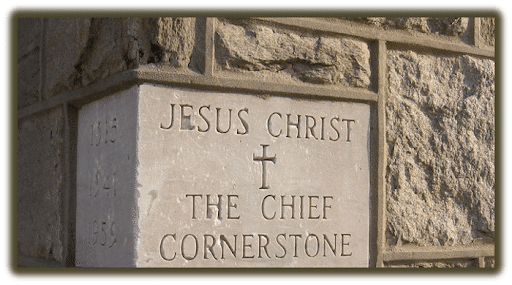
Jesus The Cornerstone, by Gloria Ssali, 2016

Indeed, today we rejoice with gladness and celebrate that Christ is risen! Christians have a firm foundation of faith that gives us strength and stability.

Everyone’s life is constructed on some sort of foundational support. If we consider a building, it’s foundation has four cornerstones. For us as people, those stones consist of the body, the mind, the emotions, and the spirit. Each of these stones is holding up the one building of our life, and so therefore, they each need our attention in order to be well maintained.

Physical

Jesus is the

Mental Spiritual

Cornerstone

Emotional

We can neither treat them as if they are different sizes (which then would never hold up the building of our life) nor as of different importance.

For example, if we get a crack in the physical stone of our life, it is insufficient to examine the mental stone and try to repair the crack through positive thinking or mindfulness. Or, if our emotional stone is damaged, it won’t get fixed by focusing on the spirit stone by only praying.

These days, a lot of people have had bad, even traumatic, religious experiences, and so they’ve jettisoned the spirit cornerstone altogether. And as their building begins to collapse, they wonder why this is all happening.

The spirit cornerstone is Jesus. We need him. We need his whole entire life – not just parts of it. Christ is not a tool that we can use and then store in the garage for next time; he’s the whole garage, and the entire hardware store. We can no more set him aside than we can set aside our lungs or our heart.

So, why do so many resist facing the cracked and damaged stones? Why resist, or even reject, Jesus? Why do so many Christians want the victory of this Resurrection Day without the hard suffering of Good Friday?

Because we are still coming to grips with what it takes to live into the victory of the Cross – yes, the Cross. There’s no new life without a death. If we want a miracle, we need to die – die to our expectations, dreams, desires, and anything we believe we need, other than Jesus.

The builders rejected the stone because it was too hard. But the reality is that you cannot build on a foundation of marshmallows. Love isn’t actually soft, but hard; it’s permanent, like solid marble; it’s not going anywhere. We need that firm base of love to construct a soul that’s worth living.

Christ’s earthly life had incredible times of miraculous healings, provisions of food and necessities, and relational connections. But that’s only part of it. There was also hardship, adversity, rejection, mockery, torture, abuse, and death. When the Apostle Paul considered it all, he said:

But whatever were gains to me I now consider loss for the sake of Christ. 

What is more, I consider everything a loss because of the surpassing worth of knowing Christ Jesus my Lord, for whose sake I have lost all things.

I consider them garbage, that I may gain Christ and be found in him, not having a righteousness of my own that comes from the law, but that which is through faith in Christ—the righteousness that comes from God on the basis of faith. 

I want to know Christ—yes, to know the power of his resurrection and participation in his sufferings, becoming like him in his death, and so, somehow, attaining to the resurrection from the dead. (Philippians 3:7-11, NIV)

Both suffering and resurrection go together for a spiritually sound life, free of cracks and damage. A new life is fresh, hopeful, and full of promise – and it’s downright hard; there is nothing easy about it. We don’t get to pick and choose which parts of Jesus we want – we must take him wholesale just as he is, the entire thing.

It’s from the person and work of Jesus Christ as our cornerstone – both his cross and resurrection – that a new building is being built into a spiritual house which is the place of hospitality for the entire world.

As you come to him, the living Stone—rejected by humans but chosen by God and precious to him—you also, like living stones, are being built into a spiritual house to be a holy priesthood, offering spiritual sacrifices acceptable to God through Jesus Christ. For in Scripture it says:

“See, I lay a stone in Zion,
    a chosen and precious cornerstone,
and the one who trusts in him
    will never be put to shame.”

Now to you who believe, this stone is precious. But to those who do not believe,

“The stone the builders rejected
    has become the cornerstone,”

and,

“A stone that causes people to stumble
    and a rock that makes them fall.”

They stumble because they disobey the message—which is also what they were destined for.

But you are a chosen people, a royal priesthood, a holy nation, God’s special possession, that you may declare the praises of him who called you out of darkness into his wonderful light. Once you were not a people, but now you are the people of God; once you had not received mercy, but now you have received mercy. (1 Peter 2:4-10, NIV)

Jesus is our cornerstone, the center of life and worship. Our priority as believers, is allowing God to build us into a community of faith that worships Jesus with lives dedicated to knowing him and making him known.

Christian worship is the expression of a relationship in which God the Father reveals himself and his love in Christ, and by his Holy Spirit gives grace, to which we respond in faith, gratitude, obedience, and love to one another and the world. 

People, at their core, exist for worship. Firmly built on Christ the cornerstone, worship becomes less about gaining truth, and more about letting truth gain us and capture us. The more we pay attention to the presence of Jesus Christ through song, prayer, Scripture, and sacrament, the more we will experience the centrality and power of God. Jesus becomes very precious to us when we align ourselves to him as the cornerstone of our faith and worship.

I urge you, brothers and sisters, in view of God’s mercy, to offer your bodies as a living sacrifice, holy and pleasing to God—this is your true and proper worship (Romans 12:1, NIV)

Jesus, as the cornerstone upon which all is supported, means that acceptable worship can happen anywhere. Everywhere can become a sanctuary and a sacred space – home, neighborhood, and marketplace – as well as church. In all these locations, Christian discipleship will prove itself.

Several years ago, a man named Matt had an aunt who had struggled for years to make ends meet. When her health started to decline, she was forced to sell her fifty acres of property to pay for health care. As an act of kindness, Matt traveled to Massachusetts and bought the land from his aunt for the appraised value of $50,000. While exploring the land to see about building a house, he discovered outcroppings of stone ledges.

Matt contracted a geologist, who surveyed the land and informed him the stone was actually Goshen stone, a type of mica used for sidewalks, patios, and landscapes. At the time, it sold for $100 a ton – and Matt had about 24 million tons on the land. The appraised value on the surface was $50,000, but experts estimated that the land was worth up to $2 billion.

Jesus is the precious cornerstone. He is much too valuable to be left in on a piece of property undiscovered. And he’s also much too needed to merely remain in a church building. He’s the cornerstone who has the resurrection power to be the foundation for all the world. So, let’s let him.

Almighty God, who through your only Son Jesus Christ overcame death and opened to us the gate of everlasting life: Grant that we, who celebrate with joy the day of the Lord’s resurrection, may be raised from the death of sin by your life-giving Spirit; through Jesus Christ our Lord, who lives and reigns with you and the Holy Spirit, one God, now and forever. Amen.

Don’t Lose Heart (2 Corinthians 4:1-12)

Therefore, since through God’s mercy we have this ministry, we do not lose heart. Rather, we have renounced secret and shameful ways; we do not use deception, nor do we distort the word of God. On the contrary, by setting forth the truth plainly we commend ourselves to everyone’s conscience in the sight of God. And even if our gospel is veiled, it is veiled to those who are perishing. The god of this age has blinded the minds of unbelievers, so that they cannot see the light of the gospel that displays the glory of Christ, who is the image of God. 

For what we preach is not ourselves, but Jesus Christ as Lord, and ourselves as your servants for Jesus’ sake. For God, who said, “Let light shine out of darkness,” made his light shine in our hearts to give us the light of the knowledge of God’s glory displayed in the face of Christ.

But we have this treasure in jars of clay to show that this all-surpassing power is from God and not from us. We are hard pressed on every side, but not crushed; perplexed, but not in despair; persecuted, but not abandoned; struck down, but not destroyed. We always carry around in our body the death of Jesus, so that the life of Jesus may also be revealed in our body. 

For we who are alive are always being given over to death for Jesus’ sake, so that his life may also be revealed in our mortal body. So then, death is at work in us, but life is at work in you. (New International Version)

We all face times of adversity and seasons of life which stretch our faith and press the limits of what we can handle. 

You will find no promise within Holy Scripture that believers will avoid trouble. In fact, it’s just the opposite. Jesus promised that those who follow him will experience trouble. (John 15:18-20; 1 John 3:13; 2 Timothy 2:12) 

The pressures of life can sometimes be so overwhelming that we may lose heart. We might blame ourselves for the adversity we’re experiencing and wish things were different. Or we may blame others for our troubles and believe that if they would just get their act together, all would be well with my soul. 

Yet, no matter the source or nature of the problem, believers need a point of focus to direct their troubled hearts. We all need to be reminded of the grace we possess in Jesus Christ.

The resurrection of Jesus from the dead is both a spiritual and a physical reality. If we believe this truth in our hearts we will be raised both spiritually and physically (Romans 10:9-10). This faith in Christ gives shape to the hope that, although we might be experiencing the effects of mortality and the fall of humanity, we are, at the same time, being spiritually renewed day by day. 

The same afflictions that cause our bodies to degenerate and dispirit us are the means to achieving a glorious, resurrected existence (2 Corinthians 4:13-18). There cannot be the glory of spiritual and bodily resurrection without a shameful death. The way of Jesus was to absorb the shame of the world’s violent ways on the cross so that we might be raised with him in his resurrection. 

However, this victory through Christ’s cross and resurrection does not mean that the church will never experience difficulty in this present life. In fact, daily spiritual renewal can and does happen through adverse circumstances. 

There must be suffering before glory, both for Jesus and for us. Just because we have spiritual deliverance, does not mean we are inoculated from daily stress and pressure. That’s because it’s the troubles of this life that teach us to trust God; it is the adversity which weans us from all that we have previously trusted upon to cope with those troubles. All of this begs several questions for each believer and every church: 

  • Do we give inordinate attention to either the tangibly physical or the intangible spiritual? 
  • How does the gospel impact us today? 
  • How do we interpret our earthly troubles? 
  • What place does faith in God have in our daily decisions? 
  • As we become older, are we being renewed in Christ? 
  • Does the Lord’s Table, as a tangible sign and seal of our intangible faith, shape our hope?

We must learn to embrace our troubles as the means of growing our faith. And the first step to this is by acknowledging those troubles. There is no accepting, coping, and transcending difficult circumstances apart from this awareness. Troubles only have power over us for ill if we ignore them or put up a false front to hide them. 

We do not want you to be uninformed, brothers and sisters, about the troubles we experienced in the province of Asia. We were under great pressure, far beyond our ability to endure, so that we despaired of life itself. Indeed, we felt we had received the sentence of death. But this happened that we might not rely on ourselves but on God, who raises the dead. (2 Corinthians 1:8-9, NIV)

The Apostle Paul wasn’t asking anything of the believers that he himself hadn’t already faced. Paul’s Christian experience sometimes resulted in beatings, stoning and shipwreck, hunger and poverty, danger and trouble, not to mention all the pressures of his concern for all the churches he established. Yet, through it all, Paul was transparent and named his troubles so he could apply the poultice of God’s grace to his afflictions. 

It is our brokenness, and not the pretension of having it all together, that shows the grace of God to others.

Over and over again, Paul described his life and ministry in apparent paradoxes: strength in weakness; glory through shame; life through death; riches through poverty. Although we experience the fallen nature of the world, God bends each situation for divine purposes so that what seems to be our downfall becomes the means to our spiritual renewal. 

Every church is inherently paradoxical, a strange amalgam of victory and defeat, faith and doubt, full of sorrow and joy. So, let us then embrace this reality and allow God to use whatever means to shape believers in Jesus for good and benevolent purposes. 

May it be so, to the glory of God.

Cyber-Monday Is (Not) My Master (Romans 6:1-11)

What shall we say, then? Shall we go on sinning so that grace may increase? By no means! We are those who have died to sin; how can we live in it any longer? Or don’t you know that all of us who were baptized into Christ Jesus were baptized into his death? We were therefore buried with him through baptism into death in order that, just as Christ was raised from the dead through the glory of the Father, we too may live a new life.

For if we have been united with him in a death like his, we will certainly also be united with him in a resurrection like his. For we know that our old self was crucified with him so that the body ruled by sin might be done away with, that we should no longer be slaves to sin— because anyone who has died has been set free from sin.

Now if we died with Christ, we believe that we will also live with him. For we know that since Christ was raised from the dead, he cannot die again; death no longer has mastery over him. The death he died, he died to sin once for all; but the life he lives, he lives to God.

In the same way, count yourselves dead to sin but alive to God in Christ Jesus. (New International Version)

Not many Christians can quote these verses of the Apostle Paul to the Romans, even though they encapsulate the heart of Christian theology about God, humanity, and sin. Maybe that’s why so many people have their own alternative story:

So what do we do? We get on-line and do some shopping, that’s what we do!

Should we keep on missing out on sales so that the great market economy keeps on slashing prices, so I have to compete for what I want? I should hope not! If we’ve left Black Friday, where sales is sovereign, how can we avoid Cyber-Monday? Or didn’t you realize what kind of price cuts are going on?

You were baptized into the ultimate deal. When you signed up for those holiday sale alerts, you left that old country of brick and mortar sales behind; you’ve entered into the new country of one touch shopping—a new life in a new cyber world!

That’s what baptism into the market economy means. When we are immersed into the ways of the savvy shopper, we are raised up with a whole new credit line! Each of us is raised into a light-filled computer screen world so that we can see where we’re going in our new sales-sovereign country.

Could it be any clearer? Our old way of a newspaper coupon clipping life was nailed to that old printing press, a decisive end to that miserable life—no longer captive to the mail carrier’s showing up at the mailbox!

If we get included in the on-line list, we also get included in those life-saving sales. We know that when the price drops it will eventually rise again. But never again will the end of the sale have the last word. The sale’s been brought to us; we don’t have to go to it. Think of it this way: physical stores and newspapers speak a dead language that means nothing to you; Cyber-Monday speaks your mother tongue, and you hang on every word.

Cyber-Monday. It’s no wonder Americans keep creating new holidays centered in sales events. After all, the impulse to shop runs high in most Westerners. Shopping can quite easily move from necessity to compulsion. Before you know it, we can be consuming without much restraint. 

On-line shopping, especially, is just so darn easy and can trigger the brain just as much as any addiction. There is often a very thin line between justified shopping and sinful rationalization of consumption. So, how do we say “no” in the face of competing choices? Whatever besetting sin is in our lives, how do we put it aside and rid ourselves of it? 

One of the practical ways of approaching this answer is to read Romans 6, not from a generic standpoint, but make it very personal. In other words, it could be quite helpful to make all of the pronouns personal and name the specific sin when sin is mentioned. For example, it could look something like this:

“What shall I say, then? Shall I go on shopping so that grace may increase? By no means! I died to shopping; how can I live in it any longer?  Or don’t I know that I am baptized into Christ Jesus and, so, am baptized into his death? I am therefore buried with him through baptism into death in order that, just as Christ was raised from the dead through the glory of the Father, I, too, may live a new life.”

You can put your own besetting sin or struggle into the text: 

“If I have been united with him like this in his death, I will certainly also be united with him in his resurrection. For I know that my old self was crucified with him so that shopping or gossiping or lying or overeating or alcoholism or legalism, etc. might be done away with, that I should no longer be a slave to shopping – because I have died and have been freed from the compulsive and obsessive need to shop.”

I think you get the idea. We are to count ourselves dead to all the addictions, compulsions, and activities that we use to replace the finished work of Christ. Instead, we are to reckon ourselves dead to it but alive to God in Christ. 

The struggle against sin comes down to daily affirmations of faith that we belong to God through Jesus – and not to some other master. Yes, the daily work of spiritually affirming our identity might seem mundane, but it is quite necessary to achieving practical victory.

Lord God, as we begin this season of Advent, grant us grace for seeking your kingdom first; and our fiefdom of self, last. Rather than spending more money and expending more worry, help us invest our time and treasures, talent and tears into your just and right way of life. Free us to love and serve others with joy, with the same generous love and sacrificial care you lavish on us. Amen.