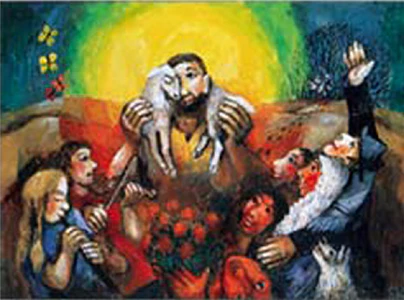
Less Is More (Luke 17:5-10)

The apostles said to the Lord, “Increase our faith!”

He replied, “If you have faith as small as a mustard seed, you can say to this mulberry tree, ‘Be uprooted and planted in the sea,’ and it will obey you.

“Suppose one of you has a servant plowing or looking after the sheep. Will he say to the servant when he comes in from the field, ‘Come along now and sit down to eat’? Won’t he rather say, ‘Prepare my supper, get yourself ready and wait on me while I eat and drink; after that you may eat and drink’? Will he thank the servant because he did what he was told to do? So, you also, when you have done everything you were told to do, should say, ‘We are unworthy servants; we have only done our duty.’” (New International Version)

You and I do not need control. Authority and power belong to God. And we are not God.

You and I need faith. And, since we belong to God, who is the ultimate authority and controls all things, we already have it.

You already have what you need: Jesus. There is no need to hustle and cajole for something you do not need.

Jesus tells his disciples two parables designed to reorient their thinking and their lives around God, and not around the typical worldly tools of power and authority.

We find self-control something very hard. We’d rather have plain old control.

In the 1990s, The Department of Transportation set aside $200 million dollars for research and testing of an automated Highway System. The plan was that this system would relieve traffic problems by placing all cars that entered the highway on “super cruise control,” allowing them to move in unison as they traveled in heavily congested cities.  

Such travel would be made possible by using special magnets embedded in the asphalt every four feet, which would transfer signals between the vehicles and a main computer system.  

Steering, acceleration and braking would be controlled by sensors, computer navigation systems and cameras along the side of the road. Control would be returned to drivers as they exited the highway.  According to the technology manager of the project, “The only thing we can’t do yet is get people to comfortably trust the system. It’s not a technology issue.”

The grace of God in Jesus Christ is our fail-safe system designed to put us in “super cruise control” when dealing with circumstances and relating to people. There is just one difficulty with the system: Getting people to comfortably trust it.

The real problem is that we prefer to retain control of life’s steering wheel, even though it is this tendency that drives us to discontentment and endless relational conflict. Rather than insisting on doing life our way, we need Jesus to take the wheel.

And the irony to all this is that we already have what we so desperately seek.

Just a little bit of Jesus makes a large impact on the world.

            Our Lord’s entire kingdom movement looked as insignificant as a mustard seed. Christ’s little band of disciples were, at best, a motley crew of very human characters who vacillated between faith and doubt; they spent as much time arguing amongst themselves as they did engaging in ministry. Yet, it was these same people who ended up turning the world upside-down.

            The insignificant and small looking mustard seed eventually becomes a world-sheltering tree. In the same way, a barbaric, bloody, seemingly insignificant cross became the means of changing the world.

            We, even though imperfect and small, can become, with Jesus in us, a healing force for the world. Little is much when God is in it. Although Gideon believed he needed to be in charge of a large army to defeat Israel’s enemies, God whittled his soldiers down to just 300, against a force described as an army with men as many as the sand on the seashore. Victory was no problem. Gideon already had what he needed: God. (Judges 7:1-25)

Never underestimate the potency of our little bit of ministry with Jesus animating it. Our…

Kind words spoken in the name of Jesus…

Hidden prayers uttered silently behind closed doors…

Secret giving in which the right hand doesn’t know what the left is doing…

Gentleness in the face of violence…

Humility in the midst of pride…

Mercy given instead of judgment…

Peacemaking wherever frustration exists…

These and so much more, when energized by Jesus, becomes a mighty force for good and change in this old fallen world.

Yet so many Christians think they need all kinds of power, authority, and control – then mountains can be moved, trees uprooted, and things can happen.

With this misguided notion, we too easily succumb to the temptations of winning success, spinning a superior self-image, and pinning down power to get what we want and need.

However, we already have what we need, Jesus, and we do not need what he has – power and authority; we just need him.

The Lord Jesus has shown us the way in this. In Christ’s incarnation, he emptied himself and became like one of us – eschewing the typical power dynamics of the world. At the beginning of his ministry, Jesus spends 40 days in the desert fasting – making himself empty.

And at the end of that time, the devil came to Christ and tempted him in the very same ways we are tempted (Matthew 4:1-11):

Satan: “You need to be successful.”

Jesus: “Nope, don’t need that.”

Satan: “Well, you definitely need to be on the right religious track.”

Jesus: “Get out of my face. I don’t need to play that game.”

Satan: “It’s simple. You can do your Father’s will with the tools of power I have.”

Jesus: “I’m not going there. I don’t need your sort of help.”

In submitting to his Father’s plan and will, Jesus showed us the way to live as his followers.

We, too, have to stare the same three temptations in the eye: the belief that I need to be successful, to be right, and to have everything under control.

The truth, however, is just the opposite. In actuality, we need to be poor in spirit, powerless,  and humble – not full of strength and control.

Jesus said, “My grace is sufficient for you, for my power is made perfect in weakness.” And Paul responded, “Therefore, I will boast all the more gladly about my weaknesses, so that Christ’s power may rest on me. That is why, for Christ’s sake, I delight in weaknesses, in insults, in hardships, in persecutions, in difficulties. For when I am weak, then I am strong.” (2 Corinthians 12:9-10, NIV)

In reality, we need to be open and vulnerable – not spinning a self-image which projects strength, authority, and power.

 In your relationships with one another, have the same mindset as Christ Jesus:

Who, being in very nature God,
    did not consider equality with God something to be used to his own advantage;
rather, he made himself nothing
    by taking the very nature of a servant,
    being made in human likeness.
And being found in appearance as a man,
    he humbled himself
    by becoming obedient to death—
        even death on a cross! (Philippians 2:5-8, NIV)

We need to be meek and gentle – just like our Lord – not puffing our chests out with a show of strength and authority.

Jesus said, “Come to me, all you who are weary and burdened, and I will give you rest.Take my yoke upon you and learn from me, for I am gentle and humble in heart, and you will find rest for your souls. For my yoke is easy and my burden is light.” (Matthew 11:28-30, NIV)

Less is truly more. Only those who have nothing to prove and nothing to protect can receive Christ. And Jesus himself will lead us on this path of self-emptying.

We already have Jesus. Therefore, we already have everything we need. Even a smidgeon of Christ is more than enough for us. What we may think we need – to win at success, to spin a narrative of rightness, and to pin down control through power and authority – amounts to nothing in the kingdom of God.

Instead, what we really need is to walk in the way of Jesus – to be weak through self-emptying, to leak out our pride and embrace humility and vulnerability, and to be meek by having a gentle spirit.

Being a servant is a good thing. And being a servant of the Lord Jesus Christ – the author and perfecter of our faith – is the only vocation we need. With Jesus, less is more.

Almighty and everlasting God, we are far too often influenced by what others think of us. We pretend to be in control, with it, in charge, and strong. Prevent us from trying to attract attention. Don’t let us gloat over praise on one hand or be discouraged by criticism on the other. Nor let us waste time weaving imaginary situations in which the most heroic, put together, and powerful person present is me. Rather, show us how to be humble of heart, just like your Son, our Lord, Jesus Christ, who with you and the Holy Spirit are one God, now and forever. Amen.


How, Then, Shall We Live? (Luke 16:19-31)

The Rich Man and the Poor Man by Laura Jeanne Grimes, 2005

“There was a rich man who was dressed in purple and fine linen and lived in luxury every day. At his gate was laid a beggar named Lazarus, covered with sores and longing to eat what fell from the rich man’s table. Even the dogs came and licked his sores.

 “The time came when the beggar died, and the angels carried him to Abraham’s side. The rich man also died and was buried.In Hades, where he was in torment, he looked up and saw Abraham far away, with Lazarus by his side. So, he called to him, ‘Father Abraham, have pity on me and send Lazarus to dip the tip of his finger in water and cool my tongue, because I am in agony in this fire.’

 “But Abraham replied, ‘Son, remember that in your lifetime you received your good things, while Lazarus received bad things, but now he is comforted here, and you are in agony. And besides all this, between us and you a great chasm has been set in place, so that those who want to go from here to you cannot, nor can anyone cross over from there to us.’

 “He answered, ‘Then I beg you, father, send Lazarus to my family, for I have five brothers. Let him warn them, so that they will not also come to this place of torment.’

 “Abraham replied, ‘They have Moses and the Prophets; let them listen to them.’

 “‘No, Father Abraham,’ he said, ‘but if someone from the dead goes to them, they will repent.’

 “He said to him, ‘If they do not listen to Moses and the Prophets, they will not be convinced even if someone rises from the dead.’” (New International Version)

Many people look for a miracle at some point in life, especially for family. Whenever we see relatives walking far from God or siblings living without much thought to the words and ways of Jesus, it can be disconcerting. We may reason that if they could just experience or see some great miracle, then they will surely believe and embrace Jesus as Savior and Lord. 

Yet, Christ’s parable to us of the rich man and Lazarus graphically depicts an important message: God has already revealed divinity to humanity through Moses and the Prophets (the Old Testament). 

If people are not convinced by what already exists and what has existed for a long time, they likely will not respond when the miraculous slaps them in the face.

Maybe we too often look for the dramatic because the mundane typically rules the day. Perhaps what we are really looking for is already present in God’s revelation to us. It could be that the greatest task we have is not to beg for a miracle (even though there is nothing wrong with that!) but first to be quiet and listen to the Spirit of God speak through the Word of God so that our prayers to God arise in God’s way and God’s time.

Today’s Gospel story gets at the heart of where we immediately and reflexively turn when in dire straits. There is nothing wrong with turning to others, consulting trusted resources, or even Google. Yet, Holy Scripture is timeless. It contains everything we need for life and godliness in this present age. And I believe it has the answers to life’s most pressing questions.

Everyone has their trusted sources, as well as sources we don’t trust. If a person has a pattern of not consulting or investigating Holy Scripture, then it doesn’t matter who encourages them, even if it is a trusted person who shows up from the grave, to look into the Bible’s contents and believe it’s message.

If we look closely at the story, we are told the poor man’s name: Lazarus. And we are not told the rich man’s name. You see, the poor man, Lazarus, had his name written in the Book of Life. The rich man’s name cannot be spoken because it is not found there.

There are two choices in life, two opposing paths we can take. One is to choose pleasure and overlook the great needs of the earth. Like old Jacob Marley in the Christmas Carol, it is to forge a chain, link by link, day after day, which will eventually leave one in bondage and regret.

The other choice is hope. To look ahead by faith and see the eternal things which are coming, then shaping our existence to act in sync with permanent values, is to choose life. Although this may bring deprivation, even suffering, in this present existence, the decision to forego temporary pleasure for eternal glory shall be rewarded. It is to live for future prosperity through present affliction.

So, how shall we then live?

  • Will we anchor our souls in the good bosom of bettering our fellow humanity?
  • Is there an acknowledgment that the measure we give to others shall eventually be given to us?
  • Do we seek to hold faith with a neighbor in their poverty?
  • Are we trusting so much in our five senses – sight, smell, taste, hearing, touch – that we either cannot or will not trust in the sixth sense of the spirit which tells us to believe Moses and the prophets?

Christ has risen. Christ is coming again. If we align our lives with spiritual truth, we shall find our names written in the Book of Life. Let us actively look for Lazarus in our lives, so that we don’t carelessly step over him day after day while selfishly indulging in the good things of this life.

Mighty God, you have done miraculous things. Help me see what you have already done and teach me to listen so that your revelation becomes alive to me. Holy Spirit, impress the redemptive event of Christ’s resurrection on the hearts of all who do not know you so that they might know your amazing grace. Amen.

The Parables of the Lost Sheep and the Lost Coin (Luke 15:1-10)

By Sieger Koder (1925-2015)

Now the tax collectors and sinners were all gathering around to hear Jesus. But the Pharisees and the teachers of the law muttered, “This man welcomes sinners and eats with them.”

Then Jesus told them this parable: “Suppose one of you has a hundred sheep and loses one of them. Doesn’t he leave the ninety-nine in the open country and go after the lost sheep until he finds it? And when he finds it, he joyfully puts it on his shoulders and goes home. Then he calls his friends and neighbors together and says, ‘Rejoice with me; I have found my lost sheep.’ I tell you that in the same way there will be more rejoicing in heaven over one sinner who repents than over ninety-nine righteous persons who do not need to repent.“

Or suppose a woman has ten silver coins and loses one. Doesn’t she light a lamp, sweep the house and search carefully until she finds it? And when she finds it, she calls her friends and neighbors together and says, ‘Rejoice with me; I have found my lost coin.’ In the same way, I tell you, there is rejoicing in the presence of the angels of God over one sinner who repents.” (New International Version)

Lost people matter to God… a lot. They matter so much to the Lord that one lost soul who is found is the grounds for a big celestial party. 

Note a simple observation of today’s Gospel lesson: If there is rejoicing in the presence of angels over one sinner who repents, then it is God who is doing the rejoicing. The Lord is absolutely giddy with joy over a lost person being found.

Jesus told two short stories, each teaching the same thing, so that we will be absolutely sure to get it: A loving God has unbounded joy over lost people being found. These parables of Jesus give us a glimpse of God’s own heart. The Lord would do anything to find a lost person, to restore and reconcile that person to right relationships. 

The Lost Sheep by Jorge Cocco Santángelo

God would go dumpster diving and wade through stinky nasty garbage to find just one lost valuable person.

Restoring lost people is such a high priority to God that the Father sent the Son to this earth. Jesus paid the ultimate price of a cruel death on a cross to reconcile a broken lost relationship between people and God.

I have not always been a devoted follower of Christ. I still remember what it felt like to be separated from God and estranged from the Church – it was lonely and awful, like being in a deep black hole with no way of getting out and no one around to help. 

But God mercifully sent people into my life to share good news with me and help me out of my prodigal way of life. I once was lost. But now I am found. When I turned from my path of destruction and embraced Jesus Christ, there was a big party in heaven.

God gathering wayward and lost persons is a gracious activity, seemingly free from criticism. But there was. The rightful Judge of the universe got judged by a group of spiritual simpletons. And because there were complaints leveled at Jesus for purposely going after the lost, it therefore needs to be asked: 

Where do we locate ourselves in these parables? 

The two stories were downright offensive to many of Christ’s original hearers. Those upset with Jesus were so inwardly focused that they believed ministry ought to revolve around them and their needs.

And, what’s more, the religious leaders were offended because they thought all the fuss about sinners would only highlight their sin. In other words, there ought to be no party and no rejoicing for people who have lived an ethically and morally dubious life.

Preaching grace is always offensive to people who work for their salvation. It is scandalous to such persons to hear that Jesus did not come to call the righteous, but sinners to repentance. 

If we hear Christ’s parables and the concern for lost sinners who don’t know Jesus and say, “Well, all this talk about outreach is well and good, but what about us?  What about me? After all, I never went down a path of immorality or hurt anyone. I’m a good person. Where’s my party?” Then, we must locate ourselves as the lost persons in need of being found by God’s grace.

Consider for a moment the worst sinner you can think of – a person for whom you would label as being akin to the devil…. Now picture that person being found by God and becoming a follower of Christ….

Would you attend the party to celebrate that person’s repentance, reconciliation, and recovery? 

If any of us feels justified in our hate, then we are the lost one in need of turning from our sin.

In leaving the ninety-nine sheep in the flock and going after the one sheep, God gave preferential attention to the lost….

Can you live with that? 

These parables of Jesus have significant meaning for church programs, budgets, and committees. By most estimations, only one-in-five lost people in America even knows one Christian. Statistics like that are what keep me up at night; it deeply saddens me. It drives me to prayer.

God’s unconditional mercy and amazing grace is what makes all the difference. 

If we lose the sense of awe and appreciation for what God has done for us in Christ, then there will be no outreach. Finding lost people is not dependent on completing a class on evangelism or getting training in how to answer every question.

Outreach is fueled by passion and desire. Healthy Christians reproduce themselves. I assume you didn’t take a class on how to procreate – you just had the desire and the willingness; and then, you celebrated nine-months later, the birth of new life.

New life always needs to be celebrated because that’s what God does. Yet, the party cannot commence until the lost are found….

O God – blessed Father, Son, and Spirit – sanctify all believers everywhere with your abiding presence. Enlighten the minds of your people more and more with the light of the Gospel. Bring lost people to the knowledge of our Savior Jesus Christ; and those who are walking in the way of life, keep steadfast to the end. Guard those who are strong and prosperous from forgetting you and straying from the flock. Increase in us your grace and love so that we may participate with you in finding the lost. Amen.

Luke 14:15-24 – The Parable of the Great Banquet

When one of those at the table with him heard this, he said to Jesus, “Blessed is the one who will eat at the feast in the kingdom of God.”

Jesus replied: “A certain man was preparing a great banquet and invited many guests. At the time of the banquet, he sent his servant to tell those who had been invited, ‘Come, for everything is now ready.’

“But they all alike began to make excuses. The first said, ‘I have just bought a field, and I must go and see it. Please excuse me.’

“Another said, ‘I have just bought five yoke of oxen, and I’m on my way to try them out. Please excuse me.’

“Still another said, ‘I just got married, so I can’t come.’

“The servant came back and reported this to his master. Then the owner of the house became angry and ordered his servant, ‘Go out quickly into the streets and alleys of the town and bring in the poor, the crippled, the blind and the lame.’

“‘Sir,’ the servant said, ‘what you ordered has been done, but there is still room.’

“Then the master told his servant, ‘Go out to the roads and country lanes and compel them to come in, so that my house will be full. I tell you, not one of those who were invited will get a taste of my banquet.’” (New International Version)

If the gospel of forgiveness in Jesus Christ is such good news, and God is so good, then why aren’t people breaking the door down to get into the Church? 

Today’s Gospel lesson gives us one reason why: They just aren’t interested. The parable Jesus told was of people, when invited to come to the great banquet, kept making one excuse after the other why they couldn’t come.

Keep in mind that Jesus wasn’t talking to sinful outsiders, but the religious insiders – they were the ones making the excuses why they could not participate. 

Let’s cut to the chase: If professing believers in Jesus Christ are not excited about the gospel… If Christians are not enthused over what they possess in the gospel… If the Church is content to go through the motions of Christianity without a concern to be with Jesus… If we are simply too busy to come and attend God’s banquet of grace…

Then, why in the world would any Christian or any Church believe that others ought to show up and be a part of their fellowship, that they would even remotely entertain a thought to profess Christ as Savior and break down the door to get into Christianity?

Jesus was offering a penetrating warning: The unresponsive religious insiders will be replaced by the responsive sinful outsiders. 

If the insiders take for granted what they possess and have better things to do, then God is going to call people who will hear, listen, and respond to the gracious invitation.

The deeply probing question for every believer in Christ today is: Are we so familiar with Jesus, and so content with the way things are that when God breaks into our lives in the form of an invitation that we refuse to respond because we are not interested in going to some stupid banquet? 

There is an incredible abundant feast for us – in fact, Jesus said that his food and drink was to do the Father’s will, that Scripture was his bread. (John 4:34) 

It’s much too easy to take the spiritual abundance of grace and mercy – as well as our physical abundance of food and water – for granted. After all,…

  • Being well-fed, it’s easy to assume that everyone else is, too.
  • Enjoying good health, it’s easy to forget that others are hurting and in pain.
  • Having money and the ability to work hard, it’s easy to think that there are not many poor people around.
  • Living around other Christians all the time, it’s natural to assume that everyone knows the gospel of Jesus – but they don’t!

In Christ’s story, the people making excuses see no real importance to take the invitation to the banquet seriously. And so, they go off to take care of their business and their family.

Like them, we can be much too busy with mundane activities to notice that people need the Lord. And then, when we get around to acknowledging that there are people who need Jesus, we keep devising ways to reach them without having to change our own lives to do it.

Jesus has no intention of calling and inviting us to a discipleship that requires no change on our part. The refusal to alter our lives to accommodate God’s invitation will result in the invitation going out to others. 

So, the master’s servant in the parable goes out into the roads and country lanes and invites any common person to come – anyone he can find.

And that is the scandal of Christ’s gospel – that the invitation to God’s abundant mercy is open to outcasts and failures, to problem people and unimpressive low-life’s, to backwater rednecks and uneducated hicks, to the jobless and the needy, to all sorts of people who are not like your circle of friends. 

People who are flawed are especially dear to Jesus, and not just people who have it all together. It’s the people who outwardly have it all together that are being replaced wholesale with those who admit their guilt, shame, and brokenness. 

Lord, have mercy. Christ, have mercy. Lord, have mercy upon us sinners.

Gracious God, forgive me for wasting time in things that just don’t matter in the scope of eternity. I choose to go out and compel outsiders to come in, so that your house will be full for the great feast at the end of the age. Through Jesus, in the power of the Holy Spirit, I pray. Amen.