First Sunday after Christmas Day – Where Is Jesus? (Luke 2:41-52)

The Boy Jesus In the Temple, by He Qi

Now every year his parents went to Jerusalem for the festival of the Passover. And when he was twelve years old, they went up as usual for the festival. When the festival was ended and they started to return, the boy Jesus stayed behind in Jerusalem, but his parents were unaware of this. Assuming that he was in the group of travelers, they went a day’s journey.

Then they started to look for him among their relatives and friends. When they did not find him, they returned to Jerusalem to search for him. After three days they found him in the temple, sitting among the teachers, listening to them and asking them questions. And all who heard him were amazed at his understanding and his answers. 

When his parents saw him they were astonished, and his mother said to him, “Child, why have you treated us like this? Your father and I have been anxiously looking for you.” 

He said to them, “Why were you searching for me? Did you not know that I must be in my Father’s house?” But they did not understand what he said to them. 

Then he went down with them and came to Nazareth and was obedient to them, and his mother treasured all these things in her heart.

And Jesus increased in wisdom and in years and in divine and human favor. (New Revised Standard Version)

Luke is the only New Testament Evangelist who included a story of Jesus’s childhood. It provides us some interesting biographical information. Yet, more importantly, the story gives us a sense of Christ’s destiny, of why Jesus grew up to  engage in his unique earthly ministry.

In many ways, Jesus was a typical Jewish boy, in a non-descript pious Jewish family. The family was careful to be observant, and annually made their pilgrimage to Jerusalem for Passover.

Joseph and his family traveled in a large caravan of people, which was common for that day. They were on their camels an entire day before they discovered Jesus was missing.

Mary likely assumed Jesus was riding on the other camel with Uncle Zechariah and his cousin John. 

But Jesus was neither with them nor with Aunt Elizabeth. So, the second day, Joseph and Mary backtracked to Jerusalem, hoping and praying they wouldn’t find Jesus in the ditch, like in the story of the Good Samaritan.

Having not found their son along the road, Joseph and Mary spent the third day scouring Jerusalem in search of Jesus. 

It seems to me that far too many people go about their daily lives without realizing Jesus is even missing. They simply assume he’s here. But he isn’t.

So, let’s search for him. And in finding him, may we see Jesus as we have never seen him before, so that our faith in God might be strengthened, and so that we do not end up losing him yet again.

Turns out, the entire time, Jesus was at the temple. As a parent and grandparent myself, I’m not a bit surprised that a twelve-year-old stayed behind and thought nothing of it. 

Jesus was curious and inquisitive with the rabbis at the temple. Those ancient teachers taught in a different way than Christians preachers today. They gave instruction more like a modern day counselor or therapist.

The rabbis didn’t just impart information; they asked questions to help people discover truth for themselves. And the rabbis were amazed at Jesus’s ability to discover truth.

Keep in mind that Jesus was not a thirty-year-old adult in a twelve-year-old body. Christ was sinless, indeed; but still immature.

The human experience involves growth and maturation. Jesus shared fully in our humanity, not partially. When Christ was born, he was not a fully aware adult looking through the eyes of a baby.

Because Jesus is fully human, he had to grow up just like us and learn in every way, just like us. (Hebrews 4:15; 5:8)

Staying in Jerusalem was not a rebellious act by Jesus. It was typical. Twelve-year-old’s do all kinds of things without saying anything to their parents.

There’s a world of difference between defiant rebellion, and just plain old garden variety immaturity. It’s unwise for adults to expect adult behavior from adolescent kids.

Jesus felt a deep need to stay and talk with the rabbis. As a human boy, he had to go through the process of self-discovery… of finding out that he was the Son of God… of reading the scriptures for himself and learning… and finding that he was reading about himself! 

To say that Jesus simply knew everything because he was God is to fall into a heresy the early church condemned at the Council of Nicaea called Docetism – a belief that Jesus is fully God and only appeared to be human.

No, the Nicaean Council said, Jesus is really a human being and did not simply appear to be one. He is like us, in every way, except sin.

Well, of course, Joseph and Mary finally found Jesus. And Jesus got the third degree from his mother: “What do you mean putting your father and I through this? I gave you birth, and you treat us like this?  What were you thinking?  What part of meeting at the two-humped camel at 9:00 don’t you understand!?”

Since Jesus grew in wisdom and stature and in favor with God and others, how much more do we need to put ourselves in a position to grow and learn and develop and mature? 

There is no spiritual machine in which God miraculously zaps into our brains all the wisdom and knowledge we need.

Rather, emulating our Lord, we must learn, grow, read, pray, ask questions, struggle, and dialogue about the good news of Jesus Christ with each other. In short, we must discover the truth of God.

Perhaps Jesus is asking us, as he did to Mary and Joseph, “Why were you searching for me?  Didn’t you know that I had to be in my Father’s house?” 

The answer of Jesus to his parents’ anxious searching of him points to Christ’s growing self-awareness about his messianic mission. The story centers around Jesus, as all stories do in the Gospel narratives, and not so much around the others.

Since Christ is the proper middle to everything for the Christian, we will, like Joseph and Mary, struggle to know where in the heck Jesus is, and why he is where he is, whenever we find him.

But it isn’t really all that hard to find Jesus, at least, once you know where to look, and where he typically hangs out.

When looking for Jesus, he will be doing the things of his Father. In the Gospel of Luke, those things are clearly connected to the prophet Isaiah’s description:

“The Spirit of the Lord is upon me,
    because he has anointed me
        to bring good news to the poor.
He has sent me to proclaim release to the captives
    and recovery of sight to the blind,
        to set free those who are oppressed,
to proclaim the year of the Lord’s favor.” (Luke 4:18-19, NRSV; cf. Isaiah 61:1-2)

The ones rejoicing at Christ’s birth, and why they were filled with such joy, is very much connected to the messianic mission of Jesus. They understood that freedom and deliverance had just been born.

O God, from our mother’s womb you have known us. You call us to follow you every single day of our lives. And you seek us out whenever we wander from you. As we grow up and grow older, clothe us with your love, so that we may mature in grace and find favor in your sight; through Jesus Christ our Savior and Lord. Amen.

Rejected (Luke 4:16-30)

Orthodox depiction of Christ in the synagogue at Nazareth

When he came to Nazareth, where he had been brought up, he went to the synagogue on the Sabbath day, as was his custom. He stood up to read, and the scroll of the prophet Isaiah was given to him. He unrolled the scroll and found the place where it was written:

“The Spirit of the Lord is upon me,
    because he has anointed me
        to bring good news to the poor.
He has sent me to proclaim release to the captives
    and recovery of sight to the blind,
        to set free those who are oppressed,
to proclaim the year of the Lord’s favor.”

And he rolled up the scroll, gave it back to the attendant, and sat down. The eyes of all in the synagogue were fixed on him. Then he began to say to them, “Today this scripture has been fulfilled in your hearing.” 

All spoke well of him and were amazed at the gracious words that came from his mouth. They said, “Is this not Joseph’s son?” 

He said to them, “Doubtless you will quote to me this proverb, ‘Doctor, cure yourself!’ And you will say, ‘Do here also in your hometown the things that we have heard you did at Capernaum.’ ” 

And he said, “Truly I tell you; no prophet is accepted in his hometown. But the truth is, there were many widows in Israel in the time of Elijah, when the heaven was shut up three years and six months and there was a severe famine over all the land, yet Elijah was sent to none of them except to a widow at Zarephath in Sidon. There were also many with a skin disease in Israel in the time of the prophet Elisha, and none of them was cleansed except Naaman the Syrian.” 

When they heard this, all in the synagogue were filled with rage. They got up, drove him out of the town, and led him to the brow of the hill on which their town was built, so that they might hurl him off the cliff. But he passed through the middle of them and went on his way. (New Revised Standard Version)

Reject:

  1. to refuse to have, take, recognize, etc.; to deny
  2. to refuse to grant (a request, a demand, etc.)
  3. to refuse to accept (someone or something); to rebuff, renounce, or repel
  4. to discard as useless or unsatisfactory; to jettison or eliminate
  5. to cast out or eject; vomit
  6. to cast out or off

Rejection can be mutual, and cut both ways. This appears to have been the case with Jesus and the synagogue goers in his hometown of Nazareth.

The townsfolk rejection of Jesus went far enough to want to throw him off a cliff. They were enraged with anger. Christ recognized the people’s rejection of him, long before they realized it themselves. Christ’s rejection of unjust and unbiblical ideas and practices went far enough to rebuke the congregation from the scriptures.

The difference in the two rejections was that the synagogue attenders were denying Jesus himself; whereas Jesus was refusing to accept a longstanding tradition of hate toward a certain group of people.

The nub of the rejection, which went both ways, had to do with non-Jewish persons, that is, Gentiles.

If you think this to be a silly sort of thing, especially of getting so worked up as to try and kill someone, then consider how frothed-up people get concerning contemporary political elections.

Jesus being pro-Gentile was not only unpopular; it was unheard of. So, the people rejected him.

The synagogue being anti-Christ meant that they were anti-Gentile and anti-God, as far as Jesus was concerned. And he wasn’t about to put up with it. So, he rejected not the people, but their entrenched hatred and unscriptural stance.

Jesus took the prophecy of Isaiah about proclaiming liberty to captives, and freedom for the oppressed, and then applied it, not to his fellow Jews who were present, but to, of all people, Gentiles.

Christ pointed out that in the days of Elijah, the prophet was sent to a Gentile woman. In addition, he let everyone know that the prophet Elisha cleansed a Gentile. 

The gathered synagogue worshipers understood exactly what Jesus was saying and doing – he was claiming to be the ultimate prophet, sent for those despised people. 

It was too much for the gathered folk to take. So all hell broke loose as the “worshipers” became so angry and insolent that they drove Jesus out of town and tried to chuck him off a cliff to his death.

Jesus had that kind of effect throughout his earthly ministry by saying and doing the unexpected, and the unwanted.

The people of Nazareth seemed to have always interpreted the message of Isaiah and the prophets as being for themselves, not others. 

This is a probing story for today’s Christian Church. Whenever we lose sight of a biblical message and re-interpret it as being for only us, then we end up like the Nazarenes of old who did not recognize Jesus for who he really is and what he really came to do. 

Perhaps the burning question from today’s Gospel lesson for individual Christians and all churches is this: Are you ready to throw Jesus off a cliff?

Spend some time alone with God today. Consider whether you have made Jesus into the image of what you want him to be, or whether you accept him as he is. 

One clue to this is if you believe some person or people group should not have Jesus – he belongs to people like us. This, by the way, is the very definition of “rejection.”

It could be that some soul-searching repentance is in order, so that Christians will be true worshipers of Jesus, and not just spectator fans of him.

O God, you made us in your own image and redeemed us through Jesus your Son: Look with compassion on the whole human family; take away the arrogance and hatred which infect our hearts; break down the walls that separate us; unite us in bonds of love; and work through our struggle and confusion to accomplish your purposes on earth; that, in your good time, all nations and races may serve you in harmony around your heavenly throne; through Jesus Christ our Lord. Amen.

The Power of Emptiness (Mark 7:24-37)

From there Jesus set out and went away to the region of Tyre. He entered a house and did not want anyone to know he was there. Yet he could not escape notice, but a woman whose little daughter had an unclean spirit immediately heard about him, and she came and bowed down at his feet. Now the woman was a Gentile, of Syrophoenician origin. She begged him to cast the demon out of her daughter. 

Jesus said to her, “Let the children be fed first, for it is not fair to take the children’s food and throw it to the dogs.” But she answered him, “Sir, even the dogs under the table eat the children’s crumbs.” Then he said to her, “For saying that, you may go—the demon has left your daughter.” And when she went home, she found the child lying on the bed and the demon gone.

Then Jesus returned from the region of Tyre and went by way of Sidon toward the Sea of Galilee, in the region of the Decapolis. They brought to him a deaf man who had an impediment in his speech, and they begged him to lay his hand on him. 

Jesus took him aside in private, away from the crowd, and put his fingers into his ears, and he spat and touched his tongue. Then looking up to heaven, he sighed and said to him, “Ephphatha,” that is, “Be opened.” And his ears were opened, his tongue was released, and he spoke plainly. 

Then Jesus ordered them to tell no one, but the more he ordered them, the more zealously they proclaimed it. They were astounded beyond measure, saying, “He has done everything well; he even makes the deaf to hear and the mute to speak.” (New Revised Standard Version)

Two stories. Two suffering people, because of their infirmities. A mother and a community suffering along with them, not knowing how to help them.

Lo and behold, Jesus, of all people, was the last person they expected to hear was in the area. He a Jew. They Gentiles. Yet, what if….

Maybe there is a ray of hope. After all, where there is emptiness, there is potential. And Jesus is the expert on that!

Christ had the rare ability to give the necessary gift of envisioning potential in another’s life, of seeing how the empty space could be filled with life and joy. Indeed, with Jesus there is possibility.

It is important to not only look at what is there, but also on what is not there. Because that’s where we find the quality, opportunity, and potential in another, and in ourselves.

The daughter in the narrative was vexed and incapacitated by an unclean spirit, a demon. The man in the story was deaf and mute, unable to hear and speak, lacking capacity for effective interaction in a society which relied so heavily on the ears and the mouth.

We may imagine their emptiness, feeling bereft of ever experiencing abundant life in their respective circumstances. However, they had those around them who cared, and interceded on their behalf.

Just realizing that Jesus was amongst them seemed to inspire a spark of possibility. Their thinking began to move in a slightly different direction with Christ in the neighborhood.

500 years before Christ’s encounters with these folks, the Chinese philosopher Lao Tzu crafted this poem:

A wheel may have thirty spokes,

but its usefulness lies in the empty hub.

A jar is formed from clay,

but its usefulness lies in the empty center.

A room is made from four walls,

but its usefulness lies in the space between.

Matter is necessary to give form,

but the value of reality lies in its immateriality.

Everything that lives has a physical body,

but the value of a life is measured by the soul.

The immaterial is the real substance. The material is only the form we see around it. It isn’t the material which effects the immaterial; it is the immaterial which has the power to transform the material.

Yet, change is never easy, even the necessary changes we long to see realized. It was not easy for any Gentile living in a Jewish world, and vice versa. Both Jews and Gentiles find out how hard things really can be.

Exorcising the Canaanite Woman’s Daughter, by Peter Gorban, 1990

The word got around that Jesus was in town. Nobody knew where he was. But desperate people discover ways to find the people they believe can help. The mother of the daughter with an unclean spirit found where Jesus was staying.

Furthermore, desperate persons are resilient; they rarely give up. The woman was used to tension in the room. She was unfazed by the Jew and Gentile disparity. I happen to think that the response of Jesus was probably expected by the woman. It certainly didn’t discourage her.

The woman asked for help. Jesus rebuffed her. Perhaps this seems incongruent with your understanding of Christ. It may even shock you. It was anything but Midwest nice.

One of the realities, it seems to me, that we need to understand and grapple with, is that Jesus was a real bona fide human being. He was born, grew up, had to learn things and become mature, in every sense of the word.

Christ also needed to develop and live into his own ministry. He had to learn how to establish personal boundaries, apply wisdom to particular situations, and deal with being hungry and tired with a world of human need around him.

I believe that is what we see in this interaction with the woman. And it in no way diminishes Christ’s divinity. We need to be able to hold all of Jesus – both his divinity and his humanity – at the same time, all the time.

Undeterred, the woman bent the words of Jesus to her advantage. That’s what desperate people do. So, Christ, recognizing true desperation and the faith behind her persistence, then immediately exercised his divinity by expelling the unclean spirit from the daughter and bringing her to full capacity.

I’m glad the Gospel writer Mark recorded the narrative as he did. I see a Messiah who deeply desires to do his Father’s will, and has to struggle with how to accomplish it.

I see Jesus in the story as actively growing in his understanding and ability, learning to break into the world with grace and truth; yet at the same time, not conforming to the world’s status quo.

Methinks that not much of this had anything to do with Christ’s sense of ethnicity and gender, but with everyone else’s understanding of the terms. Jesus, along with all of us who desire to follow the ways of God, must struggle with how to bring God’s kingdom values to people.

Jesus, to his credit, is a quick study. Being oriented to love, mercy, and obedience will do that for you. The woman was an outside voice. Christ was willing to listen and banter with her. He was not threatened when she spoke her truth to his power.

I will suggest to you that perhaps the reason for Christ’s willingness and ability to have effective ministry with the woman and her daughter (as well as everyone else) is that he had his own sacred emptiness.

Whenever we are full of ourselves, full of all our thoughts of how things ought to go, and full of all our settled beliefs, then there is no room to see and listen to another person.

Jesus was empty so that the woman could add to him with her own story and struggle. And when that happened, a miracle occurred.

The same sort of sacred emptiness happened with the deaf and mute man who was healed of his infirmity. Jesus was able to receive and be filled with the people who brought the man to him.

They begged Christ to help the man. Jesus saw them and heard them, because he was not so full of himself. And if anyone ever had a right to be full and tell others what to do, it is Jesus.

But he didn’t. In his empty humility, he had room for others. Since Christ emptied himself, he could empty others of all the stuff that gets in the way of living a peaceful life. (Philippians 2:5-8)

That is precisely why I am here. Because Jesus had room for me. Christ has a very large inner space, big enough to accommodate an untold amount of people. He has room for you, too. He sees you, and is able to listen to you.

So, go ahead; speak your own truth to Christ’s power.

The Feeding of the Four Thousand (Mark 8:1-8)

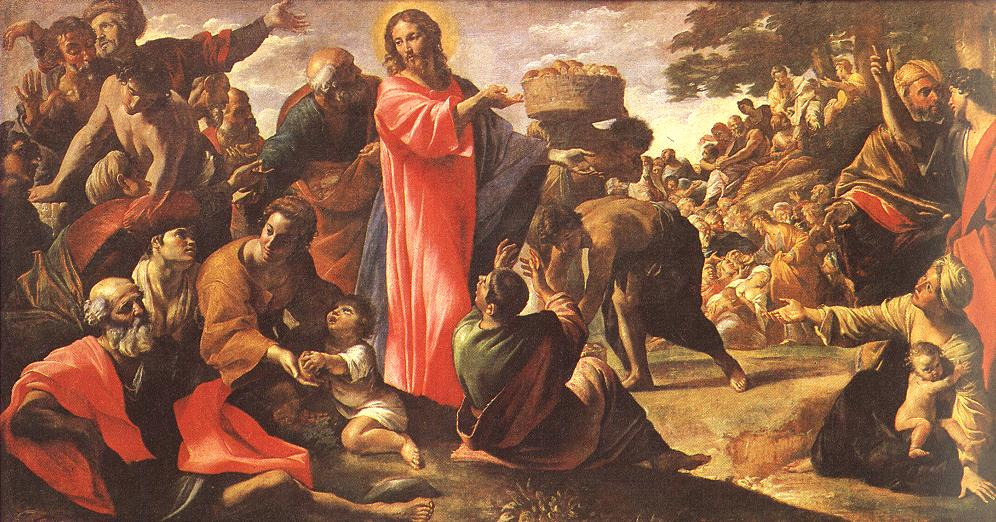
Miracle of the Loaves and Fishes, by Giovanni Lanfranco, c.1620

In those days when there was again a great crowd without anything to eat, he called his disciples and said to them, “I have compassion for the crowd because they have been with me now for three days and have nothing to eat. If I send them away hungry to their homes, they will faint on the way—and some of them have come from a great distance.” 

His disciples replied, “How can one feed these people with bread here in the desert?” He asked them, “How many loaves do you have?” They said, “Seven.” 

Then he ordered the crowd to sit down on the ground, and he took the seven loaves, and after giving thanks he broke them and gave them to his disciples to distribute, and they distributed them to the crowd. They had also a few small fish, and after blessing them he ordered that these, too, should be distributed. 

They ate and were filled, and they took up the broken pieces left over, seven baskets full. Now there were about four thousand people. And he sent them away. And immediately he got into the boat with his disciples and went to the district of Dalmanutha. (New Revised Standard Version)

This was an incredible miracle by Jesus. And it was also an incredible lack of faith on the part of his disciples. Christ had already taught them an important faith lesson by feeding 5,000 people earlier. You’d think they would have gotten it right this time.

It appears that the disciples were anxious about the situation. After all, whenever we are given to anxiety within a stressful circumstance, we typically are not thinking wisely about what to do.

There simply was no evidence that the disciples were tapping into their wise minds – even though they could have. And there’s where the rub is: Do we have the wherewithal to pause, in order to connect with what and who we know?

Let’s notice in the story that Jesus did not seem at all perturbed by the disciples’ small faith. And he certainly was not hindered in any way by the meager supply of food which was on hand. So, a remedial lesson was provided.

All the food the disciples pulled together was given to Jesus. It wasn’t much for thousands of people. Seven loaves of bread and a few fish. Yet, Christ transformed it into enough to feed the entire crowd of mostly Gentiles, without depriving the disciples of their share. They collected enough to fill seven baskets large enough to hold a man.

So there’s the lesson redone and restated, but with a different twist. Whereas the earlier miracle of food was provided for mostly Jews, the feeding of the four thousand consisted of nearly all Gentiles.

Perhaps the disciples did not really want a miracle to begin with. Maybe they believed their ministry ought to be with Israel, and not the heathen nations around them. It could be that Christ’s disciples simply did not want to be in Gentile territory at all, let alone have to engage in ministry to them, up close and personal.

So, we may be dealing with something more than an issue of faith; we might be looking at plain old fashioned prejudice against another group of people. Discriminatory behavior shrinks one’s faith and makes it small – whereas including others, and seeing their inherent worth as God’s image-bearing creatures, increases our faith and helps it grow large.

Jesus had a heart big enough, a mind open enough, and more than enough ability to make the miracle of food happen. In other words, Christ wanted to do it. He had compassion on the people, regardless of the fact that they were not like him.

It could be that a lesson in prejudice was the teaching he wanted them to get a hold of.

We see in today’s story a trajectory of inclusion, that the kingdom of God is meant to be full of diverse people from every nation, race, and background. Jesus purposely went to the Decapolis, a geographical region with a lot of different people – mostly non-Jews.

The Decapolis (which means “Ten Cities”) was a group of ten Hellenistic cities. It was a center of Greek and Roman culture, in a region mostly populated by Jews and Arameans. Each city functioned as a sort of city-state which was dependent upon Rome. There was enough diversity within the Decapolis itself which seemed to prevent them from working together as an organized region.

When it comes to Christian ministry, there are often two issues going on, namely because ministry is all about working with people. One is that we may have a problem, like the disciples of old, in going to a place we’ve never been before – and really don’t ever want to go. We have particular ideas about the people who live there and what they’re like – and we’d rather not have to deal with them.

The second issue is that we may have a problem with ourselves. Unlike the first issue in which we wonder why Jesus would care about those people, the second is wondering if Jesus really cares about me.

In this, you have no problem believing that Jesus would go to the Decapolis and have compassion on the Gentiles. But you struggle with God caring for you, and that Jesus could ever use you in ministry to people like those in the Decapolis. You can think of all sorts of other people who could do the job much better than yourself.

Since you know yourself pretty well, you understand your own doubts, weaknesses, and sins; and have a hard time trusting that the Lord could or would want to involve you in any ministry.

We, of course, could read today’s Gospel lesson from either of the two issues. Yet, we probably need not make it an either/or issue; it may be more of a both/and issue.

That is, Christ’s disciples – including those past and present – likely struggle with both: We continually keep finding that we have personal prejudices which prevent us from reaching out to particular people; and we also have personal insecurities and inhibitions about God truly loving us enough to use us in effective ministry.

Within the story of Jesus feeding the four thousand, both issues can find their resolution. The fact of the matter is that Jesus cared about the people in the region of the Decapolis, and created a miracle in order to take care of them; and, Jesus used a group of men who probably were likely prejudiced, and also insecure about being used for such a ministry.

May you know that you are infinitely loved by God – and loved alongside all sorts of other people, as well, from everywhere in every place. And may you understand that God has you on this earth to be a blessing to all kinds of persons.

May it be so, to the glory of God. Amen.