The Rhythms of Jesus

The Solitude of Christ by French painter Alphonse Osbert, 1897

As soon as they left the synagogue, they went with James and John to the home of Simon and Andrew. Simon’s mother-in-law was in bed with a fever, and they immediately told Jesus about her.So, he went to her, took her hand, and helped her up. The fever left her, and she began to wait on them.

That evening after sunset the people brought to Jesus all the sick and demon possessed. The whole town gathered at the door, and Jesus healed many who had various diseases. He also drove out many demons, but he would not let the demons speak because they knew who he was.

Incredibly early in the morning, while it was still dark, Jesus got up, left the house, and went off to a solitary place, where he prayed. Simon and his companions went to look for him, and when they found him, they exclaimed: “Everyone is looking for you!”

Jesus replied, “Let us go somewhere else—to the nearby villages—so I can preach there also. That is why I have come.” So, he traveled throughout Galilee, preaching in their synagogues, and driving out demons.

A man with leprosy came to him and begged him on his knees, “If you are willing, you can make me clean.”

Jesus was indignant. He reached out his hand and touched the man. “I am willing,” he said. “Be clean!” Immediately the leprosy left him, and he was cleansed.

Jesus sent him away at once with a strong warning: “See that you don’t tell this to anyone. But go, show yourself to the priest and offer the sacrifices that Moses commanded for your cleansing, as a testimony to them.” Instead, he went out and began to talk freely, spreading the news. As a result, Jesus could no longer enter a town openly but stayed outside in lonely places. Yet the people still came to him from everywhere. (Mark 1:29-39, NIV)

Solitude by Russian painter Tatiana Yushmanova

We need rhythm.  Everything in life is rhythmic. Each new year moves with the rhythm of the four seasons. Our hearts beat in rhythm. When we walk, our gait is in a distinct rhythm. When talking, we speak with a rhythmic cadence. We sing and make music because of rhythm. We need healthy rhythms of waking and sleeping.

When our rhythm is off, we are off. Busy or unhealthy lifestyles can insidiously drag us away from the spiritual rhythms we need for healthy living. Over time, it may go unnoticed that our rhythm is off.  For many folks, normal is getting dressed in clothes bought for work, driving through traffic in a car still being paid for, to go to a job to pay for the clothes, car, house, and other stuff that is left empty of life all day to afford to live in it. Many people are oriented more by the rhythms of work, school, and sports than by a connection to the life, death, and resurrection of Christ.

Our 24/7 world demands more time and resources, convincing us we can never slow down or take a break. Some people know their rhythm is off and out of sync with God’s ways but feel powerless to change it. So, how do we restore the unforced rhythms of God’s grace to the center of our stressed and chaotic lives without being overwhelmed by a new set of time commitments? To have healthy rhythms of life, we must look to Jesus.

Jesus was continually filled with the life of God the Father and therefore was always overflowing with that life to others. Christ had a rhythm of life which was oriented around times of inner solitude with his heavenly Father, and times of outward spiritual care to people.  Jesus needed regular, dedicated time for solitude and prayer for the rigors of ministry. So then, how much more do we!

There are two distinct sections in today’s Gospel lesson: Christ’s outward healing ministry; and his inward attention to solitude and prayer. By examining Jesus and following his rhythms of life, we can find the way to living healthy fulfilled spiritual lives as Christians.

The outward healing ministry of Jesus was powerful and effective.

Jesus was committed to helping and healing people with the authority given him. Peter’s mother-in-law was sick. Every sickness in the ancient world was serious and could easily result in either permanent physical damage or death. In a clear demonstration of power, Jesus simply took her by the hand and raised her up to new life. As soon the fever left her, the woman immediately began serving the people in the house. The proper response to being healed by Christ is to become a servant of others. 

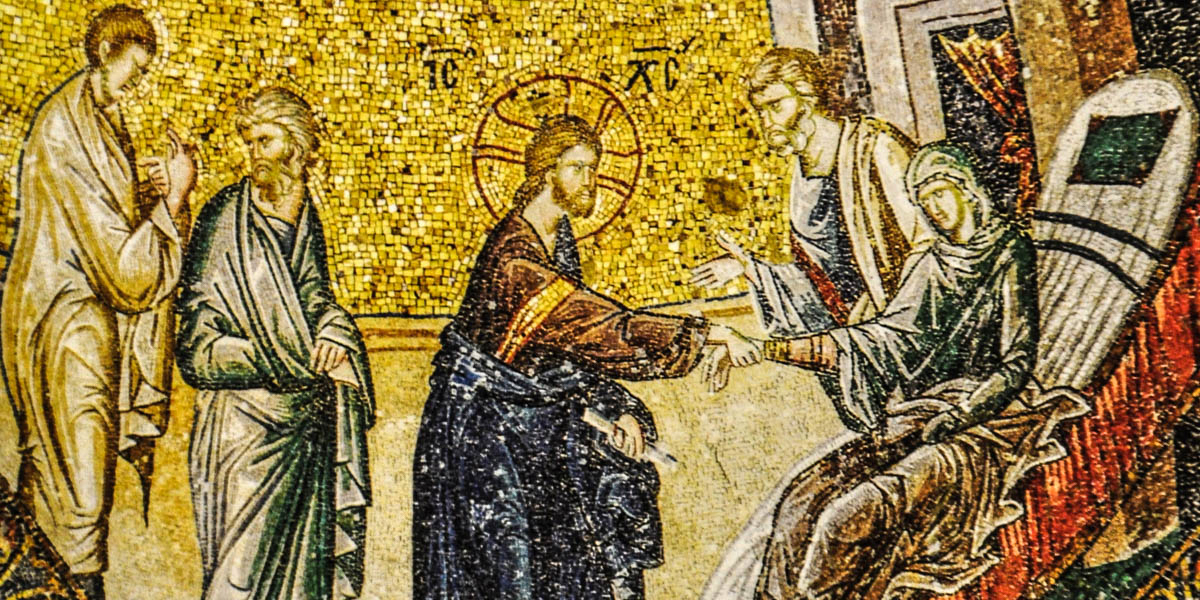
13th Century Byzantine Church mosaic of Jesus healing Peter’s mother-in-law

Jesus and the disciples were in the little village of Capernaum, and being a small town, the news spread quickly of what happened with Peter’s mother-in-law. As a result, by evening, every sick and demonized person in the village showed up to see Jesus. Christ healed them all and confronted the demonic among them. Jesus wanted to avoid creating a circus and desired to move about freely, so he commanded the demons not to speak, because they knew who he was and what he was up to.

Healing is wonderful. Talking about it, not so much. Discussing healing is difficult because seeing one person healed and restored while another person is not, defies simple answers. So, I offer a few biblical observations about this human conundrum we all have likely experienced.

  • Healing narratives in the Gospels say much more about Jesus than about us. 

Jesus has the power and authority to overthrow demons, cure the incurable, and restore people to health. It is all a sign that the kingdom of God is near, and when the kingdom comes in all its fullness, there will be no more sickness, pain, or demonic influence.

  • Good health, security, and safety are not necessarily a sign of God’s presence any more than pain and suffering are signs of God’s punishment, or a lack of personal faith. 

We have enough stories in the Bible to let us know we are not privy to the big picture of what God is doing. We will not always see what the Lord is up to and very well may never have an answer to our questions, this side of heaven.

  • Every person who is healed today will eventually get sick again and someday die. 

Even Lazarus, whom Jesus raised from the dead, died again. The ultimate meaning of any person’s healing is more than the physical – it affects the entire person – body, mind, emotions, soul, and spirit. For example, forgiveness is many times the needed miracle before any kind of physical healing can occur.

Sometimes the greatest miracle of all is our response to sickness and suffering.  A surgeon, Richard Selzer, describes one such miracle:  “I stood by the bed where a young woman lies in post-op after surgery, her mouth twisted looking clownish.  A tiny twig of the facial nerve, the one to the muscles of her mouth, has been severed to remove a tumor in her cheek.  Her young husband is in the room.  He stood on the opposite side of the bed as if I were not really in the room, his full attention on her.  She asked me, ‘Will my mouth always be like this?’  ‘Yes, it will, because the nerve has been cut,’ I say.  She nodded somberly.  But the young husband began to smile.  He said, ‘I like it; it is kind of cute.’  He bent down to kiss her crooked mouth and I was close enough to see how he twisted his own lips to accommodate hers, to show her that their kiss still works.”

Perhaps the kind of healing we all need is the ability to receive God’s love in the person of Jesus who has accommodated himself to us.

Christ did not spend every waking moment with people, teaching and healing. Jesus knew that working without prayer, rest, and solitude is not realistic and rarely ends well.

The inward prayer and solitude of Jesus caused him to be powerful and effective.

Early the next morning after a day of healing ministry, Jesus got up and went to be alone with the Father. The fact that Peter and the disciples hunted him down when they could not find him, shows they did not quite see the same value of solitude that Jesus did. In Christ’s healthy rhythm of life, he included significant doses of solitude with his Father.

It is important for believers to spend generous portions of time with God. If we fail to do this, God has ways of getting our attention. We must slow down and calm our racing thoughts enough to listen. Human suffering is a great way to meet Jesus!  We cannot rush from task to task and expect to live a healthy spiritual life.  We need time with Jesus.

“Without great solitude, no serious work is possible.”

Pablo Picasso

Only through a healthy rhythm of life that includes solitude and prayer will we have clear direction for our daily lives, and wisdom for sound decision-making.  Jesus came away from his time of solitude having re-connected with his purpose for being on earth.  It was his clear conviction that he must travel and not just stay in one place.

Traveling is important to the Christian life.  I am not talking about moving from state to state like I have done in my life; I mean that we must keep moving, like walking across the room to engage others we do not know. Our lives become stagnant when we only ever interact in our small circle of friends and family. 

So, Jesus traveled throughout Galilee, convinced to do so through his time of solitude and prayer, to spread the good news of God’s benevolent kingdom and drive out demons wherever he went.  Even in this we are to imitate our Lord.

Driving out demons is, yes, a literal reference. The demons were driven out so that people could be liberated and experience freedom and connection in community, since most demonized people were always in solitude. They were freed so that they could have healthy rhythms of life of not just solitude but of ministry, service, and community. Hell is a separation from God and others.  Jesus came to bring relational health and wholeness through relational connection.

Conclusion

Both continual work and prolonged withdrawal from others is unhealthy.  To always be working and serving eventually leads to bitterness, exhaustion, and burn-out.  To always be alone (even in a crowd) and not serving leads to spiritual sickness.  It may be counter-intuitive for us to break away from work, but solitude and prayer will help us more productive.

If we are constantly on the go, there is healing available through solitude. If we are continually withdrawn from others, then the healing we need will come through engaging with others and moving past passivity.

To attach and detach, to connect and let go, to engage and desist, are spiritual rhythms of life that we must hone and practice so that we will be healthy persons for ourselves and for others.

Matthew 21:18-22 – Faith and Prayer

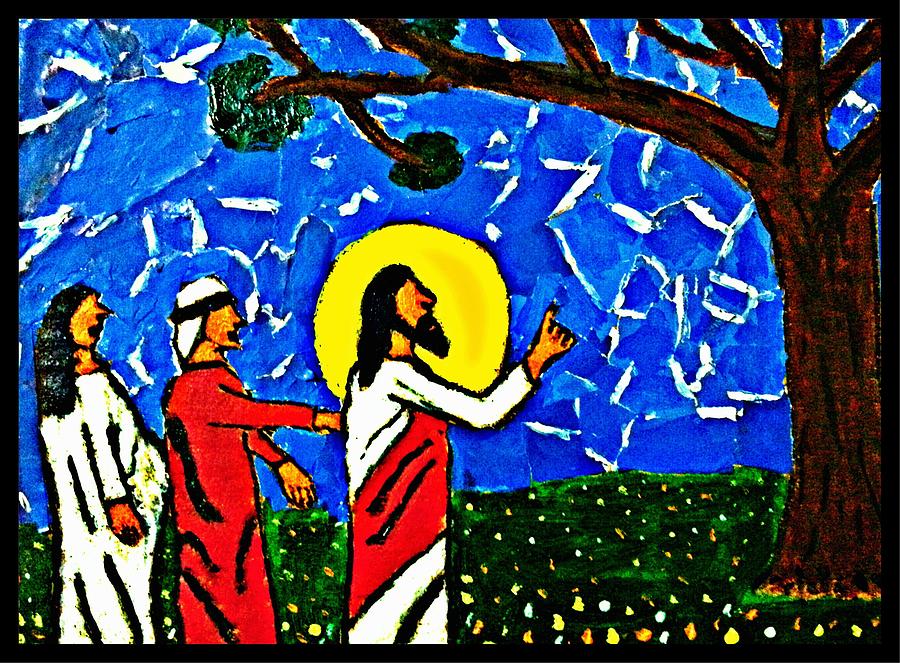
Jesus Cursing the Fig Tree
Jesus Cursing the Fig Tree by Ganosh Kelagina Beedu Shenay, 2016

Early in the morning, as Jesus was on his way back to the city, he was hungry. Seeing a fig tree by the road, he went up to it but found nothing on it except leaves. Then he said to it, “May you never bear fruit again!” Immediately the tree withered.

When the disciples saw this, they were amazed. “How did the fig tree wither so quickly?” they asked.

Jesus replied, “Truly I tell you, if you have faith and do not doubt, not only can you do what was done to the fig tree, but also you can say to this mountain, ‘Go, throw yourself into the sea,’ and it will be done. If you believe, you will receive whatever you ask for in prayer.” (NIV)

God wants us to pray! Prayer happens from a place of faith because to pray, one must believe that God is good and answers prayer. Conversely, prayerlessness is faithlessness.  A person of little faith prays only a little. A person full of faith cannot stop praying.

God’s world revolves more around promise than command – which means that Jesus merely exhorting the disciples to pray would fall flat; they needed a deep change of heart. God calls us all to transformation. Lasting change takes place at the roots of our lives. When there is a drought, pouring lots of water on our backyard trees at the first sign of withering leaves is too late. The tree may look fine on the outside, but on the inside, it is dying from lack of water. Real change comes from the inside-out.  It is the root of a person’s life, below the surface where others do not see, that needs change, and not merely the outward behavior.  Prayer must be directed to the root, to the heart of the issue.

In today’s Gospel story, Jesus was up early and going to Jerusalem. He was hungry and wanted some breakfast, so he approached a fig tree. Figs were known back in Christ’s day as the poor man’s food. Fig trees were everywhere. Approaching a certain fig tree, Jesus found one that looked fine, but no figs. He chose to use the tree as a teachable moment for his disciples. Christ cursed the tree and immediately the entire tree withered.  So, why did Jesus curse the tree?

Jesus cursed the fig tree because it looked good on the outside, but it was already dead on the inside. The tree had everything a tree needed: branches, leaves, and a trunk – except fruit.  The tree served as an illustration for the disciples of believing prayer. The tree looked fine, and had the promise of fruit, yet, none was found.  The point of the tree illustration is this: Jesus is looking for faith in his followers.

In the prophet Jeremiah’s day, the nation of Judah had enjoyed a long stretch of prosperity and good circumstances. By all outward appearances they were doing fine. Temple attendance was at its peak and everyone was offering their sacrifices. But something was wrong….

I will put an end to them,
declares the Lord;
there are no grapes on the vine,
no figs on the tree,
only withered leaves.
They have squandered what I have given them!
(Jeremiah 8:13, CEB)

Although fine on the outside, the people of Judah trusted in themselves, their ability to produce a harvest, and their outward show of how many cattle and sheep they brought to the temple. But what God was looking for was fruit, not nice leaves. He was watching for offerings of believing prayer, born of a faith that is confident in the goodness of God. And the Lord is still looking for people’s faith in God alone – rather than in religiously outward forms of success.

Jesus wants his followers to understand and believe that our words and prayers can have the immediate effect of changing the world.  We can even speak to a mountain and it will have to move if we tell it to. We probably do not go around talking to mountains, but all of us go around talking to ourselves about mountain-like problems. The power that levels mountains is prayer that speaks confidence and boldness.  If you believe, you will receive whatever you ask for in prayer.

Doubt sometimes stands in the way of prayer – not doubt in ourselves because we do not answer our own prayers. The Apostle James said:

“If any of you needs wisdom, you should ask God for it. He is generous to everyone and will give you wisdom without criticizing you. But when you ask God, you must believe and not doubt. Anyone who doubts is like a wave in the sea, blown up and down by the wind. Such doubters are thinking two different things at the same time, and they cannot decide about anything they do. They should not think they will receive anything from the Lord.” (James 1:5-8, NCV)

Both James and his brother Jesus refer to an unshakable faith in the goodness of God. This is faith in the person of God, and not faith in faith itself. If we are honest, every one of us who has made a difficult prayer request, mustering-up all the faith we can, and then being disappointed when it did not happen, has been hurt. The unstable person vacillates when this happens, doubting whether God is good (playing the he-loves-me, he-loves-me-not game). The person of faith believes God answers prayers according to his will, and that if the prayer is not answered, God knows what he is doing and will answer it in his own good timing and purposes.

Maybe you have even indulged your inner-critic, a Job-like friend, telling you that you have a failure of faith, or not enough faith, and that is why your prayer was not answered. Yet, positive thinking is not the same as Christian faith.  It is neither a matter of being optimistic, nor of sending $19.95 to some hack preacher who promises to give you the secret of answered prayer, along with a free gold cross.

God’s will for our lives is sometimes, maybe even oftentimes, a mystery. However, we do know what God’s will is for a lot of things. For example, God is not willing that any should perish but all be brought to eternal life.  So, we can pray with confidence for a person’s deliverance from sin.  We can be bold about trusting in God’s promises – he will do what he says he will do.  Boldness is only as good as the truth it is based upon.

Imposing Mountain View and Lake Glacier National Park
Imposing Mountain View and Lake Glacier National Park. Many Glacier Area. Swiftcurrent Lake.

We have every right, based in our union with Jesus Christ and our redemption in him, to ask God confidently and boldly for the removal of mountains.  We have the authority in Christ to do so.  Therefore, we do not need to offer tepid, milquetoast, mumbling prayers with sighs and hunched shoulders (i.e. “Well, God, if it is your will, could you help me?”).

It is time for men to step out and give God some healthy hairy-chested prayers.  And, this is not the time for women to be worried about what the men do, or not do. Everyone is to be bold in prayer.

“God desires of us nothing more ardently than that we ask many and great things of him, and he is displeased if we do not confidently ask and entreat.” –Martin Luther

Jesus wants faithful and fruitful prayer. He still scans the horizon of our spiritual lives looking for believing prayer. Christ desires from those who follow him bold prayers which curse and wither fruitless and feckless places. When my children were small there was an adult store in our neighborhood. It disturbed my spirit. Each time I passed it I confidently prayed that the pornography and exploitation of women would dry up and cease in Jesus’ name, and that those who worked in that establishment would find more gainful and ethical employment. And that is exactly what happened.

Aggressive prayer against the enemy of our souls is needed, prayer that claims the authority which has been given us in Christ, prayer that is based in solid biblical truth and robust theology. So, let us pray in faith and confidence….

Heavenly Father, we praise you for the grace we possess through the Lord Jesus Christ.  We rejoice in Christ’s teaching and the victory you have provided for us to live above sin and failure.  We come before you in confession and to plead your mercy over our sins, the sins of other believers, and the sins of our world.  We confess the sin of prayerlessness, faithlessness, apathy, complacency, and indifference to those who are lost.  We also acknowledge before you the wickedness of our world through the evil machinations of injustice, oppression, and exploitation of others.

We praise your holy name, O God, that there is plenty of grace through the person and work of the Lord Jesus.  We plead the blood of the cross and the power of the resurrection against the sins and rebellion of people against you.  We pray and wait for you, Holy Spirit, to bring us all to new life in Jesus Christ. 

We recognize that Satan and the kingdom of darkness have plotted and laid strategies against new spiritual life, keeping your people from believing prayer.  So, in the name of the Lord Jesus Christ, we claim our place as children of God. We smash and pull down all the strongholds which Satan has erected against humanity – and pray that the power of Christ’s resurrection would hinder and frustrate the plans formed against us. 

We pull down demonic strongholds of prayerlessness and carelessness with the Word of God. We claim back for the Lord Jesus Christ the ground Satan is claiming as a means of hindering faith, hope, and love; and, we affirm that Satan’s plans were fully defeated through the cross and resurrection of Jesus. We pull down all of Satan’s plans to divert fresh faith when it comes. Blessed Holy Spirit, may you send a renewal to the hearts and souls of all people. May it bring a wondrous season of peace and joy.

We, your people, accept the role of standing in the gap for others in prayer.  You yourself, God, said that we, in Christ, are mighty through God to the pulling down of strongholds.  So, we bring all the work of the Lord Jesus Christ to focus directly against the powers of darkness that blind people and keep them in bondage.  We pray the victory of Christ’s incarnation, crucifixion, resurrection, ascension, and glorification directly against all of Satan’s power in their lives.  We now bind all powers of darkness set to destroying them, and we unbind those demonic bonds and blinders from them in the mighty name of Jesus. 

By faith we claim humanity for fruitful lives of spiritual abundance, social justice, and sanctified relationships in the name of Jesus Christ our Lord, who defeated all powers and principalities of this world.  Amen.


Matthew 8:14-17 – A Changed Life

Jesus Heals Peters Mother In Law
A mosaic of Jesus healing Peter’s mother-in-law, from a Byzantine Church, c.1100 C.E.

When Jesus came into Peter’s house, he saw Peter’s mother-in-law lying in bed with a fever. He touched her hand and the fever left her, and she got up and began to wait on him.

When evening came, many who were demon-possessed were brought to him, and he drove out the spirits with a word and healed all the sick. This was to fulfill what was spoken through the prophet Isaiah:

“He took up our infirmities
    and bore our diseases.” (NIV)

One of the great realities we run headlong into with the New Testament Gospels is that Jesus has the authority to heal and transform the world… and me. Forty-one years ago, today, I experienced the reviving and revolutionizing work of Jesus Christ. I realize not everyone has a specific time they can point to when God does something miraculous, and I also do not expect that everyone’s experience of the divine must conform or be like my own. No, my encounter with God was just that, mine alone. Yet, I hope you find some encouragement and solace in my brief story.

I was probably the least likely person to become a follower of Jesus, let alone to have shown any promise toward the pastoral and religious life. I had serious reservations about the veracity of faith, the relevance of church, and the importance of religion. Although, outwardly, my family made attending our local church mandatory, inwardly, I felt the entire Christianity thing to be boring, irrelevant, and contrived. I was much more likely to behave passive-aggressively than piously.

But I began to rethink and revisit my doubts and epistemic assumptions about all things God and Christianity. The love of Christians around me stirred the internal upheaval. I had come to view the world as a cruel place and saw other people through jaded lenses. Relationships were for me a necessary evil. So, when love and grace entered my orbit, it threw me into sort of an existential angst. Having come to settled-thinking in my understanding of a dark world and having learned to navigate it with the tools of sarcasm and skepticism, genuineness and authenticity were a complete monkey wrench in my cosmology.

To put the whole matter succinctly, Jesus touched me. My small sin-sick heart was healed and enlarged. I walked away completely changed. I cannot accurately say what happened any more than I could tell you how a transplant doctor puts a new heart into the chest of a person. I can only speak to the results: newfound joy instead of nihilism; new desires to bless others and the world instead of looking for ways to disengage from people; new speech and wanting to edify and encourage people instead of sly words of putting others down; and, perhaps most surprising of all (to me) a thoroughly new desire to glorify God and enjoy him forever.

Pastor Tim

The love of God in Christ made all the difference for me – and still does, all these years later. I stand in a long Christian tradition of outsiders and misfits entering the kingdom of God through spiritual metamorphosis – going all the way back to today’s story of Jesus healing and transforming.

In the first century, Jewish women were not allowed as far inside the temple as Jewish men.  Lepers could not go in, at all.  Centurions and Gentiles could only get into the outer court, emphasizing that they were outsiders.  In the synagogue service, women sat in the back, under the balcony. There were pious men who would pray, not in a spirit of humility, but thanking God they were not women.  In this healing account of a woman, no one asks Jesus for healing; he just walks into a house and heals Peter’s mother-in-law just because he wants to!

Christ’s authority, concern, and healing power even extended to the demonic realm. It perhaps goes without saying that most people would not want to hang-out with demonized people who carry a load of problems and sickness with them; they are yet another example of the classic outsiders.  If we take seriously that Jesus is our model for ministry, then we need to take passages like this seriously and connect with outsiders and bring them to Jesus.

The Old Testament quote comes from Isaiah 53:4. Sickness relates to sin – not always personal sin, but from living in a fallen and fundamentally broken world.  In other words, when the biblical text says that Jesus took up our infirmities and carried our diseases, it is saying that Christ takes our sin upon himself. His healing acts are tied to the cross.  There is new life and spiritual health in the cross of Jesus Christ.  We come to the foot of the cross as spiritual beggars, looking for grace and mercy in our time of need because Jesus has the authority to extend healing and deliverance from every sin and every sickness and every problem known to people.

Through Jesus Christ there is and can be healing for damaged emotions, broken hearts, pain-ridden bodies, and sin-sick souls. There shall be joy through mourning. There is life through death. A new day will dawn, carrying fresh grace and unique mercies for the journey ahead. Behind it all is the God who is still in the business of renewing minds and hearts, and reforming attitudes and actions through extravagant and inexhaustible love.

God of all creation forgive my foolish thoughts and errant ways; clothe me in my right mind; and, calm my troubled heart. My soul is off, and I cannot seem to find my balance, so I stumble and worry constantly. Give me the strength and clarity of mind to find my purpose and walk the path you have laid out for me. I trust your love, God, and know that you will heal this stress, and mend my spirit. Just as the sun rises each day against the dark of night, bring me clarity with the light of God, through Jesus Christ, Savior and Lord, in the power of your Holy Spirit. Amen.

Matthew 11:20-24 – “C’mon, Man!”

Jesus angry
“Christ in Majesty” by Polish artist Jan Henryk de Rosen at the National Shrine of the Immaculate Conception

Then Jesus began to denounce the towns in which most of his miracles had been performed, because they did not repent. “Woe to you, Chorazin! Woe to you, Bethsaida! For if the miracles that were performed in you had been performed in Tyre and Sidon, they would have repented long ago in sackcloth and ashes. But I tell you, it will be more bearable for Tyre and Sidon on the day of judgment than for you. And you, Capernaum, will you be lifted to the heavens? No, you will go down to Hades. For if the miracles that were performed in you had been performed in Sodom, it would have remained to this day. But I tell you that it will be more bearable for Sodom on the day of judgment than for you.” (NIV)

Today’s New Testament lesson from the Gospel of Matthew, recounting the words of Jesus, are not filled with unicorns and butterflies, to say the least. We might be somewhat unfamiliar with these not so famous, maybe even infamous, words from our Lord. Before Jesus tells who is accepted in the kingdom of God (Matthew 11:28-30) he tells us who is not accepted. These scathing words are specifically leveled to the towns in which Christ had performed his ministry of healing and miracles.

We need to hear the hard words of Jesus. Up to this point in Matthew’s Gospel, he has laid out the birth narrative of incarnation in chapters 1-2; the preparation for Christ’s ministry in baptism and being sent to the desert in chapters 3-4; Christ’s teaching on what constitutes a genuine follower of God, the Sermon on the Mount, chapters 5-7; and, chapters 8-10, recording ten miracles which were meant to demonstrate that the kingdom of God has broken into history in the person of Jesus Christ. In chapter 11, Jesus begins leveling a rebuke to the crowd who had observed his ministry and did nothing in response to his works.

For Jesus, the height of hubris was to simply ignore his righteous works of gracious teaching and benevolent healing.

If you are not a fan of Monday Night Football, let me explain a pre-game segment each week during the season called, “C’mon, man!” Each commentator picks out a bonehead play from the previous week that would cause someone to shake their head in dismay and say “c’mon, man!” They are typically situations where the player’s head just was not in the game and they ended up, in some cases, costing their team points or even the game.

Cmon man

Reading Christ’s words sounds a lot like Jesus picking out the towns in which he performed his miracles, and saying to them: “C’mon, man!”  “You saw me cleanse a man from leprosy, heal paralyzed people and a woman with a chronic disease, calm a great storm, exorcise demons from people, give sight to the blind and speech to the mute. You saw all of this, but it has not changed you one bit. You still live the same way you always have and have not come to me as the source of your deliverance… “C’mon, man!”

Notice that Jesus’ denunciation comes not because he was experiencing opposition or persecution; he was denouncing them for their bonehead lack of response and refusal to change their lives to conform to what they were seeing right in front of their faces. The crowd heard his teaching and saw his miracles, and it had no effect on them. So, Jesus gave them a great big “C’mon, man!” Judgment becomes the lot of someone who is unaffected and unresponsive to the vast sea of human need around them, viewing Jesus as just another voice, and living a life of mediocrity in the face of opportunity.

So, what would the segment “C’mon, man!” look like today? What would Jesus say to us? Keep in mind we are people with access to Christ’s teaching. We have the Sermon on the Mount to read, study, meditate upon, and live by – yet, too many [Christians] don’t take the time to examine it with the intent of seeing Jesus and allowing him to change their lives… “C’mon, man!”

The Holy Spirit has been provided, who is the power source of the Christian life. We possess all the resources of grace necessary to step into this world and make a difference, yet so many do nothing but occupy a place in the pew [or couch] because they are too afraid to sacrifice their time in meaningful ministry… “C’mon, man!”

There are neighbors, relatives, and co-workers who are lost and lonely, in need of the kind of grace Jesus gives, yet too many of us are oblivious to them and instead are constantly worried about things that, in the end, don’t really matter at all… “C’mon, man!”

We have opportunities to grow in the grace and knowledge of Jesus Christ through a vast array of available ministries, yet many do not take the chance to change and be spiritually stretched… “C’mon, man!”

Today the words of Jesus are right in front of our faces, and some of us will have the audacity to read them and remain unchanged, unchallenged, and unresponsive… “C’mon, man!”

If our highest values in life are sameness, stability, and security, we may very well, at the least, miss Jesus altogether, and, at worst, find ourselves under his condemnation. These verses are for those whom Jesus has become all too familiar, as if he is just another piece of furniture in the living room – the coffee table with a dusty Bible resting on it.

Perhaps this post may seem a bit out of place on a website which promotes itself as caring. I would like to think of it as obnoxiously caring. I trust you will accept today’s writing and the words of Jesus as caring enough to confront. There are times when Mid-West nice gets us nowhere and we must have hard conversations. Yes, conversations, and not verbal rockets launched from one group to another. Jesus did not denounce from a distance; he did it up close and personal. Furthermore, he was specific and not generic about why he was speaking in the way he did.

So, may you be able to pray this prayer of repentance today with heartfelt conviction:

Almighty God, Father of our Lord Jesus Christ, Sovereign Lord of the universe, Creator of humanity, we, your unfaithful children, are sorry for our sins and the lives that we have lived apart from your grace. We sincerely believe and confess in our hearts that only through the precious blood of our Lord Jesus Christ on the cross, can we obtain your forgiveness.

We repent that: in thought, word, and deed, we have committed serious offences against you and our neighbors. Through spiritual laziness and prideful lust for power, we have provoked hatred, division, despair, and hurt within our communities.

Through our greed, deceit, and indifference, we have inflicted serious damage, unnecessary conflict, and aggravated destruction to those different than us.

Through our selfishness, insensitivity, and bias (both conscious and unconscious) we have encouraged and emboldened those who inflict hurt, pain, and sorrow on those who are already oppressed and poor.

In the name of religion, doctrine, and even of Christ himself, we have wounded fellow believers and those who genuinely pursue a faith different than ours. In stubbornness, pride, and arrogance, we have caused division and strife within your church and among your people.

Mercifully send your Holy Spirit, the Spirit of order and comfort, to cleanse us from all unrighteousness; to restore in us true faith in Christ which brings truth, peace and harmony; and, to help us walk together with our brothers and sisters in the peace of our Lord Jesus Christ, to the glory of your name. Amen.