Luke 9:1-6 – On Power, Authority, and Mission

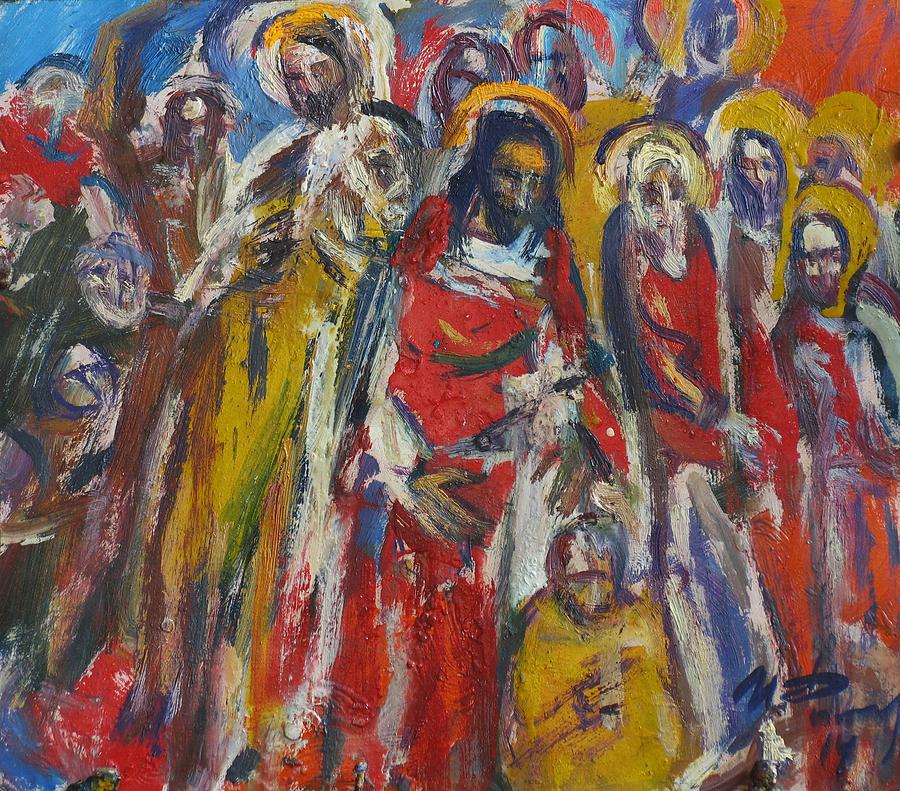
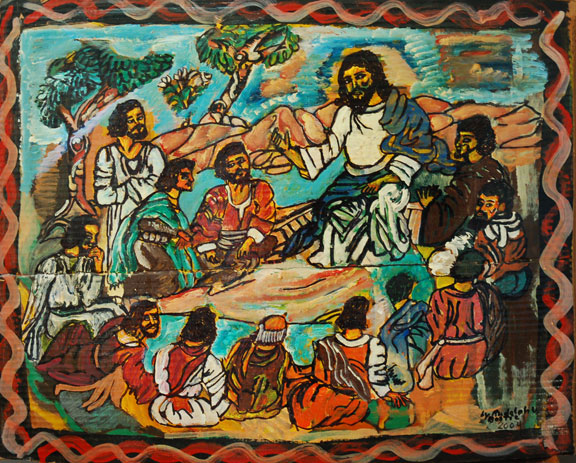
Jesus and the Disciples by Rudolph Bostic (1941-2021)

Jesus called the Twelve together and he gave them power and authority over all demons and to heal sicknesses. He sent them out to proclaim God’s kingdom and to heal the sick. He told them, “Take nothing for the journey—no walking stick, no bag, no bread, no money, not even an extra shirt. Whatever house you enter, remain there until you leave that place. Wherever they don’t welcome you, as you leave that city, shake the dust off your feet as a witness against them.” They departed and went through the villages proclaiming the good news and healing people everywhere. (Common English Bible)

You have likely heard the old nineteenth century adage from a member of the British Parliament, Lord Acton: “Power tends to corrupt, and absolute power corrupts absolutely.” The rest of the quote, which we seldom hear is this: “Great men are almost always bad men, even when they exercise influence and not authority.”

It’s almost as if Jesus knew this well before Lord Acton uttered it nearly two millennia later. Jesus Christ, in a truly wise and generous display of leadership, shared his power and authority with others. Rather than hoarding power and using authority to gain more authority, the Lord Jesus, rightful Ruler of the universe, delegated power and enabled those who ministered with him to share in carrying out his mission.

The only real Christian ministry is a bestowed ministry, granted to us by the delegation of Jesus. What this means for us, practically, is that believers minister as servants of God and stewards of the power and authority given to us. Grasping this basic accountability helps us to truly serve others with sensitivity and care – knowing we must give an account for the privilege of ministering in Christ’s name.

“There is no stronger test of a person’s character than power and authority, exciting as they do every passion, and discovering every latent vice.”

Plutarch (46-119, C.E.)

This has tremendous implications for us in all areas of life. Within the family, this means that parental authority can and ought to be delegated in wise increments, over time, as children grow and mature. The concept that a dad should be some sort of supreme leader who barks orders and demands fealty from mom and the kids is downright misguided, not to mention incredibly weird.

It also means that in the church and in faith communities, the wise use of power and authority will seek to identify and mentor younger disciples who will be given appropriate authority for expected ministry. Church leadership will listen to and equip those who have passions for particular service with the requisite authority to engage in effective ministry.

At the workplace, this involves forsaking a top-down approach of authority in favor of distributing power equitably amongst the workers with the greatest responsibilities.

In the political arena, this means Christians won’t tie their hopes in gaining power but rather in giving it away. They will seek equity and the common good of all citizens. And if that means deferring to a voice which isn’t being heard, then that is precisely what we do. Perhaps we see so little civility and concern for the other because Christians are much too enamored with dramatic miracles fueled by power.

Mosaic in the Papal Basilica, Rome, of Jesus and Disciples

Let’s not lose sight of the reality that healing sicknesses and suppressing the demonic is solely derived from Christ’s own authority, not ours. To press this reality home, Jesus instructed his disciples to take nothing with them. No staff, bread, bag, or money. Live among the locals, with them, on their turf and with their activities. Use the power and authority given to improve their lives and in so doing, lead them to greater spiritual truths.

If they don’t accept this gracious ministry, move on. No arm-twisting. No manipulation. No guilt-tripping. And definitely no using your given authority for grandstanding. A simple warning with shaking the dust off the feet is sufficient.

Every detail of the mission Christ gave to the disciples was a lesson in sheer and total dependence on God. Humble ministry and modest lifestyle will set the best table for a proper focus on benevolent and compassionate ministry. Just as increased knowledge ought to be used to love better and show us how much we actually don’t know, so increased authority ought to be used to serve others better and show us how much power we don’t have so that we might continually seek after the God who possesses all power and authority.

The good news is that God’s infinite and supreme power is given and focused in the person of Jesus Christ, who in turn, graciously bestows the authority to his followers so that they may proclaim forgiveness and new life. It’s a big message requiring large authority. And Jesus freely gives it:

And Jesus came and said to them, “All authority in heaven and on earth has been given to me. Go therefore and make disciples of all nations, baptizing them in the name of the Father and of the Son and of the Holy Spirit, and teaching them to obey everything that I have commanded you. And remember, I am with you always, to the end of the age.” (Matthew 28:18-20, NRSV)

It’s enough to make old Lord Acton smile in his grave.

Eternal God, you call us to live with faith in a world filled with so many challenges. Help us remember our mandate and our mission to use our given authority properly, lovingly, and confidently with obedience to our Lord.

Teach us by your Word, through our brothers and sisters in Christ, and in our prayers to learn and understand what you would have us to be and to do, so that we may fulfil our calling as Christ’s Body here on earth.

Draw your church together into one great company of disciples, together following our Lord Jesus Christ into every walk of life, together serving him in his mission to the world, and together witnessing to his love, in the strength of your Holy Spirit. Amen.

Matthew 20:29-34 – The Irony of the Gospel

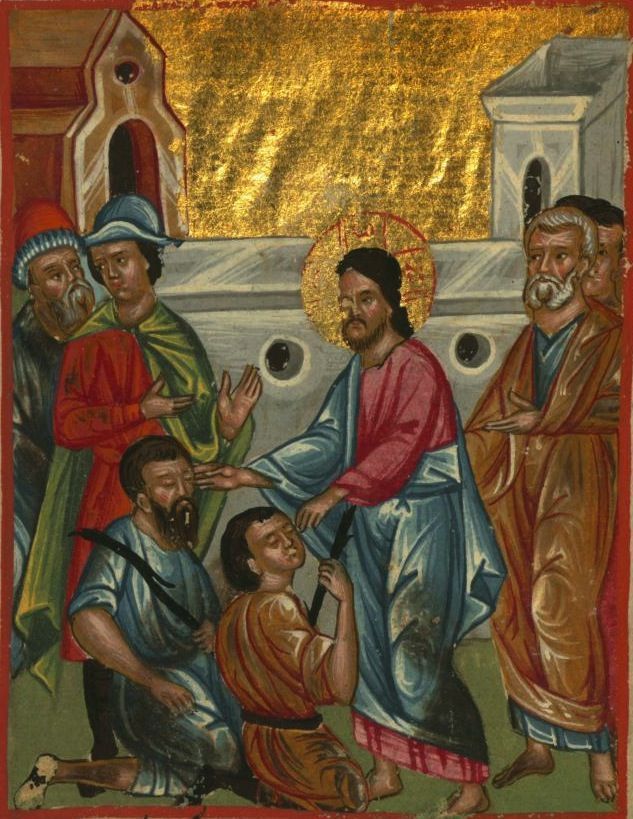
As Jesus and his disciples were leaving Jericho, a large crowd followed him. Two blind men were sitting by the roadside, and when they heard that Jesus was going by, they shouted, “Lord, Son of David, have mercy on us!”

The crowd rebuked them and told them to be quiet, but they shouted all the louder, “Lord, Son of David, have mercy on us!”

Jesus stopped and called them. “What do you want me to do for you?” he asked.

“Lord,” they answered, “we want our sight.”

Jesus had compassion on them and touched their eyes. Immediately they received their sight and followed him. (New International Version)

“Irony” is a term used to describe when an outcome of an event is contrary or different from what is expected.  Here are a few examples: The firehouse burnt down. The police officer got arrested. When I was a little kid, my family doctor’s name was (and I’m not kidding) Dr. Fail. And he smoked like a chimney in his doctor office.

There is an ironic lesson in today’s Gospel lesson: A crowd of people with 20/20 vision are spiritually blind. 

The great need of the crowd is the same need of the two physically blind men: They both needed their eyes opened to Jesus and to what God was doing around them.

Just so you know, Matthew tends not to use the term “crowd” in a favorable way. He views the crowd as a mass of people who are mostly lost, but the crowd themselves tend to think they are just fine. 

Jesus was on his way to Jerusalem, anticipating his passion and death. And we know that it is the crowd that will be the ones who eventually cry to have him crucified. 

Two blind men are marvelously and miraculously healed by Jesus. Ironically, the crowd remained unchanged and in the dark.

First Irony: A large crowd follows Jesus to Jerusalem, but only a few (2, in fact) are actually his followers. 

Throughout Christ’s earthly ministry, all kinds of people followed Jesus for all kinds of reasons. Some wanted to bask in the latest celebrity buzz that Jesus generated. Others wanted to see all the cool stuff he does, like healing people. Some were just plain curious. And a few were interested in being like Jesus by showing selfless compassion. 

Jesus wants genuine, authentic, real disciples who will follow his teaching, and not follow the crowd.

Many people desire to conform, to not stand out, and go with the flow. That’s great if the crowd is godly. Yet many, if not most, crowds of people are not godly. In the Old Testament, a few unruly complainers got the Israelites all stirred up and the result was the making of a golden calf with a complete turning away from the God of Israel. (Exodus 32:1-35)

Second Irony: Out of the massive crowd, it is two blind men that actually see Jesus for who he is, the Son of David.

Spiritual blindness afflicted the crowd. The blind men, however, discern it is Messiah Jesus coming near them. That’s why they go against the crowd by shouting out to him. They don’t care how they look. It doesn’t matter to them that they stick out like a sore thumb. 

Jesus often avoided big crowds. Most of his earthly life occurred away from the centers of power and influence.  Christ constantly swam upstream of the prevailing notions of righteousness. Jesus didn’t cow-tow to the crowd, but paid attention to the powerless and those without influence. 

The Lord Jesus didn’t “work the crowd” as the means of establishing God’s kingdom. He didn’t cozy-up to the rich and powerful. He wanted to avoid celebrity status. Jesus showed extraordinary love to two lowly overlooked people. He used his immense power for the powerless.

Third Irony 3: The ones following Jesus were the ones trying to keep the two needy blind men from Jesus.

One of the most ironic things about church is that sometimes Christ’s own followers are the greatest obstacle to others following Jesus. 

I can just picture a group of ladies shushing the two blind men: “Don’t bother Jesus, he is such a busy man. He has important work to do.” And I can imagine some men standing next to the two blind men and nudging them for shouting at Jesus saying, “Just stop, man, you’re embarrassing yourselves.” 

But the two men won’t stop. They shout all the louder. True and genuine faith is two blind men crying out in desperation for Jesus to help them. 

And Jesus asks a beautiful question: “What do you want me to do for you?” They answered, “We want our sight.” So, Jesus showed compassion and gave them their sight. It’s all rather simple and straightforward. Not only do the two men not listen to the crowd – Jesus doesn’t either. Christ mercifully heals despite what the crowd is saying.

I wonder: Why is it so hard for us to simply ask for what we want?… 

Maybe because we don’t want to buck the crowd, don’t want to look different, or don’t want to admit our need in front of others, we just stick to superficial conversations and insist everything is okey-dokey when it isn’t. 

A crowd of people may not be able to see others because they don’t even see themselves and their place in this world. Perhaps there is a plank in our own eye hindering us from seeing a speck in another’s eye. (Matthew 7:3-5)

It is the pure in heart who will see God (Matthew 5:8). As for the crowd, though seeing, they do not see (Matthew 13:13). If we are concerned about how we will be seen by others, it is likely we will not be seen by God. And we will miss Jesus when he walks by, right in front of us.

Jesus was attentive to the two blind men out of all the people in the crowd because he was listening for them.

Once Jesus listened, he took the time to heal the two men. Jesus could have simply healed them without even stopping. He could have started a healing factory where everyone with a need just got healed, as if they were on some divine conveyor belt to be fixed.

However, Jesus was doing more than giving sight; he was giving the blessing of time and personal response. The gospel is never impersonal, which is why we ought to resist being non-relational in ministry to others. It isn’t about simply meeting a need; it is about blessing other people. And that takes the time of relating to a person.

Jesus, furthermore, touched the men’s eyes. He didn’t have to do that. Christ could have healed without touching. In fact, it may have been gross. Many people had eye diseases with runny pussy eyes in the ancient world. 

Listening, taking time to be personal, and physically touching is how Jesus blessed people. So, we have the dual privilege and opportunity of receiving blessing from Jesus and giving that same blessing to others.

May the God of hope fill you with joy as you seek to bless others in the name of Jesus. Amen.

Mark 8:22-26 – A Ministry of Touch

“Healing” by Ivan Filichev

They [Jesus and his disciples] came to Bethsaida, and some people brought a blind man and begged Jesus to touch him. He took the blind man by the hand and led him outside the village. When he had spit on the man’s eyes and put his hands on him, Jesus asked, “Do you see anything?”

He looked up and said, “I see people; they look like trees walking around.”

Once more Jesus put his hands on the man’s eyes. Then his eyes were opened, his sight was restored, and he saw everything clearly. Jesus sent him home, saying, “Don’t even go into the village.” (New International Version)

Spirituality is, of course, a matter of the spirit. It is also a matter of the body. It may be lost on us that the way our spirituality is expressed is through our very real physical selves. A disembodied spirituality is really no spirituality, at all.

Christianity is profoundly physical. A core doctrine of the Church is the incarnation of Christ, God becoming man. Jesus has a real flesh and blood body. His physical body was the vehicle by which he did the will of God. Christ’s earthly ministry directed attention to people’s holistic needs – including the physical body.

So, perhaps it ought not surprise us when Jesus intentionally and literally touches people. From one person to another, Jesus was attentive to the power of compassionate and healing physical touch. For healing does not happen from afar; it is close enough to be personal, touching the spirit, the emotions, the mind, and the body.

In today’s Gospel lesson, some folks came to Jesus with a blind man in tow. They were evidently concerned and close enough to the man to beg Jesus to touch him. Yes, touch him. The small group of people were looking for a tangible reach from Jesus.

Just the other day, I visited a dear lady in the hospital for which I’m a Chaplain. As I began to speak with her, she reached out her hand, and I took it. I then realized that she was blind. This patient, in the dark because of her eyes, and in a strange unfamiliar place, needed more than a verbalized healing prayer from me. She needed a very real physical connection. The ability to compassionately touch another person has tremendous power.

“To touch is to give life.”

Michelangelo

Skin-to-skin contact is vital for our mental, emotional, spiritual, and physical health. Sensory deprivation is a real thing, and it’s a pervasive problem, especially during a pandemic.

We now know that whenever we feel unusual stress and pressure in our lives that the body releases the stress hormone cortisol. One of the biggest things actual physical touch can do is reduce the abnormal stress, allowing the immune system to work the way it should. What’s more, touch helps calm our heart rate and blood pressure, enabling us to have a more regulated way of life.

Jesus took the blind man by the hand and walked him outside the village. Let’s pause on that factoid for a moment. There was a man who literally walked with Jesus, hand-in-hand, for perhaps a few miles. I wonder what he experienced, just in that walk. What seems clear to me is that this event of walking was part of the man’s healing. He quite simply needed this bodily experience with Jesus.

I find it a bit humorous that some commentators struggle with the process of Christ’s healing the blind man, as if Jesus himself was struggling with trying to heal the guy. However, by taking the approach of an embodied spirituality, we can discern that this man required a great deal of touch from Jesus. The spitting, the putting the hands on the eyes, and then doing it again, was all deliberately tactile and just what the man needed for his healing of both body and soul.

Christ’s physical body was an instrument of grace. And our own bodies are meant to bless others with appropriate and compassionate touch. I realize this gets complicated with social distancing practices and concerns with health during a pandemic, yet we can still be agents of healing through simple acts of touch, including the following:

  1. Hug others. Hugs are healthy. I completely understand that some people aren’t huggers, and we ought to be guarded hugging others we don’t know very well. I usually ask before I hug someone outside of my family or church. Unfortunately, many people have had bad experiences being touched, and my heart goes out to them. Yet, the need for meaningful and positive touch still remains both for us and for others.
  2. Pet the dog. My wife’s little dog is a prima donna. He drives me nuts sometimes (maybe most of the time). Yet, because of his disposition, he is the perfect little gentleman when in a care facility or in public. He likes the attention. If you have a pet, let other folks pet them. I’m a busy guy, but when it comes to taking time for neighborhood kids to pet the dog while I’m walking him, I’m all in. It is a simple ministry that anyone can do.
  3. Hold hands or offer light touch. This can and perhaps should be a liberal activity within most families. It can also be done with others. It’s not weird to do this, even in some contexts with strangers. For example, when leading someone in the hospital to their appointed place, depending on the circumstance, I place a light hand on the back or shoulder. Hospitals aren’t exactly destination vacation spots, so folks can be nervous when in them. Simple ways of appropriate touch help calm the anxiety.
  4. Fist pumps and elbow bumps have replaced handshakes, and that’s a good thing. Fist and elbows just aren’t the same thing as a good old fashioned tight handshake, yet it is still an opportunity to touch. Some touch is better than no touch. Don’t give up on practicing ways to physically connect, even if those ways aren’t ideal.
  5. Use your eyes. There are just going to be some circumstances and places where you cannot offer an actual physical ministry of touch. So, use your eyes. Imagine in your mind offering a hug or a handshake to the person and intentionally focus that picture to your eyes. Since our physical eyes communicate a lot, the other person will pick it up.

Every day is an opportunity, for the believer, to walk with Jesus along our life’s journey. As we allow Christ to touch our lives, we, in turn, are able to touch others both spiritually and sometimes even physically through compassionate ministry.

May you know the grace of being touched by Jesus, and the blessing of touching others with the love of God.

Matthew 23:29-39 – Against Hypocrisy

You religious teachers are nothing but show-offs, and you’re in for trouble! You build monuments for the prophets and decorate the tombs of good people. And you claim that you would not have taken part with your ancestors in killing the prophets. But you prove that you really are the relatives of the ones who killed the prophets. So, keep on doing everything they did. You are nothing but snakes and the children of snakes! How can you escape going to hell?

I will send prophets and wise people and experts in the Law of Moses to you. But you will kill them or nail them to a cross or beat them in your meeting places or chase them from town to town. That’s why you will be held guilty for the murder of every good person, beginning with the good man Abel. This also includes Barachiah’s son Zechariah, the man you murdered between the temple and the altar. I can promise that you people living today will be punished for all these things!

Jerusalem, Jerusalem! Your people have killed the prophets and have stoned the messengers who were sent to you. I have often wanted to gather your people, as a hen gathers her chicks under her wings. But you wouldn’t let me. And now your temple will be deserted. You won’t see me again until you say,

“Blessed is the one who comes
    in the name of the Lord.” (Contemporary English Version)

Christ’s scathing and damning critique is against a distorted spirituality, a false Christianity, a controlling leadership that stifled and snuffed-out the true worship of God.

Here is what Jesus is getting at with his woe on the leadership who are so concerned with the tombs of the prophets: Honoring dead people, while ignoring live people, is not good.  Respecting the prophets and pastors and godly people of the past means nothing if we ignore the prophet and pastor that is right in front of our face. 

The surest way to hell is to give credence to those long gone yet fail to honor their teaching and the people keeping the true spirit of that instruction. It is to call evil good, and good evil.

The telltale signs of hypocrisy include:

  • Not practicing what they preach, rather than embodying and modeling the message.

The goal I pursue is the prize of God’s upward call in Christ Jesus. So, all of us who are spiritually mature should think this way, and if anyone thinks differently, God will reveal it to him or her. 16 Only let’s live in a way that is consistent with whatever level we have reached. Brothers and sisters, become imitators of me and watch those who live this way—you can use us as models. (Philippians 3:14-17, CEB)

  • Keeping people out instead of inviting them in.

I tell you for certain that I am the gate for the sheep. Everyone who came before me was a thief or a robber, and the sheep did not listen to any of them. I am the gate. All who come in through me will be saved. Through me they will come and go and find pasture. (John 10:7-9, CEV)

  • Focusing on externals and refusing to do one’s own inner work.

God does not see as humans see. Humans look at outward appearances, but the Lord looks into the heart. (1 Samuel 16:7, GW)

  • Majoring on the minors through upholding the letter of the law while forsaking the spirit of the law.

You keep meticulous account books, tithing on every nickel and dime you get, but on the meat of God’s Law, things like fairness and compassion and commitment—the absolute basics! —you carelessly take it or leave it. Careful bookkeeping is commendable, but the basics are required. Do you have any idea how silly you look, writing a life story that’s wrong from start to finish, nitpicking over commas and semicolons? (Matthew 23:23-24, MSG)

Despite the presence of hypocrisy and the misplaced energy of people, the last word to everything is God’s grace.

At the end of his tirade, Jesus did something we would do well to follow: He broke into a tear-filled, heart-rending love song for his wayward people. Today’s Gospel lesson is not just a blast-the-bad-guys message; it is a deep concern for people to know the true worship of God.

Keeping the law only truly happens when we can connect our action to a face. For example, if we follow safety protocols at work because we have to, someone will get hurt sooner than later. But if we do it with the faces of people in mind, desiring to do what is best for them, there will likely be fewer incidents.

Jesus wants people to honor God’s law so they will live well. The Lord sees faces and the stories behind those faces. He doesn’t want people damaging one another with their detached sense of moral superiority.

So, let’s be gracious, merciful, and kind – not only because we must – but because we desire to be compassionate toward our fellow humanity, as well as honor our God.

Merciful God, help us to realize when we’re being judgmental of others. Lord, I confess I am neither above you nor the master of all things. I am your servant and your child. Thank you that you have wild and abundant grace for me. Teach me your ways and help me be receptive to them, so I will not fall. I surrender all my ways, thoughts, opinions, perceptions and decisions to you, Lord Jesus. Amen.