Broken and Poured Out (Matthew 26:6-13)

Jesus was in Bethany at the house of Simon the leper. While he was there, a woman came to him. She had an alabaster jar filled with expensive perfume. She poured the perfume on Jesus’ head while he was eating.

The followers saw the woman do this and were upset at her. They said, “Why waste that perfume? It could be sold for a lot of money, and the money could be given to those who are poor.”

But Jesus knew what happened. He said, “Why are you bothering this woman? She did a very good thing for me. You will always have the poor with you. But you will not always have me. This woman poured perfume on my body. She did this to prepare me for burial after I die. The Good News will be told to people all over the world. And I can assure you that everywhere the Good News is told, the story of what this woman did will also be told, and people will remember her.” (Easy-to-Read Version)

It seems that much of the world’s default response to events right in front of their eyes is to be judgmental, binary, and negative – as if everything is a simple sum of right and wrong, good and bad – and all adjudicated by our perceptions and perspectives on it.

The disciples reflexively moralized the actions of the woman and her jar of expensive perfume. What a waste, they believed. They thought they knew better and could do better.

But there was more going on in today’s Gospel lesson than what meets the eye. In the Apostle John’s account, the woman in the story is identified as Mary, a woman with a sordid background who had her life transformed through meeting Jesus. (John 12:1-11)

Near the end of Christ’s life, as he was about to enter Jerusalem and be arrested, tried, tortured, and killed, this woman, Mary, is aware of what is happening when others are not, even the disciples of Jesus. Her own brokenness cracked open to her the true reality of life.

The surface event itself is a touching and tender moment in history. This woman, whom everyone knew was a damaged person, took a high-end perfume and broke the entire thing open. She then proceeded to anoint Christ’s feet with it. You can imagine the aroma which filled the entire house with expensive perfume for all to smell. 

The woman, Mary, was affirmed by Jesus for seeing the situation as a possibility and opportunity of loving her Lord. Mary alone had the vision amongst all the disciples, and the accompanying action, to enter through the door of risk in order to connect intimately and lovingly with Jesus.

Mary’s love, radiating outward for all to see, reflected the genuine love of God for the world – a love so great that Jesus would soon experience death and burial because of that love for humanity.

The disciples were grumping and cursing about the right way to do things; whereas Jesus blessed the woman with no reference whatsoever to morality or ethics. Mary had no concern for playing the numbers game and counting money, but instead focused on the ultimate value before her.

Giving what she had to Jesus, Mary demonstrated the path of true discipleship. She helps open our eyes to the realities which are right in front of us:

  • The broken jar of perfume shows us her brokenness and our need to be broken. (Matthew 5:3-4)
  • An extraordinary and extravagant amount of perfume was used, picturing her overflowing love for Jesus. (John 20:1-18)
  • The perfume was poured on the head of Jesus, and she herself used her hair as the application (according to John); hair is a rich cultural symbol for submission and respect. (1 Corinthians 11:14)
  • The perfume directs us to the death of Jesus. (John 19:38-42)
  • The perfume highlights for us the aroma of Christ to the world. (2 Corinthians 2:15-17)
  • There is more to the disciples’ response than mere words about perfume; the Apostle John specifically names Judas as questioning this action – the one who is not actually concerned for the poor. (Matthew 26:15)
  • The woman and the disciples (specifically, Judas and Mary) serve as spiritual contrasts: Mary opens herself to the sweet aroma of Christ; Judas just plain stinks.
  • The perfume presents a powerful picture of the upcoming death of Christ, for those with eyes to see; he was broken and poured out for our salvation. (Luke 23:26-27:12)

Christianity was never meant to be a surface religion which only runs skin deep. The follower of Christ is meant to be transformed, inside and out, so that there is genuine healing, spiritual wellness, and authentic concern for the poor and needy. 

Keeping up appearances is what the Judas’s of this world do. However, the Mary’s among us dramatically point to Jesus with their tears, their humility, their openness, and their love.

In this contemporary environment of fragmented human ecology, our first step toward wholeness and integrity begins with a posture of giving everything we have – body, soul, and spirit – to the Lord Jesus. In receiving the love of God, we can then freely give that love to a world locked in the shackles of tunnel vision, judgmentalism, and incessant moralizing.

To take the risk of breaking ourselves open and becoming vulnerable, we find love. In finding love, there we see intimacy. And where there is intimacy, there is the relational connection which transforms the dark and the negative to possibility and light.

Loving Lord Jesus, my Savior, and my friend, you have gone before us and pioneered deliverance from an empty way of life and into a life of grace and gratitude. May I, and all of your followers, emulate the path of Mary and realize the true freedom which comes from emptying oneself out for you. Amen.


Justice for All (Matthew 12:15-21)

When Jesus became aware of this [a plot to kill him] he departed. Many followed him, and he cured all of them, and he ordered them not to make him known. This was to fulfill what had been spoken through the prophet Isaiah:

“Here is my servant, whom I have chosen,
    my beloved, with whom my soul is well pleased.
I will put my Spirit upon him,
    and he will proclaim justice to the gentiles.
He will not wrangle or cry aloud,
    nor will anyone hear his voice in the streets.
He will not break a bruised reed
    or quench a smoldering wick
until he brings justice to victory.
    And in his name the gentiles will hope.” (New Revised Standard Version)

Saying the words, “I love you” is important. And it’s also significant how we say it. If our tone of voice is monotone and our affect flat, then the incongruence between the words and the manner in which they are said will leave our love unrequited. If, however, our tone is soothing and excited and our face beaming as if starstruck, then the love expressed will likely be received, and stick.

Christians have a message of love to the world. It’s a message of Jesus Christ and his love for humanity. Both the content of our message and the way we communicate it are vitally significant.

For if the words we don’t match our tone of voice and affect, then love is not what we convey. Yet, if we have been profoundly and meaningfully touched by the love of God in Christ, then that love will not be constrained; it shall find a way to express itself with appropriate mannerisms.

The way in which Christ proclaimed his message, testified that he was, indeed, the promised Savior and the rightful Ruler for God’s world.

The message of Jesus was proclaiming justice to the nations. The disciple Matthew used a quote from the prophet Isaiah to explain the reason why Jesus withdrew, and told people not to make him known. This was a curious act for a Messiah, to say the least. 

After all, we might believe Jesus should loudly proclaim who he is and what he is doing. Human ingenuity might say he ought to be advancing, not retreating – getting his name out with some notoriety in a slick marketing message so that people will come running into the kingdom of God! 

But Jesus goes a different direction. Matthew (quoting the prophet Isaiah) made it clear who Jesus is and what he is all about. Jesus is God’s servant. Jesus is God’s beloved Son with whom he is well-pleased. The Holy Spirit came on him in his baptism. Jesus became a teacher of justice to the nations, that is, to gentiles, to all kinds of people – even the ones we do not like. 

I personally find it strange that some Christian folk think justice is something which is not part of the Gospel, as if it were nice, but optional. They might believe it’s important to engage in some sort of social justice toward the downtrodden, but want to put it on a secondary shelf. Speaking the message is primary to them, as if we could or should separate the message from the messenger.

Yet, we can no more divide the good news of forgiveness in Christ from social justice any more than we can neatly separate the cross and resurrection. All of it is redeeming work; it all goes together.

In the kingdom of God, all things and all people are to be redeemed and come under the Lordship of Christ. And the practice of justice is central to making redemption a reality for humanity.

He has told you, O mortal, what is good,
    and what does the Lord require of you
but to do justice and to love kindness
    and to walk humbly with your God? (Micah 6:8, NRSV)

Mercy and justice go together like corn on the cob and butter, and like pork ribs with barbeque sauce (I’m from Iowa, after all!). Kindness and mercy refers to God’s unconditional grace and compassion. Justice treats all people with equity, without any favoritism.

Biblical justice is not primarily punishment for wrongdoing; it gives people their rights – and this concept is overwhelmingly taught in Holy Scripture – over 200 times in the Old Testament alone. Jesus Christ’s back to the Bible movement rightly emphasized justice.

God loves and defends the weak, the poor, and the powerless:

He gives justice to the oppressed
    and food to the hungry.
The Lord frees the prisoners.
    The Lord opens the eyes of the blind.
The Lord lifts up those who are weighed down.
    The Lord loves the godly.
The Lord protects the foreigners among us.
    He cares for the orphans and widows,
    but he frustrates the plans of the wicked. (Psalm 146:7-9, NLT)

We, as God’s people, are to share the Lord’s passion for justice:

Speak out on behalf of the voiceless,
    and for the rights of all who are vulnerable. (Proverbs 31:8, CEB)

“Cursed is anyone who obstructs the legal rights of immigrants, orphans, or widows.” All the people will reply: “We agree!” (Deuteronomy 27:19, CEB)

Since believers are justified by faith in Christ, we bring justice to our communities, in both word and deed, by advocating for the least, the lost, the last, and anyone else without social or economic power in this world.

We are to use our voice for both us and for those who have no voice. The voice of justice is the voice of action.  To be concerned for the justice of God is to actively work for God’s rule and reign to enter every inch of this world, to penetrate every nook and cranny of our homes, neighborhoods, and schools. 

“If you are a Christian, and you refrain from committing adultery or using profanity or missing church, but you don’t do the hard work of thinking through how to do justice in every area of your life – you are failing to live justly and righteously” Tim Keller, Generous Justice

The Christian life is much more than avoiding sin; it’s about actively pursuing God’s will through words and acts of justice on behalf of the needy. Jesus came to this earth to proclaim justice, and, as his followers, he expects us to do it, too. For this to happen, we must overcome our prejudices toward anybody unlike us so that we will stand with the weak, the poor, the oppressed, the lowly, and the pained, all around us.

The probing question for all of us is: Am I able to see the image of God in someone different from me?

Jesus did. Christ will not quarrel or cry out; no one will hear his voice. That is, Jesus is gentle, humble, and meek. He did not look for dramatic confrontations with others, but instead went quietly about his Father’s business. 

Jesus was no bullhorn guy, loudly proclaiming his message on a street corner. Instead he interacted with and ministered to the lowliest people of society who had no power and nothing to give in return. Jesus did everything to connect with them, and not to avoid them.

Along the Jordan River in Israel, reeds grew by the millions, in Christ’s day. They had little value because there were so many of them. Reeds were used to make baskets, pens, flutes, and a variety of other things. A perfect reed is fragile, and a bruised one is useless. 

The reference that God’s servant will not break a bruised reed, means that Jesus will treat the weak with sensitivity. A smoldering wick is also not worth much; if it’s damaged, you just get another one. A contemporary example might be a paper clip; it’s not worth much to us, and a damaged one we simply discard and use another. 

The point is: Jesus handles hurting people with care. Society’s poor, disadvantaged, and struggling will not be callously overlooked and tossed aside by Jesus.

Jesus Christ discovered his own island of misfit toys. He then demonstrated to the world that are a needed part of society. Small wonder, then, that droves of the lowliest people throughout history have come to Jesus, placing their hope in him.

For we do not have a high priest who is unable to sympathize with our weaknesses, but we have one who has been tempted in every way, just as we are – yet was without sin.  Let us then approach the throne of grace with confidence, so that we may receive mercy and find grace to help us in our time of need. (Hebrews 4:15-16, NIV)

Our help is in the name of Lord who made heaven and earth. May you find Christ, God’s servant, as your anchor and hope in the world. Amen.

It’s About Love (1 Peter 1:17-23)

Statue of Christ the Redeemer, Rio de Janeiro, Brazil

Since you call on a Father who judges each person’s work impartially, live out your time as foreigners here in reverent fear. For you know that it was not with perishable things such as silver or gold that you were redeemed from the empty way of life handed down to you from your ancestors, but with the precious blood of Christ, a lamb without blemish or defect. He was chosen before the creation of the world, but was revealed in these last times for your sake. Through him you believe in God, who raised him from the dead and glorified him, and so your faith and hope are in God.

Now that you have purified yourselves by obeying the truth so that you have sincere love for each other, love one another deeply, from the heart. For you have been born again, not of perishable seed, but of imperishable, through the living and enduring word of God. (New International Version)

Love makes the world go round. The cycle of life brings an end to all things. Yet, the permanence of love has always existed, and will never cease to exist. (1 Corinthians 13:8-13)

Biblical godly love comes not because we first loved God, but because God first loved us and gave his Son, Jesus Christ, as an atoning sacrifice for our sins. (1 John 4:7-12)

So, the Christian’s faith and hope are completely grounded in the person and finished work of Jesus. People are so valuable to God that we were purchased from the slavery auction block with the costliest price ever: the precious blood of Jesus. 

To know this love of God in Christ, to be thoroughly captured and enraptured by it, results in a profound and deep love for others. And I’m not only referring to a nice touchy-feely love, but also a steadfast love which is committed to love regardless of what another person says or does.

Love is wonderful. But that doesn’t mean it’s easy. Being on the receiving end of love is a beautiful thing. Giving love, however, can sometimes get dicey.

Although we Christians really do believe that everything in life and ministry centers around the grace and love of God in Christ, our boots-on-the-ground loving sometimes seems compromised and conditional. That’s because it’s easy to love those who love us back. Yet, what if our love is not reciprocated or requited?

This situation brings us face-to-face with our own selves. The painful reality is that we all discover that our love is sometimes, maybe oftentimes, dependent on an assurance that we will be loved in return.

Mutual love is a beautiful thing, but what happens when only one of the persons is able to give love?

What do we do when grace is our only option, when we must choose to love, knowing that love won’t have a response?   

Christians are supposed to give the same kind of love that God shows to us in Christ – which means we need to decide that grace is going to be our lifestyle. It comes down to this: It simply doesn’t matter what condition the other person is in. It doesn’t matter what another is going to say, or not say. Nothing on the other party’s side matters. It…just… doesn’t… matter.

What really matters is our own loving another person deeply from the heart, regardless and in spite of everything else. That, my friends, is real Christian love.         

Since we are redeemed people; have acknowledged the truth of Christ’s redemptive events of crucifixion and resurrection; are recipients of God’s great love to us in Jesus; we must choose to live our lives full of grace and love, no matter what. 

As God’s redeemed people, purchased by the precious blood of Christ, our default response to others is to be this: We will love one another unconditionally.

Unfortunately, over time, many Christians slowly become disconnected from this fountain of grace and love. It is likely that, at some past point, they were deeply touched by a gracious encounter with Jesus Christ. They found peace, love, and joy. Minds were swept up in the awe and wonder of God. Hearts were deeply moved for a few hours, days, or weeks. 

But then, there was a return to the routine grind of daily existence. Gradually, the demands of life took over. Jesus began to be treated like an old friend from another town whom we dearly loved in years past, but have just lost track of. 

Of course, it was unintentional. We simply allowed circumstances to drift us apart. We became preoccupied with something else. Now, we find ourselves with a low level of irritation, frustrated with others and unable to love as we ought. We become what the late author Brennan Manning called “Christian agnostics,” that is, people who do not deny Jesus, but just ignore him.

If your days are trivial and/or hectic…

If the clock determines what you do…

If you are numb to the news and headlines around you…

If you are all jangled and jittered by life’s circumstances…

If phones and computers and gadgets rule your day…

If there is little room for responding to humanity humanely…

If you have settled into a comfortable piety and a well-fed virtue…

If you have grown complacent and lead a practical life…

Then you need to be touched again by the grace and love of God in Christ by treating Jesus as if he were your very best friend as well as the awesome Son of God. 

We are all still here walking on this earth because none of our failures and lack of faith have proved terminal; we are here today because of grace and love. 

The forgiveness of God is a liberation from guilt and regret. It is an extreme amnesty. Through looking in the mirror, and seeing personal sinfulness, we amazingly end up encountering the merciful love of the redeeming God. 

The grace of God says to us, “Hush, child, I don’t need to know where you’ve been or what you’ve been up to; just let me love you.” 

When we have experienced that kind of love, we are then finally able to love one another deeply from the heart. It’s a new life of love, the kind that comes from God – an unconditional love that’s permanent and will never go away.

Therefore, as Christians loved by Christ and belonging to God, we make the following affirmations of love:

  • We will love, no matter whether we are loved in return.
  • We will take the initiative to love, not just waiting for others to love first.
  • We will love, even when we are imperfect and feel unworthy to do so.
  • We will give love with the love we received from Jesus.
  • We will love with a gracious, sacrificial, vulnerable, and desperate kind of love. 

Many years ago, I spent some time with someone in a hospital waiting room after her brother had been severely burned in a farm accident. In that place, we were all strangers. Yet, there was a loving vulnerability to our being together. I sat watching and waiting with anguished people, listening to their urgent questions: Will my husband make it? Will my child walk again, even if she survives? How do you live without your companion of thirty years? 

Burn unit and intensive care unit waiting rooms are places. And the people who wait are different. They can’t do enough for each other. No one is rude. The distinctions of race and class melt away. Each person pulls for everyone else. Vanity and pretense vanish. No one is embarrassed about crying or asking tough questions. In that moment their whole world is focused on the doctor’s next report. If only it will show improvement.

Everyone intuitively knows that loving someone else is what life is all about. By God’s amazing grace we will all learn to live like that without having to learn it the hard way in a place of intense anxiety and suffering.

Christ’s resurrection is not some flash-in-a-pan – it has staying power – it is real and permanent. Christ is the Christian’s hope of living a new life of gracious unconditional love. 

Jesus actually expects more failure from you than you expect from yourself. And he gives grace. So, all of our failures to love as we ought can be laid before Jesus because there is grace that covers it all – a deep love that forgives, redeems, and makes new.

God of goodness and grace, we your people are aware of our human frailties and foibles, and yet are overwhelmed by your love for us. We give you praise that there is no human experience we might walk through where your love cannot reach us. If we climb the highest mountain you are there, and if we find ourselves in the darkest valley, you are there. Continually teach us to love you and others, through Jesus Christ our Lord. Amen.

Maundy Thursday (Psalm 116:1-2, 12-19)

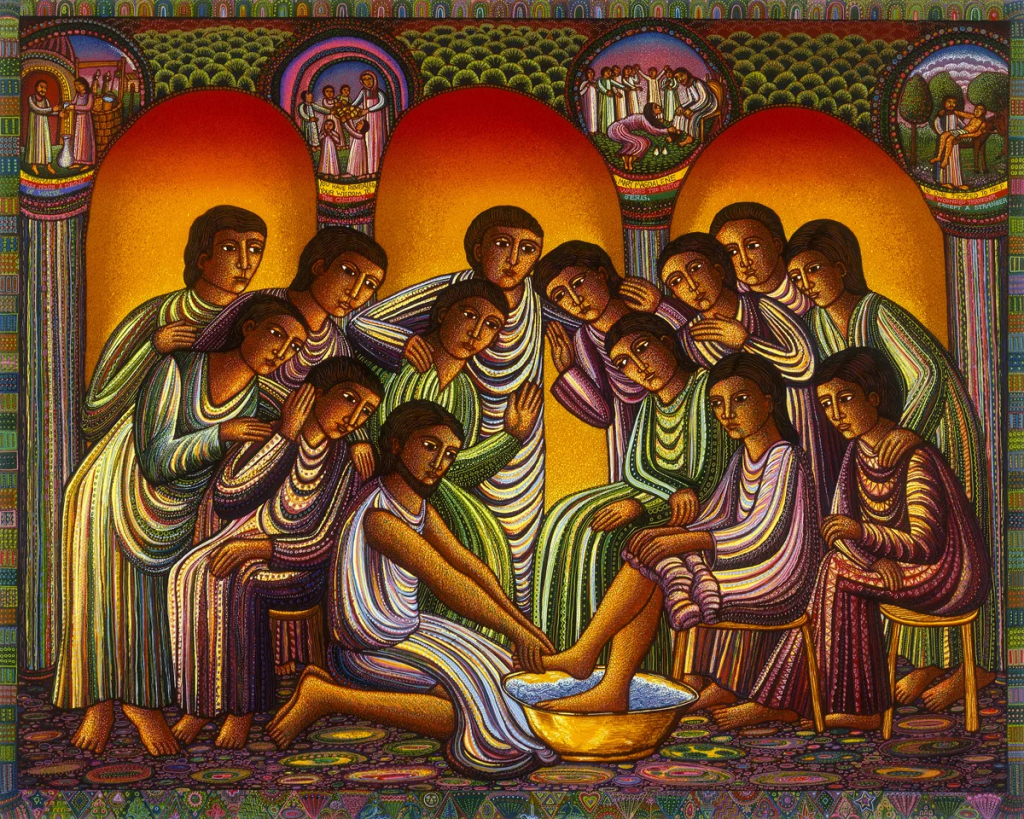
Washing of the Feet, by John August Swanson, 2000

I love the Lord because he has heard
    my voice and my supplications.
Because he inclined his ear to me,
    therefore I will call on him as long as I live….

What shall I return to the Lord
    for all his bounty to me?
I will lift up the cup of salvation
    and call on the name of the Lord;
I will pay my vows to the Lord
    in the presence of all his people.
Precious in the sight of the Lord
    is the death of his faithful ones.
O Lord, I am your servant;
    I am your servant, the child of your serving girl.
    You have loosed my bonds.
I will offer to you a thanksgiving sacrifice
    and call on the name of the Lord.
I will pay my vows to the Lord
    in the presence of all his people,
in the courts of the house of the Lord,
    in your midst, O Jerusalem.
Praise the Lord! (New Revised Standard Version)

“Pain and suffering have come into your life, but remember pain, sorrow, suffering are but the kiss of Jesus — a sign that you have come so close to Him that He can kiss you.”

Mother St. Térèsa of Calcutta (1910-1997)

There is more to the passion of Christ than sheer suffering and sorrow; the Via Dolorosa is, paradoxically, also the road to joy.

Yes, suffering is painful and unpleasant. Yet, since we all must suffer in some way, the real issue is whether our suffering is meaningless or has purpose to it. We are able to bear our suffering if we are confident that a redemptive outcome is at the end of it.

The Lord Jesus submitted to suffering because he knew that all the mockery, torture, and abuse was the pathway to deliverance for humanity.

Because of the joy awaiting him, he endured the cross, disregarding its shame. Now he is seated in the place of honor beside God’s throne. Think of all the hostility he endured from sinful people; then you won’t become weary and give up. (Hebrews 12:2-3, NLT)

Since Jesus has gone before us, enduring shame so that it could be put to death in us, we are able to live free from guilt and the ignominy of sin. What’s more, Christ’s suffering gives shape and meaning to our own suffering.

“I cannot but wonder at the virtue that lies in suffering; we are worth nothing without the cross. I tremble and am in an agony while it lasts, and all my conviction of its salutary effects vanish under the torture, but when it is over, I look back at it with admiration, and am ashamed that I bore it so ill.”

François Fénelon (1651-1715)

On this Maundy Thursday, we remember that in the midst of suffering there is the hope of glory, and in the center of pain there is the confident expectation that it will be used as the fertilizer to help love grow and bloom in the dormant places of this world.

“Love proves itself by deeds, so how am I to show my love? Great deeds have forbidden me. The only way I can prove my love is by scattering flowers and these flowers are every little sacrifice, every glance and word, and the doing of the least actions for love.”

St. Thérèse of Lisieux (1873-1897)

There cannot be love without suffering; to love is to sacrifice on behalf of another.

Because we live in a broken world full of pride and hubris, greed and avarice, hate and envy, we are victims of loveless systems and unjust actions. We need love to rescue and redeem us from the sheer muck of existential guilt and shame, evil and injustice.

Christians around the world are journeying through Holy Week, the most sacred time of the year for followers of Christ. When we think about Holy Week, we are familiar with Good Friday and certainly Easter, but Maundy Thursday? 

On this day, the Church remembers the final evening Jesus shared with his disciples in the upper room before his arrest and crucifixion. The experiences in the upper room were highly significant because this was the last teaching, modeling, and instruction Jesus gave before facing the cross. Jesus was careful and deliberate to communicate exactly what was important to him: to love one another.

“A new command I give you: Love one another. As I have loved you, so you must love one another.  By this everyone will know that you are my disciples if you love one another.” (John 13:34-35, NIV)

Maundy Thursday marks three important events in Christ’s Last Supper with his disciples: 

  1. The washing of the disciples’ feet (the action of loving service)
  2. The instituting of the Lord’s Supper (the remembrance of loving sacrifice)
  3. The giving of a “new” commandment to love one another (the mandate of a loving lifestyle)

The message of Maundy Thursday is this: Jesus Christ loves me just as I am, and not as I should be. He loves me even with my dirty stinky feet, my herky-jerky commitment to him, and my pre-meditated sin. 

Today is a highly significant day on the Church Calendar and in the Christian Year – one which deserves to be observed, and an opportunity to remember the important words and actions of Jesus on our behalf. Through Jesus Christ we are to live always in love, modeling our life and ministry after him. 

“I have found the paradox that if I love until it hurts, then there is no hurt, but only more love.”

Mother Térèsa

In Christ, love is to characterize our life together as we proclaim God’s love in both word and deed. A watching world will take notice and desire to lay down their hate and animosity if the followers of Christ are deeply and profoundly centered in the love of God.

God our Father, you invite us to participate in the life, suffering, death, and resurrection of your Son. Inspire us by his service, and unite us in his love; who lives and reigns with you, in the unity of the Holy Spirit, one God, now and forever. Amen.