You Have Found Favor with God (Luke 1:26-38)

The Annunciation, by Liviu Dumitrescu

Six months after Elizabeth had become pregnant, God sent the angel Gabriel to Nazareth, a city in Galilee. The angel went to a virgin promised in marriage to a descendant of David named Joseph. The virgin’s name was Mary.

When the angel entered her home, he greeted her and said, “You are favored by the Lord! The Lord is with you.”

She was startled by what the angel said and tried to figure out what this greeting meant.

The angel told her,

“Don’t be afraid, Mary. You have found favor  with God.

You will become pregnant, give birth to a son,
and name him Jesus.

He will be a great man
and will be called the Son of the Most High.
The Lord God will give him
the throne of his ancestor David.
Your son will be king of Jacob’s people forever,
and his kingdom will never end.”

Mary asked the angel, “How can this be? I’m a virgin.”

The angel answered her, “The Holy Spirit will come to you, and the power of the Most High will overshadow you. Therefore, the holy child developing inside you will be called the Son of God.

“Elizabeth, your relative, is six months pregnant with a son in her old age. People said she couldn’t have a child. But nothing is impossible for God.”

Mary answered, “I am the Lord’s servant. Let everything you’ve said happen to me.”

Then the angel left her. (God’s Word Translation)
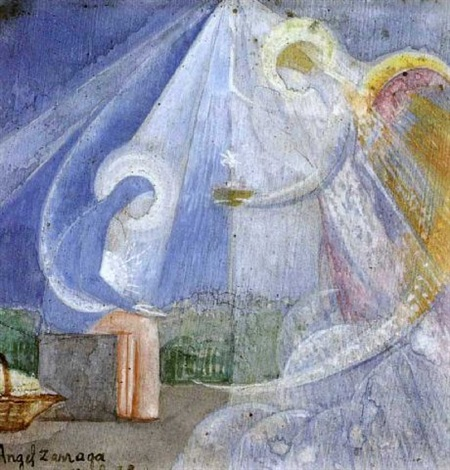
The Annunciation, by Angel Zárraga

Most of life is lived in the mundane. For the most part, we go about our business and deal with the daily grind.  That’s because we are common ordinary people.

So, we can especially relate to Mary. She is rather plain. Mary is of junior high age. If she were living in our day and age, Mary would likely be wearing clothes from the local Goodwill. She cannot read, because girls of her day rarely did.

Mary’s parents make all the decisions that affect her life, including the one that she should be married to an older man named Joseph. We don’t know if she even liked him. She lives in a small town that most people can’t even point to on a map. 

One night, this young girl is visited by the brightly beaming divine messenger Gabriel, whose name means, “God has shown himself mighty.” Mary stands there in her flannel nightgown; her life very quickly moving from the ordinary to extraordinary. The juxtaposition could not be more pronounced:

  • a mighty angel and a plain teen-ager
  • a messenger of the Most High God and a girl barely past puberty
  • holy angelic light in a simple candlelit bedroom
  • awesome power and complete vulnerability

Mary, compared to Gabriel, is defenseless, fragile, and overwhelmed. She’s in over her head. And that’s why we can relate to her. We can get our human arms around Mary. She’s like us. She has faced life with little power to make it turn out the way she planned. Forces beyond her control have rearranged her life and altered it forever. Mary is the Matron Saint of the Ordinary. We can totally understand why she responds the way she does.

Young Mary’s initial reaction was to be greatly troubled. She was disturbed, and was shaking in her ratty old slippers. The angel confidently told Mary that she had found favor with God. In other words Mary was quite literally “graced” by God. 

The situation was not that Mary had some extreme spirituality; but rather that God simply chose her to be the mother of Jesus. 

And Mary needed to come to grips with what was happening to her. This was not what she was looking for.  Becoming pregnant with the Savior of the world was not an answer to prayer for Mary. This was not on her agenda. 

Mary immediately sensed the crazy disconnect between what was being told to her and who she was. After all, she was a plain ordinary girl from the hick town of Nazareth, and she was being told that she would raise a king.  Maybe somebody in heaven screwed up. It could very well be that Gabriel got the wrong girl. Perhaps the angel’s Google map popped up the wrong town to visit. 

Relating to Mary, we can totally understand that she would question how in the world all this was going to happen. Not only is Mary ordinary, and far from royalty, but she is also very much a virgin. None of this made any sense whatsoever.

But the angel lets Mary know that God specializes in the impossible. I understand why many English translators chose to phrase the original rendering as “for nothing is impossible with God.” But I rather like a more literal translation which is “for there is nothing outside of God’s power.” 

There is nowhere we can go, no place on earth, no situation whatsoever that is beyond God’s ability, reach, and power to effect the divine will.

We do not always get straightforward answers to our questions about God. Yet, Mary asked a question and got a straight answer. She really can be pregnant with Jesus because the Holy Spirit will come upon her and overshadow her with power. 

If the story were to end here it would be a great story.  But to me the most astonishing part of this narrative is Mary’s response to what was happening to her.

Mary believed the message and took Gabriel’s words at face value. And so, having believed, she then submitted herself completely to God’s will for her life. 

I think we might totally understand if Mary simply said in her ordinary way that she was not prepared for this.  We would completely “get it” if Mary pushed back on what the angel said to her.

We could relate if Mary just dismissed it all, like Scrooge in the Christmas Carol, with the angel and his message being all humbug as if it were just “an undigested bit of beef, a blot of mustard, a crumb of cheese, a fragment of an underdone potato.  There’s more of gravy than of grave about you, whatever you are!”

And yet, Mary not only believed, but she also humbly submitted herself to what was happening. And, to me, this is what we need to relate to most about Mary – not her being just a plain ordinary person in a non-descript village, but stepping up to the calling she received. 

We, too, have received a calling in our lives. We, too, have been given the power of the Holy Spirit. And we, too, are ordinary people who have been given a very extraordinary task. 

It seems to me that our response today can and ought to be the same as Mary: “I am the Lord’s servant; may it be to me as you have said.” 

The Church is pregnant with possibilities because of the Holy Spirit. We know the end of Mary’s story. She gave birth to Jesus. She raised him in her plain ordinary way. She watched him grow up. She saw him embark on his ministry to proclaim that the kingdom of God has come near. 

Mary did not always understand what Jesus said or what he was doing. And she experienced every mother’s nightmare: seeing her beloved son killed in a terribly gruesome manner right in front of her eyes. 

Yet, just as the Holy Spirit was with the birth of Jesus, so the Spirit was with Jesus at his resurrection from the dead. Jesus, like his earthly mother, lived an ordinary life in a very extraordinary way. And today Jesus invites us to do the same. 

Because Jesus accomplished his mission of saving people from their sins and establishing a kingdom that will never end, he has given us the same Holy Spirit to follow him forever and call other people to follow him, too. 

The Christian life may often be difficult; but it is really not complicated. It’s rather simple, just like Mary. 

Mary responded to God’s revelation with faith, choosing to fully participate in what God was doing. “I am the Lord’s servant” is to be our confession, as well. “May it be to me as you have said” is to be our cry, along with Mary. 

The message Christians proclaim is that Jesus saves – he delivers from sin and Satan and will restore all things.

May you know the presence and the power of God today and always, through knowing Christ Jesus the Lord of all. Amen.

The Son (Hebrews 1:1-4)

In the past God spoke to our ancestors through the prophets at many times and in various ways, but in these last days he has spoken to us by his Son, whom he appointed heir of all things, and through whom also he made the universe. The Son is the radiance of God’s glory and the exact representation of his being, sustaining all things by his powerful word. After he had provided purification for sins, he sat down at the right hand of the Majesty in heaven. So he became as much superior to the angels as the name he has inherited is superior to theirs. (New International Version)

For Christians everywhere, we are only a few days until the culmination of Advent season: observing, remembering, and celebrating the birth of our Lord and Savior, Jesus Christ.

Christianity discerns that all of history hinges on it’s midpoint of the incarnation and birth, life and ministry, death and resurrection, and ascension and glorification of Jesus. Everything in the Bible looks to Christ.

The entire Old Testament Scriptures point forward to the time of Christ; the Gospels focus upon him; and all the rest of the New Testament points back to Jesus as the fulfillment of all God’s good promises to people.

Indeed, the Lord Jesus is central to everything in the Christian’s world and life view. Jesus Christ is the center of all Christian worship, Christian belief, Christian practice, Christian ethics, and the entirety of the Christian life.

The New Testament book of Hebrews has a lot to do with this approach to life. It’s overarching theme and focus is to point out and demonstrate the superiority of Jesus over everything and everyone in all of history.

And the reason the author of Hebrews takes pains to do this for a lengthy thirteen chapters, is that his recipients needed the reminder and the exhortation that their difficulties and hardships in living the Christian life is worth it. Jesus is worth completely centering our lives around because he is indeed the central figure of literally everything.

Historically, God spoke through many prophets. Yet, Jesus is the ultimate prophet, because he is not merely a servant of God; Christ is the very Son of God who is over all of God’s big world – and even participated in making the world.

Like Father, like Son. Jesus Christ exemplifies and shows us the very nature of God. He is the light of God’s glory, representing God in all his words and ways of being in the world.

What’s more, Jesus not only came to reveal God to us, but also to get involved in saving us from ourselves by actually becoming one of us. And after all his work was done, and his earthly life over, he sat down in his rightful place – showing us that it is finished, once and for all.

We need no longer try and purify or perfect ourselves, to try and fix all that we have messed up in this life, or to prop up our fragile egos to make it at least look like we have it all together. None of this is needed because the Lord Jesus Christ became our Savior, delivering us from a hole so deep that there was no way we could ever climb out of it on our own.

So, it is rather ironic that people (even and especially Christians) can let Jesus get pushed out of the Advent and Christmas seasons as less than superior to our worries about finances, discouragements about family, and wonderings about the future. Advent is intended to put our focus and our delight where it rightly belongs, in Jesus Christ, our Lord and Savior.

Embedded within the season of Advent are a message and a mission. The Gospel of John begins with the great proclamation that the Word became flesh and made his dwelling among us. God enters into human history in the person of Jesus. It is a message of grace and hope, completely centering around Christ. 

It is also a story – the greatest ever told – of the Creator God loving the creatures so much as to become one of them. This redemption narrative gives shape to our own witness. We simply tell the story of God’s love to humanity through the sending of the Son, Jesus, to deliver us from sin, death, and hell and bring us into a kingdom full of grace, joy, wholeness, and love.

Some may believe that Jesus laid aside his glory in order to be among us. I disagree. I believe that coming to this earth was the logical and loving thing to do in order to show and live into the radiance of God’s glory.

The word “glory” in the Hebrew Scriptures literally means to be “heavy.” In other words, God carries a lot of weight, namely because God is able to do so. That is, God is glorious. To enter this world and bear the great burden of human suffering and sin is perhaps the most glorious thing that God could ever do.

So, when we talk of the glory of God in Jesus Christ, we are really talking about the ultimate burden bearer showing who God is really like. The God, who is Love, is the God of glory, and the two are actually both sides of the same coin.

Therefore, Christians, the little Christs who walk about this earth, show the light of the glory of God in Jesus Christ when they carry one another’s burdens:

Carry each other’s burdens, and in this way you will fulfill the law of Christ. (Galatians 6:2, NIV)

In a few days, gift giving and receiving will take place. And that is appropriate. What is also more than appropriate is to be able to relate to each other in such a way that we are showing the radiance of Jesus Christ in helping others carry their heavy emotional and/or spiritual loads.

As light comes into this world through the birth of the Son, so also let your light shine before others, so that they may see your good deeds and glorify your Father in heaven. (Matthew 5:16) Amen.

The Word Is Life and Light (John 1:1-9)

In the beginning was the Word
    and the Word was with God
    and the Word was God.
The Word was with God in the beginning.
Everything came into being through the Word,
    and without the Word
    nothing came into being.
What came into being
    through the Word was life,
    and the life was the light for all people.

The light shines in the darkness,
    and the darkness doesn’t extinguish the light.

A man named John was sent from God. He came as a witness to testify concerning the light, so that through him everyone would believe in the light. He himself wasn’t the light, but his mission was to testify concerning the light.

The true light that shines on all people
    was coming into the world. (Common English Bible)

Jesus lives here. And that’s because he chose to – so that we might have an abundant life out in the bright sunshine of grace.

The Word has always been and always will be. The Word decided to show up on this earth in an unexpected way, to bring light, illumination, and awareness to a dark world and the shadowy places of our hearts.

Frankly, my friends, Jesus abides with your every dream about life and happiness, hope and fulfillment, purpose and direction, emotional healing and wholeness. Christ is for you, to experience a thriving and flourishing daily life. And what’s more:

To live the Christian life, to center your entire life totally and completely around the person and work of Jesus Christ, is an act of rebellion against all that is dark, unjust, and broken in this world.

Jonathan Edwards, one of the greatest intellects in American history, was a pastor, theologian, and scholar. He insisted that the hope of humanity lies with turning to and dwelling with Jesus:

“Conversion to Jesus Christ is a great and glorious work of God’s power, at once changing the heart, and infusing life into the dead soul…. Jesus Christ is the highest good of the reasonable creature. The enjoyment of him is our proper focus; and is the only happiness with which our souls can be satisfied.”

Jonathan Edwards

St. Augustine lived centuries ago. A big chunk of his life was apart from Christianity. He knew what it felt like to be without Jesus. Yet, after his conversion, life with Jesus was so compelling for Augustine, that his vigorous intellect and spiritual devotion were put to work, leaving an enormous footprint that can be found even today, in both the church and the academy.

Reflecting upon his life, and all he had experienced and accomplished, Augustine uttered this simple prayer to God:

“You have made us for yourself, Lord Jesus, and our hearts are restless until they rest in you.”

St. Augustine

Arguably, Christianity’s greatest convert was the Apostle Paul. Once a vehement opponent to Christ and Christ’s followers, Paul had a dramatic encounter that left him completely undone. He gave his life to Jesus and became Christianity’s most influential missionary. Here is a smattering of his thoughts on Jesus:

Though he [Christ] was in the form of God,
        he did not consider being equal with God something to exploit.
But he emptied himself
        by taking the form of a slave
        and by becoming like human beings.
When he found himself in the form of a human,
        he humbled himself by becoming obedient to the point of death,
        even death on a cross. (Philippians 2:6-8, CEB)

His glorious power will make you patient and strong enough to endure anything, and you will be truly happy… For God has rescued us from the dark power of Satan and brought us into the kingdom of his dear Son, who forgives our sins and sets us free. (Colossians 1:11, 13, CEV)

Nothing is as wonderful as knowing Christ Jesus my Lord… God accepted me simply because of my faith in Christ. (Philippians 3:8-9, CEV)

We find ourselves standing where we always hoped we might stand—out in the wide open spaces of God’s grace and glory, standing tall and shouting our praise… Christ arrives right on time to make this happen. He didn’t, and doesn’t, wait for us to get ready. He presented himself for this sacrificial death when we were far too weak and rebellious to do anything to get ourselves ready. (Romans 5:2, 6, MSG)

Jesus is the One who fills our hearts with love, delivers our wayward souls from emptiness, and sets our feet on the solid rock of faith and hope in God. The love of God is found in Jesus. And Jesus so closely identifies with us, that we enjoy God’s peace and healing in our lives. Not just personal transformation, but systemic change in institutions and corporations, families and neighborhoods, is possible in Christ. 

To live for Jesus is an act of subversion against all that is evil, dark, and unjust. Imagine a world where love rules, not hate; where creativity and faith abound, and are not squelched; and, hope, not hurt, fuels progress into a bright future. It is a world where the light of Jesus brings life.

“I am the light for the world! Follow me, and you won’t be walking in the dark. You will have the light that gives life.”

Jesus (John 8:12, CEV)

The God who said, “Out of darkness the light shall shine!” is the same God who made his light shine in our hearts, to bring us the knowledge of God’s glory shining in the face of Christ. (2 Corinthians 4:6, GNT)

I am grateful that God so loved the world, loved me and loved you, that he gave his one and only Son – the Sun of Righteousness for our benefit so that we might have life.

Praise God from whom all blessings flow
Praise Him, all creatures here below
Praise Him above, ye heavenly host
Praise Father, Son, and Holy Ghost. Amen.

Jesus of Nazareth (Matthew 2:13-23)

Nazareth Village, Israel

When they had gone, an angel of the Lord appeared to Joseph in a dream. “Get up,” he said, “take the child and his mother and escape to Egypt. Stay there until I tell you, for Herod is going to search for the child to kill him.”

So he got up, took the child and his mother during the night and left for Egypt, where he stayed until the death of Herod. And so was fulfilled what the Lord had said through the prophet: “Out of Egypt I called my son.”

When Herod realized that he had been outwitted by the Magi, he was furious, and he gave orders to kill all the boys in Bethlehem and its vicinity who were two years old and under, in accordance with the time he had learned from the Magi. Then what was said through the prophet Jeremiah was fulfilled:

“A voice is heard in Ramah,
    weeping and great mourning,
Rachel weeping for her children
    and refusing to be comforted,
    because they are no more.”

After Herod died, an angel of the Lord appeared in a dream to Joseph in Egypt and said, “Get up, take the child and his mother and go to the land of Israel, for those who were trying to take the child’s life are dead.”

So he got up, took the child and his mother and went to the land of Israel. But when he heard that Archelaus was reigning in Judea in place of his father Herod, he was afraid to go there. Having been warned in a dream, he withdrew to the district of Galilee, and he went and lived in a town called Nazareth. So was fulfilled what was said through the prophets, that he would be called a Nazarene. (New International Version)

Jesus is the New Exodus

Joseph was told to take Jesus to Egypt. He obeyed the Lord and assumed the role of protecting the child Jesus, unlike King Herod’s demented attempt to murder Jesus. Whereas Herod sought only his own personal agenda, Jesus identified with the people of God and sought their best interests.

Just as God brought the Israelites out of Egypt through a great deliverance, so God brought up Jesus, the Great Deliverer, out of Egypt as the unique Son of God. Jesus is God’s divine Son, and so is the rightful Ruler in God’s kingdom.

In Christianity, Jesus is the special God Man who secures salvation for us. God preserved Israel from Pharaoh’s wrath; God protected Jesus from Herod’s wrath.

Flight to Egypt by He Qi

God’s kindness and loyalty preserves us from the wrath of the devil who seeks to keep as many people as possible in the realm of darkness. 

Our hope is in the Lord, specifically, in Jesus who has conquered the devil; and he did it by first establishing a beachhead on this earth through his incarnation as the Son of God.

Just as Hosea’s prophecy was an appeal to turn from other gods to the true and living God of mercy and grace, so Matthew calls us to turn from idolatry, from anything that would displace Jesus as the rightful Ruler of our lives.

Jesus brought us out of exile

King Herod massacred innocent toddlers in order to ensure the destruction of Jesus. Behind his atrocity was the devil himself who knew that Jesus was the coming King who would one day bring salvation, and the satanic agenda was set in place.

However, nothing can thwart the fulfillment of God’s promises – including Satan, whose most powerful weapon, death, has now lost its sting because of Jesus.

Just as the prophet Jeremiah spoke hope to the people that exile will not be forever, so Matthew speaks the fulfillment of that hope. The incarnation is here. Jesus has arrived. Salvation has come in the form of a child. He is the Deliverer, the Savior. Christ brings us from captivity into the promises of God.

Jesus came to save the littlest, the lowly, the least, the lost, the lonely, and the last. God demonstrated the commitment to deliver such persons through a humble existence in a backwater town called Nazareth.

Jesus is the new Moses

Joseph is, again, unexpectedly visited by an angel with instructions concerning Jesus. Herod, after all his sinister shenanigans, finally dies. The ancient Jewish historian, Josephus, described Herod’s death: 

He had a terrible craving to scratch himself, his bowels were ulcerated, and his privates were full of gangrene and worms. At Jericho he assembled the men of distinction from all parts of the nation and ordered them shut inside the hippodrome. He told his sister, Salome, that as soon as he died, all these men were to be killed, so that there would be grief throughout the country at his death rather than joy. (Paul Maier, Josephus: The Essential Works, 252)

The contrast between King Herod and King Jesus could not be any more pronounced; Jesus said in a clear demonstration of his humility and grace at his death:

“Father, forgive them, for they do not know what they are doing.” (Luke 23:24, NIV)

With Herod dead, it was safe to return to Israel. Matthew links Jesus to the exodus and deliverance of the Israelites as the new Moses. Just as Moses was by God to go back to Egypt because all the men who wanted to kill him were dead (Exodus 4:19) so Jesus is also told to return from Egypt because he will save the people from their sins.

Everything in Holy Scripture points to Jesus, in one way or another, on purpose, as the center from which all things hinge and revolve. 

Christ the Deliverer, Rio De Janeiro, Brazil

At the beginning of this New Year, in the middle of Christmastide, it is good to remember the incarnation of Jesus to help set the tone for the entire year.

Christ came to us so that he might set apart a holy people, dedicated to doing his will, and living according to the ethics of God’s kingdom. 

God doesn’t determine who is a good follow through the metrics of perfect attendance to church services, but in how we interact with people while we are there, and how we live our lives when we are outside the four walls of a church building. 

God has found us, and the purpose of our existence is to know God and enjoy the Lord forever.

Jesus of Nazareth

Nazareth was an obscure village, not a likely place for a king to settle down and live. Yet, this is in line with what the prophet said would occur:

Nevertheless, there will be no more gloom for those who were in distress. In the past he humbled the land of Zebulun and the land of Naphtali, but in the future he will honor Galilee of the nations, by the Way of the Sea, beyond the Jordan—

The people walking in darkness
    have seen a great light;
on those living in the land of deep darkness
    a light has dawned. (Isaiah 9:1-2, NIV)

The choice of settling in Nazareth underlines that the gospel is not only for particular people, not just for Jews, the wealthy, or the influential; the gospel is for everyone, especially for the lost, the least, and the lowly. 

Describing Christ as “Jesus of Nazareth” means we are expressing an important theological truth that God is with us, that the Lord identifies with us, that the universal Sovereign of all is concerned for the common person, the poor, needy, and powerless among humanity.

The settling in Nazareth also underscores that Jesus is a different kind of king – he rules over God’s kingdom as a servant leader, using his power to dispense grace. Christ shares that power by giving it away, and together with the Father, gives the Holy Spirit. 

Unlike earthly political kings who demanded outward allegiance, Jesus gains followers through touching the heart by means of grace and love. Christ doesn’t coerce and cajole but serves others. He is patient, not wanting any to perish but all to come to eternal life.

Jesus is the culmination and climax of history. Hope is not found in electing the right politicians or having the right boss at a workplace; hope is not in attending church services and doing all the acceptable Christian activities.

Rather, hope resides in the child Jesus who was born to die so that we might live. We aren’t saved by the right people in the right positions, or in doing the right things, or having the right ideas – because Jesus is the Savior; he is our hope.

Almighty Lord God, give us true faith, and make that faith grow in us day by day. Also give us hope and love, so that we may serve our neighbors according to your will; through your Son, Jesus Christ our Lord, who lives and reigns with you and the Holy Spirit, one God, now and forever. Amen.