Fourth Sunday of Advent – Mary and Elizabeth (Luke 1:39-55)

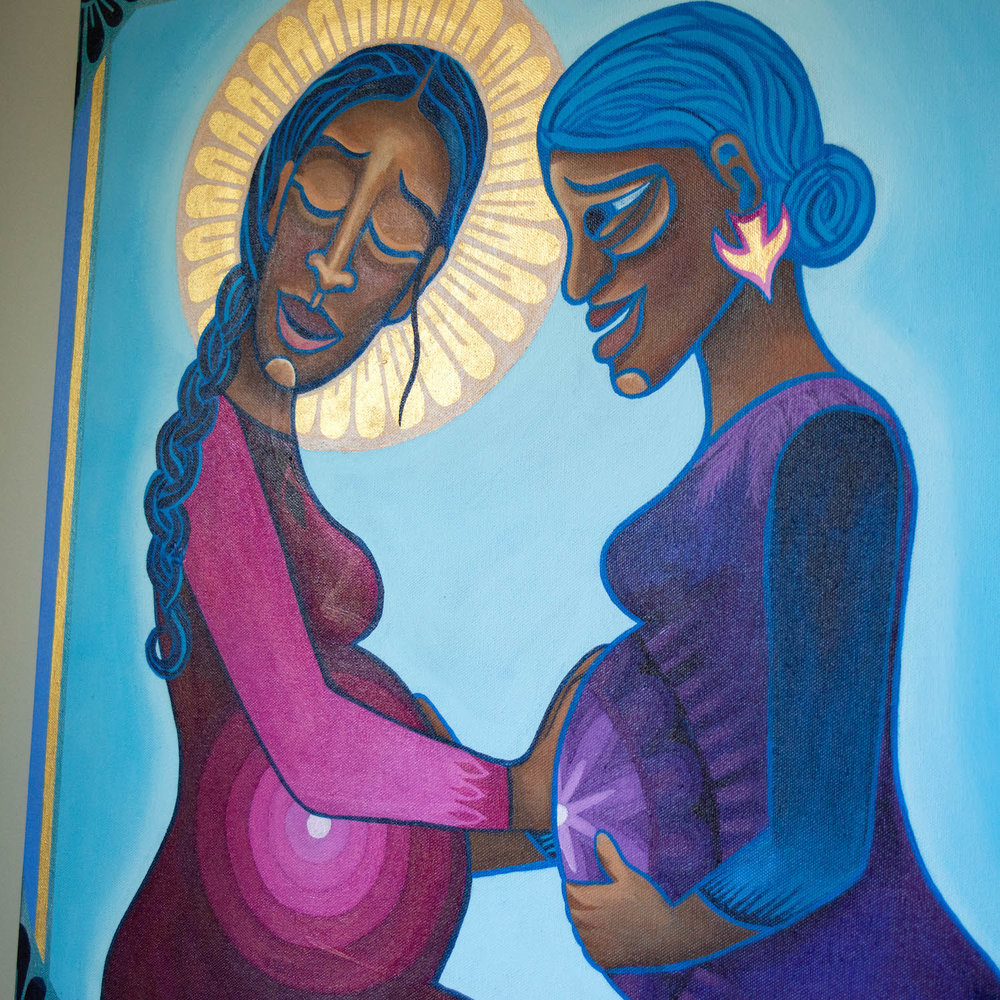
Mary and Elizabeth, by Lauren Wright Pittman

In those days Mary set out and went with haste to a Judean town in the hill country, where she entered the house of Zechariah and greeted Elizabeth. When Elizabeth heard Mary’s greeting, the child leaped in her womb. And Elizabeth was filled with the Holy Spirit and exclaimed with a loud cry, “Blessed are you among women, and blessed is the fruit of your womb. And why has this happened to me that the mother of my Lord comes to me? For as soon as I heard the sound of your greeting, the child in my womb leaped for joy. And blessed is she who believed that there would be a fulfillment of what was spoken to her by the Lord.”

And Mary said,

“My soul magnifies the Lord,
    and my spirit rejoices in God my Savior,
for he has looked with favor on the lowly state of his servant.
    Surely from now on all generations will call me blessed,
for the Mighty One has done great things for me,
    and holy is his name;
indeed, his mercy is for those who fear him
    from generation to generation.
He has shown strength with his arm;
    he has scattered the proud in the imagination of their hearts.
He has brought down the powerful from their thrones
    and lifted up the lowly;
he has filled the hungry with good things
    and sent the rich away empty.
He has come to the aid of his child Israel,
    in remembrance of his mercy,
according to the promise he made to our ancestors,
    to Abraham and to his descendants forever.” (New Revised Standard Version)

Mary had a visitation by an angel, informing her that she would give birth to the Son of God. She immediately hurried to visit her relative Elizabeth, who was pregnant with the forerunner to the Son of God.

In the two women’s encounter, the baby within Mary is portrayed as of greater significance than the one within Elizabeth. And that was not because of the adults, but because of the babies themselves.

Something amazing and spectacular was about to occur in history. It would be so cataclysmic that these two babies, especially the one within Mary, would change the world in profound ways.

There was nothing particularly special about either Mary or Elizabeth – which is probably why they were perfect for the jobs of raising the Messiah and the Prophet.

The lowly non-descript persons are usually favored by God, even though the world knows nothing about them. After all, the kingdom of God knows nothing of billionaires and those in high places, even though the world knows nearly everything about them.

Throughout the history of the world, women have often been overlooked and underrated. Even in today’s Western world, even though it’s better than it was, women are still viewed not as qualified like men are. But that’s a topic for another time.

The Visitation, by Sadao Watanabe (1913-1996)

The most obvious observation from today’s Gospel story is that we wouldn’t have babies born without women. There were two in utero babies that had responses, because of two women.

Inside of Elizabeth’s womb, John leaped at the voice of Mary carrying his new cousin. Indeed, even before birth, John was filled with the Holy Spirit and began pointing to Jesus. (Luke 1:15)

John, although getting his prophetic leap from the Spirit, also got some significant prophetic oomph from his mother. Elizabeth spoke the prophetic word about Mary, who is “the mother of my Lord.”

Good people bestow blessing on others. And that is what Elizabeth did for Mary. This then, enabled Mary to express her own inspired blessing to God. To bless and be blessed means, on the practical level, that spiritual eyes are opened to see what is truly there.

Mary is a blessed person, not only because she is the Lord’s mother, but more fundamentally because she is faithful, and trusted in the promise of God to her.

To be blessed is to have God’s stamp of approval on your life. It has little to do with wealth or abundant resources. But it does have a lot to do with living a life of godly virtue and values.

So, again, it only makes sense that God used Mary and Elizabeth, two women who embodied being poor in spirit (humble) as the divine conduits for blessing the world.

Both Mary and Elizabeth believed. Elizabeth believed the words of the angel to her husband Zechariah. And Mary believed the angel’s direct words to her when she heard them. Without hesitation or any ambiguity.

Faith accepts what it cannot see; and when faith does see with actual eyes, it can see what is underneath the physical appearance.

Let’s also make sure to observe that this sort of faith, this particular way of seeing, has its consequences. Elizabeth and Mary both knew quite well that one of them was an unmarried pregnant woman.

They understood the social judgments to come, along with the shaming, and perhaps even the ostracism that would likely occur – even though all of this is divine through and through.

But grace can always use the eyes of faith to see beyond social status and convention in order to do what is right, just, and good. Mercy can always see what is truly honorable.

Elizabeth was perfectly comfortable extending hospitality to a person for whom others were likely to whisper, judge, and reject. Which is why I like Elizabeth. Every generation needs more women like her.

The welcome and love of Elizabeth is of the same sort that Jesus would show to prostitutes, tax collectors, and sinners. Like Elizabeth, Jesus could see beyond any societal shame to what was divinely happening in front of him.

Mary magnified the Lord with immortal words infused from the blessing bestowed upon her by Elizabeth. To bless another person is to open them to the possibilities of God’s actions in them and through them to the world.

That is the real gift that keeps on giving. And it is the most appropriate and valuable gift that we can give to another this season.

O God of Elizabeth and Mary, you visited your servants with news of the world’s redemption in the coming of the Savior. Make our hearts leap with joy, and fill our mouths with songs of praise, so that we may announce glad tidings of peace, and welcome Christ in our midst. Open our souls to receive the One who came to love your flock. Amen.

Delivery and Deliverance (Isaiah 66:7-11)

Before she was in labor
    she gave birth;
before her pain came upon her
    she delivered a son.
Who has heard of such a thing?
    Who has seen such things?
Shall a land be born in one day?
    Shall a nation be delivered in one moment?
Yet as soon as Zion was in labor
    she delivered her children.
Shall I open the womb and not deliver?
    says the Lord;
shall I, the one who delivers, shut the womb?
    says your God.

Rejoice with Jerusalem, and be glad for her,
    all you who love her;
rejoice with her in joy,
    all you who mourn over her—
that you may nurse and be satisfied
    from her consoling breast,
that you may drink deeply with delight
    from her glorious bosom. (New Revised Standard Version)

Conception. Happiness. Wondering. Uncomfortable. Preparation. Pain. More pain. Delivery. Exhaustion. Joy. Celebration. New life. Bringing children into this world is a process. And its hard work.

Feeding. Pooping. Sleeping. Exhaustion. More feeding. Lots more pooping. Thank God, more sleeping. Still exhausted. So, when does the mother ever get to eat, go to the bathroom by herself, and sleep? Maybe tomorrow, or maybe in another life….

Despite all of this, there are still words which keep mothers (and fathers) going: Satisfaction. Delight. Awe. Praise. Love. Hope. Faith. Yes, faith. Lots of faith. So much faith that it’s as if the parent puts all their weight on it, and leans into it, perhaps more out of sheer necessity than anything else.

The Christian season of Advent has been growing over the past weeks. It is now large and very ready for Christmas Day and the celebration of the Christmas season (the 12 days from December 25 to the Day of Epiphany on January 6).

But we aren’t quite there yet. There is still the anticipation of birth. The Christ child is coming.

It’s quite something to imagine that God would be so humble as to become humiliated. What a wonder it is, that there is such a thing as an incarnation, that Jesus entered this world as both a human baby and a divine king.

God came to this world for us, on our behalf, to redeem, renew, and restore lost humanity. That’s a lot of love. If you think about it, the mother’s incredible love had to come from somewhere.

Love is what sustains the world. So, love must be nurtured. The feelings of it are not always there within us.

Yet, if we will continually seek to maintain the godliness which is love inside of us, we can find ourselves being little incarnations of Jesus walking about this earth providing succor, without any withholding or hatred.

To love is to love. Without conditions. To love a friend but hate an enemy is to cancel out the love. It must be all love, or it isn’t love, at all.

The person, group, organization, institution, community, or church in a miserable and wretched state is in need of restoration. That is, they are in a great need of receiving love and giving love.

If they have responsibilities toward others, and have been neglectful, they must come to the breast of God. And those who did not receive their due justice and fair recompense must also come.

Advent is more than a season in the year to recognize. And Christ’s incarnation is much more than a doctrine to believe. Advent and incarnation are powerful realities which we must live into.

The good news of this season is that God intervenes effectively to do good for those who are faithful. It’s a newness as sudden and as wonderful as the birth of a baby. The Lord does away with barrenness and hopelessness, and brings new life.

It is this good news that brings out joy. Where once there was mourning and sadness, there is now satisfaction, comfort, and consolation. God is the One who brings it about.

Therefore, it is helpful to remember and recall the words of Jesus to his disciples:

Very truly, I tell you, you will weep and mourn, but the world will rejoice; you will have pain, but your pain will turn into joy. When a woman is in labor, she has pain because her hour has come. But when her child is born, she no longer remembers the anguish because of the joy of having brought a human being into the world. So you have pain now, but I will see you again, and your hearts will rejoice, and no one will take your joy from you. (John 16:20-22, NRSV)

The joy and celebration of this first advent will lead to a second advent, the return of Christ. The peace and satisfaction we may enjoy now is only here in part. The fullness of peace will be ushered in at the end of time.

This is the sort of tension that we must continually maintain, holding together in both hands our sorrow and joy, disappointment and hope, hardship and love, at the same time, all the time, until that day when there is not only a delivery, but a deliverance from all evil.

Lord God, we adore you because you have come to us in the past.
You have spoken to us in the Law of Israel.
You have challenged us in the words of the prophets.
You have shown us in Jesus what you are really like.

Lord God, we adore you because you still come to us now.
You come to us through other people and their love and concern for us.
You come to us through people who need our help.
You come to us as we worship you with others.

Lord God, we adore you because you will come to us at the end.
You will be with us at the hour of death.
You will still reign supreme when all human institutions fail.
You will still be God when our history has run its course.

We welcome you, the God who comes.
Come to us now in the power of Jesus Christ our Lord. Amen.

The Gospel Is For Everyone (Acts 11:1-18)

The Preaching of St. Peter In Jerusalem, by Charles Poërson, 1642

The apostles and the believers throughout Judea heard that the Gentiles also had received the word of God. So when Peter went up to Jerusalem, the circumcised believers criticized him and said, “You went into the house of uncircumcised men and ate with them.”

Starting from the beginning, Peter told them the whole story:“I was in the city of Joppa praying, and in a trance I saw a vision. I saw something like a large sheet being let down from heaven by its four corners, and it came down to where I was. I looked into it and saw four-footed animals of the earth, wild beasts, reptiles and birds. Then I heard a voice telling me, ‘Get up, Peter. Kill and eat.’

“I replied, ‘Surely not, Lord! Nothing impure or unclean has ever entered my mouth.’

“The voice spoke from heaven a second time, ‘Do not call anything impure that God has made clean.’ This happened three times, and then it was all pulled up to heaven again.

“Right then three men who had been sent to me from Caesarea stopped at the house where I was staying. The Spirit told me to have no hesitation about going with them. These six brothers also went with me, and we entered the man’s house. He told us how he had seen an angel appear in his house and say, ‘Send to Joppa for Simon who is called Peter. He will bring you a message through which you and all your household will be saved.’

“As I began to speak, the Holy Spirit came on them as he had come on us at the beginning. Then I remembered what the Lord had said: ‘John baptized with water, but you will be baptized with the Holy Spirit.’ So if God gave them the same gift he gave us who believed in the Lord Jesus Christ, who was I to think that I could stand in God’s way?”

When they heard this, they had no further objections and praised God, saying, “So then, even to Gentiles God has granted repentance that leads to life.” (New International Version)

In this Advent season, the Revised Common Lectionary Daily Readings for Year C direct us toward the good news that Christ’s incarnation is not only for Jewish people; it is also for everyone.

But Peter needed some remedial teaching about this gospel. He had to get the reality that God grants repentance leading to new life for Gentiles, firmly into his Jewish head and heart.

The first advent of Jesus Christ – his incarnation as the God-Man on this earth – was meant for the world, and not exclusively for the Jewish people. Sometimes, however, it takes a vision or a dream to really get the message across.

And God is gracious to do whatever it takes in order to gain our attention and bring us to a point of changing our minds about things we are in error about.

The Gospel is for everyone.

The Gospel is Jews and Gentiles. The Gospel is for you and for me. It’s for your grumpy neighbor and your crazy uncle. It’s for that obnoxious co-worker and the persnickety church lady. It’s for the Grinches and Scrooges of this world, as well as for the already convinced.

Yes, indeed, the good news of Jesus Christ is for everyone, without exception.

I do so hope that you don’t have to learn that truth the hard way. I do rather hope that you have a wonderful experience of discovering a Cornelius of whom you had no idea even existed, until the mercy of God led you otherwise.

It is my prayer that you have (or will have) a story to tell, much like Peter’s, in which you found that the grace of God has no limits, that there is plenty of Christ to go around for everyone.

There is no need to stand in God’s way, because no one can stop God’s grace. When the mercy of God starts moving, it becomes a giant snowball gaining speed and strength and size going downhill. And when it hits, you’re going to feel it!

Grace overcomes and overwhelms everything. 

One of the most scandalous truths of Christianity is that God graces common ordinary people who seem as dead as a bowling ball with the Holy Spirit and gives them life. 

The Apostle Peter had to learn this with some difficulty, but he embraced the work of God among the non-Jewish Gentiles. “The Holy Spirit fell on them just as on us at the beginning” was Peter’s plain account and confession of the reality that God grants repentance that leads to life for all kinds of people no matter what their race, ethnicity, gender, class, or background. 

It is a wondrous and astounding spiritual truth that God’s gracious concern is not limited to a certain type of person.

Along with Peter and the other believers so long ago, let us rejoice in the work of God that brings deliverance and transformation. 

Grace is and ought to be the guiding factor in how we interact with people. 

Losing sight of grace leads to being critical and defensive. Whereas, embracing grace leads to the humility of seeing the image of God in people very different from ourselves. 

Grace tears down barriers and causes us to do away with unnecessary distinctions between others. Our appropriate response to such a grace is to glorify God for his marvelous and amazing work. 

The Gospel is not only a gift to receive; it is also a wonderful gift to give.

Gracious God, just as you brought deliverance and salvation that leads to life for people from ancient times, and gifted them with your Holy Spirit, so today continue your mighty work of transformation in the hearts of people that I share the good news of Jesus with. Amen.

Who Is Jesus? (Luke 2:22-40)

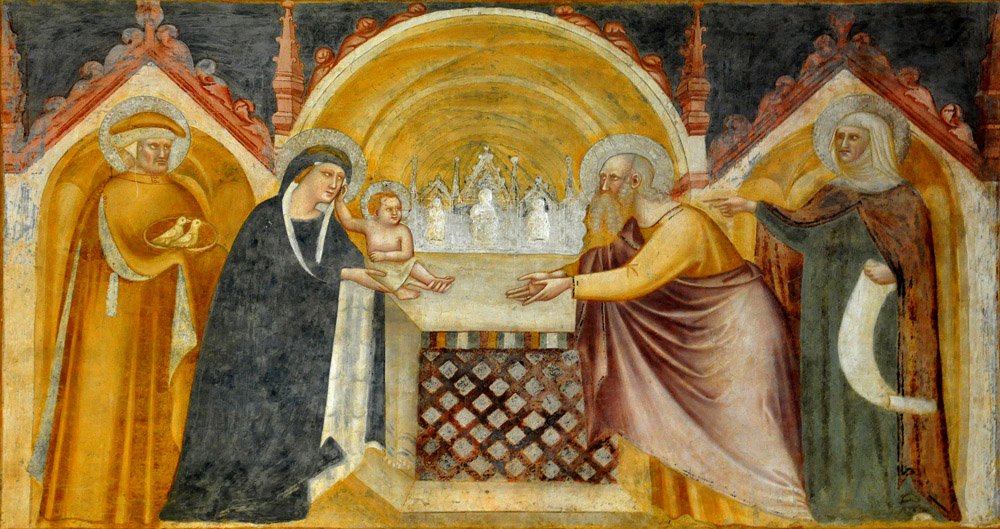
The Presentation in the Temple, 14th century fresco in Pomposa Abbey, Codorigo, Italy

When the time came for the purification rites required by the Law of Moses, Joseph and Mary took him to Jerusalem to present him to the Lord (as it is written in the Law of the Lord, “Every firstborn male is to be consecrated to the Lord”), and to offer a sacrifice in keeping with what is said in the Law of the Lord: “a pair of doves or two young pigeons.”

Now there was a man in Jerusalem called Simeon, who was righteous and devout. He was waiting for the consolation of Israel, and the Holy Spirit was on him. It had been revealed to him by the Holy Spirit that he would not die before he had seen the Lord’s Messiah. Moved by the Spirit, he went into the temple courts. When the parents brought in the child Jesus to do for him what the custom of the Law required, Simeon took him in his arms and praised God, saying:

“Sovereign Lord, as you have promised,
    you may now dismiss your servant in peace.
For my eyes have seen your salvation,
    which you have prepared in the sight of all nations:
a light for revelation to the Gentiles,
    and the glory of your people Israel.”

The child’s father and mother marveled at what was said about him. Then Simeon blessed them and said to Mary, his mother: “This child is destined to cause the falling and rising of many in Israel, and to be a sign that will be spoken against, so that the thoughts of many hearts will be revealed. And a sword will pierce your own soul too.”

There was also a prophet, Anna, the daughter of Penuel, of the tribe of Asher. She was very old; she had lived with her husband seven years after her marriage, and then was a widow until she was eighty-four. She never left the temple but worshiped night and day, fasting and praying. Coming up to them at that very moment, she gave thanks to God and spoke about the child to all who were looking forward to the redemption of Jerusalem.

When Joseph and Mary had done everything required by the Law of the Lord, they returned to Galilee to their own town of Nazareth. And the child grew and became strong; he was filled with wisdom, and the grace of God was on him. (New International Version)

The Gospel accounts of Matthew, Mark, Luke, and John actually contain very little information about the childhood of Jesus. That’s because the Gospels are not biographies – in the sense we think of them – but rather they are narratives that seek to answer a fundamental question about faith and life on this earth: Who is this Jesus?

C.S. Lewis went about exploring that very question. He reasons with us in his classis work, Mere Christianity:

“I am trying here to prevent anyone saying the really foolish thing that people often say about Him: I’m ready to accept Jesus as a great moral teacher, but I don’t accept his claim to be God. That is the one thing we must not say. A man who was merely a man and said the sort of things Jesus said would not be a great moral teacher. He would either be a lunatic — on the level with the man who says he is a poached egg — or else he would be the Devil of Hell. You must make your choice. Either this man was, and is, the Son of God, or else a madman or something worse. You can shut him up for a fool, you can spit at him and kill him as a demon or you can fall at his feet and call him Lord and God, but let us not come with any patronizing nonsense about his being a great human teacher. He has not left that open to us. He did not intend to.”

C.S. Lewis, Mere Christianity

St. Luke’s account of Christ’s childhood stories, seeks to make some important theological points about Jesus:

  • born a Jew amongst devout religious Jews in a thoroughly Jewish society, under Roman authority (Luke 2:1-7)
  • born of a woman, born under the law (Galatians 4:4-5)
  • obedient to his heavenly Father (Luke 2:49; Mark 3:35)
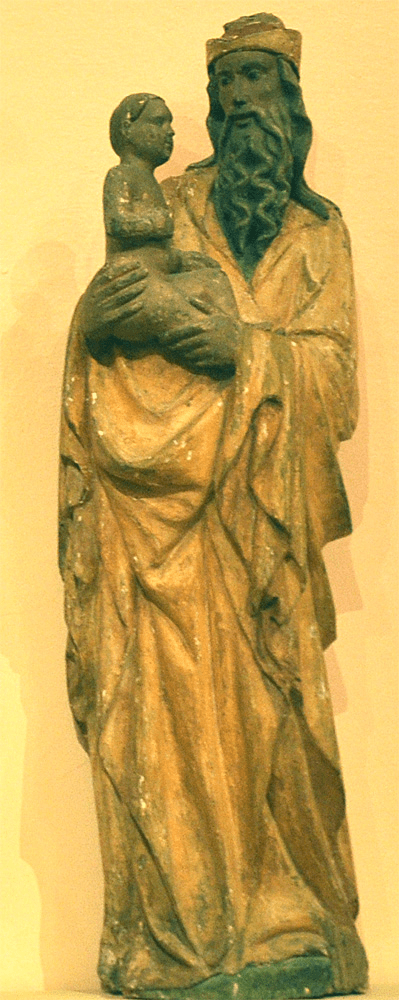
The Presentation in the Temple, 14th century marble statue in the National Museum of the Middle Ages, Paris, France

So, as such, the presentation of Jesus in Jerusalem at the temple is motivated by specific requirements of the law of Moses:

The Lord said to Moses, “Say to the Israelites: ‘A woman who becomes pregnant and gives birth to a son will be ceremonially unclean for seven days…. On the eighth day the boy is to be circumcised. Then the woman must wait thirty-three days to be purified from her bleeding. She must not touch anything sacred or go to the sanctuary until the days of her purification are over….

“‘When the days of her purification for a son… are over, she is to bring to the priest at the entrance to the tent of meeting a year-old lamb for a burnt offering and a young pigeon or a dove for a sin offering….

“‘These are the regulations for the woman who gives birth to a boy… But if she cannot afford a lamb, she is to bring two doves or two young pigeons, one for a burnt offering and the other for a sin offering. In this way the priest will make atonement for her, and she will be clean.’” (Leviticus 12:1-8, NIV)

What’s more, every first-born male (as Jesus was) specifically belongs to the Lord, and is set apart.

The Lord said to Moses, “Consecrate to me every firstborn male. The first offspring of every womb among the Israelites belongs to me… you are to give over to the Lord the first offspring of every womb….”

“In days to come, when your son asks you, ‘What does this mean?’ say to him, ‘With a mighty hand the Lord brought us out of Egypt, out of the land of slavery. When Pharaoh stubbornly refused to let us go, the Lord killed the firstborn of both people and animals in Egypt.

This is why I sacrifice to the Lord the first male offspring of every womb and redeem each of my firstborn sons.’ And it will be like a sign on your hand and a symbol on your forehead that the Lord brought us out of Egypt with his mighty hand.” (Exodus 13:1-2, 12, 14-16, NIV)

Luke was making the connection that when Joseph and Mary presented Jesus to the Lord in Jerusalem, they were essentially dedicating his life to God. Jesus will be the means of redemption for all the people.

Mary would have remembered the words the angel Gabriel told her, that her son will not only be holy, but also be called the Son of God. The life of Jesus – conception, birth, and presentation at the temple – is demonstrably dedicated fully and completely to his heavenly Father. Deliverance for both Jews and Gentiles is focused in the person of Jesus.

Simeon and the Child Jesus, 16th century statue in Zadar, Croatia

Simeon and Anna show up at the presentation of Jesus as devout Jews who are awaiting the fulfillment of God’s promises of consolation and redemption for Israel.

“I, the Lord, have called you in righteousness;
    I will take hold of your hand.
I will keep you and will make you
    to be a covenant for the people
    and a light for the Gentiles.” (Isaiah 42:6, NIV)

Break forth; shout together for joy,
    you ruins of Jerusalem,
for the Lord has comforted his people;
    he has redeemed Jerusalem.
The Lord has bared his holy arm
    before the eyes of all the nations,
and all the ends of the earth shall see
    the salvation of our God. (Isaiah 52:9-10, NRSV)

Simeon and Anna became the spokespersons for the redemption that is to come through Jesus. They both got a glimpse of the salvation that would, one day, reveal itself to the whole world. Forgiveness of sins, deliverance from death and hell, and freedom from guilt and shame all become laser focused on the suffering servant of God.

Who is Jesus? He is the ultimate meaning of Christmas, the incarnation of the Son of God, the Savior of the world. Amen.