Living In the Tension of Life (Isaiah 54:1-13)

Shout for joy, O barren one who has borne no children;
    burst into song and shout,
    you who have not been in labor!
For the children of the desolate woman will be more
    than the children of the one who is married, says the Lord.
Enlarge the site of your tent,
    and let the curtains of your habitations be stretched out;
do not hold back; lengthen your cords
    and strengthen your stakes.
For you will spread out to the right and to the left,
    and your descendants will possess nations
    and will settle desolate towns.

Do not fear, for you will not be ashamed;
    do not be discouraged, for you will not suffer disgrace,
for you will forget the shame of your youth,
    and the disgrace of your widowhood you will remember no more.
For your Maker is your husband;
    the Lord of hosts is his name;
the Holy One of Israel is your Redeemer;
    the God of the whole earth he is called.
For the Lord has called you
    like a wife forsaken and grieved in spirit,
like the wife of a man’s youth when she is cast off,
    says your God.
For a brief moment I abandoned you,
    but with great compassion I will gather you.
In overflowing wrath for a moment
    I hid my face from you,
but with everlasting love I will have compassion on you,
    says the Lord, your Redeemer.

This is like the days of Noah to me:
    Just as I swore that the waters of Noah
    would never again go over the earth,
so I have sworn that I will not be angry with you
    and will not rebuke you.
For the mountains may depart
    and the hills be removed,
but my steadfast love shall not depart from you,
    and my covenant of peace shall not be removed,
    says the Lord, who has compassion on you.

O afflicted one, storm-tossed and not comforted,
    I am about to set your stones in antimony
    and lay your foundations with sapphires.
I will make your pinnacles of rubies,
    your gates of jewels,
    and all your wall of precious stones.
All your children shall be taught by the Lord,
    and great shall be the prosperity of your children. (New Revised Standard Version)

Judgment and Grace

Throughout all of the Old Testament prophets, there is a consistent theme within each of them of both judgment and grace.

People continually wax and wane in their faithfulness to God. However, the Lord does not change in being faithful to divine promises and keeping the divine covenant toward Israel.

Judgment comes in order to set things right, and provides justice for oppressed and underprivileged people. The judgment, however, only lasts for a while; whereas grace is continually operative.

Today’s text is one of grace. In the movement and rhythm of God’s judgment and grace, these verses return to the call for celebration and joy in response to divine mercy.

The metaphor of the barren woman refers to the years the city of Jerusalem sat in ruins because of divine judgment. Yet, it will not remain this way. The prophet assures the people that Jerusalem will grow once again. The city will spread out and increase, like a mother with many children.

There is no need for fear, because the Lord is not only the Creator and Maker; God is also Jerusalem’s redeemer and husband. The metaphor is meant to convey the attention and intimacy that God shows to people through divine grace.

Reconciliation and Restoration

Even though the city was like a wife forsaken by her husband, reconciliation is initiated by God through compassion and steadfast love. The Lord will honor the covenant, and not completely toss the people away, never to be seen again.

The Lord scatters; and the Lord gathers. The Lord gives; and the Lord takes away. The Lord extends judgment; and the Lord shows mercy. Blessed be the name of the Lord.

The word “abandon” is not even in God’s lexicon. The Lord is unfamiliar with the concept. There may be natural disasters, terrible diseases, and dilapidated places, but none of these can ever separate us from God’s steadfast immovable love.

Restoration is happening. No matter how bad things get – and things can get awfully bad – nothing can stop the divine band wagon of restoration from coming into town and changing everything.

Renewal and restoration may not happen today, or tomorrow; yet, it is happening, sooner or later. Nothing and no one can stand against the right, good, and just purposes of the almighty and everlasting God.

Redemption and Hope

In Christianity, this hope is focused in the birth of the Christ child. Redemption and new life is a reality in Jesus Christ our Lord. This is the reason for the Christian’s joy and celebration in this season.

On one end of our rubber-band like tension in this present life are the disappointments, brokenness, suffering, and pain we experience. At the other end, is the promise of future glory that is yet to come.

All believers, and every church, lives in this tension between the already and the not yet. We live in an in-between time, an awkward liminal space, that makes hope a sheer necessity in order to make it through the Christian life.

“There is a birth from before the ages, and a birth from a virgin at the fulness of time. There is a hidden coming, like that of rain on fleece, and a coming before all eyes, still in the future.”

St. Cyril of Jerusalem (313-386, C.E.)

The biblical writers, along with the early church fathers and mothers, understood the sacred tension of life:

Without any doubt, the mystery of godliness is great:

He was revealed in flesh,
    vindicated in spirit,
        seen by angels,
proclaimed among gentiles,
    believed in throughout the world,
        taken up in glory. (1 Timothy 3:16, NRSV)

The one who testifies to these things says, “Surely I am coming soon.”

Amen. Come, Lord Jesus!

The grace of the Lord Jesus be with all the saints. Amen. (Revelation 22:20-21, NRSV)

Almighty God, give all of us grace to cast away the works of darkness, and put on the armor of light, now in the time of this mortal life in which your Son Jesus Christ came to visit us in great humility, so that in the last day, when he shall come again in his glorious majesty to judge both the living and the dead, we may rise to the life immortal; through him who live and reigns with you and the Holy Spirit, one God, now and forever. Amen.

‘Tis the Season For Praise (Psalm 148)

By Stushie Art

Praise the Lord!
Praise the Lord from the heavens;
    praise him in the heights!
Praise him, all his angels;
    praise him, all his host!

Praise him, sun and moon;
    praise him, all you shining stars!
Praise him, you highest heavens
    and you waters above the heavens!

Let them praise the name of the Lord,
    for he commanded and they were created.
He established them forever and ever;
    he fixed their bounds, which cannot be passed.

Praise the Lord from the earth,
    you sea monsters and all deeps,
fire and hail, snow and frost,
    stormy wind fulfilling his command!

Mountains and all hills,
    fruit trees and all cedars!
Wild animals and all cattle,
    creeping things and flying birds!

Kings of the earth and all peoples,
    princes and all rulers of the earth!
Young men and women alike,
    old and young together!

Let them praise the name of the Lord,
    for his name alone is exalted;
    his glory is above earth and heaven.
He has raised up a horn for his people,
    praise for all his faithful,
    for the people of Israel who are close to him.
Praise the Lord! (New Revised Standard Version)

By Bible Art

God is sovereign – which means that the Lord has complete power, dominion, and authority over everything that exists. God has supremacy because the Lord is the Creator God, the One who brought all things into existence.

Ideally, God and all creation exist harmoniously together. People coexist with God and recognize the Lord’s sovereignty through offering praise, adoration, and thanksgiving to the Lord.

That is what today’s psalm calls us to do, especially in this season of Christmastide. Christians are to offer their praise to God, despite whatever circumstances may be happening in their lives, and around them.

The psalmist was not telling people to simply forget their sorrows. He was exhorting everyone, including all creation, to praise the Lord in the middle of their distress.

When Christ was born, circumstances were not good for the Jews in Judea. Roman occupation had a firm authoritative hold upon them. Throughout their history, Jews have been often marginalized and oppressed. They know what suffering is.

Even though Christianity is a sizable world religion, Christians in many parts of the world today experience ostracization and discrimination. Christians everywhere are not immune to world events with situations like dictators, disasters, and diseases.

Yet, there is always an opportunity for praise to God. And the psalmist summons the faithful to do so. Praise and adoration of God shape us and form us spiritually, so that, even if we do not feel like doing it, the very act of offering the praise trains our spirits to bend in a good direction.

We could simply give-in to the status quo of things through constant complaining; or keep offering our woes. But that doesn’t negate the importance of praise.

Today we have the opportunity (and responsibility) to praise God for the incarnation of Christ. To remember that God loved us enough to become one of us. To adore the Christ child, and choose to give thanks, even though there might be oppression all around us.

We can celebrate, along with all creation, the nature of God and the Lord’s good purposes for humanity and all the earth. Adverse situations may stop us from many things we want to do, yet no circumstance can ever prevent us from praising God for divine attributes and divine sovereignty.

All of creation praises God by being exactly what God created it to be. A tree doesn’t try and be a star in the sky. It simply takes root and grows, branching out and becoming a haven for many creatures. Squirrels do what squirrels do, just like flowers, rocks, wind and weather do what they do.

It’s us people who tend to go rogue and try to be something or someone we’re not.

We can best praise God by living as God created us to live. We were designed to live in a divine/human cooperation of caring for all creation. We best exist alongside God by being good stewards of all that God has given to us – including the earth, our families and neighborhoods, and especially ourselves.

Praise is the job description of everything which exists. We will do that well as we honor our mandate to care, and not to harm; to serve others, and not be self-serving.

All things are connected on this planet. The ecosystems of the earth, and the economies of people, are all meant to live in harmony with each other, so that all of creation is blessed.

You and I have a sacred trust of relating well with each other, and everything around us.

The human condition is one of ongoing ups and downs. We experience a full range of tragedy, division, and hardship; along with joy, wonder, and happiness. In all things, no matter what, we are called to praise the Lord.

Each of us needs to find that place and that way of orienting and reorienting ourselves to what is important and why we are here.

For me, that happens whenever I hug my dear wife. Sometimes, I even go out in my backyard and hug my oak tree. The very act of hugging helps ground me to what is here and real, what is important and necessary.

If we can but touch one another, not just literally, but with well-placed words and helpful actions, then we can recall why harmony with all things is so important.

I’m in no way saying this is easy. It isn’t. There are many days when either the world seems as if it is a big collective ball of grumpy; or you yourself can hardly do the barest of responsibilities.

Yet, we can still find a way to praise, to be grateful, to offer what little care there may be to give.

Because it’s not so much about the amount of what we do, but rather how we are able to do it. A smidge of something done with love is infinitely better than lots of accomplishment without any care behind it.

The holidays are some of the hardest days for some folks. Christmas and the New Year are associated with grief for various reasons. It can bring isolation, not connection. The last thing such a person may want to do is praise the Lord, especially with a community of folks. And yet, that may just be the best activity.

There is no one-dimensional way of praising God; our offerings to the Lord can be multi-faceted. It can be achieved according to what we have to offer, and why we are offering it. It will not look the same for everyone.

Whatever you really need to do for an offering of praise this year, then do it. It’s okay if it’s a bit avant-garde, or off the beaten path. You are, after all, talking to a guy who hugs trees, for God’s sake.

Maybe this is the time to re-establish an old tradition that has fallen by the wayside. It could be the right opportunity to pick up that old musical instrument or to stretch your voice in singing again.

The exhortation we have from the psalmist is to praise. How you go about it, is up to you, my friend.

May almighty God, who sent his Son to take our nature upon him, encourage you in this holy season, scatter the darkness of sin, and brighten your heart with the light of his holiness. And may the blessing of God – Father, Son, and Spirit – be upon you and remain with you forever. Amen.

Christmas Day (John 1:1-14)

Art by Lourry Legarde

The Word was first,
    the Word present to God,
    God present to the Word.
The Word was God,
    in readiness for God from day one.

Everything was created through him;
    nothing—not one thing!—
    came into being without him.
What came into existence was Life,
    and the Life was Light to live by.
The Life-Light blazed out of the darkness;
    the darkness couldn’t put it out.

There once was a man, his name John, sent by God to point out the way to the Life-Light. He came to show everyone where to look, who to believe in. John was not himself the Light; he was there to show the way to the Light.

The Life-Light was the real thing:
    Every person entering Life
    he brings into Light.
He was in the world,
    the world was there through him,
    and yet the world didn’t even notice.
He came to his own people,
    but they didn’t want him.
But whoever did want him,
    who believed he was who he claimed
    and would do what he said,
He made to be their true selves,
    their child-of-God selves.
These are the God-begotten,
    not blood-begotten,
    not flesh-begotten,
    not sex-begotten.

The Word became flesh and blood,
    and moved into the neighborhood.
We saw the glory with our own eyes,
    the one-of-a-kind glory,
    like Father, like Son,
Generous inside and out,
    true from start to finish. (The Message)

Art by Linnaea Mallette

Joy to the world! Merry Christmas to you, my friend. On this day, and for the next twelve days, we remember and celebrate the nativity of Christ, and the mystery of his incarnation.

We acknowledge with Christians, both past and present, all around the world, in proclaiming together:

“Glory to God in heaven, and on earth peace among those whom he favors.” (Luke 2:14, CEB)

We relate to the shepherds, out in their fields, caring for the flocks of sheep at night, who were terrified, yet went and offered their worship to the newborn king, listening to the angelic message:

Then the angel said to them, “Do not be afraid, for behold, I bring you good tidings of great joy which will be to all people. For there is born to you this day in the city of David a Savior, who is Christ the Lord.” (Luke 2:10-11, NKJV)

We identify with Mary, the mother of Jesus, who pondered the meaning of the nativity in her heart. (Luke 2:19)

This Christmas season extends from December 25 through January 5. Celebrating throughout these days helps us enter into the profound meaning and mystery of Christ’s incarnation – rather than just observing one day.

Today’s Gospel lesson moves us to do just that, to acknowledge and affirm the identity of Jesus Christ as fully human, and at the same time, all the time, fully divine.

Christ was both born into this world, and pre-existed from the very beginning. Indeed, Jesus has always existed, without any sort of preconditions to his eternal being. He is a person, a persona of God. In other words, Jesus is God.

The Lord Jesus is the pre-existent light-bearer who is designated to come as the light-giver, whose light is unquenchable and never goes out. He is the Light of the world.

John is a witness to that light. And although this light should have been expected, there were (and are) many who reject the Light, who is the Word for the world.

Yet, any sort of rejection cannot possibly hinder the light’s ability to illumine the hearts of many people.

This Word, this Light, this pre-existing Christ, has actually enfleshed himself, becoming present with us in this world. And this is precisely what the faithful are celebrating this day, and in this season. God has come among us!

The giving of the Son, this person of God, this incredible light and life, is a grace well beyond the divine giving of the Law – because the Law has been incarnated in the person of Jesus the Christ.

There is much to ponder, and much to celebrate, on this day, and for the upcoming days of this season.

We were all physically born of the flesh. We may all also become spiritually born of God through the Word of God, Jesus, the Savior whom we acknowledge and adore today and every day.

“The Word of God, our Lord Jesus Christ, through his transcendent love, became what we are, so that he might bring us to what he is himself.”

St. Irenaeus

By means of the incarnation, in Christ, and through the Spirit, we have the chance, the ability, made possible by God’s grace, to participate in the divine nature; and in the divine dance of unhindered and unending unity, harmony, peace, and love which continually exists within the Holy Trinity – Father, Son, and Spirit.

This is a spiritual reality worth a robust celebration today – and all the days which God gives us on this earth. To God be the glory.

God, you spoke, and your Word became flesh, breathing a new song of joy and praise into the world. Grant that we may bear the good news of your salvation, proclaiming your promise of peace to the ends of the earth. Amen.

Nativity of the Lord (Luke 2:1-20)

Nativity, by He Qi, 1998

In those days a decree went out from Caesar Augustus that all the world should be registered. This was the first registration and was taken while Quirinius was governor of Syria. 

All went to their own towns to be registered. Joseph also went from the town of Nazareth in Galilee to Judea, to the city of David called Bethlehem, because he was descended from the house and family of David. He went to be registered with Mary, to whom he was engaged and who was expecting a child. 

While they were there, the time came for her to deliver her child. And she gave birth to her firstborn son and wrapped him in bands of cloth and laid him in a manger, because there was no place in the guest room.

Now in that same region there were shepherds living in the fields, keeping watch over their flock by night. Then an angel of the Lord stood before them, and the glory of the Lord shone around them, and they were terrified. 

But the angel said to them, “Do not be afraid, for see, I am bringing you good news of great joy for all the people: to you is born this day in the city of David a Savior, who is the Messiah, the Lord. This will be a sign for you: you will find a child wrapped in bands of cloth and lying in a manger.” 

And suddenly there was with the angel a multitude of the heavenly host, praising God and saying,

“Glory to God in the highest heaven,
    and on earth peace among those whom he favors!”

When the angels had left them and gone into heaven, the shepherds said to one another, “Let us go now to Bethlehem and see this thing that has taken place, which the Lord has made known to us.” 

So they went with haste and found Mary and Joseph and the child lying in the manger. When they saw this, they made known what had been told them about this child, and all who heard it were amazed at what the shepherds told them, and Mary treasured all these words and pondered them in her heart. 

The shepherds returned, glorifying and praising God for all they had heard and seen, just as it had been told them. (New Revised Standard Version)

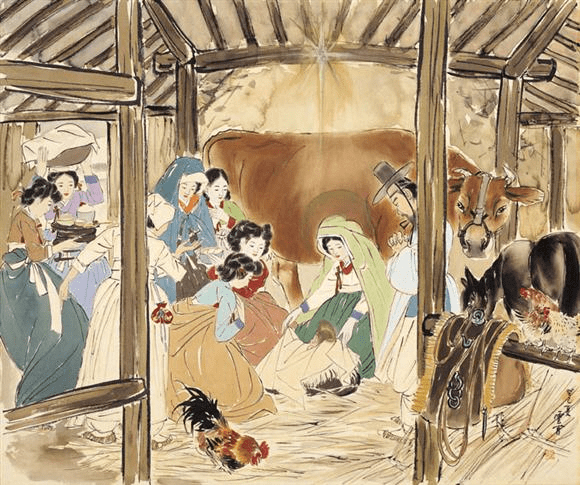
The Birth of Jesus Christ, by Woonbo Kim Ki-chang, 1953

Overwhelmed. That’s the word I imagine the characters in this story had, for various reasons.

To have spiritual or emotional overwhelm is to feel overpowered by several circumstances at once. It’s experiencing a lot of emotions all at the same time.

The sense of overwhelm can come from many different things, including complicated grief, relational distance, and too many responsibilities. Depending upon why we are overwhelmed, it will likely either leave us stuck and chronically tired, or free and forever rejoicing.

A good sense of overwhelm is awe and wonder. A bad sense of overwhelm is despondency and dejection.

Mary probably experienced the full range of overwhelm. An angel showed up and announced to her that she would give birth to a son and name him Jesus, meaning that God will save the people. He will fulfill the promise of being the Son of the ancient King David who has a permanent reign.

In other words, Mary would give birth to the Messiah. That sounds like the very definition of overwhelm, in both its good and bad sense.

Despite the temporal worldly power of the Roman Empire, Mary’s child would have a kingdom without end. And in spite of the Romans, God’s will and purpose would prevail.

And yet, Mary and Joseph were still subject to Roman authority. That meant they needed to be registered, along with everyone else in the Empire, so that the government knew about their tax base, and who was going to pay it.

The decree from Ceasar meant that, even though Mary was quite pregnant, she and Joseph would have to travel to Bethlehem, the family’s ancestral town, in order to be properly registered.

Jesus would not be born in the city of overwhelming power and control in Jerusalem. Rather, Bethlehem, a small non-descript town south of the city, is the place for an overwhelming birth experience to happen.

It’s appropriate that from the beginning, the life and ministry of Jesus would be more about the smaller and less powerful place and people.

And so, the new king, from the line of David, is born in the most humble of circumstances. It is fitting that the humblest of persons were the first to receive the birth news.

Shepherds were literally out on the margins of society. Their typical reputation was not good. They stink. They drink too much. They’re on the lower rung of cultural power.

Yet, a huge angelic delegation was sent from heaven to shepherds to announce the birth. It was an overwhelming experience, no matter how you view it.

Seeing Shepherds, by Daniel Bonnell

Angels showed up, and the shepherds were nearly paralyzed with fear. But their terror turned on a dime to awe, wonder, and joy.

What’s more, the good news shared with the lowliest of persons, is for everyone. All the overwhelm and awe is contained in a savior who has been born, Christ the Lord.

Overwhelming feelings were a regular experience of people in the Gospel of Luke who encountered angels – fear being the initial response. But it’s then followed by an assurance that God is extending grace to them, not judgment. No one need be afraid, because God is with them.

It’s not a new message; but it is a message that is newly focused in this savior of a baby. He is Immanuel, God with us. The presence of God is here, because the attention and love of God are here.

Out of my distress I called on the Lord;
    the Lord answered me and set me in a broad place.
With the Lord on my side I do not fear.
    What can mortals do to me?
The Lord is on my side to help me;
    I shall look in triumph on those who hate me. (Psalm 118:5-7, NRSV)

The real genuine authentic power of the universe is here – not found within political empires or governments, nor with the wealthy and influential – but discovered in the arrival of the actual savior, who holds all power and authority, and wields it according to proper justice and righteousness.

All along, God is the true deliverer who backs up the needy and oppressed. It is demonstrated in the angelic proclamations of good news about this Savior, the Christ, the One anointed and chosen by God, the son of David, the deliverer from ancient enemies.

The angel’s proclamation erupts with the sudden appearance of a multitude of God’s heavenly messengers praising God, declaring God’s glory, favor, and blessing of peace on the earth. The emphasis is upon God’s grace rather than human action.

In response to the announcement they received, the shepherds went to see if what they had heard was true, and indeed, it all was. When they saw the sign for themselves, they could not keep silent about all they had heard and seen.

The shepherds praised God, out of an overwhelming sense of amazement that the Lord had paid attention to them.

Praise is still the reaction in the life of the person touched by all that they have seen and heard.

Creator God, by your greatness you became small; by your power you became powerless; and by your limitlessness you became limited. Through the birth of your son, we can live in the divine light that shines on a world transformed by the limitless power of your love. Amen. Praise the Lord!