“Your Faith Has Made You Well” (Luke 17:11-19)

Jesus heals ten lepers, with one returning to give him thanks

On the way to Jerusalem Jesus was going through the region between Samaria and Galilee. As he entered a village, ten men with a skin disease approached him. Keeping their distance, they called out, saying, “Jesus, Master, have mercy on us!” When he saw them, he said to them, “Go and show yourselves to the priests.” And as they went, they were made clean. Then one of them, when he saw that he was healed, turned back, praising God with a loud voice. He prostrated himself at Jesus’s feet and thanked him. And he was a Samaritan. Then Jesus asked, “Were not ten made clean? So where are the other nine? Did none of them return to give glory to God except this foreigner?” Then he said to him, “Get up and go on your way; your faith has made you well.” (New Revised Standard Version)

Ten persons seeking healing called out to Jesus. And they got it. Yet, those persons were much more than passive receivers of healing. And Jesus was more than simply a giver.

Even though the lepers had heard about Jesus, they did not personally know him. It seems that – from their perspective – they had a chance encounter with Jesus. When they least expected a healing, a healing happened.

They called out to Christ, recognizing who it was that had entered their village. There was enough faith present for the diseased persons to make themselves known to Jesus – to expectantly put themselves out there and cry out for a healing to happen.

If you think about it, the power of any healing is really in the connection of being seen and heard in crying out to Jesus.

Although the healing of a person can come through a wondrous miracle, healing most often happens by the beautiful act of mutuality and participation. That is, the healer and the one in need of healing encounter each other with the willingness to both give and receive.

It’s in real human connection that healing happens. And it’s more than a physical cure; it’s also a healing reconnection of persons who were once isolated from the community. In other words, the healed person no longer needs to be on the outside of society, but can once again be a full participant in neighborhood and community.

Faith is central to what happens in the healing process. We all have some agency in realizing our own healing. We need not be passive spectators just wishing for things to be different.

Our anxiety and/or discouragement of present circumstances can move to a different place. We can discover relief through participating in social activities, taking walks in nature, and other modes requiring us to actively make a meaningful connection.

It requires faith.

Where faith is present, relational interaction and participation happens. In this context, a healing can occur. Rarely, if ever, does healing happen in complete isolation from others.

The fact that Jesus declared to the cleansed leper, “your faith has made you well,” indicates the mutuality of the healing encounter.

Let’s keep in mind that it takes at least two in order to have a healing: the healer and the healed one. Both participate together in the healing.

What’s more, when Christ heals, he heals without prejudice or favoritism.

In my front yard is a large ash tree with broad and expansive boughs. It is the ultimate shade tree. The tree’s name is Bob (I have a tendency to name trees, especially the ones I enjoy daily). Bob and I share the similarity of being created by the same Creator; and we both glorify God by simply being who we are created to be.

For Bob, he provides shade to people and animals without prejudice or favoritism. Anyone who comes under his great limbs can enjoy his shade. All that is needed for the protective and enjoyable experience of Bob’s boughs is a person under him.

Although it is appropriate to highlight the need for gratitude and praise in today’s story, the narrative itself builds to the climax of faith, of a participatory experience between Jesus and the leper(s).

And it did not matter if the persons healed were lepers, Samaritans, or even miscreants. What mattered was the faith-dialectic of the healer Jesus and the ones to be healed. All may enjoy the grace of divine shade if they move to becoming participants together with Christ by merely coming under his mercy.

I find that many people get hung-up about faith. We often make faith either too simple or too difficult. We create an overly simplistic faith when it becomes a completely passive affair of just waiting on God, or expecting someone else to heal me. We make faith a great difficulty whenever it becomes all about our level or amount of faith through the strenuous effort of intense prayer and contacting umpteen prayer chains.

But more or less prayer, more or less work, more or less of anything misses the point – because even a puny amount of faith will do, if it moves toward Jesus and seeks the participatory experience of a divine/human relation.

There is a cost to healing. It requires participation, relationship, and most of all, the humility to be seen and heard, instead of trying to control some sort of process to get the healing I want.

We call this genuine participation faith.

When the Son of Man comes, will he find faith on the earth? (Luke 18:8)

The only thing that counts is faith expressing itself through love. (Galatians 5:6)

Your faith has made you well. (Luke 17:19)

In your love, O God of all, your people find healing. Grant that the pains of our journey may not obscure the presence of Christ among us, but that we may always give thanks for your healing power as we travel on the way to your kingdom; through Jesus Christ, your Son, our Lord, who with you and the Holy Spirit are one God, now and forever. Amen.

Renewal (Mark 6:30-34, 53-56)

Great Crowds Followed Jesus as He Preached the Good News, by Elizabeth Wang (1942-2016)

The apostles gathered around Jesus and told him all that they had done and taught. He said to them, “Come away to a deserted place all by yourselves and rest a while.” For many were coming and going, and they had no leisure even to eat. And they went away in the boat to a deserted place by themselves. 

Now many saw them going and recognized them, and they hurried there on foot from all the towns and arrived ahead of them. As he went ashore, he saw a great crowd, and he had compassion for them, because they were like sheep without a shepherd, and he began to teach them many things….

When they had crossed over, they came to land at Gennesaret and moored the boat. When they got out of the boat, people at once recognized him and rushed about that whole region and began to bring the sick on mats to wherever they heard he was. 

And wherever he went, into villages or cities or farms, they laid the sick in the marketplaces and begged him that they might touch even the fringe of his cloak, and all who touched it were healed. (New Revised Standard Version)

Recuperation

Christ’s disciples had just returned from their first ministry trip without Jesus. He had sent them in pairs to take authority over unclean spirits, with specific instructions on how to handle themselves. (Mark 6:6-13)

Now they had come together after a successful experience. Jesus immediately recognized that the disciples needed rest in a private retreat so that they could recover and debrief on their mission.

Jesus knew a thing or two about what we now call “self-care.” Christ understood the necessity for awareness of one’s physical, mental, emotional, and spiritual state – and to take appropriate steps in caring for oneself in order to maintain a vigorous life and ministry. He often punctuated his life with solitary times away with his heavenly Father. (e.g. Mark 1:35)

So, the disciples followed Jesus to a deserted place where they could be alone. Besides, it had become ever more risky to be out in the open. The religious authorities were looking for ways to snuff out this popular upstart of a movement with Jesus as rabbi.

Redirection

Things don’t always go as planned, even for the Son of God. Interruptions are part of working with people. Yet, Jesus never saw those disruptions as a bad thing. It seems that perhaps he even understood them as part of the plan from his heavenly Father. However Christ thought of them, he was unfazed by them.

With an expanding ministry came a larger and more expansive crowd following Jesus. Like a group of ancient paparazzi, there were people dedicated to tracking down Jesus and watching for him; they were absolutely intent on seeing him.

Whereas a lot of people might be annoyed with this behavior (especially us introverts!) Jesus truly saw them, viewing the crowds as “sheep without a shepherd.” In other words, Christ understood the people’s vulnerability, and he had compassion on them.

Refocus

Christ felt genuine care and concern for the people from the pit of his gut. Jesus knew their very real spiritual predicament, an age-old one that God was familiar with:

I, the Lord God, say you shepherds of Israel are doomed! You take care of yourselves while ignoring my sheep. You drink their milk and use their wool to make your clothes. Then you butcher the best ones for food. But you don’t take care of the flock! You have never protected the weak ones or healed the sick ones or bandaged those that get hurt. You let them wander off and never look for those that get lost. You are cruel and mean to my sheep. They strayed in every direction, and because there was no shepherd to watch them, they were attacked and eaten by wild animals. (Ezekiel 34:2-5, CEV)

Jesus, in the spirit Moses, took up the concern for people:

Moses spoke to the Lord: “Let the Lord, the God of all living things, appoint someone over the community who will go out before them and return before them, someone who will lead them out and bring them back, so that the Lord’s community won’t be like sheep without their shepherd.” (Numbers 27:15-17, CEB)

Because the Lord Jesus is the Good Shepherd and takes up the responsibility of caring for the flock, there were sheep (the crowds of people) continually either present around him or pursuing him (hence, the need for continual times of rest and recuperation).

All of this resulted in the impossibility of Jesus strolling into a town, village, or city under the radar.

Restoration

Not only did everyone want to see Jesus, but the people also desired to touch him, or at least the tassels of his garment – anything toget close and experience healing.

What’s so amazing about this account is that every single person who Jesus saw or touched experienced healing – without exception. It wasn’t that a few people, or even some of them, walked away changed. All of them did.

Indeed, Jesus is the divine shepherd, who will gather his sheep from the places where they have been scattered.

Christ went into towns and villages to the public places where the people were. That meant Jesus spent a good deal of time in the marketplaces. Since these were gathering areas where people bought and sold and interacted with each other, there you would also find the weakest, sickest, and most vulnerable people.

The needy were looking for help. And Jesus did for them, well beyond what any of them expected.

The Lord Jesus was also doing more than we might expect, as well. By conducting ministry in the economic center of a town, he was introducing a different (and subversive) economy from the kingdom of God.

Those with goods, resources, and money do not occupy the commercial spaces in God’s kingdom realm. Instead, the ones with the least, inhabit the spaces and places of honor. Indeed, many who are first will be last, and the last will be first. (Mark 10:31)

Christ’s earthly ministry restored people’s bodies, minds, emotions, and spirits – thus bringing a thriving economy into God’s kingdom. All of his work resulted in renewal of people’s lives, and a renewed way of living in this world.

“Healer of Our Every Ill” by Marty Haugen, 1987

Refrain:
Healer of our every ill,
light of each tomorrow,
give us peace beyond our fear,
and hope beyond our sorrow.

You who know our fears and sadness,
grace us with your peace and gladness;
Spirit of all comfort, fill our hearts. [Refrain]

In the pain and joy beholding
how your grace is still unfolding,
give us all your vision, God of love. [Refrain]

Give us strength to love each other,
every sister, every brother;
Spirit of all kindness, be our guide. [Refrain]

You who know each thought and feeling,
teach us all your way of healing;
Spirit of compassion, fill each heart. [Refrain]

Amen.

Don’t Fear, Believe! (Mark 5:21-43)

Jesus heals the daughter of Jairus, by Hyatt Moore

When Jesus had crossed again in the boat to the other side, a great crowd gathered around him, and he was by the sea. Then one of the leaders of the synagogue, named Jairus, came and, when he saw him, fell at his feet and pleaded with him repeatedly, “My little daughter is at the point of death. Come and lay your hands on her, so that she may be made well and live.” So he went with him.

And a large crowd followed him and pressed in on him. Now there was a woman who had been suffering from a flow of blood for twelve years. She had endured much under many physicians and had spent all that she had, and she was no better but rather grew worse. She had heard about Jesus and came up behind him in the crowd and touched his cloak, for she said, “If I but touch his cloak, I will be made well.” Immediately her flow of blood stopped, and she felt in her body that she was healed of her disease. 

Immediately aware that power had gone forth from him, Jesus turned about in the crowd and said, “Who touched my cloak?” And his disciples said to him, “You see the crowd pressing in on you; how can you say, ‘Who touched me?’ ” He looked all around to see who had done it. But the woman, knowing what had happened to her, came in fear and trembling, fell down before him, and told him the whole truth. He said to her, “Daughter, your faith has made you well; go in peace, and be healed of your disease.”

While he was still speaking, some people came from the synagogue leader’s house to say, “Your daughter is dead. Why trouble the teacher any further?” But overhearing what they said, Jesus said to the synagogue leader, “Do not be afraid; only believe.” He allowed no one to follow him except Peter, James, and John, the brother of James. When they came to the synagogue leader’s house, he saw a commotion, people weeping and wailing loudly. When he had entered, he said to them, “Why do you make a commotion and weep? The child is not dead but sleeping.” And they laughed at him.

Then he put them all outside and took the child’s father and mother and those who were with him and went in where the child was. Taking her by the hand, he said to her, “Talitha koum,” which means, “Little girl, get up!” And immediately the girl stood up and began to walk about (she was twelve years of age). At this they were overcome with amazement. He strictly ordered them that no one should know this and told them to give her something to eat. (New Revised Standard Version)

Christ Healing the Hemorrhaging Woman, by Ivan Rutkovych, 1698

Hopeless. That’s how two people felt in today’s story. One of them a woman, and the other the father of a little girl.

To have a sense of hopelessness is perhaps one of the worst feelings a person could ever have; it is to suffer with the despair that your suffering isn’t going to end.

It was still early in Christ’s earthly ministry. Jesus had already performed amazing exorcisms and healed people. His fame was spreading, and crowds began to form everywhere he went.

The Hemorrhaging Woman

The woman had suffered for 12 years with hemorrhaging. She went through a string of doctors with no answers to her malady. Her condition drained her not only bodily, but also emotionally and financially. Despite everything she tried, not only did things not get better, but they got worse.

She likely didn’t get out much because of her situation. But even if she did, the woman would have to literally remain on the margins of the community because of all the blood. In other words, she was unclean, and anyone who touched her would be, as well.

I see many folks in my line of work who have had an adverse health condition for years. Some of them have had a debilitating illness for so long that the sickness is what now defines them. Their daily schedule is ruled by doctor appointments and therapy sessions. Their health maladies have taken over their identity.

Despair and desperation are close cousins. The woman’s desire to gain back her life aroused the courage to seek out Jesus. And she believed that by resolutely getting through the crowd of people, that even if the edge of his cloak could be touched, restoration would happen.

True faith leads us to act in a way that seems irrational to others.

The woman pushed and wormed her way close enough to Jesus to touch just the edge of his cloak… and the effect was immediate. She felt it in her body. The woman was cured with but a simple touch.

Then the woman became afraid, realizing that Jesus was aware that someone touched him. And a woman, no less, who had a hemorrhaging issue. Christ looked around, trying to find out who did it.

The extreme awareness of Jesus contrasts with the blatant unawareness of his disciples. They dismissed their Teacher’s investigation because of all the people who clamored around him. But Jesus was determined to find the person who touched him.

The woman realized she could not hide what she did, and what happened. With her robust faith in Jesus, she was willing to face any consequence for touching the rabbi. She was so scared that she trembled as she talked to Jesus. The woman revealed her story to him of who she is and what brought her to this point.

Genuine faith and healing always brings light, because grace and redemption will have its way in this fallen dark world.

Whereas we might expect a religious leader to respond with disdain or shock, and likely a firm rebuke, Jesus honored the woman by calling her “daughter.” He truly saw her, and publicly bestowed blessing and peace upon her.

Jesus confirmed and affirmed the woman’s healing in front of everyone. She was hopeless no more.

The Sick Young Girl

Christ continued his journey to young girl’s house. Her faither, Jairus the synagogue ruler, appealed to Jesus to come and heal her. She was at the end of life. As the father of three daughters myself, I can easily imagine the despair and desperation of Jairus concerning his precious little girl’s condition.

Somehow he knew there was only one hope for his daughter; Jairus needed Jesus because there was nothing he could do, or anybody could do, to save her. And once he got to Jesus, his poverty of spirit was evident, his humility palpable.

Jairus fell to his knees and became a spiritual beggar. He pleaded with Jesus to come and lay healing hands on his dear girl.

But his hope morphed into hopelessness; while on the way, Jairus received the devastating news that his daughter had died. All is lost… or is it?

Jesus didn’t think so. He simply gave a hopeful reassurance, “Don’t fear. Believe!” To the unbeliever, those words must seem cruel – giving a father whose child has died false hope. But for God, nothing is impossible. In God’s kingdom, death never has the last say on a person’s life.

It’s hard to have faith and hope whenever everyone else is mourning and crying and grieving. Arriving at the house, Jesus said yet another possibly cruel thing: “The child’s not dead but sleeping.” Christ understood that she was not all dead, just mostly dead.

The nervous and stressed laughing of the people in the house did nothing to deter Jesus. He was supremely confident about what would happen – a future that no one else could yet see.

A simple command, just a few words, was all it took. Taking the girl’s mother and father into the room, I imagine Jesus saying with a combination of authority and compassion, “Little girl, get up!”

Since Christ’s authority knows no bounds, the girl immediately got up. She was alive – so alive that it’s as if nothing ever made her ill to begin with.

Only a Story?

You may think this is only a story. Perhaps you believe there’s nothing to this, other than an ancient follower of Jesus trying to make his Teacher look like a healer, a savior.

For me, the story confirms what I know and believe to be true from my own experience as a church pastor, hospital chaplain, and follower of God: The impossible happens with Jesus. Christ is more powerful than anything life throws at us. Jesus is enough.

Amen. Soli Deo Gloria.

What Will You Do with Jesus? (John 5:1-18)

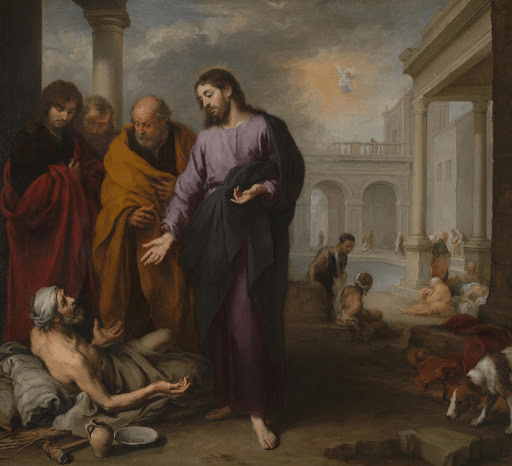
Healing the Paralytic, by Bartolomé Esteban Murillo, 1670

Sometime later, Jesus went up to Jerusalem for one of the Jewish festivals. Now there is in Jerusalem near the Sheep Gate a pool, which in Aramaic is called Bethesda and which is surrounded by five covered colonnades. Here a great number of disabled people used to lie—the blind, the lame, the paralyzed. One who was there had been an invalid for thirty-eight years. When Jesus saw him lying there and learned that he had been in this condition for a long time, he asked him, “Do you want to get well?”

“Sir,” the invalid replied, “I have no one to help me into the pool when the water is stirred. While I am trying to get in, someone else goes down ahead of me.”

Then Jesus said to him, “Get up! Pick up your mat and walk.” At once the man was cured; he picked up his mat and walked.

The day on which this took place was a Sabbath, and so the Jewish leaders said to the man who had been healed, “It is the Sabbath; the law forbids you to carry your mat.”

But he replied, “The man who made me well said to me, ‘Pick up your mat and walk.’ ”

So they asked him, “Who is this fellow who told you to pick it up and walk?”

The man who was healed had no idea who it was, for Jesus had slipped away into the crowd that was there.

Later Jesus found him at the temple and said to him, “See, you are well again. Stop sinning or something worse may happen to you.” The man went away and told the Jewish leaders that it was Jesus who had made him well.

So, because Jesus was doing these things on the Sabbath, the Jewish leaders began to persecute him. In his defense Jesus said to them, “My Father is always at his work to this very day, and I too am working.” For this reason they tried all the more to kill him; not only was he breaking the Sabbath, but he was even calling God his own Father, making himself equal with God. (New International Version)

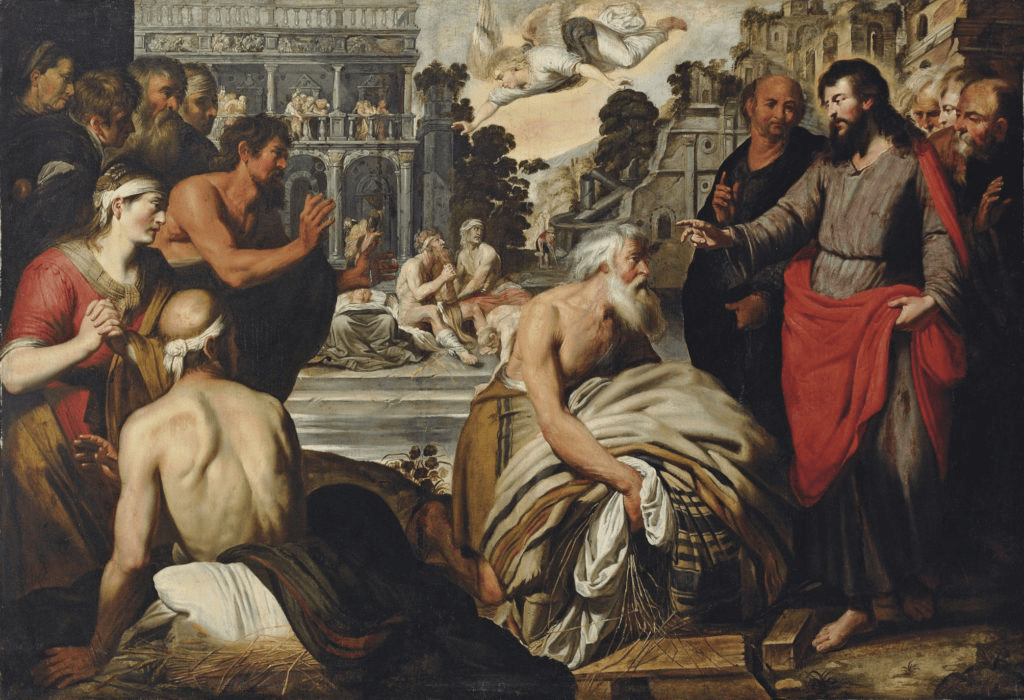
Christ at the Pool of Bethesda, by Artus Wolffort, c. 1625

During one of the yearly Jewish festivals, on a Sabbath day, a miracle happened. Miracles of healing are typically accompanied by celebration and joy. But not so much with this one.

It’s one of those things about living in a messed up world of broken systems, that an invalid can start walking and there are people who have frowns and furrowed brows about it.

Granted, the man who was healed by Jesus may seem a bit hard to like in some ways. We don’t really know what he was into, but when Christ bestows healing on you, then says to stop sinning, it’s probably a significant sin to warrant the Lord’s exhortation.

Regardless of any sort of sin, the man appears to be paraplegic. Especially in the ancient world, this meant all sorts of problems had to be navigated – such as needing others to literally carry you around (no wheelchair or handicapped accessible anything), long periods of social isolation, lack of bodily control over your bowels and bladder, and the continual needs for cleanliness.

This made the man hard to like by many people just because he likely had strong body odors and had to crawl to get around if no one would help. He would not have been pleasant to look at. But he would have to make sure you did because, in the absence of any charity, the guy’s only option was to beg.

I’m glad there are greater forces in the world than indifference and dislike. There is grace – which is an act of bestowing honor and/or forgiveness to another person. It is not dependent upon whether one deserves it. Grace chooses not to hold something over or against another. It is a deep concern for others that comes from within and not from without.

“I do not understand at all the mystery of grace – only that it meets us where we are but does not leave us where it found us.”

Anne Lamott

Another gracious act that Jesus did was to honor the man’s dignity by respecting him with a question. By asking a question, we don’t assume we know what’s best for another. Sincere questions acknowledge another’s basic humanity. “Do you want to get well?” Jesus asked.

In the life of being an invalid and having little control over much of anything, including one’s own body, being asked a question is to receive the gift of autonomy.

There are many times in my work as a hospital chaplain that I speak with patients who don’t have a lot of control in their lives. I go out of my way to ask questions such as, “May I come in?” “Is it alright with you if I pull up a chair and sit down?” “Would you be okay telling me about what is going on?” “May I pray with you?”

This is important, because there are too many other people in this world who would just barge into a room, act like they own the place, and talk at them, and not with them – hence reinforcing to the person that they’re nothing compared to others, that they don’t have any real say.

The man’s response to Jesus was to essentially say that he is alone. He has no one to help him. Even though the man is in a city, surrounded by hundreds and thousands of others, he is lonely.

Not anymore. Jesus saw him, even inquired about him and learned about the man. Jesus Christ, the Lord of all, cared about a non-descript invalid and was sincerely curious about him. In a world of everyone for himself, Jesus championed the lonely and the lost.

A simple command to obey was all. Christ told the man to pick up his mat and walk. That’s it. Just as words created the world, so a few words created a whole new life for the man. So, he got up, and he walked.

It’s interesting that the religious leaders never seemed to notice the man when he was lame, but now that he’s up and walking around, they pay attention to his apparent work on a Sabbath.

The invalid was validated by Jesus, but Jesus, the one validated by the Father, was invalidated by the religious leaders, who are the spiritual invalids.

It was against the (their) rules to carry something around. Apparently, it was okay for people to be lonely, not contribute to society in meaningful and dignifying ways, and to suffer; but it’s not okay to walk and carry a mat.

Even worse, is anyone who would heal on the Sabbath and tell the healed person to walk and carry a mat. It was so bad, apparently, that it warranted persecuting such a person. But that’s what happens when people are forced to serve rules, instead of the rules serving people.

On top of it all, Jesus was working; and he justified it by stating that his Father keeps working. This was dangerously close to blasphemy by likening himself to God. For the religious leaders, not only was Jesus unethical in breaking the law, but he was also theologically immoral; he claimed a special relation with God.

The more that laypeople get to know Jesus, the more compelling he becomes; they want to follow him. But the more that clergy discover Jesus, the more angry they become and want to do away with him.

Ultimately, it is Jesus we must contend with, and not the law and our interpretations of scripture. We need to decide what we are going to do with Jesus… what will you do?…