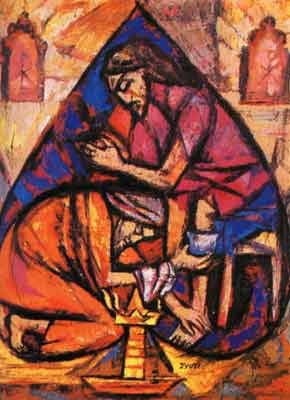
The Example To Follow (1 Peter 2:19-25)

The Crucifixion, by John Kohan

For it is commendable if someone bears up under the pain of unjust suffering because they are conscious of God. But how is it to your credit if you receive a beating for doing wrong and endure it? But if you suffer for doing good and you endure it, this is commendable before God. To this you were called, because Christ suffered for you, leaving you an example, that you should follow in his steps.

“He committed no sin,
    and no deceit was found in his mouth.”

When they hurled their insults at him, he did not retaliate; when he suffered, he made no threats. Instead, he entrusted himself to him who judges justly. “He himself bore our sins” in his body on the cross, so that we might die to sins and live for righteousness; “by his wounds you have been healed.” For “you were like sheep going astray,” but now you have returned to the Shepherd and Overseer of your souls. (New International Version)

The reality of this life, for every one of us, is that we will suffer in some way. It’s not a matter of if we will suffer, but when and why. What’s more, my suffering is really not about me; it’s about him.

Therefore, let’s ensure that when the suffering comes, we know why – that it isn’t because of our own stupidity and poor choices, but because we are in solidarity with the One who suffered on our behalf and are living for him.

And in the midst of such suffering, let’s make sure that we face it and deal with it according to the example of Christ. Let’s imitate him.

Let’s also be honest from the start: We don’t like pain and suffering, and we often spend an inordinate amount of time and energy trying to avoid pain. 

Yet, in reality, our own suffering weans us away from the temporal things we tend to find consolation in, and drives us to the permanent source of comfort, strength, help, and encouragement. Our consolation is ultimately found solely in him.

When the athlete goes into the weight-room, they purposely go there to suffer. There is grunting and straining and difficulty. There is a tearing-down of muscle fibers. There is pain. 

That’s because strength-training needs commitment which suffers, and the pain that comes with growth. One cannot simply go into a weight-room, sit and watch other people lift weights, and believe they will then get in shape by only observing. 

God will put us in unwanted circumstances we did not ask for, and would not choose for ourselves, in order to position us to know him, to know Jesus. 

Crucifixion, by John Kohan

There are things in our lives that need to experience the suffering of death, in order for new life and growth to occur. For example, fire is an important part of Yellowstone National Park, because it brings environmental growth. According to ecology experts:

“Fire promotes habitat diversity by removing the forest overstory, allowing different plant communities to become established, and preventing trees from becoming established in grassland. Fire increases the rate that nutrients become available to plants by rapidly releasing them from wood and forest litter and by hastening the weathering of soil minerals.”

Concerning Christianity: Suffering is a necessary part of the Christian life because it creates the conditions for new life and growth and releases fresh sources of God’s grace into the church and world. 

We are to put to death anger, rage, malice, slander, lying, and useless language. They are to be replaced with compassion, kindness, humility, gentleness and patience, forgiveness, and love. (Colossians 3:7-14) 

More pointedly: Quit fighting against your suffering. Stop kicking and screaming long enough to look your suffering square in the face and learn from it.

Your suffering is trying to tell you something. But if you keep taking the stance of a pugilist trying to punch the pain away, suffering will just keep moving forward at you and never topple. 

You and I cannot beat suffering. We can only learn from it. In order to learn from it, we must embrace it.

So, here’s the counter-intuitive, counter-cultural practice that you might not like, and might think I’m off my rocker for suggesting: Submit to suffering. Yes, because in doing so you are submitting to him.

Don’t hear what I’m not saying. I am, in no way, trying to sanitize troubles, adverse circumstances, or even terrible trauma. Evil is evil, bad is bad, and no amount of saying otherwise will change the leopard’s spots. 

However, only through submitting to the process of what suffering teaches us will we ever have power over it.

Fighting against suffering is about as useful as taking on a bear. Bears, like suffering, can be dangerous. We don’t blame bears if they act like bears. Likewise, we ought not to be surprised when suffering hurts.

I suggest we treat suffering like facing a bear in the wilderness of trouble: 

  1. Calmly talk in low tones to your suffering. Speak to it. Remember who you are. You belong to God. Treat suffering as if it is curious about you. Stay calm. Doing the big freak-out only encourages suffering to do damage.
  2. Walk with others through suffering. Both yours and theirs. Christian community is one of the best practices of the Christian life. Suffering becomes connection within a community of persons who discern its purpose. 
  3. Keep your eye on suffering.  Don’t ignore it, or pretend it isn’t there. Don’t run. Face suffering. Keep it in front of you. It will pass, but you must be patient and calm. Once it is gone, then you can reflect on what happened and debrief with others about the experience.

For anything to change, we must stop something, and start something else. When it comes to suffering:

  • Stop fighting. Start accepting. 
  • Stop going it alone. Start living in vital and vulnerable community. 
  • Stop being a martyr. Start letting the martyrdom of Christ be your center of life. 
  • Stop talking. Start listening. 
  • Stop treating your suffering as an adversary. Start relating to suffering as a companion to learn from.

Lord Jesus Christ, by your patience in suffering you hallowed earthly pain, and gave us the example of obedience to your Father’s will. Be near me in my time of weakness and pain. Sustain me by your grace, so that my strength and courage may not fail. Heal me according to you will. And help me always to believe that what happens to me here in this life is of little account, if you hold me in eternal life, my Lord and my God. Amen.


Maundy Thursday (John 13:1-17, 31b-35)

Jesus Washing the Disciples’ Feet, by Leszck Forczek (1946-2019)

Now before the festival of the Passover, Jesus knew that his hour had come to depart from this world and go to the Father. Having loved his own who were in the world, he loved them to the end. The devil had already decided that Judas son of Simon Iscariot would betray Jesus. And during supper Jesus, knowing that the Father had given all things into his hands and that he had come from God and was going to God, got up from supper, took off his outer robe, and tied a towel around himself. 

Then he poured water into a basin and began to wash the disciples’ feet and to wipe them with the towel that was tied around him. He came to Simon Peter, who said to him, “Lord, are you going to wash my feet?” Jesus answered, “You do not know now what I am doing, but later you will understand.” Peter said to him, “You will never wash my feet.”

Jesus answered, “Unless I wash you, you have no share with me.” Simon Peter said to him, “Lord, not my feet only but also my hands and my head!” Jesus said to him, “One who has bathed does not need to wash, except for the feet, but is entirely clean. And you are clean, though not all of you.” For he knew who was to betray him; for this reason he said, “Not all of you are clean.”

After he had washed their feet, had put on his robe, and had reclined again, he said to them, “Do you know what I have done to you? You call me Teacher and Lord, and you are right, for that is what I am. So if I, your Lord and Teacher, have washed your feet, you also ought to wash one another’s feet. For I have set you an example, that you also should do as I have done to you. Very truly, I tell you, slaves are not greater than their master, nor are messengers greater than the one who sent them.If you know these things, you are blessed if you do them….

“Now the Son of Man has been glorified, and God has been glorified in him. If God has been glorified in him, God will also glorify him in himself and will glorify him at once. Little children, I am with you only a little longer. You will look for me, and as I said to the Jews so now I say to you, ‘Where I am going, you cannot come.’I give you a new commandment, that you love one another. Just as I have loved you, you also should love one another. By this everyone will know that you are my disciples, if you have love for one another.” (New Revised Standard Version)

Today is Maundy Thursday. It is a time in Holy Week to reflect upon the great love of Christ for humanity, as well as much of humanity’s great resistance to that divine love.

The word “Maundy” is the Latin word for “commandment.” It’s a reference to Christ’s mandate for his followers to love one another. And Jesus gave his disciples an example of this love in a way they would never forget.

The jaw-dropping illustration of love for each other is preceded by setting the stage. It is the Last Supper, the final meal of Jesus with the disciples. Christ’s imminent crucifixion is very much tied to the Jewish Passover. Just as the festival is about to happen, dominating the spiritual landscape of Jerusalem, so the cross of Christ looms heavy in the Upper Room. The hour is nearly upon them.

Washing of the Feet, by John August Swanson, 2000

And only Jesus seems to know the brevity of the moment. He knows that Judas is about to betray him. Events that were prophesied centuries earlier are about to be set in motion. Every word and action of Jesus at this Supper is formed and informed by what is about to take place in the next few days.

We are meant to understand, as observers to this Upper Room meal, that Jesus not only knows what is happening, but that he also has control over the unfolding events. Satan may believe that he knows what’s going on and can influence Judas for diabolical purposes; but Jesus is really the One in charge. Even the workings of the devil are used for the divine agenda. Every event – whether meant for good or for ill – shall be bent toward the will of God.

The example, the capstone of all Christ’s teaching, is now divulged and acted out. The disciples themselves are participants in the drama; and they are aghast at what Jesus is doing. Christ proceeds to divest himself, humble himself, and serve them all by washing their feet.

Jesus intends his actions to be followed. Whereas the disciples likely believed that, over the past three years, they were being groomed for ruling in God’s new government, Christ was informing them that they will be servants in that new rule and reign of God. Yes, they will be leaders; but it will be a servant-leadership that uses its authority to love others.

Not everyone was immediately on board with this type of leadership and service. That’s because there were those who found it extremely hard to accept such a love as this.

Peter had serious difficulties with this foot washing thing. Maybe Peter thought that the roles should be reversed; he should be serving Jesus, and not the other way around. It could be that Peter was simply clueless or confused. Or perhaps he believed this action to be socially inappropriate and foolish. Yet, no matter what was going through Peter’s mind, he blatantly resisted the love of Christ.

Jesus would have none of this resistance to his loving service. Sharing in Jesus involves being served by him, even in so lowly and intimate a form as foot washing. Bottom line: the disciples of Jesus must be washed by him.

Peter (bless his extrovert mouth and heart) totally changes from rejection to the foot washing, to wanting a complete bath. Even in this, however, Jesus brings the zealot spirit down a few notches. He brought Peter to where he needs to be, and not where Peter wants to be.

Jesus Washing the Feet of His Disciple by Japanese artist Sadao Watanabe (1913-1996)

The whole washing of feet is an act of love and service that Jesus performed for them. Judas is there, too, getting his feet washed, as well. The example Jesus set was not simply one of service to an elite group of believers. The love of disciples for one another includes even those people we might prefer to forget.

Slaves were the ones who performed the service of washing feet whenever guests arrived at the master’s house. For the Christian, since our own Master initiated this practice, we ought also to love one another through meeting even the most mundane and stinky of needs. After all, we are not above our Master.

Yet, Christ considers us friends, and not necessarily as slaves, and even grants us an inheritance with him. Meeting needs requires the utilization of love.

It seems that Peter wanted to make the symbolic practice of washing feet something it was not meant to be. He asked for a lavish display of cleanliness for his entire body. Perhaps Peter thought that if you’re going to make a mark and a statement, then really go all out and do it!

For sure, Peter didn’t really know what he was saying. Jesus told Peter as much. But later, Jesus assured Peter, and all the disciples, that they indeed would, in time, understand all that he was opening up for them.

Of utmost value to Jesus was to have his disciples be driven by what drives he himself: love. Being a Christ follower is only secondarily about what one knows, and primarily about how one loves.

Christians have been profoundly loved by God through Jesus Christ. And what we do with that received love is of great importance to Jesus. As the Apostle Paul would say later to a young Corinthian Church, “Knowledge puffs up, but love builds up.” (1 Corinthians 8:1)

On this Maundy Thursday, it is more than appropriate to contemplate the incredible love shown to the original disciples, and toward us, all these centuries later. Let this contemplation compel us to put a great deal of thought and conversation into the best ways of loving the people in front of us with actions that have real meaning for them.

O God of love,
giver of concord,
through your only Son
you have given us a new commandment
that we should love one another
even as you have loved us,
the unworthy and the wandering,
and gave your beloved Son for our life and salvation.
Lord, in our time of life on earth
give us a mind forgetful of past ill-will,
a pure conscience and sincere thoughts,
and hearts to love one another;
for the sake of your Son, Jesus Christ our Lord.
Amen. – A Prayer of St. Cyril of Alexandria, 5th century

“I Have Set You an Example” (John 13:1-17)

Jesus Washes Peter’s Feet

Now before the festival of the Passover, Jesus knew that his hour had come to depart from this world and go to the Father. Having loved his own who were in the world, he loved them to the end. The devil had already decided that Judas son of Simon Iscariot would betray Jesus. And during supper Jesus, knowing that the Father had given all things into his hands and that he had come from God and was going to God, got up from supper, took off his outer robe, and tied a towel around himself. Then he poured water into a basin and began to wash the disciples’ feet and to wipe them with the towel that was tied around him. 

He came to Simon Peter, who said to him, “Lord, are you going to wash my feet?” Jesus answered, “You do not know now what I am doing, but later you will understand.” Peter said to him, “You will never wash my feet.” Jesus answered, “Unless I wash you, you have no share with me.” Simon Peter said to him, “Lord, not my feet only but also my hands and my head!” Jesus said to him, “One who has bathed does not need to wash, except for the feet, but is entirely clean. And you are clean, though not all of you.” For he knew who was to betray him; for this reason he said, “Not all of you are clean.”

After he had washed their feet, had put on his robe, and had reclined again, he said to them, “Do you know what I have done to you? You call me Teacher and Lord, and you are right, for that is what I am. So if I, your Lord and Teacher, have washed your feet, you also ought to wash one another’s feet. For I have set you an example, that you also should do as I have done to you. Very truly, I tell you, slaves are not greater than their master, nor are messengers greater than the one who sent them. If you know these things, you are blessed if you do them. (New Revised Standard Version)

One of the reasons I like Jesus so much is that he loves me as I am, and not merely as I should be. Jesus loves me even with my dirty stinky feet, my herky-jerky commitment to him, and my pre-meditated sin.

In fact, Jesus loved even Judas and washed his feet. Jesus serves people because they need his love, and not so that they will love him back.

I recently read about a man who lived in Paris. His wife had Alzheimer’s. He was an important businessman and his life was filled with busyness. Yet, he said when his wife fell sick:

“I just couldn’t put her into an institution, so I kept her. I fed her. I bathed her. Through the experience of serving my wife every day, I have changed. I have become more human. The other night, in the middle of the night, my wife woke me up. She came out of the fog for a moment, and she said, ‘Darling, I just want to say thank you for all you are doing for me.’ Then she fell back into the fog. I wept for hours to know this grace.” A Severe Mercy, by Sheldon Vanauken

Sometimes Christ calls me to love people who either cannot or will not love me in return. They live in the fog of some sort of disability, depression, poverty, or common spiritual blindness. As I serve them, I may only receive brief glimpses of gratitude. Just as Jesus loves me within my own spiritual confusion, so I desire to continue loving others as they walk through whatever fog they are in.

Lord willing, my life will be useful through my words and my witness. If God desires, my life will bear fruit through my prayers, my service, and my love. Yet, the usefulness of my life is God’s concern, not mine; it would be indecent of me to worry about that. I simply desire to follow my Lord’s example.

Ethiopian Orthodox Church icon of Jesus washing the disciples’ feet

Neither many Christians nor churches wash feet anymore. So, the following is today’s Gospel lesson put in a slightly different contemporary context:

It was just before the biggest and most important feast of the year. Jesus knew that it was finally the time for him to face the cross and die for the world’s sins. Having spent the past three years loving his followers, he now wanted to leave them with a clear demonstration of his love that they would never forget.

The evening meal was being served, and the devil had already gotten a hold of Judas Iscariot to betray Jesus to those who wanted him dead and gone. But it was all according to plan. Jesus knew that his heavenly Father had given him all authority because he was his Son, and he was ready to do what needed to be done to secure salvation and return to his rightful place at his Father’s right hand. 

So, Jesus got up from the meal, rolled up his sleeves, put an apron on, and ran a sink full of hot water. Jesus told the servants to take the night off, and he began taking the dishes from the dinner table and started washing them, taking care to do all that waiters and dishwashers would do.

When Jesus came to take care of Simon Peter’s dishes and serve him dessert and coffee, Peter said to him, “Lord, are you going to serve me?” Jesus replied, “I know you do not understand why I am doing this since it seems like something that is beneath me to do, but later you will look back on this night and understand completely what I am doing.”

“No,” said Peter, “this is not right – you are the Master, and this is not what a well-respected rabbi does – you are only disrespecting yourself and making us all look foolish. You are not going to take my dishes and wash them.”

Jesus answered, “Unless I wash these dishes and serve you, you are not going to be able to follow me anymore, and you will have no part of what I am doing in this world.”

“Well, then, Lord,” Simon Peter replied, “if that is the way it really is, then don’t just wash the dishes – come on over to my place and clean out the fridge and scrub the kitchen floor!”

Jesus answered, “A person who has had a decent meal needs only to wash the dishes so that he can enjoy the freedom of hospitable relationships with me and those around him. And all of you here have had a decent meal, though not every one of you.” For Jesus knew that Judas was only picking at his food in anticipation of betraying him.

When Jesus was all done washing the dishes and serving his disciples, he took his apron off, rolled his sleeves back down, and returned to the table. He looked them all squarely in the eye and said, “Do you understand what I just did for you? 

You call me ‘Teacher’ and ‘Master,’ and rightly so, for that is exactly what I am. So, now that I, your Master, and your Teacher have washed your dishes, you also should wash one another’s dishes. I have set you an example that you should do as I have done for you. I am telling you the plain truth that no follower is greater than the one he follows, nor is a preacher greater than the one he preaches about. 

Now that you know it is your task in this life to provide humble loving service, you will have God’s stamp of approval on your life if you quit thinking about how to possess and use power for your own purposes, and start thinking about how to use the authority I am giving you to love other people into the kingdom of God.

Loving Lord Jesus, how shocking it was for your disciples to be served by you in such a humble manner. But I cannot be spiritually cleansed unless I allow you to love me in an almost embarrassing fashion. Help me not to be so proud that I neither refuse your humble loving service toward me, nor neglect to offer that same kind of service to others. May love be the word, the idea, and the action that governs my every motivation and movement in your most gracious Name, I pray. Amen.

John 13:1-17, 31-35 – Maundy Thursday

Welcome, friends. The Gospel of John, chapter 13, provides the last words and final actions of Jesus Christ for his disciples. And it all centers in humble love. Click the videos below, and let us observe and remember…

Maundy Thursday, Pastor Tim Ehrhardt
Behold the Lamb (Communion Hymn) – sung by Keith & Kristyn Getty, words by Stuart Townsend, 2009

Holy God, you give us this meal of bread and wine in which we celebrate your great compassion; grant that we may work with you to fulfil our prayers, and to love and serve others as Christ has loved us; this we ask through Jesus Christ our Redeemer, who is alive with you in the unity of the Holy Spirit, one God, now and for ever. Amen.